“Good omen or warning?” is the first thing that occurs to anyone who dreams of a snake while pregnant. Here is the direct answer: the snake dream meaning during pregnancy is neither a confirmed blessing nor a confirmed warning, because nothing in this subject is confirmed. More importantly, there is not one line in the classical dream books we work from that connects a snake dream to the baby’s sex, to the safety of a pregnancy, or to a birth that is near or difficult.
We put that in the first paragraph rather than the last, because a pregnant woman searching at three in the morning should not have to read three thousand words before she is reassured. Everything written elsewhere tying this dream to a baby — boy or girl, well or unwell — has no basis in the source. It is a real harm laid on a woman at one of the most vulnerable points of her life.
What follows is what the sources actually say, with the section and page for every line — the same rules read for a single woman, a married woman and a man on their own pages — plus what sleep research says about why dreams change during pregnancy — an explanation that is very often closer to the truth than any symbol. Interpretation throughout is a matter of informed opinion. It settles nothing, obliges nothing, and diagnoses nothing.
The Bottom Line
In short: the snake dream meaning during pregnancy is the meaning of the snake itself, read by the same rules that apply to any dreamer, with the dreamer’s circumstances taken into account. The classical books have no chapter for pregnant women, and anyone claiming otherwise has added something.
What is worth knowing right away:
- What the source never says. Nothing about the baby’s sex, nothing about miscarriage, nothing about birth, nothing about the health of mother or child. Everything attributed to it on those points was added afterwards.
- Appearance is not a verdict. The section headed “Ibn Sirin said” states that “the enmity of each serpent is according to its harm, its size and its venom” (p. 329). The measure is graduated.
- The symbol is broad, not narrow. A serpent “may be an authority, and may be a wife, and a child” (p. 330). Note that “a child” appears there as one of several possibilities, not as a warning.
- Some passages are outright favourable. A dead serpent is an enemy whose harm is spared the dreamer; one that speaks gently brings good “that people marvel at” (p. 330); a garden full of serpents “grows, and the plants in it increase and thrive” (p. 331).
- And sleep in pregnancy has its own explanation. Sleep becomes more broken, waking becomes more frequent, and frequent waking raises dream recall — so a dream feels sharper and heavier without its meaning having changed at all.
If you want one line that settles things: the honest thing the source supports is that what you saw tells you nothing about your baby, and that fear in a dream is read as fear rather than as an event — “and if he saw it and feared it, that is fear” (p. 330).
And if you have any physical symptom while awake — pain, bleeding, reduced movement, or anxiety that is keeping you from sleeping — the place to take it is your healthcare provider. Not an interpretation page, and not this one.
What this page covers
- The Bottom Line
- What this chapter does not say about pregnancy
- How interpreters asked before they answered
- What actually changes for a pregnant dreamer
- Where the snake appeared: the strongest variable
- When the source turns the symbol toward water
- Does the reading change with the stage of pregnancy?
- When a partner or children appear in the scene
- Colour — and why it is no medical indicator
- Size
- Number
- The favourable passages, gathered
- Movement: approaching, circling, passing
- Moving away
- Being bitten: a qualified line, not an absolute one
- Killing, contending, and the still snake
- The passages, with their locations
- Ibn Sirin and al-Nabulsi: agreement and divergence
- Why dreams multiply and intensify during pregnancy
- What to do after a distressing dream
- When the searching becomes the problem
- Misconceptions specific to pregnancy
- When the dream is an echo of your day
- Frequently asked questions
- Does a snake dream indicate the baby’s sex?
- Is the dream warning me about a risk to my pregnancy or my baby?
- A snake bit me in a dream while I was pregnant. What does it mean?
- Does the snake’s colour change the reading during pregnancy?
- I read that a small snake means a baby. Is that right?
- I saw a snake in my home while pregnant. Is it about my family?
- The snake circled me without coming closer. Is that bad?
- Why have my dreams become more frequent and more vivid since I became pregnant?
- The dream repeated over several nights. Does that mean something?
- Do I need to do something after this dream?
- Are a pregnant woman’s dreams truer than anyone else’s?
- Where can I read about the other symbols in the same dream?
- A practical summary
- Sources
What this chapter does not say about pregnancy
When we say “there is nothing about pregnancy in the serpent chapter”, that is not an evasion. It is the answer. And it deserves to be stated precisely.
The serpent chapter in the reference copy runs across several pages (pp. 329–333) in both of its sections, “Ibn Sirin said” and “Abd al-Ghani al-Nabulsi said”. We read those pages one by one. They contain:
- No mention of a pregnant woman, or of pregnancy, anywhere in the chapter.
- No mention of a baby’s sex, or of any sign indicating it.
- No mention of miscarriage, of birth, or of a difficult delivery.
- No mention of illness in a mother or a child.
- No colour table linking any colour to a medical condition.
So where does everything else come from? From modern writing attributed to the classical authors, or from analogy with other symbols in other chapters, repeated without a citation until it reads like an original.
We do not attribute to Ibn Sirin or al-Nabulsi anything we have not found written. When we apply a general rule to a pregnant woman’s situation, we say plainly that the application is ours and not theirs.
How interpreters asked before they answered
The largest difference between the classical books and the pages you find online is not in the meanings. It is in the order. The pages start at the symbol and end there: “snake”, then a verdict. In the stories the book itself preserves, the interpreter asks first.
In one story inside the serpent chapter, a man related a dream involving a serpent, a burrow and a spade. The first thing he received was a question, not an answer: “Are you seeking a woman in marriage?” (p. 330). The symbol was not ruled on in isolation; it was tied to the dreamer’s circumstances before anything else.
That order is what this page follows, and it may be the most useful thing to take from it. Before asking what a snake means, four questions come first:
- Where was the scene? A home, somewhere outside it, or a place you did not recognise.
- What did the snake do? Approached, circled, passed by, stayed still, or did nothing at all.
- What did you do? Moved away, faced it, stood still, or felt nothing in particular.
- How did you feel? Afraid, safe, in control, or indifferent.
Those four are not an order we invented. They are the elements this entire chapter is built on in the source, as every section below will show. Anyone who answers without asking about them is not interpreting your dream — they are interpreting a generic dream that belongs to nobody.
There is a third layer that must never be blended with the first two: the modern psychological reading. It explains why dreams intensify during pregnancy in particular. It does not cancel the classical reading, does not replace it, and is not a diagnosis of anyone. This page keeps all three separate in every section: a quoted line with its page, a declared application, and a modern reading with its sources.
What actually changes for a pregnant dreamer
If the chapter has no section for pregnancy, what remains? Something more useful than an imagined section: a rule that can be applied. The rule is that a symbol is read inside the dreamer’s own circle, and that her relationship to what she saw — near or far, afraid or safe — is part of the interpretation.
A pregnant woman’s circle is a circle of waiting: a changing body, an approaching responsibility, decisions deferred until after the birth, and legitimate worry about things she cannot control. So the nearest reasonable reading of a distressing dream connects it to that waiting — not to a warning about her baby.
Note the wording: “the nearest reasonable reading”, not “it means”. The distance between those is the distance between a possibility offered and a conclusion imposed.
One caution belongs here. Many women come out of a distressing dream feeling they must do something — a ritual, a vow, a change of plan, a postponed appointment. Nothing in this chapter requires any of that. A dream creates no obligation, and it is never a reason to delay medical follow-up.
Where the snake appeared: the strongest variable
Place is the clearest thing this chapter states, and it outranks colour, size and number.
From the “Ibn Sirin said” section: if he saw serpents entering his house and leaving without harm, “they are enemies from among his household and his relatives; and if he saw them somewhere other than his house, the enemies are strangers” (p. 331). Al-Nabulsi adds: “the serpents of houses are neighbours, and the serpents of the wilderness are highway robbers” (p. 333).
Place narrows or widens the circle. It never names anyone inside it. And notice the qualifier that drops out of most retellings: “and leaving without harm”. What is described is a passage that does no damage, not an intrusion. Removing that clause is what turns a calm line into a threat.
Applied to a pregnant woman: a dream inside the home is read in a near circle, and one in a hospital, a street or a workplace in a wider one. Neither circle has anything to do with the baby, because the baby is not the subject of this chapter at all.
When the source turns the symbol toward water
One of the most interesting things in this chapter — and among the least quoted — is that the source itself sometimes turns the serpent away from enmity entirely.
From the Ibn Sirin section: serpents “perhaps take their name from life itself, as when they are seen in ploughed fields, or gliding beneath trees; then they are waters, and floods” (p. 330). From al-Nabulsi: “the serpent indicates the flood, and the state, and life” (p. 333). And elsewhere: “water serpents are wealth” (p. 331).
Notice the word “life” in both. The source connects the name itself with life and growth, not with harm. This is not a gentle reading invented to reassure you; it is written on the same pages from which the frightening sentences are selectively quoted.
Anyone who reads the chapter through finds that the proportion of favourable passages is far higher than the material published about it suggests. That alone should lighten things for a woman who woke up frightened.
Does the reading change with the stage of pregnancy?
A recurring question: is a snake dream in the third month different from one in the ninth?
From the source, the answer is plainly no. The chapter does not mention pregnancy at all, let alone distinguish its stages. Anyone who has divided the interpretation up by month or trimester has built a structure that does not exist in the book, and may have attributed it to an interpreter who never said it.
From the sleep side the answer is completely different, and far more useful. Sleep in pregnancy does not change once and settle; it changes by stage:
- In the first trimester, sleepiness and fatigue dominate, daytime sleep often increases, and the rhythm of the night shifts.
- In the second trimester, sleep is relatively more settled for many women — usually the calmest stretch.
- In the third trimester, waking becomes frequent for well-known reasons: needing the bathroom, difficulty finding a comfortable position, heartburn, fetal movement and back pain.
The Sleep Foundation sets out these changes across the stages of pregnancy. And because dream recall is tied to waking from a dream, it follows that dreams feel more intense and more vivid in the third trimester — not because their meaning changed, but because the number of awakenings did.
So the difference between the months is real, but it is a difference in noticing the dream rather than in its meaning. That distinction explains why so many women feel that their dreams “suddenly got strange” in the final months.
When a partner or children appear in the scene
Many of these dreams are not only about a snake. A partner appears, or an older child, or a relative. These are common questions with an honest answer.
First: this chapter has no passage treating “a husband with a serpent” or “a child with a serpent” as a scene. Anyone offering a detailed interpretation of those scenes attributed to a named interpreter has added it themselves.
Second: what can honestly be said is that the presence of people we love changes the dreamer’s own position in the scene. A woman who saw herself shielding a child did not see herself as helpless; she saw herself acting. And the source treats the dreamer’s position as an interpretive element: whoever mastered the serpent without fear has one reading, and whoever saw it and feared it has another (p. 330).
Third, from the psychological side: children appearing in mothers’ distressing dreams — and in pregnant women’s especially — is a familiar pattern tied to what occupies the mind during the day. It reads far more like an expression of care than a warning. That is a general observation, not a diagnosis.
What is never acceptable is reading these images in a way that touches a real person: saying the partner is the serpent, or that something is wrong with the baby, or that the dream discloses someone’s intentions. None of that is in the text, and all of it is a certain harm traded for a guess.
Colour — and why it is no medical indicator
This section needs to be strict, because linking colours to medical conditions or to a baby’s sex is among the most written and least supported claims in the whole subject.
The chapter contains exactly one sentence about colour: “the white of them are the most difficult of enemies, and the black of them the strongest” (p. 330). It:
- describes degree of intensity, not a different kind of meaning;
- places white in the same register of difficulty, demolishing any table that makes white an auspicious sign;
- mentions no magic, no envy, no illness, no pregnancy and no baby.
Then, on the same page, a line inverts the picture: whoever saw that he possessed a group of great black serpents “led armies and attained a great kingdom” (p. 330). Blackness in the same passage is favourable when the dreamer is in command.
As for the claim that one colour indicates a boy and another a girl: there is no basis for it in this chapter or anywhere else we have read. Repeating it is not merely a mistake of interpretation. It can build a woman’s entire expectation of her child on nothing, and then leave her with a disappointment that had no cause.
Size
Size is stated: “the enmity of each serpent is according to its harm, its size and its venom” (p. 329). Three graduated measures.
Elsewhere: “the small serpent is a child … and the serpent’s limbs and fangs are the strength of the enemy and the severity of his scheming” (p. 331).
Pause on “the small serpent is a child”, because that line in particular gets picked up and built into a great deal of talk aimed at pregnant women. The honest reading: it sits inside a list of the symbol’s possible senses, and it is neither a prediction of a child nor a report about a baby. The same passage says a serpent may be “an authority” — and nobody concludes from that that the dreamer will become a ruler.
Anyone who takes “the small serpent is a child” and converts it into “your dream announces a baby” has lifted a line out of a sequence and used it to occupy territory that belongs to the unseen.
Number
Number is its own variable, and it is read through place rather than count alone.
In a house, two passages appear that are tied to their historical setting: a man saw his house full of serpents and was told, “Fear God, and do not shelter an enemy of the Muslims!” (p. 330), and a comparable line at p. 331. Both address a householder in a specific time; neither is a rule to drop on every woman who dreamt of more than one snake.
In a garden, a large number is explicitly favourable: “the garden grows, and the plants in it increase and thrive” (p. 331).
So the same count in two places yields opposite meanings. That alone answers anyone treating number as an omen, and shows that this chapter cannot be read off a table.
The favourable passages, gathered
We collect them here because they are so rarely collected, and because anyone reading while anxious deserves the whole picture:
- The garden: “the garden grows, and the plants in it increase and thrive” (p. 331).
- Ascent: a serpent climbing to a height brings “ease, gladness and joy” (p. 331).
- A dead serpent: “an enemy whose harm God spares him without any effort of his own” (p. 330).
- Gentle speech: good “that people marvel at” (p. 330).
- Mastery without fear: a smooth serpent that obeys brings “a treasure from the treasures of kings” (p. 330); al-Nabulsi: “ingots of silver or gold” (p. 332).
- Fear without sight: “he is safe from his enemy” (p. 330).
- Water and life: “then they are waters, and floods” (p. 330); “the flood, and the state, and life” (p. 333).
Seven favourable or reassuring passages in a single chapter. Anyone who publishes only the frightening half has selected, not transmitted.
Movement: approaching, circling, passing
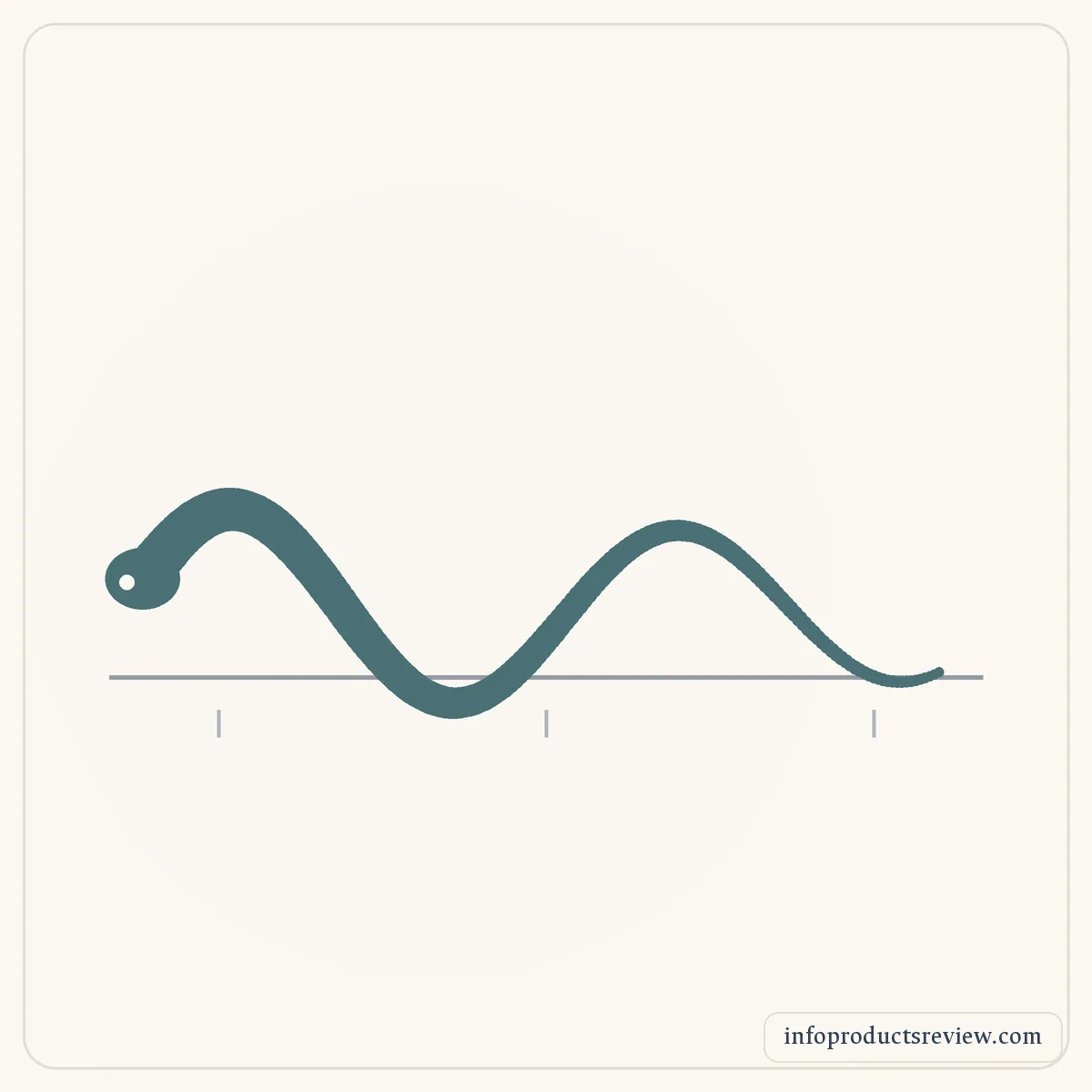
Nothing wears a sleeper down like watching something approach. The text on that image is precise:
“If he saw a serpent walking behind him, his enemy wants to scheme against him; and if it walked in front of him or circled around him, they are enemies who mix with him, and they cannot harm him” (p. 331).
- Behind you: an intention, not an act. The text chose “wants” and did not say “does”.
- In front of you: visibility with nothing hidden.
- Circling you: proximity with harm explicitly denied.
The third image is the most terrifying to live through and the most reassuring in the text. That inversion between feeling and text is worth saying to anyone who woke with her heart pounding: what you saw is, in the book, a picture of powerlessness rather than of danger.
Moving away
There is no passage in this chapter under the heading of escape. We say so rather than invent one. But the source illuminates it.
First, the outcome hangs on contention rather than on sight. Al-Nabulsi: whoever contends with a serpent “is fighting a strong enemy … and the victory belongs to whichever of them prevailed” (p. 332). Where there was no contest, there is no outcome waiting for you.
Second, fear is a meaning in itself: whoever feared a serpent without seeing it is safe from an enemy, “and if he saw it and feared it, that is fear” (p. 330).
That modest interpretation — fear read as fear — serves a pregnant reader better than any bold one. It adds nothing to her worry, promises her nothing, and describes what happened truthfully.
Being bitten: a qualified line, not an absolute one
The bite frightens pregnant readers more than anything else in this chapter, and it is the passage most often quoted with a piece missing.
From the Ibn Sirin section: “and if it bit him, harm reaches him from his enemy to the extent of the bite” (p. 330). That final clause is the whole sentence: the effect is measured by the bite, not asserted absolutely. A slight bite has a slight effect, by the book’s own words.
Al-Nabulsi’s wording is heavier: “if it bit him, he meets with an adversity he does not escape” (p. 332). We quote it as it stands, and say what must be said alongside it: it is an interpreter’s judgement rather than a report about the unseen, and it specifies no event, no time, no person and no magnitude.
And a caution we will not soften: a bite in a pregnant woman’s dream must never be read as a sign about her baby, her pregnancy or her delivery. There is nothing of the kind in the text, and no one is in a position to say it. Anyone who does has laid an anxiety on a woman with no support from the book they claim to be quoting.
If you have any physical symptom while awake, the place to ask is your healthcare provider. A dream diagnoses nothing, rules out nothing, and is never a reason to delay a test or stop a medication.
Killing, contending, and the still snake
Three common images remain, and each has a text.
Killing. From the Ibn Sirin section: “if he killed it, he prevailed over his enemy”, and “if he cut it in two, he got the better of an enemy” (p. 330). It is a favourable passage meaning victory and resolution. Al-Nabulsi gives it another face: “whoever sees that he killed a serpent, he marries a woman” (p. 333) — a narrow line whose setting is a male dreamer, and which cannot be applied to a pregnant woman at all. We quote it because it is in the source, and because two faces in one book rule out certainty about either.
Contending. Al-Nabulsi: whoever contends with a serpent “is fighting a strong enemy, and he is in fear and apprehension of him until they separate, and the victory belongs to whichever of them prevailed” (p. 332). The outcome is left open; the text does not settle it against the dreamer.
The still snake. This is among the most dreamt and least written-about images: a snake that does not move, does not approach, and takes no interest in the dreamer. The text repeatedly makes stillness and the absence of injury favourable — the dead serpent (p. 330), the smooth serpent that obeys “with no malice and no weapon that harms” (p. 330), the one that speaks gently (p. 330).
All three share one feature: the text measures the symbol by what it does, not by the fact that it is there. Presence without action is nowhere in this book a place of warning. Which is genuinely useful for anyone who woke up repeating: but it didn’t do anything.
The passages, with their locations
Here are the passages used above, with a note on the copy they come from.
The reference copy is a printed book of dream interpretation attributed to Muhammad ibn Sirin, and it is in fact a compilation placing its material under explicit headings: “Ibn Sirin said” and “Abd al-Ghani al-Nabulsi said”. We keep that separation.
And a caution we do not soften: the attribution of the widely circulated Tafsir al-Ahlam to Ibn Sirin is famous but is not established by a continuous chain of transmission in the judgement of specialists. This is why we write “the section headed ‘Ibn Sirin said’ in the reference copy” rather than “Ibn Sirin said”, and give the page.
- p. 329 (Ibn Sirin section): “Serpents are enemies … and the enmity of each serpent is according to its harm, its size and its venom.”
- p. 330 (Ibn Sirin section): the range of possibilities; biting and killing; fear and sight; the dead serpent; gentle speech; the smooth serpent; the colour line; waters and floods.
- p. 331 (Ibn Sirin section): direction of movement; the house and outside it; size and fangs; ascent; the garden; water serpents.
- p. 331 (al-Nabulsi section): “A serpent in a dream: an enemy, or a state, or a treasure, or a woman, or a child.”
- p. 332 (al-Nabulsi section): contending and biting; smooth serpents that obey.
- p. 333 (al-Nabulsi section): “the serpent indicates the flood, and the state, and life”; “the serpents of houses are neighbours”.
- p. 208 (al-Nabulsi section, the thu’ban entry): “whoever sees that he possessed a serpent attains a great authority”.
Ibn Sirin and al-Nabulsi: agreement and divergence
The division between the sections is not cosmetic.
They agree that the symbol turns on rivalry and power, that mastery without fear is favourable, and that a bite indicates a measured harm.
They differ in that al-Nabulsi is broader on material and vital possibilities: he names the state, treasure and wealth; he states outright that the serpent “indicates the flood, and the state, and life” (p. 333); and he offers a neat justification for the wealth reading — “because venom is interpreted as wealth” (p. 331).
That divergence is itself an answer to anyone offering a single certain reading. If two major interpreters in one volume differ, certainty has nowhere to come from.
Why dreams multiply and intensify during pregnancy
This section may be the most useful part of the page for many readers, because it explains what is actually happening rather than what is assumed.
Sleep changes in pregnancy in ways that are well described in the sleep-medicine literature: it becomes more fragmented and waking becomes more frequent, especially in the third trimester, for familiar reasons — needing the bathroom, difficulty finding a comfortable position, heartburn, fetal movement, back pain. The Sleep Foundation sets these out stage by stage.
Here is the link most writing on this subject misses: dream recall is tied to waking from a dream. Most remembered dreaming occurs in REM sleep, a stage that lengthens through the last third of the night, as the National Institute of Neurological Disorders and Stroke explains. Someone who wakes repeatedly remembers more.
The practical consequence is significant: your dreams may not have become more disturbing at all. They may simply have become more remembered. A dream that would once have passed unrecorded now gets retold at breakfast because you woke in the middle of it. That alone accounts for a great deal of what gets attributed to symbols.
Add to that the fact that anxiety and short sleep are among the factors most consistently associated with distressing dreams, as reviewed by the Sleep Foundation. And the American Academy of Sleep Medicine classifies nightmare disorder in its international classification of sleep disorders, where the criterion is a recurring pattern causing genuine distress or impairment — not a particular image.
All of that is general description, not diagnosis. If disrupted sleep is affecting your days or your appointments, mention it at your next visit; sleep is a normal part of what gets discussed in pregnancy care, and the American College of Obstetricians and Gynecologists treats comfort and rest as part of routine care.
What to do after a distressing dream
Islamic practice offers a known response to seeing something one dislikes in sleep: seeking refuge in God from its harm, spitting lightly to the left three times, turning onto the other side, and not relating the dream to anyone. These are reported in Sahih al-Bukhari and Sahih Muslim.
Their practical value during pregnancy is obvious: they turn the dreamer away from rumination at a time when the mind is already primed for worry. Searching frantically through dozens of contradictory pages after a bad dream is itself one of the largest causes of escalating anxiety — and one of the largest causes of a worse night after it.
When the searching becomes the problem
This section describes readers’ experience rather than the classical books, and we say so.
The pattern after a distressing dream in pregnancy is remarkably consistent. A woman wakes in the last third of the night, opens her phone, and reads ten contradictory pages in half an hour. One says the dream announces a boy. Another warns her about envy. A third links a colour to an illness. She goes back to sleep — if she does — carrying more frightening possibilities than the dream itself contained.
Then something worse happens: the following night repeats the pattern, because the anxiety accumulated during the day becomes the fuel for a new one. The problem is no longer the symbol. It is the loop: waking, searching, worrying, sleeping worse, waking more.
Which is why “do not relate it to anyone” carries a plainer practical wisdom than it first appears to. It is not secrecy about something dangerous. It breaks the cycle of retelling and reinterpreting that makes a dream several times larger by daylight than it ever was at night.
As for this page: it is long for one reason — so that it can spare you the other ten. That is why the answer sits in the first paragraph and in The Bottom Line, before any of the detail, so you never have to read to the end to be reassured.
Misconceptions specific to pregnancy
- “The snake’s colour indicates the baby’s sex.” No basis. The single colour sentence concerns intensity and mentions neither a baby nor a pregnancy.
- “The dream warns of a risk to the pregnancy.” Pregnancy is not mentioned in the chapter at all, let alone a risk to it.
- “A small snake announces a baby.” The line “the small serpent is a child” (p. 331) sits inside a list of the symbol’s possible senses, alongside “an authority”. It is not an announcement.
- “A bite means a problem at the birth.” The text measures a bite’s effect “to the extent of the bite” and mentions neither birth nor baby.
- “A pregnant woman’s dreams are truer than others’.” Nothing in this chapter, or in the reported practice around dreams, makes the dreamer’s condition a measure of a dream’s truth.
- “You must do something after this dream.” A dream creates no obligation, and is never a reason to delay an appointment or to pay a healer.
When the dream is an echo of your day
Before hunting for a symbol, rule out what is not one. This is not belittling dreams; it is part of the discipline. Not everything a sleeper sees is a dream to be interpreted.
Signs that make “the mind talking to itself” the likelier reading, in pregnancy particularly:
- The image was already in your day: a clip, a conversation about labour, a pregnancy forum read before bed.
- The dream tracks an existing worry: a scan coming up, a test result you are waiting on, arrangements for after the birth.
- There is no structure: fragmentary, scrambled imagery is a different category from a dream with a scene, an action and an ending.
- Your sleep is broken: which in pregnancy is the rule rather than the exception, and which raises recall as described above.
One small practice helps more than people expect: keep a note where you write a single line each morning after a dream that unsettled you — the place, the action, the feeling, and the time you woke. After a fortnight, a clear relationship usually emerges between broken nights and distressing dreams. It is a relationship you see for yourself rather than one anybody has to persuade you of, and it is far more useful to a clinician than a general description.
Frequently asked questions
Does a snake dream indicate the baby’s sex?
No. There is no mention of a baby’s sex, or of any sign indicating it, in the serpent chapter of the reference copy (pp. 329–333). Everything said on that point was added after the book, and no expectation should be built on it.
Is the dream warning me about a risk to my pregnancy or my baby?
No. Pregnancy itself is not mentioned in this chapter, let alone a risk to it. A dream should never be read as a medical warning. If you have any symptom while awake, the place to take it is your healthcare provider.
A snake bit me in a dream while I was pregnant. What does it mean?
The text measures the effect “to the extent of the bite” (p. 330) — qualified, not absolute. Al-Nabulsi’s wording is heavier (p. 332), but it is an interpreter’s judgement rather than a report about the unseen and specifies no event. Nothing in the text connects a bite to pregnancy or to a baby in any form.
Does the snake’s colour change the reading during pregnancy?
The only sentence about colour is “the white of them are the most difficult of enemies, and the black of them the strongest” (p. 330). It concerns degree, not kind; it mentions no medical condition and no baby; and it places white in the same register. The circulating colour tables have no support.
I read that a small snake means a baby. Is that right?
The line “the small serpent is a child” appears at p. 331, but inside a sequence listing the symbol’s possible senses: an authority, a wife, a child. It shows the breadth of the symbol; it is not an announcement of a baby, and it should not be lifted out of its sequence.
I saw a snake in my home while pregnant. Is it about my family?
The text places what is seen inside the house in the circle of “his household and his relatives” (p. 331), but it names nobody. A circle is not an accusation. And the same sentence carries the qualifier “and leaving without harm”.
The snake circled me without coming closer. Is that bad?
This is one of the most reassuring images in the chapter: “they are enemies who mix with him, and they cannot harm him” (p. 331). Harm is denied outright in the text, however frightening the scene felt.
Why have my dreams become more frequent and more vivid since I became pregnant?
Because sleep in pregnancy is more broken, and frequent waking raises dream recall. Most remembered dreaming occurs in REM sleep, a stage that lengthens through the last third of the night. Your dreams may not have changed; your recall of them has.
The dream repeated over several nights. Does that mean something?
No passage in this chapter makes repetition a meaning in itself. From the sleep side, recurrence is associated with stress and short sleep more than with content. If it is causing real distress in your days, mention it to your healthcare provider.
Do I need to do something after this dream?
A dream creates no obligation. The reported practice for a dream one dislikes is seeking refuge, spitting lightly to the left, turning over, and not relating it. Anything beyond that — a payment, a vow, a change of plan — rests on nothing, and no test or medication should be postponed because of it.
Are a pregnant woman’s dreams truer than anyone else’s?
Nothing in this chapter, or in the reported practice around dreams, makes the dreamer’s condition a measure of a dream’s truth. That claim is common and unsupported.
Where can I read about the other symbols in the same dream?
A single dream often gathers several symbols, and a symbol should not be cut out of its setting. You can browse the rest of ATHAR in English, where every entry names the book, the section and the page it came from.
A practical summary
Compressing the snake dream meaning during pregnancy into lines that are actually usable:
- What you saw tells you nothing about your baby: not its sex, not its health, not your due date. There is not a letter of it in the source.
- Start with the details: place, then movement, then feeling. The text reads fear as fear, not as an event.
- Do not apply the harshest possibility to yourself. There are at least seven favourable or reassuring passages in this chapter.
- Dreams becoming more frequent and vivid in pregnancy has a known explanation rooted in broken sleep, not in the symbol.
- Build no decision, no payment and no postponed appointment on a dream. Any physical symptom belongs with your healthcare provider.
We add entries to this reference one symbol at a time, after reading its page in the source and recording the number. What we cannot cite, we do not publish.
Editorial note: dream interpretation in this tradition is a matter of informed opinion. It changes with the dreamer’s circumstances and the details of the dream, and it establishes no religious ruling and no accusation. Nothing on this page predicts the future, diagnoses a medical or psychological condition, or says anything about a baby’s sex or the health of a pregnancy. Any health question belongs with your healthcare provider.