

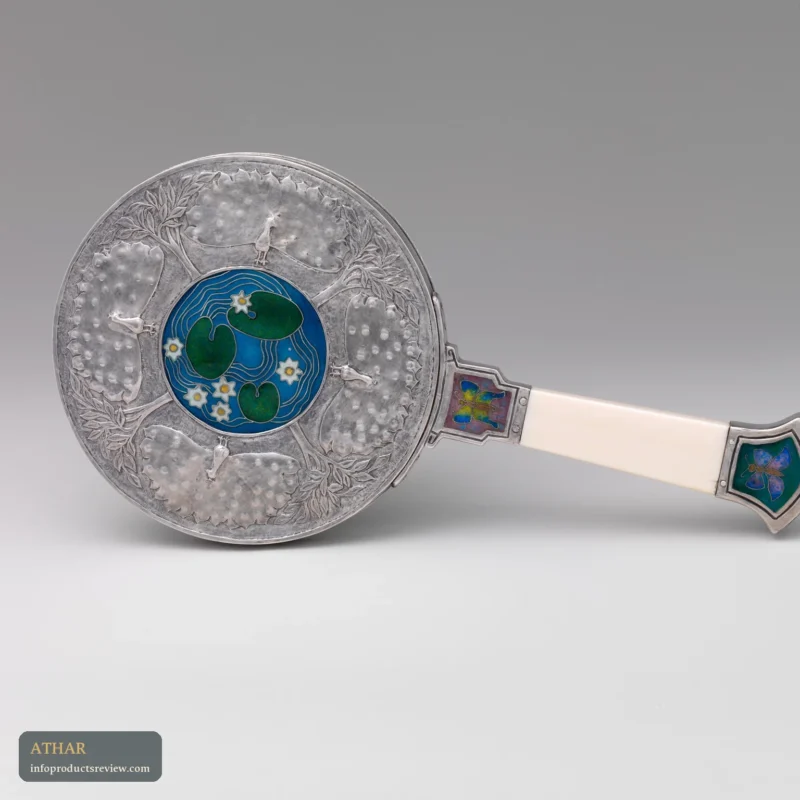
You dreamed of silver: a rough lump that had never been worked, a mirror you looked into, a fetter around your ankle, or a bright vessel in your hands. The short answer is that the meaning of silver comes from its shape, where it sat and what you did with it, not from what it costs. A raw lump reads one way, a mirror almost the opposite way, and a fetter a third way, and all three are silver.
The bottom line
- The direct answer: silver has no single meaning in a dream. Shape decides, and the closest reading for a rough lump that has never been worked is that it stands for a woman, because unworked silver is compared to “the substance of women.”
- One piece or many? A single lump reads as a woman; many lumps, gathered and carried, read as treasures, meaning stored good rather than a sum with an amount and a date.
- A silver mirror: reads as something unwelcome touching your standing, and standing here means your place among people, not your money and not your health.
- A silver fetter on the leg: reads as staying and holding firm, not imprisonment. The metal changes what holds you: silver, a woman; gold, money that goes; brass or lead, some ordinary good of this world.
- A silver vessel: a ewer or a basin reads as a servant. The meaning belongs to the vessel as a vessel, not to the metal it was made from.
- All of this is possible, not settled: these are meanings to weigh against your own situation. None of them promises a marriage or money, and none of them warns of illness.
- And where there is no fixed meaning: a silver ring, buying or selling silver, losing it, being given it, and its shine or tarnish. The books of dream interpretation give these no specific reading, so understand them through how you felt in the dream and what is going on in your days.
What this page covers
- The bottom line
- Why silver turns up in a dream
- Why silver is read alongside jewellery and gold
- What does a rough lump of silver (nuqra) mean?
- And if there were many pieces?
- The key rule: worked or raw?
- I saw a silver mirror — what does it mean?
- And what if the dreamer holds authority?
- What does a silver fetter mean?
- Why is a fetter read as something good?
- Why the fetter is liked and the collar disliked
- A traveller who sees himself fettered
- The sick, the imprisoned, the distressed and the happy
- What about dirhams? That’s a different page
- Where do silver and gold part company?
- Iron, brass and lead
- What does it mean to see yourself melting metal down?
- Silver vessels: the ewer and the basin
- What about a silver ring or a bracelet?
- Buying or selling silver
- Silver lost or stolen
- Shine, tarnish and colour
- Silver given to you as a gift
- Where was the metal on your body?
- How were these readings built? Four routes
- Why does the reading change with the fetter’s metal?
- Silver for people who work with it
- Silver in someone else’s hands
- If the dream repeats
- What if you can’t remember the details?
- When you’re told the dream is a warning
- Do the readings differ for men and women?
- Reading your own dream, step by step
- How the dream felt
- What this dream cannot tell you
- What to do after the dream
- What changes the reading from one person to another?
- Describing your dream so it can be read
- Cases and examples
- Quick table: the detail and the closest reading
- Related dreams
- Frequently asked questions
- What does silver mean in a dream?
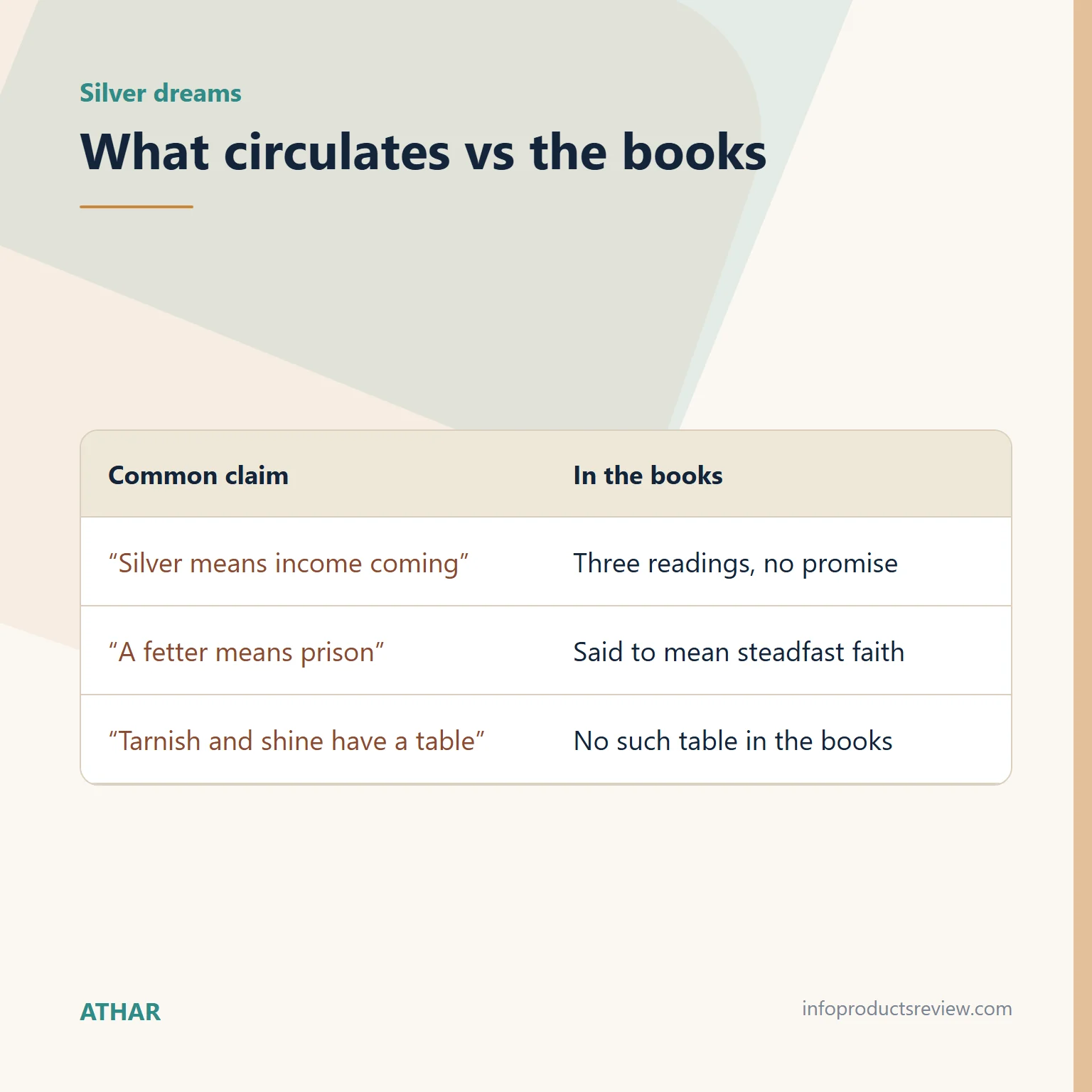
- Is silver in a dream a sign of income?
- What is nuqra?
- Does that mean I am going to get married?
- I saw a silver mirror — is that bad?
- What does a fetter mean in a dream?
- Does a fetter mean prison?
- How do silver and gold differ in a dream?
- What does melting metal mean?
- What about a silver ring?
- Does tarnished or shining silver mean anything?
- Is anything on this page a definitive interpretation?
- In summary
Why silver turns up in a dream
Before you go looking for a symbol, ask about your day. Did you see silverware in a house or a shop window? Was there talk of a ring, a bracelet, a set of spoons? Did you watch something about mining or metalwork? Did you spend a while in front of a mirror?
The US National Institute of Neurological Disorders and Stroke says in its guide to sleep that events from the day often find their way into our thoughts while we sleep.
That is about sleep in general, not about silver. But it explains something reassuring: what filled your day can come back to you at night in some form, with no distant symbol behind it.
So if silver had a place in your day, the likeliest explanation is that the dream is echoing it, and it needs no symbolic reading at all. If it had no place, and the dream came through clear and detailed, the rest of this page sets out what the books say and where they stop.
Why silver is read alongside jewellery and gold
In the books of dream interpretation, silver does not get a section of its own. It appears together with ornaments, gems and gold in a single place, among the things that are worn, kept and shaped.
That grouping teaches you something useful. Silver was never handed one meaning that follows it everywhere; it was placed among the objects that are made out of it. Two practical points follow from that.
First, the meaning of silver overlaps with the meaning of shape. A mirror, a fetter, a vessel and a ring are all shapes, and each one carries a reading of its own.
Second, when silver is mentioned on its own, raw and unshaped, it keeps a meaning that belongs to it and to nothing else. That is the meaning most people are looking for when they dream of an ingot.
What does a rough lump of silver (nuqra) mean?
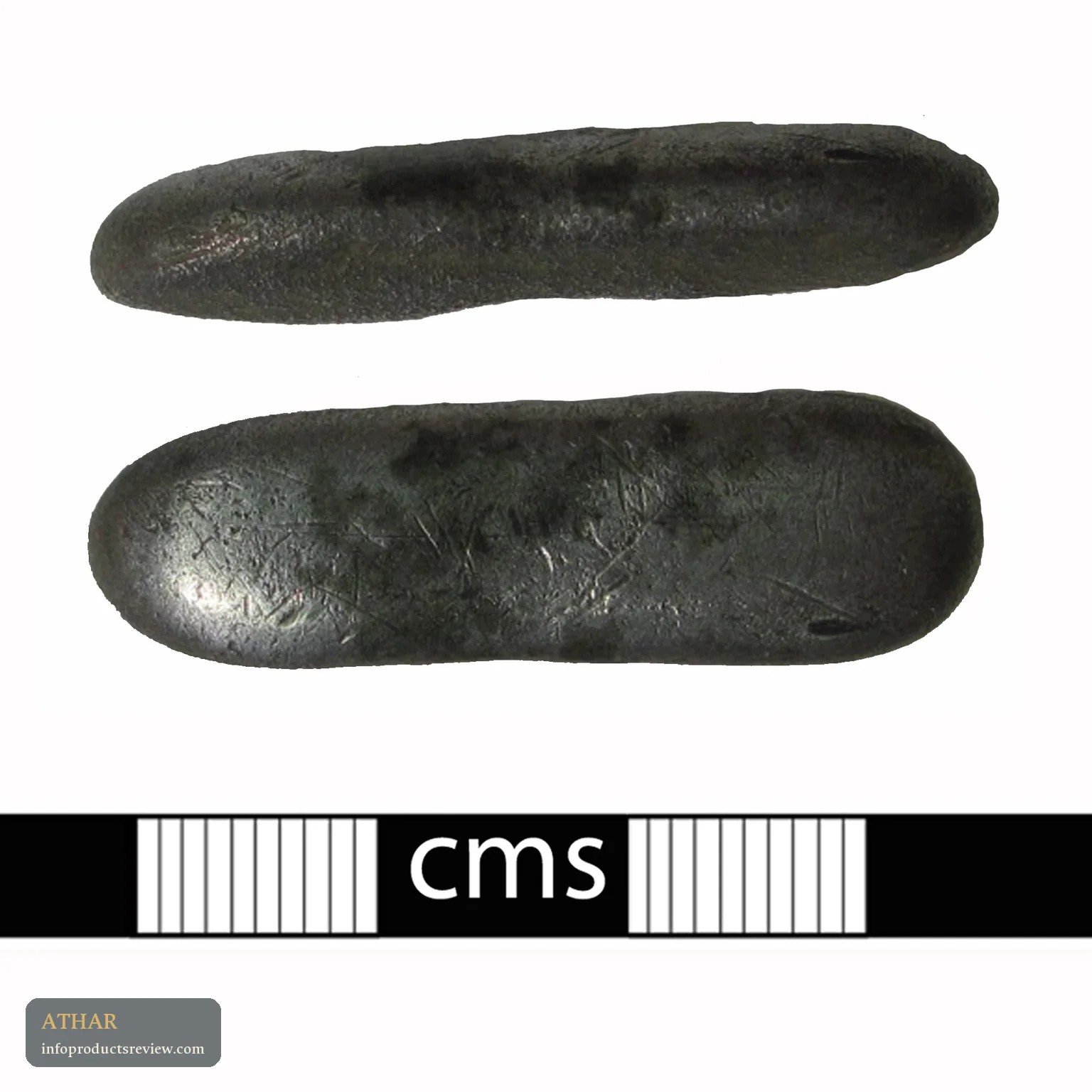
Nuqra is an old word for a melted piece of gold or silver. An ingot, in other words: not a ring, not a bracelet, not a bowl.
Dream interpreters hold that whoever comes by a rough lump of silver has come by a woman. And the reason is given in their own words: the substance of silver, before it is worked, is compared to the substance of women.
Notice that the meaning arrived with its reasoning attached. That is what makes it something you can follow, rather than one more line in a table to memorise. The picture rests on a likeness in the nature of the material, not on its price.
The reading stays the reading of a symbol; it never becomes news. There is no date in it, no description of a particular woman, and no announcement of a marriage. If you are single, it tells you nothing about your prospects. If you are married, it points at no one in your household.
Take an example. A young man who has been thinking about marriage dreams he is holding a silver ingot. The image is probably close to what already occupies him, and he can take some quiet comfort from it. But it does not tell him when he will marry, or whom.
And a married woman who has the same dream will find nothing in it that should make her suspicious of her husband or of anyone in her family. A symbol is read where it belongs, and people are never put on trial over dreams.
And if there were many pieces?
Here the meaning shifts a little. Many rough pieces of silver, once they are gathered and carried, read as treasures: stored good that their owner benefits from.
The gap between one piece and many is not a grammatical nicety. A small amount is read one way; a large amount that is collected is read another. It is a pattern that recurs across more than one symbol in these books.
So if you saw a single ingot, the first reading is the closer one. If you saw a heap of rough pieces, the second is. And if you cannot remember how many there were, do not force it; leave the question open.
Remember, too, that “treasures” here is the meaning of a symbol, not a sum on its way to you. Do not borrow against it, and do not wait for money to arrive on a particular day.
The key rule: worked or raw?
One qualifier comes back again and again in the classical passages on metals: “when it has not been worked” — that is, when it has not been shaped into anything. The repetition turns it into a rule rather than an exception.
Raw metal is read by what it is; shaped metal is read by the shape it was given. Which means the first question about your dream is not “which metal?” but “which shape?”
That is why there is no contradiction in raw silver meaning one thing, a silver mirror meaning something almost opposite, and a silver fetter meaning a third thing. All three are silver. The shape did the separating.
That rule alone is enough to set aside the many tables online that give “silver” one meaning whatever form it took. The books never did that, and neither should we.
I saw a silver mirror — what does it mean?
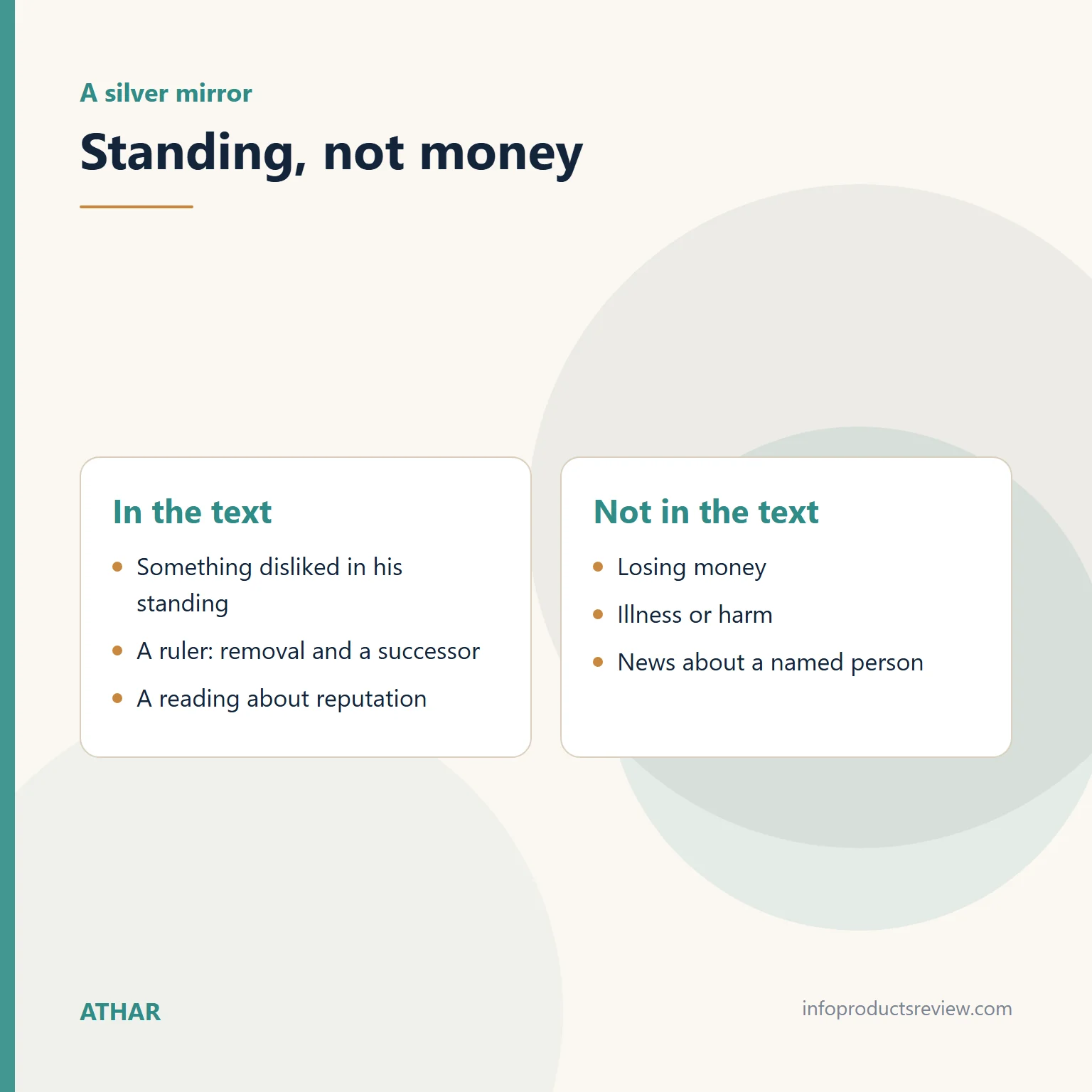
A mirror made of silver, looked into by the dreamer, reads in the books of dream interpretation as something unwelcome touching his standing. The word is precise: standing means your place among people, not your money and not your health.
It is worth noticing that the reading is a caution even though the material is precious. This is one of the clearest signs that these books do not tie meaning to the price of a thing.
And the picture itself explains the reading. A mirror shows you your own face, and silver shines. Put together, the image is about looking at yourself and at what others see of you. Hence standing, rather than wealth.
“Something he dislikes in his standing” does not mean a scandal or losing your job. It is a general possibility to do with reputation. If you dreamed this, there is no need to fear for your good name or to suspect a colleague. It is enough to mind your conduct and your words, as anyone should.
And what if the dreamer holds authority?
This is a special case, and its condition is spelled out in the books: “if the man was a ruler.” Someone in authority here means anyone with real power over others — a governor, a manager, the head of a group.
For such a person, looking into a silver mirror is read as being removed from his position, seeing his counterpart in his place, and perhaps parting from his wife, with that counterpart taking his place with her.
One idea holds both halves together: a mirror shows a person his likeness. Someone in a position that another will fill after him sees, in that image, a hint of his successor.
But pay attention to this point. It is the reading of a symbol, not news about anyone. It must never be pinned on a particular spouse, partner or colleague, and no suspicion about a home or a workplace should ever be built on it.
Notice too that the condition is part of the meaning and has to travel with it. If you hold no office and no position of responsibility, this case is simply not about you, and there is no reason to read it onto yourself.
What does a silver fetter mean?
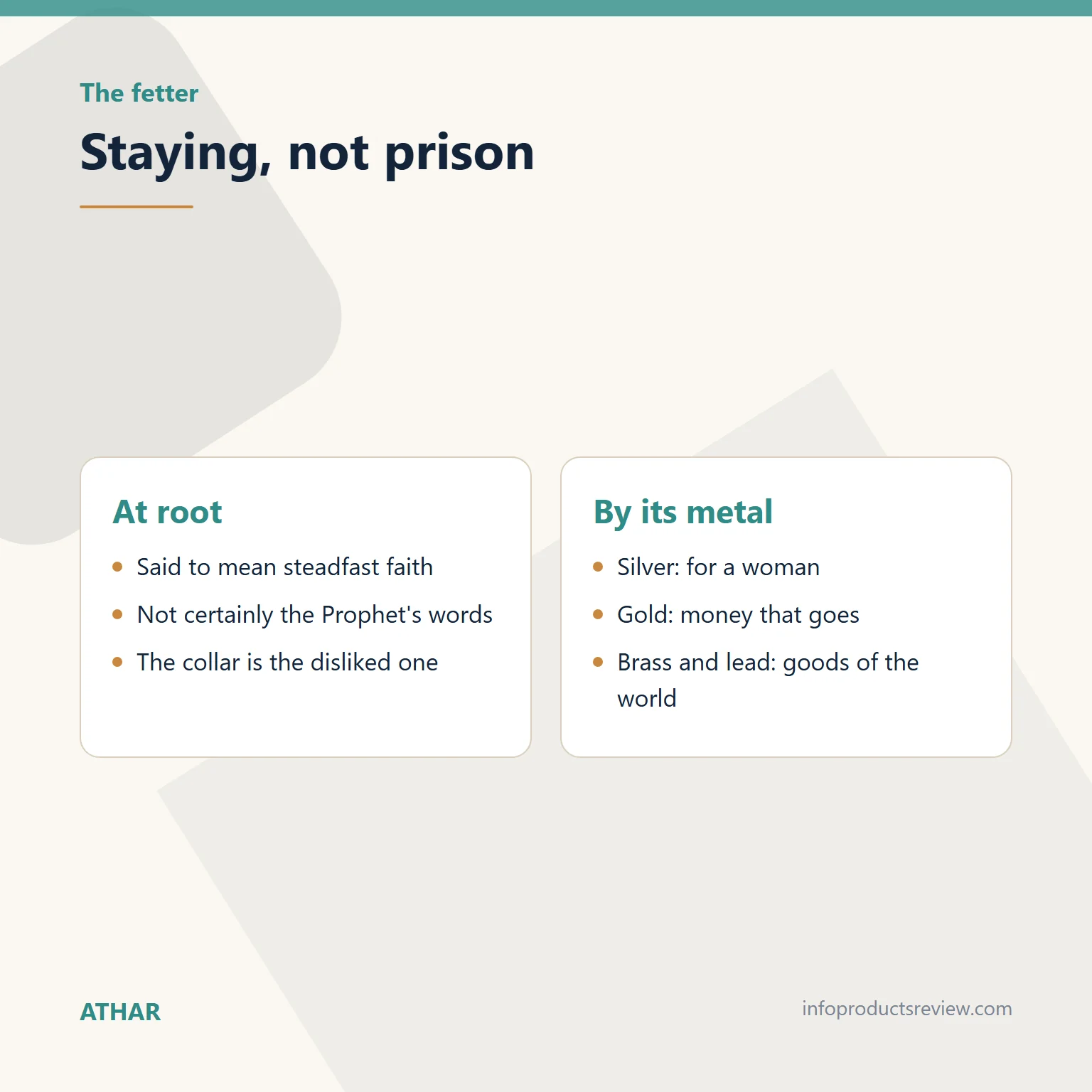
After the ingot and the mirror comes a third silver shape, quite unlike either: the fetter. A fetter is what is fastened around the leg so that it cannot move freely.
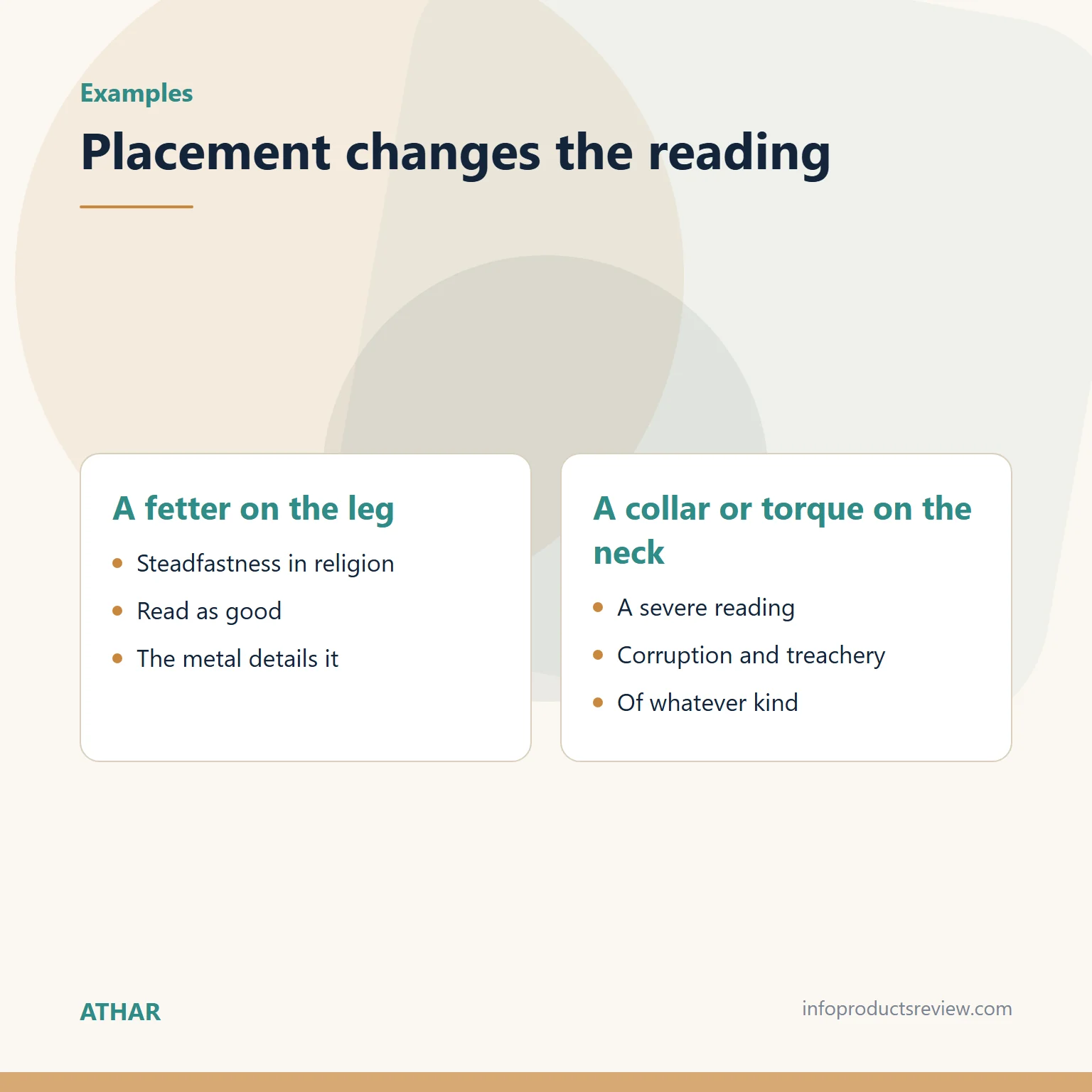
The books get unusually detailed here. The fetter is one object, and the metal it is made of changes what its wearer is held by. Silver: staying on account of a woman. Gold: staying because of money that goes from him. Brass or lead: staying for some good of this world.
The word shared by all four is “stayed.” A fetter is read as remaining and holding fast, not as imprisonment or punishment. What changes is what keeps the dreamer in place, not the fact that the dream is about staying.
For instance, a man weighing a move to another city dreams of a silver fetter on his ankle. The image probably reflects the ties that keep him where he is, perhaps his family or his home.
But it does not make the decision for him. It does not forbid a move he has thought through carefully, and it does not push him into one he has not prepared for. A dream describes what is in a person; it does not sign off on decisions.
Why is a fetter read as something good?
The answer lies in a well-known old sentence: “A fetter is steadfastness in religion.” What stops a foot from moving may, in the language of symbols, stand for what stops its owner from slipping.
Those words appear in Sahih Muslim (Book of Dreams, hadith 2263), but the narrator adds straight afterwards that he does not know whether they belong to the hadith or were spoken by Ibn Sirin:
He said: "I like the fetter and dislike the collar, and the fetter is steadfastness in religion." I do not know whether that is in the hadith or something Ibn Sirin said.
In other words, the narrator himself would not commit to who said it. Another narration in the same place in Sahih Muslim (hadith 2263) gives the words as Abu Hurayra’s own.
So the honest way to take them is as an early saying about the symbol of the fetter, not as an established prophetic text. We spell this out because common accounts attribute the sentence to the Prophet ﷺ without qualification, when Sahih Muslim itself records the narrator’s own hesitation about it.
Even so, the fetter remains one of the few images read as good despite how heavy it looks when you are awake. That is the most striking thing about this symbol: a frightening picture on the surface, and a reassuring meaning underneath.
Why the fetter is liked and the collar disliked
The same sentence draws the contrast: the fetter is liked, the collar disliked. The collar, ghull in Arabic, is a ring of iron or another material locked around the neck, sometimes with the hands chained to it.
The collar is read severely in the books of dream interpretation, and the reading is drawn from the Qur’an: “We have put collars around their necks” (Ya-Sin 36:8).
In its context in Surat Ya-Sin, the verse describes people who had turned away from faith, and the collars on their necks picture what held them back from guidance. That Qur’anic image is where the dream reading of the collar comes from.
But the verse describes particular people in its own context. It is not a rule for every dream with a collar in it, and it is no judgement on the faith of anyone who sees one. Whoever tells a dreamer that his dream means his religion is weak has gone beyond what the books say.
The difference between the two images lies in where they sit. A fetter on the leg stops you walking; a collar on the neck restrains the head and the hands. So the first came to mean steadfastness, and the second restraint and humiliation.
It is a good illustration of how these books read a picture by its details rather than by the name of the object. Which is why it helps to remember where the metal was in your dream: on your leg, around your neck, in your hand, or simply in front of you, never worn at all.
A traveller who sees himself fettered
Among the practical details in the books: a traveller, or someone planning to travel, who sees himself fettered stays behind from that journey.
This reading depends on the dreamer’s situation, just as the mirror reading depended on holding authority. It is not for everyone who sees a fetter, only for someone with travel already on his mind.
And it is a possibility rather than a verdict. Do not cancel a trip because of it, and do not book one because of it either. Decisions are built on their own reasons in waking life.
If you dreamed this shortly before a trip, ask yourself: am I in two minds about going? Am I leaving something unfinished behind? Those questions will do more for you than waiting to see what happens.
The sick, the imprisoned, the distressed and the happy
The fetter passage closes with a set of parallel cases. A sick person who sees himself fettered has a long illness; a prisoner’s confinement is prolonged; a distressed person’s distress is prolonged.
And on the other side: someone in authority continues in his authority, and a happy person continues in his happiness. The image is one and the same; the outcome follows the dreamer’s own state.
One idea runs through all of them: a fetter means continuation. Whoever is in something good stays in it, and whoever is in hardship finds it lasting. The meaning does not change; what changes is the state the dreamer was already in.
And here we need to be plain. Nobody should tell a sick person that a dream means their illness will drag on. This is a possible reading of a symbol, illness is a matter for doctors, and no treatment decision should ever rest on a dream.
If you are unwell and dreamed this, carry on with your treatment exactly as before and pray for good health. If you are happy in something, be thankful for it. Either will serve you better than any interpretation.
What about dirhams? That’s a different page
You might object that dirhams are silver. They are, but the books do not read a dirham as a metal. They read it as money.
Money has meanings of its own in these books, and they do not come from the metal it was struck from. That is why it has its own page, covering dirhams, dinars and small change, along with the scenes no specific meaning is given for, such as counting, losing or finding.
So if your dream had money being counted, given or spent, start there: Money in a dream.
If your dream had raw silver, a mirror, a fetter or a vessel in it, you are on the right page.
Where do silver and gold part company?
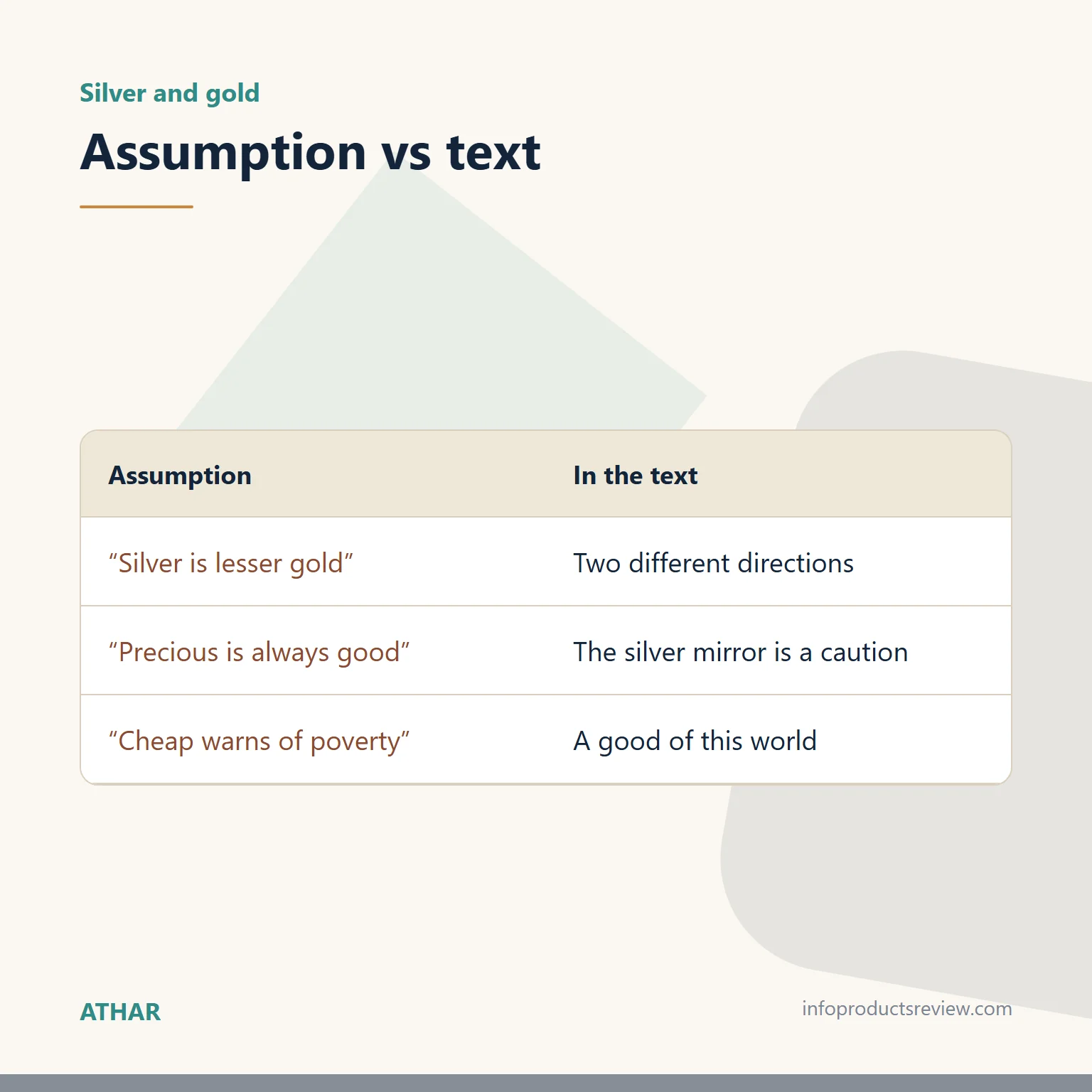
A lot of what circulates treats silver as a weaker grade of gold, giving it the same meaning at lower strength. That is not what the books of dream interpretation do. The two metals part company in clear places.
The clearest is the fetter: silver means staying on account of a woman, gold means staying because of money that will go. The direction differs, not the degree. Gold has other readings of its own, and they are not simply silver’s readings turned up a notch.
If your question is really about gold — wearing it, being given it, a gold ring — our gold pages will serve you better, and they go into detail by the dreamer’s situation. This page stays with silver and the metals around it.
Iron, brass and lead
Three ordinary metals are grouped under a single reading: heaped iron (piled up rather than shaped), brass, and lead.
All three read as some good of this world, so long as they have not been worked. Goods of this world and nothing more: furniture, tools, usefulness. No power in them, and no knowledge.
This corrects a common assumption, that a cheap metal in a dream warns of poverty. It does not. The cheap metal was made a good of this world, while something precious, the silver mirror, came out as a caution about standing.
Market value is not the measure in dream interpretation. Someone who saw a pile of iron should not read it as poverty on the way, and someone who saw shining silver should not read it as wealth on the way.
What does it mean to see yourself melting metal down?
Melting a metal down is read in the books of dream interpretation as backbiting: the dreamer being spoken about badly behind his back.
The image is apt once you think about it. Melting takes away a thing’s form and turns it into something other than what it was. Backbiting does exactly that to a person’s image among other people.
So the reading rests on a likeness of action, not on the value of the metal. Which is why it does not change with the metal being melted.
Our practical advice here: if you dreamed this, do not go looking for whoever might be talking about you. A dream names nobody, and hunting for a culprit after a dream does nothing but harm. Take it, if you want to take something, as a reminder to hold your own tongue.
Silver vessels: the ewer and the basin
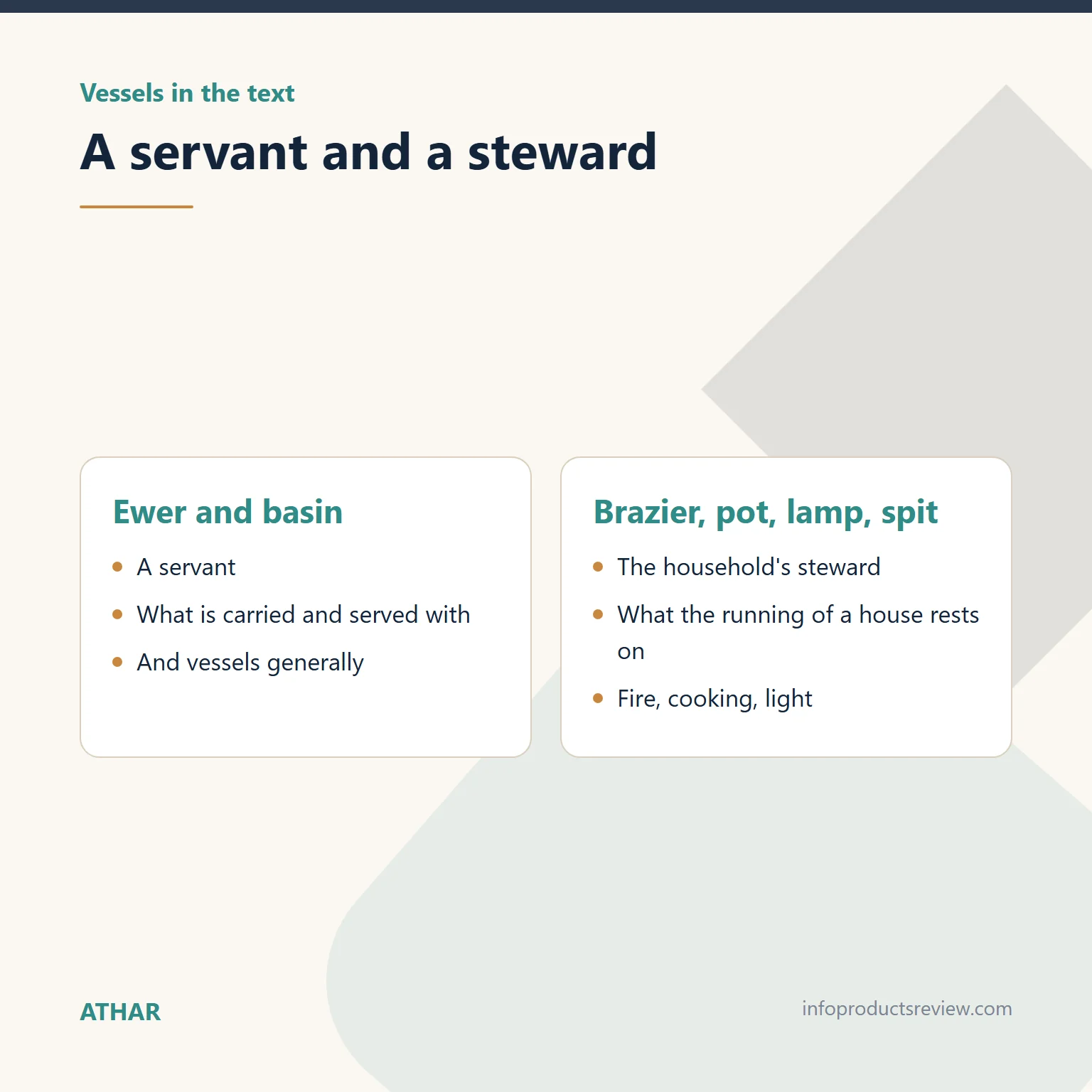
Vessels appear in the very same lines as the metals. The ewer is a servant, the basin is a servant, and vessels in general are read the same way.
Four are singled out as exceptions: the brazier (a fire pit for coals), the cooking pot, the lamp, and the roasting spit (an iron rod meat is grilled on). Each of those four reads as the steward of the household, the person who keeps it running.
That is a reading of a vessel as a vessel, not as silver. If you saw a silver ewer, you are dealing with a “ewer” first. Which is why the meaning of raw silver cannot simply be carried over to it.
The split between vessels in general and those four makes sense in the picture. Things that are carried and used to serve read as a servant, while the things a household’s running depends on — fire, cooking, light — read as its steward.
This also answers a common question: “Does silverware in a dream mean wealth?” The books never say so. They read the vessel by what it is used for, and its price never came into the meaning at all.
What about a silver ring or a bracelet?
This is one of the most frequent questions, and the honest answer is that the passages on silver give no specific meaning for a silver ring.
Rings are discussed separately in these books, and what is said there rests on the ring as a ring, not on the metal it was made from. So if your dream was about a ring, read it alongside other ring dreams rather than alongside metals.
You will find a worked example on the page A Gold Ring in a Man’s Dream. We will not write you a meaning for a silver ring that the books do not give.
Nor should the meaning of a raw ingot be carried over to a ring. That meaning is tied to silver that has not been worked, and a ring is worked by definition. It is a neat example of how one qualifier prevents a great deal of confusion.
Buying or selling silver
The books of dream interpretation give no specific meaning for buying or selling silver. If someone hands you a table for it, ask which book it comes from.
What helps here are questions rather than verdicts. Were you buying or selling? Did you come out of the dream satisfied or regretful? Was there haggling, or did it all happen without a word?
None of that gives you a meaning from a book, but it gives you a clearer picture of what is on your mind. Which is the point in the first place.
One more question worth asking: was the buying or selling out of need, or out of desire? Many scenes like this echo something left unresolved in waking life — a financial decision you keep putting off, something you have been meaning to get rid of, a commitment you intend to honour.
Silver lost or stolen
Silver being lost or stolen is likewise given no specific meaning. Fear for something precious is perfectly understandable, and it shows up in dreams as the image of losing it.
And here a word that matters: never take an accusation out of a dream. A dream is not evidence, and thinking ill of people without proof is wrong in itself. If you saw someone taking it, build nothing on that in waking life.
Work with what you have. What exactly went missing? Was it yours or someone else’s? How did you feel when you realised it was gone? Here the feeling tells you more than the symbol does.
Shine, tarnish and colour
The books offer no table linking shining or tarnished silver to set meanings. The popular claim that “bright silver is good and blackened silver is bad” has no basis in them.
Describing the state of the metal still helps you, though. Someone who saw a dull, lifeless metal and woke up feeling low is describing their own mood far more than they are matching any table.
We report what the books say, and we do not invent what they leave out. That serves you better than a ready-made meaning that knows nothing about you.
Silver given to you as a gift
A gift in a dream is a layered image: the metal, the giver, and whether you accepted or refused. Being given silver is given no specific meaning in the books of dream interpretation.
So start with the act rather than the material. Who gave it to you? Were you pleased, or hesitant? Did you keep it or hand it back?
Then come back to the shape: an ingot, a vessel, a piece of jewellery. The shape is what leads you to the fitting reading. And a gift from a relative is not the same as a gift from a stranger, just as easy acceptance is not the same as awkward acceptance.
Where was the metal on your body?
This question changes the meaning completely. Three placements are named explicitly, each with its own reading: the fetter on the leg, the collar on the neck, and the torque, also on the neck.
All three are worn metal, and all three read completely differently. The fetter on the leg is steadfastness, a good reading. The collar on the neck carries the severe reading drawn from the verse of Ya-Sin already mentioned.
As for the torque — a rigid band encircling the neck, whether worn as ornament or not — it is read in these books as corruption in religion and treachery, of whatever kind it may be.
That is an old judgement passed on as it stands. It is not a verdict on the dreamer’s religion and not an accusation of treachery. If the metal alone were the measure, these three placements could not diverge like this, since all of them might be silver.
Placement did the separating, not material. Hence the one question we keep asking: where exactly was the metal? If it was on your leg, you are looking at a fetter. If it was around your neck, look again: was it a torque or a collar?
And if you cannot tell the two apart, say so. Do not pick one just to get a meaning. This detail is also why short tables are of so little use: they give you the word “silver” and a single meaning.
How were these readings built? Four routes
Follow silver through the classical passages and you will see the readings were not assigned at random. They rest on four clear routes, and knowing them will serve you better than memorising the table.
One: likeness in the image. A mirror shows a likeness, hence the man in authority seeing his successor. Melting changes a thing’s form, hence backbiting, which changes a person’s image among others.
Two: the nature of the material. Unworked silver is linked to women, and the reason is given in the text itself: its substance is compared to the substance of women. The reasoning belongs to the books, not to us.
Three: a religious text or an early saying. For the collar, the verse of Ya-Sin (36:8) is cited. For the fetter, a sentence recorded in Sahih Muslim (hadith 2263) whose narrator would not commit to whether it was the Prophet’s ﷺ words or Ibn Sirin’s.
The difference between the two matters. The verse is established scripture; the sentence is an early reading of a symbol, not a hadith of certain attribution. That is exactly the distinction most circulating pages drop.
Four: the dreamer’s situation. “If the man was a ruler,” “if a traveller sees,” “if a sick person sees.” Three explicit conditions that keep a reading with the person in that situation instead of extending it to everyone who sees the image.
Once you know these four routes, you can tell for yourself what has been handed down from what was added later. If a claim about silver traces back to none of them, it is a later addition, and whoever makes it should be asked which book it comes from.
Why does the reading change with the fetter’s metal?
Notice the order: silver, then gold, then brass, then lead. All four are fetters and all four mean staying; the difference lies in what a person is held by.
So the metal here is not a rung on a ladder from best to worst. It describes the kind of thing a person is caught up in.
Silver is linked to a woman, just as the raw ingot was, so the text is consistent with itself. Gold is linked to money that goes, spent and gone. Brass and lead are linked to the goods of this world in general, just as heaped iron was.
Read as a whole rather than in fragments, these books repeat their own meanings in their places and repeat the same qualifier: worked and unworked. That consistency is reassuring evidence that this really is the reading, not a sentence cut from its context.
Silver for people who work with it
For a jeweller, a dealer or anyone who works in a metal shop, silver is part of the working day rather than a rare symbol. A dreamer like that, more than anyone, should start with the mind talking to itself: the wants and thoughts that fill a person’s day and come back at night.
That is not a way of brushing the dream aside. It is the right order of looking: whatever belongs to a person’s habits, trade and preoccupations is put down to those first.
If something then remains that the day does not explain — an odd shape, an unusual placement, a feeling far stronger than the scene deserves — that is when the symbol is worth considering.
The practical point: do not let your trade become a reason to dismiss the dream, and do not let it become a reason to inflate it. Treat it as one more fact in the description.
Silver in someone else’s hands
Seeing the metal with someone else is different from seeing it with yourself, and no specific meaning is given for seeing silver in another person’s hands.
Our advice is simple: do not transfer the meaning onto the person you saw. If a relative was holding an ingot, the books tell you nothing about him. A dream mostly describes the dreamer’s own state and outlook, not the state of whoever appeared in it.
Ask instead why that particular person appeared. Is there something unsettled between you in waking life? The answer to that is likely to be closer to the truth than any table.
If the dream repeats
Repetition does not, by itself, make an image mean more. It often comes from an ongoing preoccupation: a worry you keep putting off, a decision you keep putting off, something that turns over in your mind every night.
It may also repeat because you have started thinking about it every evening. A long search for an interpretation keeps the image alive in your head, so it comes back in your sleep.
Repetition does have one practical use, though: it lets you notice what stays the same and what changes. Each time, note the shape, the act, the placement and the feeling.
If the shape stays the same while the feeling grows stronger, you are looking at something in your waking life that is asking you to act in your day, not in your interpretation.
What if you can’t remember the details?
That is common, and it is no failing on your part. Forgetting dream details is perfectly ordinary, nobody is to blame for it, and the gap should not be filled with guesswork.
The rule is: what you do not remember cannot be built on. If you do not know whether the silver was raw or worked, do not pick one just to get an answer.
Stay with what you do remember, however little. A short, honest answer beats a complete one resting on a guess. Most frightening interpretations are built on details added after waking, not on what the dreamer actually saw.
When you’re told the dream is a warning
You might describe your dream to someone and be told that the silver is an omen, or that the fetter means trouble on the way, and then be offered a remedy for a fee. We warn against this on every page we write.
Ask for three things before accepting any reading: the name of the book it comes from; the language of possibility rather than certainty; and no request for a decision or for money. If any one of them is missing, walk away from the whole thing.
You have already seen on this page that the strongest image here, the fetter, comes out as good rather than bad, and that the apparently precious one, the silver mirror, comes out as a caution. Anyone trying to frighten you with silver is not speaking from these books.
Do the readings differ for men and women?
In the passages on silver, no reading belongs to a woman as a woman or a man as a man, apart from two explicit places: “if a woman sees that,” about the crown, and “if the man was a ruler,” about the mirror.
Everything else is addressed to the image itself. We do not invent a meaning for women or for men that the books do not give, and we do not treat the dreamer’s social situation as a blank to be filled with guesses.
What helps you, whether you are a man or a woman, are the same details: the shape, the act, the placement, the quantity and the feeling. Those do not vary from one person to the next.
Reading your own dream, step by step
Take these in order, and you will find most questions answer themselves before you reach any book:
- Name the shape: raw, mirror, fetter, vessel or jewellery. This is the most important question of all.
- Name the act: did you only see it? Take it? Wear it? Melt it? Give it away?
- Name the quantity: one piece, or many? The books separate the two explicitly.
- Name the placement: on your leg, around your neck, in your hand, or in front of you, untouched.
- Note the feeling: ease, unease, fear, or nothing much at all.
- Then read: if this page has a meaning for your image, take it as a possibility. If it does not, settle for describing your own state and what is on your mind.
Notice that the first five steps need nobody’s help. They are entirely yours, and they are the most useful part of understanding any dream.
A worked example: a woman dreams she is wearing a silver fetter on her ankle and feels calm. Shape: fetter. Placement: the leg. Metal: silver. Feeling: calm.
The closest reading in the books is staying and holding firm, and a fetter at root is steadfastness in religion. There is no news in it about marriage or travel; it is a calm image she can take some comfort from.
How the dream felt
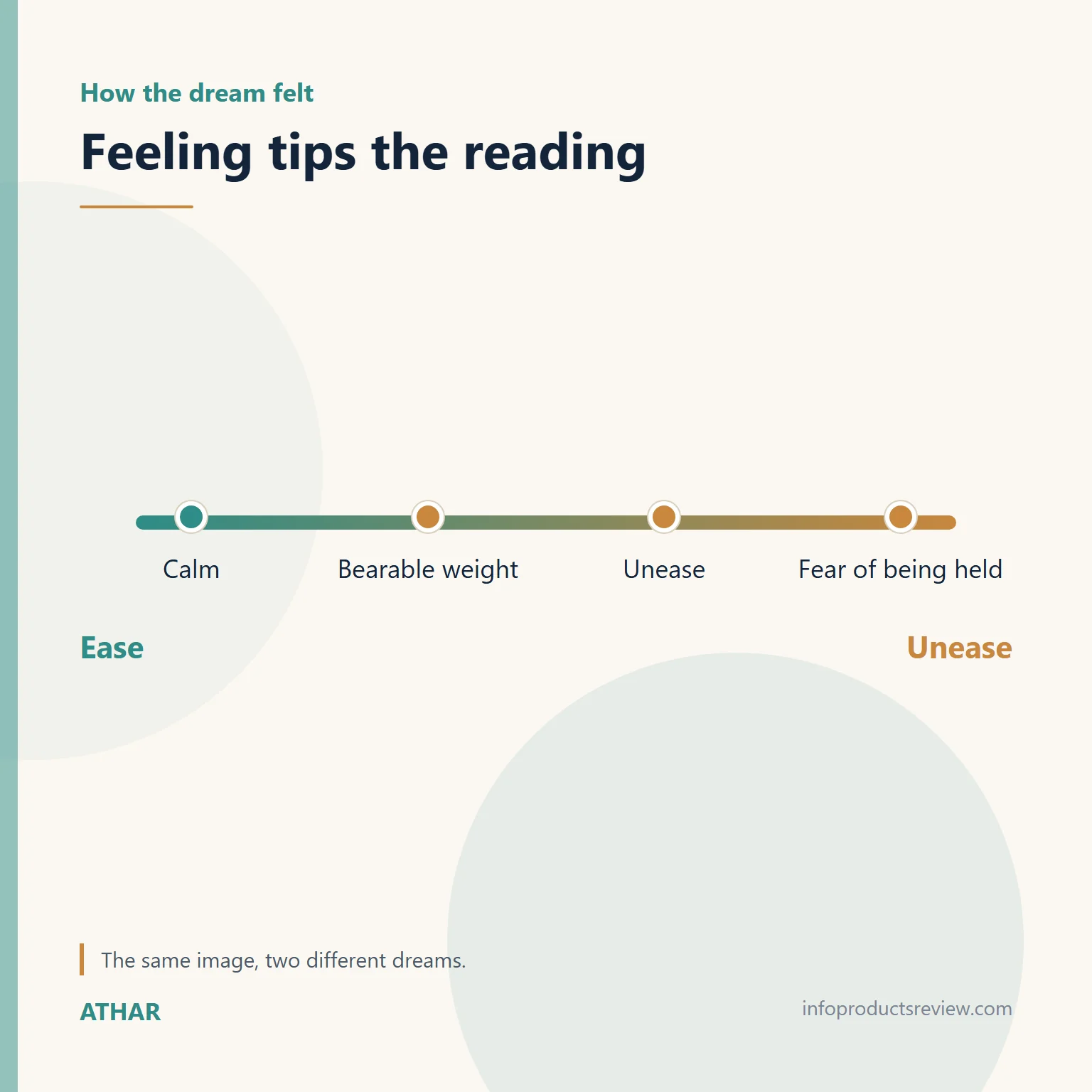
One image can make two very different dreams. Someone who saw a fetter on his leg and felt at peace is not having the same dream as someone who saw it and felt trapped.
When the books read a fetter as steadfastness, they do not cancel your feeling; the feeling is part of the dream, not a footnote to it. That is a large part of the difference between reading a table and understanding your dream.
So write the feeling down before the symbol: “I saw this, and I felt that.” Then, whatever book you open next, you will know where you are starting from, and a general phrase that does not describe you will not carry you off.
What this dream cannot tell you
It is only honest to gather in one place everything this dream cannot tell you, so that you do not ask it to carry more than it can:
- It cannot tell you a sum that is coming, or when.
- It cannot tell you a marriage will happen, and it describes no particular woman and no particular man.
- It cannot tell you an illness will drag on, and it must never be used to frighten a patient.
- It cannot name who is speaking ill of you or betraying you, and it builds no case against anyone.
- It passes no verdict on the dreamer’s faith, nor on the faith of whoever appeared in the dream.
- It is no basis for a decision about travel, treatment, buying and selling, or cutting off a relative.
Beyond that, everything above is a possible meaning, read calmly and understood alongside your own situation. The rule on this page is simple: where the books give no meaning, we say so plainly; where they do, we pass it on with its conditions exactly as they stand, and add nothing of our own.
What to do after the dream
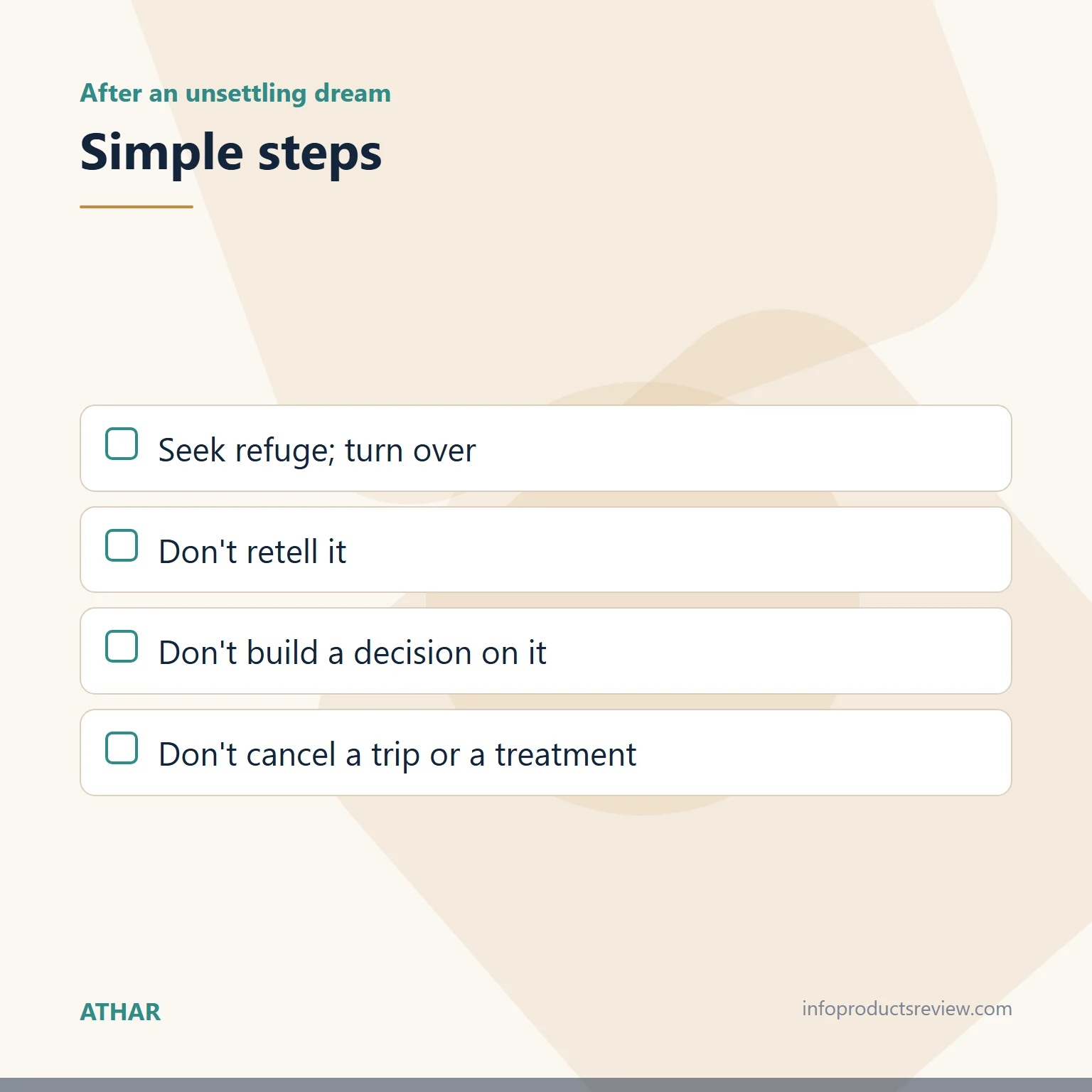
If what you saw unsettled you, the guidance for an unwelcome dream — a dream that disturbs you — is clear and practical. Sahih al-Bukhari (Book of Dream Interpretation, hadith 7044) records from Abu Qatada that the Prophet ﷺ said:
A good dream is from God. If one of you sees something he likes, let him tell it only to someone he loves. And if he sees something he dislikes, let him seek refuge in God from its harm and from the harm of Satan, spit lightly three times, and not tell anyone about it, for it will not harm him
And Sahih Muslim (Book of Dreams, hadith 2262) records from Jabir that the Prophet ﷺ said:
If one of you sees a dream he dislikes, let him spit to his left three times, seek refuge in God from Satan three times, and turn over from the side he was lying on
In practice: seek refuge in God from its harm, spit lightly to your left three times, turn over onto your other side, and do not tell anyone about the dream. Bukhari’s wording ends with a clear reassurance: “it will not harm him.” Then get on with your day.
And if what you saw was good, be thankful for it, tell it only to someone you love, and do not turn it into a wait that holds up your life.
One simple rule after that: do not build a decision on a dream. Do not cancel a journey, stop a treatment, cut off a relative, or buy or sell because of something you saw at night.
What changes the reading from one person to another?
There is a clear principle in the books of dream interpretation: interpretation differs with people’s conditions and standing. The dreamer’s own situation has to be looked at before any general meaning.
We have seen that twice on this page: with the man in authority at the mirror, and with the traveller who saw himself fettered. One and the same fetter means one thing for a traveller and something else for a sick person.
A second principle matters just as much: interpretation is all conjecture — analogy and comparison that nothing certain can be built on. What an interpreter offers is help towards understanding, not confirmed news, and its truth only shows if it appears in waking life.
And a third: some of what we see is not a dream with an interpretation at all, but the mind talking to itself — desires and feelings held back that wake up in sleep and have no interpretation.
This is especially useful for anyone who works with silver or saw it during the day. Not everything we see at night needs a book; much of it only needs us to pay attention to our days.
Describing your dream so it can be read
A good description does half the work. Say: “I saw a piece of raw silver in my hand, I didn’t wear it, I was alone, and I felt calm.” That can be read.
“I saw silver” is not enough, because every reading of silver depends on shape and act. Anyone who gives you a confident answer to that sentence alone has answered a question you did not ask.
Write your description down as soon as you wake, before details from your own mind slip into it. An honest description is more useful than a complete one.
Cases and examples
These examples are built from common scenes rather than from any particular person’s dream. The point is to show how the understanding shifts with the details and with the dreamer’s situation.
A rough ingot of silver in the hand
The closest image to the reading of a raw lump: a woman. The meaning is passed on as it stands, and it is not turned into good news about marriage or a description of anyone.
A heap of silver pieces
Here the reading moves to abundance: treasures. It is the meaning of a symbol, not news of money arriving with an amount and a date.
Looking into a silver mirror
The reading given is that the dreamer meets something unwelcome in his standing among people. Nobody should be told their reputation will suffer tomorrow.
Someone in authority looking into a mirror
The reading is tied to his situation: removal, and a successor in his place. It does not apply to anyone who holds no such position.
A silver fetter on the leg
The reading given is staying on account of a woman. And a fetter at root is steadfastness in religion, so this is one of the images read as good.
A gold fetter
The reading given is staying because of money that will go. The difference from silver is one of direction, not degree.
A traveller who sees himself fettered
The reading given is that he stays back from his journey. Even so, no trip is cancelled over a dream; the reading is a possibility, not an instruction.
A sick person who sees himself fettered
The reading given is that the illness may be prolonged. We never say this to a patient as a verdict, and we do not let a dream add to their anxiety. Treatment carries on as before.
A collar around the neck
The reading given is severe, and it is drawn from a verse. It is the reading of a symbol, not a judgement on anyone’s faith, and it should never be delivered to a dreamer in those terms.
Melting a metal down
The reading given is that the dreamer is spoken ill of. Don’t go looking for a culprit; take it, if anything, as a reminder about your own tongue.
A silver ewer and basin
The reading belongs to the vessel as a vessel: a servant. Shape comes before metal.
A pile of iron
The reading given is a good of this world, as long as it is unworked. A cheap metal is no warning of poverty.
A silver ring
No specific meaning is given for a silver ring here. Read it with other ring dreams rather than with metals, and don’t carry the reading of raw silver over to it.
Silver dreamed after a day in the jewellery market
The likeliest explanation is the ordinary residue of the day, and that is the first thing to consider before any symbol.
Silver that went missing
No specific meaning is given for loss. Work with what remains and how you felt, and accuse nobody.
Being given silver as a gift
No specific meaning is given for the gift itself. Start from the act and the shape, then stop where the books stop.
Quick table: the detail and the closest reading
| What you saw | Closest reading in the books | The limit |
|---|---|---|
| Raw silver (nuqra) | A woman; unworked silver is compared to the substance of women | No date, no description of anyone |
| Many lumps | Treasures | No amount, no timing |
| Silver mirror | Something unwelcome in one’s standing | Standing, not money |
| A man of authority at a mirror | Removal, and a successor | Tied to the dreamer’s situation |
| Silver fetter | Staying on account of a woman | A fetter is steadfastness at root |
| Gold fetter | Staying because of money that goes | A different direction, not a grade |
| Iron, brass or lead | Good of this world | Only while unworked |
| Melting metal | Being spoken ill of | Nobody is named |
| Ewer or basin | A servant | A reading of the vessel, not the metal |
| Silver ring | No specific meaning given here | Read it with other ring dreams |
Related dreams
- Money in a Dream: Speech, Documents and Trust
- Pearls and Gems in a Dream: Speech and Knowledge
- A Gold Ring in a Man’s Dream
Frequently asked questions
What does silver mean in a dream?
There’s no single meaning; the shape decides. Raw silver is read as a woman, a silver mirror as something unwelcome in one’s standing among people, and a silver fetter as staying on account of a woman. All of these are possible readings rather than settled ones.
Is silver in a dream a sign of income?
That isn’t what the books of dream interpretation say. What they do say is that many raw lumps are treasures, which is the reading of a symbol, not news of money with an amount and a date.
What is nuqra?
A melted, unworked piece of silver. Whoever comes by one is read as having come by a woman, and the reason given is that unworked silver is compared to the substance of women.
Does that mean I am going to get married?
No. The reading names no person and no time, and it isn’t news about the future. It’s the meaning of a symbol, passed on as it stands.
I saw a silver mirror — is that bad?
The reading given is that the dreamer meets something he dislikes in his standing among people. That’s a possible caution about reputation, not a warning of disaster and not a certainty.
What does a fetter mean in a dream?
A fetter is read as steadfastness in religion, while the collar is the disliked image. The well-known words “I like the fetter and dislike the collar” appear in Sahih Muslim (hadith 2263), but the narrator wouldn’t commit to whether they were the Prophet’s ﷺ or Ibn Sirin’s. The metal changes what a person stays for, not the fact of staying.
Does a fetter mean prison?
No. In these books the image means remaining and continuing, which is why a sick person’s illness is said to be prolonged and a happy person’s happiness to continue. These are possibilities, not verdicts.
How do silver and gold differ in a dream?
By direction, not degree. The clearest example: a silver fetter means staying on account of a woman, a gold one staying because of money that goes.
What does melting metal mean?
The reading given is that the dreamer is spoken about badly behind his back. That reading should never be used to accuse a particular person.
What about a silver ring?
No specific meaning is given for it in the passages on silver, and the reading of raw silver doesn’t carry over, because that one is tied to metal that hasn’t been worked. A ring is best read with other ring dreams.
Does tarnished or shining silver mean anything?
The books give no table of colours or states. Describing the metal’s condition helps you understand your own state, not extract a verdict.
Is anything on this page a definitive interpretation?
No. These are possible meanings drawn from their sources, together with a plain note of what the sources leave out. Interpretation is conjecture throughout, never certainty.
In summary
- Silver is read by its shape: raw, mirror, fetter or vessel.
- A raw lump reads as a woman, many lumps as treasures, and a silver mirror as something unwelcome touching one’s standing among people.
- A fetter is steadfastness in religion; its metal changes what one stays for, not the staying itself. The narrator of “I like the fetter” in Sahih Muslim wouldn’t commit to the words being the Prophet’s ﷺ.
- Ordinary metals are goods of this world while unworked, and melting them is backbiting.
- Dirhams are money rather than metal, and they belong on the money page.
- ATHAR dream interpretation guide
If you take one thing away, let it be this: the meaning of silver isn’t measured by what it costs, but by its shape, its placement, and what the dreamer did with it.
Written and reviewed by the ATHAR editorial team. Quoted texts are taken from the editions named in the references.
Note: everything on this page is a possible meaning rather than an established fact, and none of it predicts marriage, money or illness.