

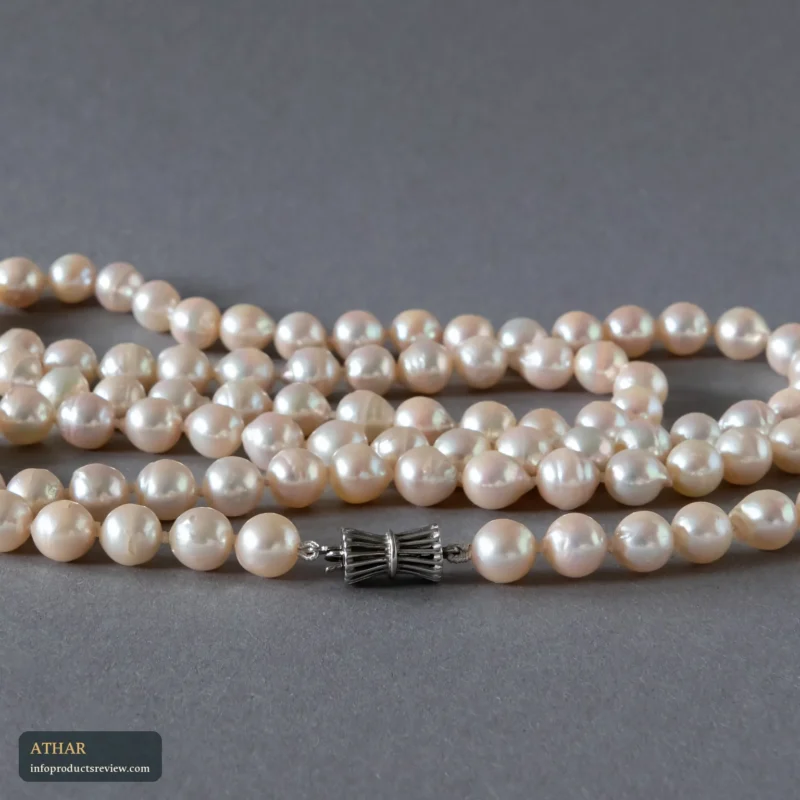
You dreamed of pearls or gems, and you woke up wanting to know what it meant. The short answer is that in the books of dream interpretation, pearls stand for good words and knowledge long before they stand for wealth. Two simple details decide the rest: the form of the gem, strung in a necklace or loose and scattered, and the amount, a single stone or a heap being carried.
The bottom line
- The closest meaning: strung pearls, meaning pearls threaded in order like a necklace, are read as the word of God or righteous speech. The books of dream interpretation saypearls are Qur’an.
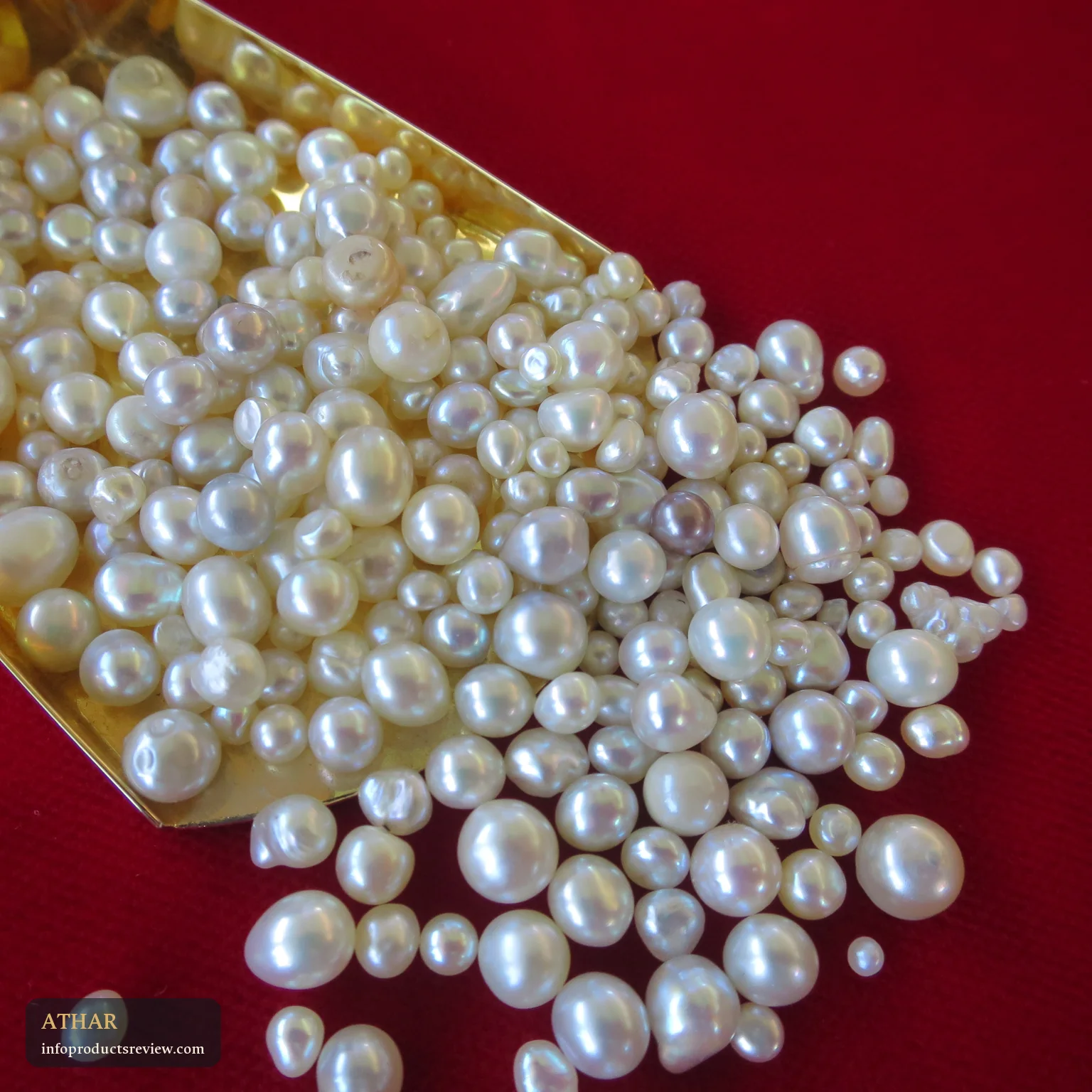
- What changes it: form and amount. Pearls scattered on the ground are read as a child or as good words; a single pearl may be a woman; and only pearls plentiful enough to be measured and carried stand for much wealth.
- Eating pearls or throwing them: eating hides something away, so it reads as keeping knowledge to yourself. Throwing sends it out, so it reads as teaching. Throwing is not waste here.
- Rubies, emeralds and beads: a ruby you are given is read as a beautiful woman; an emerald as good company, lawful money and pure speech; beads as servants and as money of little value.
- Where there is no set meaning: a gem breaking or getting lost, buying and selling, the colours of stones, and imitation gems. Read those through how the dream felt and what is on your mind, not through a ready-made meaning.
- The limits: everything on this page is a possible meaning. It announces no pregnancy, promises no marriage and guarantees no money.
What this page covers
- The bottom line
- Why you dreamed of gems
- What do strung pearls in a necklace mean?
- What do pearls scattered on the ground mean?
- What does a single pearl in your hand mean?
- When do plentiful pearls come to mean wealth?
- The stringing itself is a meaning
- How were these readings built?
- Eating pearls and throwing them: what does each mean?
- Why do the gems run from the most precious to the least?
- What do rubies mean in a dream?
- What does an emerald mean?
- And what do beads mean?
- What does a necklace mean in a dream?
- And what about earrings?
- What does a crown of gems mean?
- What does a collar around the neck mean?
- Does it matter whether you wore the gem or carried it?
- Where the gem sat on the body
- You saw the gem in someone else’s hands
- Gems in a jeweller’s or a trader’s dream
- A gem you bring up from the sea or the earth
- What does a pearl in its shell mean?
- A gem given to you
- Children playing with beads
- Buying or selling gems
- Imitation gems, or glass that looks like a jewel
- A gem broken or lost: is it a warning?
- Gathering scattered pearls: how to read it
- Hiding a gem away and keeping it safe
- Do the colours of stones carry a meaning?
- Value and price in the dream
- Why are gems tied to knowledge and speech?
- When is a gem wealth?
- Gems at weddings and occasions
- When you’re told a pearl means a baby
- A worked example: reading your own dream
- If the dream keeps coming back
- If the dream or a reading worried you
- Telling what’s reported from what’s been added
- What if you don’t remember the details?
- Getting something practical from it
- How the dream felt changes the reading
- What changes a reading from one person to the next?
- What this dream can’t tell you
- What to do after the dream
- How to describe your dream so it can be understood
- What you can take away with confidence
- Examples
- A strung pearl necklace
- Pearls scattered on the ground
- Eating pearls
- Throwing pearls to people
- Given a red ruby
- A clear green emerald
- A heap of coloured beads
- Pearls carried in containers
- Her necklace snapped and the pearls scattered
- A collar around his neck
- A gem dream after watching a programme about stones
- Discovering the pearls were glass
- Diving to bring up pearls
- A necklace on a woman he knows
- Given coloured beads at a gathering
- A student who dreamed of scattering pearls among people
- Quick table: the detail and the closest reading
- Related dreams
- Frequently asked questions
- What do pearls mean in a dream?
- Are pearls good news of a pregnancy?
- What does eating pearls mean?
- What do rubies mean?
- What does an emerald mean?
- And beads?
- Is every gem in a dream wealth?
- My necklace broke in a dream. What does it mean?
- What does a collar mean in a dream?
- Do the colours of stones have meanings in the books?
- I dreamed of gems after seeing them at a market. Does it mean anything?
- Is this interpretation definitive?
- In summary
Why you dreamed of gems
Before you go looking for a symbol, think about your day. Gems are part of many people’s lives: a shop window, a wedding photo, a present at a family occasion, a documentary about precious stones, or a conversation at home about an old necklace the family has kept.
The US National Institute of Neurological Disorders and Stroke notes in its guide to sleep that events from the day often find their way into our thoughts while we sleep.
That is a general point about sleep rather than about pearls. But it explains something useful: what occupies you by day tends to come back at night in some shape.
So start with a few plain questions about your week:
- Did you see a necklace or a precious stone today, in a shop, a photo or at an event?
- Were you at a wedding or a party where people wore jewellery?
- Did you talk about a present you’re planning to give, or hoping to receive?
- Did you read or watch something about pearls or gemstones?
If the answer is yes, the dream is most likely an echo of what you lived through, and it needs no symbolic reading. If gems played no part in your day and the dream came through vividly, the rest of this page will help you make sense of it.
What do strung pearls in a necklace mean?
The clearest meaning of pearls in the books of dream interpretation is speech. Strung pearls are read as the word of God, or as righteous speech, meaning words that are good and do good.
To string, in Arabic, is to join one thing to another in a single ordered row. Pearls on a thread become an ordered necklace, and words put in order become composed speech. The reading grows out of that likeness.
The books of dream interpretation say “If you see pearls, that is Qur’an; if you see a necklace, that is judgement; if you see a crown, that is kingship; and earrings, if he sees them on himself, are adornment and beauty among people.”
So if you saw a strung pearl necklace, the nearest reading is good words or knowledge, not riches. It is clear from the start that gems in these books are closer to meanings than to prices.
Bring the picture close to your own life: a student memorising the Qur’an, a teacher preparing a lesson, a writer putting their thoughts in order. If any of them dreams of a strung pearl necklace, the image sits close to their situation.
For anyone else, the dream does not say they will become a scholar. It stays a pleasant image to take heart from, and then you can look at your own words: are they ordered and clear, or scattered?
What do pearls scattered on the ground mean?
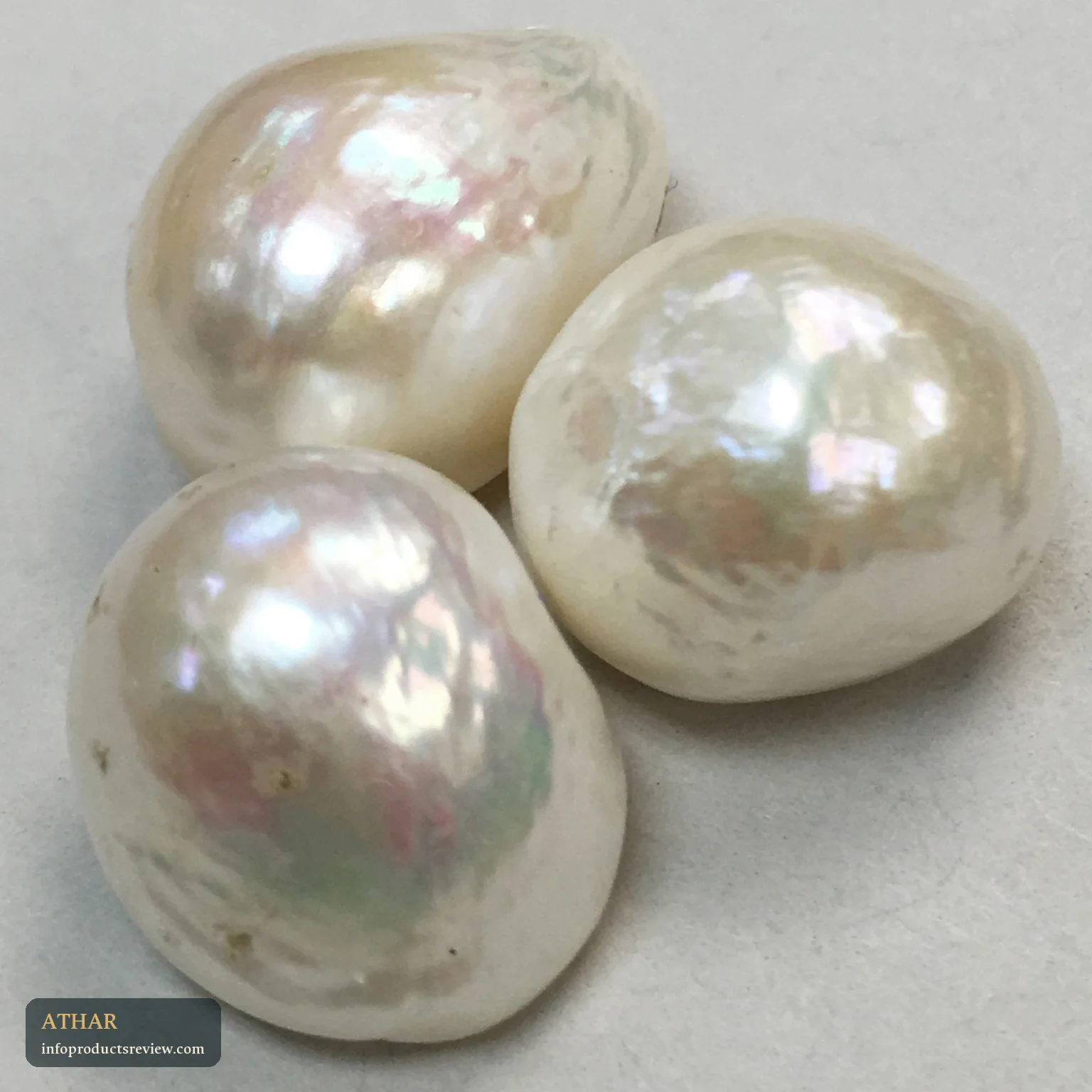
Loose pearls, meaning pearls not strung together, carry two readings in the books: a child, and good words. Both appear side by side, so it isn’t fair to keep one and drop the other.
Three things keep this reading in proportion.
First, it rests on a Qur’anic simile. The reading is drawn from the verse “And there will circulate among them young servants of their own, as though they were hidden pearls” (al-Tur 52:24; our translation). A hidden pearl is one kept covered and safe in its shell.
The verse describes the young servants who wait on the people of Paradise and likens them to pearls in their clarity. That comparison is where the link between pearls and young boys comes from. But it is a description in its own setting, not a rule for reading every pearl dream, and it says nothing about a child yet to be born.
Second, it is not news of a pregnancy. No woman hoping for a baby should be told that scattered pearls are a sign for her. On ATHAR we give no news of a pregnancy and none about a baby’s sex.
Third, the second meaning sits in the very same passage. Good speech is given alongside the child, explained by the way people praise fine words: “like scattered pearls.” The two possibilities arrived together.
So if you saw scattered pearls, ask yourself: is a child on your mind, their upbringing, schooling or health? Or is it something you said, or something said to you? Your situation may tip the balance, but it doesn’t turn either reading into a prediction.
What does a single pearl in your hand mean?
A single pearl may be a bondwoman or a woman, as the old books of interpretation have it. It belongs to the same family of readings as the one given for a ring, where someone asked what a ring means in sleep and was answered: a woman.
The word “may” is doing real work there. This is a symbolic reading in an old book, not a description of any particular woman, and not news of a marriage on the way.
So nobody should base a proposal, or a judgement about anyone, on a single pearl in a dream. A dream names no one and describes no one’s character.
It is more useful to look at what you did with the pearl. Were you keeping it safe, admiring it, or handing it to someone? And how did it feel? Those details say more about you than any general sentence can.
When do plentiful pearls come to mean wealth?
Here the meaning shifts a little. Once pearls are so plentiful that they are measured out and carried in loads, the meaning moves from speech to much wealth, and whoever obtains any of it obtains wealth.
Notice how precise that is: not every pearl is money, only pearls on the scale of measuring and carrying. The gap between one stone and a load is a wide one.
That gives you a practical rule for every gem on this page: quantity changes the reading. One pearl isn’t a necklace, and a necklace isn’t a load being weighed.
Even so, reading abundance as wealth does not mean money is on its way to you. It describes what a heap of gems stands for; it doesn’t forecast a windfall. Don’t make a business or borrowing decision on the strength of a dream.
The stringing itself is a meaning
The difference between “strung” and “scattered” isn’t cosmetic: it is the hinge of both readings. Strung means ordered speech; scattered means dispersed.
That gives you a practical question when a gem appears in your dream: was it arranged in order, or loose and scattered? The answer moves you between two readings the books give side by side.
It may also explain why the necklace is read as “judgement” in the old report: a necklace is gems in order, and a judgement is ordered speech that settles matters between people.
How were these readings built?
One of the most useful things about this chapter is that a meaning usually arrives with its reason attached, rather than on its own. That is uncommon in dream books, and it serves you better than memorising meanings:
- Scattered pearls and children: the reason given is the verse of Surat al-Tur (52:24), which likens young servants to hidden pearls. The verse is the source of the image, not a rule for every pearl dream.
- Scattered pearls and good speech: the reason given is how people praise admired words: “like scattered pearls.”
- Rubies and women: the reason given is that rubies are “associated with women”.
- Beads and low worth: no reason is given, and it most likely comes from how cheap beads are.
So the method rests on comparison, language and everyday usage, not on knowledge of the unseen. Once you see that, no reading needs to frighten you, and none is worth waiting on.
Eating pearls and throwing them: what does each mean?
Among the finest things in this passage are two opposite pictures: whoever sees himself eating pearls is keeping knowledge to himself, and whoever sees himself throwing them is teaching it.
The logic is clear once you remember that pearls here stand for speech and knowledge. Eating takes something inside and hides it; throwing sends it out and spreads it. So the first becomes concealment, and the second becomes teaching.
This suits scholars and teachers especially, and anyone who asks themselves whether they are holding back what they know or putting it to use for others. It describes a state of mind; it doesn’t reveal the future.
Notice that throwing isn’t waste in this reading, even though throwing away something precious would be wasteful when you’re awake. An act is read by what it means, not by how it looks. Someone who shares their knowledge hasn’t lost it.
If you dreamed you were eating pearls, there’s no need to be alarmed. Just ask yourself calmly: is there knowledge, advice or useful news I am keeping from the people who need it?
And if you were throwing pearls to people, the picture sits close to teaching, advising or saying something helpful. It is one of the kindest images in this whole dream.
Why do the gems run from the most precious to the least?
Look at the order of the old chapter and you’ll see it runs from the most precious downwards: pearls first, in detail, then rubies, then emeralds, then beads. Each has a reading to match its place.
That order hints at the method itself: a symbol is read by its worth and its role in people’s lives. What is precious and rare is read by what is precious: the word of God, knowledge, purity. What is common and cheap is read accordingly.
Knowing this protects you from a common mix-up: treating every shiny stone in a dream as “great good fortune”, with no difference between a pearl and a glass bead.
What do rubies mean in a dream?
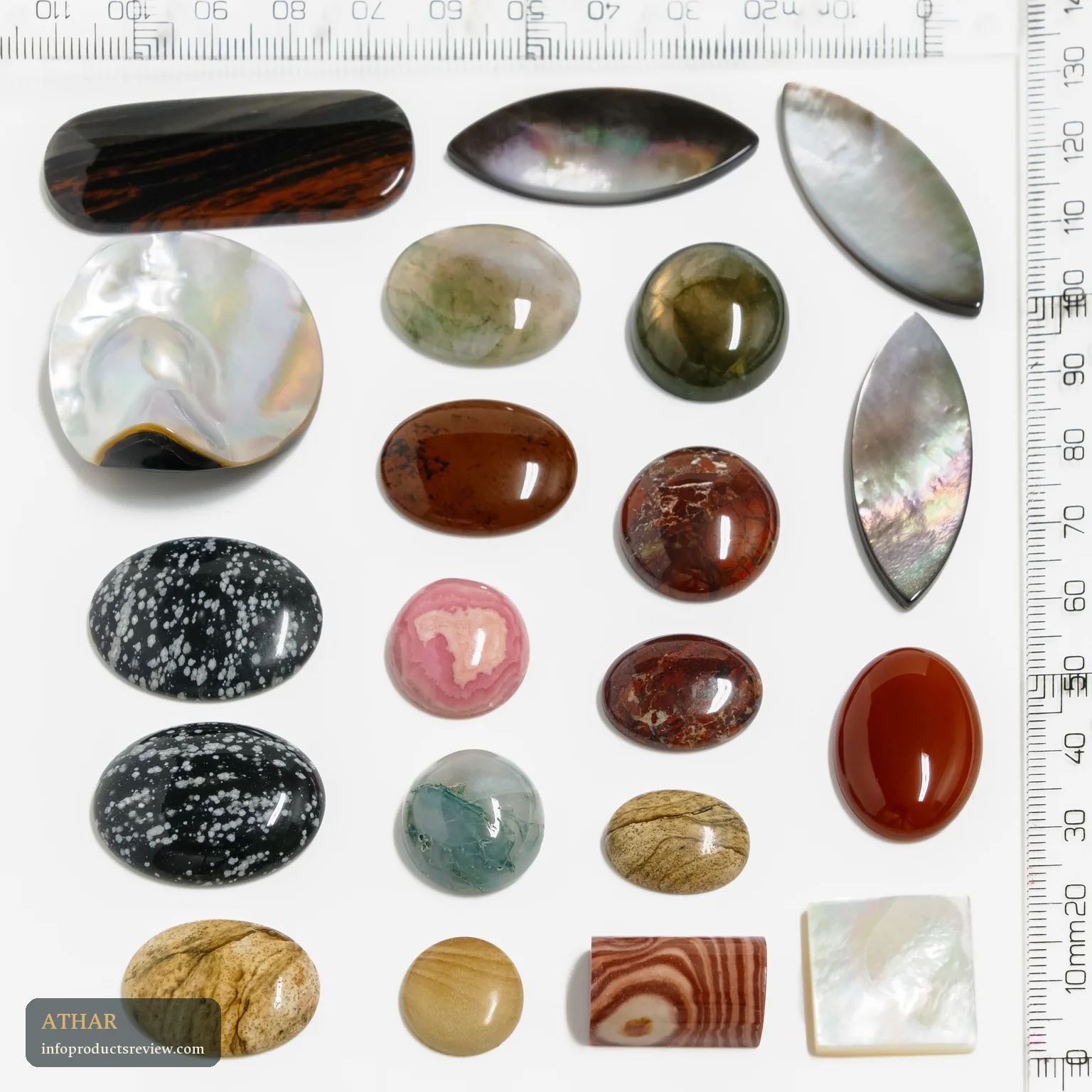
Whoever is given a ruby obtains a beautiful woman, as the books of interpretation have it, and the reason given is that rubies are associated with women. Once rubies are plentiful enough to be measured, the meaning moves to wealth, just as with pearls.
Three things in that sentence deserve attention. The reading is about being given the stone, not about merely seeing it. It comes with a stated reason. And abundance turns it into wealth.
It is not a promise of marriage, and it doesn’t describe any particular woman. It is a reading passed on as it was given, and nothing should be waited on because of it.
If the dreamer is a woman, the books give her no separate meaning for rubies. Her dream shouldn’t be read as news about anyone else, or as a description of someone she knows.
What does an emerald mean?
The emerald, in the books of interpretation, is “the refined among brothers and children, lawful wholesome money, and pure speech of righteousness”.
It is one of the kindest readings in the chapter: good company, honest money, sincere words. All three share a single idea, clarity and purity, which suits the stone itself with its clear colour.
Still, it is a reading and not a report. If you dreamed of an emerald, take heart from it, without waiting for a particular sum of money or a particular friend.
And what do beads mean?
Beads, in the books of interpretation, are “servants; and if they are wealth, it is lowly wealth” — meaning of little value.
Beads are cheap pieces of glass or stone strung into necklaces. So it fits that they are read as servants, and that any money they stand for is small.
This shows the method clearly: a gem’s worth in the world carries over into its reading. The more precious is read by the more precious, the humbler by the humbler. That idea helps with details the books never mention.
Dreaming of beads doesn’t mean you are of little worth, or that whoever gave them to you looks down on you. The reading describes the value of the symbol, not the value of people.
What does a necklace mean in a dream?
In the old report the necklace is “judgement”. Nearby comes another line: whoever sees a necklace of gold, silver, gems or beads on himself takes charge of an office and is entrusted with a trust.
Taking charge of an office, meaning being given an affair to run and answer for, looks today like being handed a job, a team or a file. So the meaning turns on what is placed on a person and committed to them.
A necklace here isn’t only an ornament; it is a picture of responsibility. That is also why the necklace is read as “judgement”: a judgement is ordered speech that settles matters between people.
If you dreamed you were wearing a necklace and felt at ease, the closest reading is a responsibility you are carrying well. If it felt heavy or tight, the dream may echo a burden you feel by day.
A necklace doesn’t mean a promotion is coming, and one falling off doesn’t mean losing a job. Describing what is in your hands and forecasting what will happen are two very different things.
If your question is about a gold necklace in particular, the gold pages on ATHAR cover it in detail for different dreamers.
And what about earrings?
Earrings seen on oneself are “adornment and beauty among people”. An earring hangs from the ear, and it is one of the most visible things a person wears.
So the reading turns on how you come across to others, not on money or news. It suits anyone preoccupied with how they are seen: at work, in company, or at an occasion.
The earring is also one of the few pieces of jewellery said to suit a man in a dream, while all jewellery suits women. The reading is the same for men and women; the difference lies in the wearing, not the symbol.
What does a crown of gems mean?
In the old report the crown is “kingship”. The books add that whoever sees a crown of gold or gems on himself attains great and remarkable authority — meaning standing, and a large affair to carry.
They also say that a woman who sees this marries a handsome man who is prominent in worldly life rather than in faith. We pass that on as it stands and don’t turn it into a promise of marriage.
It contains something popular pages leave out: it describes the man as prominent “in worldly life rather than in faith”, so it is hardly pure praise. Take half the sentence and you have changed its meaning.
A crown is at root an image of standing. Your dream may be about recognition you are hoping for, a position you are working towards, or a responsibility you feel equal to.
We look at the crown for women in more detail on Dreaming of Gold as a Single Woman.
What does a collar around the neck mean?
A collar is a solid ring that encircles the neck, unlike a strung necklace. The old books separate an ornament placed on someone from a collar clamped around them.
Their reading of it is harsh: “A torque — of whatever kind — is corruption in religion and treachery.” We pass it on as it stands, and we add nothing to it.
But here is the point that matters most in the whole passage: this is a reading of the symbol, not a verdict on the dreamer. It describes what a collar meant to the author, not the state of the person who dreamed it.
So if you saw a collar on a relative, a spouse or a friend, don’t accuse them because of a dream. A dream neither clears anyone nor condemns them, and it is no testimony against a person.
If the collar was around your own neck and it felt tight, the dream may be about something restricting you by day: a heavy commitment, a draining relationship, or fear.
It is more useful to look at that restriction itself than to put yourself on trial over a general line in an old book.
Does it matter whether you wore the gem or carried it?
Yes, and it is a fine distinction in the picture. The line about the necklace runs “whoever sees a necklace on himself”; the line about the ruby runs “whoever is given a ruby”; and the line about abundance runs “measured and carried in loads”.
Wearing draws the meaning towards office and trust; being given draws it towards a share or portion; carrying and measuring draw it towards wealth. Three ways into one image.
So ask yourself: was the gem on you, given to you, or in your hands to carry? The answer moves you between the three readings, and all three are in the books.
Where the gem sat on the body
The old lines name particular places: a necklace at the neck, earrings at the ears, a crown on the head, a ring on the hand. The necklace is office and trust; earrings are adornment among people; the crown is standing.
That suggests a way of reading a gem somewhere the books never mention: ask what that part of the body does, and what is usually carried there.
The neck bears what is entrusted to you, the ear is the most visible place for adornment, the head is the seat of standing, and the hand is where you take hold and act. That is reasoning you can follow yourself.
We draw a clear line here: this is a way of reading, not a new meaning we are attributing to the books. We always keep what they said apart from what we infer.
You saw the gem in someone else’s hands
You might see the gem not with you but with someone else: a woman wearing a necklace, a man showing off a stone, a child playing with beads. The books give this picture no specific meaning.
Useful questions: were you just watching, or hoping to be given it? Did you feel admiration, or comparison? Where you stand in the scene describes your relationship with something on your mind.
Comparing yourself with others is an ordinary human feeling and it isn’t envy. And what you saw is no news about that person or their situation, and shouldn’t be passed on as if it revealed something.
Gems in a jeweller’s or a trader’s dream
People who work with jewellery or stones see these images often. The principle that the dreamer’s situation matters means their dreams shouldn’t be read like anyone else’s.
For them, these dreams most likely belong to the mind talking to itself: what occupies a person by day comes back at night. What deserves attention is anything out of the ordinary: a strange form, a strong feeling, a scene unlike their work.
A jeweller who dreams of weighing pearls in the shop is seeing his day, not a symbol. But if he dreams of eating a pearl, or throwing pearls to a crowd, that is outside his work and may be worth a thought.
It is a clear example of one image read two ways depending on who saw it. The dreamer’s situation is part of the dream, not something outside it.
A gem you bring up from the sea or the earth
Pearls come from the sea and stones from the ground, and you may dream you are diving, digging, or finding a stone in the dirt.
The books give these pictures no specific meaning. The closest approach is to look at the act: diving and digging involve seeking and effort, while finding something without effort is a different picture.
Bringing something up isn’t a sign of coming wealth, and it isn’t news that what you are working for will happen. It describes the effort itself.
A student who dreams of diving for a pearl during exam season is seeing their effort, not their result. There is something reassuring in that: in the picture you are working, not waiting.
What does a pearl in its shell mean?
You may see a pearl still in its shell, or open an oyster and find something inside. The books give the shell no specific meaning.
But the idea of “hidden” is there in the verse of Surat al-Tur (52:24) you have already seen. The word means covered and kept safe. A gem in its shell is a picture of something precious and protected that hasn’t come to light yet.
Read it by what resembles it in your waking life: news not yet shared, a talent not yet used, something you are preparing whose time hasn’t come. Don’t treat it as a sign that something is about to be revealed.
A gem given to you
Being given a gem appears in the books in the case of the ruby in particular. Other gifts of gems carry no specific meaning there.
So start with the questions that help with any gift: who gave it to you, how did it feel, and did you accept it gladly or hesitate? A present from a parent isn’t one from a stranger, and accepting with pleasure isn’t accepting with embarrassment.
A gift in a dream is never news about the giver’s intentions towards you. If the giver is someone who has been on your mind, the dream is most likely an echo of that, not a message from them.
Children playing with beads
A familiar picture: a child playing with coloured beads, or holding a necklace. The books give this no specific meaning.
The context is usually simple: a toy you saw, a child at home, or thoughts about raising children. The scene is no news about that child or their future.
You have already seen that scattered pearls are read as a child. But that is a symbolic reading of the symbol itself, and it shouldn’t be turned into news about particular children.
Buying or selling gems
The books give buying and selling no specific meaning. The context is usually clear: an occasion coming up, thinking about buying a piece, or talk about prices.
If the dream involved haggling, or doubt about whether a stone was real, read it by what resembles it while you are awake: a choice you are weighing, or a worry that something is worth less than it looks.
If you dreamed of selling a gem you love because you needed the money, ask whether money is on your mind at the moment. And don’t change a real decision to buy or sell because of a dream.
Imitation gems, or glass that looks like a jewel
The books give imitation gems no specific meaning. But they do separate the precious gem from the cheap bead and give each its own reading, so telling the valuable from the cheap runs through the whole passage.
If you discovered in the dream that what you held was glass, the closest reading is disappointment, or finding that something was worth less than you thought.
A useful question: has a promise, an opportunity or a friendship let you down lately? Nobody should be accused because of this dream, and it is no news about anyone’s intentions.
A gem broken or lost: is it a warning?
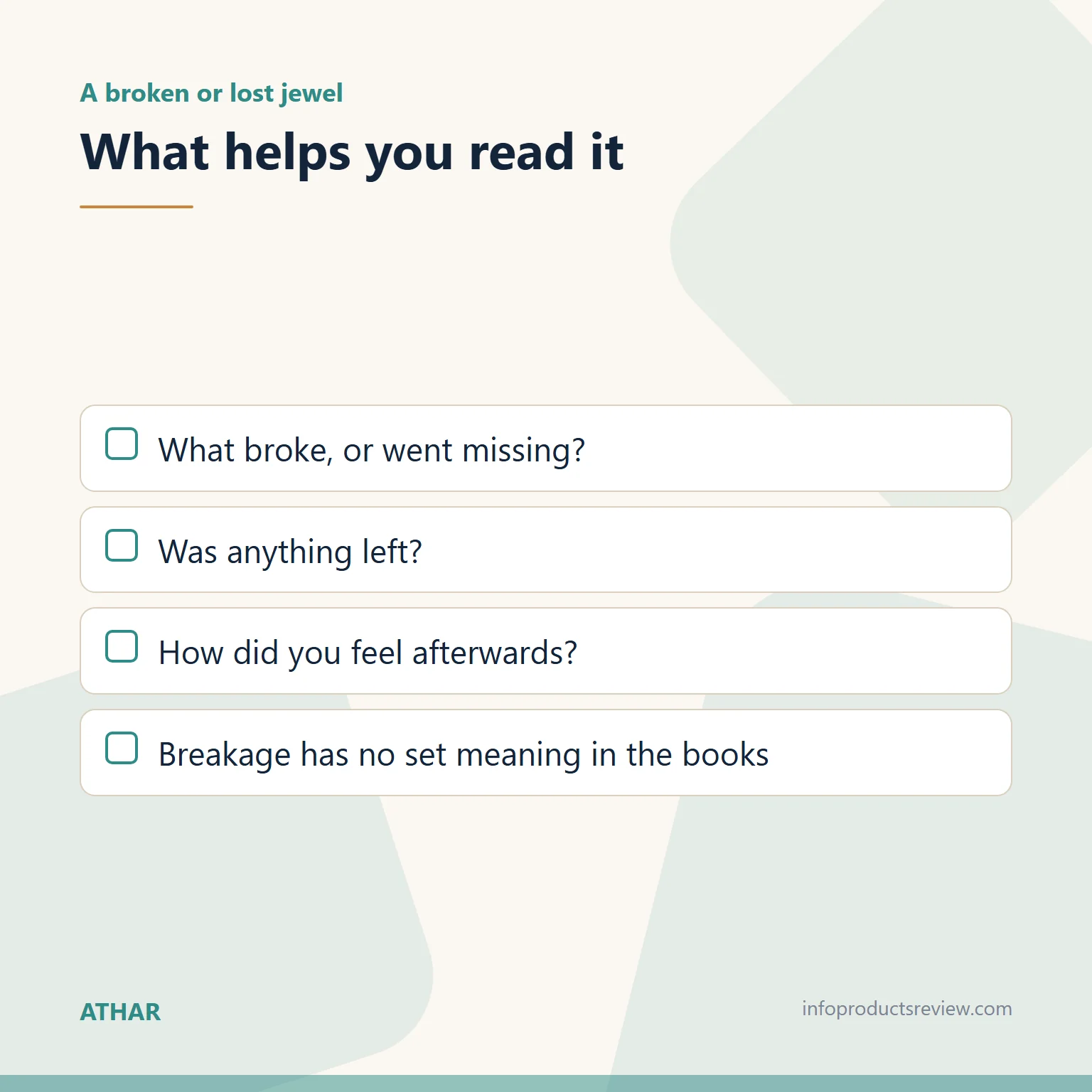
The books give a gem breaking or getting lost no specific meaning. Even so, it is one of the dreams most often written about online in frightening terms.
The calmer approach is to ask: what exactly broke? Did anything remain? How did it feel? The end of the scene is part of the scene.
There is a related picture in the section on rings that teaches you the way of looking. The band is the circle you wear on your finger, and the stone is the raised face set into the top of it.
If the band breaks and falls away while the stone remains, the meaning is that the affair its owner was in charge of has gone, while his good name and standing among people remain.
So that is a way of reading, looking at what went and what stayed. It was said of the ring and not of gems, so we don’t carry its verdict across; we take only the question: what has stayed with you?
A break isn’t news of a quarrel, and a loss isn’t news of a bereavement. If the gem in your dream belonged to someone in your life, don’t build any suspicion of them on it.
And if the gem was a present from someone and you lost it in the dream, your worry may be about the relationship rather than the stone. It is more useful to think about the relationship than to hunt for a frightening meaning.
Gathering scattered pearls: how to read it
A common picture: a necklace snaps, the pearls scatter, and you find yourself gathering them up. The books give gathering no specific meaning.
But look at the two forms: strung is ordered speech, scattered is dispersed. Gathering is a return from scattered to strung, which sits close to putting right something that fell apart, whether a conversation or a relationship.
The practical questions: did you manage to gather them, or were some lost? And how did it feel while you were doing it? That is a truer guide than a ready-made meaning.
Hiding a gem away and keeping it safe
You might dream of hiding a gem somewhere safe, or worrying about it and locking it in a box. The books give this no specific meaning.
The nearest sense comes from the chapter itself: a gem is precious, and precious things are protected. In the verse the pearl reading is built on, the pearls are called “hidden”, meaning covered and kept safe.
The picture describes your care for something you treat as valuable: knowledge, a secret, or a relationship. It says more about how you look after things than about anything coming towards you.
Do the colours of stones carry a meaning?
People often ask about colour: red, green, blue. What the books give is the ruby and the emerald by name, both known for their colours, without giving colour a reading of its own.
So we don’t build a colour chart and pin it on the books. If a colour stood out in your dream, read it by what it stirs in you. Note that the emerald was read in terms of clarity, which sits close to its clear colour.
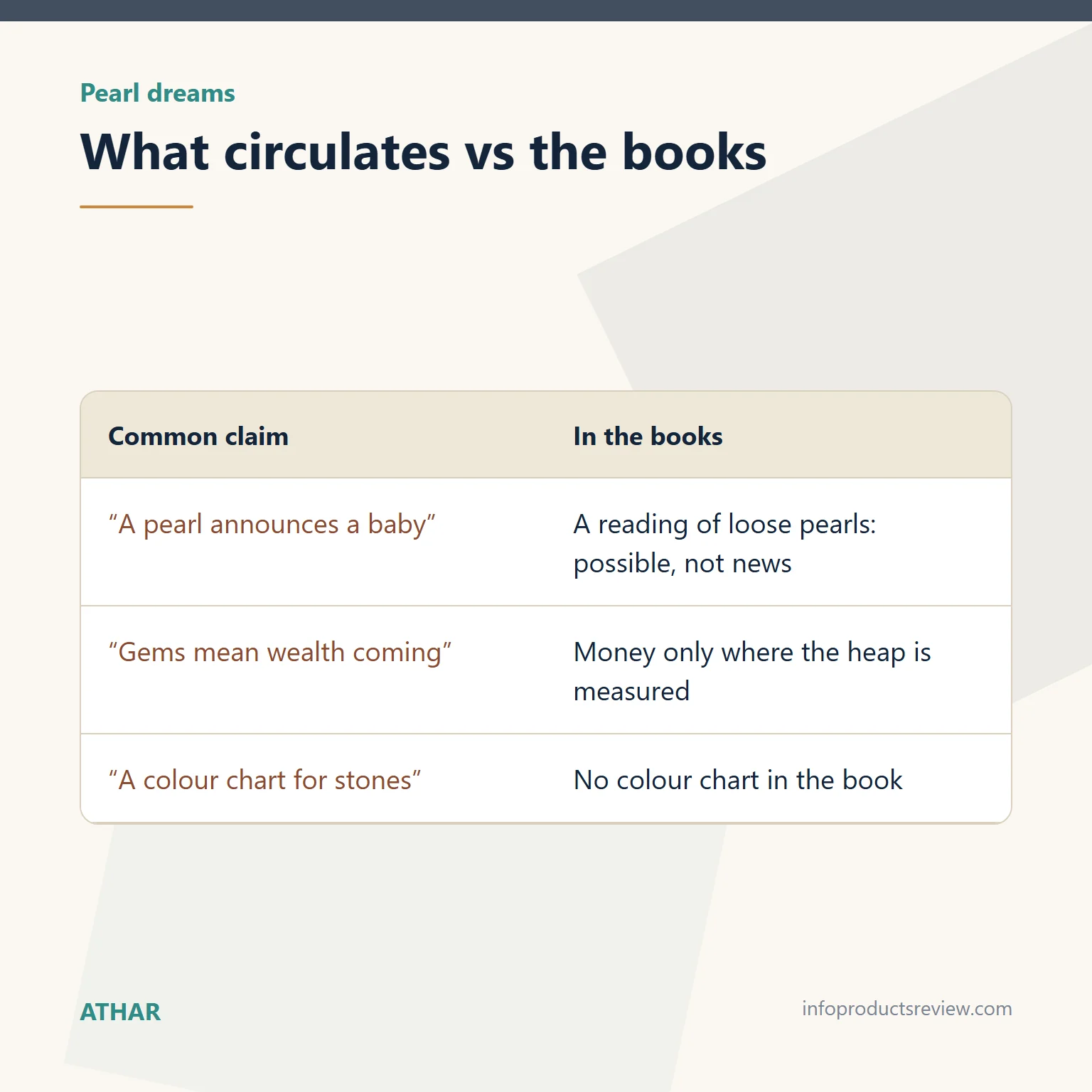
If a website tells you blue stones mean one thing and red stones another, ask where that comes from. The colour charts that circulate online have no basis in these books.
Value and price in the dream
A price may come up in the dream: someone tells you the gem is expensive or cheap, or you find yourself haggling. The books give price no specific meaning.
But value does count in them, as the beads show. A scene where the gem is called cheap differs from one where it is called priceless.
Read that by what resembles it while you are awake: are you weighing up the worth of something at the moment? Your work, a relationship, or effort you are putting in?
Why are gems tied to knowledge and speech?
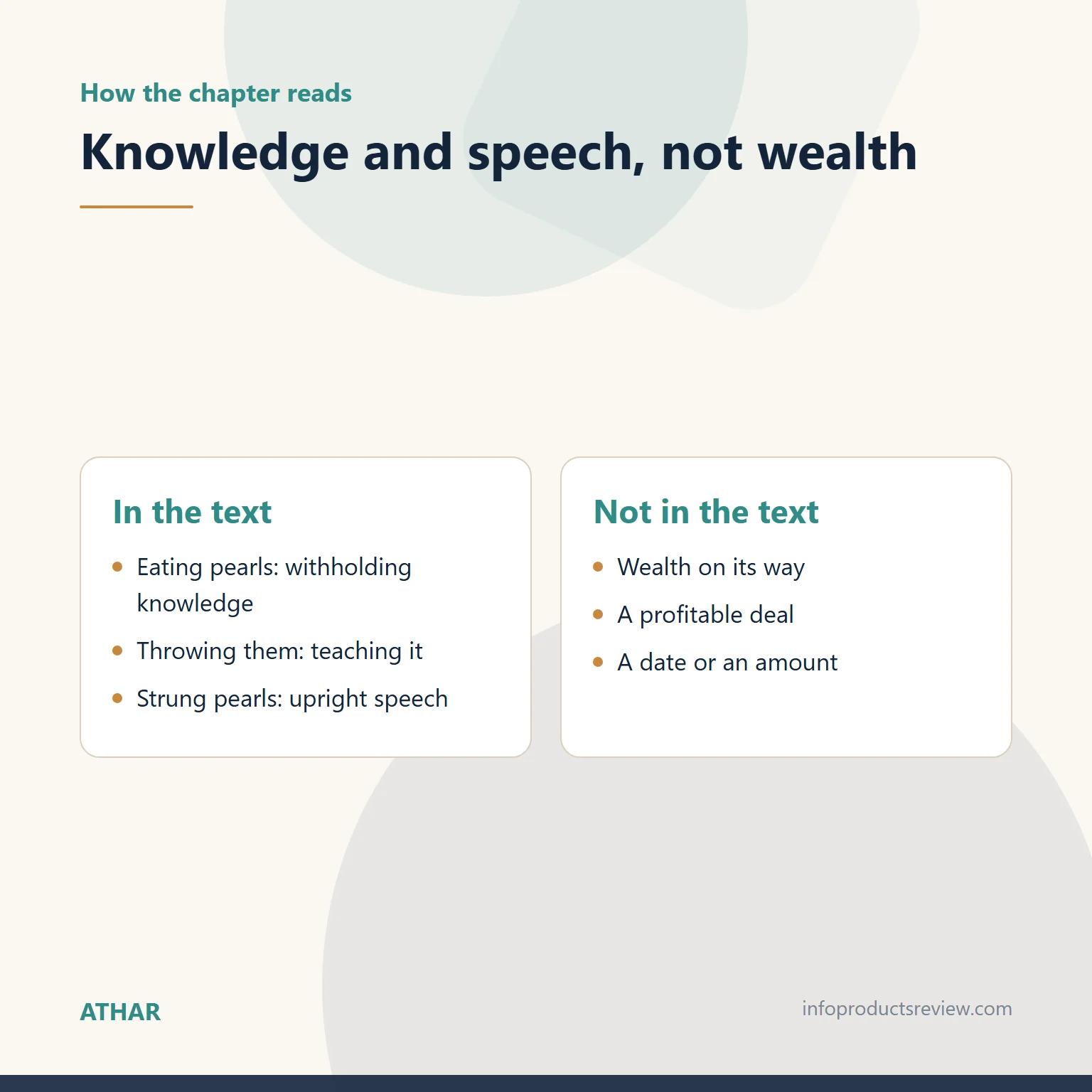
You will have noticed that most readings of gems turn on speech and knowledge: strung pearls are righteous speech, scattered ones good words, eating them is concealing knowledge, throwing them is teaching, and the emerald is pure speech.
That makes these readings closest to students, teachers and people who work with words. If you write, teach or memorise, they sit nearer to your situation than any reading about wealth.
It doesn’t mean everyone who dreams of a pearl is a scholar. It means this is the direction the interpreters took with this symbol.
The reason is fairly plain: fine speech is rare and precious like a gem, it is strung together as a necklace is, and it is kept in the heart as a pearl is kept in its shell.
Once the interpreters saw that likeness, they built their reading on it. You can see the reasoning and judge it for yourself, which is more than you can say for a meaning handed to you with no reason attached.
When is a gem wealth?
The answer is precise: when there is enough of it to be measured and carried. Pearls measured out are “much wealth”; rubies become wealth once they are plentiful enough to be measured; and beads, if they are wealth, are “lowly wealth”.
So quantity is what moves the symbol from one meaning to another. That precision is missing from the common accounts that make every gem mean money.
Even so, reading something as wealth doesn’t mean wealth is coming. The reading describes the symbol; it doesn’t reveal the future.
Gems at weddings and occasions
Many gem dreams come during wedding and party season, simply because jewellery is everywhere then. That is reason enough for them to appear, and they need no far-fetched interpretation.
If the dream was about your own wedding, or a wedding ring, those scenes have their own pages in ATHAR’s guide to dream interpretation.
When you’re told a pearl means a baby
This is one of the most repeated claims about pearls, especially to women. You have seen that it rests on a reading built on a Qur’anic simile, paired with another possibility: good speech.
So anyone who assures a woman she will conceive because she saw scattered pearls has taken one of two possibilities and turned it into a forecast. That isn’t how the interpreters worked.
And it should never be said to a woman who is hoping for a child or having treatment. A sentence like that weighs heavily on the person who hears it, and the dream cannot carry what is being loaded onto it.
On ATHAR we neither announce a pregnancy nor rule one out, and we give no news about a baby’s sex, whatever the symbol. Pregnancy is a question for a doctor, not a dream.
A worked example: reading your own dream
Say you dreamed that a necklace snapped, its pearls scattered, and you gathered some while others were lost. How would you read it with what is on this page?
- Form: it started strung and ended up scattered. Each form has its reading: ordered speech, then dispersed.
- Action: you gathered some. Gathering is a return to order.
- Amount: it wasn’t a load to be measured, so it doesn’t move towards wealth.
- Feeling: were you calm or flustered?
- Your situation: is something in your life scattered, and are you trying to put it back together?
You arrive at a reading that fits you: something that was in order came apart, and you are putting it back together. It is built on what the books say and on your situation, not on a stock sentence, and it stays a guess rather than a certainty.
If the dream keeps coming back
A recurring gem dream isn’t any truer, and it doesn’t bring anything closer. It usually repeats because one thing keeps occupying you: an occasion ahead, study or words you are wrestling with, or worry about something precious.
It may also repeat because you have spent a long time searching for its meaning and kept the image alive. The way out is to deal with what is on your mind while awake, and to search less.
If the dream or a reading worried you
Gem dreams are rarely upsetting. But a harsh reading you have heard, like the one for the collar, can worry you, and so can an expectation built on the pearl reading.
The rule of thumb is simple: a harsh reading is never aimed at a person, and a pleasant one is never turned into a promise. Everything in between is read through your situation and your feelings.
If an interpretation you heard upset you, follow the practice for an unwelcome dream — a dream the sleeper dislikes and wakes from uneasy — recorded in Sahih al-Bukhari (hadith 7044) and Sahih Muslim (hadith 2262). Both texts appear in the section on what to do after the dream.
Then let the matter go. Reading on adds worry rather than knowledge, and the thirteenth page knows no more about you than the first.
Telling what’s reported from what’s been added
Gems attract made-up additions, because they are beautiful and lend themselves to good news. Three questions are enough:
- Who said it? Ask for the book and its author. A claim with no source isn’t worth building on.
- Is it about this exact form? Strung isn’t scattered, and one pearl isn’t a measured load.
- Has a possibility become a certainty? There is a wide gap between “may be” and “indicates”.
What if you don’t remember the details?
If all you’re left with is a gem and a feeling, read the feeling and leave it there. Don’t fill in a form you didn’t see: don’t make the scattered strung, or a single pearl a necklace.
Form is the key to the whole reading, and supplying it from memory creates a meaning that wasn’t in the dream. It is safer to jot down what you remember as soon as you wake, even if it’s only a little.
Getting something practical from it
Because the readings of gems turn on speech, knowledge and purity, the most useful things to take away are questions to ask yourself:
- What knowledge or news am I holding back? Eating pearls is concealment.
- What am I passing on and teaching? Throwing them is teaching.
- Is my speech ordered or scattered? Both are meanings in the books.
- What do I treat as precious, and am I looking after it?
- Who are the good people around me, and do I give them their due? The emerald is the refined among friends.
These questions help you whether your dream has an interpretation or belongs to the mind talking to itself. They are also a measure in themselves: take what helps you while you’re awake, and leave whatever claims to know the future.
How the dream felt changes the reading
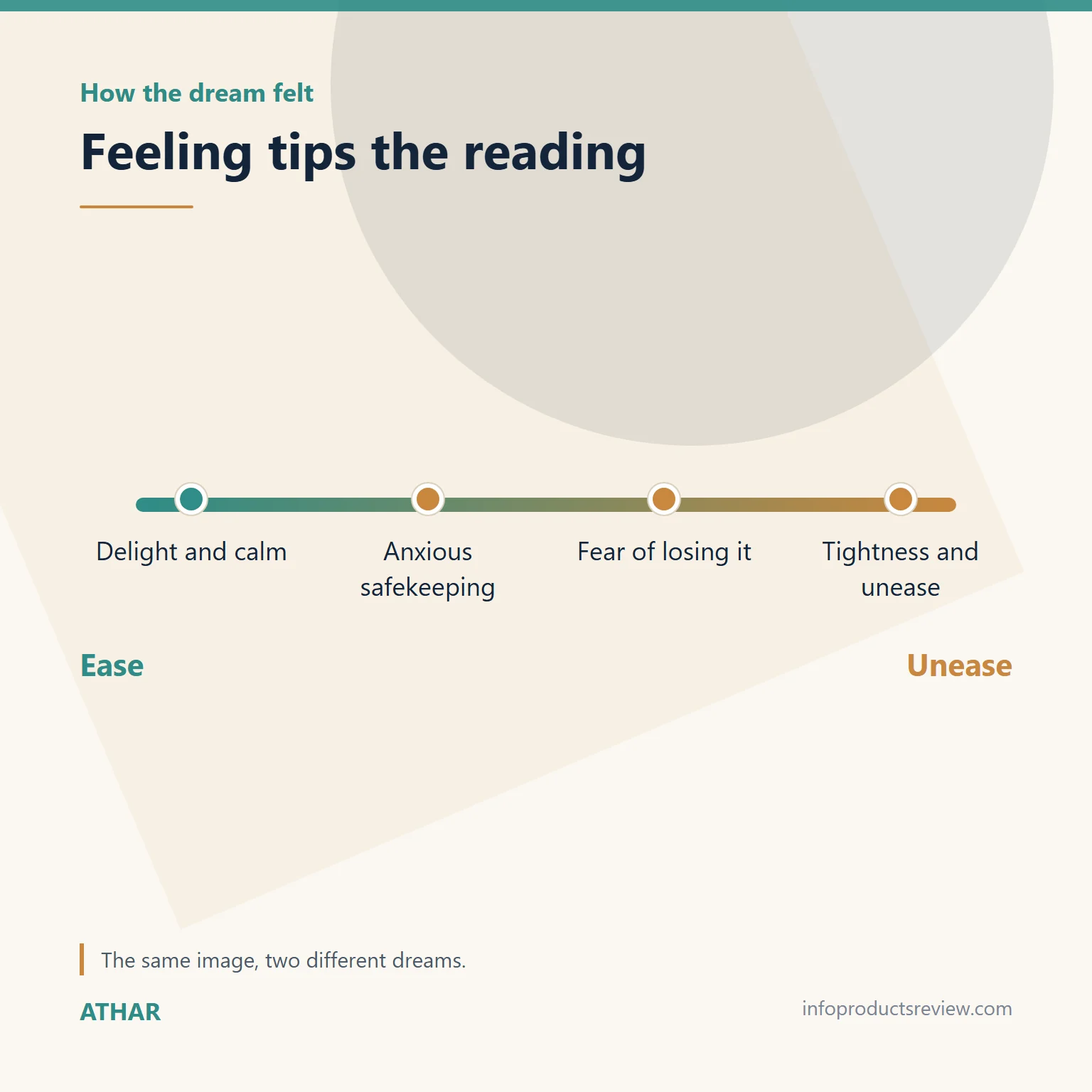
The same gem can appear in two similar dreams, and the two can mean quite different things depending on how you felt:
- Delight and admiration: close to the readings of good speech and clarity.
- Fear for what you held: describes what you’re afraid of losing, not what will be lost.
- Doubt about whether it was real: close to a sense that something is worth less than it looks.
- Weight or clutter: abundance that is measured was read as wealth, and wealth can weigh on its owner.
- Hardly anything: the gem may have been a passing detail in a dream about something else.
What changes a reading from one person to the next?
Three rules stand behind every line on this page, and the first is plain: interpretation differs with people’s conditions and standing, so the dreamer’s own situation is looked at first, and the fitting reading is built on that.
So a gem seen by a jeweller or a trader isn’t the same as one seen by a student, or by someone getting ready for a celebration. Your own situation comes before the general meaning.
The second rule: interpretation is analogy, comparison and conjecture, never certainty. Nobody may swear to it, and its truth is only known if it shows itself while you’re awake.
So everything on this page is a possible meaning to take comfort from. That isn’t a way of belittling interpretation; it is the boundary its own practitioners drew around it.
The third rule separates two kinds of thing. There is a true dream, which can be interpreted, and there is the mind talking to itself: desires and feelings held back by day that wake up in sleep and carry no interpretation.
Gem dreams often belong to that second kind, because they are tied to understandable wishes: jewellery, presents, occasions. If you have been wanting a particular piece or getting ready for an event, your dream is most likely one of those. There is nothing wrong with that at all.
What this dream can’t tell you
We have gathered in one place what a dream can’t tell you, so you don’t load it with more than it can carry:
- It can’t announce a pregnancy or a baby’s sex.
- It can’t promise a marriage or describe a particular person.
- It can’t guarantee money or warn of a loss.
- It can’t judge anyone’s faith, even where the reading is harsh, as with the collar.
- It can’t expose a thief or an envier, or anyone’s intentions.
- It isn’t a basis for a decision about an engagement, a partnership or a purchase.
Everything else is a possible meaning, read calmly and understood alongside your own situation.
What to do after the dream
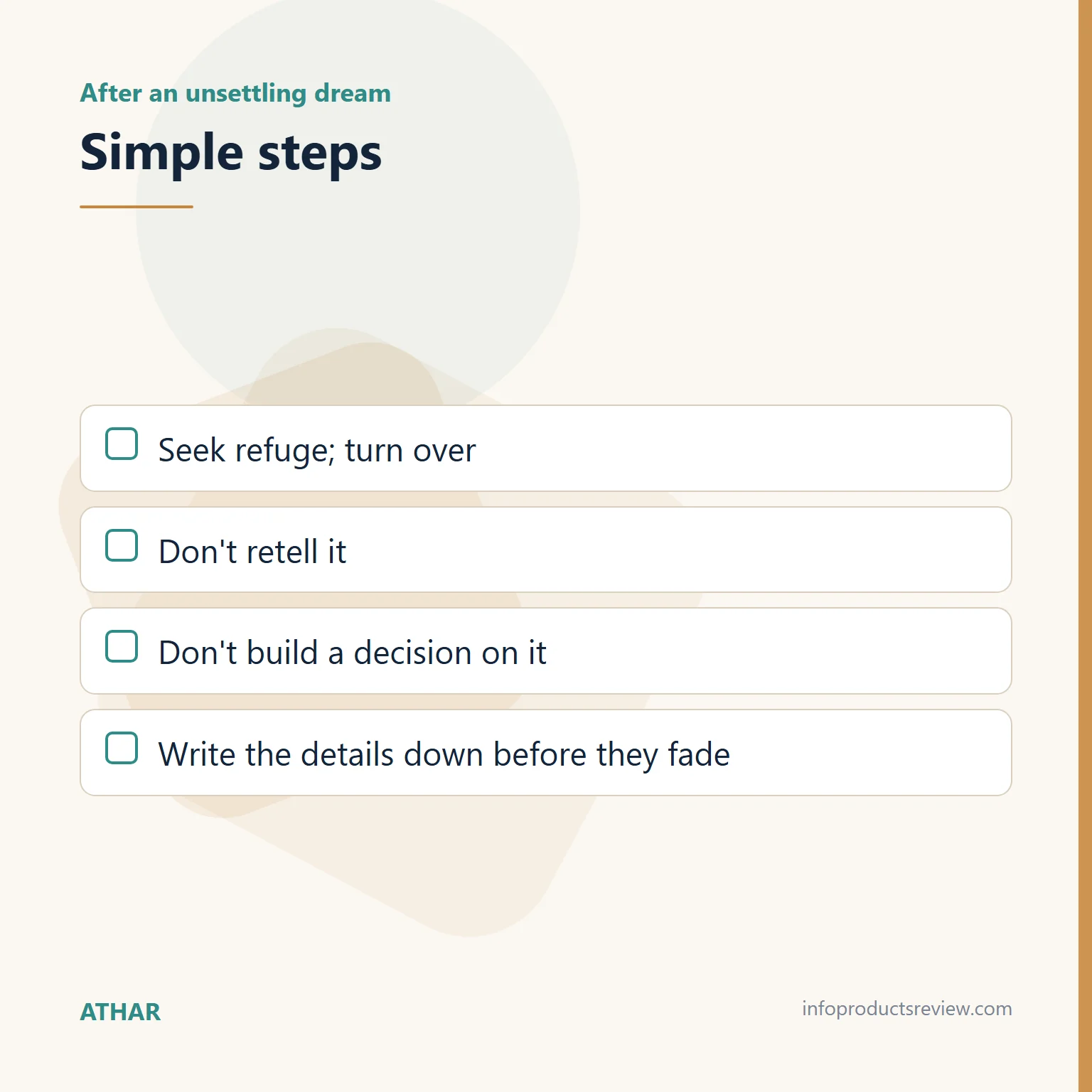
If the dream was lovely, thank God, share it with someone you love if you like, and don’t turn it into a wait. If it was unsettling, Sahih al-Bukhari (hadith 7044) records from Abu Qatada:
A good dream is from God. If one of you sees something he likes, let him tell it only to someone he loves. And if he sees something he dislikes, let him seek refuge in God from its harm and from the harm of Satan, spit lightly three times, and not tell anyone about it, for it will not harm him
And Sahih Muslim (hadith 2262) records from Jabir:
If one of you sees a dream he dislikes, let him spit to his left three times, seek refuge in God from Satan three times, and turn over from the side he was lying on
What the two say together: a good dream you share with people you love. With a bad dream, you seek refuge in God from its harm, spit lightly to your left three times, turn onto your other side, and tell nobody about it.
Bukhari’s wording ends with a clear reassurance: “it will not harm him”. So there is no need to chase an unsettling dream with a search for its meaning.
- Seek refuge in God from the harm of what you saw, spit lightly to your left three times, and turn onto your other side.
- Don’t retell an unsettling dream, and don’t go looking for its worst interpretation.
- Don’t accept any interpretation that promises you a child, a marriage or money.
- Ask about your day before you ask about the symbol.
How to describe your dream so it can be understood
If you want to understand your dream, or ask someone knowledgeable you trust about it, a good description is half the work. After you wake, write down:
- Which gem: pearl, ruby, emerald or beads?
- Its form: strung in a necklace, scattered, a single stone, or a load being carried?
- What you did: wore it, were given it, ate it, threw it, bought it?
- Who was with you?
- How you felt, and what’s on your mind at the moment.
With those details the dream becomes something you can make sense of, and you’re less at the mercy of a ready-made interpretation that knows nothing about you.
What you can take away with confidence
First: the readings of gems in these books are about meanings, not prices. Most of them turn on speech, knowledge and clarity, which spares you both the wait for riches and the fear of loss.
Second: form and amount are the keys: strung or scattered, one stone or a measured load. Ignore them and you blur readings the books kept apart.
Third: the promises of babies and marriages you will hear have no basis in these books. The most honest thing anyone can tell you is that these are possibilities, and your own situation tips the balance.
Examples
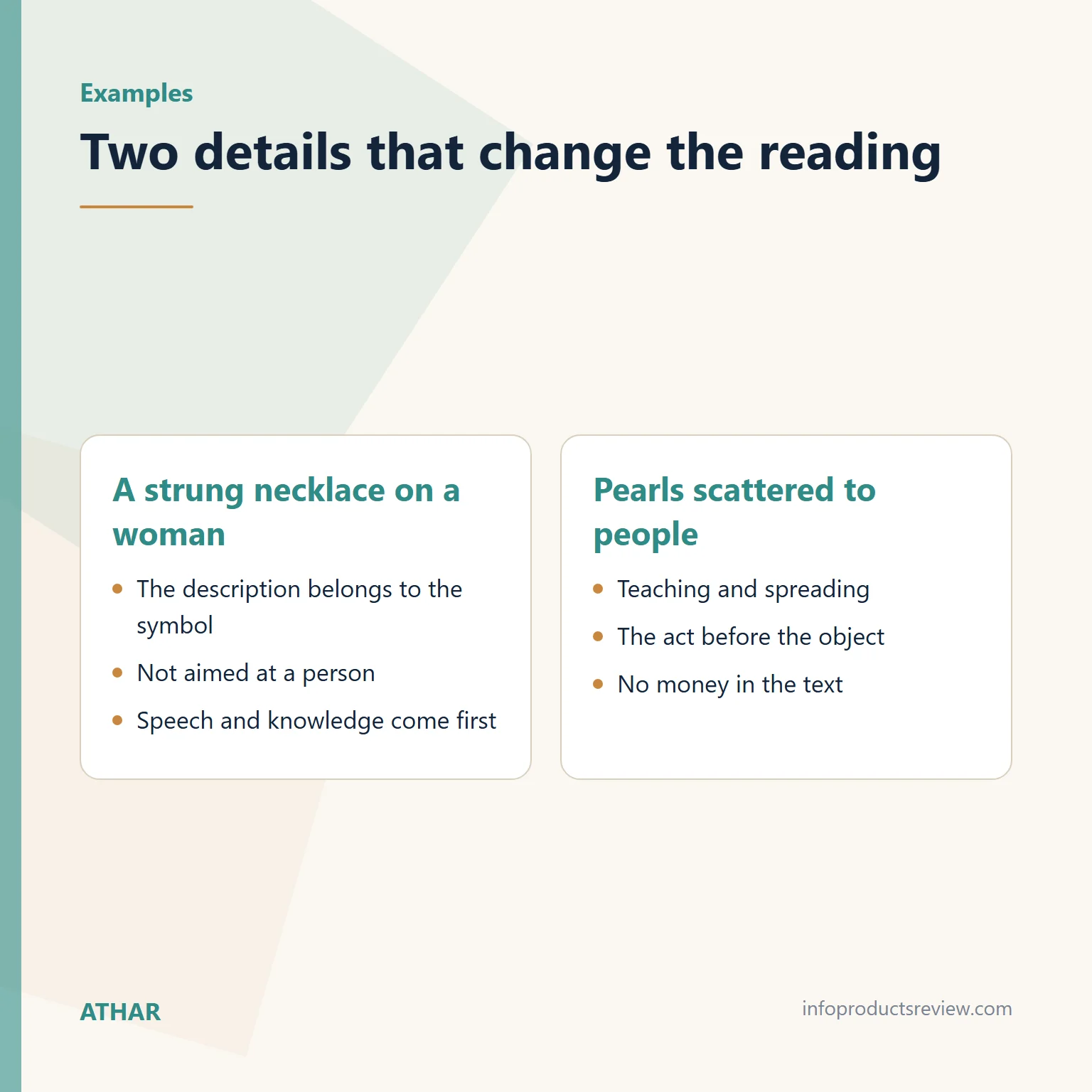
These are composite examples built from common scenarios, not readings of any real person’s dream. They show how the details and the dreamer’s situation change the reading.
A strung pearl necklace
Closest to righteous speech or knowledge, as the books have it and as in the old report. Not riches.
Pearls scattered on the ground
Two possibilities here: a child, and good speech. The first is never to be offered as news of a pregnancy.
Eating pearls
Someone who eats pearls is keeping knowledge to himself. It describes a state, and the question is whether you’re holding back what you know.
Throwing pearls to people
This is the picture of teaching: spreading benefit, not wasting it.
Given a red ruby
Whoever is given a ruby obtains a beautiful woman, because rubies are associated with women. Passed on as it stands, never made into a promise of marriage.
A clear green emerald
The emerald is the refined among brothers and children, lawful wholesome money and pure speech. A picture of clarity, not news of money.
A heap of coloured beads
Beads are servants, and if they are wealth it’s lowly wealth. The symbol’s modest value carries into its reading.
Pearls carried in containers
Pearls measured in quantity are read as much wealth. It’s still a reading of a symbol, not news of riches.
Her necklace snapped and the pearls scattered
Breaking has no specific meaning in the books. Scattering is its own picture, read as a child or good speech, so the break isn’t automatically bad.
A collar around his neck
The collar was read as corruption in religion and betrayal. A harsh reading of the symbol, passed on as it stands, never used to judge anyone, and never read as a prophecy.
A gem dream after watching a programme about stones
Most likely the mind replaying the day; no symbolic reading needed.
Discovering the pearls were glass
Imitation carries no specific meaning in the books, though they do separate the precious from the cheap. The feeling of disappointment is the truest guide to this dream.
Diving to bring up pearls
Bringing gems up carries no specific meaning in the books. The act involves seeking and effort, so it most likely describes an effort under way, not its outcome.
A necklace on a woman he knows
Seeing a gem on someone else carries no specific meaning in the books. It’s no news about her, and it shouldn’t be passed on as if it revealed something.
Given coloured beads at a gathering
Beads are servants, and if they are wealth it’s lowly wealth. The reading describes the symbol’s worth, not the giver’s.
A student who dreamed of scattering pearls among people
Throwing pearls is read as teaching. The picture suits the student’s situation and can be taken as encouragement, without being treated as a certificate.
Quick table: the detail and the closest reading
| Detail | What the books say | How to read it |
|---|---|---|
| Strung pearls | The word of God, or righteous speech | Good words or knowledge |
| Scattered pearls | A boy or boys, and possibly good speech | Two possibilities; no news of a pregnancy |
| A single pearl | Possibly a bondwoman or a woman | A symbolic reading, not a description of anyone |
| Pearls measured and carried | Much wealth | Quantity moves the meaning |
| Eating pearls | Concealing knowledge | Holding back what you know |
| Throwing pearls | Teaching it | Spreading benefit |
| Being given a ruby | A beautiful woman; plentiful rubies become wealth | Passed on as it stands, not a promise |
| Emerald | The refined among family, lawful money, pure speech | Meanings of clarity |
| Beads | Servants; lowly wealth | Low value carried over |
| Breaking, loss or imitation | No specific meaning | Through context and feeling |
Related dreams
- Silver in a Dream: Raw Silver, Mirrors, Fetters and Where the Books Stop
- Dreaming of Gold as a Single Woman
- A Gold Ring in a Man’s Dream (including the stone)
- Money in a Dream
- ATHAR’s guide to dream interpretation
Frequently asked questions
What do pearls mean in a dream?
Strung pearls are read as the word of God or righteous speech, scattered pearls as a child or good words, a single pearl as possibly a woman, and pearls plentiful enough to be measured as much wealth. These are possible meanings, not predictions.
Are pearls good news of a pregnancy?
No. The reading rests on a Qur’anic simile, and the same passage pairs it with the possibility of good speech. We give no news of a pregnancy or a baby’s sex.
What does eating pearls mean?
Eating pearls is concealing knowledge, and throwing them is teaching it. Two opposite pictures that describe a state of mind, not the future.
What do rubies mean?
Whoever is given a ruby obtains a beautiful woman, because rubies are associated with women, until they are plentiful enough to be measured, when they become wealth. Passed on as it stands, it isn’t a promise.
What does an emerald mean?
The emerald is the refined among brothers and children, lawful wholesome money, and pure speech of righteousness.
And beads?
Beads are servants; and if they are wealth, it’s lowly wealth, meaning of little value.
Is every gem in a dream wealth?
No. The meaning only moves to wealth with abundance that is measured and carried.
My necklace broke in a dream. What does it mean?
Breaking has no specific meaning in the books of interpretation. Read it by what was left of the necklace and how you felt, and don’t take it as a warning of a quarrel.
What does a collar mean in a dream?
A collar, of whatever kind, was read as corruption in religion and betrayal. It’s a general reading of the symbol and is never aimed at a particular person.
Do the colours of stones have meanings in the books?
There is no colour chart in the books of interpretation. The ruby and the emerald are named individually, each with its own reading.
I dreamed of gems after seeing them at a market. Does it mean anything?
Most likely it’s the mind replaying your day, and it needs no symbolic reading.
Is this interpretation definitive?
No. These are possible meanings given by the interpreters, along with where they give none. Interpretation is analogy and conjecture throughout, never certainty.
In summary
- The readings of gems in these books sit closer to speech and knowledge than to wealth.
- The form of the gem changes its reading: strung, scattered, single, or measured in quantity.
- Eating pearls is concealing knowledge; throwing them is teaching it.
- Rubies, emeralds and beads each have their own reading, and low worth carries into the meaning.
- No news of a baby, no promise of marriage, no guarantee of money.
- ATHAR’s guide to dream interpretation
If you take one thing away, let it be this: in the dream books, a gem is read by what it resembles in meaning: clarity, speech, and knowledge either kept to yourself or shared.
Written and reviewed by: the ATHAR editorial team. Quoted passages are taken from the editions listed in the sources. Translations from Arabic are our own.
Please note: this page sets out possible meanings, not certainties. It predicts no pregnancy, no marriage and no money.