


Pregnancy is a season when worry runs a little closer to the surface, and every small detail gets more attention than usual. So a dream about a snake tends to stay with a pregnant woman longer than it would otherwise, and it often pulls her into a long search in the middle of the night.
Let’s start with the sentence you most need to hear. Snake dreams during pregnancy carry nothing about your baby’s sex, nothing about its health, nothing about the safety of your pregnancy, and nothing about when you’ll give birth. The classical dream books make no connection between this symbol and any of that.
We’ve put that at the beginning rather than the end, because someone searching at 3am while pregnant shouldn’t have to read three thousand words before she can be reassured.
What can be discussed is the meaning of the snake itself. The oldest and best-attested line comes from Ibn Qutayba, whose classical manual Ta’bir al-Ru’ya opens its chapter on scorpions and snakes by calling the snake an adversary who keeps his enmity hidden. In your case it is read exactly as it would be for any dreamer: from the place, from what the snake did, and from how you felt. We’ll also explain a well-understood reason why dreams become more frequent and more vivid in pregnancy — a reason that’s reassuring once you know it.
The Bottom Line
If you have no time for the whole page, this is the whole page:
- The closest reading: Ibn Qutayba records that the snake is an adversary who conceals his enmity. That is the oldest source here and the strongest. It reads as conflict or friction, or someone whose presence doesn’t sit well with you — no further. Pregnancy in itself doesn’t change the meaning of the symbol.
- The detail that changes it: what the snake did. Stillness and passing by are the lightest images. A bite is read in proportion to how severe it was, and no further. Killing and cutting are read favourably.
- Two common cases: a calm snake that never approached, which is the lightest image and the one we’re asked about most. And a snake walking behind you, which reads as the intention of harm rather than harm that happened.
- The symbol is wider than its reputation: a book attributed to Ibn Sirin records the snake as an enemy, or a realm, or buried treasure, or a woman, or a child — and elsewhere as money, as ease, as gladness and as growth.
- And this is a possibility, not a promise: everything here is a possible meaning offered by an interpreter, not news about your future. A dream does not establish that anyone is your enemy, and it does not establish magic, envy, betrayal or illness.
- Where the sources are silent, we say so: there is no mention of a pregnant dreamer, no baby’s sex, no due date, no risk to a pregnancy, and no treatment of where on the body a bite lands. You won’t find an invented answer to any of that here.
The most useful thing to take from that list is this: the worry carried by the frightening pages is far larger than the worry carried by the sources. The sources speak in “perhaps” and “it may be”, and they tie every reading to its scene.
If you have any physical symptom while awake — pain, bleeding, reduced fetal movement, contractions — the right place for that is your midwife or doctor, not an interpretation page. A dream diagnoses nothing and rules nothing out, and it should never be a reason to delay an appointment or a test.
What this page covers
- The Bottom Line
- What the classical books don’t say about pregnancy
- What does a snake stand for?
- What actually changes for a pregnant dreamer
- Why dreams multiply and sharpen in pregnancy
- Does the reading change with the month?
- Where did the snake appear?
- When the meaning turns toward water
- Colour — and why it indicates nothing medical
- Size and number
- What did the snake do?
- Being chased
- Being bitten
- When the snake appears near your belly
- Killing, confronting, and the calm snake
- If your partner or children appeared
- Reassuring passages that rarely get quoted
- What you can take away, reassured
- When does a dream deserve your attention?
- When the searching itself becomes the problem
- When is a dream just your mind talking to itself?
- How to describe your dream so it can be read
- The classical tradition, and its limits
- How dreams are handled in Islamic practice
- The psychological reading
- Mistakes specific to pregnancy
- Situations and examples
- I saw a snake from a distance and it never came near
- A snake came into the house and then left
- A snake chased me until I woke up frightened
- A snake bit me while I was pregnant
- I killed the snake
- I saw a small snake
- I saw many snakes
- I felt afraid for my baby rather than for myself
- A comparison: similar dreams, different meanings
- Frequently asked questions
- Does a snake dream indicate the baby’s sex?
- Is the dream warning me about a risk to my pregnancy or my baby?
- A snake bit me while I was pregnant. What does it mean?
- Does the snake’s colour change the reading?
- I read that a small snake means a baby. Is that right?
- Why have my dreams become more frequent and vivid since I became pregnant?
- A snake circled me without coming closer. Is that bad?
- I saw a snake in my home while pregnant. Is it about my family?
- The dream repeated over several nights. Does that mean something?
- Do I need to do something after this dream?
- Are a pregnant woman’s dreams truer than anyone else’s?
- Where can I read about the other symbols in the same dream?
- Final summary
- Sources and references
What the classical books don’t say about pregnancy

When we say pregnancy isn’t mentioned in this material, that isn’t a dodge. It is the answer, and it’s the most important thing on this page.
The snake material in these books is arranged by symbol, not by the dreamer’s circumstances. There is no chapter called “snakes for a pregnant woman.” There is no mention of a baby’s sex or any sign of it, of miscarriage, of a due date, or of illness affecting a mother or a child. Nor is there any colour table linking a colour to a medical condition.
Where the word “child” does appear, it appears inside a list of possibilities for what the symbol can turn toward — an authority, a spouse, a child — and never as an announcement about an expected baby. Anyone who lifts that one word out and builds talk about your baby on it has taken it well out of its setting.
So where does the rest of it come from? From later writing attributed to the old authors, or from analogy with other symbols — repeated without a source until it began to look original.
We attribute nothing to Ibn Sirin or al-Nabulsi that isn’t written in front of us. And when we apply a general principle to a pregnant woman’s situation, we say plainly that the application is ours rather than theirs.
That knowledge alone is a considerable relief. Any worry built on connecting this dream to your baby was built on something that isn’t there.
What does a snake stand for?

If pregnancy isn’t mentioned, what’s left? The meaning of the symbol itself — and it’s wider than most people think.
The oldest material available is Ibn Qutayba’s, in the critical edition prepared by Ibrahim Salih. His chapter on scorpions and snakes opens with one short sentence: the snake is an adversary who conceals his enmity. Note the qualifier — concealed. The line is about a hidden dispute, not an approaching danger, and not about anything happening in your body or to your baby. Readers also ask about a viper or an adder by name. The sources relied on here keep no separate entry for a species, so such a dream is read exactly as any other snake is read.
The snake is an adversary who conceals his enmity.
Alongside Ibn Qutayba there is a modern printed compilation, arranged alphabetically by Basil al-Buraydi. It is widely attributed to Ibn Sirin, and that attribution is not established. So we never write that Ibn Sirin held a view; we write that a book attributed to Ibn Sirin records it.
In that compilation the symbol widens considerably. The snake in a dream is recorded as an enemy, or a realm, or buried treasure, or a woman, or a child. And there is a striking qualifier attached: a serpent that is not feared is read as strength and standing. The absence of fear reverses the direction of the reading — and that matters more to you than you might expect, because plenty of readers wake having forgotten that they were not frightened in the scene at all.
In a dream the snake is an enemy, or a realm, or buried treasure, or a woman, or a child; and a serpent a man does not fear is his own strength and standing.
The same compilation also records that the snake may be a ruler, and may be a spouse or a child, supporting that with a verse from Surat al-Taghabun, verse 14, about enmity that can come from spouses and children. We name where the image comes from rather than quoting scripture here, because the point is the origin of the image and not a ruling about anyone’s dream. Notice that “child” there sits in a passage about possible friction with grown children, not in a passage about a pregnancy or an expected baby.
The snake may be a ruler, and may be a wife, and a child.
The compilation’s entry for the large serpent adds more possibilities still: a man of the valley, enmity from the direction of family, spouses and children, and a bad neighbour. Those are options listed in a single line, offered with “perhaps”. Not one of them is a verdict, and not one of them names anybody.
The serpent points, for whoever sees it in a dream, to a man of the valley; and it may point to enmity from family, spouses and children; and it may be a bad and envious neighbour.
So anyone who hands you one fixed meaning for this symbol has picked one item from a long list and presented it as the whole list.
There is also a general principle stated outright: the enmity of each snake is in proportion to its harmfulness, its size and its venom. The reading is a sliding scale, not a fixed judgement. A large, close snake carries a stronger meaning; a small, calm one carries a lighter one.
The enmity of each snake is according to its harmfulness, its size and its venom.
What actually changes for a pregnant dreamer

If there’s no chapter for pregnancy, what remains that’s useful to you? Something better than an imagined chapter: a principle you can apply.
The principle is that a symbol is read inside the circle of the dreamer’s life. And a pregnant woman’s circle is one of waiting — a changing body, a responsibility approaching, decisions deferred until after the birth, and legitimate worry about things outside your control.
So the nearest reasonable reading of a distressing dream in pregnancy connects to that waiting, not to a warning about your baby. We say plainly that this application is ours, built on the principle of reading inside the circle of a life, rather than a line handed down by an interpreter.
One question is worth asking yourself after a dream like this: is anything actually unresolved around me at the moment? A scan coming up, a dispute nobody has settled, an arrangement for after the birth that hasn’t been fixed. If the answer is yes, the dream has revealed nothing new. It has returned something you already knew.
One important caution: many women leave a distressing dream feeling they must do something — a vow, a payment, a change of plan, a postponed appointment. Nothing in this material requires any of that. A dream creates no obligation, and it should never be a reason to delay medical care.
Why dreams multiply and sharpen in pregnancy

This section may be the most useful part of the page, because it explains what’s actually happening rather than what’s assumed.
Many pregnant women sleep in a more broken way, particularly in the later months. The reasons are familiar: needing the bathroom, difficulty finding a comfortable position, heartburn, fetal movement, back pain. The Sleep Foundation sets these changes out stage by stage.
And here’s the link most writing on this misses: remembering a dream is tied to waking from it. Most remembered dreaming happens in a stage that lengthens through the last third of the night, as the National Institute of Neurological Disorders and Stroke explains. Someone who wakes repeatedly remembers more.
The practical consequence matters: your dreams may not have become more disturbing — you may simply be remembering more of them. A dream that once passed unnoticed now gets retold at breakfast, because you woke in the middle of it.
Add to that the fact that anxiety and short sleep are among the factors most consistently associated with distressing dreams, as reviewed by the Sleep Foundation. That’s general description, not diagnosis, and no judgement about any person follows from a single dream.
We keep the two layers clearly apart. The classical reading offers a possible meaning inside a tradition. The sleep references describe when distressing dreams become more frequent and what they track. Neither is evidence for the other.
If disrupted sleep is affecting your days or your appointments, mention it at your next visit. Rest is a normal part of what gets discussed in pregnancy care, as the American College of Obstetricians and Gynecologists notes.
Does the reading change with the month?
A recurring question: is a snake dream in the third month different from one in the ninth?
From the classical side: no. Pregnancy isn’t mentioned at all, let alone divided into stages. Anyone who has split the interpretation up by month has built something that doesn’t exist.
From the sleep side: yes — and this is the more useful answer. Sleep in pregnancy changes by stage:
- First trimester: sleepiness and fatigue dominate, daytime sleep often increases, and the rhythm of the night shifts.
- Second trimester: relatively more settled for many women, and usually the calmest stretch.
- Third trimester: frequent waking, for the familiar reasons.
And because remembering a dream is tied to waking from it, dreams naturally feel more vivid in the later months — not because their meaning changed, but because the number of awakenings did.
So the difference between the months is real, but it’s a difference in noticing the dream rather than in its meaning. That explains why so many women feel their dreams “suddenly got strange” near the end.
Where did the snake appear?
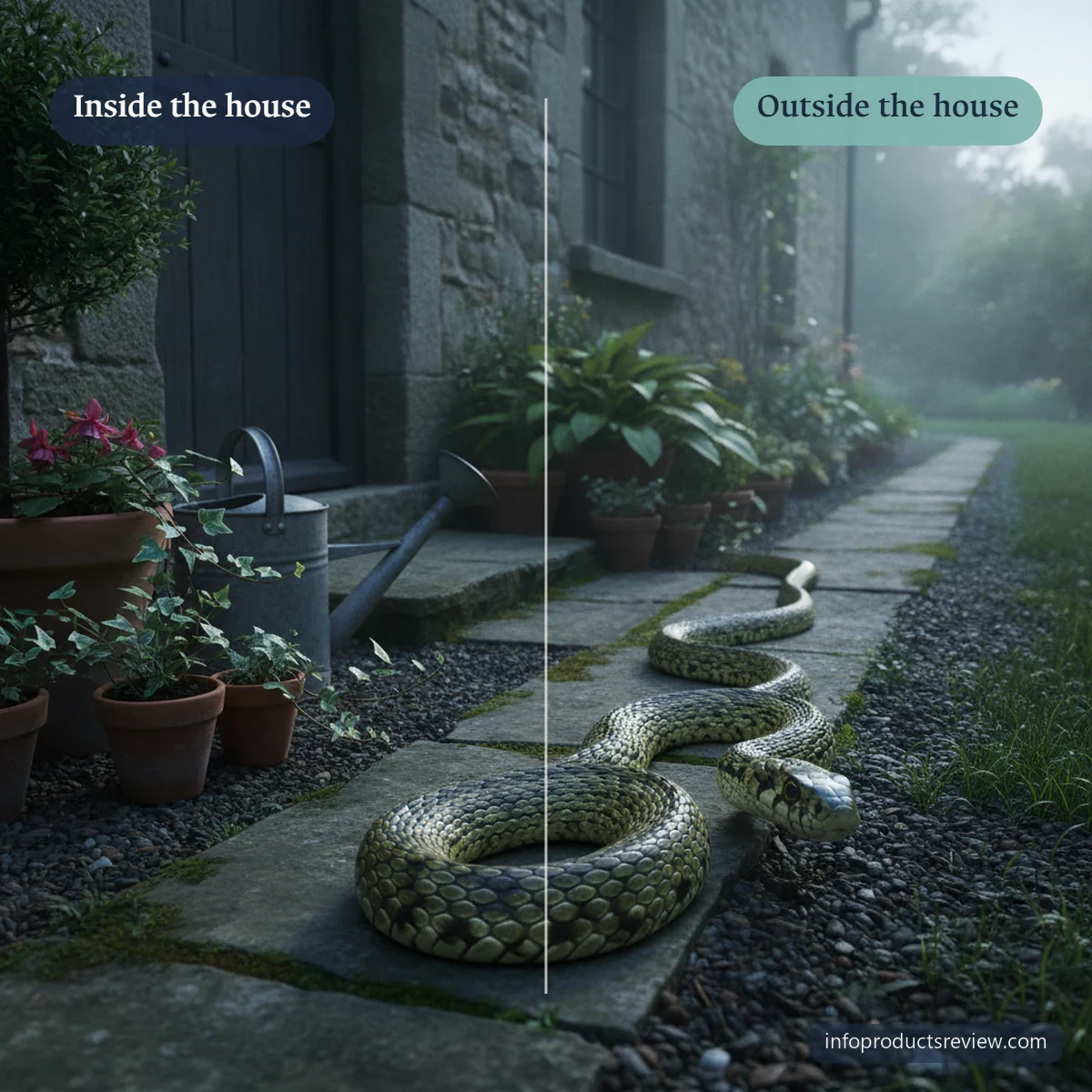
Of everything you can remember, the setting does the most work. It comes ahead of colour, size and number — and it’s the first thing people leave out when they describe a dream.
The plainest statement is Ibn Qutayba’s, and it is one line: whoever sees a snake in his house, there is an adversary in his house. Two qualifiers belong with it immediately. It is a possible meaning rather than news, and it names nobody in the household.
If he sees a snake in his house, then there is an adversary in his house.
The compilation attributed to Ibn Sirin develops the image usefully. It records that snakes entering the house and leaving again without causing harm are adversaries from among the household and relatives, and that if the same thing is seen elsewhere, the adversaries are strangers.
If he sees snakes entering his house and leaving without causing harm, they are adversaries from his household and his relatives; and if he sees them elsewhere, the adversaries are strangers.
That qualifier — without causing harm — is the part that drops out of most retellings. The recorded scene is a passage through, not a break-in. Yet the line gets quoted as a warning about a woman’s own family, and a pregnant reader finishes it suspecting her sister, her mother or her partner.
In the same compilation there is a second entry for the snake with no printed section heading above it. It records that snakes of houses are neighbours, and snakes of open country are highway robbers. The distinction there is nearness and distance, not good and evil.
Snakes of houses are neighbours, and snakes of open country are highway robbers.
Applied to you: a dream set in your home reads in a close circle; one set in a hospital or a street reads in a wider one. And whichever it is, it is a circle and never a named person — and it has nothing to do with your baby, because your baby isn’t the subject of this material at all.
One more caution: nearness is not severity. What is seen inside the house is a closer circle, not a worse meaning. Many readers treat “the house” as an alarm; the sources treat it as a location.
When the meaning turns toward water

One of the gentler things in this subject, and among the least quoted: the meaning can turn away from conflict entirely.
The book attributed to Ibn Sirin records that a snake seen in the fields, or gliding under the trees, is waters and floods. The setting alone turned the meaning away from conflict.
As when it is seen in the fields, or slides under the trees: then it is waters and floods.
The same book records that water snakes are money. Near water the symbol reads as provision rather than as danger.
Water snakes are money.
And in the compilation, in the entry with no printed section heading, the snake is said to point to a flood, and to a realm and to life. Notice the word “life” there: these books connect the name itself with life and growth rather than with harm.
The snake points to a flood, and to a realm and to life; and whoever sees that he has killed a snake marries a woman.
This isn’t a soft reading we’ve invented to calm you down. It’s written in the same passages the frightening lines get selectively quoted from.
And to be fair: these favourable readings aren’t guarantees either, and not one of them tells you anything about your pregnancy. They’re recorded possibilities, exactly as the worrying ones are.
Colour — and why it indicates nothing medical
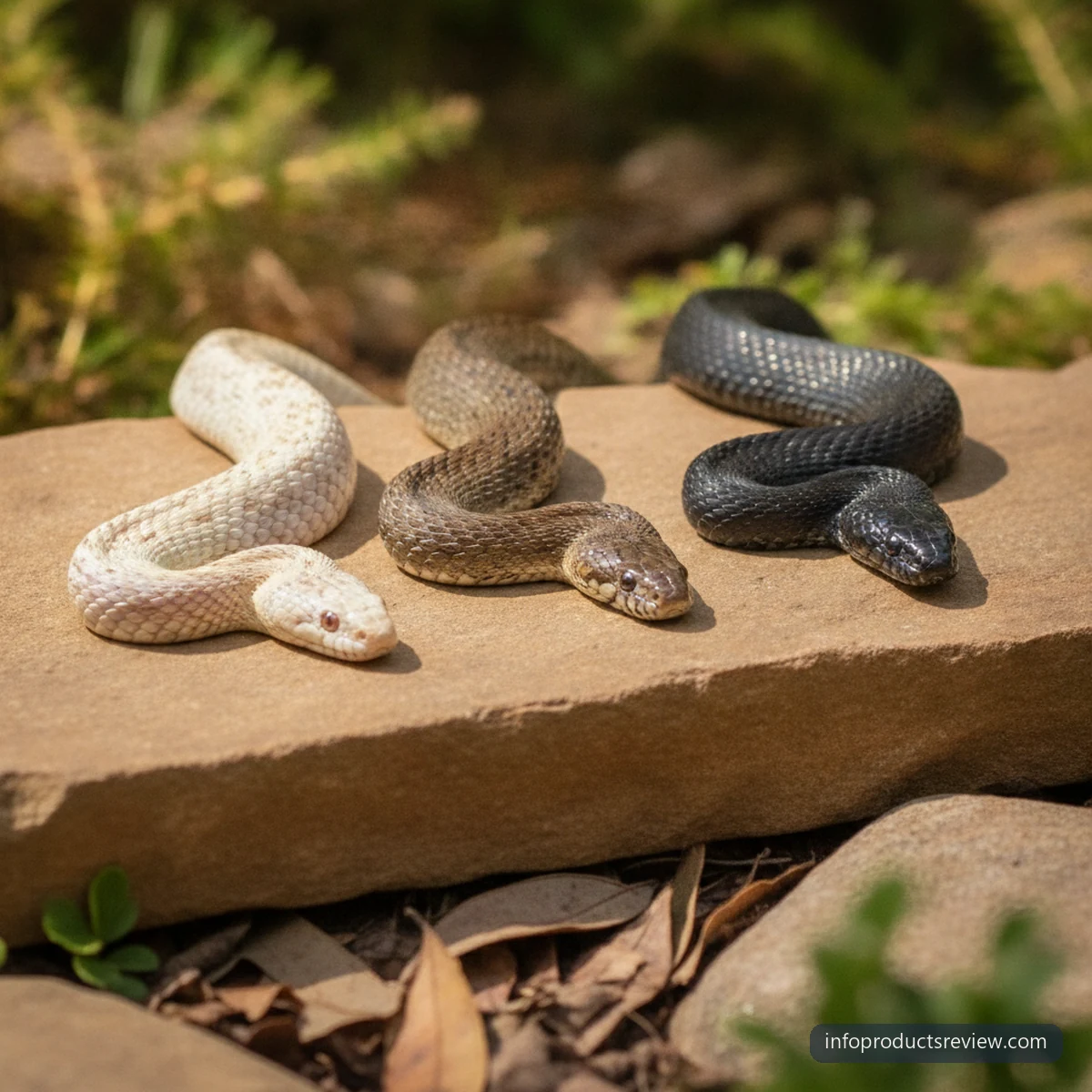
We need to be completely clear here, because linking colours to medical conditions or to a baby’s sex is among the most written and least supported claims in this whole subject.
What is recorded about colour is very little, and it sits in two places that disagree.
Ibn Qutayba writes that the white of snakes are the weakest of snakes and the black of them the most severe. For him white is the weakest.
The white of snakes are the weakest of snakes, and the black of them the most severe.
The compilation attributed to Ibn Sirin writes that the white of them are the hardest of enemies and the black the most severe of them. There white is the hardest.
The white of them are the hardest of enemies, and the black of them the most severe of them.
The two lines contradict each other plainly on white: weakest in one, hardest in the other. So we say outright that the colour question is unsettled and that nothing should be built on it. We prefer Ibn Qutayba when a choice has to be made, because he is older and better attested — but we don’t hide the other line.
- Both lines are about degree of severity and nothing else. Neither describes a kind of harm.
- Neither mentions magic, envy, illness, pregnancy or a baby. Anyone who builds a claim about magic or envy on a colour has added what the text does not contain.
- White is not a good omen in either line: it is either the weakest or the hardest. A table that makes it a good omen contradicts what it claims to be quoting.
- And black appears elsewhere in an entirely favourable setting, where the dreamer had the upper hand.
The plainest example of that last point is Ibn Qutayba’s: whoever sees that he has come to own a group of the great black snakes leads armies and attains great authority. Black itself turned favourable once the dreamer’s position in the scene changed.
Whoever sees that he has come to own a group of the great black snakes leads armies and attains great authority.
As for the other colours — green, yellow, red — neither of those two places mentions them. Anyone who gives you a meaning for every colour has built a table on nothing.
And as for the claim that one colour indicates a boy and another a girl, there is no basis for it here or anywhere else. Repeating it isn’t merely an interpretive error. It can build a mother’s whole expectation of her child on nothing, and then leave her with a disappointment that had no cause.
Size and number
Size is a core element, and the recorded principle is explicit: the enmity of each snake is in proportion to its harmfulness, its size and its venom. The stronger the scene, the stronger the reading; the smaller it is, the lighter.
The fangs carry a detail people often get wrong. The book attributed to Ibn Sirin records that the snake’s limbs and fangs are the adversary’s strength and the force of his scheming — a description of the other party’s capacity, not a judgement on the outcome. There is a wide gap between “the other party is strong” and “something is going to happen to you.”
The snake's limbs and fangs are the adversary's strength and the force of his scheming.
And here is the important point, because one line gets picked up and built into a great deal of talk aimed at pregnant women: that a small snake is a child. The honest reading is that this line sits inside a sequence of what the symbol can turn toward, in the very same sentence that speaks of snakes fighting in the market and of prevailing over adversaries. It demonstrates the breadth of the symbol. It is not an announcement of a baby, and it names no pregnancy, no baby’s sex and no date. The other passage says the snake may be a ruler — and nobody concludes from that that the dreamer will become one.
A small snake is a child; and if he sees snakes fighting one another in the market, war breaks out and he prevails over the adversaries.
Number is read through place rather than by the count alone. In a garden, the book records that whoever sees his garden filled with snakes will see that garden grow and its plants increase and thrive — one of the most explicitly favourable lines in the material. The same sentence says that a snake coming out of the ground is a torment in that place, and we qualify that at once: it speaks of a place rather than a person, and of neither a pregnancy nor a baby.
If he sees a snake that has come out of the ground, it is a torment in that place. And if he sees his garden filled with snakes, the garden grows and the plants in it increase and thrive.
In a market, snakes fighting arrived attached to prevailing rather than to defeat. In a house, the recorded image is coming and going without harm — a passage through a close circle rather than an alarm. The same count produced three different directions in three settings, two of them favourable or neutral.
What did the snake do?
If you keep only one idea from this page, keep this one: what the snake did matters more than its shape or its colour. The table gathers the recurring cases with the closest reading for each, and every row is covered in detail in its own section.
| What the snake did | Closest meaning |
|---|---|
| Stayed still | Presence without action — not a warning |
| Passed by without noticing you | Something passing that doesn’t concern you directly |
| Came closer, then stopped | Pressure that reached a limit and held |
| Circled around you | Closeness with the ability to harm explicitly ruled out |
| Walked behind you | An intention to harm that never became an act |
| Bit you | Difficulty in proportion to the bite — unconnected to your pregnancy |
| Obeyed you, or you held it without fear | Treasure from the treasure of kings |
| It was dead | An adversary whose harm is spared you without any effort |
Look at the table closely. Colour appears nowhere in the meanings column, and neither does the word “baby”. Four of those eight aren’t troubling, and two are clearly favourable.
Notice too that most rows describe an action: passed, approached, circled, walked, bit, obeyed. If the snake in your dream did nothing at all, you are outside most of this table to begin with.
Being chased
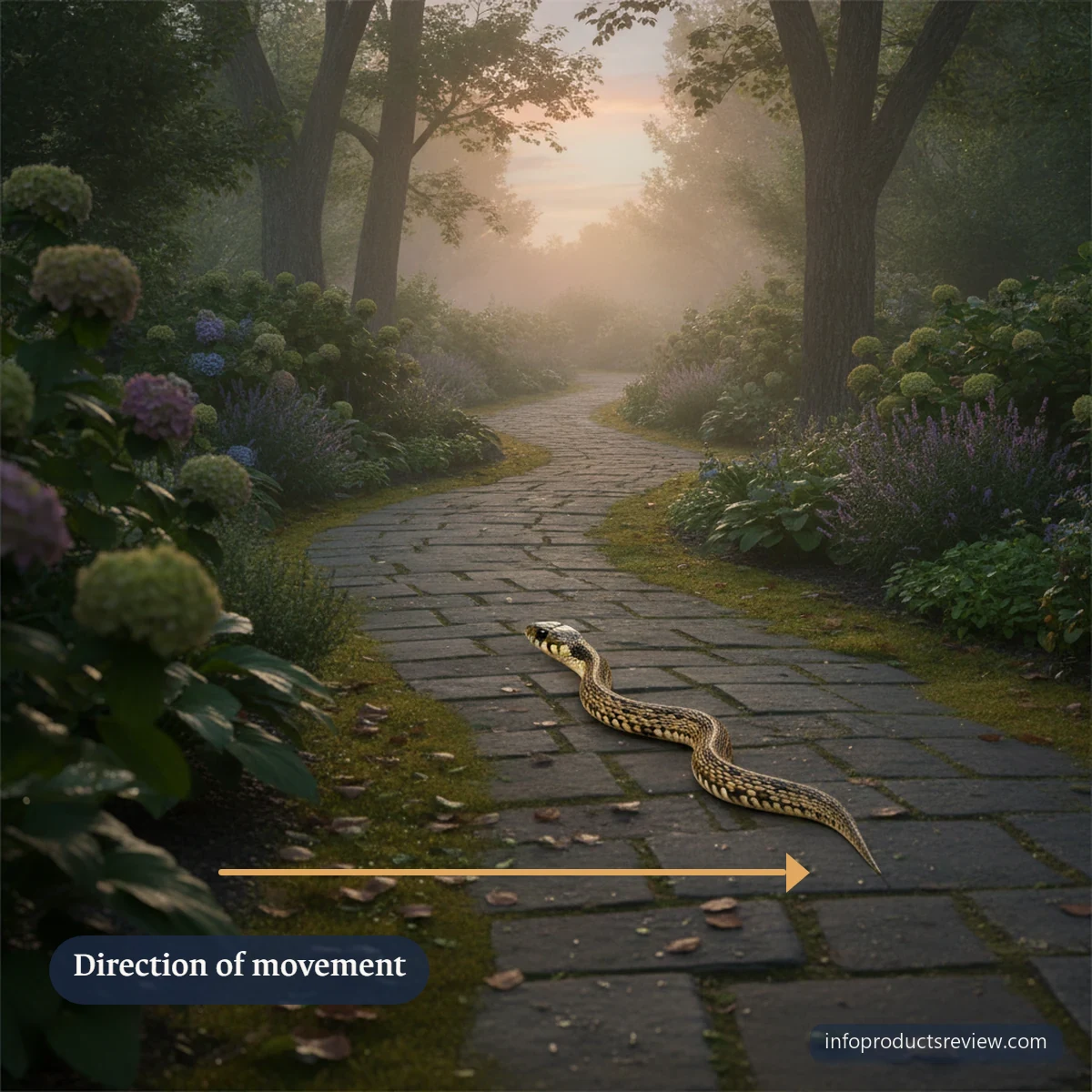
Nothing exhausts a sleeper more than watching something approach. The reassuring part is that the recorded line here is explicit and genuinely useful.
The book attributed to Ibn Sirin records that if a snake walks behind the dreamer, an adversary wants to plot against him; and that if it walks in front of him or circles around him, they are adversaries who mix with him and cannot harm him.
If he sees a snake walking behind him, his adversary wants to plot against him; and if it walks in front of him or circles around him, they are adversaries who mix with him and cannot harm him.
That single line carries three useful things:
- Behind you: the recorded word is “wants”. An intention, not an accomplished act. The gap between them is the gap between a possibility and an event.
- In front of you, or circling you: the text puts both in one ruling, and it explicitly rules out the ability to cause harm.
- Mixing is not danger: the text says they mix with him, then denies their power to harm him in the same breath.
Consider the inversion. The most terrifying image to live through — something circling you while you can’t get away — is the most reassuring one in the reading. That is worth saying to anyone who woke with her heart pounding.
There’s a fourth image people ask about: a snake that comes out and returns, over and over. It appears in the compilation, in the entry with no printed section heading, read as a devil that grieves the dreamer. We give it as it stands: it speaks of a recurring distress rather than assigning a meaning to a dream repeating, and it points at no particular adversary.
If he sees a snake coming out of a district once and returning once, it is a devil that grieves him.
And a very plausible possibility in pregnancy: if your sleep is broken, a reflection of that may explain the scene better than any symbol.
Being bitten

The bite frightens pregnant readers more than anything else here, and it’s the passage most often quoted with a piece missing.
Ibn Qutayba records that if a snake bites the dreamer, his adversary gets at him to the extent of the bite. Notice the qualifier: to the extent of the bite. The effect is proportional rather than absolute, so a slight bite carries correspondingly little. That qualifier is exactly what falls away on the pages that turn every bite into a catastrophe.
And if it bites him, his adversary gets at him to the extent of the bite.
The compilation, in the entry with no printed section heading, carries a heavier line about being bitten. We give it as it stands with three notes: it is an interpreter’s judgement rather than knowledge of the future; it sits in an entry whose author cannot be established; and it names no event, no time, no person and no magnitude. The older and better-attested wording is Ibn Qutayba’s, tied to the extent of the bite.
We find no passage in these books giving a different meaning to each part of the body. Tables that separate a bite to the hand from one to the foot or the abdomen are a later addition rather than something handed down.
And a caution we won’t soften: a bite in a pregnant woman’s dream must never be read as a sign about her baby, her pregnancy or her delivery. Nothing of the kind exists in this material, and nobody is in a position to say it.
If you have any physical symptom while awake — whatever it is — the right place is your midwife or doctor. A dream diagnoses nothing, rules nothing out, and is never a reason to delay a test or stop a medication.
When the snake appears near your belly
This question reaches us constantly, and it deserves a straight answer because it’s the one that worries people most.
What we say plainly: there’s no treatment of where a bite lands on the body, no mention of the abdomen, and no mention of pregnancy. Anyone giving you a specific reading for a snake near your belly, and attributing it to Ibn Sirin or al-Nabulsi, has added it themselves.
What can be observed: a pregnant woman spends months with her attention on her abdomen every single day — watching for movement, feeling, measuring. It would be surprising if that attention didn’t surface in her dreams.
So a dream centred on your belly isn’t necessarily a pointer to your baby. It may be a reflection of where your attention already lives while awake.
We state that in its correct form: a general psychological possibility, not a diagnosis, not a denial, and not a confirmation — and an observation of ours rather than a line from an interpreter.
And what to do: if you have any real symptom while awake — abdominal pain, bleeding, reduced movement, contractions — it has nothing to do with the dream, and it belongs with your midwife or doctor straight away.
Killing, confronting, and the calm snake

These are among the few images the sources agree in reading favourably or reassuringly, so we gather them in one section.
Confrontation and killing. Ibn Qutayba records that whoever fights a snake is contending with such an adversary, and that if he kills it he prevails over him. Fighting, in itself, is not a judgement of defeat, and killing is among the clearest favourable readings — often experienced as getting past a problem or the end of a dispute.
Whoever fights it is contending with such an adversary; and if he kills it, he prevails over his adversary.
Confrontation without a result. The compilation, in the entry with no printed section heading, is more explicit: whoever wrestles with a snake is fighting a strong adversary, in fear and unease of him until the two of them part, and victory belongs to whichever of them prevails. The outcome is left open in so many words, and there is no advance verdict against you. That matters to anyone who woke feeling she had lost something.
If he wrestles with a snake, he is fighting a strong adversary, in fear and unease of him until the two of them part, and victory belongs to whichever of them prevails.
The same entry carries another face connecting the killing of a snake with marrying a woman. Its setting is a male dreamer marrying a woman, so it isn’t carried across to you and says nothing about your situation. It also contradicts Ibn Qutayba’s reading of the same image, and the disagreement rules out being definite about either.
Cutting. Ibn Qutayba records that whoever cuts it in two gets his due from his adversary. The image is read as decisiveness and redress.
If he cuts it in two, he gets his due from his adversary.
The calm snake. Among the most commonly seen images and the least written about: a snake that doesn’t move, doesn’t approach, and takes no interest in you. Stillness and the absence of harm appear in several reassuring passages, and three of them are the plainest.
The first is the dead snake. Ibn Qutayba records that whoever sees a dead snake faces an adversary whose harm God spares him, without any strength or power of his own — relief that arrived without effort.
If he sees a dead snake, it is an adversary whose harm God spares him, without any strength or power of his own.
The second is gentle speech. He records that if a snake speaks to the dreamer with gentle, kindly words, good comes to him at which people marvel, and that the same applies to the speech of anything that does not normally speak.
If a snake speaks to him with gentle, kindly words, good comes to him at which people marvel. And the same applies to the speech of everything that does not speak.
The third is the obedient snake. He records that whoever obtains a smooth snake that obeys him, with no malice and no weapon that harms, obtains treasure from the treasure of kings, and that it may be his good fortune when it has that description. Note the three conditions: obedience, no malice, no harm.
If he obtains a smooth snake that obeys him, with no malice and no weapon that harms, he obtains treasure from the treasure of kings; and it may be his good fortune when it has that description.
What all of these share is that the meaning is built on what it did, not on the fact that it was there. So if you keep telling yourself, “but it didn’t do anything” — that’s a correct observation, and part of the reading.
If your partner or children appeared
Many of these dreams aren’t only about a snake. A partner may appear, or an older child, or a relative.
First: we find no treatment of such scenes in these books. Anyone offering a detailed reading of them has added it themselves.
Second: what can honestly be said is that the presence of people we love changes your own position in the scene. A woman who saw herself shielding a child didn’t see herself helpless; she saw herself acting. That sits closer to mastery than to weakness, and mastery is a favourable indication, as we’ve seen.
Third: children appearing in mothers’ distressing dreams — and pregnant women’s especially — is a familiar pattern tied to what occupies the mind during the day, and it reads more like care than warning.
What is never acceptable is saying something is wrong with the baby, or that the dream reveals anyone’s intentions. A dream doesn’t reveal what is in people’s hearts, and it establishes nobody’s envy, magic or betrayal.
Reassuring passages that rarely get quoted
Since most of what’s published selects the frightening side, here’s the other side gathered in one place — and you of all readers deserve to see it whole:
- A dead snake: an adversary whose harm is spared without any effort — Ibn Qutayba.
- Gentle speech: good that people marvel at — Ibn Qutayba.
- An obedient, harmless snake: treasure from the treasure of kings — Ibn Qutayba.
- Fear without sight: safety from the adversary — Ibn Qutayba.
- Killing and cutting: prevailing and redress — Ibn Qutayba.
- Eating the flesh: money from an adversary, with joy and gladness — Ibn Qutayba.
- Owning great black snakes: leading armies and great authority — Ibn Qutayba.
- Climbing upward: ease, gladness and joy — the book attributed to Ibn Sirin.
- A garden filled with snakes: growth and increase — the book attributed to Ibn Sirin.
- Water snakes and water settings: money, waters and floods — the book attributed to Ibn Sirin.
- Owning a serpent: great authority — the book attributed to Ibn Sirin.
- A snake on the head: rising in standing — the compilation, in an entry with no printed section heading.
The most useful of those deserve spelling out.
Climbing upward. The book attributed to Ibn Sirin records that if the snake climbs to a height, the dreamer gains ease, gladness and joy. That is about as far from the symbol’s popular reputation as a line can get.
If the snake climbs to a height, he gains ease, gladness and joy.
Eating the flesh. Ibn Qutayba records that whoever eats of its flesh obtains money from his adversary, and joy and gladness come to him. It is one of the plainly favourable passages, and among the least quoted.
And if he eats of its flesh, he obtains money from his adversary, and joy and gladness come to him.
Mastery. The entry for the large serpent in the book attributed to Ibn Sirin records that whoever sees that he has come to own a serpent attains great authority. It is the mastery that turns the meaning, not the kind of animal or its colour.
Whoever sees that he has come to own a serpent attains great authority.
A snake on the head. The compilation, in the entry with no printed section heading, records that whoever sees that a snake swallowed him attains authority, and that whoever sees a snake on his head rises in standing with rulers. Both are clear examples of a frightening picture that reads favourably.
Whoever sees that a snake swallowed him attains authority, and whoever sees a snake on his head rises in standing with rulers.
Fear without sight. The fullest line on feeling is Ibn Qutayba’s: whoever fears a snake without actually seeing it, that is safety for him from his adversary; and if he sees it and fears it, then it is fear. He adds that the same applies to everything that is feared and seen. Fear here is read as fear, and it is not converted into a coming event or a particular person.
Whoever fears a snake without actually seeing it, that is safety for him from his adversary; and if he sees it and fears it, then it is fear. And the same applies to everything that is feared and seen.
Twelve favourable or reassuring passages in a single subject, seven of them from Ibn Qutayba alone, the oldest and strongest source here. If the symbol were purely negative, none of them would exist.
And to be fair once more: these aren’t guarantees, they are recorded possibilities like the worrying ones, and not one of them tells you anything about your pregnancy. The point of gathering them is so you can see the whole picture rather than trading fear for overstated optimism.
What you can take away, reassured
We gather the substance of the page here, because someone searching at night while pregnant deserves an answer that settles rather than one that adds.
First: pregnancy isn’t mentioned at all. So any worry built on connecting this dream to your baby rests on nothing. That’s not comfort — it’s the result of reading.
Second: fear is read as fear. If the feeling is what stayed with you, the interpretation stops there and goes no further. Ibn Qutayba’s line on that is explicit, as we saw above.
Third: the most common images are the lightest. A snake that passes, stays still, or does nothing isn’t a warning — and that’s what most people actually see.
Fourth: the increase in your dreams has a known cause. Broken sleep raises recall, so what feels like “more dreams” may be more remembering.
Fifth: nothing obliges you to act. No money, no vow, no change to your plans or appointments.
Sixth: the reassuring passages are many. Don’t apply the harshest possibility to yourself alone; there are at least twelve favourable or reassuring passages on this page.
And if worry remains after all that, it deserves to be raised with your midwife or doctor as worry — not as the interpretation of a dream.
When does a dream deserve your attention?
Not all dreams are equal, and this practical distinction saves a great deal of effort.
Likelier to deserve a pause if it combines: a clear scene with a beginning, an event and an end you remember in detail; a real action by the snake rather than mere presence; a place you recognise; and one consistent feeling throughout.
Likelier to be an echo of a day if it combines: fragmentary scenes with no order; images you saw while awake; a night you woke repeatedly — the norm in the later months; and a day full of worry or waiting for a result.
Most of the questions we receive from pregnant readers fall into the second group. That isn’t dismissing how you feel — it’s saving your energy at a time when you need it most.
And a third case deserves different attention: if distressing dreams have become frequent and are affecting your sleep or your days, that’s a sleep question rather than an interpretation question, and it belongs in your antenatal care.
When the searching itself becomes the problem
This section describes readers’ experience rather than the classical material, and we say so.
The pattern after a distressing dream in pregnancy is remarkably consistent. A woman wakes late at night, opens her phone, and reads ten contradictory pages in half an hour. One promises her a boy. Another warns her about envy. A third links a colour to an illness.
She goes back to sleep — if she does — carrying more frightening possibilities than the dream itself contained.
Then something worse happens: the next night repeats the pattern, because the anxiety accumulated during the day becomes fuel for a new one. The problem is no longer the symbol. It’s the loop.
Which is why we put the answer in the first line and in The Bottom Line, before any of the detail — so you never have to read to the end to be reassured.
And if worry is genuinely keeping you from sleeping, or affecting your days, that’s itself worth mentioning at your next appointment. Not because it signals anything serious, but because it’s something you can be helped with.
When is a dream just your mind talking to itself?
Before hunting for a symbol, it helps to rule out what isn’t one:
- You saw the image before sleeping: a clip, a conversation about labour, a forum read before bed.
- The dream follows an existing worry: a scan coming up, a result you’re waiting on, arrangements for after the birth.
- The scene has no structure: fragments with no beginning and no end.
- Your sleep is broken: which in pregnancy is the rule rather than the exception.
- You forgot the scene quickly and only the unease stayed.
One practical habit helps more than people expect: write a single line each morning after a dream that unsettled you — the place, the action, the feeling, and the time you woke. After a fortnight a clear relationship usually appears between broken nights and distressing dreams. It’s a relationship you see for yourself, and it’s far more useful to a clinician than a general description.
How to describe your dream so it can be read
Most questions that reach us can’t be usefully answered, because they say: “I’m pregnant and I saw a snake, what does it mean?” That has no context.
A question that can be answered names four things:
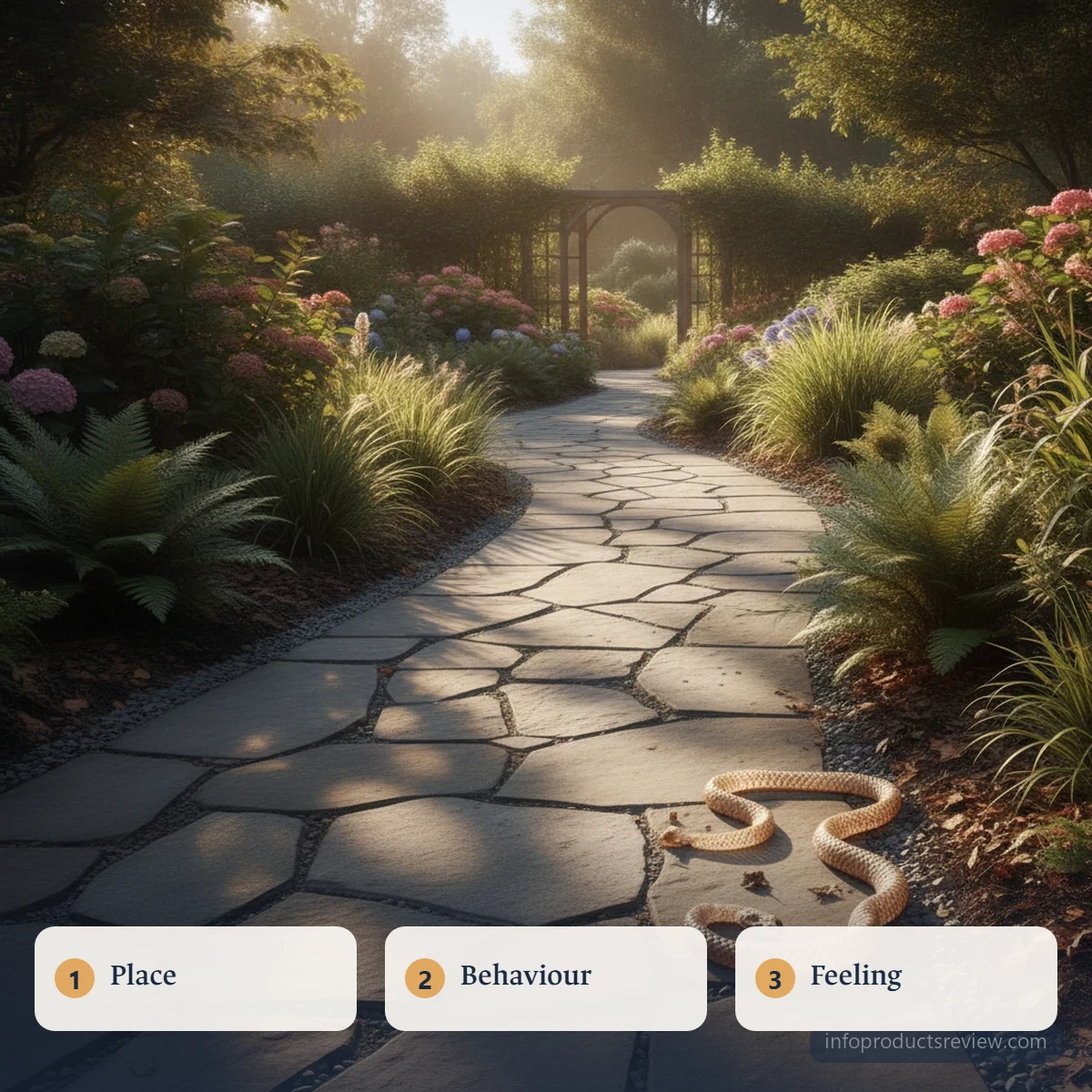
- Where was the scene? Your home, a hospital, the street, or somewhere you didn’t recognise.
- What did the snake do? Approached, circled, passed, bit, or stayed still.
- What did you do? Moved away, faced it, stood still, or called someone.
- How did you feel inside the scene? Afraid for yourself, worried for your baby, calm, or indifferent.
Notice that we didn’t put “pregnancy” among the four. That’s deliberate: your circumstances help identify the circle, but they aren’t a detail inside the dream itself.
And if the place was one you didn’t recognise, we find no passage covering that case, and we’d rather say so than invent one. The nearest honest observation is that without a known setting the whole basis for choosing between readings weakens, and the meaning stays in a wide field of possibility.
The classical tradition, and its limits

It’s only fair to explain where this material comes from, briefly and without weighing the page down. This page rests on two places.
The first is Ibn Qutayba’s Ta’bir al-Ru’ya in Ibrahim Salih’s critical edition. It is the older and stronger of the two, and its chapter on scorpions and snakes is the backbone of what we present. Words in square brackets in that text are the editor’s additions.
The second is a modern printed dream-interpretation compilation, gathered and alphabetised by Basil al-Buraydi, attributed to Muhammad ibn Sirin and to Abd al-Ghani al-Nabulsi. The attribution in that book needs stating clearly: headings such as “Ibn Sirin said” and “Abd al-Ghani al-Nabulsi said” are section titles inside a modern compilation, not continuous chains of transmission. So we write that a book attributed to Ibn Sirin records something, and never present it as established speech of his.
One detail matters especially. The second body of snake material in that compilation has no printed section heading above it. Assigning it to al-Nabulsi is an inference from the arrangement rather than a printed fact. So on this page we say that it appears in the compilation in an entry with no printed section heading, and we do not state that it is certainly his. Al-Nabulsi is a well-known author with a famous dream-interpretation manual, but that does not make every unheaded passage his words.
One more note. The reference copy in use has no section under the name of Ibn Shaheen, although the name recurs constantly in what gets published. So nothing here is attributed to him. What is not written, we do not write.
Where the two places disagree — as they do on colour — we report the disagreement rather than picking a side for you and staying quiet about the other.
The method of the old interpreters is worth noticing too. They didn’t hand out a single answer for a symbol. They asked first: where was the scene, what did the animal do, how was the dreamer placed — and built from the answers. That’s why a single book holds several readings for one symbol, sometimes even conflicting ones. It isn’t confusion; it’s the method.
If you want the general treatment of the symbol rather than your own situation, our general guide to snake dream meaning sets out the four details that decide a reading.
How dreams are handled in Islamic practice
Before interpreting anything there is a prior question worth asking: is this the kind of dream that calls for interpretation at all?
The hadith literature divides what a sleeper sees into three: a good dream, which is glad tidings; a distressing dream, from Satan; and a dream from what a person tells himself. That wording is in Sahih Muslim, hadith 2263. The division alone is a relief, because it means the first question is not “what does it mean” but “is this something that gets interpreted”.
Dreams are of three kinds: a good dream, which is glad tidings from God; a distressing dream, from Satan; and a dream from what a person tells himself
There is also a recorded response for someone who sees what she dislikes. Sahih al-Bukhari, hadith 7044, records that one should seek refuge in God from its harm and from the harm of Satan, spit lightly three times, and tell nobody about it, and that it will not cause harm. Its place is Sahih al-Bukhari, the Book of Dream Interpretation.
A good dream is from God. If one of you sees something he likes, let him tell it only to someone he loves. And if he sees something he dislikes, let him seek refuge in God from its harm and from the harm of Satan, spit lightly three times, and not tell anyone about it, for it will not harm him
Sahih Muslim, hadith 2262, adds detail to the manner: spitting to the left three times, seeking refuge in God from Satan three times, and turning over from the side one was lying on. Its place is Sahih Muslim, the Book of Dreams.
If one of you sees a dream he dislikes, let him spit to his left three times, seek refuge in God from Satan three times, and turn over from the side he was lying on
So the response has four parts: seeking refuge, spitting three times, turning over, and leaving the dream untold. None of it costs anything and none of it needs an intermediary.
Its practical value in pregnancy is clear: it turns you away from turning the dream over at a time when the mind is already primed for worry. And the last part carries a further benefit — retelling a dream and its interpretation within earshot of the person being suspected is usually the source of the harm, rather than the dream.
Anything beyond those four — a payment, a vow, consulting anyone who claims access to hidden things — has no basis, and can open you up to being taken advantage of.
The psychological reading

Alongside the classical reading there’s what modern sleep references describe. We include it as general context that helps you understand what’s happening — not as a diagnosis of you, and not as a replacement for the classical reading.
Psychologically, the mind may use the image of a snake to express a sense of threat or unease, particularly during a stressful period. That doesn’t indicate a disorder, and it isn’t a diagnosis of anyone.
In pregnancy several known factors combine: changed sleep, worry about the birth, waiting on test results, a changing body, and sometimes family or financial pressure. All of these raise the likelihood of distressing dreams without the symbol itself playing much of a role.
And if distressing dreams have become frequent and are affecting your sleep or your days, mention it in your antenatal care. Not because it signals anything serious, but because it’s something you can be helped with.
Mistakes specific to pregnancy
- “The snake’s colour indicates the baby’s sex.” No basis. The two colour lines concern degree of severity and mention neither a baby nor a pregnancy.
- “The dream warns of a risk to the pregnancy.” Pregnancy isn’t mentioned at all, let alone a risk to it.
- “A small snake announces a baby.” The line sits inside a list of the symbol’s possible senses, not an announcement.
- “A bite means a problem at the birth.” The effect is measured by the extent of the bite, and neither birth nor baby is mentioned.
- “A pregnant woman’s dreams are truer than other people’s.” Nothing makes the dreamer’s condition a measure of a dream’s truth.
- “Black means magic or envy.” What is recorded is “most severe”, a word about degree — and black appears favourably elsewhere for whoever owned it.
- “Many snakes are a bad sign.” In a garden, abundance is recorded as explicitly favourable; in a market it arrives attached to prevailing.
- “You must do something after this dream.” A dream creates no obligation, and is never a reason to delay an appointment.
Situations and examples
I saw a snake from a distance and it never came near
One of the lightest images: no action, no approach, no harm. We find no reading of its own for it, which is itself reassuring, and the closest sense is a passing worry. If there was no fear at all it is lighter still, because the absence of fear is an explicitly favourable indication.
A snake came into the house and then left
Nearly the recorded image word for word: coming and going without harm. It was read as adversaries from a close circle, and the scene is a passage through rather than an intrusion. It names nobody in your household, and it has nothing to do with your pregnancy.
A snake chased me until I woke up frightened
What is recorded for a snake walking behind the dreamer is that someone “wants” to plot — an intention rather than an accomplished act. If it circled you, the text rules out the ability to harm in so many words. And if your sleep is broken, that’s a closer explanation.
A snake bit me while I was pregnant
The effect is to the extent of the bite, as Ibn Qutayba qualifies it, and it has no connection to your pregnancy or your baby. Where the bite landed has no separate treatment, so any table separating the hand from the abdomen is an addition.
I killed the snake
Among the clearest favourable images: prevailing over the adversary in Ibn Qutayba, often read as getting past a problem or the end of a dispute. The compilation carries another face whose setting is a male dreamer, and the disagreement between the two rules out being definite about either.
I saw a small snake
Smallness lightens the meaning. Linking it to a baby lifts a line out of its sequence, as explained in the section on size, and it announces no pregnancy, no baby’s sex and no date.
I saw many snakes
Number is read through place. In a garden, abundance was explicitly read as growth and increase; in a market it arrived attached to prevailing; in a house it was coming and going without harm. We find no principle making abundance bad in itself.
I felt afraid for my baby rather than for myself
That feeling is extremely common in pregnancy, and it reads far more like an expression of care than a warning. We build no ruling on it, but it’s worth weighing before loading the dream with more than it carries.
A comparison: similar dreams, different meanings
Comparison shows how these principles work better than any rule does. Each example assumes the rest of the scene was neutral.
First pair. A pregnant woman saw a snake in her room that didn’t move, and woke frightened. Another saw a snake approach and bite her.
The first is presence without action, and the fear in it is read as fear. The second has a clear action, and the meaning sits closer to difficulty in proportion to the bite. In both cases: no connection to the baby.
Second pair. A woman in her fourth month had one distressing dream. Another in her ninth month has them almost nightly.
The first is an isolated dream whose symbol can reasonably be read. The second is a recurring pattern coinciding with the most broken-sleep stage of pregnancy — and there, sleep explains more than the symbol does.
Third pair. One woman saw a snake and felt afraid for herself. Another saw the same scene and felt afraid for her baby. The second feeling is extremely common, and reads far more like care than warning.
Fourth pair. One woman saw a large snake in a garden. Another saw a small snake in her bedroom, coming toward her. The expected order inverts: the first is bigger but sits in the setting where abundance was read as growth, while the second is smaller but sits in a close circle with a clear action. Size tips a reading; it does not decide one.
Frequently asked questions
Does a snake dream indicate the baby’s sex?
No. There’s no mention of a baby’s sex, or of any sign indicating it, anywhere in this material. Everything said on that point was added later, and no expectation should be built on it.
Is the dream warning me about a risk to my pregnancy or my baby?
No. Pregnancy itself isn’t mentioned, let alone a risk to it. A dream should never be read as a medical warning. If you have any symptom while awake, that belongs with your midwife or doctor.
A snake bit me while I was pregnant. What does it mean?
Ibn Qutayba records that the adversary gets at the dreamer to the extent of the bite, so the effect is measured rather than absolute, and it is an interpreter’s judgement rather than knowledge of the future. The compilation carries a heavier line, but it sits in an entry whose author cannot be established and names no event, no time and no person. There is no link anywhere between a bite and a pregnancy or a baby.
Does the snake’s colour change the reading?
What is recorded on colour is one line in each book, and the two disagree. Ibn Qutayba writes that white snakes are the weakest and black ones the most severe; the compilation writes that the white are the hardest of enemies and the black the most severe of them. So the question is unsettled. Neither line mentions magic, envy, illness or a baby, and neither mentions any other colour. The circulating colour tables have nothing behind them.
I read that a small snake means a baby. Is that right?
The line sits inside a sequence listing what the symbol can turn toward: an authority, a spouse, a child. It shows the breadth of the symbol; it isn’t an announcement, it shouldn’t be lifted out of its sequence, and it names no baby’s sex and no date.
Why have my dreams become more frequent and vivid since I became pregnant?
Because sleep in pregnancy is more broken, and frequent waking raises dream recall. Most remembered dreaming happens in a stage that lengthens through the last third of the night. Your dreams may not have changed; your recall of them has.
A snake circled me without coming closer. Is that bad?
One of the most reassuring images: what is recorded is that adversaries who circle the dreamer or walk in front of him mix with him and cannot harm him. Harm is ruled out explicitly, however frightening the scene felt.
I saw a snake in my home while pregnant. Is it about my family?
What appears inside the house belongs to a close circle, but it names nobody, and a circle is not an accusation. The same image also carries the qualifier of coming and going without harm.
The dream repeated over several nights. Does that mean something?
Repetition wasn’t made a meaning in its own right. The nearest image is a snake that comes out and returns, read in the compilation as a recurring distress rather than a particular adversary. From the sleep side, recurrence tracks stress and short sleep more than content. If it’s causing real distress in your days, mention it in your antenatal care.
Do I need to do something after this dream?
A dream creates no obligation. The recorded response is simple and costs nothing: Sahih al-Bukhari, hadith 7044, has seeking refuge in God from its harm, spitting lightly three times, and not retelling it; Sahih Muslim, hadith 2262, adds spitting to the left three times and turning over from the side you were lying on. Anything beyond that — a payment, a vow, a change of plan — rests on nothing, and no test or medication should be postponed because of it.
Are a pregnant woman’s dreams truer than anyone else’s?
Nothing makes the dreamer’s condition a measure of a dream’s truth. That claim is common and unsupported.
Where can I read about the other symbols in the same dream?
A symbol shouldn’t be cut out of its scene, and meanings shouldn’t be added together arithmetically. Read the scene as one thing. Our general guide to snake dream meaning gathers the four details that decide a reading, you can browse the rest of ATHAR in English, and the same principles are applied to a single woman, a married woman and a man on their own pages.
Final summary
Compressing snake dreams during pregnancy into lines you can actually use:
- What you saw tells you nothing about your baby: not its sex, not its health, not your due date.
- The closest reading in Ibn Qutayba is an adversary who conceals his enmity — a possibility, not a verdict.
- Start with the place, then what the snake did, then how you felt. Fear is read as fear, not as an event.
- Don’t apply the harshest possibility to yourself; there are at least twelve reassuring or favourable passages here.
- More frequent, vivid dreams in pregnancy have a known explanation rooted in broken sleep.
- A dream cannot establish magic, envy, betrayal, illness or anyone’s intentions.
- Build no decision on a dream, and take any physical symptom to your midwife or doctor.
And if you take one thing from this page, let it be that a symbol is read inside its scene — and that your pregnancy isn’t the subject of this dream at all.
Written and reviewed by: the ATHAR editorial team — classical material checked and attributions verified before publication.
Last reviewed: 24 September 2026.
Note: what appears on this page is a possible meaning rather than a confirmed fact, and it changes with the details of the dream and the dreamer’s circumstances. Nothing here predicts the future, diagnoses a medical or psychological condition, says anything about a baby’s sex or the health of a pregnancy, or establishes magic, envy or betrayal. Any health question belongs with your midwife or doctor.