

You wake up and, for a moment, they are still there. Your father in his usual chair. Your mother saying your name the way only she said it. A friend who died too young, laughing as though nothing had happened. Then the room comes back, and with it the questions: was that a message? Are they all right? Did they want something from me?
Dreams of people who have died are among the most searched-for dreams there are, and among the most tender. A careless answer here doesn’t just add a passing worry; it can press on grief that hasn’t settled. So this page goes slowly. It keeps three things apart: what one classical interpreter actually recorded, checked against the printed page; what the most authoritative hadith collections establish about unsettling dreams; and what simply circulates online with nothing behind it.
It also says plainly what a dream like this cannot tell you. It doesn’t reveal what has become of the person who died. It doesn’t bind you to carry out an instruction. And it doesn’t predict anyone else’s death. Dreaming of a dead person is read through its details and through your own situation, and whatever it means is a possibility, never a verdict.
The bottom line
At its most natural, a dream of someone who has died reflects longing, memory, and whatever still connects you to them: prayers you offer for them, charity in their name, a promise or a debt still open, a conversation that never finished. The reading shifts with how they looked, what they said or did, and how you felt.
- They looked well, glad, coming towards you: one of the most reassuring images. In a passage by the ninth-century scholar Ibn Qutayba that we checked on the page, this is read as a kindness from the living reaching them, such as charity or prayer.
- They frowned, turned away or seemed angry: Ibn Qutayba reads this as the living falling short on a will or on something left in their care. That’s a prompt to check real obligations, not a sentence of guilt.
- They asked you for something or told you to do something: weigh it against your faith and your real life. Something good is worth doing because it is good. Anything that contradicts your religion or breaks families apart is set aside.
- How you felt, during the dream and after waking, is one of the most honest details you have.
None of this can tell you where someone is in the hereafter, confirm that anyone is about to die, or justify a divorce, a family rift or a disputed inheritance.
What this page covers
- The bottom line
- Why do we dream about people we’ve lost?
- Which details change what the dream may mean?
- When they look well, or glad to see you
- When they frown, seem angry or turn away
- When they speak to you or tell you to do something
- When they ask for food, water or prayers
- When they seem alive, or tell you they’re alive
- When you embrace them, hold their hand or kiss them
- When they are sleeping, unwell or exhausted
- Dreaming of a parent who has died
- When the loss is recent: dreams during mourning
- Does it mean something different for women, men, or during pregnancy?
- Does a dream at dawn mean more?
- What do the classical dream books actually say?
- What about the book attributed to Ibn Sirin?
- What is actually established about unsettling dreams?
- Grief and dreams: what happens to sleep after a loss?
- When is a dream more likely your mind processing the loss?
- Common claims that need correcting
- What this dream cannot tell you
- What to do after dreaming of someone who has died
- How to describe your dream so it can actually be read
- What have interpreters said in recorded interviews?
- A few typical scenes
- Quick reference: detail and nearest reading
- Related guides
- Frequently asked questions
- Is it good or bad to dream of someone who has died?
- A dead person spoke to me in a dream. Is what they said true?
- Does dreaming of the dead mean someone will die?
- My late father looked angry in my dream. Is he angry with me?
- What does it mean to hug a dead person in a dream?
- I dreamed a dead relative asked for food. Are they in need?
- What should I do after a disturbing dream of the dead?
- Do I have to carry out a dead person’s instruction from a dream?
- Does dreaming of the dead at dawn mean something special?
- If I see them alive and well, does it mean they’re in paradise?
- I dream about my late mother often. Is that normal?
- Is any of this certain?
- In summary
- Sources and references
Why do we dream about people we’ve lost?

Before any interpretation, it helps to know that many people report dreaming of those who have died, in the first weeks after a loss and years later too, and especially around the dates that bring someone back to mind: religious holidays, the anniversary of a death, a wedding they should have been at.
Grief doesn’t stop at the edge of sleep. At night the mind returns to what filled the day, and the person you lost filled your days for years: their voice, their place at the table, the way they asked how you were. It’s not strange that they come back in dreams, sometimes as they were at their best, and sometimes in a way that carries whatever went unsaid between you.
That doesn’t rule out some of these dreams being meaningful, and it doesn’t prove it either. The point is simpler: seeing someone you love after they’ve gone does not mean something bad has happened or is about to. Many people wake from these dreams comforted rather than frightened.
If you want the broader framework for when a dream might matter, our guide to dream interpretation sets out how we approach every symbol: sources first, then limits.
Which details change what the dream may mean?
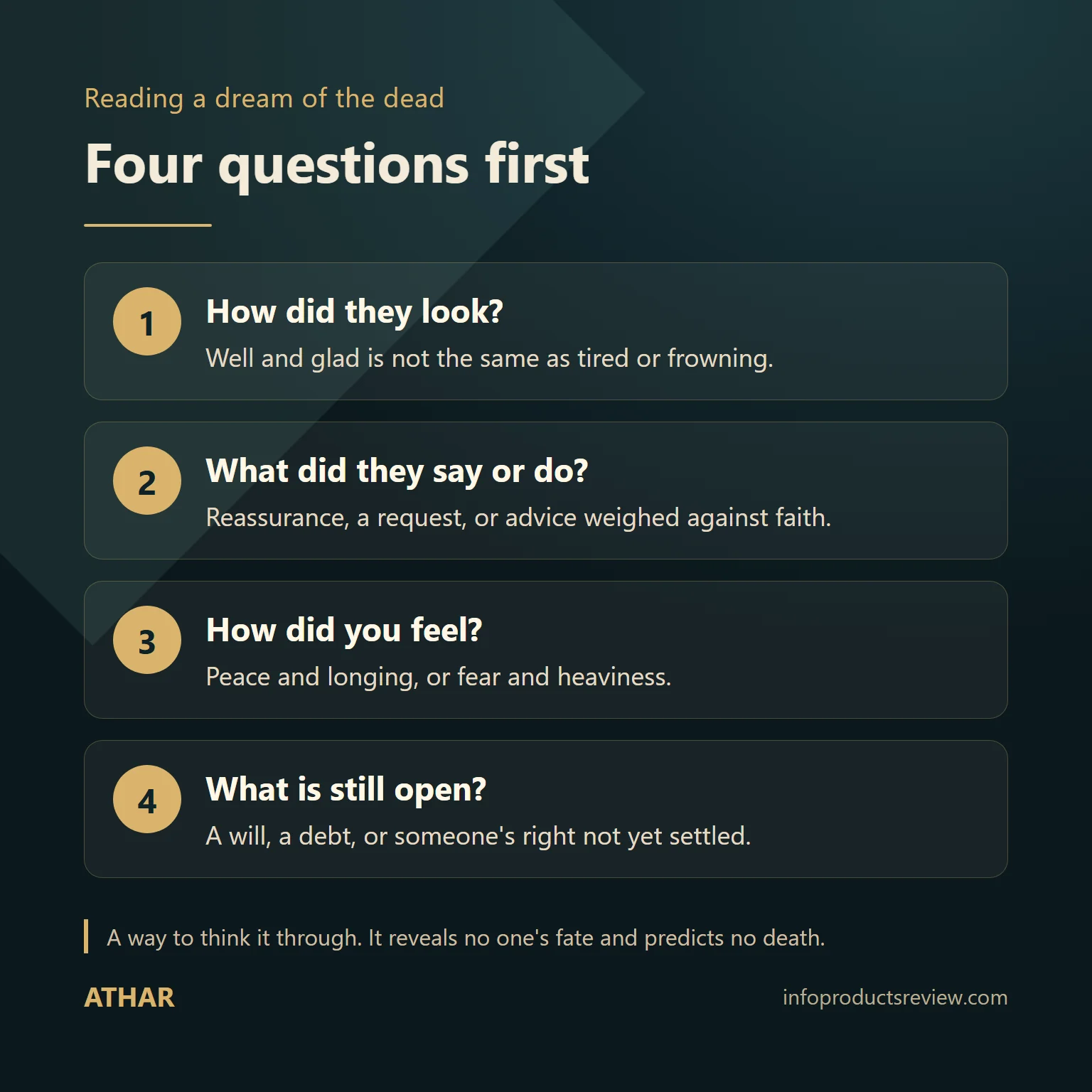
Most people start with one question: “Is it good or bad to dream of the dead?” Put that way, there’s no answer, because the same dream can lean in different directions depending on its details. Here they are, from the most important to the least:
First: how the person looked. Well and at peace, smiling, dressed cleanly? Or tired, frowning, turned away? Classical interpreters gave this detail the most weight.
Second: what they said or did. Did they speak to you, ask for something, give you something, take something, embrace you?
Third: how you felt. Peace and longing, or fear and heaviness? And how did you wake up?
Fourth: your own situation. Was the loss recent? Is something between you unresolved? Is there a will, a debt or a responsibility connected to them?
Last: place, time and colour. They adjust the degree of a reading; they don’t create a new one.
When they look well, or glad to see you
This is one of the most common images in the dreams of bereaved people, and one of the most comforting: the person in clean clothes, their face bright, smiling, somewhere spacious and calm, or walking towards you pleased.
The clearest passage we checked on this comes from Ibn Qutayba al-Dinawari’s Ta’bir al-Ru’ya, a ninth-century work on dream interpretation that has its own chapter on seeing the dead. On a dead person approaching gladly, he writes:
If he sees the dead person coming towards him glad, that is for a kindness the living did them: charity given on their behalf, or a prayer for them.
Notice what that reading does and doesn’t do. It says nothing about the unseen, or about the person’s standing with God. It talks about a connection between the living and the dead: charity given in their name, prayers offered for them, care taken of the children they left. For Ibn Qutayba the dream is a reminder of what can still pass between you after death, which sits very close to the life of someone grieving and praying.
On the next page of the same chapter, he reads the dead seen sleeping peacefully as a sign of their rest. These are an interpreter’s judgements, cited because they can be checked on the page, not because they settle anyone’s fate.
If you dream of someone looking well, the practical response is simple: thank God, pray for them, and if you can, give something in charity on their behalf. You don’t need to know whether the dream was “true” to do any of that. Prayer and charity are good either way.
People sometimes ask, “I saw them happy, so does that mean they’re in paradise?” The honest answer is that a good dream can gladden you, but no dream can pronounce on anyone’s fate. Treat it as good news that moves you to pray, not as testimony about what only God knows.
When they frown, seem angry or turn away
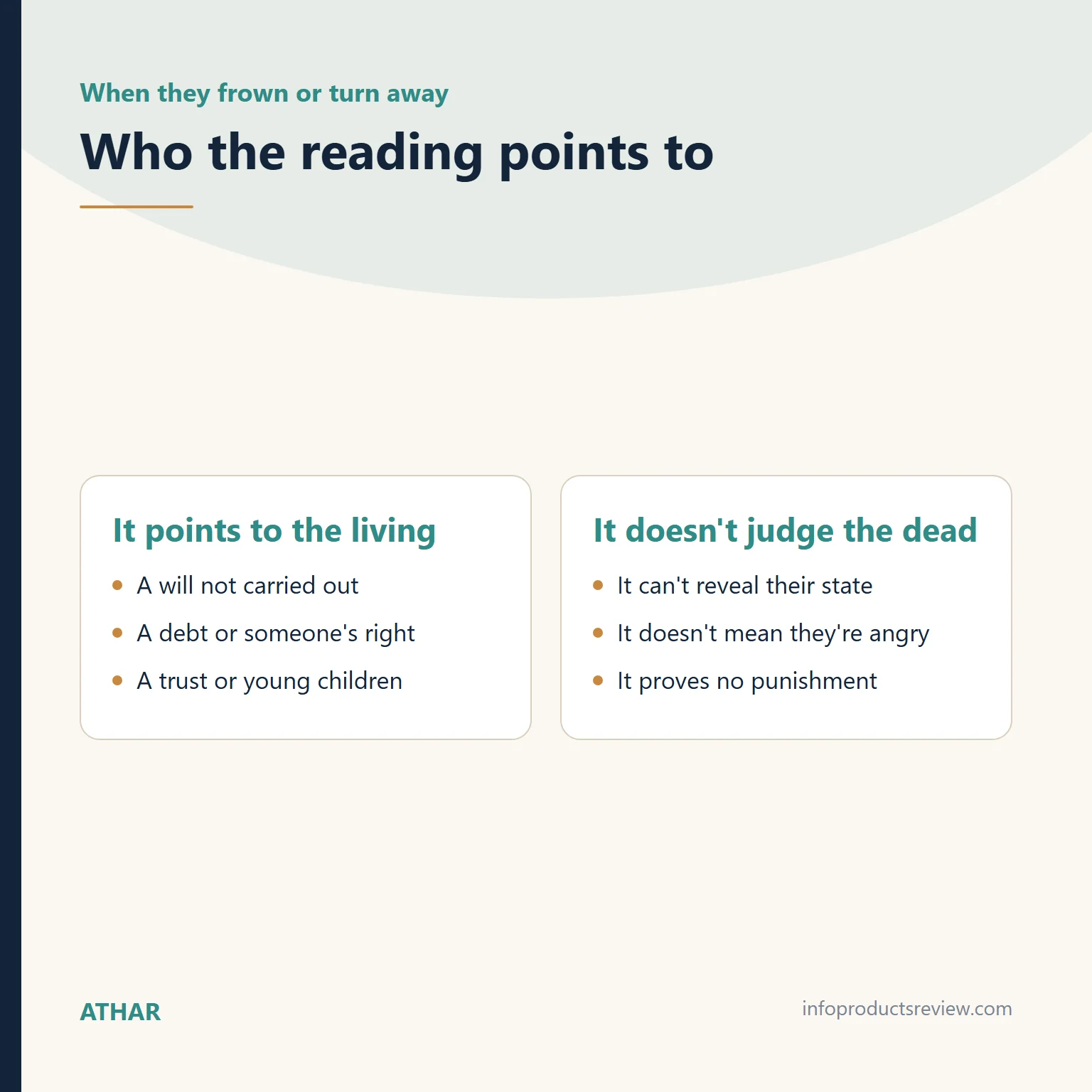
This image weighs heavily, and it opens painful questions. Are they angry with me? Did I let them down? Are they suffering? It deserves a careful reading.
In the same chapter, on the same page, Ibn Qutayba reads a frowning or averted dead person in very practical terms:
If he sees them frowning, turning away or angry, that is for the living falling short in their will, or in something left in their care.
His reading points at the living, not the dead: a will not carried out, something entrusted to you, young children whose affairs need looking after, a debt still unpaid. If the reading holds, the dream is an invitation to look calmly at real obligations, not a reason for endless guilt.
So the useful step after a dream like this isn’t hunting for a darker meaning. It’s asking practical questions. Did they leave a will, written or spoken? Is there a debt nobody has traced? Does someone have a right in what was left behind? Has a family tie they cared about gone quiet? If you find something, put it right. If you don’t, then there’s nothing to put right, and a dream doesn’t hold you responsible for what you couldn’t have known.
Grief itself can colour a dream, too. Someone who feels they didn’t say goodbye properly, or didn’t visit enough during the last illness, often sees exactly that feeling reflected back at night. Then the dream is closer to the mind working through regret than to a message, and what helps is prayer, asking forgiveness, and some gentleness with yourself.
What the image can’t do is prove that the person is being punished or that their standing is poor. That would be a judgement on the unseen, and neither an interpreter nor a dreamer can make it.
When they speak to you or tell you to do something
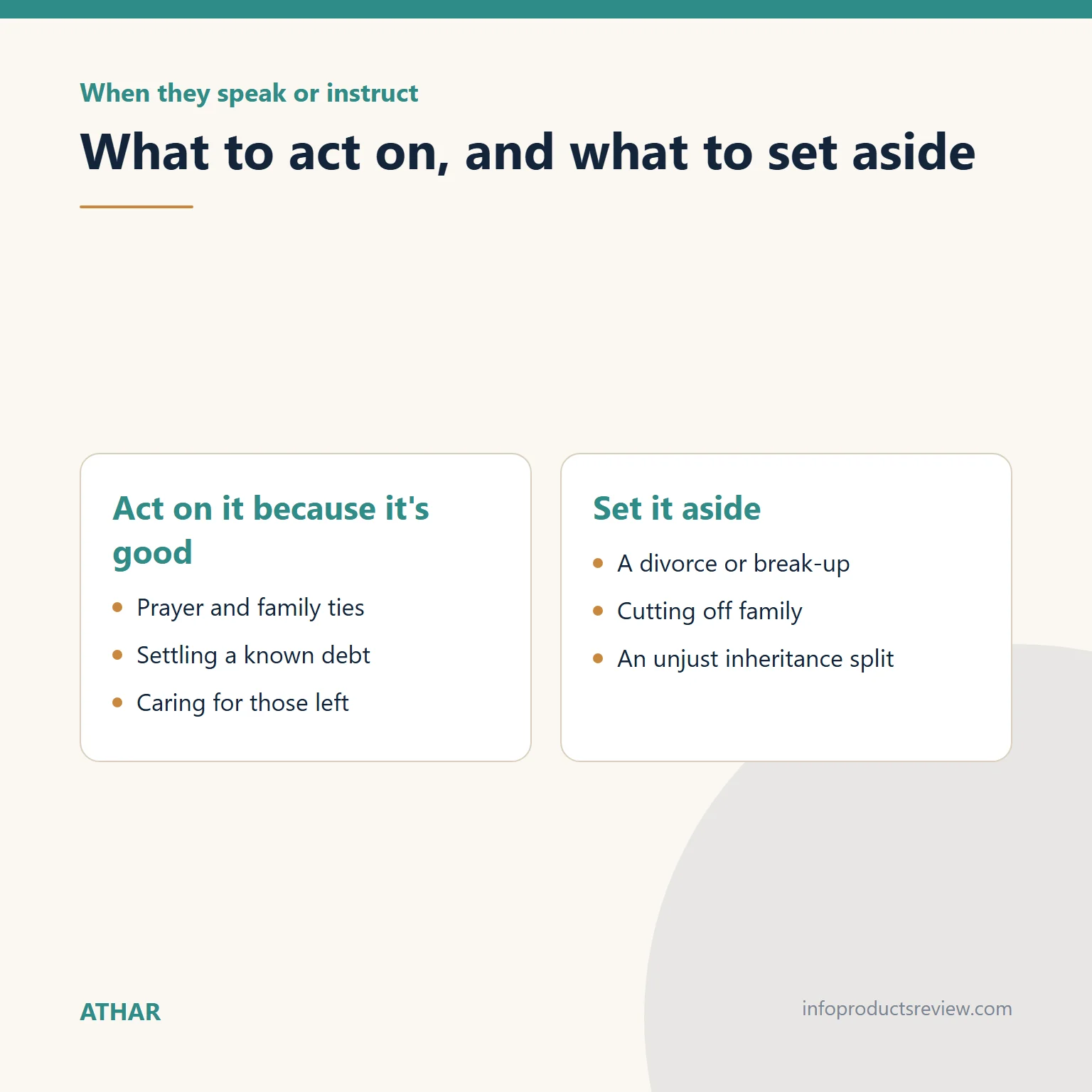
“My late father spoke to me in a dream” and “she told me to do something” are two of the most common things people search for. It matters to separate the different kinds of message, because confusing them has done real damage in families.
Words that reassure: “I’m fine,” “don’t grieve,” “I’m pleased with you.” These can be received with gratitude, and they move you to pray.
Words that remind you of something good: keeping in touch with family, prayer, looking after a surviving parent, settling a debt. These are worth acting on, but not because someone said them in a dream; they were good before the dream and remain good after it.
Words that point to something concrete: a document somewhere, a debt, something owed to someone. Check it calmly in real life. If you find something that supports it, good. If not, nothing is required of you.
Words that order something against your faith or that would break relationships: divorce, cutting off relatives, quitting a job for no reason, dividing an inheritance unjustly. These are set aside. In a published interview, one interpreter says exactly this: such “instructions” come from Satan, not from the person who died, and religion is not taken from dreams. That clip is below, in the interviews section.
The principle that ties all of this together: what the dead say in a dream is measured against your faith and your real life, never the other way round. A contemporary book on dream interpretation makes the same point, that a dream commanding what contradicts settled religious rulings comes from Satan. It’s a principle that protects families from life-changing decisions built on a picture seen in sleep.
When they ask for food, water or prayers
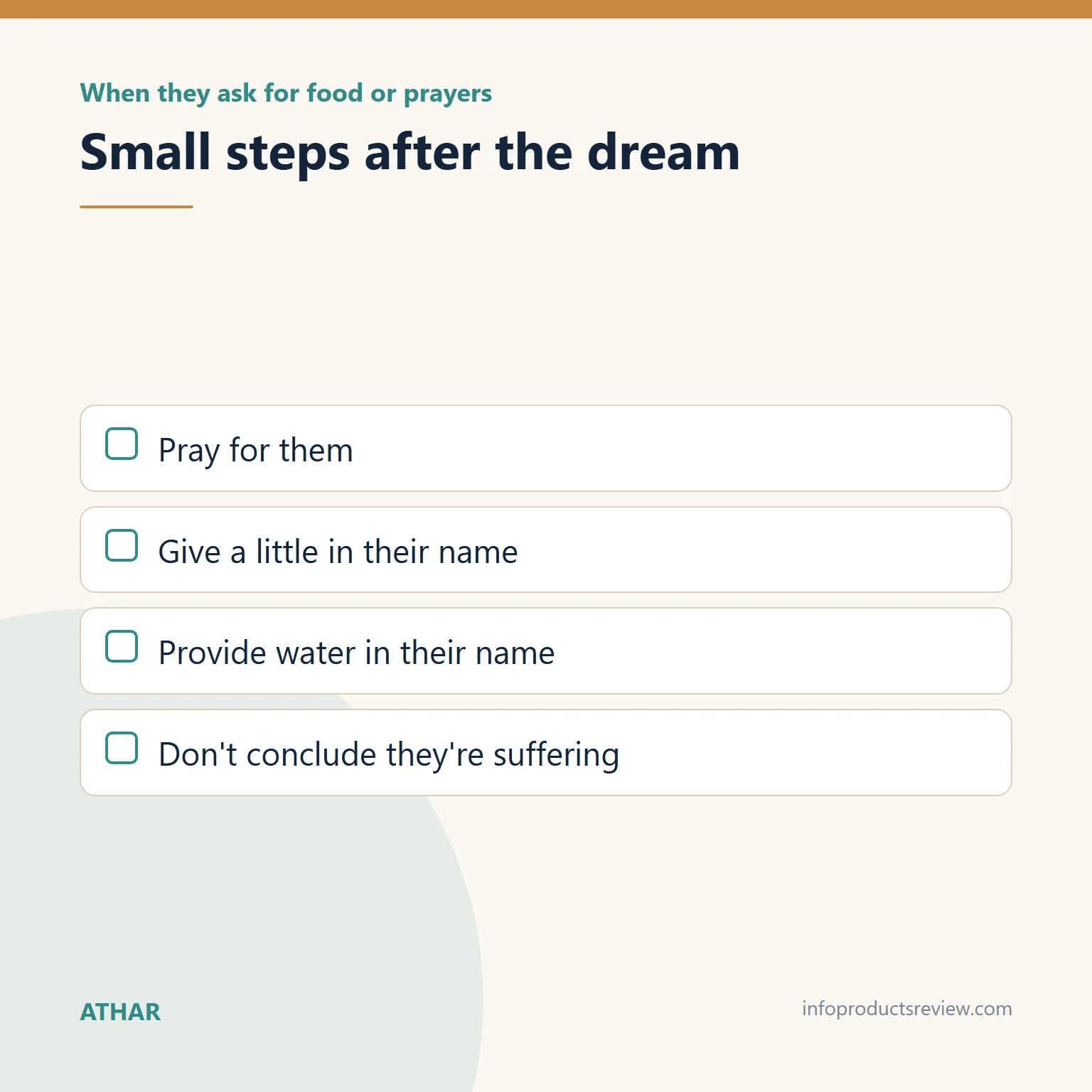
Some people dream of the dead person hungry and asking for food, thirsty and asking for water, or simply saying “pray for me.” They often wake with a heavy question: are they in need? Are they suffering?
The most practical way to read these dreams is as a reminder to pray for them and give charity in their name, both of which Muslim scholars widely hold benefit the dead. That fits Ibn Qutayba’s reading, where the dead approaching the living is tied to kindnesses like charity and prayer.
What the dream can’t do is establish that the person is in distress. Take it as a nudge towards something small and good: a prayer in your prostration, a donation however modest, a gift of water, a meal for someone in need in their name. All of these are worthwhile whether the dream carried a message or not.
If the dream keeps returning and weighs on you, follow the Prophet’s guidance on unsettling dreams, lean on prayer, and don’t let it become a source of constant fear.
When they seem alive, or tell you they’re alive
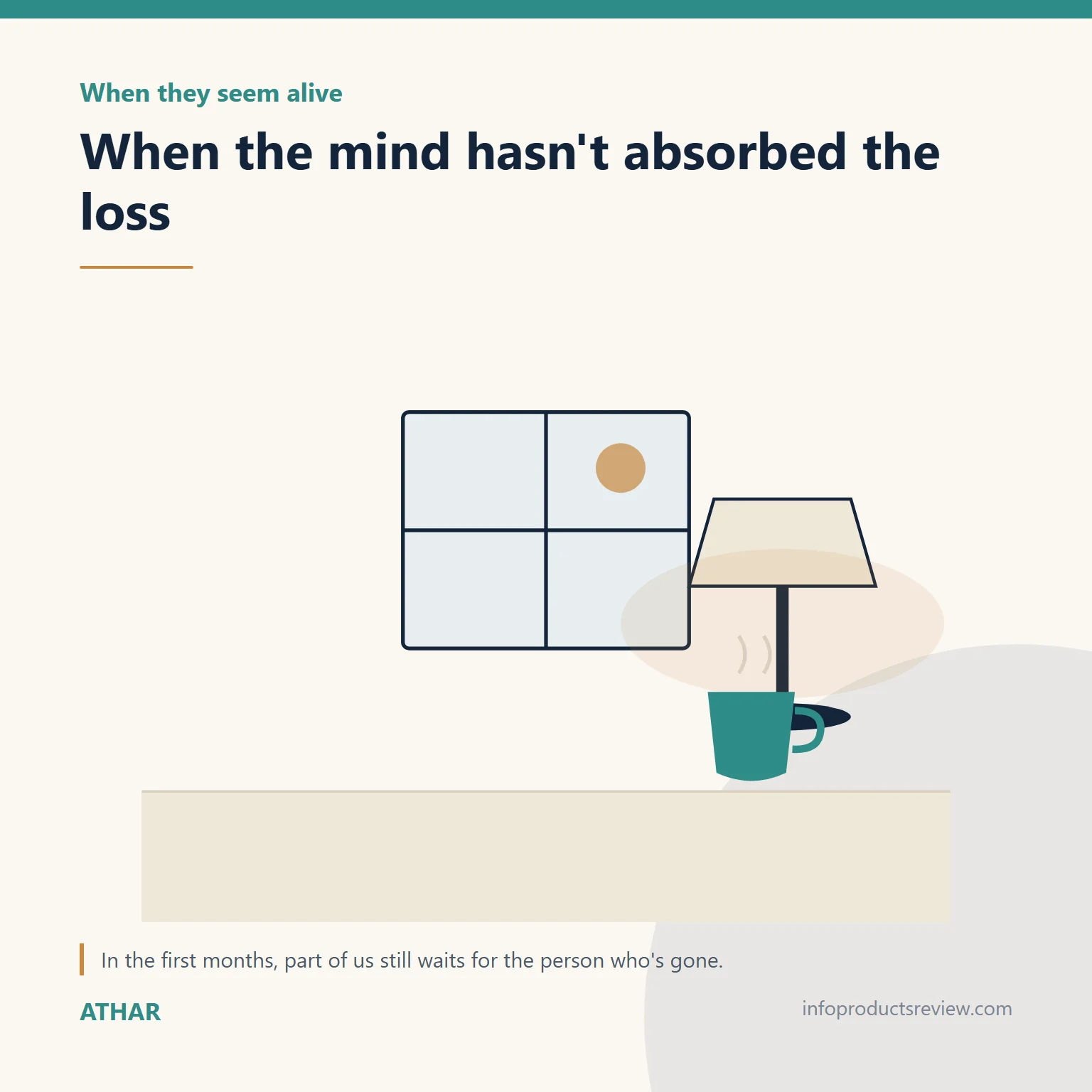
Many people see someone who has died carrying on as though they never had: walking around the house, sitting with the family, behaving as if nothing happened. Sometimes they even say it outright: “I’m alive.”
At the start of the chapter we checked, Ibn Qutayba reads a dead person telling the dreamer they are alive as a sign that their state is good, and he cites the Qur’anic verse that those killed in God’s cause are not dead but alive with their Lord. That’s an interpreter drawing comfort from a verse, not a statement about any particular person.
There’s another side to this dream that shouldn’t be overlooked. When a loss is recent, the mind often hasn’t absorbed it yet. In the first weeks and months, part of us still expects their name to light up the phone or their key to turn in the door, and the dream gives that expectation a picture.
Waking up from a dream like this and remembering can hurt. That’s normal, and it doesn’t make the dream a bad one. Be gentle with yourself that morning, and pray for them.
When you embrace them, hold their hand or kiss them

Holding someone you’ve lost in a dream can stay with you long after waking: the warmth of a hand, a face close to yours, the feeling that you finally said what you didn’t get to say.
Some people are frightened by this image because of a common claim that embracing the dead means your own death is near. The passage we checked in Ibn Qutayba’s chapter says the opposite: he reads embracing and mingling with a dead person as long life for the living. It’s still an interpreter’s reading, but it’s enough to show that the frightening version doesn’t come from this source.
Shaking hands, kissing or simply sitting with them are most naturally read as images of closeness, longing and lasting love. If something between you was never resolved before they died, the dream may reflect a wish for reconciliation, and the way to answer it is to pray for them and ask forgiveness for you both.
When they are sleeping, unwell or exhausted
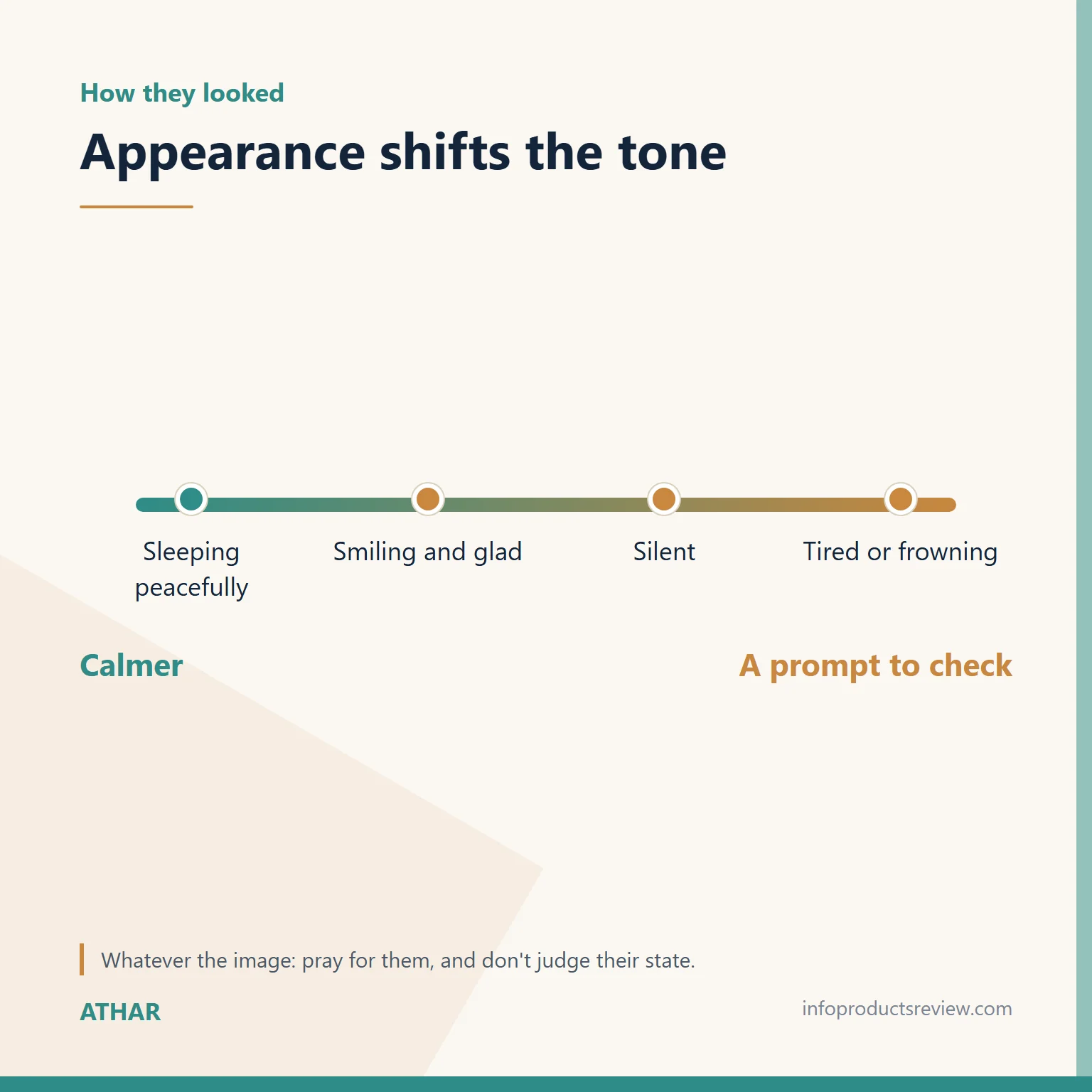
Seeing the dead sleeping peacefully is read by Ibn Qutayba, in the passage we checked, as their rest. It’s one of the quieter images, and a comforting one.
Seeing them ill, exhausted or in a state that disturbs you is among the hardest images for a family. Some classical books give harsh readings of this, and we’ve chosen not to present them in a way that pronounces on anyone’s condition, both because what happens after death is unseen and because those readings can wound a grieving person for no benefit.
The most useful response is to treat the dream as a prompt to pray, give charity and ask forgiveness for them, and to check whether they owed anything to anyone. It may also simply be an echo of how you last saw them. People who sat with someone through a final illness often find those scenes returning at night.
If this image keeps coming back and hurts, talk about it with someone you trust. You don’t have to carry the memory of those last days alone.
Dreaming of a parent who has died
Dreams of a mother or father who has died carry their own weight, because no other relationship is quite like it. They often hold one of three things: longing, a sense of responsibility for what they left behind, or a need to know they were pleased with you.
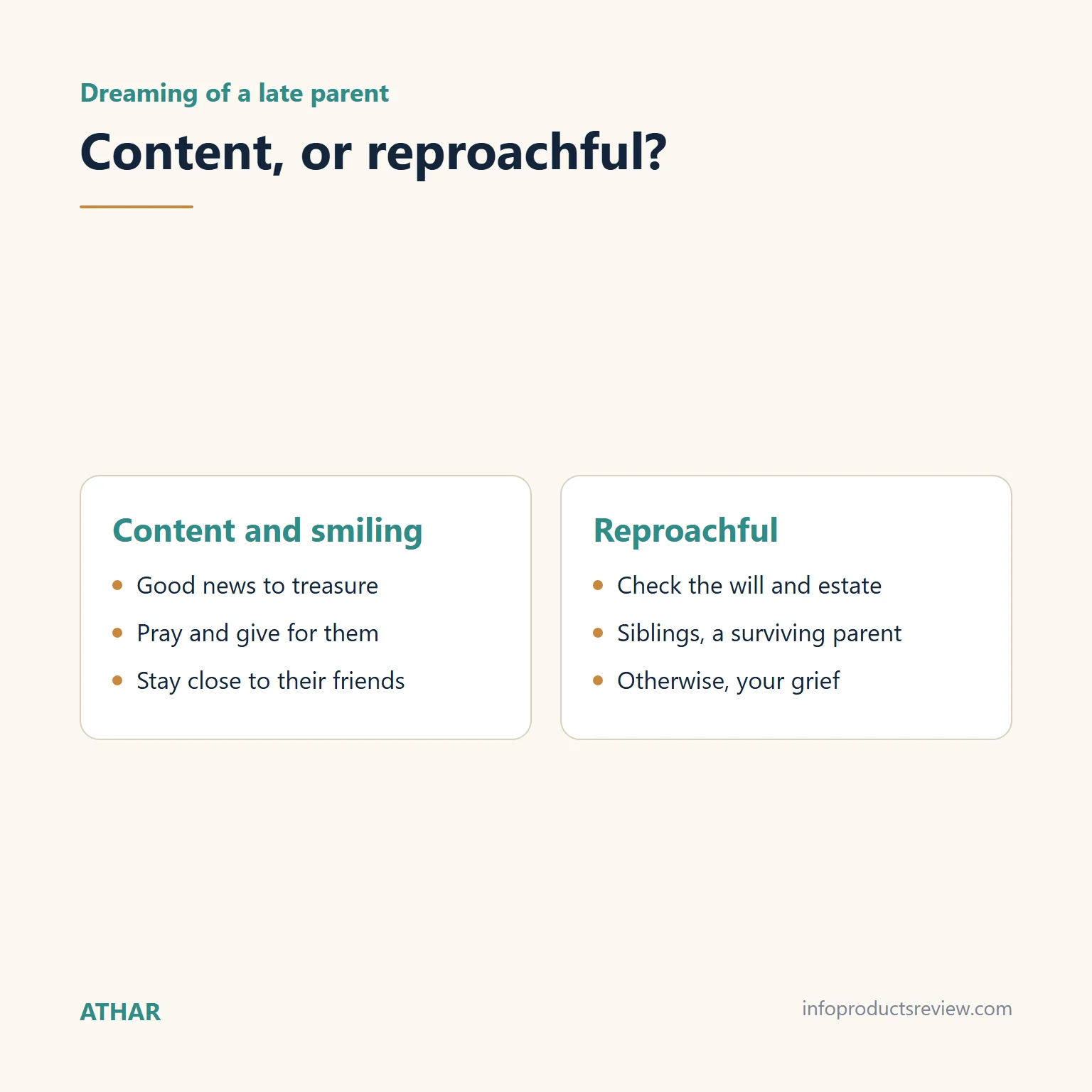
If they looked content and smiled: this is the kind of dream people treasure. It’s a good moment to honour them the ways that remain open: praying for them, giving charity for them, staying close to their friends and relatives.
If they seemed to reproach you: on Ibn Qutayba’s reading, the first thing to check is their will and what they left in your care: younger siblings, a widowed parent, a debt, an inheritance not yet settled properly. If everything is in order, the dream is more likely your own grief and longing than a real reproach.
If they asked you to look after your siblings or your surviving parent: that’s worth doing because it is kindness and family loyalty, whether the dream was a message or not.
Honouring parents after their death, as Muslim tradition describes it, includes praying for them, asking forgiveness for them, keeping their promises, maintaining the family ties that ran through them, and being generous to their friends. All of that is open to you now, without waiting for a dream.
When the loss is recent: dreams during mourning
In the days and weeks after a death, families often dream of the person they’ve lost. The reason is usually plain: they’re on your mind constantly, sleep is broken, the house is full of their things, and every visitor talks about them.
Mourning also brings a lot of interpretations from visitors and relatives, some comforting and some frightening: “they came because they want something,” “if you see them three nights running, it means…” Most of this has no source at all.
The most important advice for this stage: don’t let dreams become the centre of your grief. Pray for them, read what you can, give in their name if you’re able, carry out what you know of their wishes, and let yourself grieve. If a dream comforts you, take the comfort. If one disturbs you, seek refuge in God. Don’t add more to it than that.
Does it mean something different for women, men, or during pregnancy?
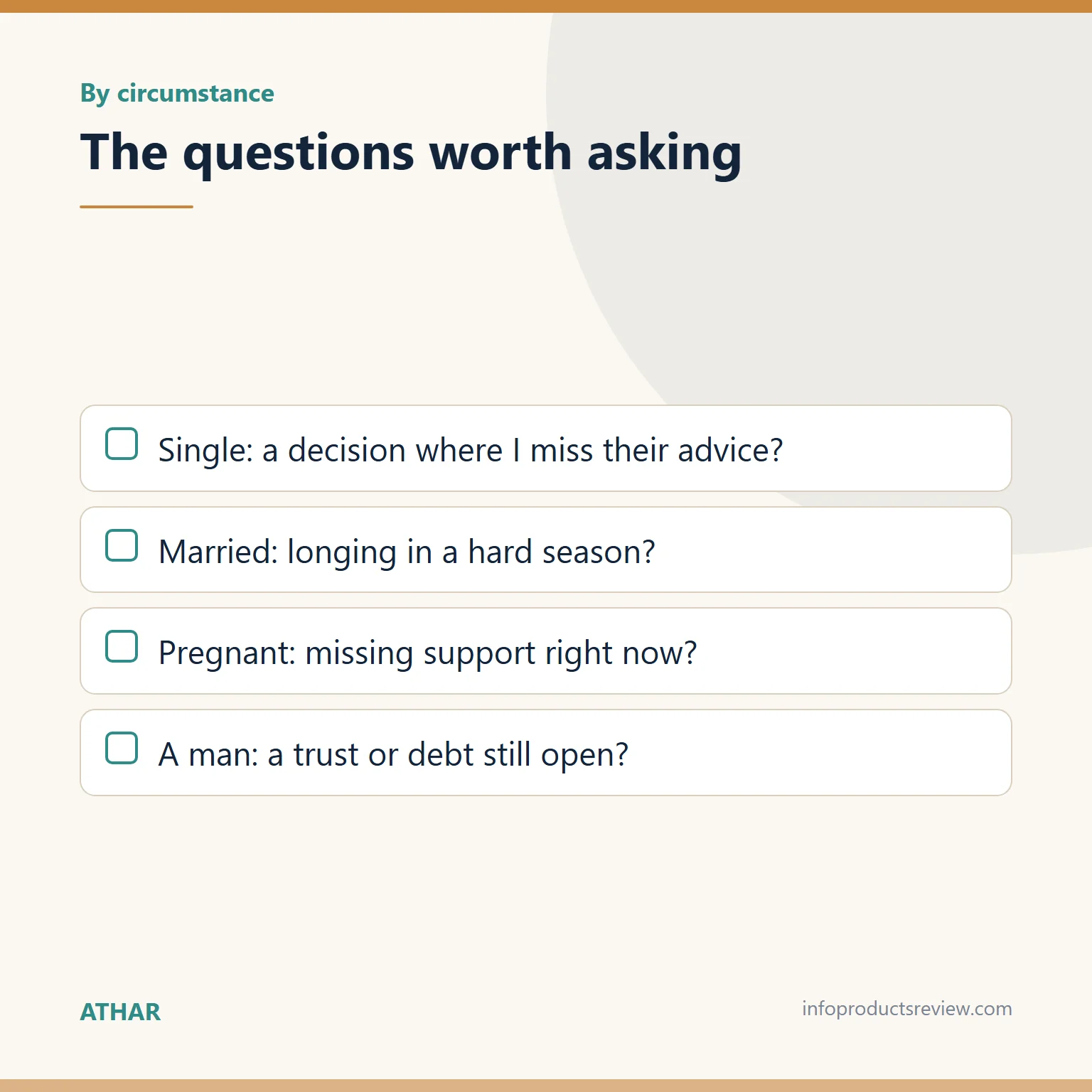
People often ask what this dream means for a single woman, a married woman, a pregnant woman, a divorced woman or a man. The core reading is the same for everyone. Your circumstances change which questions are worth asking, not the meaning itself.
If you’re single: dreams of a late parent or grandparent often arrive at decision points, such as study, work or a marriage proposal. They most naturally reflect missing the person whose advice you relied on. The dream doesn’t set a wedding date or oblige you to accept or refuse anyone. If a real decision is in front of you, consultation and the prayer for guidance matter far more than the dream.
If you’re married: the dream may carry longing for family you’ve lost, especially in hard seasons, around childbirth, or during conflict. If the dead person seems to tell you to leave your husband or cut off his family, that isn’t something to act on, or to present to your spouse as a message.
If you’re pregnant: many women dream of a late mother or grandmother in the final months, most likely because they miss the person who would have supported them through it. The dream says nothing about the baby or the birth. If a name or an event comes up in it, it isn’t a reason to worry.
If you’re divorced: the dream may reflect a need for support, or a longing for the family home as it used to be. It isn’t a judgement on the divorce or on what comes next.
If you’re a man: dreams of a late father often connect with the responsibility that has passed to you, looking after a mother and siblings, managing what was left, settling what was owed. If he seemed to reproach you, the practical question is whether a trust, a debt or a wish remains unfulfilled.
Does a dream at dawn mean more?
It’s widely said that dawn dreams are the truest, and that dreaming of the dead just after dawn has a special meaning. In the sources we checked for this page, we found no rule that gives a dream of the dead after dawn a separate meaning.
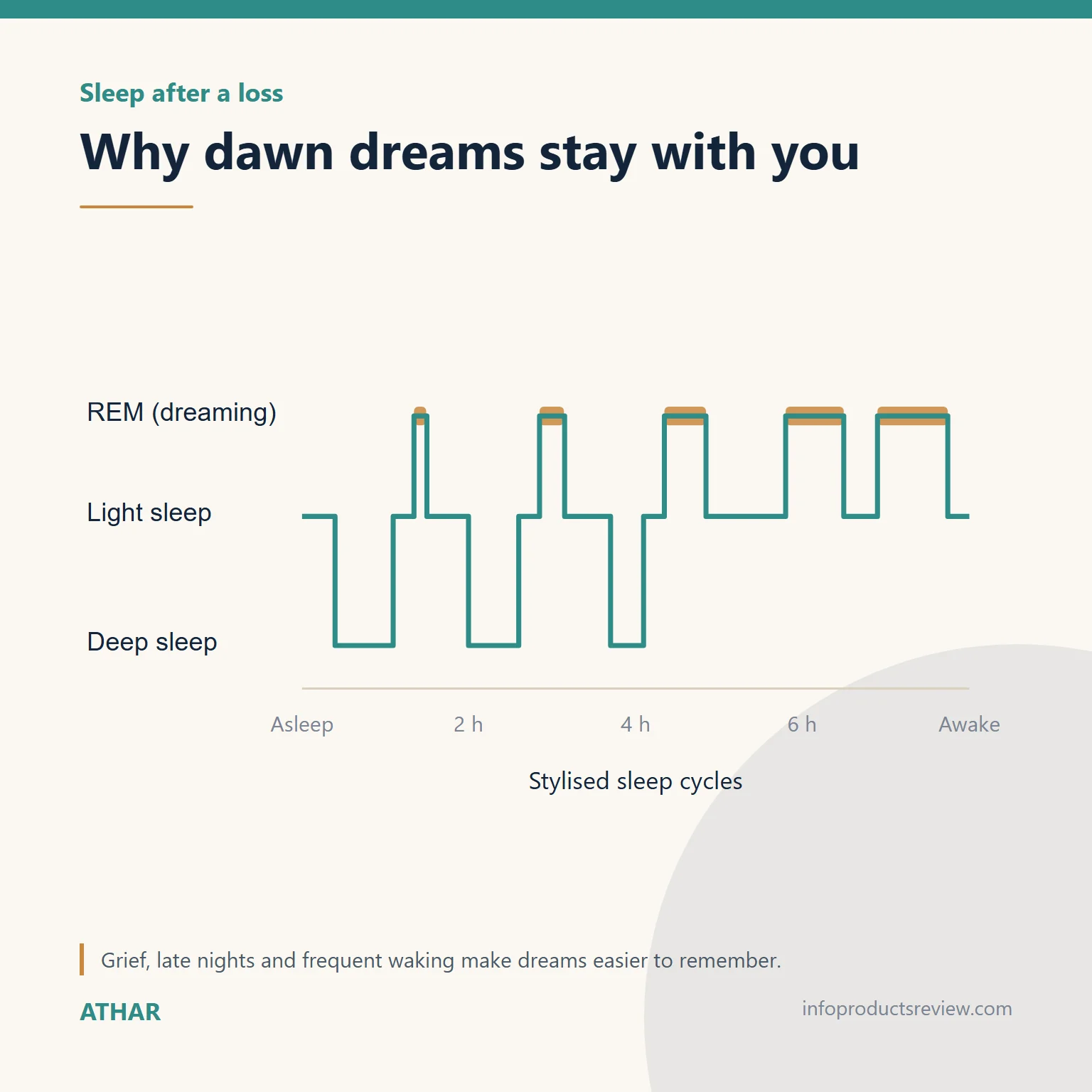
What general health references do say is something else: dreaming (REM) periods grow longer later in the night. That may be part of why dawn dreams can feel so vivid and stay with us. Vividness doesn’t make a dream true, and it doesn’t make it false.
It’s better to read the dream by its details and your circumstances than by the clock.
What do the classical dream books actually say?

Ibn Qutayba al-Dinawari, a scholar of the ninth century, devoted a whole chapter of his Ta’bir al-Ru’ya to seeing the dead. We checked its pages in the critical edition and quoted only what we read directly on the page image.
Two things stand out in that chapter. First, its readings mostly point towards the living: a kindness they do, a will they neglect, long life, a good state. Second, it relies on how the dead person appears and what they do, not on the mere fact that they appeared.
A contemporary book on rules of dream interpretation states that what comes from “the abode of truth”, meaning the hereafter, is usually true when supported by other indications, and gives dreams of the dead as an example. That’s a modern author’s rule, not a religious text, and its qualifiers matter: “usually” and “when supported”. The same book says that a dream commanding what contradicts settled rulings comes from Satan, which stops the rule from becoming blanket acceptance of whatever the dead say in sleep.
Some classical books contain frightening readings of certain images of the dead. We only present what we’ve checked on the page, and we avoid anything that would wound a grieving reader or pronounce on anyone’s fate.
What about the book attributed to Ibn Sirin?
Many websites attach confident meanings for dreams of the dead to Ibn Sirin, with no book or page. Muhammad ibn Sirin was an early Muslim scholar who died in 110 AH (728 CE). The famous dream book that circulates under his name is attributed to him, and scholars who have examined it do not accept that attribution as established.
So we put it precisely: a book attributed to Ibn Sirin contains material about dreams of the dead, and we haven’t relied on it here, because we haven’t traced it to a critical text we can quote with a page number. What we quote comes from Ibn Qutayba, whose authorship is documented and whose book exists in a critical edition.
Interestingly, Ibn Qutayba’s own chapter on the dead includes reports transmitted with a chain of narrators back to Muhammad ibn Sirin. That shows how Ibn Sirin’s views on dreams often reached us: scattered through other scholars’ books, not in one volume he wrote himself.
What is actually established about unsettling dreams?
Two things often get blurred together. One is interpreting an image of the dead, which is human judgement. The other is the Prophet’s guidance on what to do after a dream you dislike, which is recorded in the most authoritative hadith collections.
If a dream of someone who has died left you shaken, that guidance doesn’t ask you to find its meaning. It asks you to seek refuge in God and leave it alone. In Sahih al-Bukhari:
If he sees something he dislikes, let him seek refuge in God from its harm and the harm of Satan, spit lightly three times, and tell no one; it will not harm him.
In a separate hadith in Sahih Muslim (2262), narrated by Jabir, the instruction is to spit to the left three times, seek refuge in God from Satan three times, and turn away from the side you were sleeping on. So if you wake up distressed: seek refuge in God, spit lightly to your left three times, turn over, and don’t retell the dream to everyone. The hadith is explicit that it will not harm you.
If the dream gladdened you, the guidance is to thank God and share it with people you love.
Much more is not established. Nothing makes a dream of the dead proof that someone will die. Nothing makes a dream “instruction” binding on a divorce, a family rift or an inheritance. Nothing lets a dream pronounce on the fate of the person who died. Worship and religious rulings come from scripture, the Prophet’s teaching and qualified scholars, not from dreams.
Grief and dreams: what happens to sleep after a loss?
We keep this section apart from the classical one on purpose, because they answer different questions and blending them distorts both.
General health references note that dreaming (REM) periods grow longer later in the night, and that people under stress or anxiety are more likely to have frightening dreams. It’s plausible that the days after a loss, with late nights, frequent waking and constant thoughts of the person who’s gone, make such dreams more likely, though that varies from person to person.
Reactions to these dreams can differ widely: some people may find them comforting, others painful or frightening. No single reaction, on its own, means something is wrong.
This overlap between grief and dreaming is an observation about human experience. It doesn’t prove that every dream of the dead is just the mind processing, and it doesn’t prove that they’re all messages. Nor does a dream diagnose depression or complicated grief; that’s work for a professional.
When is a dream more likely your mind processing the loss?
No single sign settles it, but several together say a lot:
- You dreamed of them after a day of talking about them or looking at their photos.
- The dream came near the anniversary of their death or a family occasion they used to attend.
- It replayed a scene from their final days exactly as you lived it.
- You went to bed exhausted, or woke many times in the night.
- Before sleeping, a question about them was on your mind: were they pleased with me? Did I do enough?
If several of these apply, the dream is most likely an echo of what’s weighing on you. That doesn’t make it worthless. It tells you something true about your love and your grief, and it invites you to pray for them and to be kind to yourself.
Common claims that need correcting
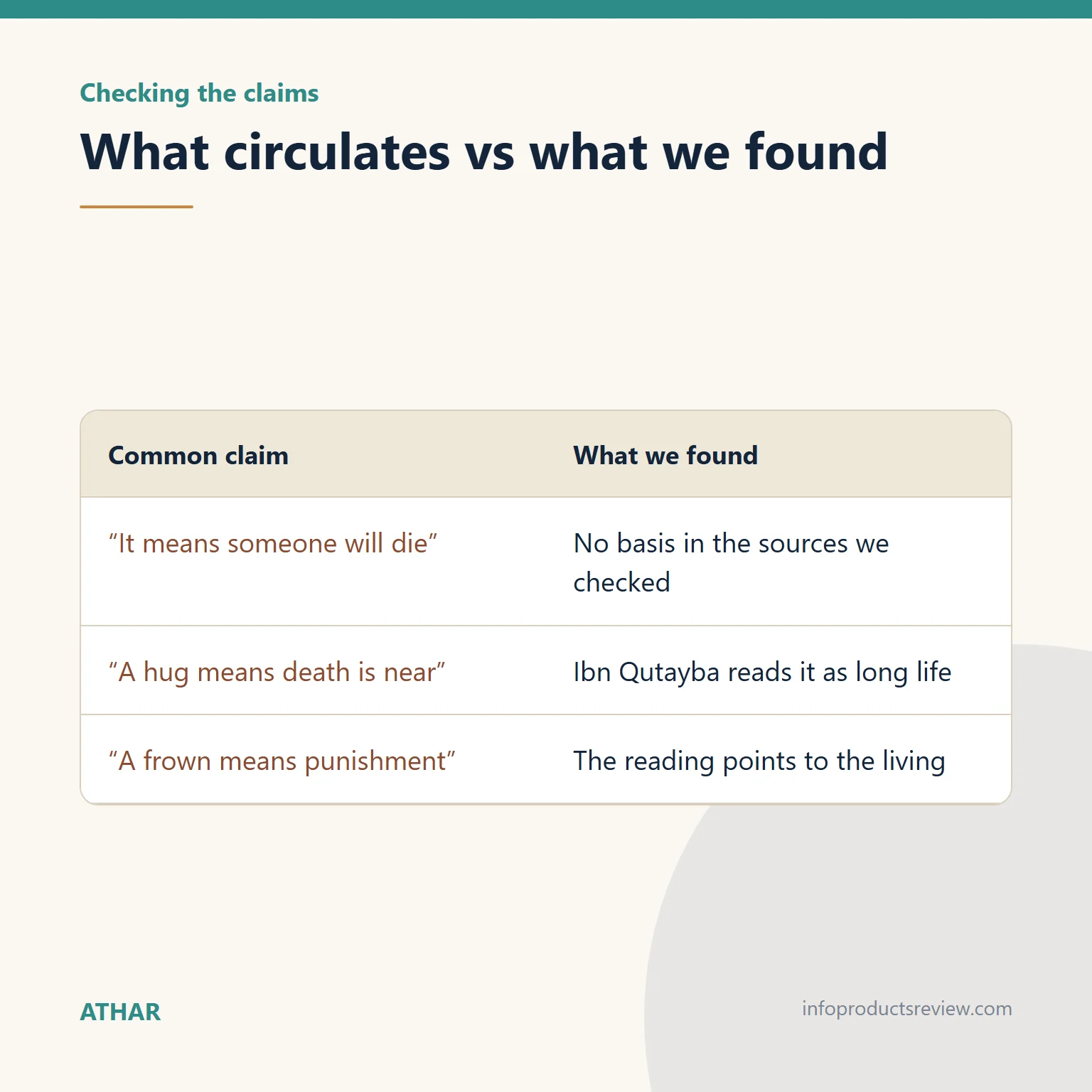
- “Dreaming of the dead means someone in the family will die.” We found no basis for this in the sources we checked, and no one should be frightened about death because of a dream.
- “Hugging a dead person in a dream means your own death is near.” The passage we checked in Ibn Qutayba reads embracing the dead as long life for the living, the opposite of the popular claim.
- “If they looked angry, they’re being punished.” Their state is unseen. The reading we checked points to the living falling short on a will, not to the condition of the dead.
- “Whatever the dead say in a dream is true and must be carried out.” What agrees with goodness is worth doing because it’s good. What contradicts your faith is set aside, however often the dream repeats.
- “Don’t tell anyone for three days after dreaming of the dead.” We know of no source for that rule. What’s established is that a disliked dream isn’t retold, and a good one can be shared with people you love.
- Attributing fixed meanings for dreams of the dead to Ibn Sirin as settled fact. The popular book is only attributed to him, that attribution isn’t established, and quoting it with certainty claims more than is known.
What this dream cannot tell you
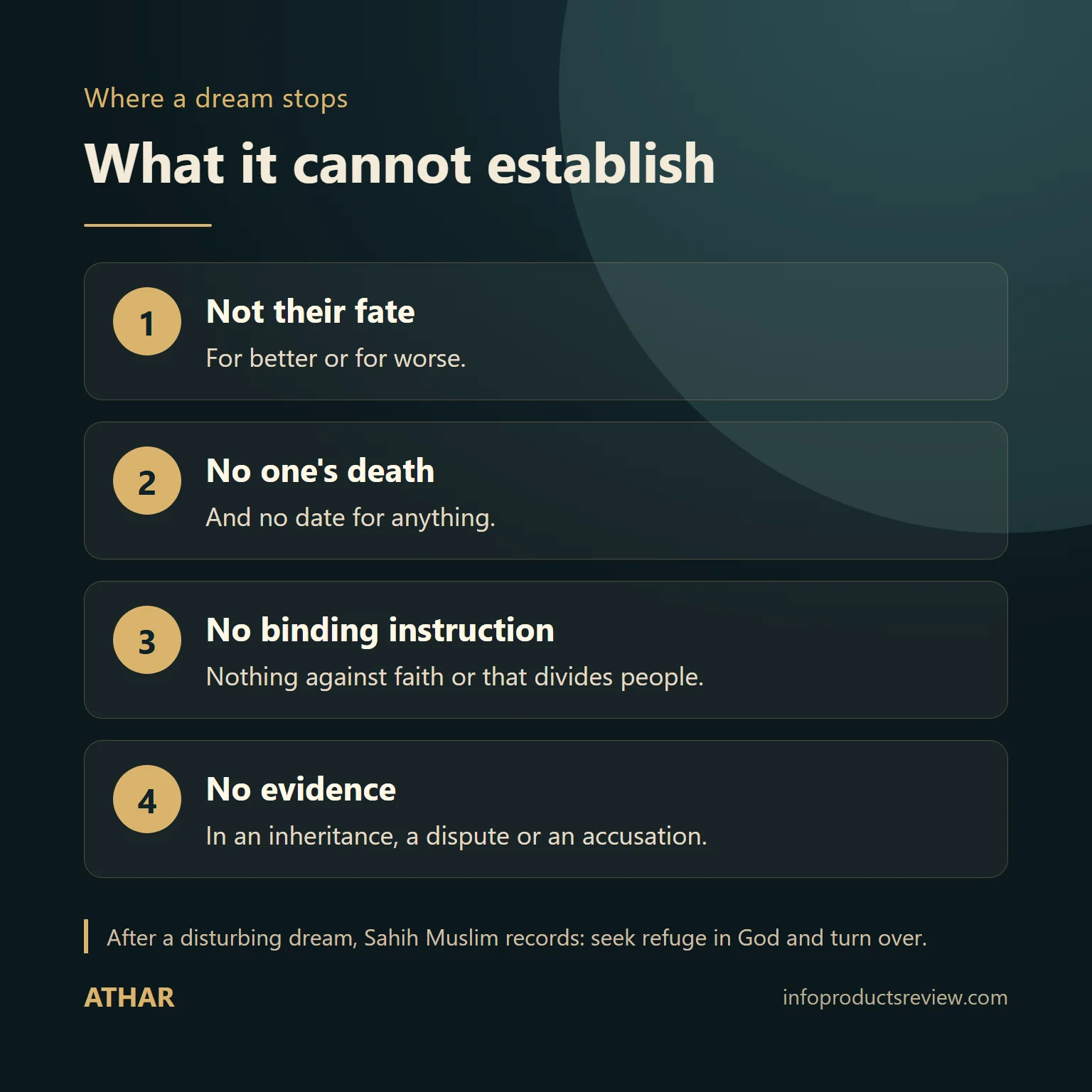
- It can’t reveal the fate of the person who died, for better or worse.
- It can’t predict anyone’s death or set a date for one.
- It can’t bind you to an instruction that contradicts your faith or divides people.
- It isn’t evidence in an inheritance, a dispute or an accusation.
- It can’t create a religious ruling or a new act of worship.
- It doesn’t mean you failed them, or that they’re angry with you.
What to do after dreaming of someone who has died
- Settle first. If the dream disturbed you, seek refuge in God and turn over. If it comforted you, thank God.
- Pray for them. It’s the most useful thing you can do after any dream of them, message or not.
- Give something in their name if you’re able, however small.
- Check what concerns them in real life: a will, a debt, something owed to someone, a family tie they valued.
- Don’t make a major decision on the strength of the dream: marriage, divorce, inheritance or cutting anyone off.
- Be gentle with yourself. Grief isn’t a failing, and a painful dream isn’t a punishment.
How to describe your dream so it can actually be read
- Who it was, how you were related, and when they died.
- How they looked: well or tired, smiling or frowning.
- What they said or did: speaking, asking, giving, embracing.
- How you felt, during the dream and after waking.
- Your real situation: is there a will, a debt, or an unresolved disagreement?
What have interpreters said in recorded interviews?
Two short pointers to published interviews, because hearing how someone reasons can be clearer than reading about it. Take them for what they are: personal views, not religious rulings and not a reading of your dream.
In the first, an interpreter discusses “instructions” from the dead in dreams. He separates advice that agrees with religion, which can be followed, from dreams that command a break-up or cutting off family, which he treats as coming from Satan. He also describes seeing the dead in good clothes and a good state as a hopeful sign for them.
Why it's here: the speaker holds that a deceased person 'instructing' a divorce or a family rift in a dream is not to be acted on, and that religion is not taken from dreams. Summarised from the Arabic interview; an opinion, not a ruling. Not a religious ruling or a definitive interpretation.
In the second, a different interpreter draws a line that matters for anyone who has dreamed of the dead telling them what to do: don’t build the big decisions of your life on dreams.
Why it's here: a practising interpreter's own view, paraphrased. Don't build life decisions on dreams. An opinion from an interview, not a religious ruling or a definitive interpretation.
That agrees with the established prophetic guidance: a dream can gladden and reassure you, but it doesn’t replace faith, good sense, and checking things in the real world.
A few typical scenes
A daughter dreams her late mother smiles and says, “I’m fine.” A reassuring image. What helps afterwards is praying for her mother, giving charity in her name, and being gentle with her own grief.
A man dreams his late father frowns and won’t speak to him. On Ibn Qutayba’s reading, he might check his father’s will and the needs of those his father supported. If everything is in order, the dream is more likely an echo of grief or of feeling he fell short.
A woman dreams her late grandmother asks for water. Read as a reminder to pray and give charity for her, perhaps providing water in her name, without concluding that she is in distress.
A young man dreams a friend killed in an accident is alive and joking with him. Dreams like this often come in the first months after a sudden loss, when it hasn’t fully sunk in. It’s an image to take comfort from.
A husband dreams his late father tells him to divorce his wife. Not something to act on: he seeks refuge in God, doesn’t pass it on as a message, and builds nothing on it.
Quick reference: detail and nearest reading
| Detail in the dream | Nearest possible reading |
|---|---|
| They look well and glad | Good news that moves you to pray and give |
| They frown or turn away | Check a will or an obligation in real life |
| You embrace them | Closeness and longing; for Ibn Qutayba, long life |
| They sleep peacefully | For Ibn Qutayba, their rest |
| They tell you they’re alive | For Ibn Qutayba, a good state |
| They ask for prayers or food | A reminder to pray and give charity |
| They advise something good | Worth doing because it is good |
| They order a divorce or a rift | Set aside |
| Soon after the death | A natural echo of loss |
Related guides
- All English dream guides by topic — every guide reads a symbol by its details first, then its limits.
- Snake dream meaning: what the details change — another dream that circulating pages turn into a warning of death without any basis.
- ATHAR — dream meanings with sources — how we check attributions before we publish them.
Frequently asked questions
Is it good or bad to dream of someone who has died?
It can’t be summed up in one word. It’s read by how they looked, what they said and how you felt. A good appearance is among the most reassuring images; a disturbing dream is met by seeking refuge in God, and it won’t harm you.
A dead person spoke to me in a dream. Is what they said true?
Measure it against your faith and your real life. Something clearly good is worth doing because it’s good; anything that contradicts your religion or divides people is set aside.
Does dreaming of the dead mean someone will die?
No. We found no basis for that in the sources we checked, and no dream sets a date for anyone’s death.
My late father looked angry in my dream. Is he angry with me?
That can’t be concluded. Ibn Qutayba reads a frowning dead person as the living falling short on a will or on what was left behind, so check that calmly. If nothing is outstanding, the dream is more likely your grief.
What does it mean to hug a dead person in a dream?
Most naturally, closeness and longing. The passage we checked in Ibn Qutayba reads embracing the dead as long life for the living, not approaching death.
I dreamed a dead relative asked for food. Are they in need?
Their state can’t be judged from a dream. Read it as a reminder to pray for them and give charity in their name, both good in any case.
What should I do after a disturbing dream of the dead?
You don’t need to interpret it. The established guidance is to seek refuge in God from its harm, spit lightly three times and not retell it, as recorded in Sahih al-Bukhari (7044). Sahih Muslim (2262) specifies the left side and adds turning away from the side you were lying on.
Do I have to carry out a dead person’s instruction from a dream?
A dream doesn’t bind you. If the instruction is good and agrees with your faith, do it because it’s good; if it contradicts your faith, don’t.
Does dreaming of the dead at dawn mean something special?
We found no rule in the sources we checked that gives dawn dreams of the dead their own meaning. Late-night dreams are more vivid in memory, which isn’t the same as being true.
If I see them alive and well, does it mean they’re in paradise?
It’s good news to take heart from and a reason to pray for them, but no dream can pronounce on anyone’s fate. Ibn Qutayba read it as a good state, which is an interpreter’s judgement.
I dream about my late mother often. Is that normal?
Yes. It’s very common after a loss and around meaningful dates. If grief is making it hard to get through your days for a long time, talking to someone you trust or to a professional really helps.
Is any of this certain?
No, and that’s deliberate. What we offer are possible meanings that shift with the details. None of it predicts the future or reveals the unseen.
In summary

- Dreaming of someone who has died sits closest to longing, memory and what still connects you to them.
- A good appearance and a glad approach are among the most reassuring images, and they move you to pray and give.
- For Ibn Qutayba, a frowning dead person is a prompt to check wills and obligations, not a judgement on them.
- What the dead say in a dream is weighed against your faith and your real life, and binds you to nothing.
- No dream reveals anyone’s fate, predicts a death, or justifies an inheritance dispute or a family rift.
- After a disturbing dream: seek refuge in God, turn over, and pray for them.
If you take one thing from this page, let it be this: the person you lost doesn’t need you to decode a dream. They need your sincere prayers, your faithfulness to what they left, and your kindness to yourself while you grieve.
If grief feels heavy: losing someone you love is one of the hardest things a person goes through, and it’s natural for grief to last and for memories to return in sleep. If grief is keeping you from sleeping, working or looking after yourself for a long stretch, speaking with a doctor or a mental-health professional is a brave and useful step. It’s not a lack of faith or of loyalty.
Written and reviewed by: the ATHAR editorial team. Classical and hadith quotations are taken from the named editions and checked against the page image; English renderings of Arabic texts are our own translation.
Last reviewed: 15 September 2026.
Note: what appears here is a possible meaning, not a confirmed fact, and it changes with the details of the dream and the dreamer’s circumstances. Nothing here reveals the state of anyone who has died, predicts a death, binds anyone to an instruction, or offers a religious ruling or medical advice.