

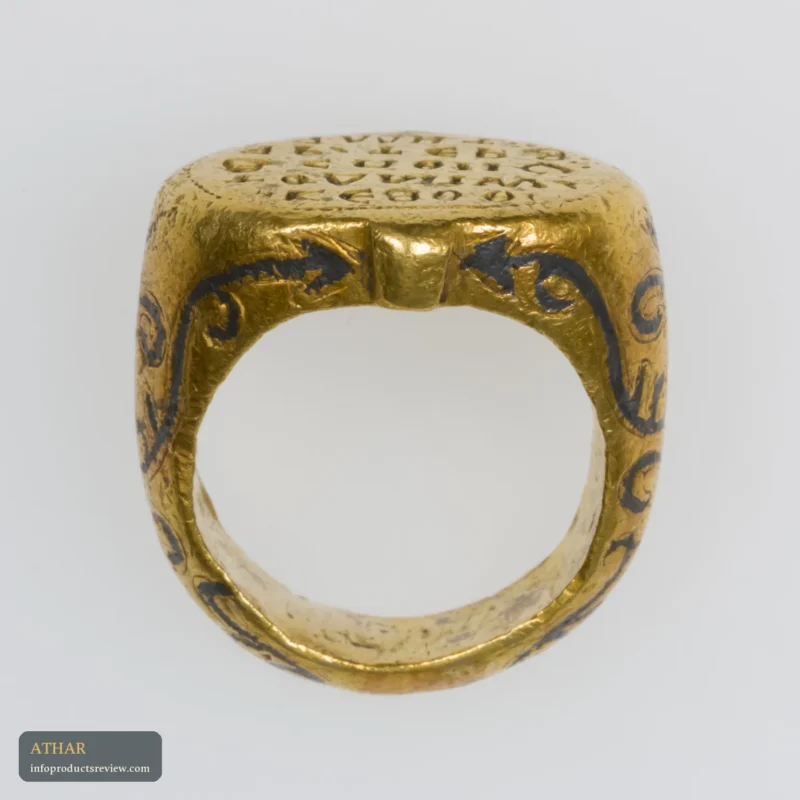
You dreamed of a gold ring: on your finger, handed to you by someone, its band broken with the stone still there, or lost and searched for. Then you woke up asking what a gold ring means in a man’s dream, and whether it says anything about your work, your money, or something you’ve been waiting on.
The ring is one of the most detailed symbols in the classical dream books, and one of the most clearly addressed to a male dreamer: its making and engraving, its stone and its band, sealing with it, and who gave it to you. That’s why it has its own page here, after the short section on rings in Dreaming of Gold as a Man.
As on that page, we keep the waking religious ruling separate from the reading of the symbol. The first belongs to qualified scholars; the second is interpretive reasoning that can’t be treated as certain.
The bottom line
- A well-made, engraved ring: for Ibn Qutayba, its owner’s authority, or part of what he owns.
- It may also be a woman, money or a child: possibilities the text lists with “may”.
- The stone: the face by which the ring changes things, and in a report from al-Asma’i a ring in sleep is a woman, her beauty matching the quality of the stone.
- The band breaking while the stone remains: authority or possession lost, reputation and standing remaining.
- A gold ring specifically: “what is attributed to him is unlawful” — a possibility within interpretation, not a verdict on your earnings.
- The ring is one of the exceptions for a man: one of the three pieces Ibn Qutayba says suit a man, with the necklace and the earring.
What this page covers
- The bottom line
- Why rings turn up in dreams so often
- A well-made, engraved ring
- The stone, and al-Asma’i’s report
- Being given a ring and sealing with it
- The band breaks and the stone remains
- The metal: gold, iron, brass or lead
- A note: the ruling and the interpretation
- Sealing clay, or sealing a letter
- A ring from a king or ruler
- The ring is one of the exceptions for a man
- When the text says a ring may be a woman
- A ring lost or stolen
- Finding a ring
- Being given a ring at an occasion
- A ring too tight, too loose, or stuck
- Which hand was it on?
- A plain ring, or one with no stone
- More than one ring on a hand
- Taking the ring off
- A ring you inherited, or your father’s ring
- The ring, promises and agreements
- What about a silver ring?
- A ring too big or too heavy
- The ring and your work
- How the interpreters actually read this symbol
- When someone says your dream proves wrongdoing
- If the dream keeps coming back
- If the dream worried you
- What if you don’t remember the details?
- The engraving on the ring
- A ring on another man’s hand
- Wedding bands
- How the dream felt
- Rules that govern this reading
- Getting something practical from the dream
- Common claims that need correcting
- What this dream can’t tell you
- What to do after the dream
- How to describe your dream so it can be read
- What you can take away with confidence
- Examples
- An engraved ring worn with ease
- Given a ring, and he sealed a document with it
- The band broke and the stone remained
- He saw his ring was gold and woke up worried
- An iron ring on his finger
- His ring went missing in the dream
- A king handed him his ring
- A ring that wouldn’t come off
- He saw his ring on a colleague’s hand
- He bought a ring before his engagement
- A plain ring with no engraving
- He took his ring off and put it in a drawer
- His late father’s ring on his hand
- He sealed an open letter in front of people
- Quick table: the detail and the closest reading
- Related dreams
- Frequently asked questions
- What does a gold ring mean in a man’s dream?
- Does a gold ring in a dream prove my money is unlawful?
- What does it mean if someone gives me a ring in a dream?
- What does a broken ring mean?
- My ring went missing in a dream. Is it a warning?
- Is seeing a gold ring sinful for a man?
- What does the stone mean?
- Is a silver ring better than gold in a dream?
- What does sealing a document mean in a dream?
- I dreamed of a wedding band. Where do I read about that?
- Does a ring mean a position is coming?
- Is this interpretation definitive?
- In summary
- Sources and references
Why rings turn up in dreams so often
A ring is a small object with a large presence: many men wear one daily, for others it’s tied to marriage and a promise, and it belongs to the world of documents, signing and sealing. So it appears in dreams often, sometimes with no distant symbolism at all.
General health references on sleep note that the day’s events often find their way into our thoughts at night:
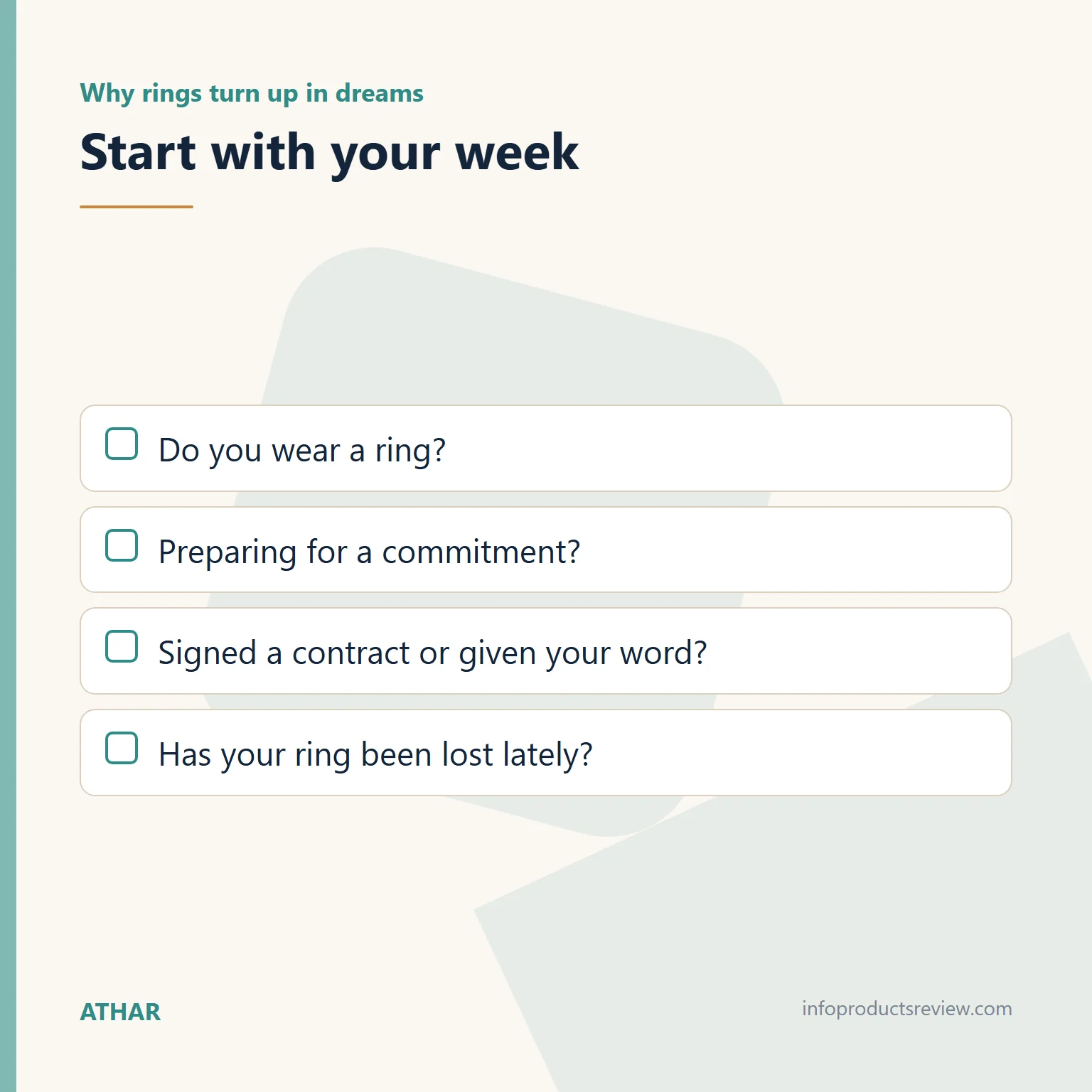
So start with your week:
- Do you actually wear a ring, and has it been lost or grown tight lately?
- Are you preparing for an engagement, a marriage or an agreement?
- Have you signed a contract or given your word on something?
- Did you see rings in a shop or a photo?
A well-made, engraved ring
The clearest passage is Ibn Qutayba’s, in Ta’bir al-Ru’ya, edition of Ibrahim Salih, printed page 161:
The ring: if it is known in its making and engraving, it is its owner's authority, or part of what he owns … And the ring may be a woman he is married to, or money, or a child.
So a finely made, engraved ring is read as its owner’s authority: something he holds or presides over, or part of what he owns. That reading suits a man whose mind is on his position, his property, or what he’s responsible for.
The text then lists other possibilities: the ring may be a woman he is married to, or money, or a child. All of them come with “may”, so none is asserted.
The stone, and al-Asma’i’s report
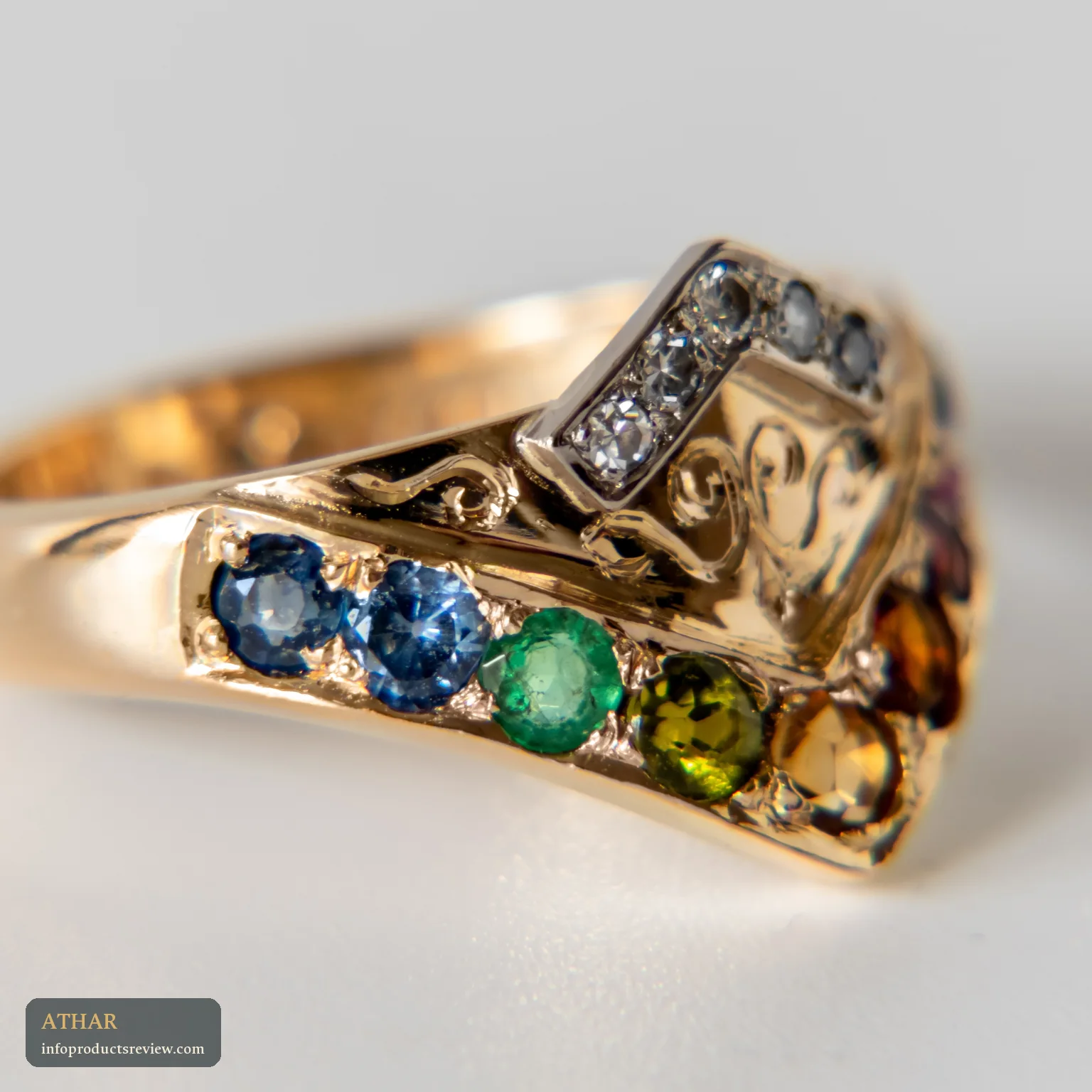
Ibn Qutayba defines the stone as “the face by which the ring changes things”, then reports on the same page:
The stone of the ring is the face by which the ring changes things. Al-Asma'i said: I asked Ibn Qada: a ring in sleep? He said: a woman, and her beauty matches the quality of the stone.
This is the most widely quoted report in the whole chapter on rings, and we’ve already used it in Dreaming of Your Own Wedding, in the wedding-ring section, so we won’t set it out in full again.
What matters here is that the quality of the stone in the text is not a verdict on a particular woman, and not a description of an existing wife. A man who dreams of a cracked stone shouldn’t build a suspicion about his family on it. A dream doesn’t describe people, and it doesn’t judge them.
Being given a ring and sealing with it
One of the most precise images in the chapter is a gift combined with use:
If he is given a ring and seals with it, he comes to own something he did not own, and that is in proportion to his standing.
The reading is compound: not the gift alone, but the gift plus the use. Whoever is given a ring and then seals with it has come to own something he didn’t own before, “in proportion to his standing”, that is, according to the giver’s position and the recipient’s.
Practically: if you were given a ring and sealed with it, ask about something new being entrusted to you or placed under you. Don’t read it as news of a post or a contract; interpretation is conjecture.
The band breaks and the stone remains
On the same page comes another precise image:
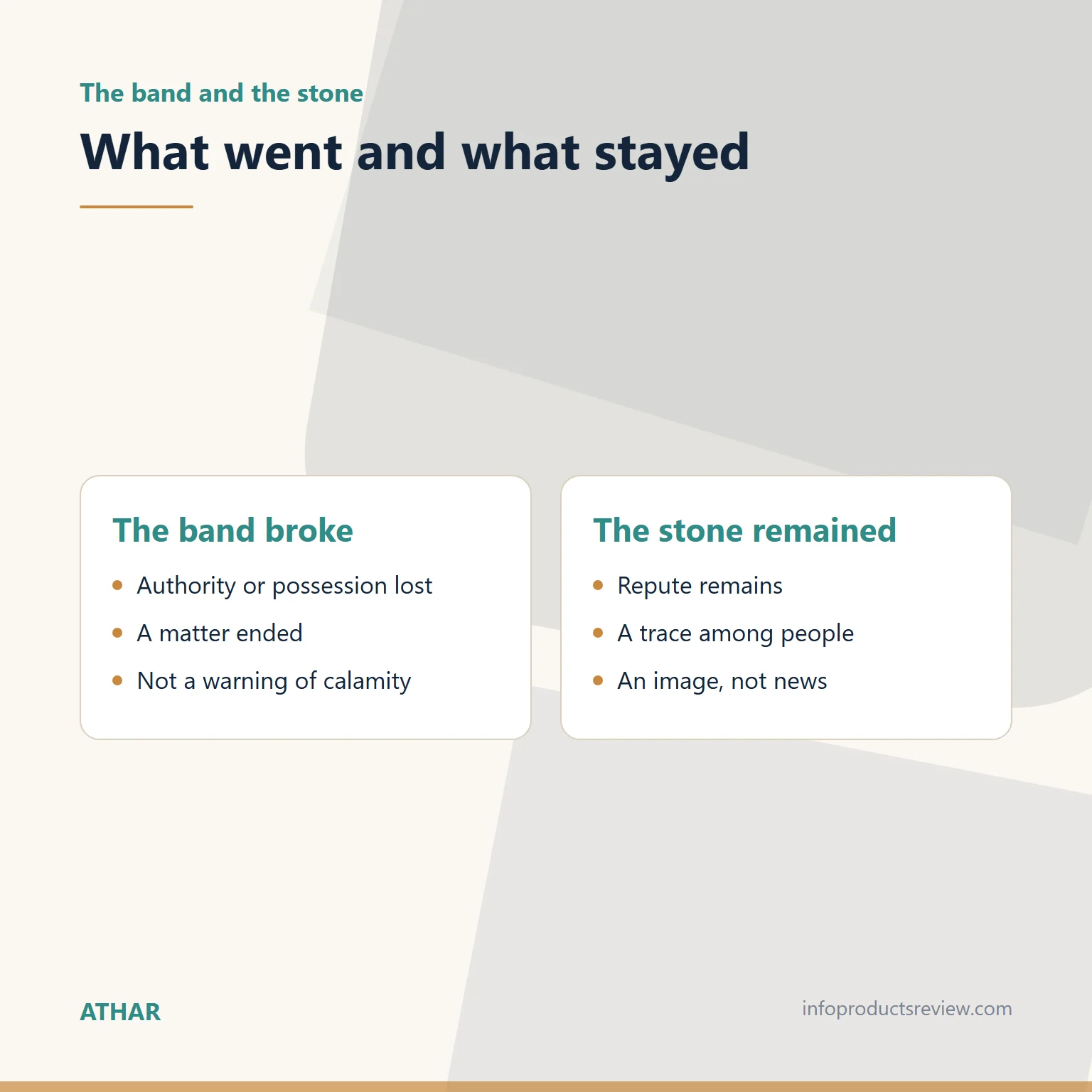
If he sees that the band of his ring broke and fell from him while the stone remained, his authority has gone, or the thing he owned, and his repute and standing among people remain.
If the band breaks and falls away while the stone remains, the reading is authority or possession lost, with reputation and standing remaining among people. It’s an eloquent picture: what held the thing has gone; what it was known by has stayed.
That suits a man who has left a position or whose responsibility has ended, and who still has a name among people. We don’t read it as news of a loss to come, or a warning that something will break.
The metal: gold, iron, brass or lead
Immediately afterwards, the text distinguishes by metal:
If the ring is of gold, what is attributed to him is unlawful. If it is of iron, brass or lead, he is of low standing.
This is the sentence that unsettles many men, so let’s be precise about it.
First, it concerns “what is attributed to him”. That means something ascribed to the ring’s owner: an affair, an authority, a possession. Not the whole of his earnings, and not all of his wealth.
Second, it’s a possibility within interpretation, from an author whose statements we treat as possible readings, not as religious rulings.
Third, it can’t function as an accusation. The dream isn’t a conviction of you, isn’t evidence that your money is unlawful, and is no grounds for suspecting anyone else.
If you genuinely doubt a specific transaction, the way forward is a religious question, while awake, about its form and its conditions. That’s the distinction we hold to across this whole subject.
A note: the ruling and the interpretation
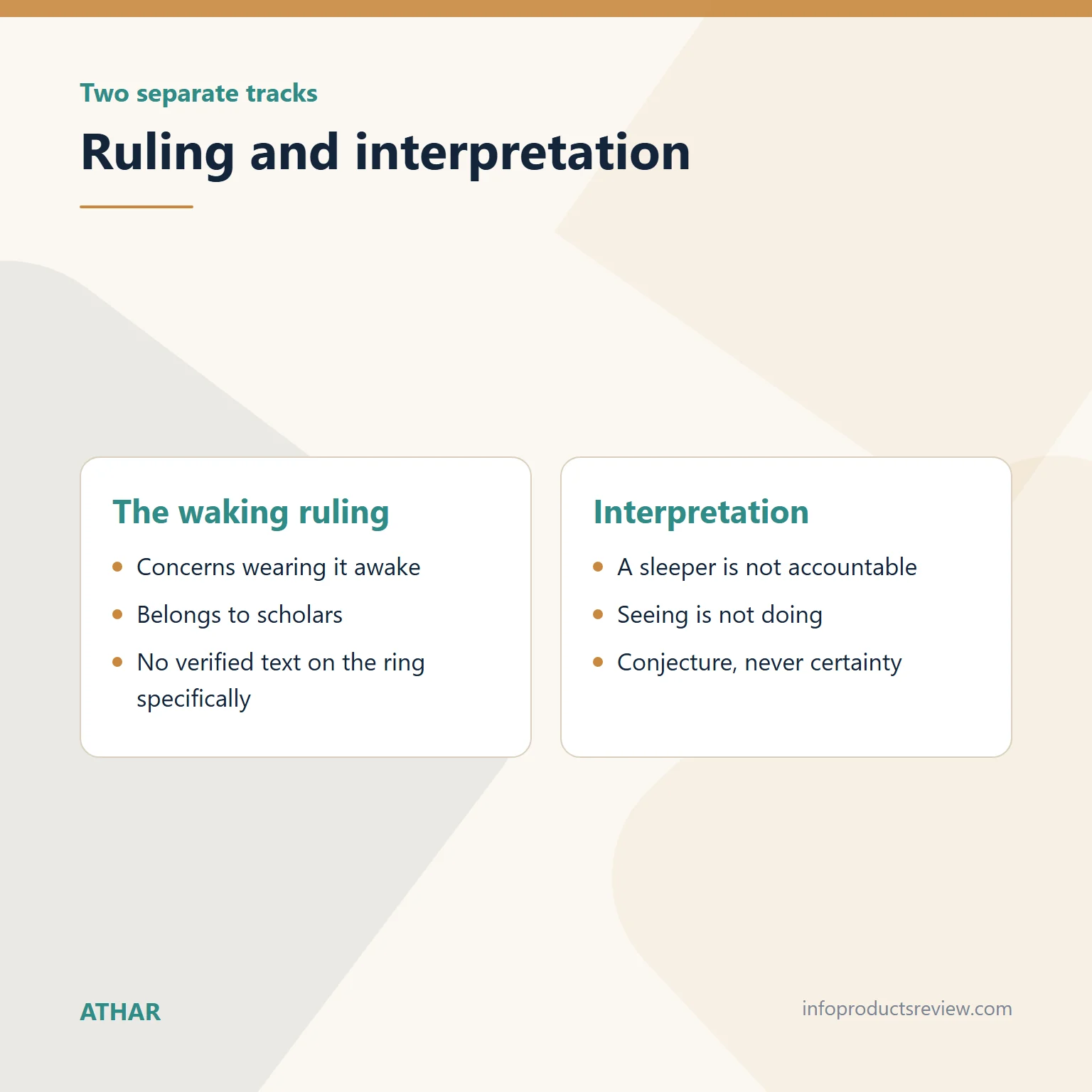
Many men ask: isn’t a gold ring forbidden for men? So what does it mean to see one on my finger?
What we can say with a verified source is that commentators mention gold being forbidden for men in waking life, in the course of explaining the Prophet’s ﷺ dream of the two bracelets. Al-Qurtubi says, as Ibn Hajar quotes him in Fath al-Bari, page 442:
Al-Qurtubi said: it weighed on him only because gold is among women's ornament and among what is forbidden to men.
That’s a statement about gold in general, brought in to explain one particular dream. We did not find, in the sources we checked page by page, a verified text dealing specifically with a gold ring in detail, so we state no ruling about it here, and anyone who wants the question settled should put it to qualified scholars.
In interpretation, though, the position is clear: a sleeper is under no obligation, seeing isn’t doing, and no sin or expiation follows from dreaming of a ring. We gave that distinction its own section on the men’s gold page, and we simply point to it here.
Sealing clay, or sealing a letter
Among the images Ibn Qutayba gives on page 162:
If he sees that he sealed clay for a man, the one it was sealed for attains authority from the ring's owner. If he seals a letter, the letter is his news, and sealing it confirms that news. If the letter is open, the news is public.
Sealing clay for a man is read as that man gaining authority from the ring’s owner; sealing a letter is read as the news being confirmed, and if the letter is open, the news is public.
These are close to modern working life: a signature, an approval, an endorsement, news announced or kept quiet. If you saw yourself sealing a document, ask what you’re approving or endorsing at the moment.
Notice the precision of the text: it doesn’t read sealing as one thing. It distinguishes sealing clay from sealing a letter, then distinguishes an open letter from a folded one. That detail teaches you that one symbol changes with what it acts upon, and that “what did I seal?” is a more useful question than “what does sealing mean?”.
A ring from a king or ruler
On the same page comes an image with a condition attached:
Whoever sees that a king or ruler gave him his ring and he wore it, and he was fit for what that king holds, attains part of his authority; otherwise it returns to the people of the one who saw it, or his kin, or his namesake among people, or his counterpart among them.
The text doesn’t treat the gift alone as sufficient. It requires the recipient to be “fit for what that king holds”. If he isn’t, the matter returns to his people, his kin, his namesake or his counterpart.
This is among the most precise things in the chapter, because it blocks the naive reading: not everyone who dreams of being given a ring is being given a position. Fitness counts, and context counts.
The ring is one of the exceptions for a man
On page 162, after his passage on bracelets and anklets, Ibn Qutayba states that only three kinds of jewellery suit a man:
No jewellery is good for a man in a dream except a necklace, an earring and a ring. And all jewellery is good for women.
The ring is one of them. That matters, because it lifts from your dream the frightening reading that circulates about “gold for men” in general. In the text, the ring doesn’t belong with the bracelet and the anklet; it belongs with the exceptions.
What remains is the detail already covered: a gold ring specifically carries the reading about “what is attributed to him”, and that is a possibility, not a ruling.
When the text says a ring may be a woman
We’ve seen that the text says a ring “may be a woman he is married to, or money, or a child”, and that al-Asma’i reported that a ring in sleep is a woman. These readings need care, because they’re among the most misused.
First, they’re possibilities, stated as such. The text lists them in sequence: a woman, or money, or a child. Anyone who makes the ring always mean a woman has picked one and dropped the rest.
Second, they don’t describe a particular woman. Nobody can say “this is your wife” or “this is the one you’ll marry”. A dream names no one and describes no one’s character.
Third, they’re no basis for a decision. A man shouldn’t propose because of a fine stone in a dream, or step back from something because of a poor one. The interpreters themselves call all of this conjecture.
What helps here is noticing what actually occupies you: a man approaching a commitment sees images of commitment; a man preoccupied with money or children sees what matches his preoccupation. That’s one face of the rule that the dreamer’s situation matters.
A ring lost or stolen
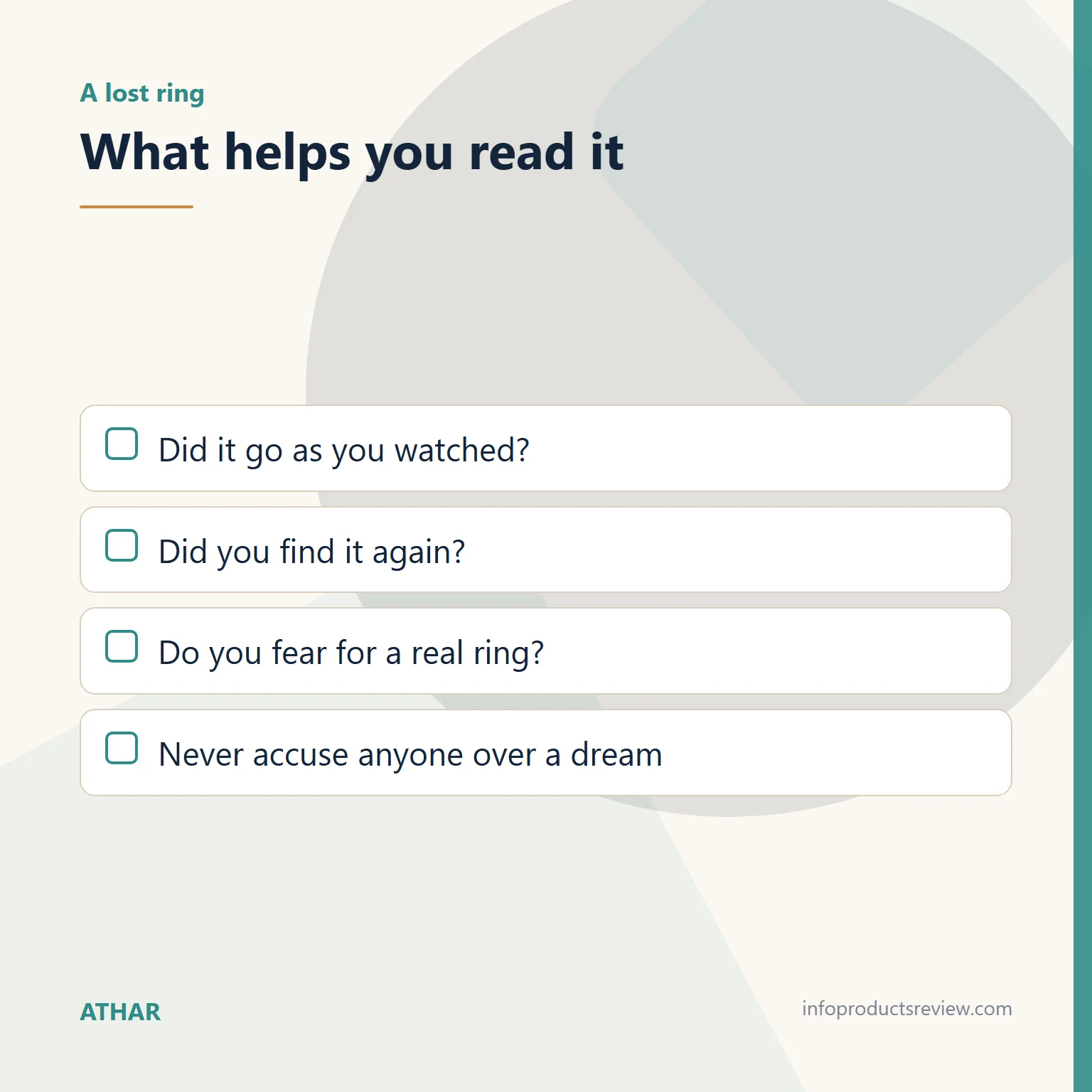
We found no verified text on losing a ring or having one stolen. The nearest thing in the chapter is the band breaking, which we’ve covered, and that isn’t loss.
So read the scene by what it contains:
- Did it go while you watched, or did you notice it was gone? Losing and realising are different feelings.
- Did you search and find it? The end of the dream is part of it.
- Are you afraid for a real ring? Many men take theirs off for work or sport and worry about losing it.
- If you saw someone take it, don’t build a suspicion on it. A dream is not evidence about anyone.
Finding a ring
Some men dream of finding a ring on the ground or in a place they don’t know. There’s no verified text on finding a ring.
The difference between finding and being given matters here: the text sets out the gift in detail, and attaches a condition of fitness when the giver is a king. What is simply picked up, with no giver, isn’t covered in the sources we checked.
Read it by what’s in it: did you keep it, or look for its owner? That question describes your stance towards something that arrived without effort, which is closer to you than any stock meaning.
Being given a ring at an occasion
A gift in a dream may come without sealing: someone simply holds out a ring and you take it. The text mentions the gift joined to sealing in the first image, and a king’s gift in the second.
If the gift stood alone, read its context: who gave it, what your relationship with him is, and how it felt. A gift from a father isn’t a gift from a stranger, and accepting with ease isn’t accepting with awkwardness.
And a gift is never news about the giver’s intentions towards you. That rule recurs across these pages because it’s where people go wrong most often.
A ring too tight, too loose, or stuck
A recurring image is a ring that tightens on the finger and won’t come off, or one so loose it slips away. There’s no verified text for it.
The image itself describes a sensation: tightness resembles a commitment you can’t get free of, looseness something that won’t settle. And the cause may be purely physical: swelling, heat, or sleeping on your hand.
We don’t read tightness as divorce or a quarrel, or looseness as a cooling relationship. Those are additions with no basis in the texts.
Which hand was it on?
Men often ask about the hand and the finger. We found no text, in anything we checked page by page, that distinguishes the ring by hand or by finger.
The many detailed claims in circulation about this have no basis in what we checked, so we don’t repeat them and don’t build on them. If you wear your ring on a particular hand while awake, seeing it there at night is habit rather than symbol.
It’s more useful to look at what the text is clear about: the ring’s making and engraving, its metal, what you did with it, and who gave it to you.
A plain ring, or one with no stone
A plain ring is one with no engraving. The passage above makes the first reading conditional on the ring being “known in its making and engraving”, so when the engraving is absent, that particular reading is absent too.
That doesn’t leave the dream meaningless; it means the text doesn’t give it that meaning. Read it by what it is: a ring with no mark, a matter with no clarity, something in your hand not yet defined.
This is a practical example of the method on this page: we don’t stretch a text beyond what it says, and we don’t leave you without a way to read your dream.
More than one ring on a hand
You might see two or three rings on your hand. There’s no verified text on multiplicity in the ring chapter.
The image can carry a sense of abundance: several matters you preside over, commitments that have piled up, or an appearance you want. Your feeling decides: was it adornment or weight?
Some pages count the rings and assign each number a meaning. That’s among the additions we find no basis for, and we don’t build on it.
Taking the ring off
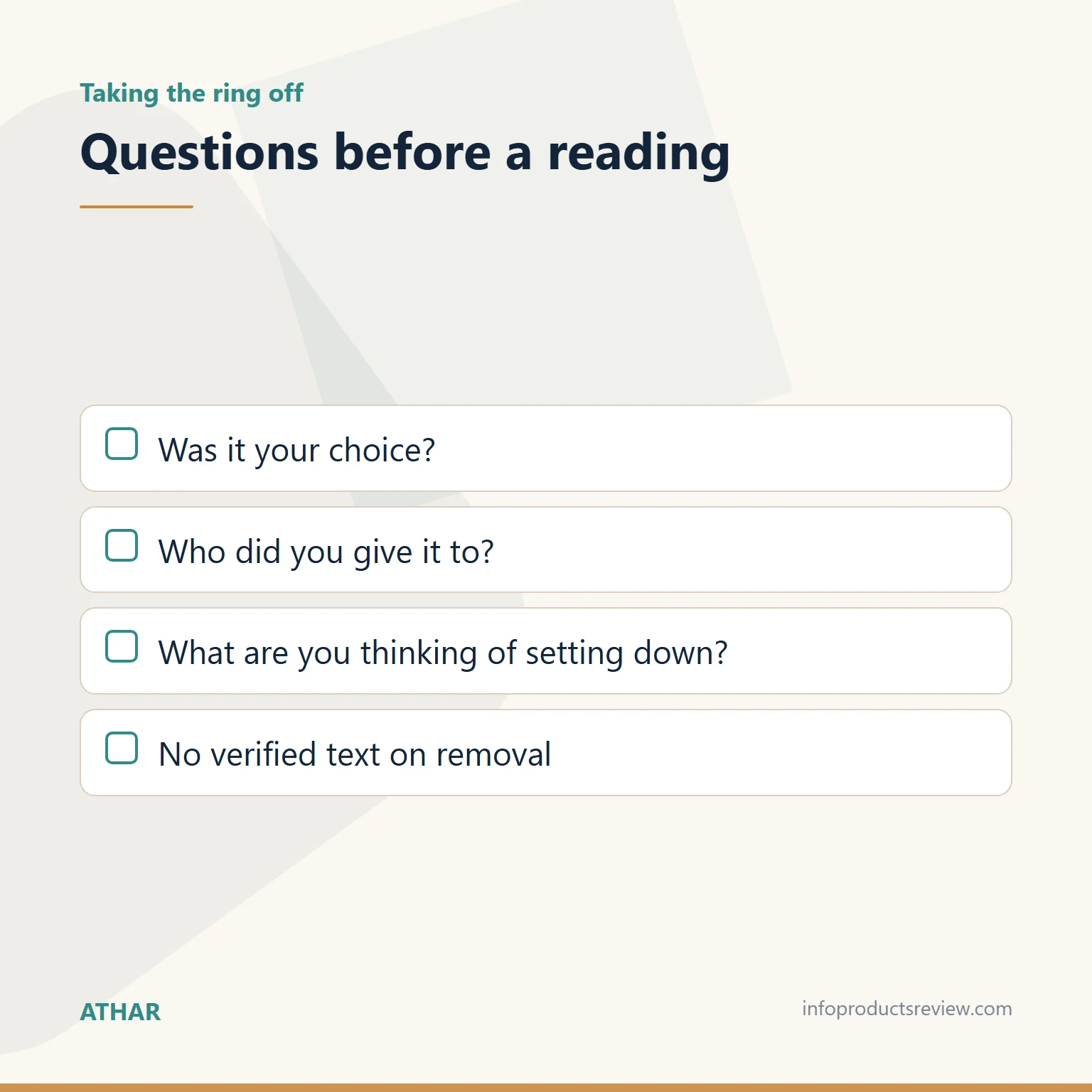
Men also ask about seeing themselves remove a ring and set it down, give it away, or throw it.
There’s no verified text on removal. But the broken-band image is instructive: when what holds a thing goes, the reading is a matter ending while its trace remains. Removal is closer to a deliberate letting go; breaking is closer to an ending you didn’t choose.
The practical question: are you thinking about leaving something? A job, a responsibility, a commitment, a habit? If so, the dream describes that rather than announcing it.
A ring you inherited, or your father’s ring
Seeing your father’s or grandfather’s ring on your hand recurs, especially after a loss or around an anniversary. No text covers it.
Two readings come closest: memory, and succession. A ring is a small thing that carries its owner’s presence, and having it on your hand resembles the feeling that you now stand where he stood, or carry what he carried.
It isn’t a message from the dead, and it isn’t news about an inheritance. Dreams of the dead are their own subject.
The ring, promises and agreements
The text reads sealing a letter as the news being confirmed, which brings the ring close to the idea of attestation: a contract concluded, a promise confirmed, something made official.
So if you’re between an agreement awaiting signature and a promise awaiting confirmation, the ring’s appearance makes sense. The dream doesn’t tell you the agreement will go through; it describes your preoccupation with it.
That also explains why this dream is so common among businessmen and employees in contract and promotion seasons.
What about a silver ring?
Some men ask about silver, since that’s what they usually wear. What we found is that Ibn Qutayba lists the metals of a ring as gold, then iron, brass and lead. We found no independent reading of silver in the ring passage.
He does compare silver and gold elsewhere, in the passage on bracelets, not on rings. So we don’t carry that comparison over, because moving a reading from one passage to another is what damages this subject most.
If you saw a silver ring, read the image: its making and engraving, what you did with it, and how it felt. Don’t ask a text that didn’t mention it for a meaning.
A ring too big or too heavy
Dreamers also describe a ring too large for the finger, or heavy enough to drag on the hand. No verified text covers this.
But notice that many readings in this chapter turn on one idea: whether a thing suits its place. A well-made ring is read as authority; jewellery out of place is read as something in the wrong position; a broken band is read as the loss of what held things.
So if the ring didn’t fit your hand, the nearer question is whether something in your life is bigger than you or wrong for you. That’s a reading by context, not a fixed meaning added to the sources.
The ring and your work
Many men’s ring dreams connect to work, because the text’s main reading turns on authority, office and possession. If you’re waiting on a promotion, leading a team, or thinking about leaving a position, those meanings sit close to your situation.
But note an important difference: the text reads the ring as something you hold or preside over. It doesn’t say you will obtain it. The gap between describing your state and announcing your future is the gap between disciplined interpretation and fortune-telling.
What’s useful in practice is to ask: what is in my hands at the moment, and am I carrying it well? That question serves you whether the dream needed interpreting or was never more than the mind talking to itself.
How the interpreters actually read this symbol
If you look at the passages in this chapter, the ring is read through four doors, not one memorised meaning:
- Making and engraving: is it a known, well-crafted ring, or a plain, anonymous one? The authority reading rests on this.
- The parts: stone and band, each with its own reading, to the point that one breaking while the other remains becomes an image in itself.
- The action: wearing, sealing, giving. Sealing with it is not the same as merely wearing it.
- Who acts: who gave it, a king or an ordinary man? And who received it, someone fit for it or not?
Those four doors will serve you better than any table of meanings, because you can apply them to your own dream. Ask what the ring looked like, which part of it appeared, what you did with it, and who was there, and you have what you need for a reading close to your situation.
And one limit stays: the result is conjecture to take comfort from. Anyone who turns it into news of the unseen has stepped outside the method of this field.
When someone says your dream proves wrongdoing
You mention the dream and back comes a flat verdict: there’s something doubtful in your money. We’ve seen that the text speaks about “what is attributed to him”, and that this is a possibility within interpretation.
The rule we hold to across these pages: a dream creates no ruling, establishes no accusation, and is never used as evidence against anyone. We set that out in Dreaming of Gold as a Man.
If the dream keeps coming back
Repetition doesn’t turn a ring dream into news. Usually it repeats because one thing occupies you: a decision you’re waiting on, a commitment ahead, a heavy responsibility.
It may also repeat because you now think about it every night before sleeping. A long search for a meaning keeps the image present, and it returns. The remedy is practical: deal with the matter while awake, and search less.
If the dream worried you
Some men wake from a ring dream anxious about work or a commitment, then spend days turning interpretations over. That anxiety can weigh more than the dream.
The measure we keep repeating: if something was on your mind before the dream, the dream doesn’t make it more certain, and the remedy starts with that matter. If nothing was, don’t manufacture a worry out of a dream.
What if you don’t remember the details?
If all that’s left is a ring and a feeling, read the feeling. Don’t add an engraving you didn’t see, a metal you couldn’t make out, or a person who didn’t appear.
Most frightening interpretations are built on details added after waking, not on what the dreamer actually saw.
The engraving on the ring
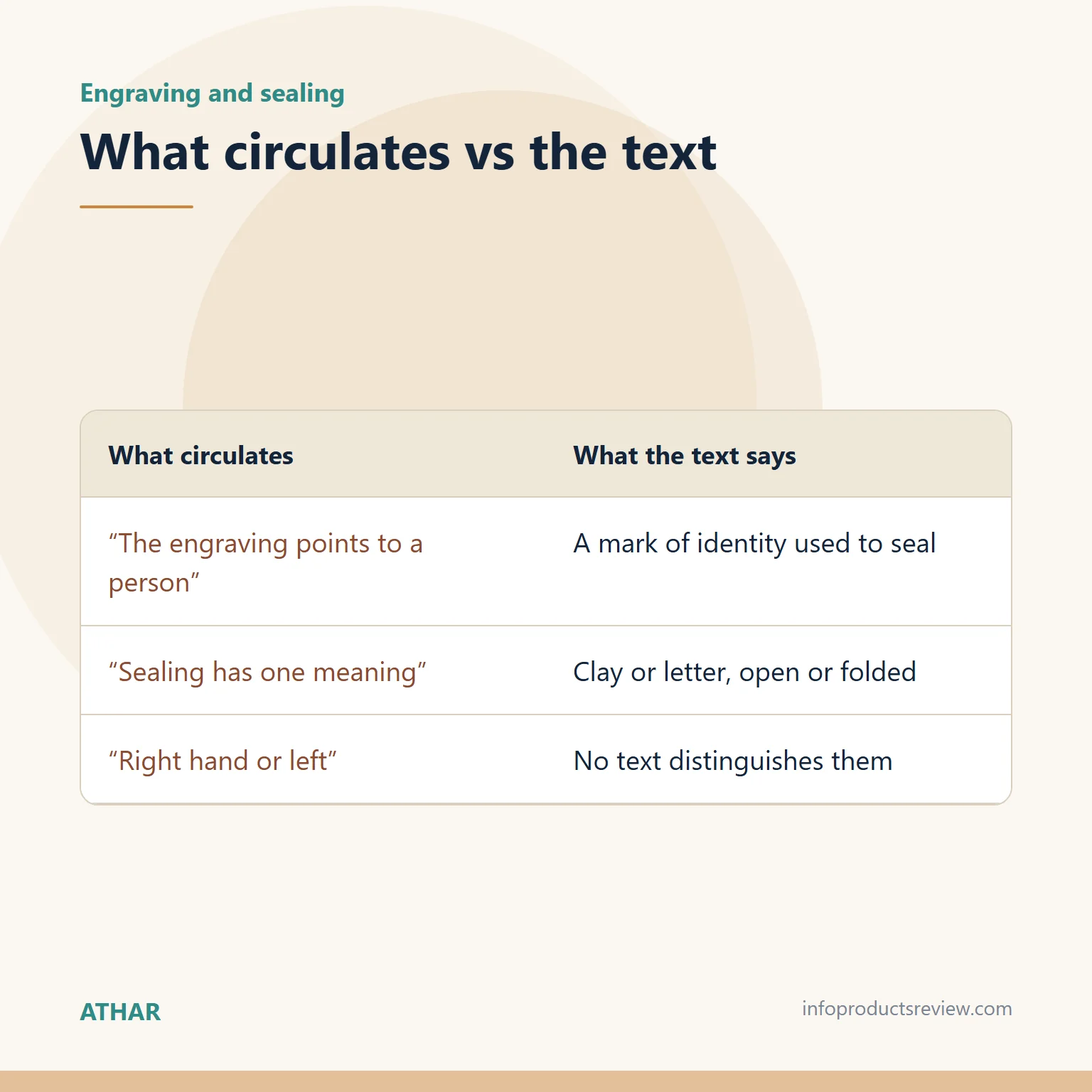
The text makes the first reading conditional on the ring being “known in its making and engraving”, so the engraving is part of the image, not a spare detail.
If you saw a clear engraving you recognised, that’s closer to the reading given. If it was strange, worn away, or unreadable, there’s no text for it, and the nearer approach is to read it through your feeling: clarity or obscurity in something you’re handling.
We don’t read engraved names as pointers to particular people; that’s a door to endless suspicion.
It’s worth noticing that engraving in the text isn’t decoration but identification: by it the ring is known, and with it he seals. That’s why the reading is tied to the making, and why the passage on sealing clay and letters follows it. Engraving and sealing are connected in this chapter, and reading the engraving apart from its use separates what the text joined.
A ring on another man’s hand
You might see the ring on someone else: a brother, a manager, a stranger. No text covers this scene.
The better question is where you stood in it. Were you watching, waiting for it to be handed to you, or did he take it from you? Those positions describe your relationship to whatever occupies you: waiting, competition, or the feeling that what you deserved went elsewhere.
It isn’t news about that man, and it isn’t a verdict on him.
Wedding bands
If the ring in your dream was a wedding band, or an engagement ring that went missing, those scenes belong to the wedding itself and are covered in Dreaming of Your Own Wedding, including the ring passage with its page reference.
We don’t repeat that here. We only note that the classical reading of a ring is wider than a wedding band: it covers authority, possession, trust and sealing. Not every ring in a dream is a wedding ring.
How the dream felt
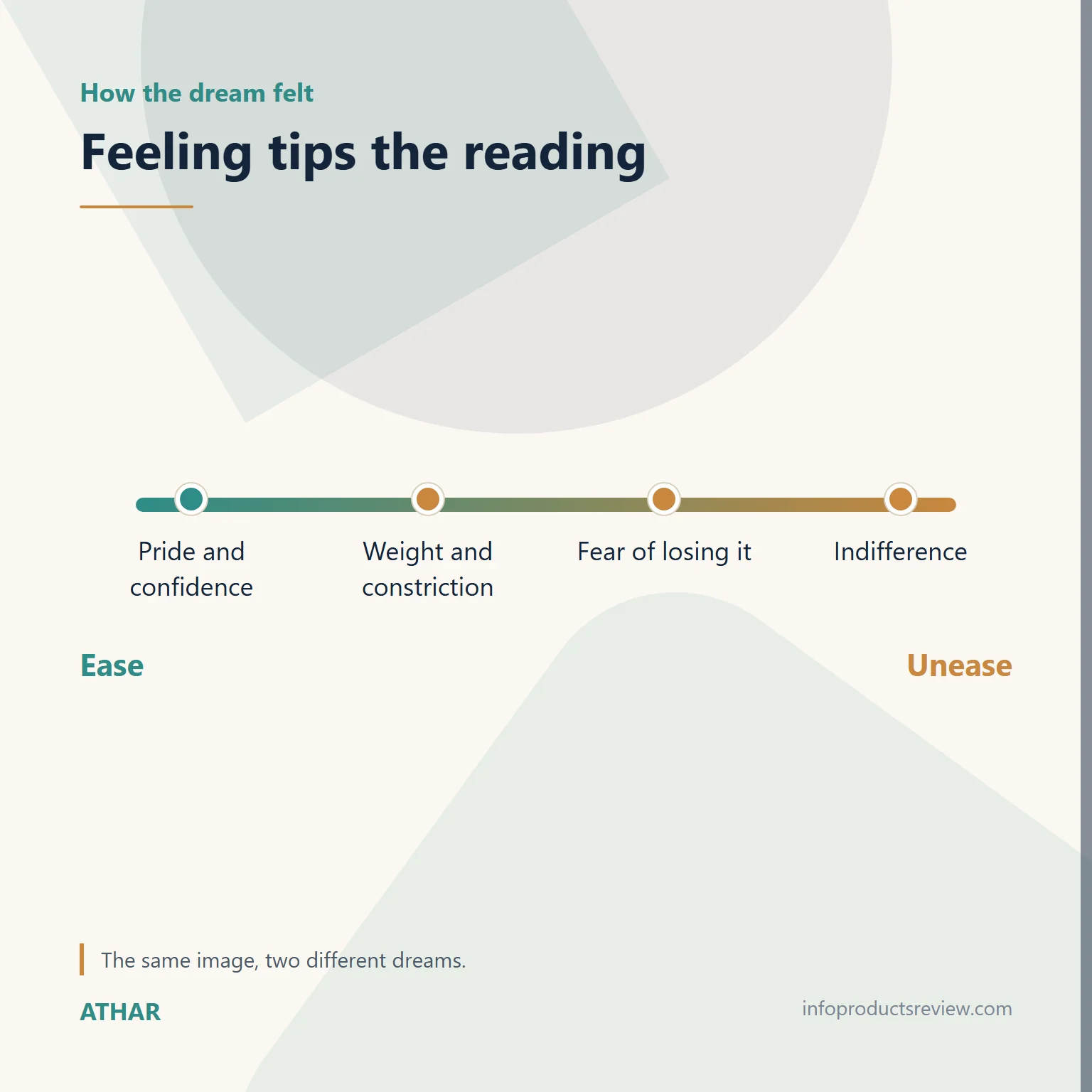
- Pride and confidence: close to the reading of authority and possession.
- Weight or constriction: ask about a commitment you’re carrying.
- Fear of losing it: possibly about something you’re afraid will be taken from you.
- Indifference: the ring may have been a passing detail.
Rules that govern this reading
The rules books say interpretation looks at the dreamer’s situation:
Interpretation differs with people's conditions and standing: one must look at the dreamer's state and standing, and build the fitting interpretation on that.
So a ring in the dream of an employee waiting on a promotion isn’t the same as a ring in the dream of a man approaching marriage, or of a man who wears one every day.
They also say interpretation is conjecture:
Interpretation is analogy, comparison and conjecture that cannot be treated as certain, though one may take comfort in it; no one may swear to what it foretells unless its truth appears in waking life.
And that some dreams are the self talking to itself, with no interpretation at all:
As for the self talking to itself, it belongs to the body: desires and feelings held back in the unconscious that wake up in sleep, and they have no interpretation.
Getting something practical from the dream
Because the readings in this chapter turn on office, trust and covenant, the most useful thing a dreamer can take away is a set of questions rather than an expectation:
- What is entrusted to me now? Work, someone else’s money, a family, a promise I gave.
- Am I fit for what I hold? The text itself makes fitness a condition in the king’s-gift image.
- What has ended while its trace remains? That’s close to the band and the stone.
- And what do I want to set down? Which resembles taking the ring off.
These serve you whether your dream called for interpretation or was simply the mind talking to itself. That’s a measure in itself: take what helps you while awake, and leave what claims to know the unseen.
Common claims that need correcting
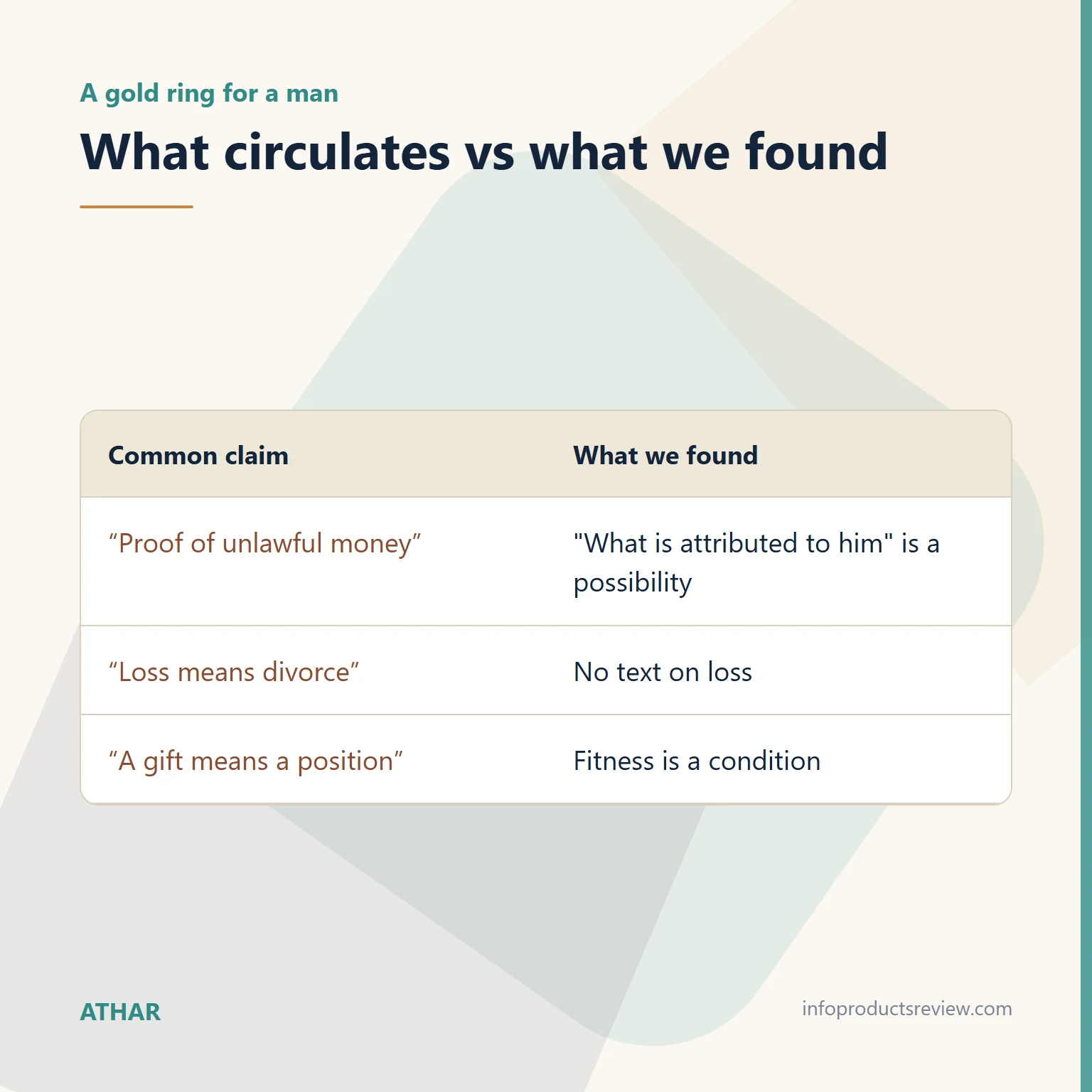
| What you’ll often read | What we found in verified sources |
|---|---|
| A gold ring proves unlawful money | The text says “what is attributed to him”; a possibility, not a verdict on your earnings |
| Losing a ring means divorce or separation | No verified text on loss |
| A loose ring means coolness, a tight one a quarrel | No text on either |
| Anyone given a ring receives a position | The text makes fitness a condition; otherwise it returns to others |
| A broken ring means disaster coming | The text reads a broken band as authority lost with reputation remaining |
| An engraved name points to a specific person | No basis in anything we checked |
What this dream can’t tell you
- It can’t judge your faith or your earnings.
- It can’t announce a post, a contract or a marriage.
- It can’t describe a particular woman or pass judgement on your family.
- It can’t expose a thief or a betrayer.
- It isn’t a basis for a decision about work, marriage or a purchase.
What to do after the dream
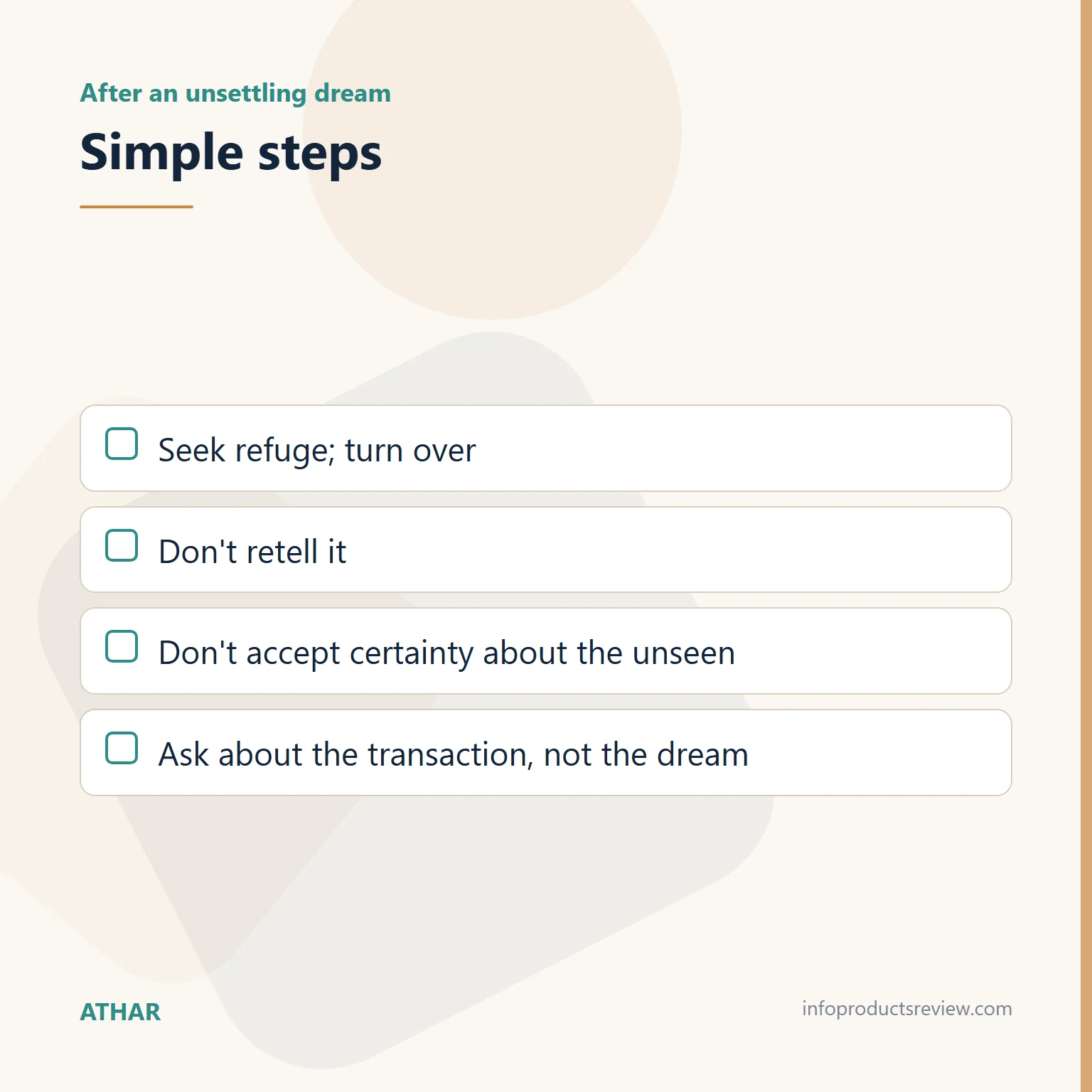
If the dream was good, thank God and don’t turn it into waiting. If it was unsettling, the practice is clear. In Bukhari:
And in Muslim, with more detail:
- Seek refuge in God from the harm of what you saw, and turn onto your other side.
- Don’t retell an unsettling dream.
- Don’t accept an interpretation that claims certainty about the unseen.
- If your worry is about a transaction or money, ask scholars about that matter itself.
How to describe your dream so it can be read
- What the ring looked like: known in its making and engraving, or plain?
- Its metal: gold, silver, iron, something else?
- Where it came from: worn, given, bought, found?
- What you did with it: sealed with it, took it off, gave it away, lost it?
- Did anything break: the band or the stone?
- How you felt, and what’s occupying you now.
What you can take away with confidence
First: in the dream books a ring is a symbol of office, trace and covenant before it is anything frightening. Most of its readings turn on what you hold and what remains of your name.
Second: the two most misused claims in this chapter are making a gold ring a verdict on your earnings, and making the stone a description of a particular woman. Both go beyond the text.
Third: reading your dream starts from the details the interpreters themselves used: making and engraving, stone and band, the action, and who acted. Those give you a reading close to you rather than a general sentence.
Examples
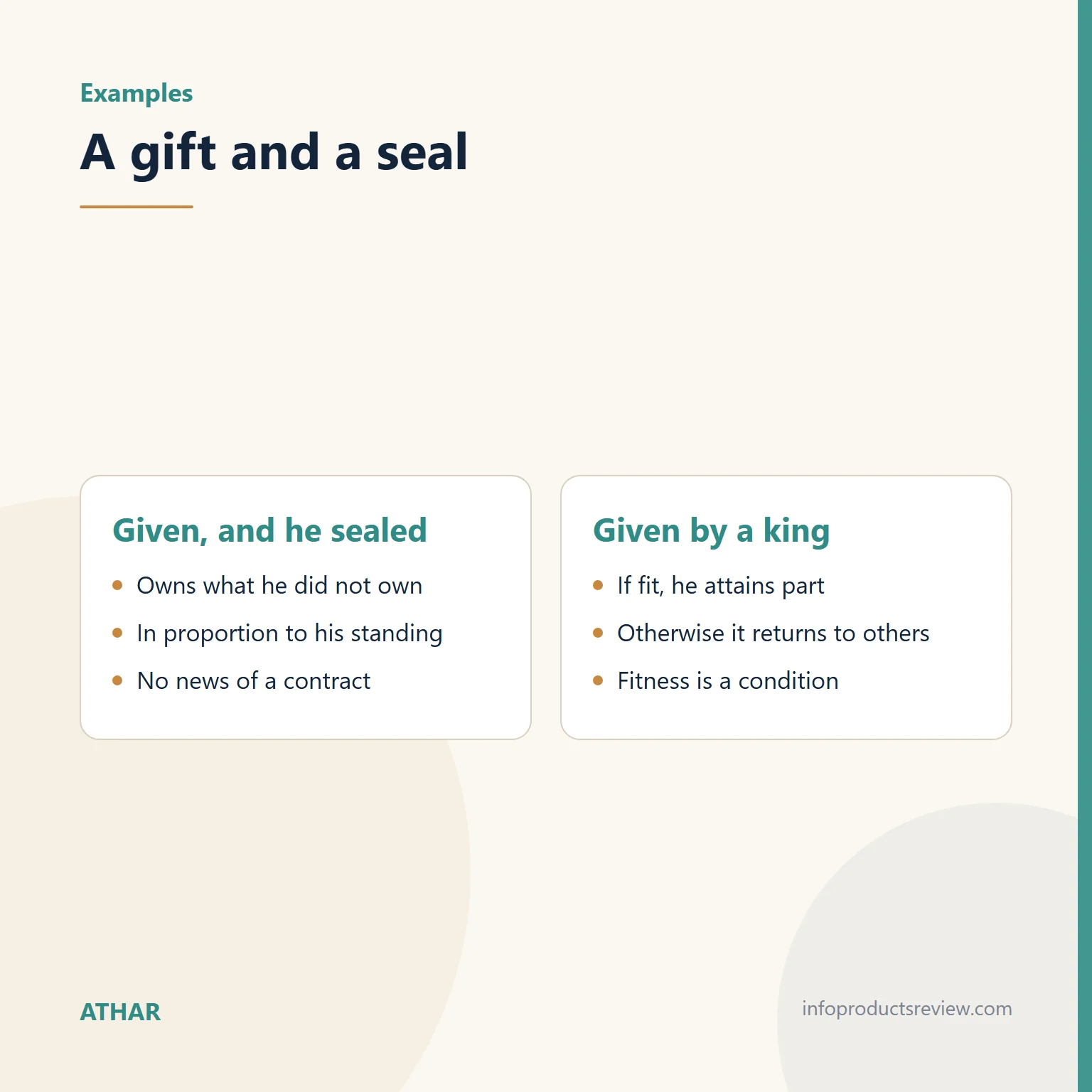
Composite examples built from common scenarios, not readings of any real person’s dream.
An engraved ring worn with ease
The closest image to Ibn Qutayba’s well-made, engraved ring: its owner’s authority or part of what he owns. The nearest reading is something he presides over, not news of a post.
Given a ring, and he sealed a document with it
The text reads the gift plus sealing as coming to own something he didn’t own, “in proportion to his standing”. Ask what’s being entrusted to you; don’t expect a particular contract.
The band broke and the stone remained
In the text: authority or possession lost, with reputation remaining among people. It suits a man whose responsibility has ended while his trace remains. It isn’t a warning of calamity.
He saw his ring was gold and woke up worried
The reading concerns “what is attributed to him”, and it’s a possibility. He shouldn’t build a self-accusation on it. A real doubt about a transaction goes to a scholar.
An iron ring on his finger
The text reads iron, brass and lead as low standing. It’s an interpretive reading, not a verdict on a man’s worth, and it’s read with his situation and his feeling.
His ring went missing in the dream
No text on loss. Fear for something valuable is understandable. He seeks refuge, accuses no one, and asks what he’s afraid of losing while awake.
A king handed him his ring
The text sets a condition: if he’s fit for it he attains part of that authority; otherwise it returns to his people or his counterpart. So it isn’t a promise.
A ring that wouldn’t come off
No text for it. The image describes a commitment or a tie he feels he can’t escape. It isn’t a verdict on a marriage.
He saw his ring on a colleague’s hand
No text for it. More likely a reflection of competition or waiting. It’s no news about that colleague, and no accusation.
He bought a ring before his engagement
No text on buying. The context is plain: real preparation. Closest to the mind talking to itself.
A plain ring with no engraving
The authority reading is conditional on making and engraving, so their absence moves us away from it. Read the image as it is: something not yet defined.
He took his ring off and put it in a drawer
No text on removal. The image is closer to a deliberate letting go, and the fitting question is what he’s thinking of setting down.
His late father’s ring on his hand
No text for it. Closest to memory and to responsibility passing on. Not a message from the dead, and not news of an inheritance.
He sealed an open letter in front of people
The text says an open letter means the news is public. Close to something being announced or endorsed openly.
Quick table: the detail and the closest reading
| Detail | What verified sources say | How to read it |
|---|---|---|
| A ring known in its making and engraving | Its owner’s authority, or part of what he owns (p. 161) | Something you preside over, not news of a post |
| The stone | The face by which the ring changes things; al-Asma’i’s report (p. 161) | A reported saying, not a description of a particular woman |
| Given a ring, then sealing with it | He owns what he didn’t own, in proportion to his standing (p. 161) | By standing and context |
| Band broken, stone remaining | Authority lost, reputation remaining (p. 161) | Something ended, its trace remaining |
| A gold ring | What is attributed to him is unlawful (p. 161) | A possibility, not a verdict on your earnings |
| Iron, brass or lead | Low standing (p. 161) | An interpretive reading, not a verdict on your worth |
| Sealing clay or a letter | Authority, or news confirmed (p. 162) | Approval or endorsement |
| A ring from a king | Part of his authority, if he is fit (p. 162) | Fitness is a condition in the text |
| Loss, tightness or looseness | No verified text | Through context and feeling |
Related dreams
- Dreaming of Gold as a Man: the ruling, the dream and the difference
- Dreaming of Your Own Wedding: the ceremony, the contract and the details
- ATHAR’s guide to dream interpretation
Frequently asked questions
What does a gold ring mean in a man’s dream?
For Ibn Qutayba, a ring known in its making and engraving is its owner’s authority or part of what he owns, and it may also be a woman, money or a child. If it’s gold, the text reads what is attributed to him as unlawful, which is a possibility within interpretation, not a verdict on your earnings.
Does a gold ring in a dream prove my money is unlawful?
It can’t function as a verdict. The text speaks about “what is attributed to him”, which is a possibility. If you genuinely doubt a transaction, ask qualified scholars about that transaction itself.
What does it mean if someone gives me a ring in a dream?
The text says whoever is given a ring and seals with it comes to own something he didn’t own, in proportion to his standing. If the giver is a king or ruler, the text requires the recipient to be fit for it; otherwise the matter returns to his people or his counterpart.
What does a broken ring mean?
The text describes the band breaking and falling while the stone remains: authority or possession lost, with reputation and standing remaining. That’s different from loss, and we found no verified text on loss.
My ring went missing in a dream. Is it a warning?
We found no verified text on losing a ring. Read it through the dream and your feelings, and don’t accuse anyone over it.
Is seeing a gold ring sinful for a man?
A sleeper is under no obligation, and seeing isn’t doing. What commentators said about gold being forbidden for men appears in explaining the Prophet’s ﷺ dream of the two bracelets; it’s a statement of a ruling, not an interpretation of every dream.
What does the stone mean?
Ibn Qutayba defines it as the face by which the ring changes things, and reports from al-Asma’i that a ring in sleep is a woman whose beauty matches the quality of the stone. It’s a reported saying, not a description of a particular woman.
Is a silver ring better than gold in a dream?
The text we found compares the metals for bracelets, not rings, and reads iron, brass and lead as low standing. So we don’t construct a comparison for rings that the text didn’t make.
What does sealing a document mean in a dream?
The text says sealing a letter confirms its news, and that an open letter means the news is public. It sits close to an approval or an endorsement in your waking life.
I dreamed of a wedding band. Where do I read about that?
Wedding bands, engagement rings and rings lost before a wedding are covered in Dreaming of Your Own Wedding, and we don’t repeat them here.
Does a ring mean a position is coming?
The authority reading exists, but it isn’t news of an event, and the text itself attaches a condition of fitness in the king’s-gift image.
Is this interpretation definitive?
No. These are possible meanings from texts we checked on the page, and interpretation is conjecture you can take comfort from, not certainty.
In summary

- A ring known in its making and engraving is read as its owner’s authority or possession.
- A gift plus sealing is coming to own something new, “in proportion to his standing”, and fitness is a condition in the king’s-gift image.
- The band breaking while the stone remains: a matter ended, its trace remaining.
- A gold ring specifically: “what is attributed to him is unlawful” — a possibility, not a verdict on your earnings.
- Loss, tightness, looseness and buying have no text, and are read through context and feeling.
If you take one thing away: in the dream books a ring is a symbol of office, trace and covenant. It is neither an indictment of you nor a promise to you.
Written and reviewed by: the ATHAR editorial team. Classical and hadith passages were checked against scans of the original printed pages of the editions cited. Translations from Arabic are our own.
Please note: this page sets out possible meanings, not certainties, and it is not a religious ruling. Questions of Islamic law should be put to qualified scholars.