

You’re standing in your own wedding. The hall is lit, your family is around you, and you’re wearing the dress or the groom’s outfit. Then you wake up asking what it meant. The closest answer: dreaming of your own wedding is usually a picture of transition or a new commitment, and very often it echoes whatever is already on your mind, especially if a real wedding is close. It announces no date and names no spouse.
This page is about one scene only: your own wedding, your own marriage contract, and the details of the celebration itself. If your question is about marriage as a symbol, or about who you married in the dream, that belongs in our complete guide to marriage dream meaning.
The bottom line
- The closest meaning: a wedding in a dream pictures transition or a new commitment, and it often simply echoes the weeks of planning. The clearest line the books of dream interpretation give on any of its details is about the ring: a ring in sleep is a woman, and her beauty matches the quality of its stone, the stone being the raised jewel set at the top of the band.
- The detail that changes it: the atmosphere. Quiet joy sits closer to reassurance. Drums, pipes and dancing carry heavy meanings in the old books, but in a passage about people’s trades rather than about weddings, and that reading is a possibility that predicts no particular misfortune.
- Two common cases: a late groom or a lost dress, which are closer to planning anxiety than to news; and a wedding with no groom, which usually reflects a focus on the occasion and on the idea of marriage before there is any particular person.
- A possibility, not a promise: everything on this page is a possible meaning. None of it sets a wedding date, names a spouse, decides whether a marriage will succeed or fail, or gives you a reason to postpone or cancel a contract.
- Where there’s no set meaning: the colour of the dress, ululation, the procession, the wedding feast and a contract held in a mosque. The old books give none of these a fixed meaning, so what we say about them is a reading by the logic of the image, not a quotation.
More important than any symbol is your real situation. If your wedding is a few weeks away, most of what you see at night is simply the day carrying on.
What this page covers
- The bottom line
- Why do people dream of their own wedding?
- Marriage dream or wedding dream: what’s the difference?
- Which details change how a wedding dream reads?
- What does signing the marriage contract mean?
- What does the wedding dress mean in a dream?
- What do the groom’s clothes mean in a dream?
- What does the wedding ring mean in a dream?
- What do gold and jewellery mean on the wedding night?
- What does henna before the wedding mean?
- Are drums, pipes and dancing at a wedding a bad sign?
- Singing, ululation and quiet joy
- What does the wedding procession mean?
- What does the wedding feast mean?
- What does a wedding with no groom, or no bride, mean?
- A late groom, a lost dress, a missed date
- A wedding among strangers
- What does a marriage contract in a mosque mean?
- A married woman dreams of her wedding again: is it divorce?
- Loved ones who have died, at your wedding
- Running away from your wedding
- Wedding dreams in the weeks before the real thing
- What’s actually established in Islam about dreams
- What a wedding dream can’t tell you
- What to do after a wedding dream
- How to describe a wedding dream so it can be read
- What interpreters say in recorded interviews
- Examples
- Quick table: the detail and the closest reading
- Related dreams
- Frequently asked questions
- What does it mean to dream of my own wedding?
- What does signing a marriage contract mean if I’m not engaged?
- What does wearing a wedding dress in a dream mean?
- What does a wedding ring mean in a dream?
- Does losing an engagement ring in a dream mean the engagement will end?
- Are drums and dancing at a wedding in a dream a bad sign?
- What does a wedding with no groom mean?
- I dreamed the groom was late on the wedding day. Is that bad?
- What does henna before a wedding mean in a dream?
- I’m married and dreamed I was a bride again. Is it divorce?
- What should I do if a wedding dream upset me?
- Is this interpretation definitive?
- In summary
Why do people dream of their own wedding?
A wedding isn’t an ordinary day. It’s preceded by weeks or months of planning, waiting and negotiating, and the whole family gets involved. It carries big questions about a new home, new responsibility and a changed life. It would be strange if none of that followed you into sleep.
In a published interview, one interpreter says that someone about to marry may become so preoccupied with it that they start dreaming about marriage. That’s one person’s view rather than a rule, but it matches what a lot of people know from experience.
The US National Institute of Neurological Disorders and Stroke notes in its guide to sleep that events from the day often find their way into our thoughts while we sleep. That’s about sleep in general, not weddings. But it explains why someone who has spent the week booking a hall, choosing a dress or discussing a dowry sees some of it again at night.
Some people dream of their wedding when marriage isn’t anywhere near their plans: no engagement, no serious thought about it. Then the question widens. Is there another transition in your life that resembles a wedding? A new job, a move, a commitment that’s about to become public?
At its core, a wedding is the announcement of a beginning, and a dream can borrow that imagery for anything that feels like one. So it’s worth asking what in your waking life is about to be announced.
There’s a simpler third reason too: weddings are everywhere. If you went to a cousin’s wedding last week, scrolled through someone’s wedding photos, or heard your family talking about who’s getting married, you may well see yourself in the bride’s or groom’s place. The dream is rearranging what you saw, nothing more.
For the general approach behind every symbol on this site, meaning first and limits always, see our guide to dream interpretation.
Marriage dream or wedding dream: what’s the difference?
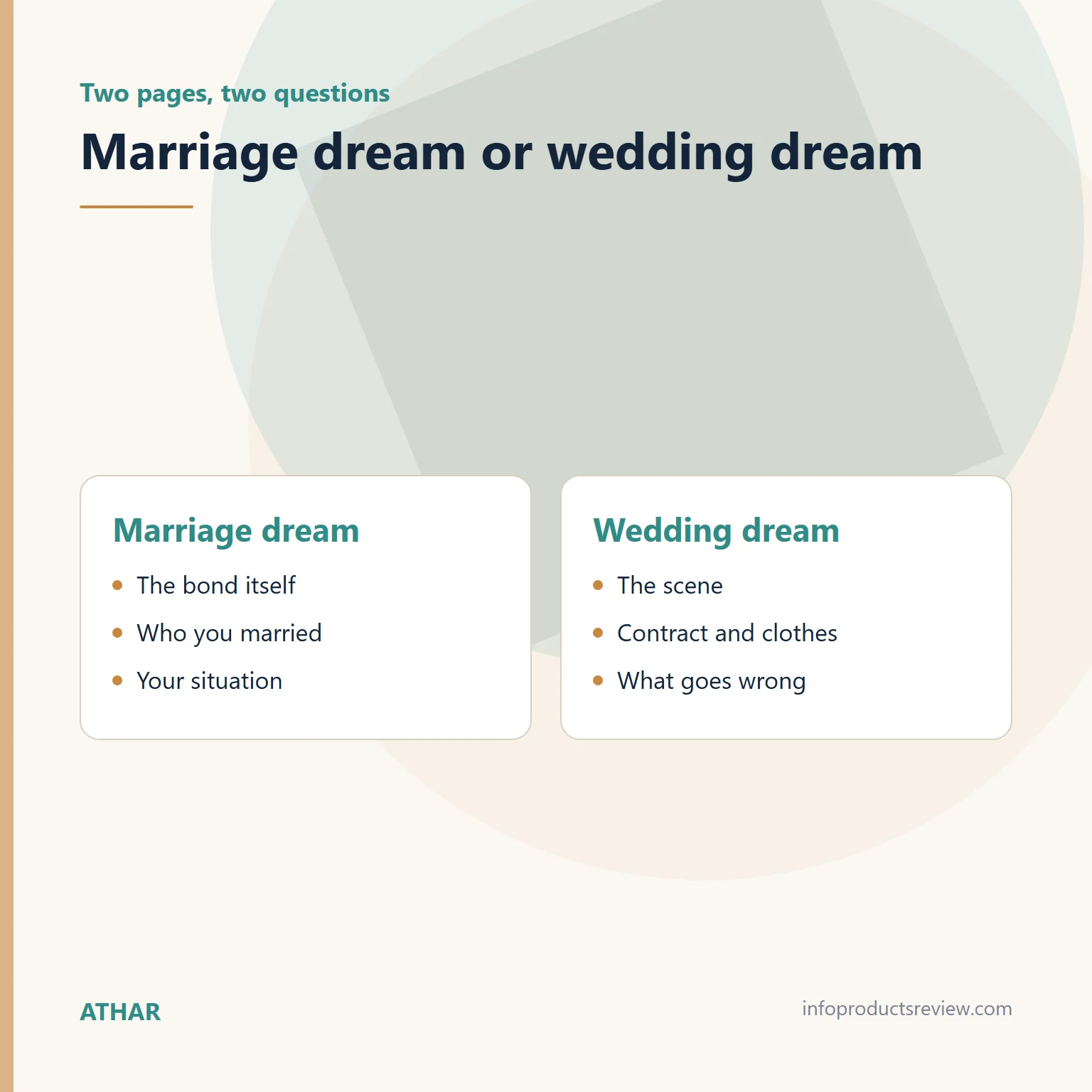
The difference is simple, but a lot of pages blur it, which is why each has its own page here.
A marriage dream is about the bond itself: that you got married, who you married, and how your situation changed. That’s the subject of the marriage dream guide, which covers what the old books say about marriage in dreams and the different situations of single, married and divorced dreamers.
A wedding dream is about the scene: the venue, the contract, the clothes, the ring, the henna, the music, the guests, the food and whatever goes wrong. You might not see your partner at all. You might see the whole celebration without knowing who you’re marrying. That scene is what this page is for.
The distinction matters in practice. Someone who dreamed of marrying a particular person is asking what the bond means. Someone who dreamed of a noisy wedding with no groom is asking what the details mean. Those are two different questions with two different answers.
Sometimes both turn up in one dream: you marry someone you know, and then the celebration falls apart or the dress goes missing. Read it in two layers. The bond belongs to the marriage guide; the scene and its details belong here.
Don’t let an upsetting detail at the party cancel out a reassuring meaning in the bond itself, or the other way round. One dream can hold happiness about the person and worry about the arrangements at the same time. That’s exactly where many engaged people are in real life: content with their choice, and nervous about the day itself, with its costs, its waiting and everyone watching.
Which details change how a wedding dream reads?
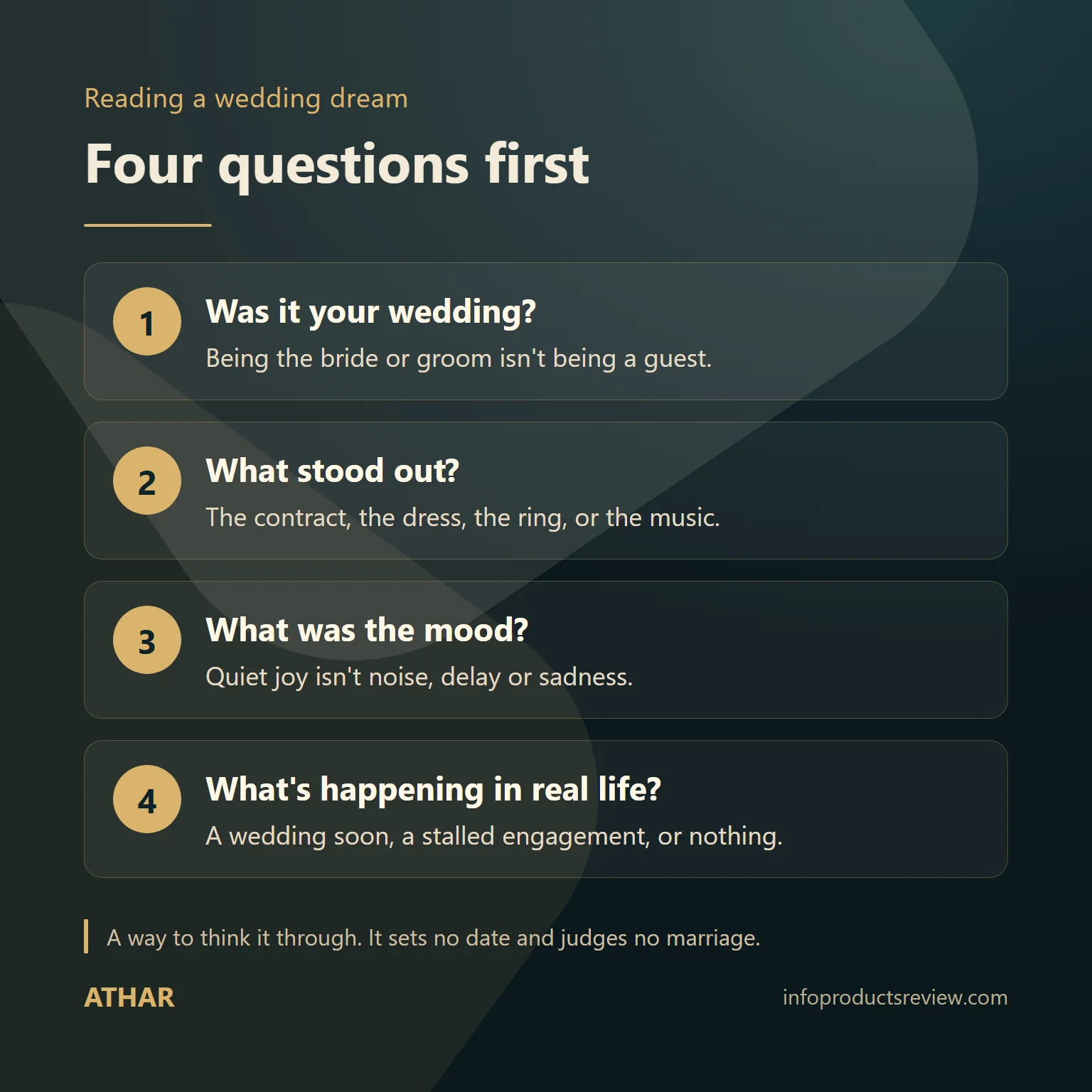
Here they are, from most to least important:
First: was it your wedding? Being the bride or groom is different from attending someone else’s. This page is about the first.
Second: what stood out? The contract, the dress, the ring, the music and noise, the meal, or something missing, like the groom or the dress?
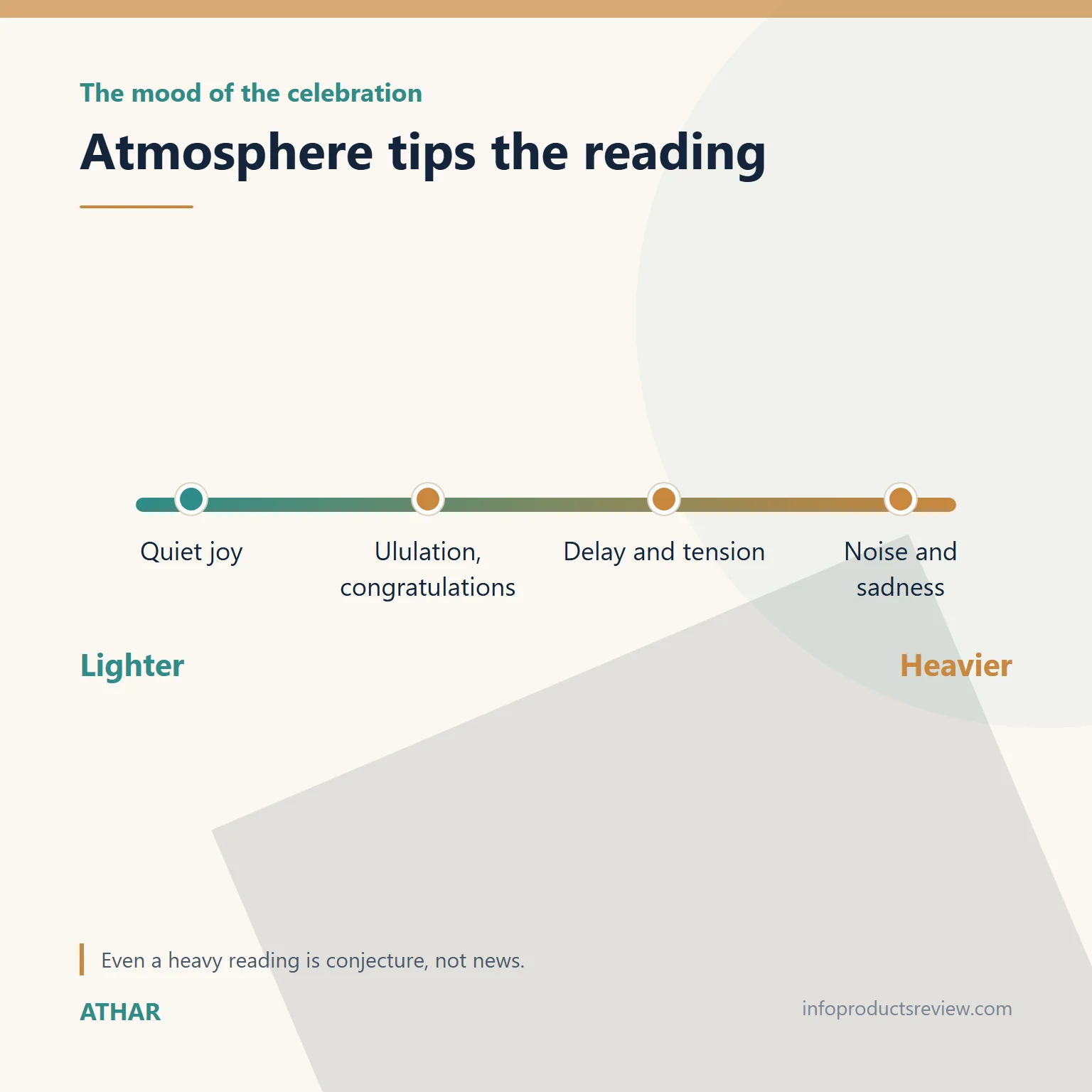
Third: what was the atmosphere? Calm happiness and dignity, noise and chaos, delays and tension, or sadness in the middle of a celebration?
Fourth: your real situation. Is a wedding actually coming up? Is an engagement stalling? Or is none of this happening? The answer alone can turn the whole dream into an echo of the preparations.
Before any of the detail, here is the principle that governs all of it. Interpretation is analogy, comparison and conjecture. It can comfort a person, but nobody should swear by what it seems to foretell until its truth shows in waking life. Every detail below tilts a reading; none of them settles it.
For example, a torn dress in the dream of a bride whose wedding is a week away is not the same as a torn dress in the dream of a woman who isn’t thinking about marriage at all. Same image, different life, different reading.
What does signing the marriage contract mean?
In Muslim weddings the contract, the nikah, is the moment the marriage becomes official: words are spoken, witnesses are present, a signature is written. So if you’re about to marry, seeing it in a dream is most likely an echo of that moment, whether you’re longing for it or nervous about it.
If you’re not about to marry, a contract is a natural picture for any commitment made in front of others: a partnership, a job, an agreement, a responsibility you formally accept. That’s a reading by analogy rather than something a book states, and we offer it because it fits how interpretation actually works better than the claim that every contract in a dream means an imminent wedding.
Some details change how a contract dream feels:
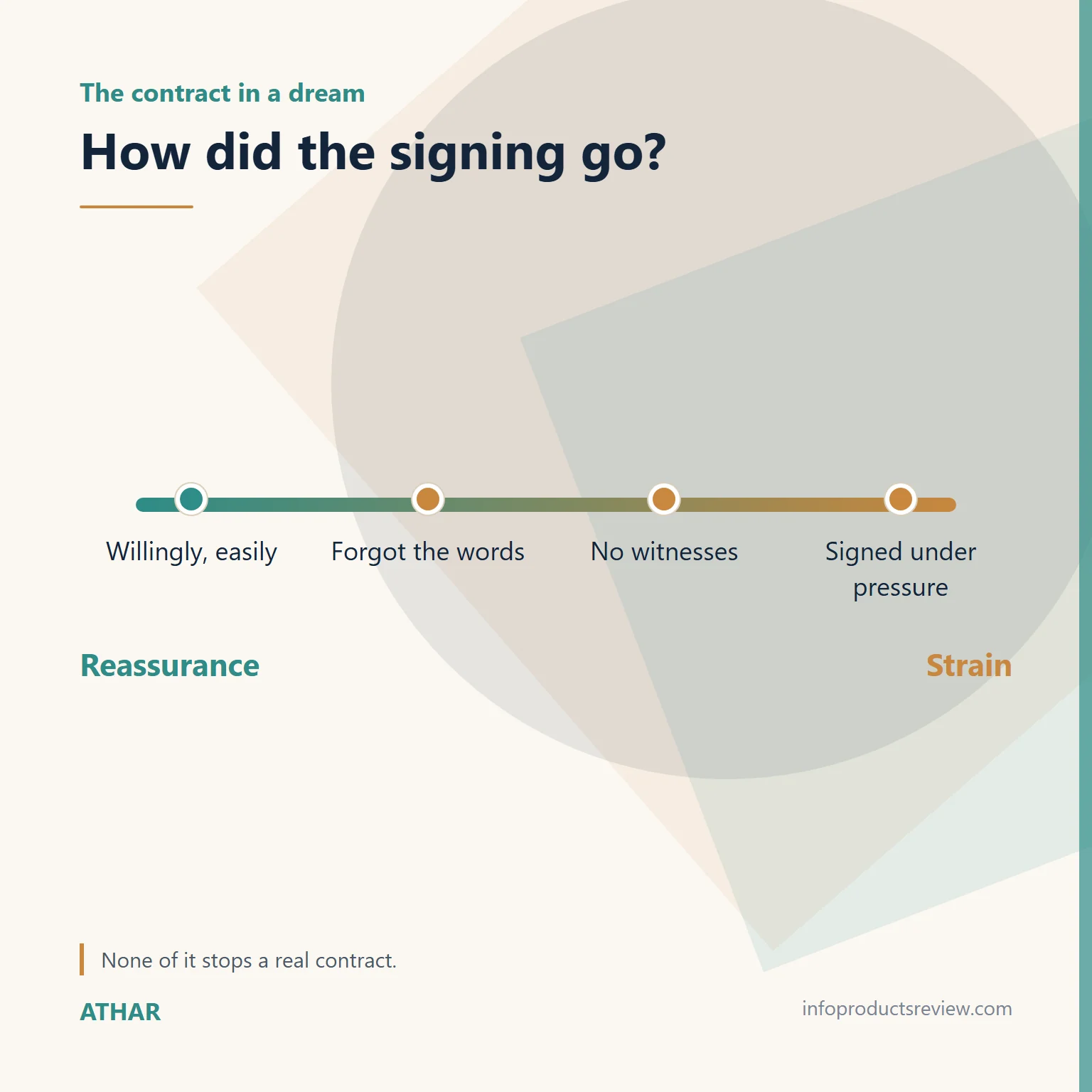
- It went smoothly and willingly: closer to reassurance, or to something in your life going easily.
- It stalled, or the witnesses or officiant didn’t turn up: closer to worry about a delay in something you’re waiting for.
- You signed under pressure, or without understanding what was written: closer to strain around a decision you haven’t fully made peace with.
- You forgot the words or got them wrong: a common picture of the fear of being embarrassed in public.
None of that says your real contract will fall through. If you’re genuinely unsure about the decision itself, the traditional path is to pray the istikhara prayer for guidance and to ask people you trust, not to wait for a dream.
After a contract dream, ask yourself two things. Am I waiting for a signature or an answer on something? Is there a decision I’m afraid of being bound to before I really understand it? Your answers will bring you closer to the dream’s meaning than any ready-made list.
What does the wedding dress mean in a dream?
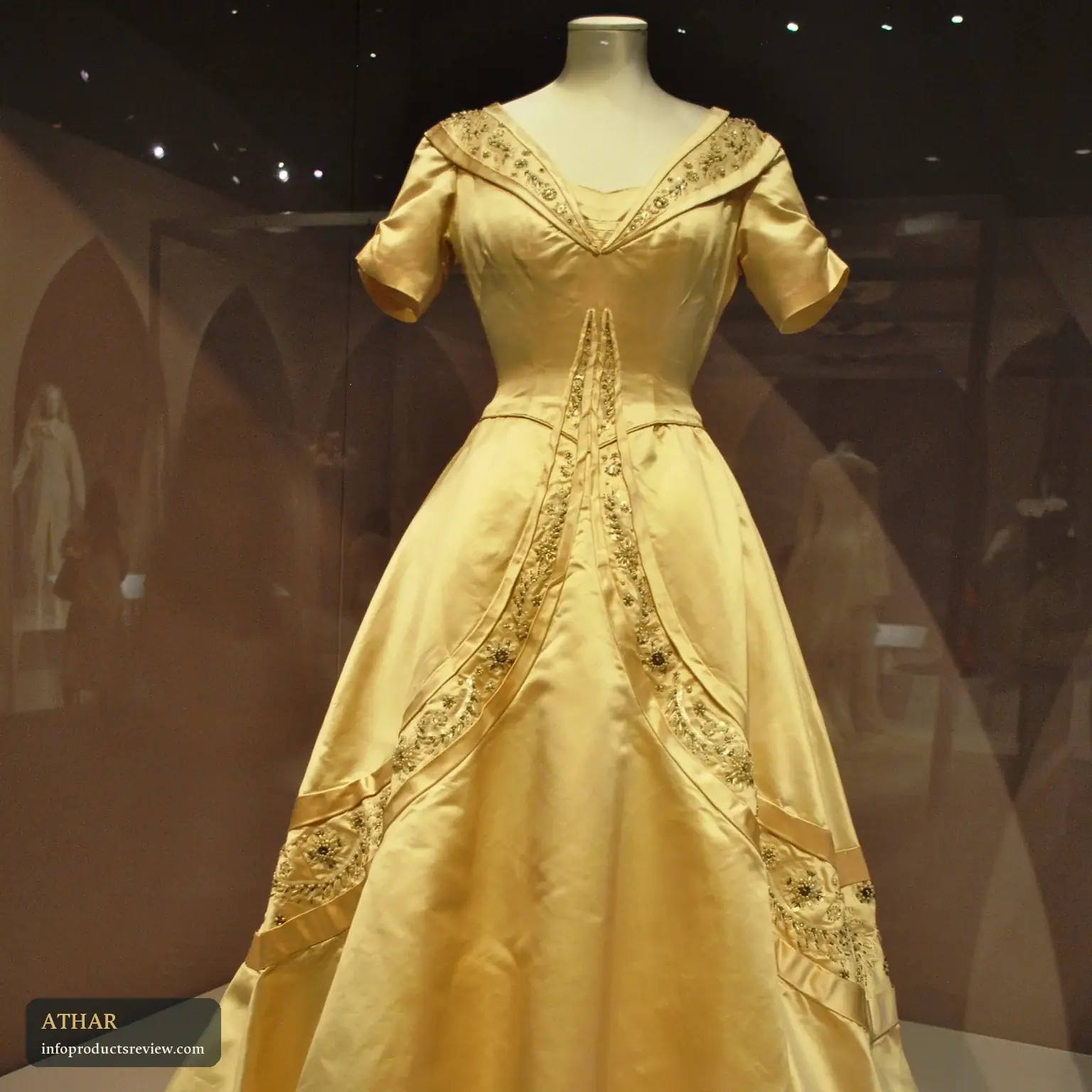
For many women, the dress is the most vivid part of a wedding dream: trying it on, choosing it, wearing it at the celebration, losing it, finding it stained.
One interpreter says in a published interview that when a woman dreams she’s been dressed in a wedding dress, it may be read for her as protection and modesty, or as a good husband, depending on her situation. He frames this as interpreting through custom: what people in the dreamer’s own country wear at weddings is read by what it means to them. That’s one person’s view in an interview, not a rule and not a promise of a husband.
The details can be sorted like this:
A clean, fitting dress you were happy in: the most natural reading is reassurance and a sense of being protected, or an echo of preparations you’re enjoying.
A stained or torn dress: closer to worry about a flaw or embarrassment, or to the pressure of planning. It says nothing about your husband or about how the marriage will go.
A dress that doesn’t fit: a familiar picture of fearing you’re not ready, or of worrying about how others will see you.
Losing the dress on the day: one of the best-known pre-wedding anxiety dreams. We come back to it in the section on delays and losses.
As for colour, it may be read through local custom. White is familiar at weddings in many countries, so an unusual colour might catch an interpreter’s attention simply because it breaks the norm. There is no fixed rule for each colour in the old books.
What do the groom’s clothes mean in a dream?
In the same interview, the interpreter gives an example from Gulf custom. A man prayed for guidance about a marriage and then dreamed that people dressed him in a black bisht, the formal cloak grooms wear there. He read it for him as good news that the marriage would go ahead, because in that region a groom is dressed in a bisht.
He adds that for someone from a place where men don’t wear it, the same dream might be read quite differently, as worry or debt. The value here isn’t the cloak. It’s the method: wedding clothes are read by what they mean where the dreamer lives.
A suit, a robe, a turban, whatever a groom traditionally wears in your culture, is closer to getting ready for a new stage if that’s what grooms wear where you’re from. The worry-or-debt reading is a possibility he mentions for a different setting, not a verdict on everyone who dreams of a cloak.
Clean clothes that fit sit closer to reassurance. Clothes that are too tight, borrowed or simply wrong for you sit closer to feeling that the responsibility is bigger than you are. None of it decides anything about your future wife or how the marriage will go.
What does the wedding ring mean in a dream?
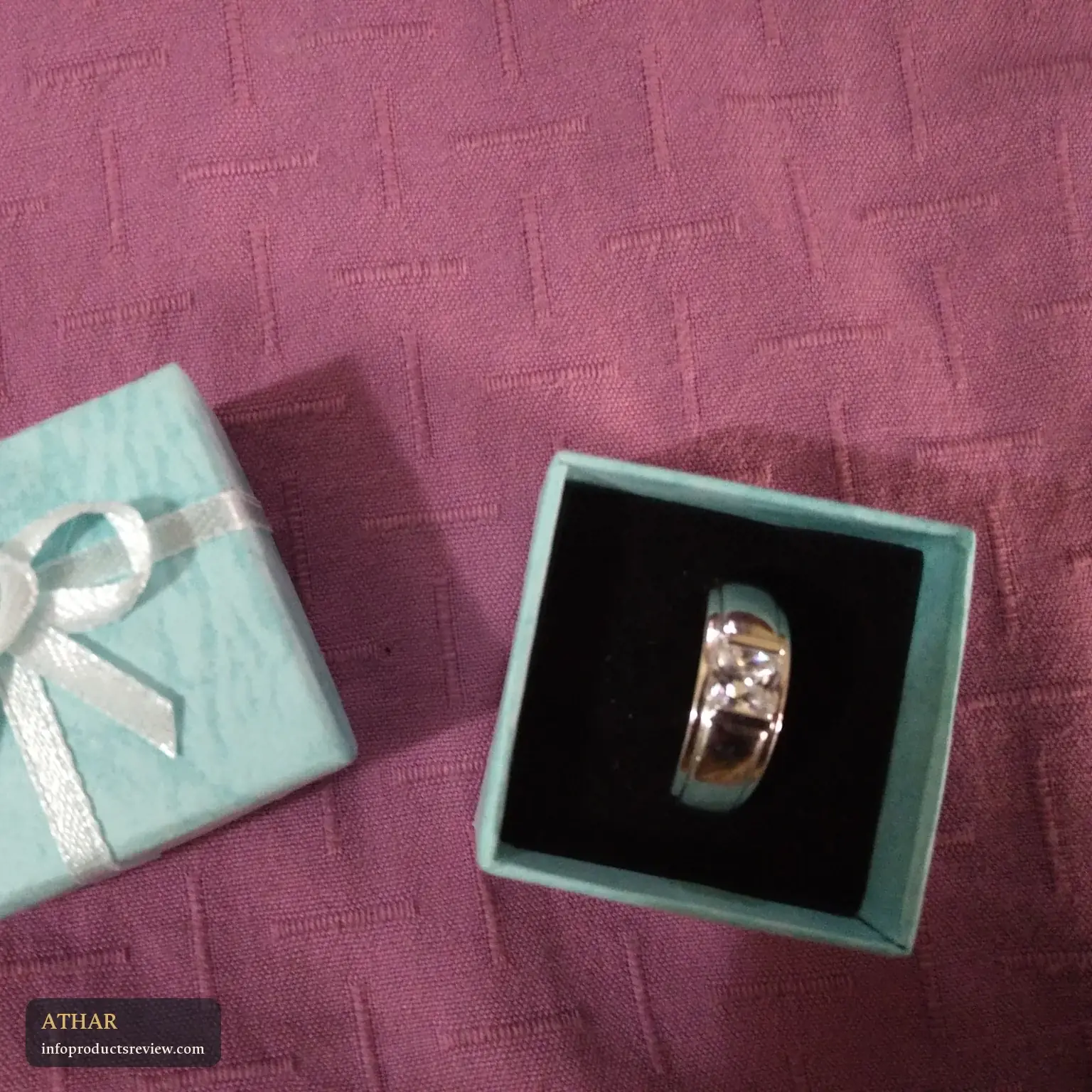
Here the books of dream interpretation are unusually specific. A ring, they say, can stand for its owner’s authority, meaning something he holds or is responsible for, and it may also be a woman he has, or wealth, or a child.
The best-known line on it comes from an old exchange, a short question and a shorter answer: a ring in sleep is a woman, and her beauty is in proportion to the quality of its stone. The stone here is the raised jewel set at the top of the band, the part by which a ring is recognised.
The same passage adds a second image. If someone sees the band of his ring break and fall away while the stone remains, he loses the authority or the thing he owned, while his reputation and standing among people remain. The band is the circle that goes round the finger and holds the stone.
That’s useful for dreams about engagement rings and wedding bands, but with care:
- A beautiful ring put on at the celebration: consistent with reading a ring as a good wife, and it may simply echo the happiness of an engagement.
- A ring that’s too tight, or that goes missing: closer to worry about losing or stalling something, not to a specific engagement being called off.
- A ring that breaks: the recorded reading is losing something you own while your standing remains. It’s a possible reading, not news of a divorce or a broken engagement.
Notice that this reading was written, as most dream books of its time were, with a male dreamer in mind. So a woman who dreams of a lovely ring can’t conclude, “I’ll marry a good man within the month.” A ring can reassure. It can’t name a person or a date.
The old books give no specific meaning for the couple exchanging rings, or for a name engraved inside the band. Anything said about those is a reading by analogy, not a quotation.
What do gold and jewellery mean on the wedding night?
Jewellery is part of many weddings: a necklace, earrings, a bridal crown. The classical books hold that whoever sees a necklace of gold, silver or gems on himself takes on an office and is entrusted with a trust, meaning a responsibility placed in his hands.
Then comes something rarer: Dream interpreters hold, the early scholar whose name is attached to so much dream lore. It says that pearls are the Quran, a necklace is judgement, a crown is kingship, and earrings seen on oneself are adornment and beauty among people.
That report sits inside an early book whose author is firmly established, which is very
So if a bride dreams of wearing beautiful earrings or a necklace at her wedding, the closest meaning these texts support is adornment, standing and trust. If the jewellery is heavy or painful, the nearer reading is a sense of how much she’s carrying. None of it points to the size of a dowry or money on its way.
One small point that matters in Arabic: the word for necklace in that report, ‘iqd, looks almost identical to the word for a marriage contract, ‘aqd. The resemblance doesn’t turn a dream about a necklace into news of a wedding contract.
If you’re single and the gold turned up outside a wedding scene, as a gift, a purchase or something you lost, we look at those dreams in Dreaming of Gold as a Single Woman.
What does henna before the wedding mean?

The henna night is a pre-wedding tradition across much of the Middle East, North Africa and South Asia, so it often appears in brides’ dreams. The classical books say that whoever dyes his hands or feet with henna adorns his relatives with an adornment other than that of religion, and covers over their circumstances; and that henna in the wrong place brings worry and fear, followed by relief.
That text is general, and the passage around it mostly talks about men, so it can’t be turned into a rule about brides. The phrase “other than that of religion” describes the kind of adornment being discussed; it’s no judgement on anyone’s faith.
What the passage does show is the logic of the symbol, and that’s the useful part: henna is adornment and covering, and adornment in the wrong place is a passing worry that gives way to relief.
- Beautiful henna in the usual place: closer to adornment and enjoying the preparations.
- Henna in the wrong place, or smudged and running: closer to worry that some detail is off, and the same passage mentions relief afterwards.
- Henna that won’t take its colour: close to the fear that things won’t turn out the way you want.
Are drums, pipes and dancing at a wedding a bad sign?
This is one of the most common questions, and one of the most exaggerated. The short answer is no: it isn’t a warning of disaster on its way. But the old books do carry heavy language here, and it’s worth understanding calmly.
Listing people by their trades and what they signify in dreams, the books of dream interpretation say that the drummer invents false talk whose sound carries far against him, that the piper announces someone’s death, and that the dancer is a man on whom misfortunes follow one after another.
That text needs its context before anyone builds on it:
First, it describes the person seen drumming, piping or dancing, in a passage about occupations. It isn’t about weddings.
Second, the readings are heavy: false talk, announcing someone’s death, misfortunes one after another. In a later dream book, Ta’tir al-Anam by the Damascene scholar Abd al-Ghani al-Nabulsi, there’s something similar: pipes, drums or something like dancing alongside a lute are a misfortune for the people of that place. That’s a reading nothing should rest on by itself.
Third, an interpreter mentions in an interview that some people read dancing and loud celebration in a dream as their opposite, turning noisy joy into sorrow, and then says himself that this is conjecture he can’t be certain of.
What does that leave? That very loud celebration and exaggerated dancing in a dream may be read against its surface by some interpreters. It doesn’t justify telling a bride who dreamed of drums at her wedding that disaster is coming. The reading is conjecture, the details change it, and if her wedding is near, the likeliest explanation is that she dreamed about what she’s preparing.
We include these harsh readings because they’re in the books, not because they apply to you. The “announcing a death” in that text describes the person seen piping; it is not news that anyone in your family or among your guests will die. No one learns the unseen from a dream.
If the scene unsettled you, follow the guidance recorded in Sahih al-Bukhari (7045) and Sahih Muslim (2262) for a dream you dislike. You’ll find the details in the section on what’s established in Islam below.
Singing, ululation and quiet joy
Not every celebration in a dream is noisy. There’s a real difference between a wedding filled with calm, smiles and congratulations and one dominated by chaos and loud sound.
Quiet happiness without uproar sits closer to reassurance and contentment, or to an echo of real joy you’re looking forward to. Nothing in the old books turns it into a warning.
Ululation, the high trilling cry of celebration at many Arab weddings, has no specific meaning in those books. In many cultures it announces happiness, so the closest reading is announcement and good news when the atmosphere is calm, and simply noise when it takes over the scene.
Loud singing with chaos and sadness inside the celebration: this combines noise with a heavy feeling, which is the picture some interpreters read against its surface. It’s still conjecture, never news.
A useful question after this kind of dream: was the noise bothering you in the dream, or were you enjoying it? Joy you were living comfortably isn’t the same as a racket you were trying to escape.
What does the wedding procession mean?
The procession, the zaffa in Arabic, is the bride or groom being escorted in public to the venue or the new home. In a dream, it’s a clear picture of a visible transition: from one stage to the next, from one home to another.
- An orderly procession that arrives: closer to a smooth move toward something you’re waiting for.
- A procession that loses its way: closer to worry about the road to a goal, not a certain failure.
- A convoy or walk that never arrives: a common picture of a long wait.
The old books give the procession no specific meaning. As with any journey in a dream, the move itself matters more than how you travel.
What does the wedding feast mean?
A meal is part of a wedding almost everywhere: a table, guests, generosity. In a dream it can take several forms.
A full table with family gathered around it: closer to togetherness, blessing and good relationships, or an echo of planning the hospitality.
Food running out before the guests eat: a common picture of the fear of falling short in front of people, especially for whoever is organising the wedding.
A feast with no guests: may echo a fear of being alone, or that the people you love won’t come.
There’s no specific text on the wedding feast in the old books, so these are readings by the logic of the symbol, offered as possibilities. If you’re the one actually working out the catering budget, a dream of food running short is most likely that budget talking.
What does a wedding with no groom, or no bride, mean?
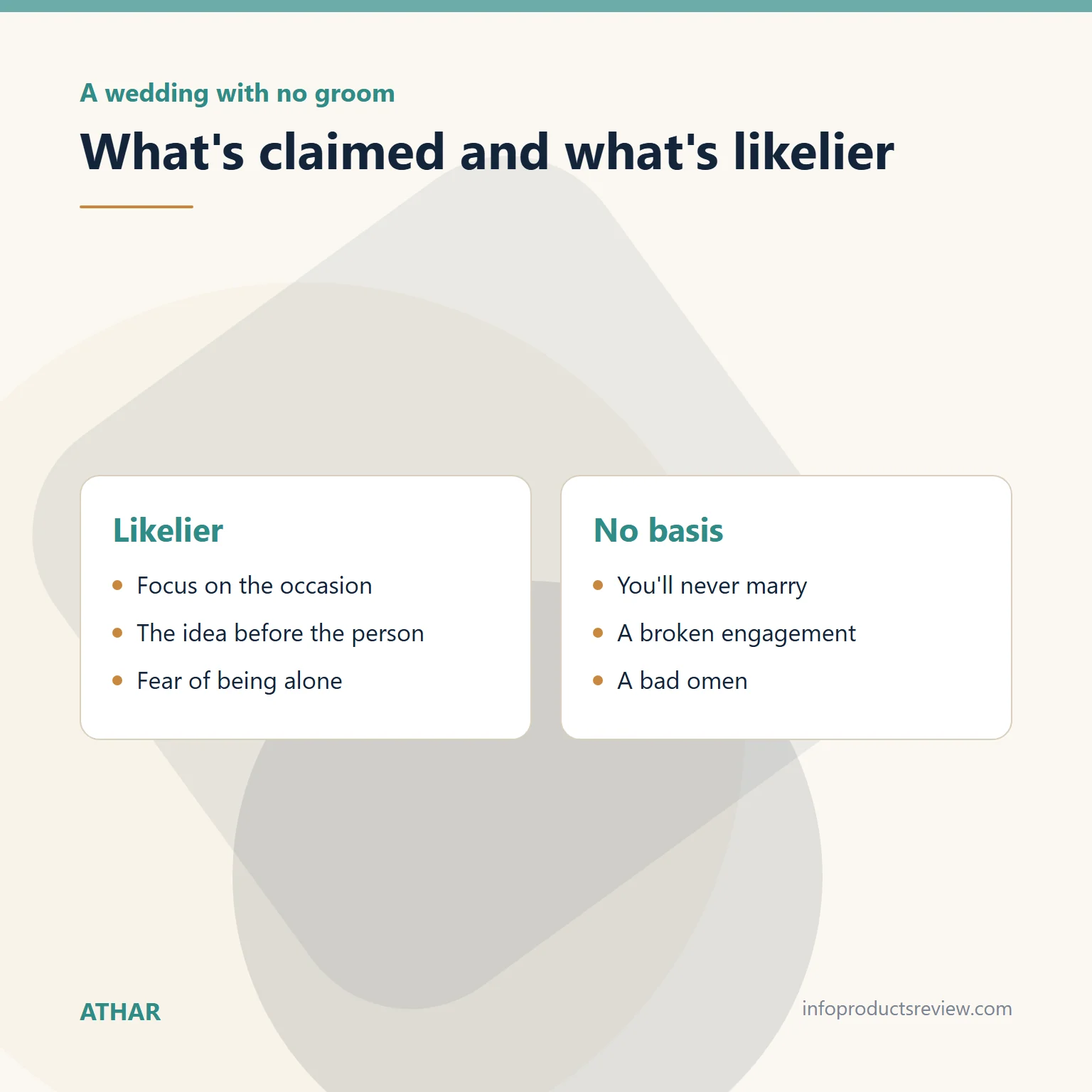
This is one of the most puzzling wedding dreams. The celebration is on, the hall is full, the dress is ready, and there’s no groom. Or a man sees his whole wedding and never sees the bride.
The closest reading is that the dreamer is more focused on the occasion than on a person: the preparations, what people will think, the idea of marriage itself before there’s a particular partner. That’s common among people who are thinking about marriage but haven’t had a proposal, or who are waiting on an engagement that hasn’t come together.
It can also be a picture of the fear of being left alone at an important moment. It does not mean an engagement will be broken off, or that the dreamer will never marry.
If you’re engaged and had this dream, don’t let it make you suspicious of your fiancé or start checking up on him. The dream is about your own worry, not about anyone else’s intentions.
If the groom or bride does appear and turns out to be someone other than the person you expected, that’s the “who did you marry” question, which is covered in the marriage dream guide.
A late groom, a lost dress, a missed date
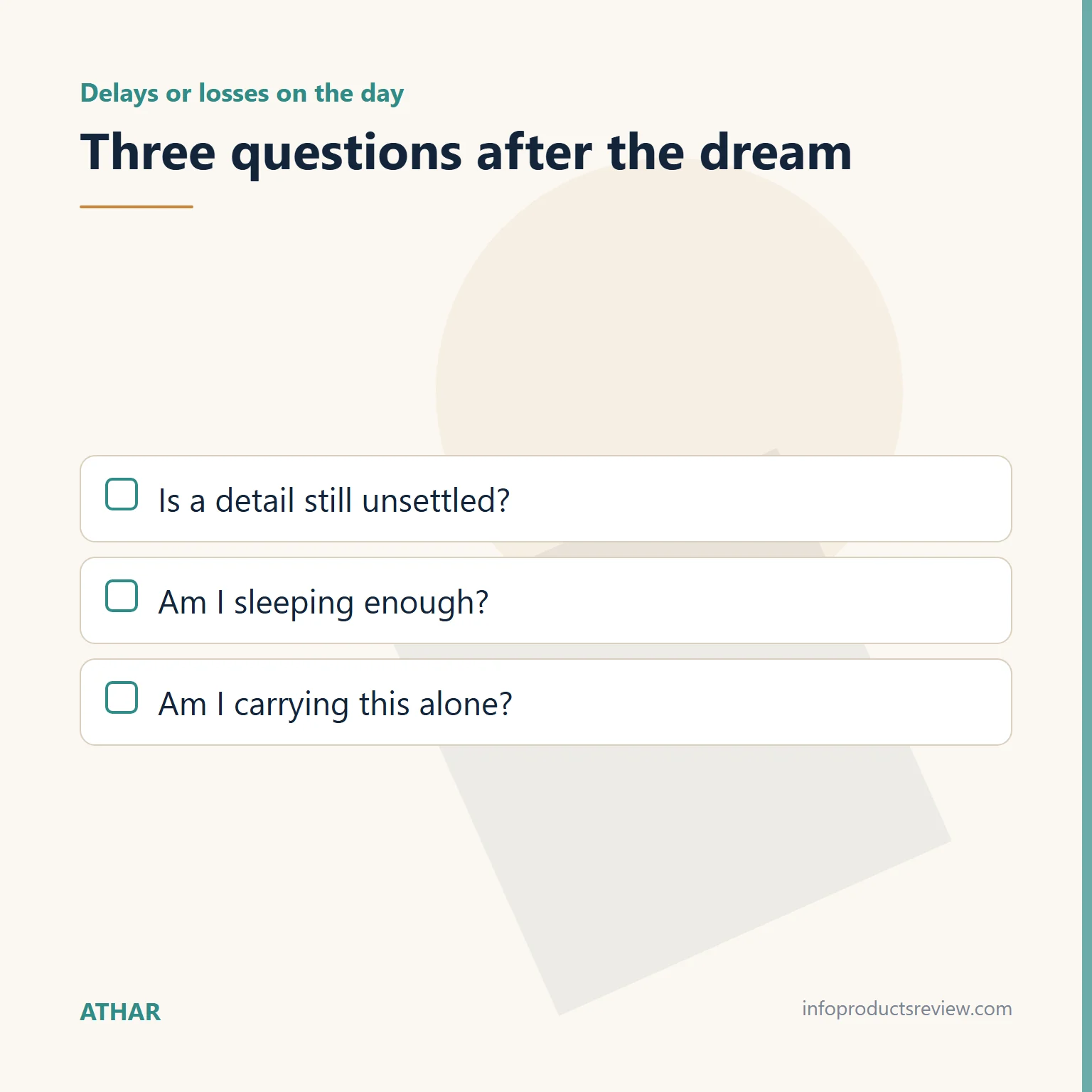
These dreams share one thing: something is missing or late on a day that’s supposed to be perfect. The groom hasn’t arrived, the dress is gone, the date has passed.
Or the venue is locked, or you’ve forgotten something essential and only remember it in front of everyone.
The Sleep Foundation lists stress, anxiety and too little sleep among the causes of disturbing dreams. The weeks before a wedding tend to be full of all three: appointments, costs, late nights and endless small decisions. So these dreams most likely reflect that pressure rather than anything about the day itself.
After one of these dreams, it can help to ask:
- Is there a detail in the planning that still hasn’t been settled?
- Am I getting enough sleep right now?
- Am I carrying something alone that someone else could share?
If the answer to any of those is yes, the dream has pointed at something you already knew. If not, seek refuge in God and don’t give it more weight than it deserves.
And a groom who’s late in your dream isn’t careless or hesitant in real life. Don’t hold him to account for something you saw in your own sleep.
A wedding among strangers
It’s your wedding, but you don’t know the guests, you’ve never seen the hall, and your family isn’t there.
The closest reading is a sense of being a stranger in a new stage of life: a new home, a new family you’re joining, or a new country you’ll move to after marriage. That’s a natural feeling for many people before they marry, especially if they’re moving far from home.
Your family’s absence in the dream may echo a disagreement with them about the marriage, or a fear that they won’t approve. It points to no rift on the way.
What does a marriage contract in a mosque mean?
In many countries the nikah is held in a mosque, and dreams often carry that setting’s calm and dignity.
There’s no specific meaning for a contract held in a mosque in the old books. What we say here is a reading by the logic of the image: a mosque is a place of worship and calm, and a contract held there pictures a commitment the dreamer wants to begin on a good footing.
So the nearer reading is to take heart from it if the atmosphere was calm, without treating it as a guarantee of a marriage or of anyone’s character. If something in the scene bothered you, like a crush of people or an argument at the signing, it most likely echoes tension about the arrangements rather than anything about the marriage.
A married woman dreams of her wedding again: is it divorce?
A woman married for years dreams she’s at her wedding again: the dress, the celebration, the guests. The first thought is often, “Is this divorce? Another marriage?” The answer is no.
If the groom is her own husband, the closest reading is renewal in the relationship, nostalgia for the early days, or an anniversary on her mind.
If it’s someone else, the books of dream interpretation hold that a woman who has a husband and sees that she married another man gains favour and good, and that the same goes for a man. The marriage dream guide goes into that in detail.
Either way, the dream does not mean divorce or betrayal, and it’s no ground for accusing a husband of anything. If something in her marriage is weighing on her, our readings of other symbols for married women, like lice dreams for a married woman and snake dreams for a married woman, follow the same method: her situation first, then the details.
Loved ones who have died, at your wedding
You see your father, your mother or a grandparent who has passed away, standing at your wedding, smiling or giving their blessing. Few wedding dreams are as moving.
The closest reading is longing for them at a moment they were meant to share, especially if your wedding is near. If they looked well in the dream, it’s the kind of dream that comforts. It says nothing about their state in the hereafter, and it predicts nobody’s death.
What’s established and what isn’t about these dreams is gathered in our guide to dreaming of someone who has died. And if you woke up in tears, our page on crying in a dream may help.
Running away from your wedding
You walk out of the hall, run before the contract is signed, or refuse to come out to the guests.
The closest reading is hesitation, fear of the responsibility or the change, or family pressure around a decision you haven’t fully made your own. It can also come to people who are completely happy about their marriage, because fear of change isn’t the same as rejecting the person.
The dream is no reason to call off a wedding. If you do have real doubts, talk to someone you trust, pray for guidance, and ask for advice. If the dream is the only thing worrying you, it’s most likely an echo of an ordinary fear.
Wedding dreams in the weeks before the real thing
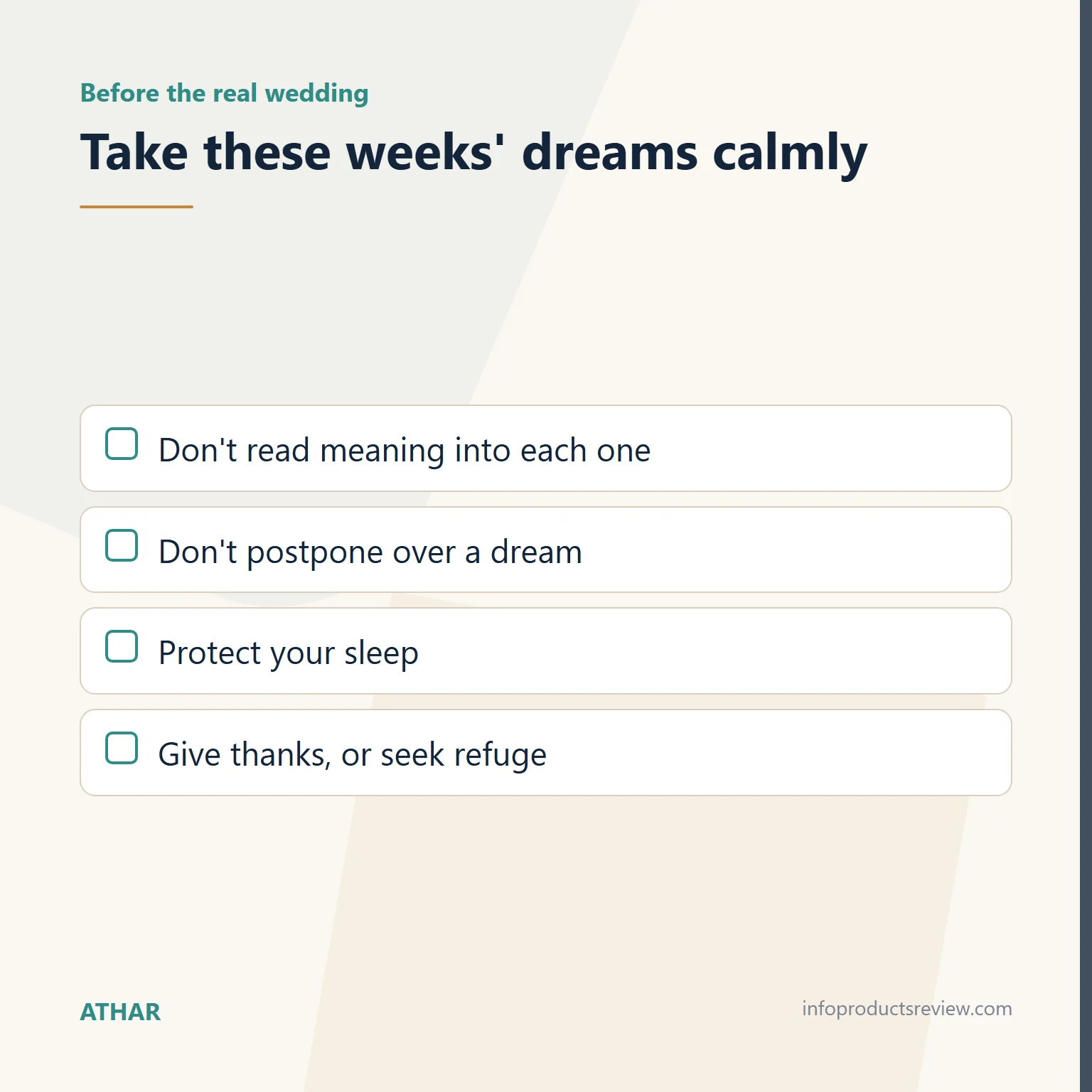
The people who dream of their wedding most are the ones whose wedding is actually close. In that case, the dream is usually an extension of the day: guest lists, the dress, the venue, the money, the nerves.
So we’d suggest treating dreams from this period calmly:
- Don’t look for a meaning in every one. Planning images repeating in your sleep is to be expected.
- Don’t postpone or cancel because of a dream. Big decisions rest on real life, advice and prayer for guidance.
- Protect your sleep. Long late nights before a wedding can make dreams more unsettling.
- If a dream made you happy, thank God for it. If it upset you, seek refuge in God and don’t retell it to everyone.
It’s normal for fear and joy to get tangled up in these weeks. Great happiness often carries a fear that something will spoil it.
If these dreams are starting to wreck your sleep, try a few simple things. Write tomorrow’s remaining tasks down before bed so they stop circling in your head. Keep late-evening talk about the arrangements to a minimum. And hand over whatever someone else could take off your plate.
What’s actually established in Islam about dreams
Two things need to stay separate here: reading the symbols of a wedding, which is interpretation and can be right or wrong; and the Prophet’s guidance on how to handle dreams, which is established in Sahih al-Bukhari and Sahih Muslim.
In Sahih al-Bukhari, in the Book of Dream Interpretation (hadith 7045), Abu Sa’id al-Khudri reports that the Prophet ﷺ said:
If one of you sees a dream he likes, it is from God, so let him praise God for it and speak of it; if he sees otherwise, something he dislikes, it is from Satan, so let him seek refuge from its harm and mention it to no one, for it will not harm him.
In other words, a dream you like is something to thank God for, and you may speak about it. A dream you dislike is something to seek refuge from and keep to yourself, and it won’t harm you. That’s guidance on how to treat dreams, not an interpretation of any particular symbol.
And in Sahih Muslim, in the Book of Dreams (hadith 2262), Jabir reports that the Prophet ﷺ told anyone who sees a dream they dislike to spit lightly to the left three times, seek refuge in God from Satan three times, and turn over from the side they were lying on.
If one of you sees a dream he dislikes, let him spit to his left three times, seek refuge in God from Satan three times, and turn over from the side he was lying on
So if you dreamed of a wedding that made you happy, thank God and share it with people you love. If you dreamed of a chaotic wedding, a groom who never came or a torn dress, seek refuge in God from its harm and don’t retell it to everyone. The hadith in al-Bukhari (7045) reassures you that it won’t harm you.
A dream establishes no religious ruling, dissolves no contract and accuses no one. Scholars treat a dream as something that may bring comfort, never as a sole basis for acting.
What a wedding dream can’t tell you
To close the door on scaremongering, here’s where the dream stops:
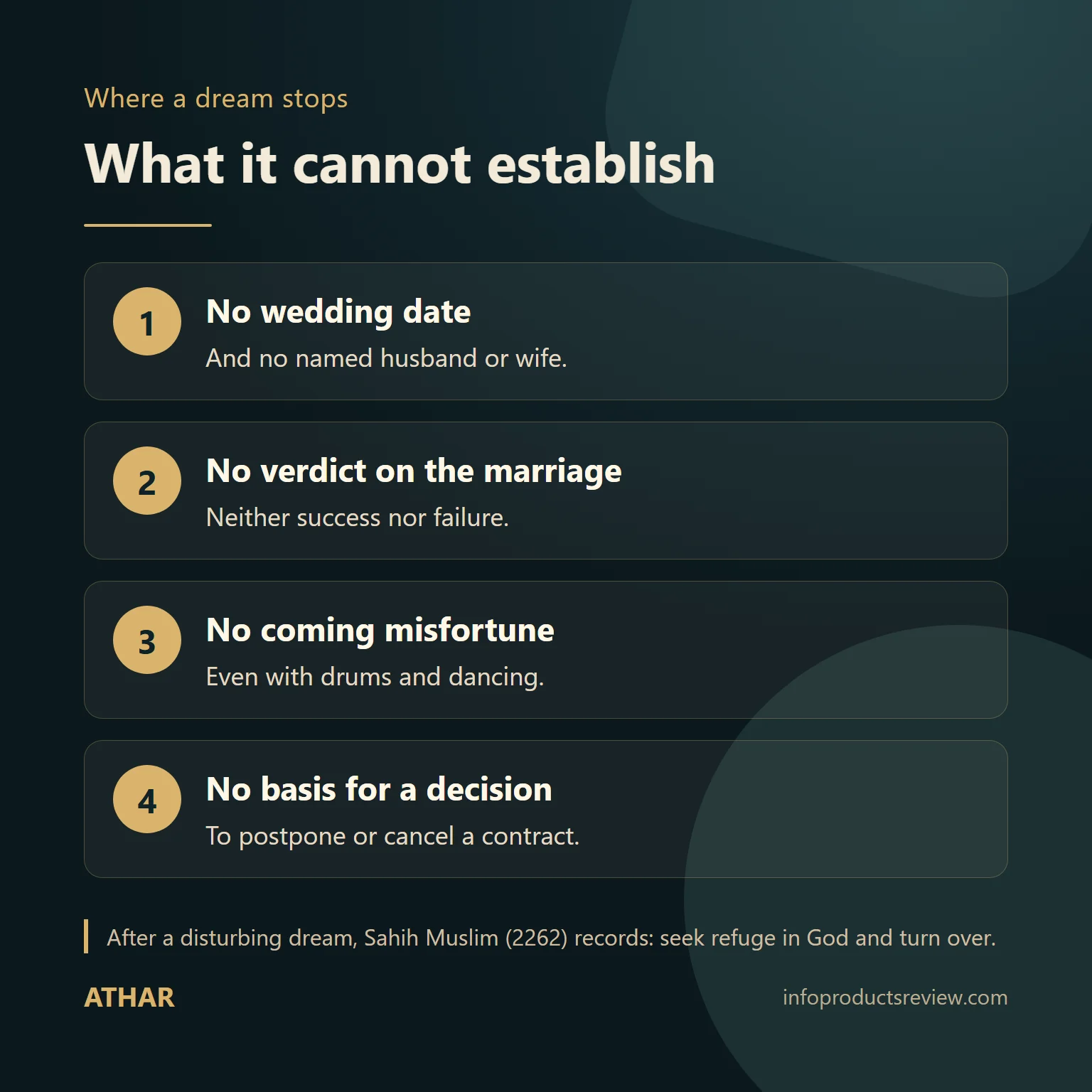
- It can’t set a wedding date or name a husband or wife.
- It can’t tell you whether the marriage will succeed or fail.
- It can’t predict a particular misfortune, even with drums and dancing in it.
- It isn’t a reason to postpone or cancel a contract.
- It can’t show whether your family approves or objects.
- It can’t foretell the death of anyone who was there.
Those limits are what protect you from both scaremongering and easy promises. A dream describes what’s inside you far better than it maps what’s ahead of you.
What to do after a wedding dream
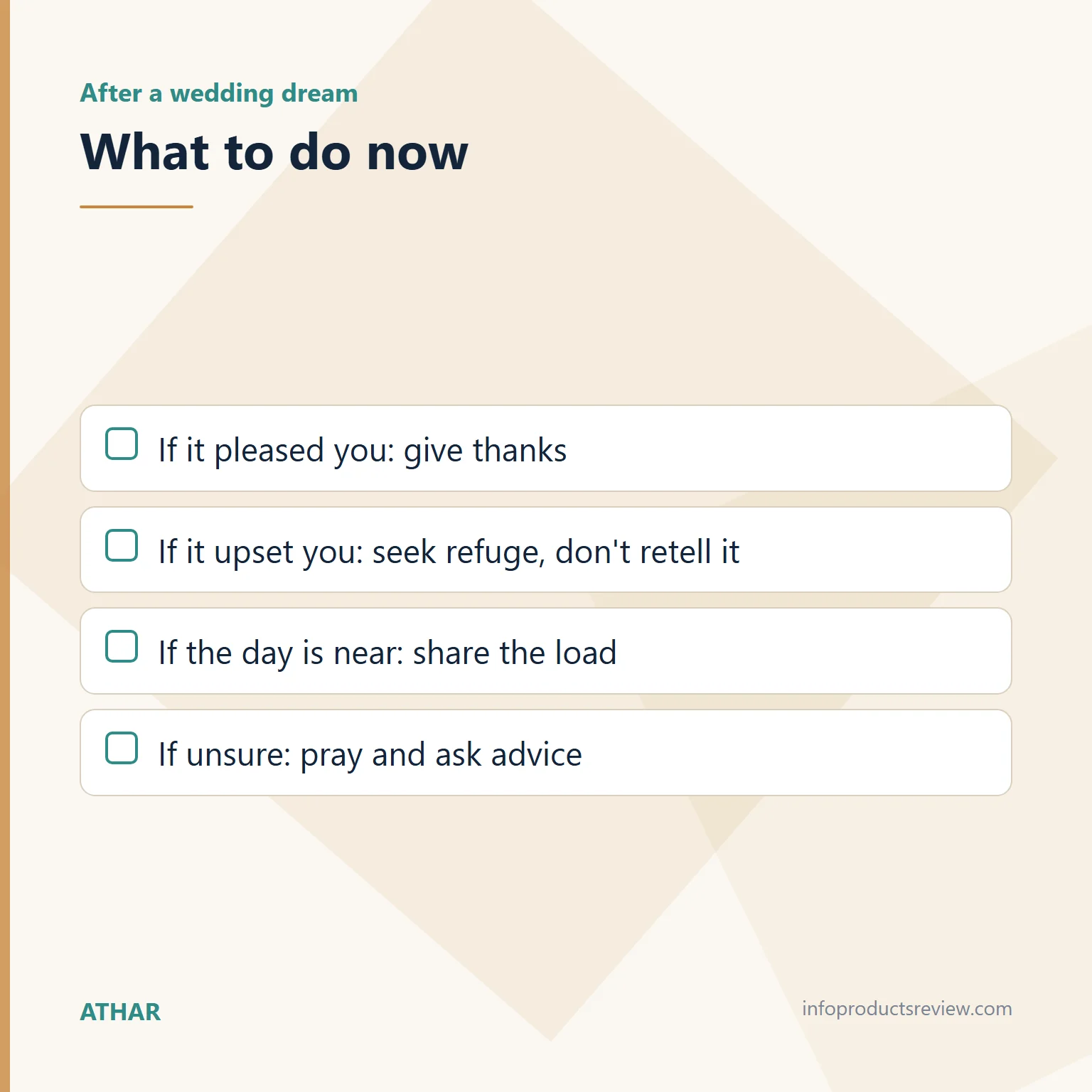
If it was a happy dream: thank God, and share it with someone you love if you want to. Don’t hang specific hopes about a date or a person on it.
If it was disturbing: seek refuge in God from its harm, spit lightly to your left three times, turn over, and don’t retell it to everyone, as recorded in Sahih al-Bukhari (7045) and Sahih Muslim (2262).
If your wedding is close: look at what’s worrying you in the planning, share the load, and get enough sleep.
If you’re unsure about marrying at all: don’t look for the answer in a dream. Pray for guidance and ask people with experience whom you trust.
If the same dream keeps coming back: ask what keeps coming back in your days. Repetition is often tied to what’s on your mind.
How to describe a wedding dream so it can be read
If you want to make sense of the dream yourself, or talk it through with someone whose knowledge you trust, describe it in this order:
- Your situation: engaged, wedding coming up, none of that, or already married?
- What stood out: the contract, the dress or groom’s clothes, the ring, henna, music, or the meal?
- What was missing or went wrong: the groom, the dress, the date, the guests?
- The atmosphere: calm and dignified, loud and chaotic, tense, or sad?
- How you felt on waking: happy, anxious, or confused?
You’ll often find that an orderly description makes half the meaning clear before you ask anyone. It also stops you from fixing on one dramatic detail and reading the whole dream through it.
What interpreters say in recorded interviews
Here are two excerpts from published interviews, because they show how some interpreters think about wedding details. A clear caveat: what speakers say in interviews is personal opinion, not religious text and not an established rule, and we paraphrase rather than quote.
In the first, an interpreter talks about reading dreams through custom, using the example of the groom’s cloak and the bride’s dress, and how the same clothing can be read two ways depending on local practice.
The speaker holds that wedding clothes in a dream are read through the dreamer's own customs, so a groom's cloak or a bride's dress may read as good news or as protection depending on local practice. Paraphrased; an opinion from an interview, not a religious ruling or a definitive interpretation.
In the second, another interpreter mentions that some people read dancing and loud celebration in a dream as their opposite, and then says plainly that this is conjecture he can’t be sure of.
The speaker says some interpreters read dancing and loud celebration in a dream as its opposite, and says himself that this is conjecture he cannot be sure of. Paraphrased; an opinion from an interview, not a religious ruling or a definitive interpretation.
Both line up with what this page has said throughout: details are read in context, interpretation is conjecture rather than certainty, and a disturbing dream is something to seek refuge from, not something that can harm you.
Examples
An engaged woman, two weeks before her wedding, dreamed her dress vanished at the venue. Closest reading: an echo of planning pressure, with nothing in it about the marriage.
A single man with no engagement dreamed he was signing a marriage contract in an office. Closest reading: a new commitment in his life, like a job or an agreement, or preoccupation with the idea of marriage.
A young woman dreamed a beautiful ring was placed on her finger at her wedding. It fits the reading of a ring as a good wife, and it may reassure. It names no suitor and no date.
A woman dreamed of her wedding with loud drums, wild dancing and sadness. Some interpreters read that scene against its surface, and that reading is conjecture. She seeks refuge in God, doesn’t retell it, and doesn’t wait for a disaster.
A married man dreamed he was a groom again, marrying his own wife. Closest reading: renewal in the relationship, or nostalgia for the beginning.
A bride dreamed her late father was smiling at her wedding. Closest reading: longing for him at a moment she wished he could share. A comforting dream.
A young man about to sign his marriage contract dreamed he forgot the words in front of the witnesses. Closest reading: an ordinary fear of embarrassment at a formal moment. It says nothing about the contract stalling, and if the dream bothered him, seeking refuge in God is enough.
A young woman dreamed the henna on her hands ran and smudged. The classical books read henna in the wrong place as worry and fear followed by relief, and that text is general, not about brides. Closest reading: a passing worry about the details of the preparations.
A woman dreamed she wore a necklace and earrings at her wedding. earrings are adornment and beauty among people. Closest reading: adornment and standing, with nothing to say about a dowry or any sum of money.
A man with no marriage plans dreamed of a long procession that never reached the hall. Closest reading: a long wait for something he’s hoping for, like a job or a move. Not a sign of failure.
Quick table: the detail and the closest reading
| What you saw | Closest reading | What it doesn’t mean |
|---|---|---|
| A contract signed willingly | An easy commitment, or an echo of waiting | A wedding date |
| A clean dress you were happy in | Reassurance and protection, by custom | Marriage within a set time |
| A beautiful ring | In the books of dream interpretation, a good wife | A specific suitor |
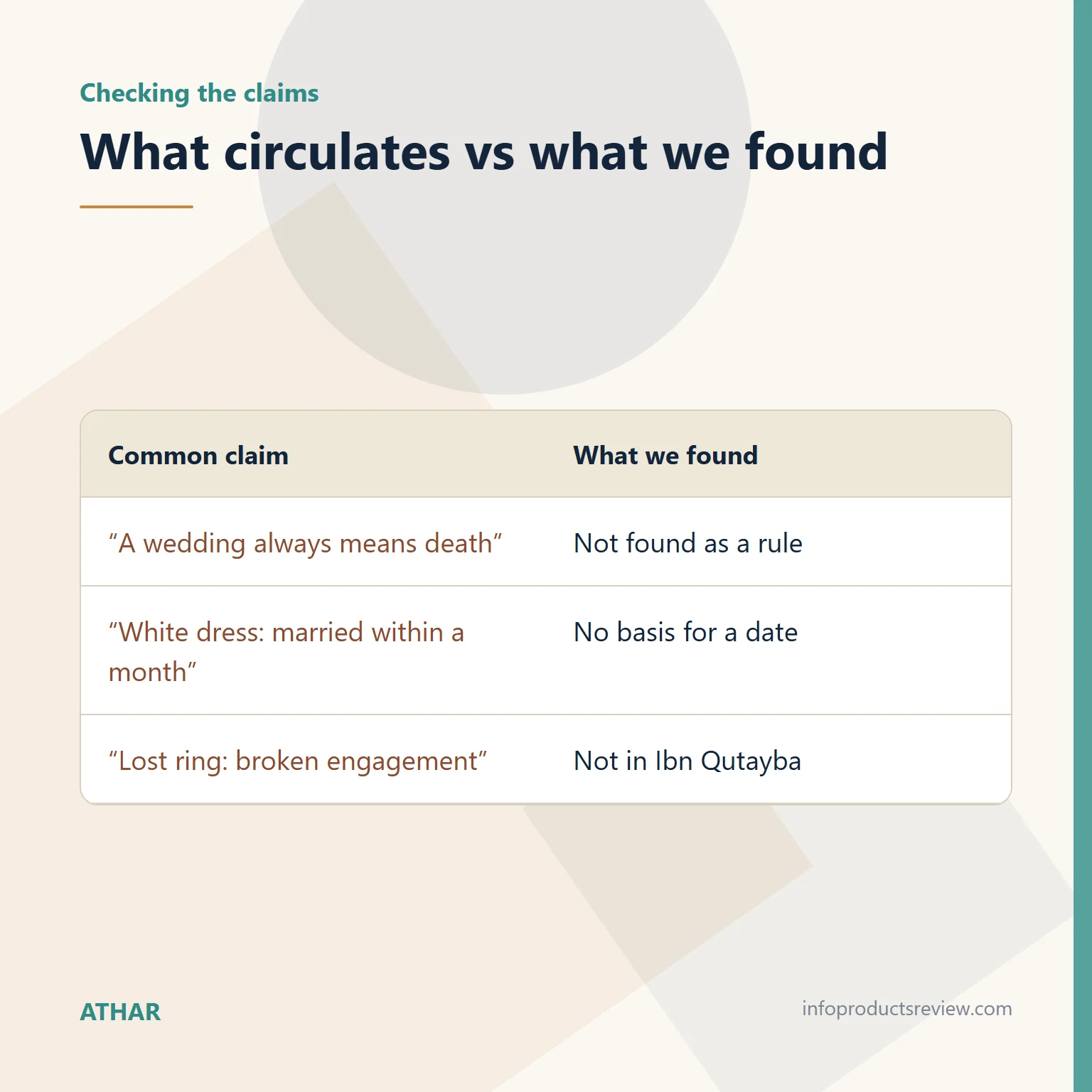
| A ring whose band breaks | Losing something owned, standing kept | A broken engagement |
| Henna in its usual place | Adornment, enjoying the preparations | A rule about brides |
| Loud drums, pipes and dancing | A heavy, conjectural reading for some | A specific misfortune |
| A wedding with no groom | Focus on the occasion before the person | You’ll never marry |
| Delays or losses on the day | Anxiety and planning pressure | A failed marriage |
| Running from the wedding | Hesitation or fear of change | A reason to call it off |
Related dreams
- Marriage dream meaning: the complete guide to marriage as a symbol, by situation, partner and feeling.
- Lice dreams for a single woman: another example of how a single woman’s situation shapes a reading.
- Lice dreams for men: how a man’s responsibilities shape the reading of a symbol.
- Athar in English
- National Institute of Neurological Disorders and Stroke: Brain Basics, Understanding Sleep
- Sleep Foundation: Nightmares
Frequently asked questions
What does it mean to dream of my own wedding?
Most naturally, a picture of transition or a new commitment, often echoing what’s on your mind, especially if your wedding is close. It sets no date and names no person.
What does signing a marriage contract mean if I’m not engaged?
It can picture a new commitment, like a job or an agreement, or preoccupation with the idea of marriage. That’s a reading by analogy that no particular book states.
What does wearing a wedding dress in a dream mean?
One interpreter says in an interview it may read as protection or a good husband, depending on custom; that’s an opinion, not a promise. A torn dress points to worry, not to a failed marriage.
What does a wedding ring mean in a dream?
The classical books record that a ring in sleep is a woman, and her beauty matches the quality of its stone, the jewel set at the top of the band. It names no person and no date.
Does losing an engagement ring in a dream mean the engagement will end?
Nothing establishes that. It’s closer to worry about something stalling, and the recorded reading of a broken ring isn’t about ending an engagement.
Are drums and dancing at a wedding in a dream a bad sign?
No. The old books give heavy meanings to the person seen drumming or dancing, but that’s conjecture and predicts no specific misfortune. Seek refuge in God and don’t retell it.
What does a wedding with no groom mean?
Most likely a focus on the occasion and the idea of marriage before a particular person, or a fear of being alone. It doesn’t rule out marriage, and it says nothing about your fiancé.
I dreamed the groom was late on the wedding day. Is that bad?
It most likely reflects planning stress and anxiety, especially before a real wedding. It says nothing about problems in the marriage.
What does henna before a wedding mean in a dream?
Henna is adornment and covering. In the old books, whoever dyes his hands or feet with it adorns his relatives, while henna in the wrong place is worry and fear, then relief. That text is general, not specific to brides.
I’m married and dreamed I was a bride again. Is it divorce?
No. If the groom was your husband, it’s closer to renewal or nostalgia; if someone else, the old books hold that she gains favour and good, not divorce.
What should I do if a wedding dream upset me?
Seek refuge in God from its harm and tell no one, as in Sahih al-Bukhari (7045); Sahih Muslim (2262) adds spitting lightly to the left three times and turning over.
Is this interpretation definitive?
No, and deliberately so. These are possible meanings that change with the details, and none of them predicts the future.
In summary
- Dreaming of your own wedding pictures transition or commitment, and often echoes the preparations. It isn’t a date.
- The classical books record that a ring in sleep is a woman, and her beauty matches the quality of its stone.
- They give drums, pipes and dancing heavy meanings, but that’s conjecture, not a forecast of misfortune.
- The dress and the groom’s clothes are read through the dreamer’s customs: an interview view, not a rule.
- Delays and losses on the day are closer to anxiety.
- After a disturbing dream: seek refuge in God, turn over, and don’t retell it.
If you take one thing from this page, let it be this: your wedding day is built in real life, through understanding, preparation and prayer for guidance. A dream might make you happy or show you what’s worrying you, but it doesn’t plan that day for you.
Written and reviewed by: the ATHAR editorial team. Classical and hadith quotations are our own translations from the editions listed.
Last comprehensive update: 15 September 2026.
Note: the meanings on this page are possibilities, not established facts, and they change with the details of a dream and the dreamer’s situation. Nothing here predicts the future, sets a wedding date, judges whether a marriage will succeed, or gives a religious ruling.