

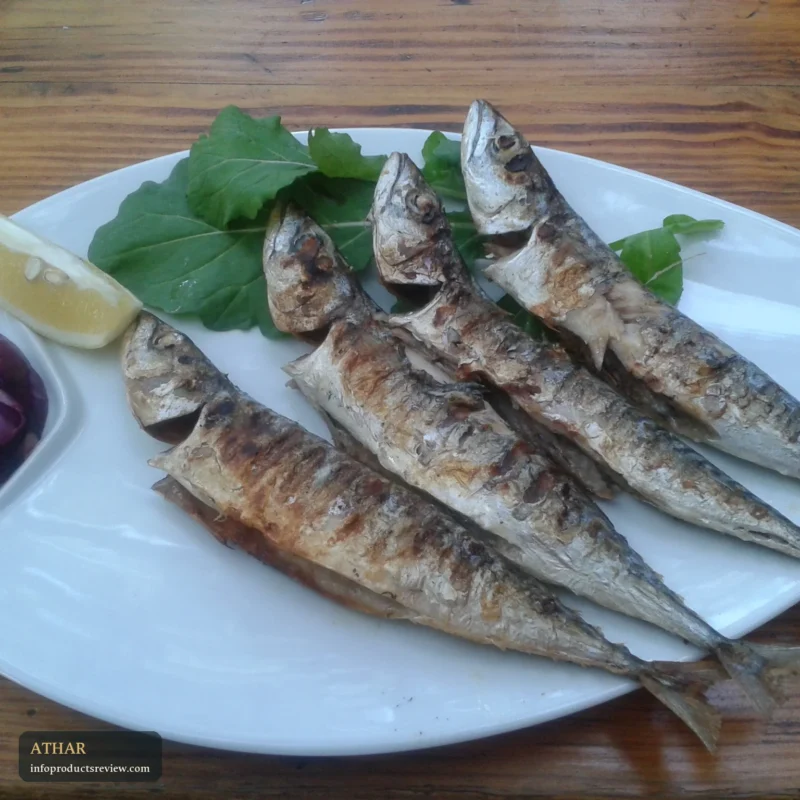
You dreamed you were eating fish: grilled, fried, raw, or salted and dried. Maybe earlier in the dream you were buying it, cleaning it or cooking it.
The short answer is that the way the fish was prepared is the detail that moves the meaning, and only grilled and salted fish get a clear reading in the books of dream interpretation. Before any of that, one simple question settles a lot of these dreams: did you eat fish, or want it, during the day?
The bottom line
- The direct answer: eating fish in a dream has more than one meaning, not a single one. The closest readings are these: grilled fish is a picture of provision that arrives without effort, and salted fish is either worry, or money and good fortune for someone used to that pattern, or a journey undertaken to learn.
- What actually moves the reading: how the fish was prepared in those two cases, then your day before the dream, then how the dream felt and who you were eating with.
- Grilled fish: provision without effort. That reading comes from a contemporary author on the principles of dream interpretation, and it rests on an analogy with the story of the Table, so take it as a possibility that shifts with your own details.
- Salted fish: three possible readings — worry, money and good fortune for someone who has noticed this dream before good news, or a journey to seek knowledge. Your own situation is what tips it.
- Fried, stewed, raw, taste, bones, buying, cleaning: the books give none of these a meaning of their own. That’s no reason to ignore them; read them from the whole scene — the mood, the feeling, who was there.
- How far this page goes: these are possible meanings, not promises. Eating fish in a dream can’t guarantee money, announce a pregnancy or a marriage, or tell you that you’re ill.
If your question is about fish in general, by type, size or condition, read Dreaming of Fish. If it’s about catching them, read Dreaming About Fishing. This page is about eating fish and getting it ready.
What this page covers
- The bottom line
- Why eating fish turns up in dreams
- Were you hungry, full, or made to eat?
- What do you do with a detail that has no meaning of its own?
- What does eating grilled fish in a dream mean?
- Does the grilling passage apply to grilled fish?
- What does eating fried fish in a dream mean?
- Fish cooked in a pot, stewed or boiled: does it mean anything?
- What does eating raw fish in a dream mean?
- What does eating salted or dried fish mean?
- What about canned or smoked fish?
- What does buying fish in a dream mean?
- Cleaning fish, and what’s inside it: what do the books say?
- Cutting fish
- Cooking it yourself, or seeing a cook
- How it tasted: good, or off?
- A fish bone stuck in your throat: what does it mean?
- Eating with others, or being fed
- Where did you eat it? Home, restaurant, beach
- Smelling fish in a dream without eating it
- Is it different for a single woman, a married woman, a pregnant woman, or a man?
- What an eating-fish dream can’t tell you
- If the dream left you uneasy: what to do
- If the dream keeps coming back
- How to describe an eating-fish dream to someone you trust
- Quick reference: eating-fish details and their meanings
- Some typical eating-fish dreams
- Frequently asked questions
- What does eating fish in a dream mean?
- What does eating grilled fish in a dream mean?
- Is eating fish in a dream a sign of provision?
- Does grilled food in a dream mean meagre provision with sorrow?
- What does eating fried fish in a dream mean?
- Does eating raw fish in a dream mean gossip?
- What does eating salted fish in a dream mean?
- What does buying fish in a dream mean?
- Does cleaning fish in a dream mean anything?
- What does it mean if a fish bone gets stuck in my throat in a dream?
- Does eating fish in a dream mean pregnancy?
- I dreamed about eating fish after having it for dinner. Does it mean anything?
- Is anything on this page a definitive interpretation?
- In summary
Why eating fish turns up in dreams
Food is one of the commonest things we dream about, and fish is an everyday food in a lot of homes. People have it at weekends, at family occasions, and in coastal towns almost daily.
So it’s hardly strange to see it in your sleep after a fish supper, after craving it and not getting it, or after walking through a fish market. With many of these dreams, the answer is simpler than it looks.
Not everything we see in sleep is a message. In Sahih Muslim, Abu Hurayra reports from the Prophet ﷺ:
Dreams are of three kinds: a good dream, which is glad tidings from God; a distressing dream, from Satan; and a dream from what a person tells himself
The third kind is the one that matters here: a dream made by your own thoughts and wishes. The books call it hadith al-nafs, “the self talking to itself” — whatever occupies you by day and comes back to you at night. It comes from the body, and it carries no interpretation.
Food isn’t named at that point in the books, but the principle is clear. If you wanted fish during the day and then dreamed about it, the likeliest explanation is that your dream is this kind, and needs no symbolic meaning at all.
The US National Institute of Neurological Disorders and Stroke says in its guide to sleep that events from the day often find their way into our thoughts while we sleep.
That’s about sleep in general, not about fish. But it explains why last night’s dinner shows up in tonight’s dream.
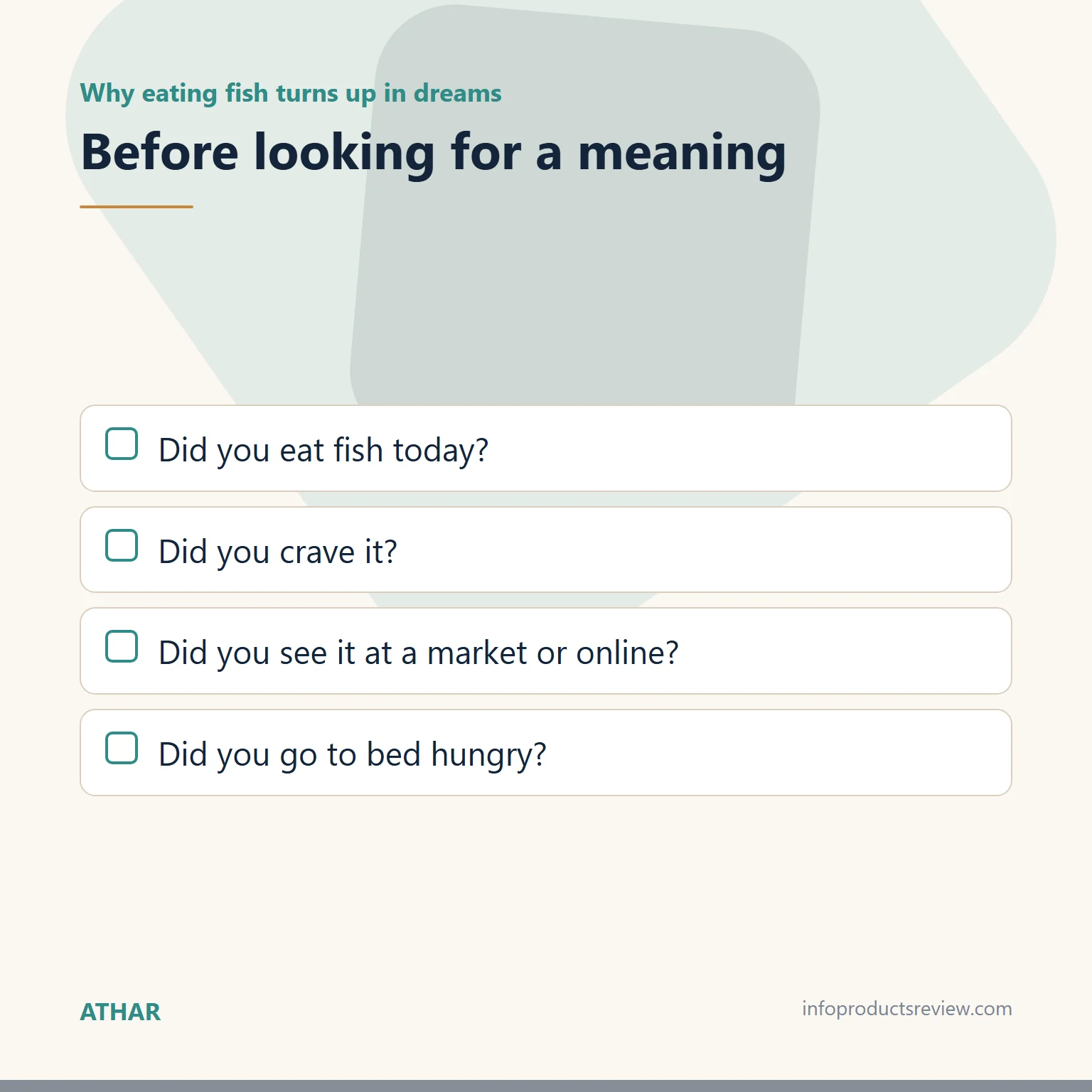
So the first question, before any meaning: did you eat fish, want it, or see it today? If the answer is yes, your dream may not need anything more.
Were you hungry, full, or made to eat?
Before the cooking method, notice how you were eating. Eating fish in a dream isn’t one scene:
You ate hungrily: this is the closest to the “self talking to itself”, especially if you went to bed hungry or have been keeping yourself from a food you love.
You were full but kept eating: there’s excess or politeness in the scene, like eating because someone keeps pressing you. It may echo a situation where you take on more than you want.
You were made to eat, or ate reluctantly: here the feeling matters more than the food. It may point to something you feel is being forced on you.
You wanted to eat but couldn’t: the plate is taken away, the fish vanishes, or you wake before the first bite. That’s common in broken sleep and feels like a wish left unfinished.
None of these four distinctions is an interpretation handed down by anyone. They’re a way of describing your dream precisely, and a precise description is half of understanding it.
What do you do with a detail that has no meaning of its own?
You’ll see on this page that some details, like frying, taste or fish bones, have no meaning of their own in the books. So what do you do with a detail like that?
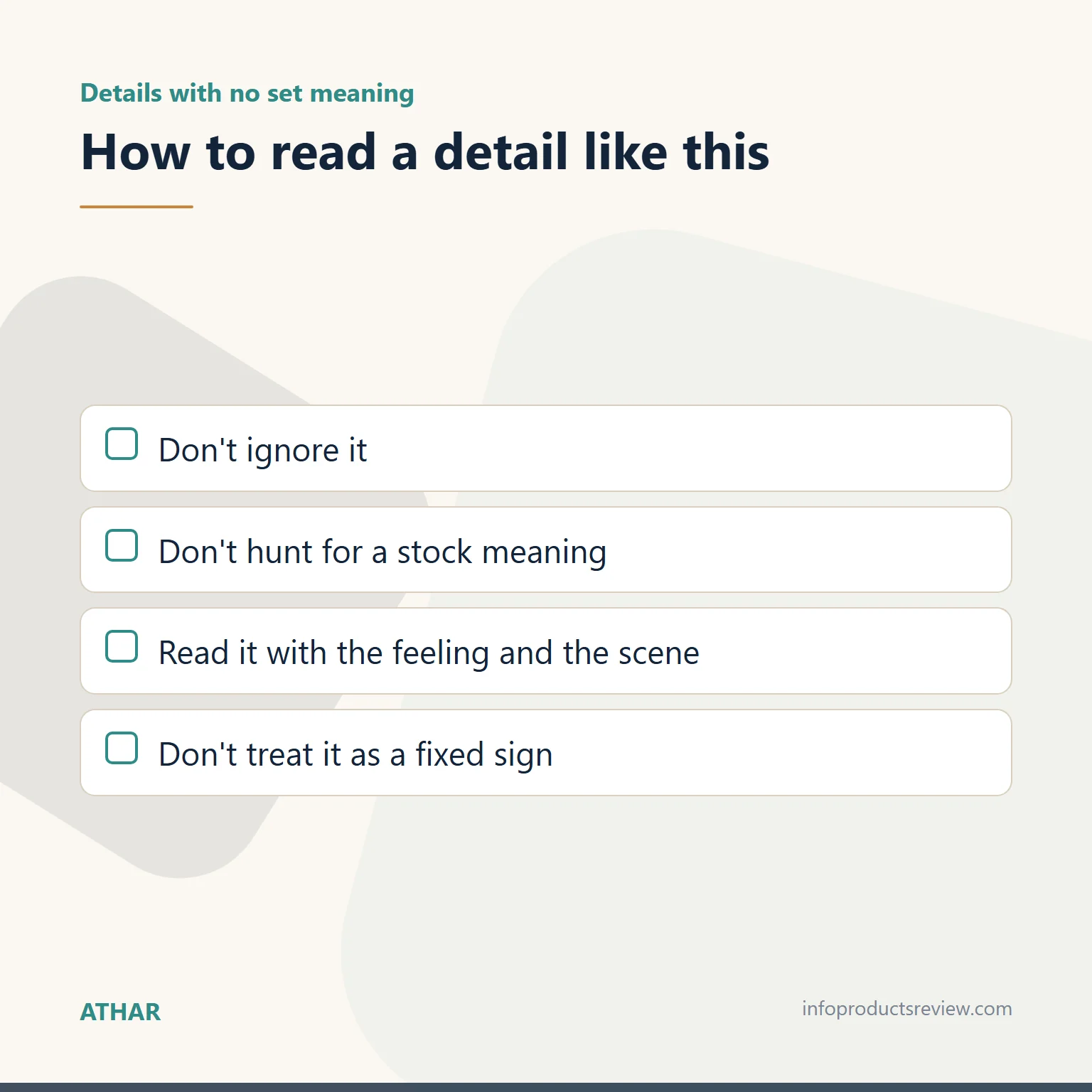
Don’t ignore it, and don’t hunt for a ready-made meaning. Look at it together with the rest of the scene: how did you feel, who was there, and what’s occupying you in life right now?
Take fried fish you ate happily with family in a relaxed room, and fried fish you ate alone while anxious. Same dish, two different dreams.
What separates them is the mood and the feeling, not the cooking. That isn’t dodging the question; it’s the honest answer.
One of the oldest pieces of advice in dream interpretation makes the same point: when a dream could go two ways, the interpreter should ask the dreamer about their intention and their habits, because a person’s own pattern in dreams can outweigh the general meaning.
What does eating grilled fish in a dream mean?
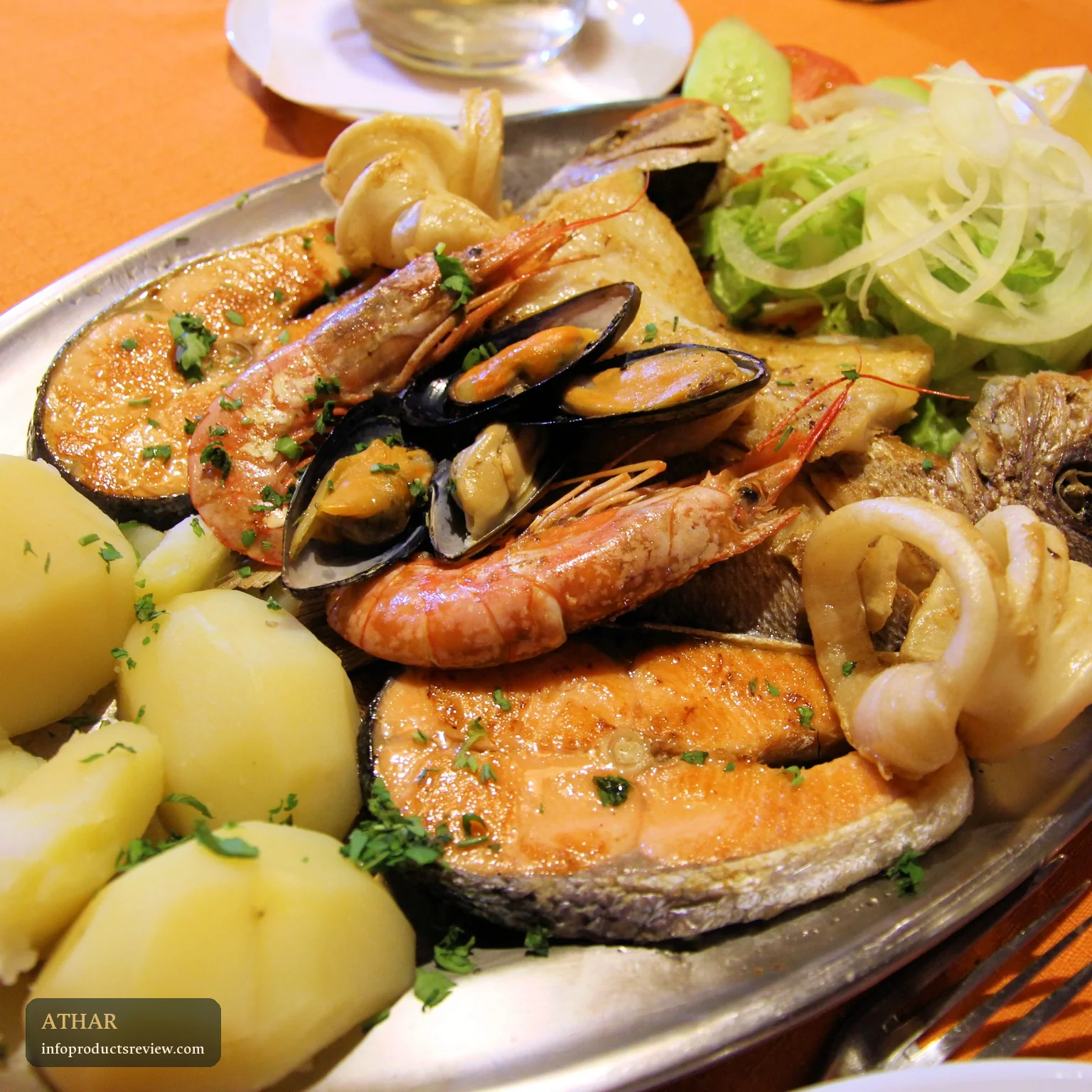
Grilled fish is provision that reaches you without effort. That’s the clearest reading in eating-fish dreams, and grilled fish is what people ask about most.
The reading comes from dream interpretation, in a passage about surrounding clues — the details around a dream that tip its meaning one way or another.
And it rests on an analogy: the author compares grilled fish to the story of the Table in the Qur’an, food that came down ready-made, which to him fits provision without toil.
The “fresh fish” in the same line is about seeing fish rather than eating it, and it belongs on another page.
To take this reading for what it is, keep three things in mind:
It’s a modern author’s view. His book is a recent one on the principles of dream interpretation. What’s in it is considered opinion, not religious ruling.
It rests on an analogy. Linking grilled fish to the story of the Table is his own comparison. The story being in the Qur’an doesn’t turn every grilled fish in a dream into guaranteed provision.
The details can change it. The example is given precisely to show that clues change meaning. If you grilled the fish with long, hard work, or ate it burnt, or ate it while afraid, your dream has moved away from “provision without effort”.
In practice: if you dreamed you were eating good grilled fish somewhere pleasant, you’re welcome to take heart. Just don’t expect money without effort because of a dream, and don’t base a decision on it.
Does the grilling passage apply to grilled fish?
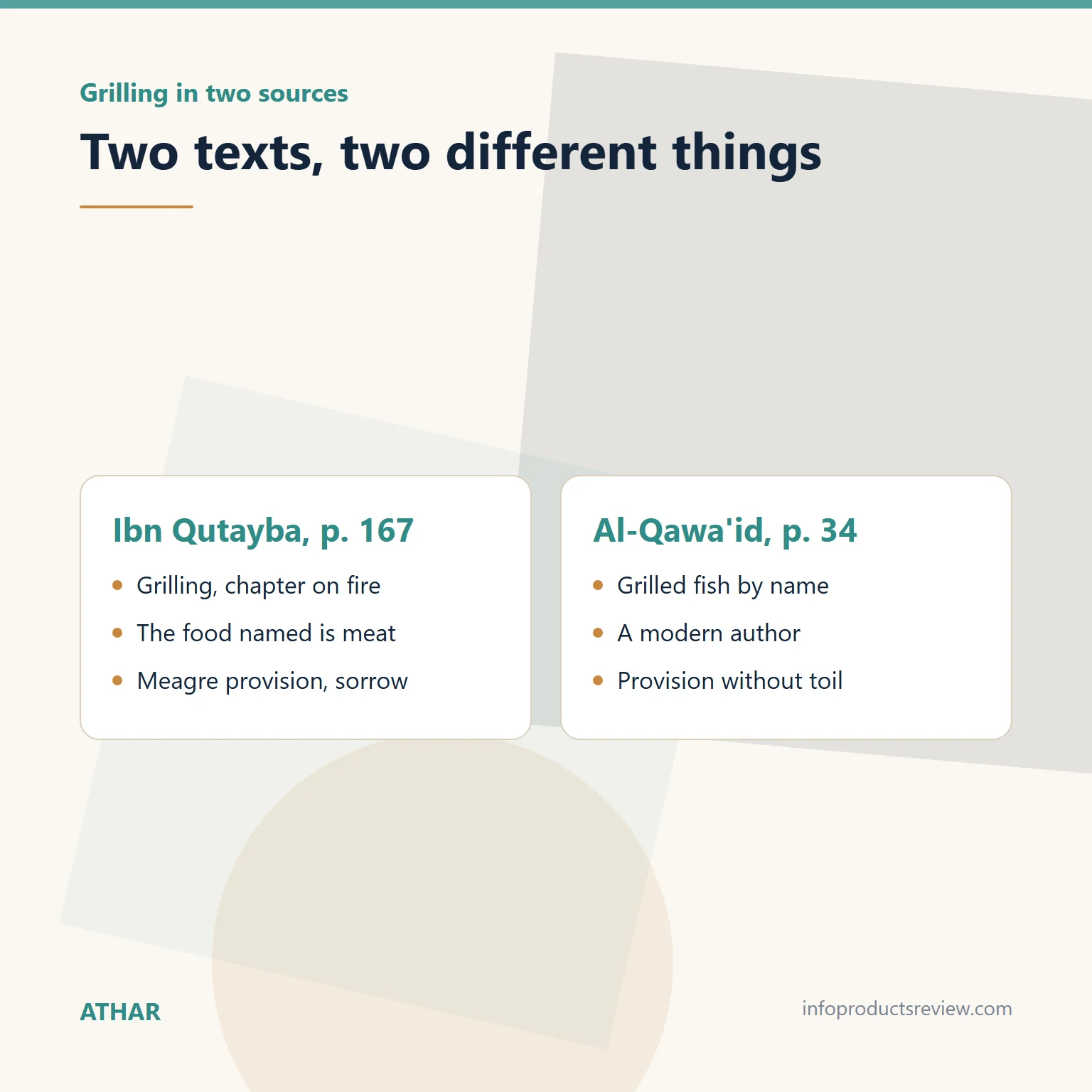
You may read that grilled food in a dream means meagre provision with sorrow, and see it applied to grilled fish. The line is real, and it does sit in the books of dream interpretation — but it sits in what they say about fire.
Here is the picture it draws: someone stokes a fire, building up the flame, in order to grill meat over it, and then eats from what’s grilled; he comes by a little provision along with sorrow.
Read it carefully: it’s about fire and meat, and fish doesn’t come into it. And where the older books write about fish itself, they say nothing about grilled fish.
So you have two views about two different things:
| Book | What it says | What it’s about |
|---|---|---|
| The older books of dream interpretation | Eating from the grill: meagre provision with sorrow | Grilling meat over a fire |
| A contemporary book on the principles of interpretation | Grilled fish: provision without effort | Grilled fish, by name |
The two shouldn’t be blended, and neither should be chosen just because it sounds nicer. The modern reading names grilled fish, but it reasons by analogy. The old line is far older and better grounded, but it’s talking about meat.
The upshot: the meaning of eating grilled fish in a dream isn’t settled, and the details of your dream are what tip it.
In the same old passage there’s a general rule: any food or drink touched by fire has no good in it, unless its root meaning is strong, in which case it brings quarrelling and talk.
That’s a rule about cooked food in general. Applied mechanically to every cooked fish, it would contradict the grilled-fish reading outright. So it’s worth knowing about, but it isn’t a verdict on your dream.
What does eating fried fish in a dream mean?
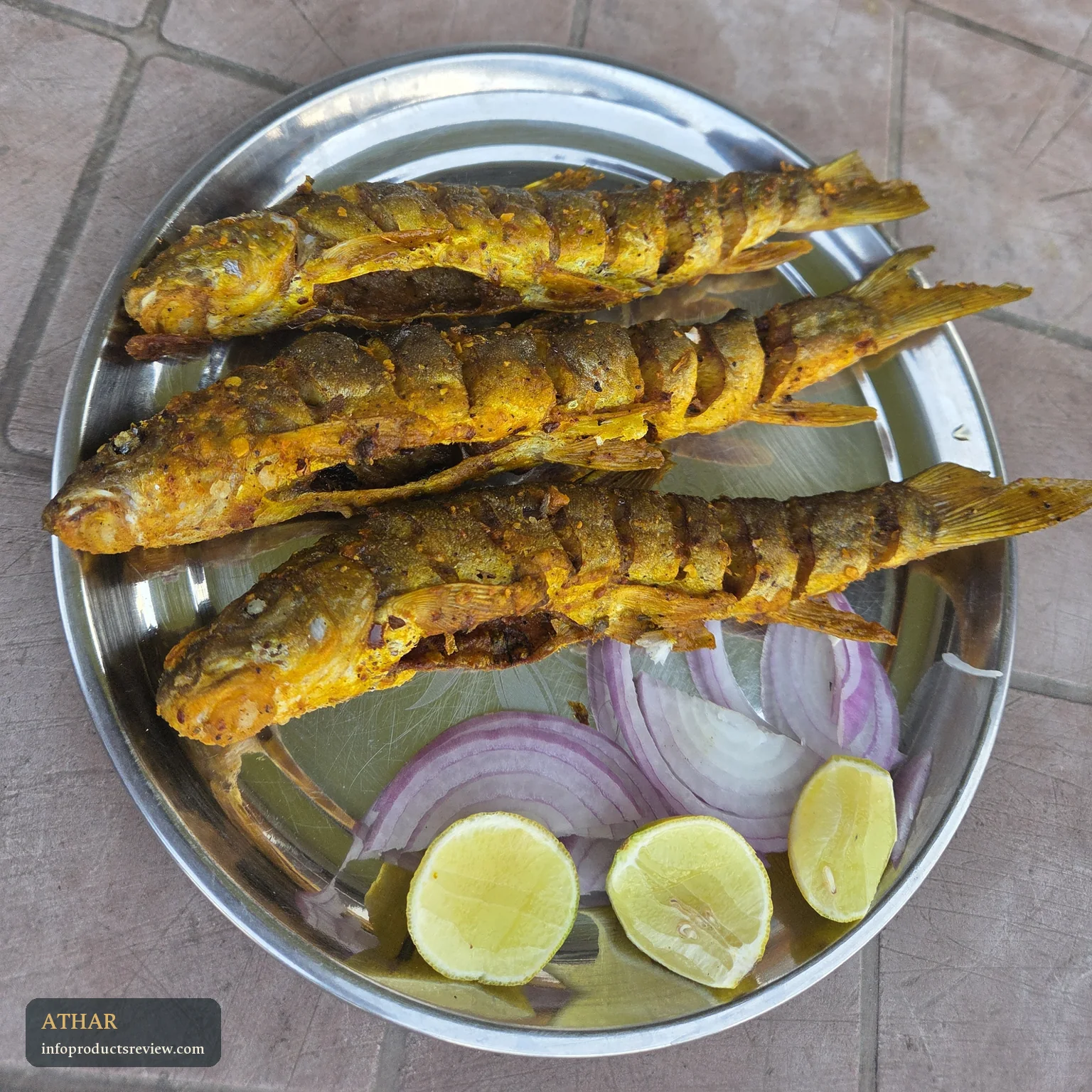
Fried fish is a very familiar sight: golden pieces on a plate, the smell of oil, a full table. There are plenty of claims about it online, that it means quick profit, say, or lawful money.
But the books of dream interpretation say not a word about fried fish. So it isn’t “certain profit”, and it isn’t “provision without effort” by analogy with grilled fish either; comparing cooking methods is the work of whoever makes the comparison, not of the books.
What helps instead is looking at the whole scene:
- Were you frying it, or was it served to you ready?
- Was it good, burnt, or undercooked?
- Was it at a celebration, or eaten in a hurry?
- Was anything unsettling, like spitting oil or a flame getting out of hand?
These details describe how the dream felt, and the feeling will tell you more than the cooking method.
If you dreamed you were frying fish with oil spitting at you, the dream may be more about pressure and busyness than about food.
Fish cooked in a pot, stewed or boiled: does it mean anything?
In some dreams the fish is neither grilled nor fried but cooked with rice, in a stew, or boiled. None of those appear in the books where they write about fish.
A cooking pot does appear in the lines about fire: someone who lights a fire to cook a pot with food in it, and someone who lights it with the pot empty.
But that’s about pots and food in general, and fish isn’t mentioned. If you dreamed you were cooking fish in a pot, nobody can honestly tell you the books interpreted that exact dream.
What you can rely on is the scene itself: cooking calmly for your family, cooking under pressure for guests, or an empty pot waiting to be filled. Each of those says more about you than about the fish.
What does eating raw fish in a dream mean?
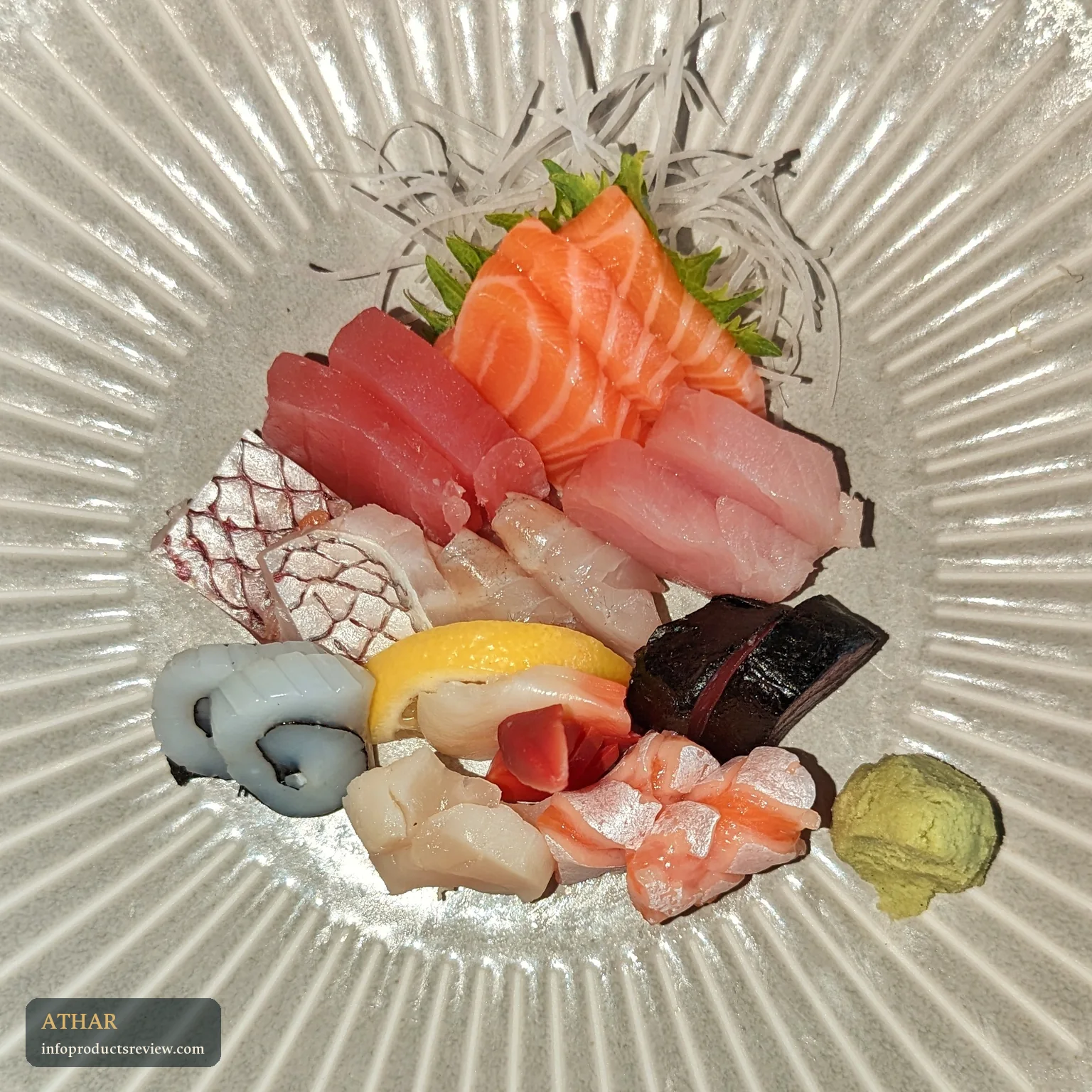
Eating raw fish puzzles people who don’t eat it, so it gets asked about a lot. Some sites say it means gossip or ill-gotten gains.
The likely source is an old line in dream interpretation: “whoever eats fresh raw meat has backbitten people.” But that line comes at the end of a passage about sheep, and it’s about eating meat. Fish isn’t mentioned.
Carrying it over to raw fish doesn’t work, for two reasons. First, it’s about meat, in a passage about sheep, not about fish.
Second, raw fish is a normal food in plenty of cuisines, unlike raw meat. And as you’ve already seen, a person’s habits can outweigh the general meaning.
So eating raw fish in a dream has no meaning of its own in the books, and you read it from the scene. If you ate it with disgust, the dream reflects that disgust. If you eat it in real life, it’s most likely just habit.
Nobody should tell you you’re a gossip because of a dream. That’s an accusation, and a dream can’t make one.
What does eating salted or dried fish mean?
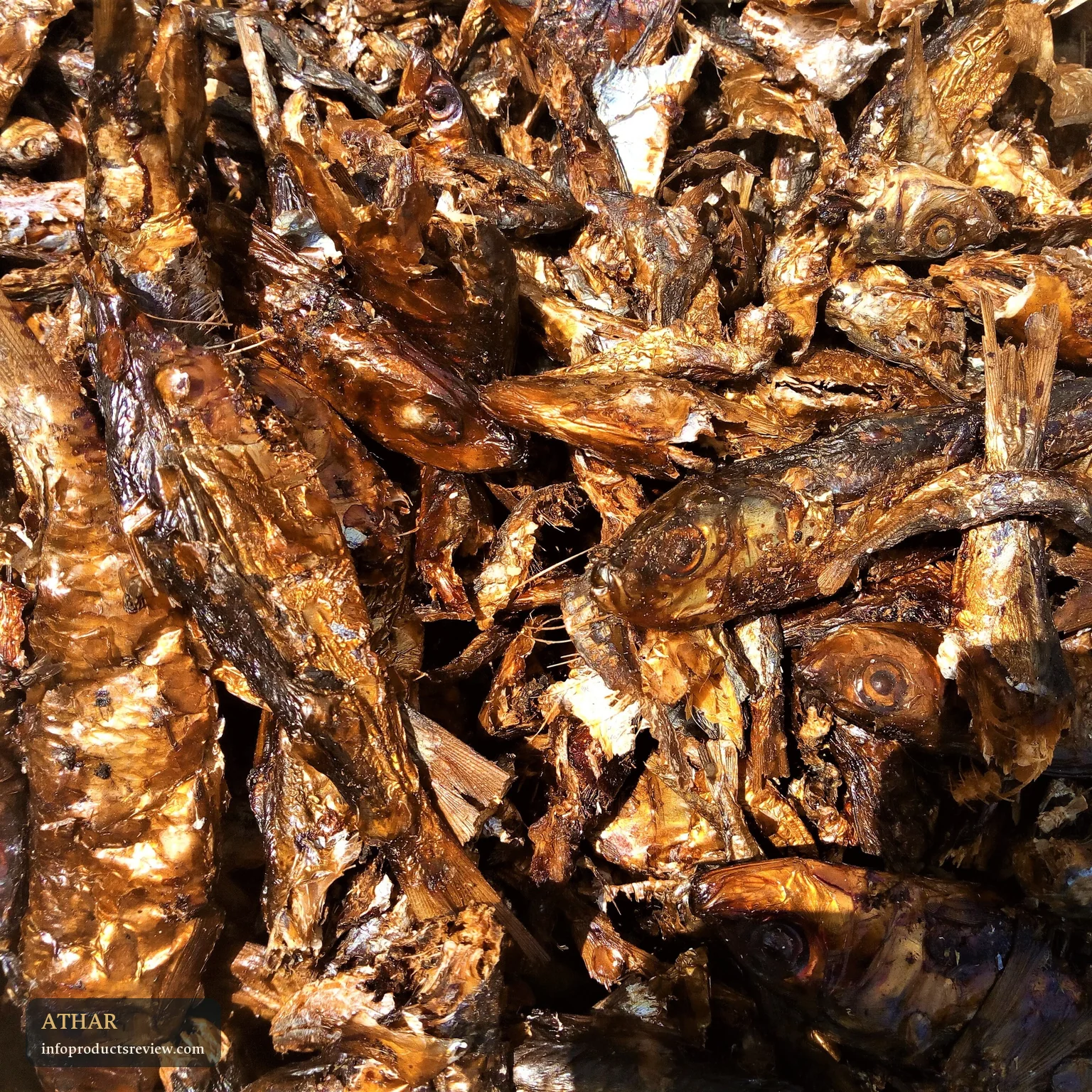
Salted fish is the one eating-fish detail that two different writers discuss, one classical and one modern. That’s why it carries three readings rather than one.
The old reading is double: whoever comes by salted fish is struck by worry on account of its saltiness. Then comes the qualification — and it may be in a person’s nature that when he sees salted fish in a dream, he comes by money and good fortune.
So notice that salted fish was never given a single meaning. First it’s called worry; then the correction follows: some people are used to seeing salted fish and then coming into money and good.
That’s the general advice in action, the same advice you met earlier: a person’s own pattern in dreams can outweigh the general meaning.
The modern reading takes salted fish as a journey to seek knowledge in a coastal land, and links it to the story of Moses, peace be upon him, and al-Khidr, which is a journey undertaken to learn. That too is the author’s analogy, a considered opinion and no more.
So there are three possible readings: worry, money for someone used to that pattern, or a journey for knowledge. Nothing tells you which one is yours.
Your situation is what decides: are you about to travel or study? Is something weighing on you right now? Have you noticed this dream before a particular kind of event?
What about canned or smoked fish?
The early interpreters didn’t know canned or smoked fish in their modern form, so they don’t mention them.
It’s tempting to lump them in with salted fish because they’re preserved too. But that’s guesswork, and salted fish itself points two opposite ways, so it isn’t a firm base to reason from.
Read canned and smoked fish from the dream: was it a quick meal with no time to cook? Were you travelling? Were you eating in a rush?
If you’re asking about salted fish as something you saw rather than something you ate, Dreaming of Fish goes into it further.
What does buying fish in a dream mean?
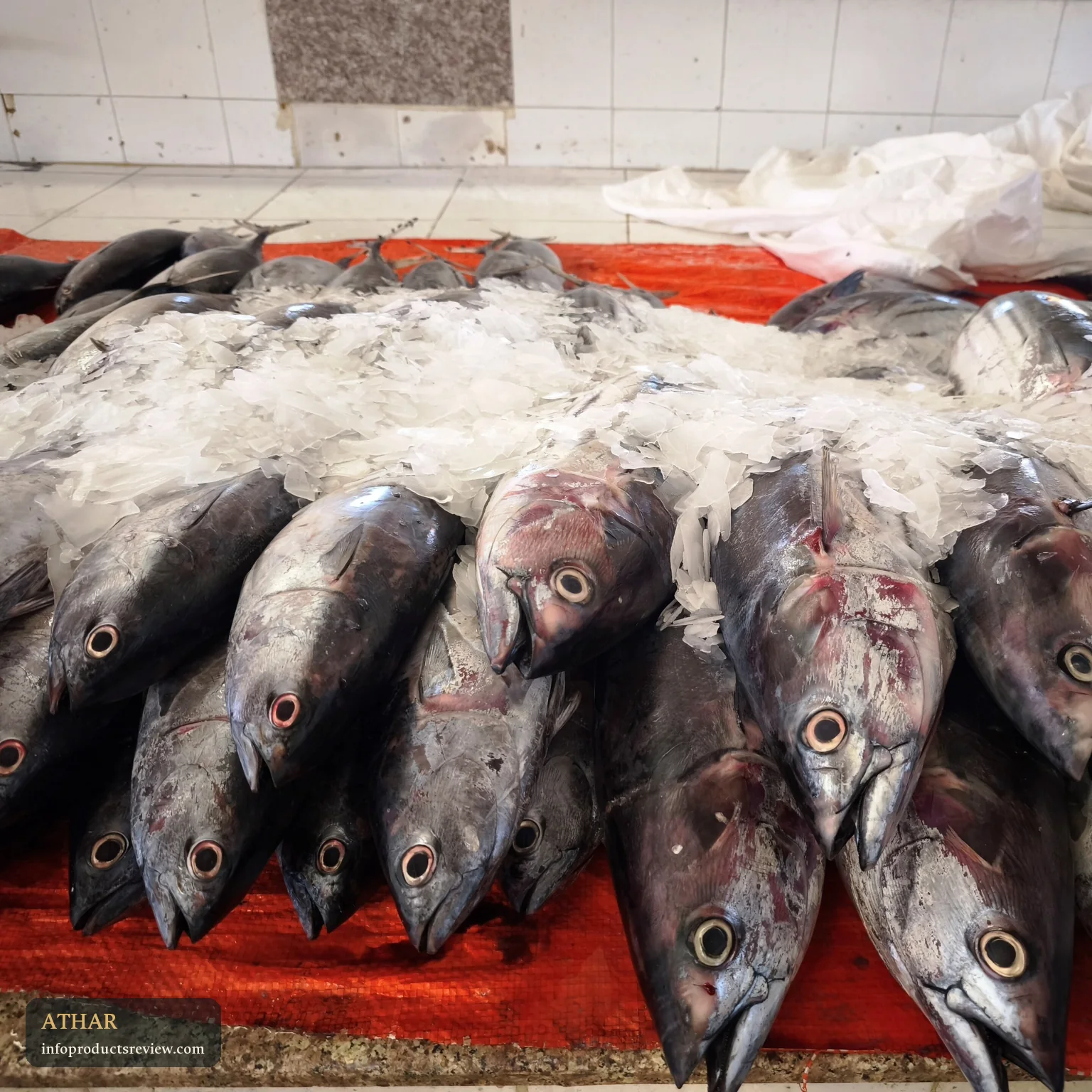
Before eating comes buying. Plenty of people dream they’re at the fish market: choosing, haggling, paying, carrying it home.
The books say nothing about buying or selling fish. So it isn’t right to call buying fish “income on the way” or “money spent well” as if that were a set meaning.
But a buying scene is full of details that help, because it’s a scene about choice:
- What did you choose? Fresh fish you checked carefully, or the first thing to hand?
- What was the price like? Fair, more than you could afford, or suspiciously cheap?
- Who were you buying for? Your household, guests, or to sell on?
- How did it end? You got what you wanted, couldn’t find it, or found the fish was off?
That third question, who it was for, is close to the old advice about asking the dreamer their intention. The purpose of an action is part of understanding it.
Cleaning fish, and what’s inside it: what do the books say?
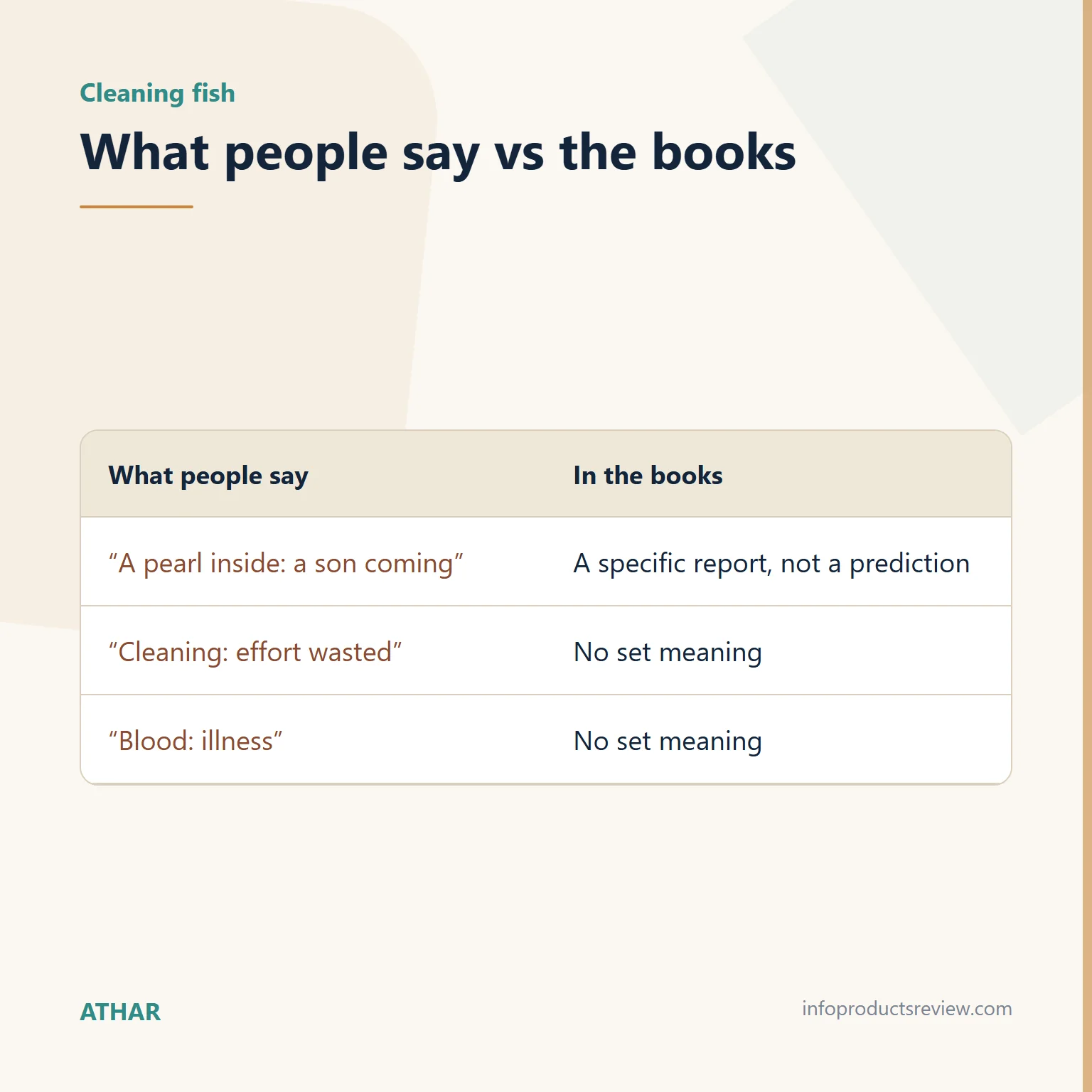
Cleaning fish is a job with steps: scaling it, opening the belly, taking out what’s inside, rinsing it. It’s a job many people dislike, so in a dream it can feel heavy or unpleasant.
Cleaning itself has no meaning of its own in the books. But something close to it does appear: whoever finds a pearl inside the fish gains a son from it, and whoever finds fat inside it gains money and good from it.
That line needs careful reading. It comes straight after Dream interpreters hold in which a fresh fish is read as a woman.
The “from it” points back to that fish read as a woman. In other words, the meaning belongs to a particular context and isn’t a rule for everyone who opens a fish in a dream.
So nobody should tell you a pearl in a fish means you’ll have a son; that would be a claim about the future the words can’t carry.
The rest of a cleaning scene, like scattered scales, the smell, blood, or how hard the work was, you read from context. Was the job exhausting, more than you could manage? Were you doing it lovingly for your family? Did the mess bother you?
Hard work before a meal often mirrors effort you’re putting in before you see the reward.
Cutting fish
Cutting sits between cleaning and cooking: a sharp knife, a big fish being divided, portions handed out. Cutting fish has no meaning of its own in the books.
The detail worth noticing is the sharing. If you dreamed you were cutting a big fish and handing it round to family or neighbours, the scene is about dividing and sharing, closer to your relationships than to the fish.
If you were cutting it with difficulty, or cut your hand, the scene is about effort going wrong or fear of getting hurt. A dream doesn’t announce an illness or an accident.
Cooking it yourself, or seeing a cook
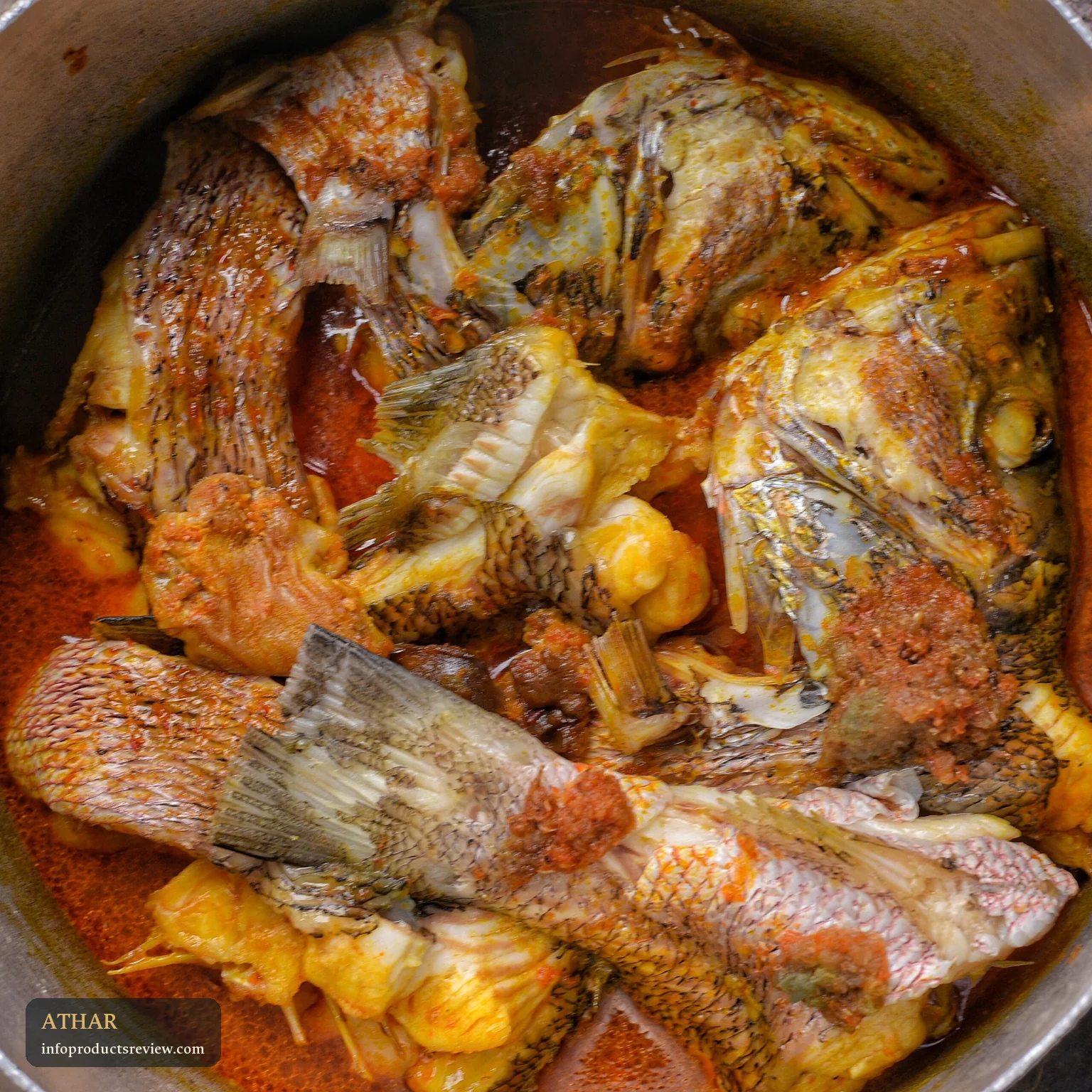
Cooking fish yourself in a dream is different from seeing a cook at work, and the difference matters, because the books do talk about the cook himself.
In what they say about trades, bakers, cooks and grill-men are described as people of quarrelling and talk in earning their living.
That’s a reading of the cook as a person who appears in your dream, not of your own cooking. And it covers every cook, not just someone cooking fish.
So if you saw yourself cooking fish in your own kitchen, that detail has no meaning of its own, and you read it from context: were you enjoying it? Running late with guests waiting? Did the food burn?
Those questions will get you closer than anything about the cook’s trade.
And if cooking is actually your job, the point about habit applies to you directly. Someone who stands in a kitchen every day dreams of kitchens, the same way an office worker dreams of the office.
How it tasted: good, or off?
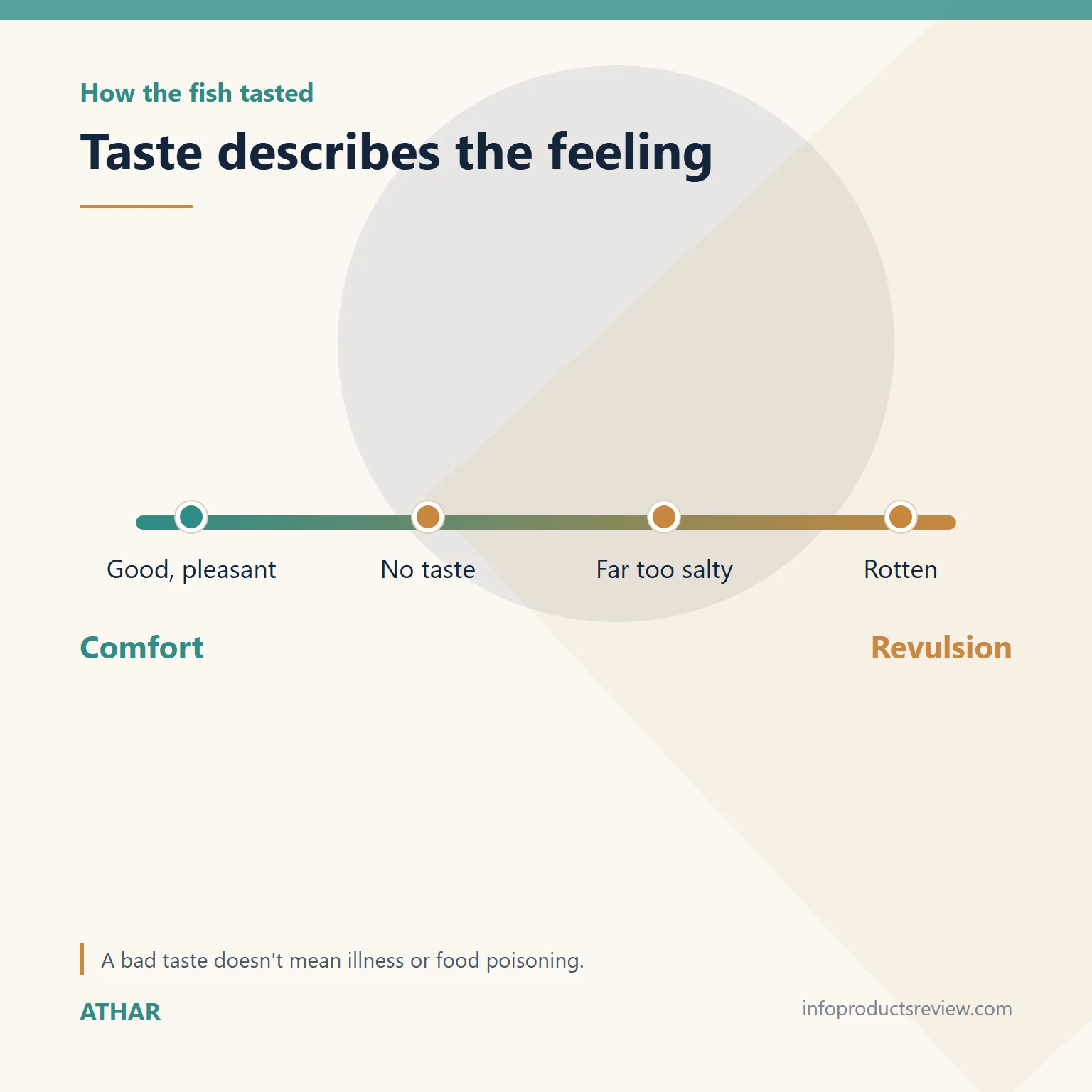
Some people remember the taste clearly: delicious fish, far too salty, or rotten and foul-smelling enough to spit out.
Neither writer says anything about how fish tastes in a dream. Still, taste is a useful detail, because it’s the clearest sign of how you felt inside the dream:
- Good and tasty: a pleasant scene; take heart from it without treating it as a promise.
- Off or foul-smelling: a scene of disgust, perhaps echoing something in your life you no longer accept. A bad taste in a dream points to no illness and no food poisoning on the way.
- Far too salty: what’s said about salted fish doesn’t automatically carry over; that’s about fish preserved in salt, not a dish with too much salt in it.
- No taste at all: common in dreams, because the senses don’t work in sleep the way they do awake.
A fish bone stuck in your throat: what does it mean?
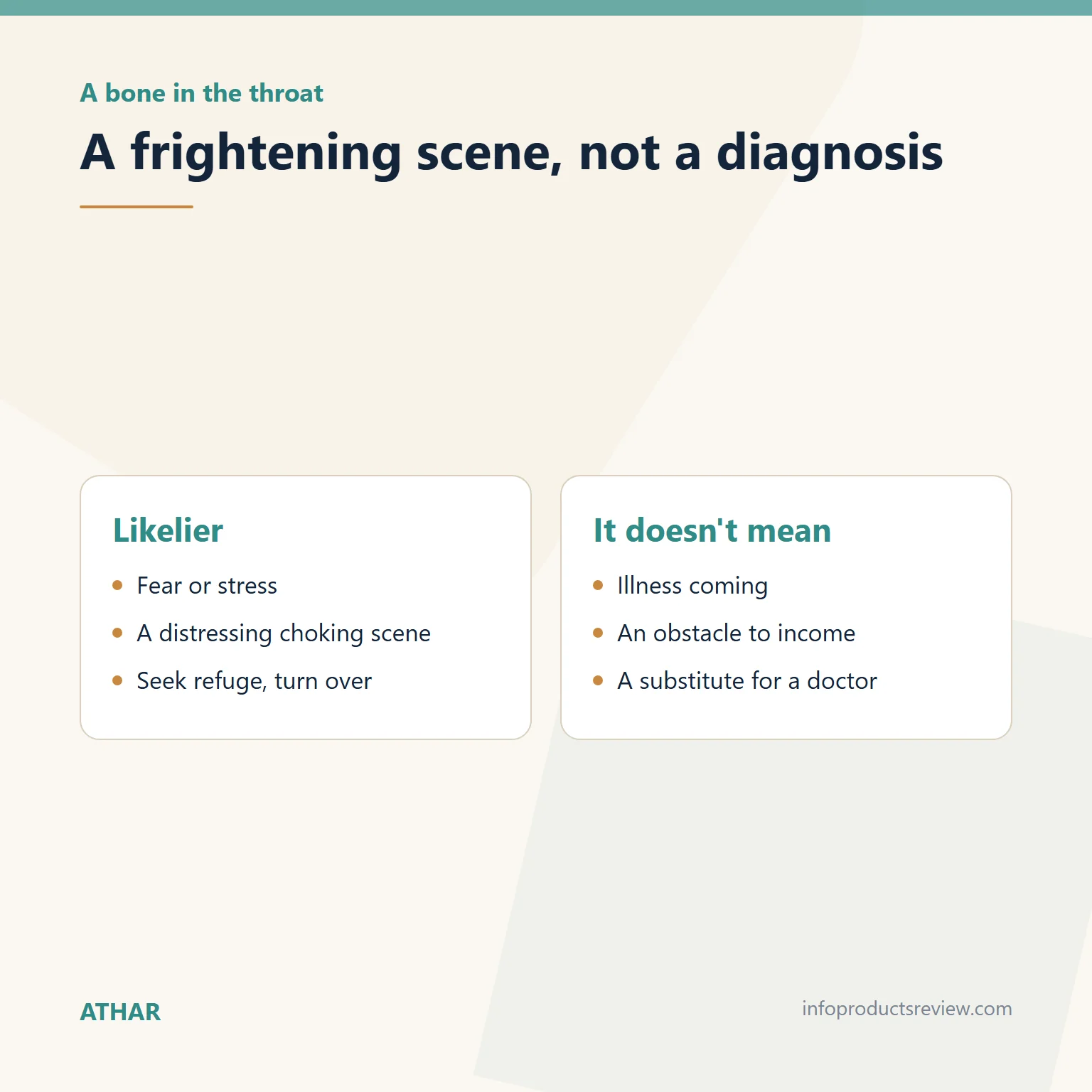
One of the most upsetting eating-fish scenes is a bone catching in your throat, so you choke or it hurts and you wake in a panic. The explanations you’ll find online include an obstacle to your income, a hurtful remark, or illness.
But fish bones appear nowhere in the books, old or modern. So it can’t fairly be called an obstacle, an illness or bad news.
What can honestly be said is this: the choking sensation makes the scene frightening, and scenes like this sometimes come at stressful times.
The Sleep Foundation notes that sad or worrying situations that cause stress and fear can trigger nightmares. That’s about sleep in general, not about what a fish bone means.
If you genuinely have trouble swallowing or breathing, asleep or awake, that’s a question for a doctor. A dream can’t diagnose anything and is no substitute for a check-up.
Eating with others, or being fed
A lot of food dreams are social: a family table, a feast, a friend handing you a plate of fish, or you feeding someone else. People ask about these because they involve people they know.
The books give a shared table, or someone putting food in your hand, no meaning of its own. So be wary of readings that turn whoever appeared in the dream into a source of coming income, a business partner, or an enemy out to harm you.
More likely these scenes reflect your relationship with the people in them, a wish to get together, or the memory of a meal you shared.
A warm table is a picture of closeness. Tension at the table, or someone eating alone, may draw your attention to how you feel about a relationship. These are things to reflect on, not judgements about anyone.
Where did you eat it? Home, restaurant, beach
The setting changes a food dream more than people expect. Fish eaten in your own kitchen isn’t the same as fish in a smart restaurant, on a beach on holiday, or at a wedding feast.
- At home: habit and family, usually close to your daily life.
- In a restaurant: a break from routine, perhaps a celebration, a work meeting, or nostalgia for an occasion.
- On a beach or a trip: rest and getting away, perhaps a wish for a holiday.
- At a feast or occasion: a social scene; worth recalling the occasion itself and who was there.
- Somewhere strange or unsettling: the sense of not belonging matters more than what’s on the plate.
Where you ate has no meaning of its own in the books, but it’s part of the scene anyone should look at if they want to understand a dream fairly.
Smelling fish in a dream without eating it
Some people don’t see fish in the dream at all; they smell it. Grilling filling the house, or rotten fish in a closed room. Smells are rarer than images in most people’s dreams, which is why they stick when they do come.
The smell of fish in a dream has no meaning of its own in the books. The most useful thing is to check something simple first: was there a real smell where you slept, from a kitchen, the neighbours, an open window?
If so, the dream built a picture around what you smelled. If not, a pleasant smell makes the scene comfortable and a bad one makes it unpleasant, and it goes no further than that.
Is it different for a single woman, a married woman, a pregnant woman, or a man?
This is one of the most common questions, and the plain answer is no. The books draw no distinction between a single woman, a married woman, a pregnant woman and a man when it comes to eating fish. Grilled is grilled and salted is salted, whoever dreamed it.
What you may read elsewhere, that eating fish means a marriage soon for a single woman, or a baby boy for a pregnant woman, isn’t in the books at all. Don’t build hopes or worries on it.
Your situation does matter, though, in a different way: through what’s on your mind.
A pregnant woman craving particular foods may dream of fish because she craves it, which is the self talking to itself. Someone about to marry may dream of a laden table because weddings are on their mind. A man who works at sea or in a restaurant dreams of fish because it’s his day.
Your situation explains why you had the dream more than it changes what the fish means.
If your question is about seeing fish, not eating it, by the dreamer’s situation, Dreaming of Fish covers that.
What an eating-fish dream can’t tell you
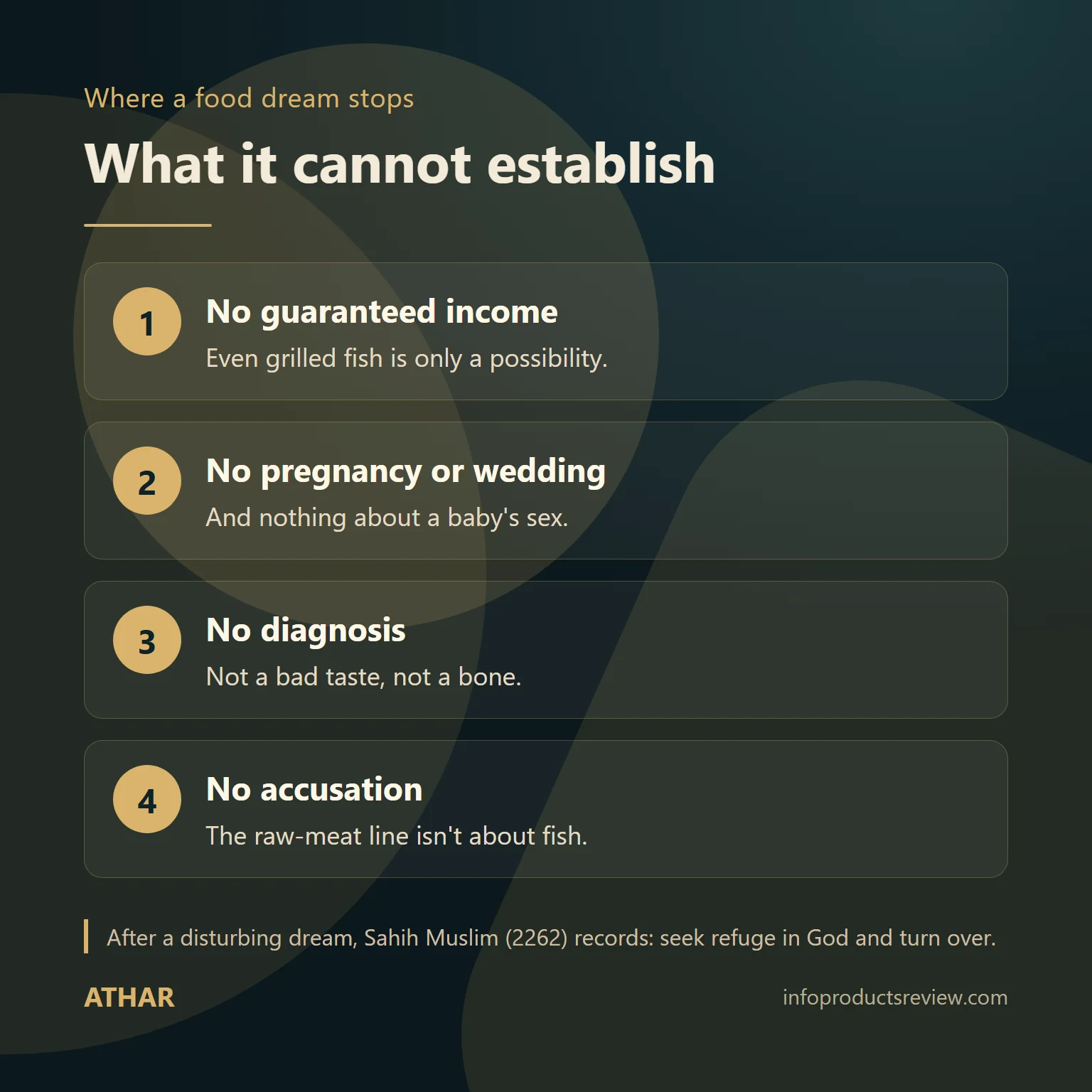
This is the one place where all the limits sit together, so the warning doesn’t have to be repeated in every section. Whatever the details, eating fish in a dream, or preparing it:
- Can’t guarantee income. Even the grilled-fish reading is an opinion, and interpretation is by its nature conjecture that can’t be treated as certain.
- Can’t announce a pregnancy or a baby’s sex. Neither writer links eating fish to either.
- Can’t fix a marriage. The mention of a woman in the old lines on fish belongs to a specific report about a fresh fish, not to eating fish.
- Can’t diagnose an illness. A bad taste is no sign of illness, and a bone is no warning of choking to come.
- Can’t accuse you of gossip. The raw-meat line is about meat, not fish, and not about you.
- Has nothing to do with magic or the evil eye. Neither writer links food seen in sleep to anything like that.
- Isn’t grounds for a decision, financial, medical or personal.
- Can’t testify against anyone. Whoever appeared in your dream carries nothing because of it, and no suspicion of a spouse or a relative should rest on it.
The authors of these books say themselves that interpretation is comparison, analogy and conjecture: never certain, and nobody should swear to what it foretells.
So anyone who hands you a definite meaning for a dream about eating fish is claiming more than the authors of these books claimed themselves.
If the dream left you uneasy: what to do
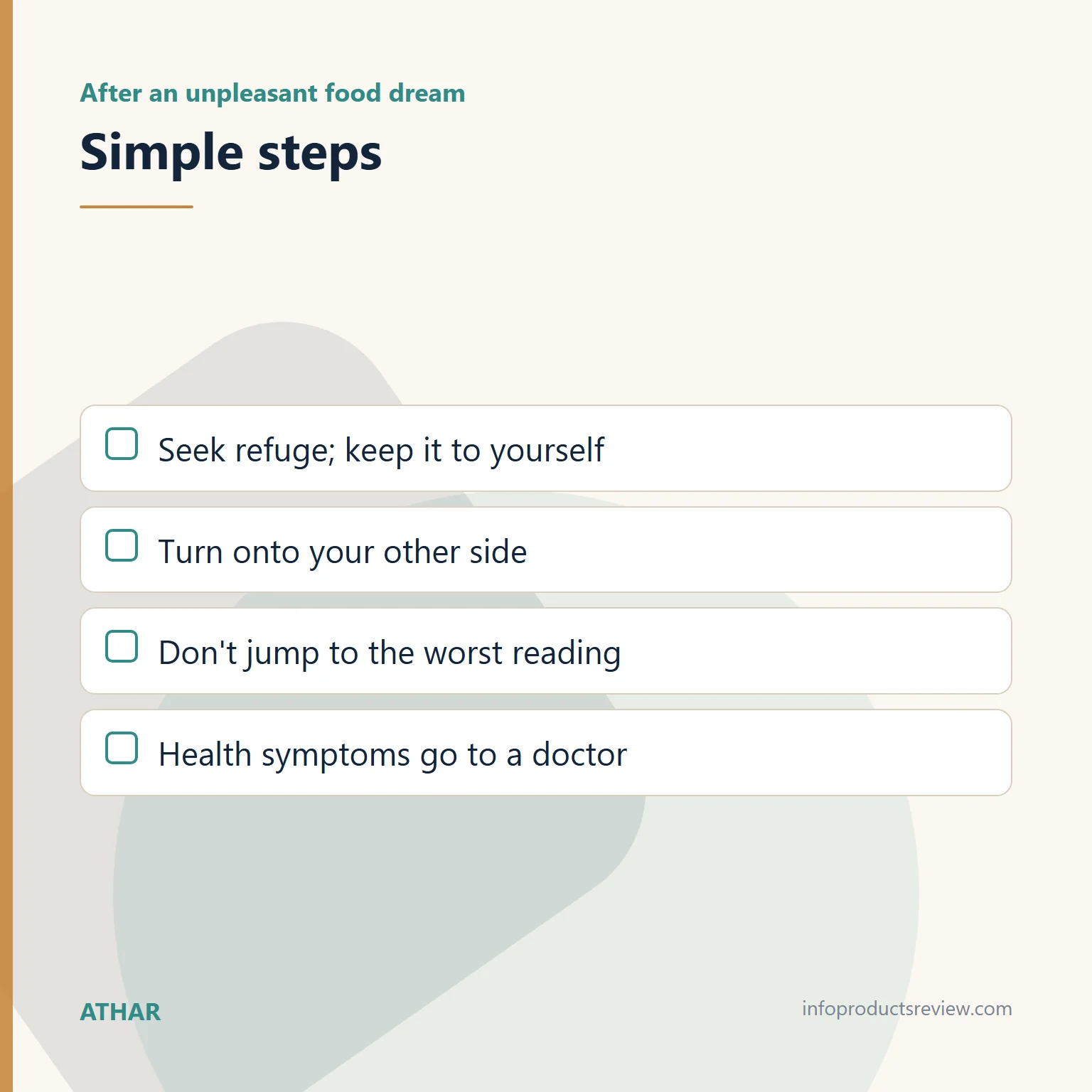
Some food dreams are unpleasant: rotten fish, a bone that chokes, burnt food at an important meal. The Prophet ﷺ gave simple steps to anyone who sees a dream they dislike. In Sahih al-Bukhari, from Abu Qatada:
A good dream is from God. If one of you sees something he likes, let him tell it only to someone he loves. And if he sees something he dislikes, let him seek refuge in God from its harm and from the harm of Satan, spit lightly three times, and not tell anyone about it, for it will not harm him
And in Sahih Muslim, from Jabir:
If one of you sees a dream he dislikes, let him spit to his left three times, seek refuge in God from Satan three times, and turn over from the side he was lying on
Sahih Muslim also has, in the hadith of Abu Hurayra quoted near the top of this page: “If one of you sees something he dislikes, let him get up and pray, and not tell people about it.” So if you want to get up and pray after a dream that upset you, that is part of the same guidance.
What does that mean in practice? If a dream upsets you, seek refuge in God from its harm and from the harm of Satan, spit lightly to your left three times, turn over from the side you were sleeping on, and don’t tell anyone about it.
The first hadith ends with plain reassurance: “it will not harm him.” A disliked dream — the kind you wake from heavy-hearted — won’t hurt you if you do this. So there’s no need to carry it around or hunt for its meaning.
And if the dream was a good one? The same hadith in Bukhari begins: “If one of you sees something he likes, let him tell it only to someone he loves.” So if you dreamed of eating good fish with your family and it made you happy, you can share it with someone you love, without treating it as a promise of anything.
After that, three things help:
Don’t jump to the worst reading. One principle of interpretation is that when a dream comes with fear and dread, the default is to read it in terms of ease and good news. The point isn’t that a frightening dream secretly means something happy; the point is not to assume the worst.
Keep the dream separate from your body. If you have a real problem with digestion, swallowing or sleep, a doctor treats it. A dream isn’t a diagnosis.
Don’t post the dream looking for an interpretation. Quick readings in public groups usually add to the worry and rarely give you anything you can trust. That fits the guidance in Bukhari too: don’t tell anyone about a dream you dislike.
If the dream keeps coming back
A dream repeating doesn’t make its meaning stronger. Repetition often comes from something ongoing: a food you’re denying yourself, a worry that returns every night, an occasion you’re waiting for.
Repetition does have one practical use: it lets you notice what stays the same and what changes. Each time, note how the fish was prepared, who was there and how you felt.
If the scene holds steady while the feeling grows, most likely something in your day needs your attention, and the answer lies there rather than in a dream book.
If a recurring dream is upsetting and wakes you, go back to the steps set out earlier on this page. If it goes on for weeks and affects your sleep and your days, talk to a doctor; sleep problems can be treated.
How to describe an eating-fish dream to someone you trust
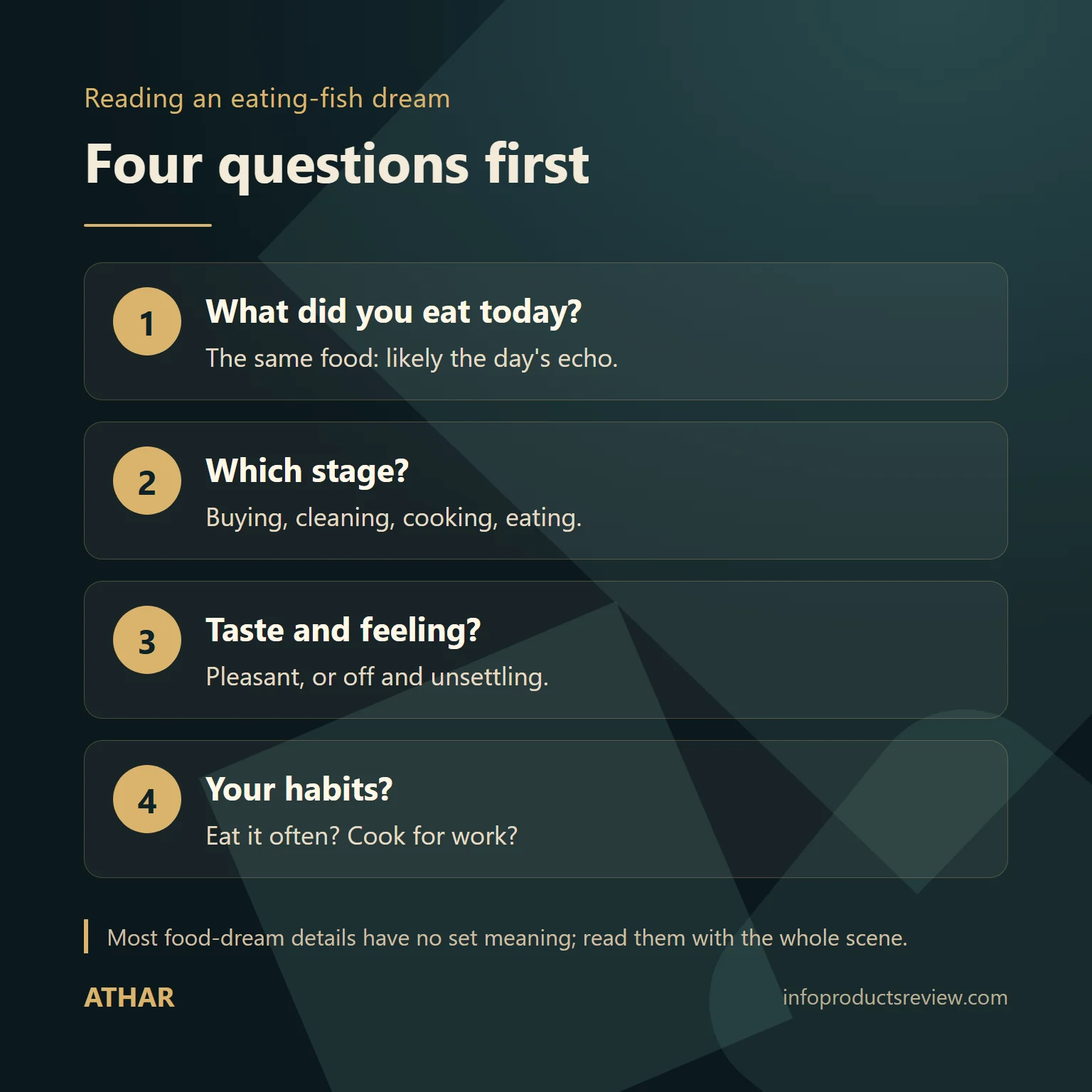
Most details in food dreams have no meaning of their own in the books, so describing the dream well matters more than hunting for its meaning. Before you ask a scholar or a relative you trust, put what you remember in this order:
- Your day before the dream: did you eat fish, want it, or see it?
- Which stage you saw: buying, cleaning, cooking or eating.
- How it was prepared: grilled, fried, cooked, raw or salted.
- Taste and feeling: good and comfortable, or off and unsettling.
- Who was with you: alone, with family, or with strangers.
- Your habits: do you eat fish often? Do you cook for a living?
The first point shows whether it’s the self talking to itself, and the last shows your habits. As you’ve seen, both come before any meaning in the books.
Quick reference: eating-fish details and their meanings
| Detail | What’s been said | How to take it |
|---|---|---|
| Grilled fish | Provision without effort, in a modern reading built on analogy | Take heart, no promise; details can change it |
| Grilling in general | Meagre provision with sorrow, in the old lines about grilling meat | Doesn’t carry over to grilled fish |
| Salted fish | Worry, or money for someone used to it, in the old books; a journey for knowledge in the modern reading | Your situation and habits decide |
| Fried, stewed, boiled | No meaning of its own for fish | From the scene and how you felt |
| Raw fish | No meaning of its own; the raw-meat line is about meat | Doesn’t carry over; your habits count |
| Buying, cutting, cooking it yourself | No meaning of its own | From your intention and the scene |
| What’s inside the fish | A pearl or fat, within a specific report | Not a statement about the future |
| Seeing a cook | Someone of quarrelling and talk in earning a living | Doesn’t apply to your own cooking |
| Taste, bones, sharing | No meaning of its own | Reflects how you felt; no sign of illness |
Some typical eating-fish dreams
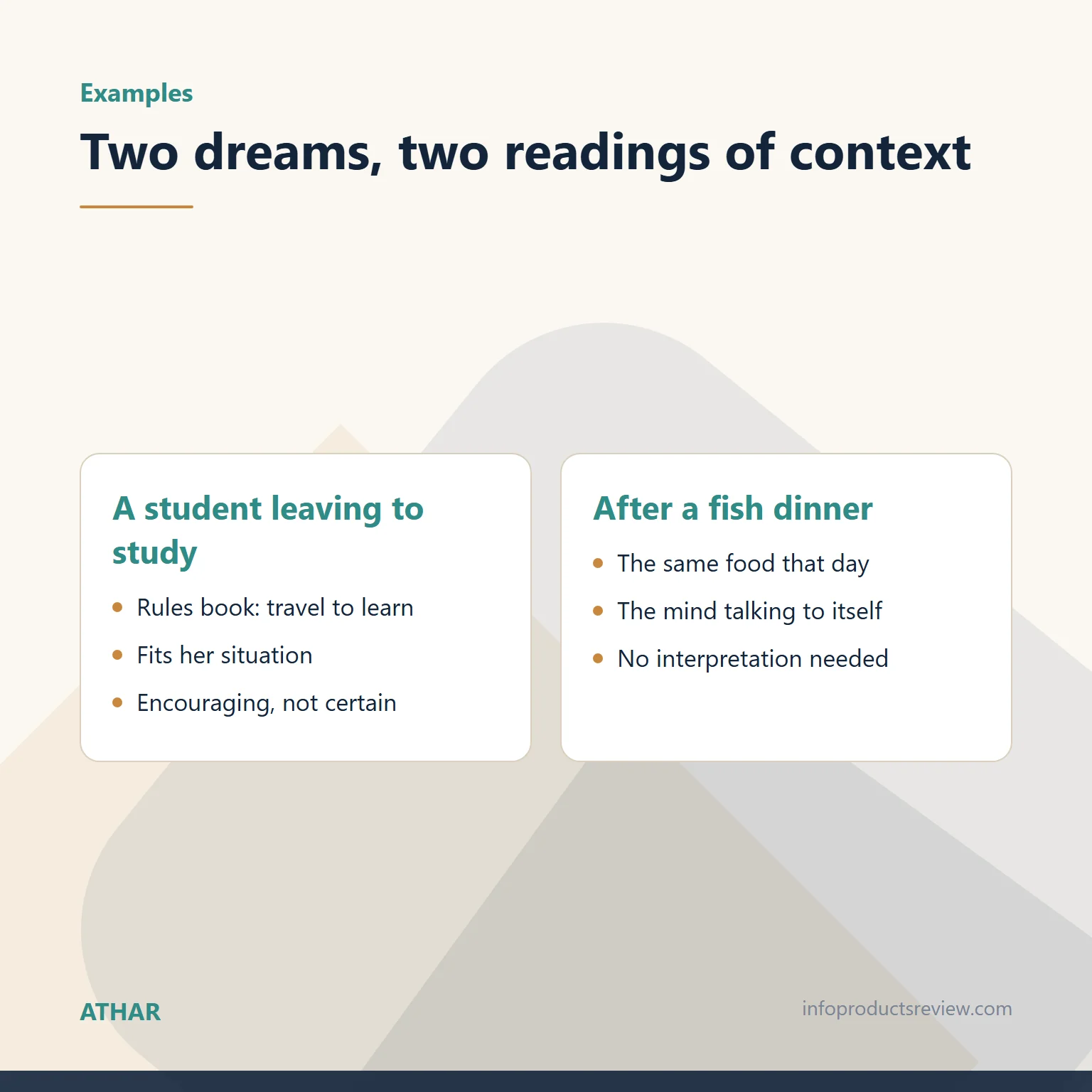
These examples are made up to illustrate the point; they aren’t anyone’s actual dream.
One: an office worker had grilled fish for dinner with friends, then dreamed he was eating grilled fish at a seaside restaurant. That’s closest to the self talking to itself, because the same scene was in his day. There’s no need to look for a meaning.
Two: a student getting ready to travel abroad to study dreamed she was eating dried salted fish. Salted fish is read as a journey for knowledge in one of the readings, so she can take some encouragement from a reading that fits her situation — without reading into it that her trip will happen or her studies will go well.
Three: a mother dreamed a fish bone stuck in her son’s throat while he was eating, and woke frightened. She’d read online that this means he’ll fall ill, a link with no basis in the books at all.
The better course is to treat it as a disliked dream: seek refuge, turn over, and keep it to herself. If her son has a real health complaint, that’s for a doctor.
Four: a man who cooks in a seafood restaurant dreamed he was cleaning huge amounts of fish and falling behind on orders. That’s a scene from his working day and may reflect pressure at work. There’s nothing in it pointing to gain or loss.
Frequently asked questions
What does eating fish in a dream mean?
There’s no single meaning. The clearest readings: grilled fish is provision without effort, and salted fish is worry, money or a journey for knowledge. Most other details are read from the scene and how you felt.
What does eating grilled fish in a dream mean?
It’s read as provision that comes without effort, by analogy with the story of the Table. That’s a modern author’s reading, it shifts with the details, and it promises no guaranteed money.
Is eating fish in a dream a sign of provision?
Not as a rule. Provision comes up in only two cases: grilled fish in the modern reading, and salted fish in the old books, for someone used to that pattern. Eating fish in general, however it was cooked, carries no guarantee of income, and nobody should wait for money because of a dream.
Does grilled food in a dream mean meagre provision with sorrow?
That line is in the older books, but it was said about someone who lights a fire to grill meat, in a passage about fire, not fish. So it doesn’t carry over to eating grilled fish.
What does eating fried fish in a dream mean?
The books give it no meaning of its own. Read it from the dream: who fried it, how it tasted, and how you felt eating it.
Does eating raw fish in a dream mean gossip?
That isn’t established. The old line about eating raw meat comes in a passage about sheep, and it’s about meat, not fish. Eating raw fish is a normal habit for many people, and habits count in interpretation.
What does eating salted fish in a dream mean?
In the old books: worry because of its saltiness, or money and good for someone used to seeing it before good things. In the modern reading: a journey to seek knowledge. Your situation decides between them.
What does buying fish in a dream mean?
It has no meaning of its own in the books. The details of buying, like what you chose, the price and who it was for, will help you more than a stock meaning.
Does cleaning fish in a dream mean anything?
Cleaning itself, no. What’s said about a pearl or fat inside the fish belongs to a specific report, so it shouldn’t be read as news of a child or money on the way.
What does it mean if a fish bone gets stuck in my throat in a dream?
Fish bones have no meaning in the books. The scene may reflect worry or stress; it’s no sign of illness. Any real trouble swallowing or breathing is for a doctor.
Does eating fish in a dream mean pregnancy?
No. The link is common online but isn’t in the books of dream interpretation, and no expectations about pregnancy or a baby’s sex should rest on it.
I dreamed about eating fish after having it for dinner. Does it mean anything?
Most likely it’s the “self talking to itself”, an echo of your day. That kind of dream comes from the body and carries no interpretation.
Is anything on this page a definitive interpretation?
No. These are possible meanings given by interpreters, along with what they didn’t say. The authors of these books themselves say interpretation is conjecture, so nothing certain about income, health or the future can rest on it.
In summary
- Grilled fish is provision without effort in a modern reading built on analogy.
- The old line on grilling is about grilling meat, so it doesn’t carry over to fish.
- Salted fish can mean worry, money or a journey for knowledge; your situation decides.
- Fried and raw fish, taste, bones, buying, cleaning and cutting have no meaning of their own in the books.
- A food dream after a day with the same food is most likely the self talking to itself.
- The dream can’t guarantee income, announce a pregnancy, or diagnose an illness.
- ATHAR’s guide to dream interpretation
If you take one thing from this page, let it be this: before asking what the fish you ate in your dream means, ask what you ate that day, and what’s really on your mind.
Written and reviewed by the ATHAR editorial team. Quoted texts are taken from the editions listed in the references.
Note: everything on this page is a possible meaning, not an established fact. Nothing here predicts the future, guarantees income, diagnoses a health condition or gives a religious ruling.