

You dreamed you were fishing, from a rock, from a small boat, or with your bare hands in the shallows, and you woke up wanting to know whether that was a good sign. Here’s the short answer: a fishing dream is not simply “money is coming.” The classical books of dream interpretation read this scene two ways, one hopeful and one cautious, and what tips it either way is what you were fishing for and what your own life looks like.
As for the tool, whether a rod, a net or your hands, and for a fish that slips away or a net that comes up empty, those books give no separate meaning at all. We’ll say so plainly where it applies, and give you better questions instead.
The bottom line
- The straight answer: fishing in a dream is usually read as effort and pursuit: something you are working to get hold of in your life. A big haul of large fish is read as wealth and gain, and “gain” here means what a person wins by going after it.
- There is also a narrower reading: an old report back to dream interpreters, read catching fish from the water as unlawful money. But that was an answer to one man who asked about his own dream, not a rule for everyone who dreams of fishing.
- What tips the balance: your intention and your habits. What were you after? And is fishing part of your life at all? Those two questions matter more than the symbol.
- Two common cases: small fish are read as sorrow for whoever gets them. And someone who caught one or two fresh fish, meaning fish still raw, neither salted nor cooked, was told in that same report that he would gain a woman, or two women.
- All of it is a possibility, never a promise. Interpretation is informed guesswork, not news. So there’s no guaranteed money, no accusation against you or anyone else, and no announcement of a marriage or a pregnancy.
- And where the books give nothing: fishing by hand, with a rod or with a net, the bait, a fish that gets away, an empty net, and where you were fishing. Read those from how the dream felt and what’s on your mind, not from a dictionary.
If you’re asking about fish in general, including their size, colour and condition, the broader guide is what dreaming of fish may mean. This page is about the act of fishing itself.
What this page covers
- The bottom line
- Why fishing dreams get their own questions
- What do the books of dream interpretation actually say about fishing?
- Why is a big haul read as gain? The other reading
- How do you tell which reading fits your dream?
- Catching fish with your bare hands
- Fishing with a rod
- Fishing with a net
- Did you land the catch, or did it get away?
- What did you do with your catch?
- Fishing alone, or with other people?
- Where were you fishing? The place and the water
- What did you catch? Size and number, briefly
- Seeing a fisherman, or fishing for a living
- What a fishing dream can’t tell you
- If the dream left you uneasy
- How to describe a fishing dream to someone you ask
- Quick reference: fishing details and what the books say
- Some typical fishing dreams
- Frequently asked questions
- Is dreaming about fishing a good sign?
- Did Ibn Sirin really say fishing in a dream means unlawful money?
- What does catching a fish with your hands mean in a dream?
- What does fishing with a rod mean in a dream?
- Does a net in a dream mean falling into a trap?
- What does it mean if the fish slipped out of my hands?
- Does an empty net in a dream mean loss?
- Does catching a big fish in a dream mean a lot of money?
- Is a fishing dream different if fishing is my job?
- Does a fishing dream mean marriage?
- What should I do after an unsettling fishing dream?
- Is anything on this page a definitive interpretation?
- In summary
Why fishing dreams get their own questions
When you dream of a fish in the water, you ask about the fish. When you dream that you’re the one fishing, you ask about yourself: the effort you’re putting in, what you’re hoping for, and whether you’ll get it.
That’s why fishing dreams tend to follow people into the day. The scene has movement, waiting and an outcome, and all three feel like ordinary life.
Real fishing is a mix of patience, skill and luck. You can sit for hours with nothing, then land something in a moment. Or you fill a bucket on the first cast.
Anyone who has spent months job-hunting, waited on exam results or tried to get a small business off the ground knows that rhythm. The effort stays the same; the result either arrives or keeps you waiting.
So it’s tempting to read the dream the way you’d read a day on the water: a big catch means success, an empty net means disappointment. That may be an honest description of how you feel, but it isn’t something the classical interpreters wrote.
There’s another reason these dreams are confusing. The pages people find online contradict each other. Some say fishing in a dream is blessed, lawful income. Others say it’s dubious money, and both often claim the same famous name.
The whole thing is simpler than it looks, and in a moment we’ll show you where that muddle comes from.
Before you look for a meaning at all, though, ask something simpler: did fishing come up in your day? Did you watch something about the sea, walk past a fish market, or talk to a friend about a fishing trip?
If so, the dream is most likely an echo of the day and needs no symbolic reading. If fishing played no part in your day, the rest of this page will help you make sense of what you saw.
What do the books of dream interpretation actually say about fishing?
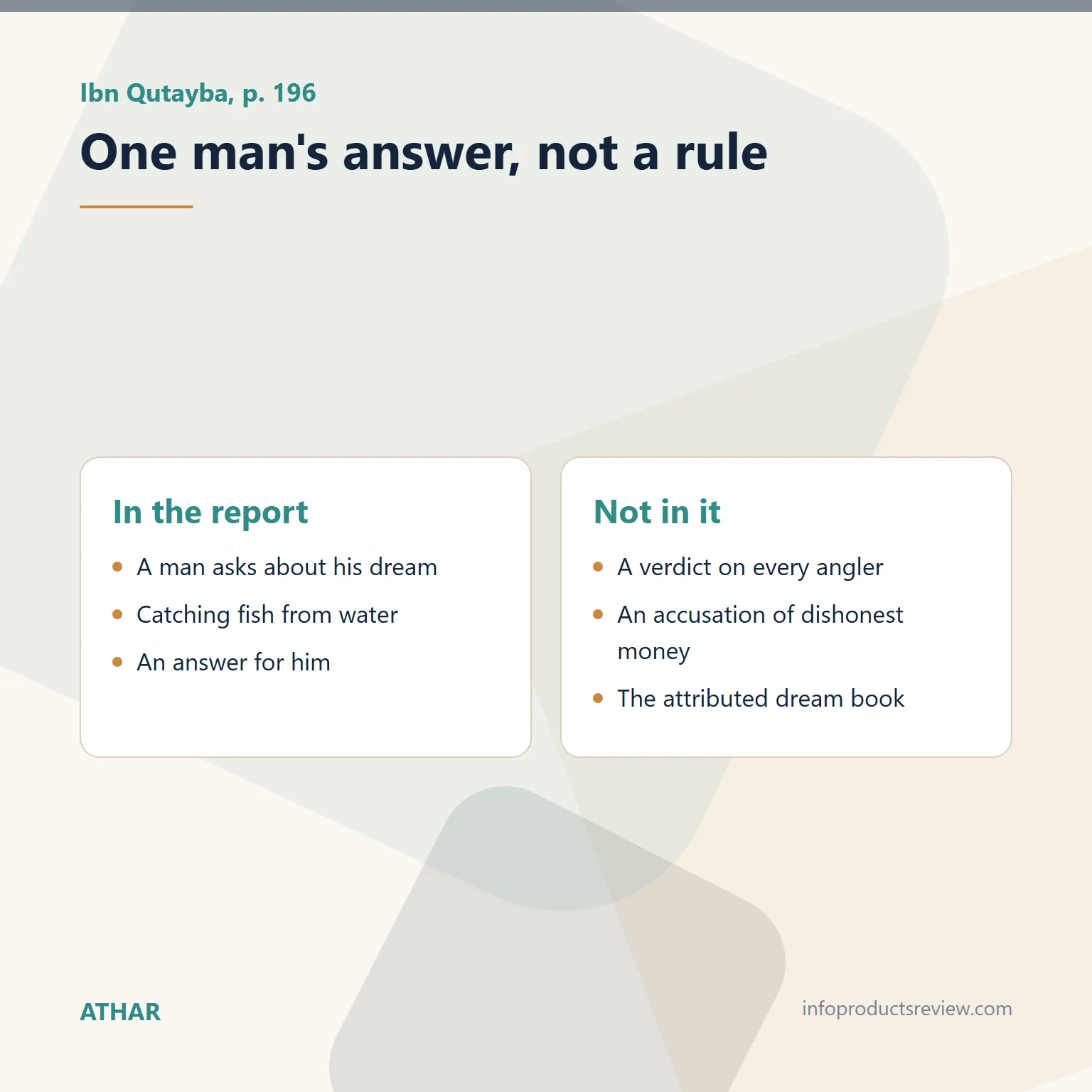
The earliest writing on this scene sits in a section on creatures of the water, fish and others, in the books of dream interpretation of dream interpretation. There you find Dream interpreters hold who was asked about a man who dreamed he was catching fish from the water, and answered that the man would come by unlawful money.
The people there then asked about someone who dreamed he’d caught one or two fresh fish. The answer was different: he would gain a woman, or two women. That is the clearest early statement specifically about catching fish.
Before carrying it over to your own dream, though, four things are worth noticing. They matter more than the report itself.
It answers one questioner. The report describes a particular man asking about his own dream. An interpreter answers the person in front of him, drawing on what he knows of them, and might say something quite different to someone else.
That’s why we call it a report, not a ruling.
It is also a completely different thing from the popular dream book that circulates under Ibn Sirin’s name. That book’s attribution to him isn’t established either, and it is one of the biggest sources of confusion around this symbol.
The reading isn’t an accusation. “Unlawful money,” given as a reading of a dream, doesn’t say the dreamer is living on dishonest money, and it can’t be used as evidence against anyone. It’s one interpreter’s view of a symbol, and nobody’s income is judged by a dream.
The report itself makes a distinction. The answer changed as soon as the picture did. Fishing away at the water is one scene; a fish or two in hand is another.
And the reading of fresh fish as a woman was an answer to that particular questioner. Don’t turn it into a promise of marriage for anyone who dreams of a fish; we’ll come back to it when we get to the limits.
Why might fishing be read cautiously at all? The report doesn’t say, and we’re not going to supply a reason it never gives. It’s enough to know that this reading exists in a well-known early book, and that it doesn’t cancel out the other reading that follows straight after it.
Why is a big haul read as gain? The other reading
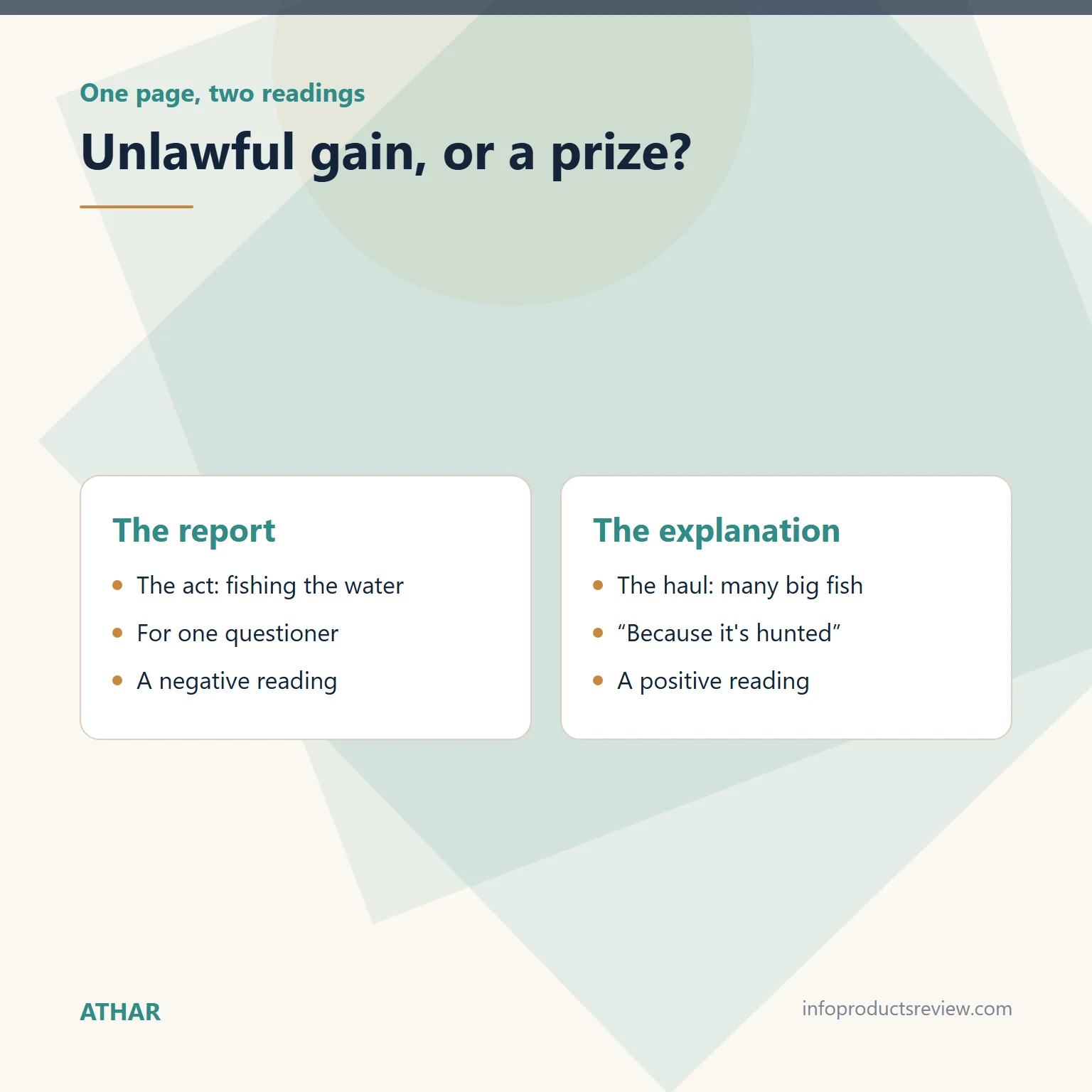
Just before that report, and again just after it, on the same page, sits a different meaning: fresh fish, when they are large and many, are wealth and gain for whoever gets them.
The reason given is the interesting part. Plentiful large fish are wealth and gain because they come from hunting. In other words, the fact that they were caught is what makes the reading a hopeful one, not a cautious one.
“Gain” in that older Arabic sense means what a person wins through effort, pursuit and hard work. Fishing is the obvious picture of exactly that: you go out, you wait, you tire yourself, and then you take something home.
Notice another detail. Large fish, when there are only a few, go the way of the report just before them; when there are many, they become gain. So the number changes the reading, not just the size.
How can one page say that catching fish is unlawful money, and also that plenty of fish is gain because it’s caught? A hasty reader sees a contradiction and picks the half they like. A careful reader notices that the two scenes aren’t the same:
- In the report, a man “catching fish from the water,” and the answer is about that act, for that questioner.
- In the explanation, a large haul of big fish that the dreamer ends up with. It’s about what he gained, not how he took it.
We don’t want to reconcile the two more neatly than the wording allows. The books don’t spell out how the readings relate, and we’re not going to add what isn’t there.
But this much does settle one thing: anyone who tells you that fishing in a dream is “always lawful provision,” and anyone who tells you it’s “always dishonest money,” is claiming more than the books say.
How do you tell which reading fits your dream?
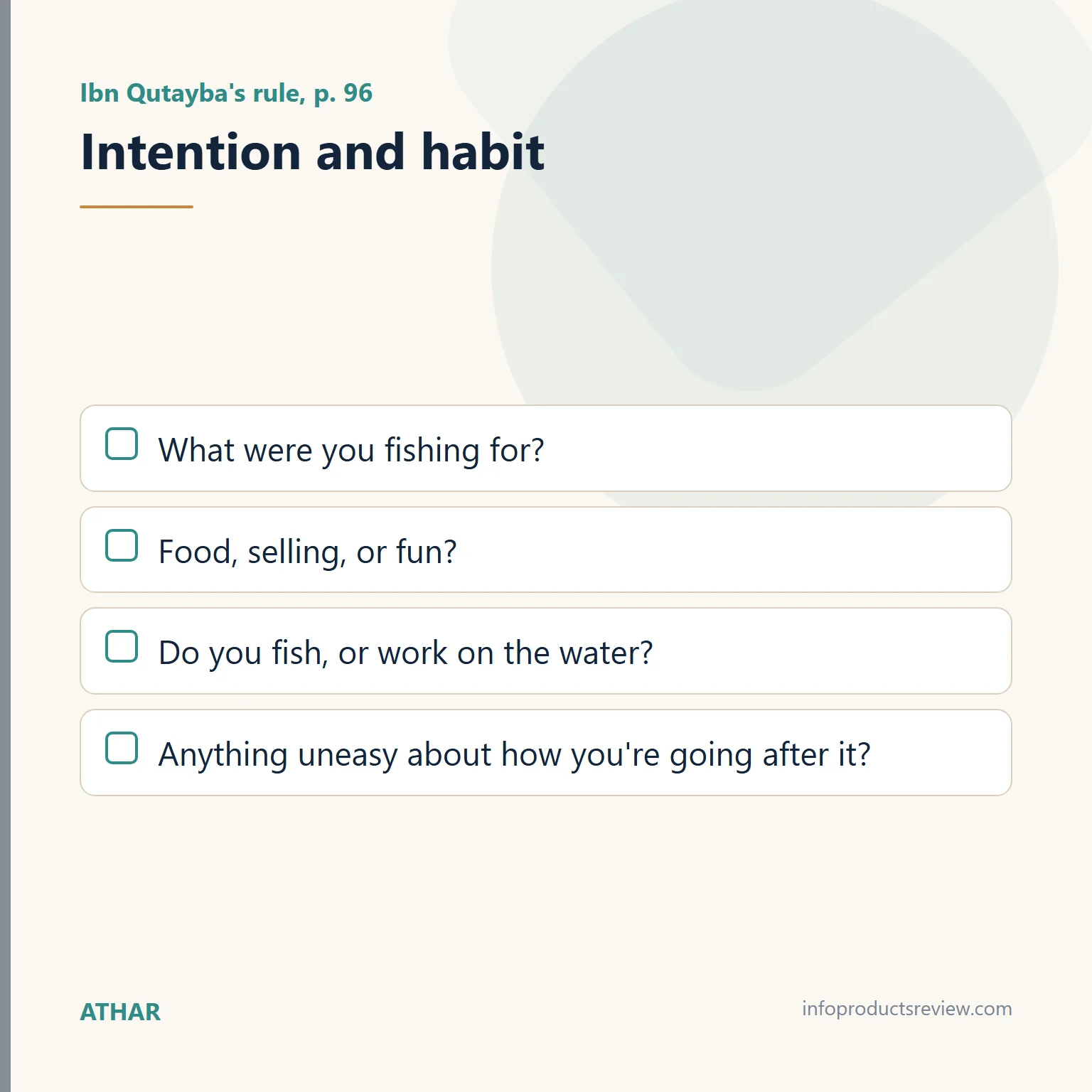
What settles it isn’t the fish. It’s a rule of method the books of dream interpretation set out, with hunting named as one of the examples: when a dream is unclear, the interpreter asks the dreamer what they intended by their hunting and judges by that, and asks too about their temperament and what they are used to.
For anyone asking about a fishing dream, this rule says three useful things.
A dream can point two opposite ways. An interpreter doesn’t just pick the one he prefers. He goes back to what he knows about the dreamer.
What you meant by the hunt is part of the reading. Were you after food for your family, or enjoyment, or fish to sell? Or were you fishing somewhere you had no right to fish?
These are questions an interpreter puts to the dreamer. No dictionary and no website can answer them for you.
People have their own patterns in dreams. If you know from experience that a certain dream tends to come before a certain kind of event, that personal pattern counts for more than the general meaning.
In practice, someone who fishes for a living every day shouldn’t have their dream read the same way as an office worker who has never held a rod. The meaning shifts a good deal here.
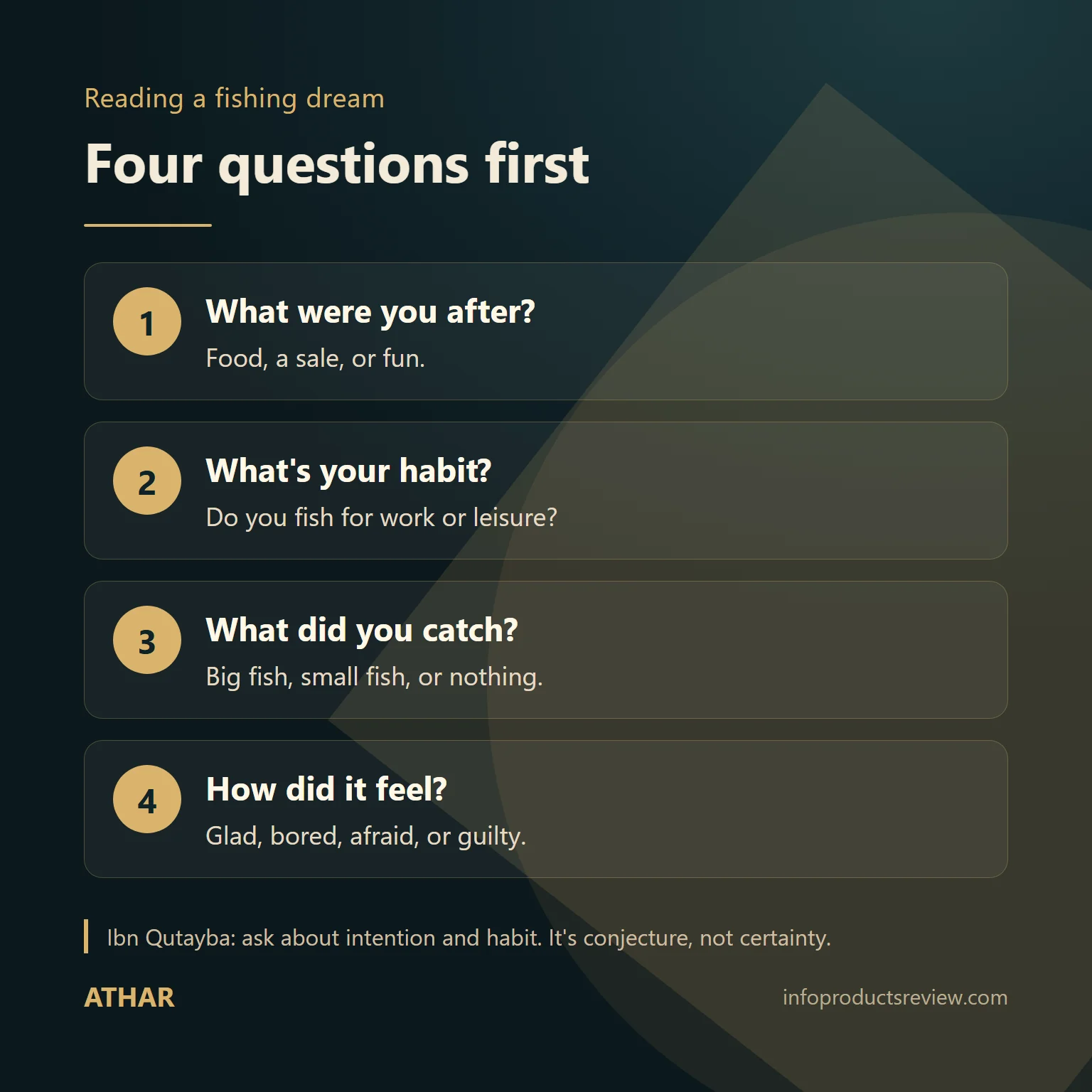
In the same passage comes a sentence that puts the whole business in perspective: an interpreter is never certain about a dream, because interpretation is surmise and the weighing of guesses.
In other words, he never knows what a dream means for sure; he weighs likelihoods. That line on its own is reason enough to walk away from anyone who promises you money, or accuses you of wrongdoing, on the strength of a fishing dream.
If you want to use the rule on your own, ask yourself honestly: What was I trying to get in the dream? What am I trying to get in my life right now? Is there anything about how I’m going after it that doesn’t sit right with me?
You may not reach “the meaning” of the dream, but you’ll reach a much better question than the one you started with.
Here’s a short illustration. Two men have the same dream: each is pulling fish after fish out of a river. The first runs a business he’s at ease with, and in the dream he was fishing to feed his family.
The second has recently taken on work he has doubts about, and in the dream he was fishing on the quiet. The rule doesn’t give them the same answer, because their intentions and circumstances differ.
And even for the second man, the dream passes no judgement on him. At most it nudges him to take an honest look at his work, if there’s something there worth looking at, and that’s a useful thing to do in any case.
Catching fish with your bare hands
Grabbing a fish by hand is a distinctive scene. There’s nothing between you and the fish. It’s slippery and it wriggles, and holding on takes speed and a steady grip. People ask about this one specifically.
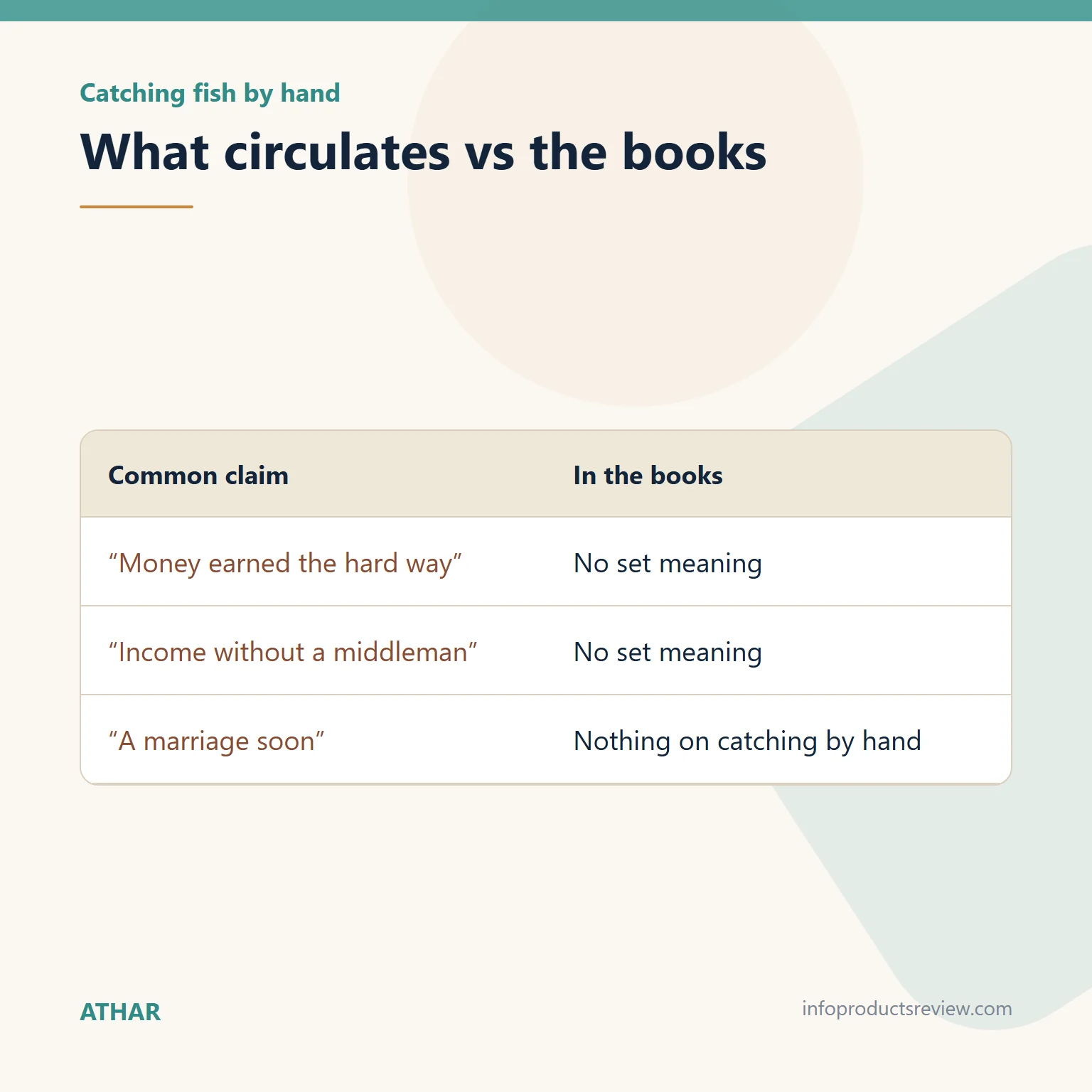
The straight answer: the books of dream interpretation give catching fish by hand no meaning of its own, separate from fishing in general.
Claims that it means “money earned the hard way” or “income without a middleman” have no source anyone can point to. Don’t treat them as an established interpretation.
The closest thing in those books is the second half of the report above, about someone who got hold of one or two fresh fish. But that’s about obtaining the fish, not about using your hands, and it answered one man asking about himself.
So what can you do? Pay attention to the details that are specific to you, rather than looking for a stock meaning:
- Was it easy, or did it take several tries?
- Was the fish alive and thrashing, or did you pick it up still from shallow water?
- Did you keep it, put it back, or lose your grip?
- Was anyone with you, waiting to see what you’d catch?
None of this hands you an interpretation. It does make your account of the dream precise, if you want to talk it through with someone you trust.
And it may show you that the dream resembles something you’re living through: trying to get hold of something on your own, or an opportunity that feels slippery and needs a steady hand.
It’s also natural for the feel of the fish, or the way it twisted, to stay with you after you wake. Dreams with touch and movement in them tend to stick in the memory, which makes them easier to recall rather than more significant.
Fishing with a rod
A rod is a tool of patience. You cast, you wait, sometimes for a long time, and then you feel the pull and reel in. So reading rod fishing as patience and waiting feels completely natural, and dream websites repeat it endlessly.
Natural isn’t the same as documented, though. The books give fishing with a rod no meaning of its own, and nothing that separates it from fishing with a net or by hand. The report speaks of “catching fish from the water” without naming any tool.
So treat what follows as a description of the scene, not an interpretation of it.
You waited a long time and then caught something: the scene resembles waiting for slow effort to pay off. It may echo what you’re going through, or it may not.
The fish pulled hard and you worried the line would snap: it resembles the tension of the last moments before a result you’re waiting for.
You cast where you knew the fish were: it looks more like a considered effort than a gamble.
What about the bait? Some people remember exactly what they put on the hook, a worm, a bit of bread, a lure, and ask about that. The old books say nothing about bait as a symbol of its own.
In the scene, though, bait is what you offer in order to get what you want. So it can be worth asking yourself: what am I putting in right now to reach what I’m after, and is it suited to what I want? That’s a question to think about, not a meaning for the bait.
And remember the rule about intention and habit. If you fish as a hobby and spend your weekends on a pier or a riverbank, it’s no surprise the image keeps turning up in your sleep.
The US National Institute of Neurological Disorders and Stroke says in its guide to sleep that events from the day often find their way into our thoughts while we sleep.
That’s about sleep in general, not about the fishing symbol. But it’s a reminder that not everything you see at night is a message.
Fishing with a net
A net works differently from a rod. It’s built for a haul, not a single fish: you throw it once and gather whatever’s there. That’s why many people see a full net as abundance and a torn one as loss.
There’s a mix-up worth clearing up here. The old books do mention a net, but not in connection with fishing.
Among the signs of worry and dismissal for someone in a position of power, they list dreaming that “a net was set for him and he fell into it.” That net is a trap laid for the dreamer, not a net the dreamer is fishing with.
It isn’t right to carry that reading over to someone who dreamed of casting a net into the sea and pulling in fish. Having a net set for you and casting one yourself are two very different pictures.
As for fishing with a net in the ordinary sense, it’s the same as with a rod: the books give it no meaning of its own.
What they do cover is what ends up in the net, rather than the net itself. If yours came up full of large fish, the old reading of a large haul is wealth and gain for whoever gets it. If it came up with small fish, the old reading of small fish is sorrow.
Both readings are about the fish, not the gear. That distinction is worth holding on to, because blurring it is where most of the frightening stories come from.
If you describe a net dream to someone, these details help more than the net itself:
- Did you cast it alone or with other people?
- Did it come in easily, or was it heavy?
- What came up in it: fish, just water and mud, or other things?
- Was it your net, or someone else’s?
A torn or tangled net comes up often, and it frightens some people because it seems to spell loss. The books give it no reading at all.
What can honestly be said is that it’s a picture of a tool that no longer does its job, and it may draw your attention to something you rely on that feels like it needs mending: a plan, a way of working, a partnership.
That’s something to reflect on, rather than news of a loss on the way.
Did you land the catch, or did it get away?
A lot of fishing dreams don’t end with a fish in the bucket. The fish wriggles free, the line snaps, the net comes up empty, someone takes your catch, or you wake before you find out. Those endings are what worry people most.
First, the plain fact: the books give a failed catch, an escaped fish or an empty net no meaning of their own.
Anyone who tells you a fish slipping away means certain financial loss, a broken engagement or trouble at work is adding that themselves.
That said, these endings make sense psychologically. Here’s what they often mirror in people’s lives, offered as something to reflect on rather than as an interpretation:
| How the fishing ended | What it may resemble in waking life | What the dream doesn’t say |
|---|---|---|
| The fish slipped out of your hands | Fear of losing an opportunity that’s close | That you’ll actually lose it |
| The line snapped | The tension of a decisive moment | Certain failure |
| The net came up empty | A sense that your effort hasn’t paid off yet | That the effort is pointless |
| Hours of waiting, no bites | Frustration with how long something is taking | That it will keep dragging on |
| Someone took your catch | Worry about competition or unfairness | An accusation against a real person |
| You woke before the end | Something still unresolved | A bad outcome |
The gap between the middle column and the last one is the whole point. The middle column describes what might be on your mind now; the last column refuses to turn a dream into news about the future.
If you keep having dreams of failed fishing during a stressful stretch, such as a long job search or waiting on an important result, the Sleep Foundation notes that sad, traumatic or worrying situations that cause stress and fear may provoke nightmares.
That’s a general observation about sleep under pressure. It says nothing about what the fish that got away means.
And if the catch went well, with a full bucket or a big fish landed after a struggle, the earlier point applies: a large haul is read as gain for whoever gets it, and the reading turns on your intention and your circumstances. Take heart from it if you like, and read it as something about you rather than about tomorrow.
What did you do with your catch?
People often remember what happened after the fishing more clearly than the fishing itself. The fish went into a bucket, got sold on the beach, was handed to someone, or went back into the water.
Those details belong to the act of fishing, because they show what it was for. The books don’t give each of them a meaning of its own.
They still matter, because of the rule about intention: ask the dreamer what they were after. What you did with the catch is part of that answer.
- You kept it for yourself or your family: the aim was food or providing. That’s the plainest reason to fish.
- You sold it: the aim was earning. Here the how matters more. Was it a fair sale?
- You gave it away: the aim was sharing or kindness, and the scene reaches beyond what you wanted for yourself.
- You put it back: the fishing was the point, not the fish. Anyone who does catch-and-release will recognise that.
- You didn’t know what to do with it: the scene has no clear purpose, which is common in fragmented dreams.
If what you remember is eating, cleaning or cooking the fish after catching it, that is covered in our guide to eating fish in a dream, which deals with grilled and salted fish and what’s found inside a fish.
We won’t repeat any of that here.
None of this interprets the dream. It helps you answer the question a careful interpreter would ask. And as you think it over, you may notice that what you did in the dream resembles what you want in life: to provide, to earn, or to give.
Fishing alone, or with other people?
Some fishing dreams are shared: a boat full of friends or relatives, or several people hauling on one net. Others are completely solitary: just you and the water.
The books don’t distinguish the two in meaning. But the difference shows up clearly when you describe the dream, and it’s worth noticing.
If you were working with others: it’s a scene of shared effort, and it may resemble a project or a responsibility you’re carrying together. It helps to remember who was there, and whether working together felt easy.
If everyone was fishing for themselves, side by side: the scene is closer to comparison or competition. You might remember feeling that others were catching more than you, which is a familiar feeling when awake, too.
If you were alone: it’s a scene of self-reliance, or of isolation, depending on how it felt.
One thing to be careful about: someone you know turning up beside you in a fishing dream is no sign that they’ll share in some coming windfall, or that they’re a rival who wishes you harm. That’s asking far more of the dream than it can carry.
If there’s a real issue between you and that person, deal with it calmly while awake, not through suspicions built on a dream.
Where were you fishing? The place and the water

The setting is part of the scene: open sea, a river, a small pond, a tank at home. So is the water: clear enough to see the fish, or murky and opaque.
Here we only look at the setting as it bears on the act of fishing. The books don’t link where you fish, or how clear the water is, to any particular meaning.
The popular claim that fishing in clear water is good and fishing in murky water is trouble has no early source anyone can point to, however often it’s repeated.
The setting is still worth noting when you describe the dream, whether to an interpreter or to yourself:
- Clear water, fish visible before you catch them: the fishing is a matter of choosing. You can see what you’re after.
- Murky water, casting blind: the fishing is trial and error in the dark.
- Rough sea or a rocking boat: the sense of danger is central to the scene, and may matter more than the fish.
- From a boat or from the shore: fishing from a boat out on the water means leaving solid ground and taking a chance. Fishing from a beach or a pier has safety and limits. Whether you felt safe or uneasy matters more than the spot itself.
- Water you weren’t entitled to fish in: someone else’s pond, a forbidden spot. This brings back the question of intention.
Elsewhere in the old books, diving into the sea to bring up pearls is read as seeking knowledge, or seeking treasure and wealth. We mention it because people sometimes blur diving and fishing.
But it’s a reading of diving for pearls, not of catching fish, so we don’t transfer it.
Fish swimming in a tank or the sea, their colours and their condition, when you aren’t catching them, are covered in our broader guide to fish dreams, since that goes beyond fishing.
What did you catch? Size and number, briefly
Once you’ve thought about the tool and how it went, the obvious question is what you actually caught. This is where the old books have the most to say, because their section is really about the fish.
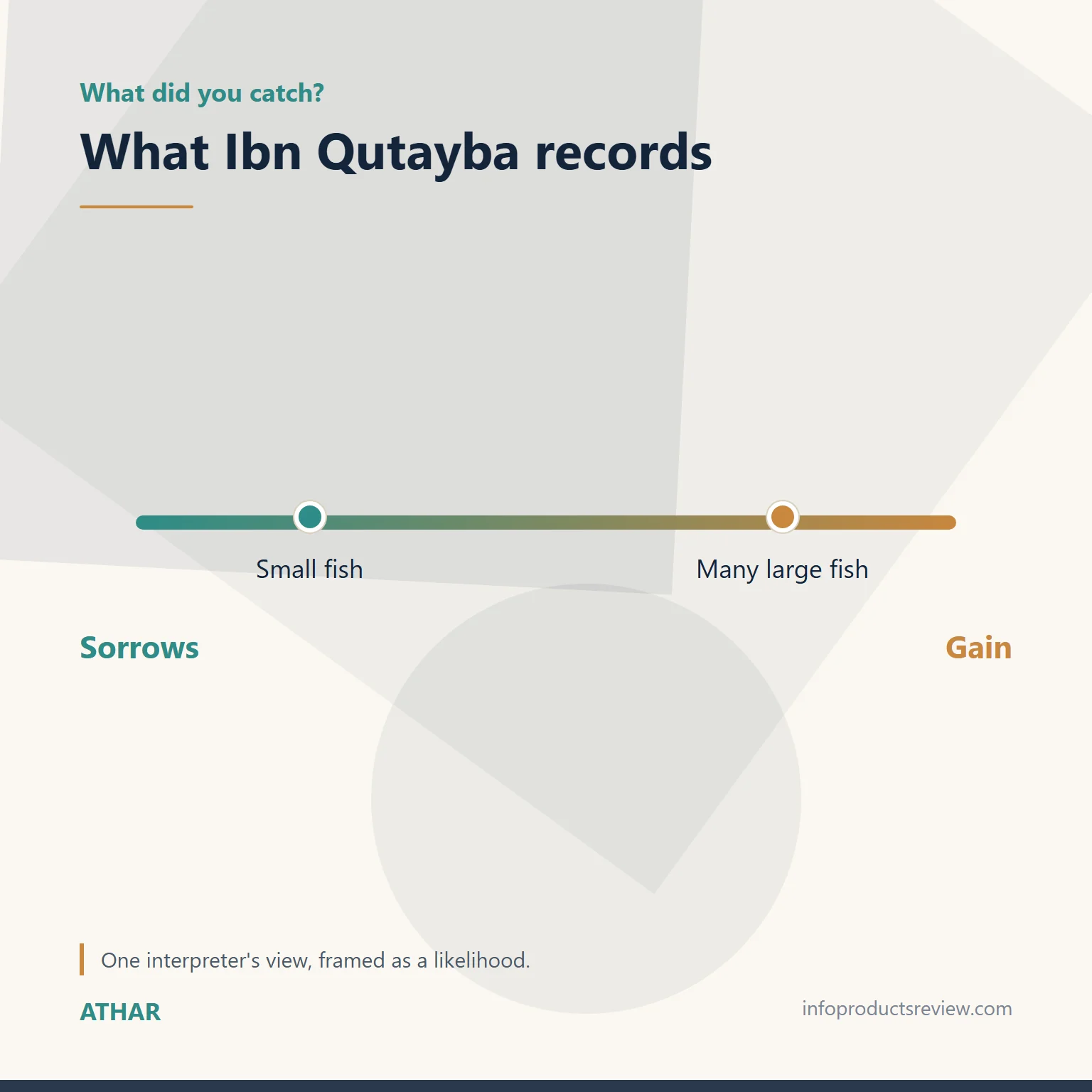
Fresh fish, meaning fish still raw rather than salted or cooked, are read as wealth and gain for whoever gets them when they are large and many in number.
Small fish, on the other hand, are read as sorrow for whoever gets them, and are likened to young children. The comparison is never explained, so we won’t invent an explanation for it.
In short, here is what the books say about the catch:
- Many large, fresh fish: wealth and gain for whoever gets them.
- Small fish: sorrow for whoever gets them.
- One or two fresh fish: in the report carried back to dream interpreters, the questioner was told he would gain a woman, or two women.
We’ll leave it there, because the size, number and condition of fish belong to the broader guide rather than this page.
What matters for a fishing dream is that all of these are readings tied to specific features, and that the way to choose between them is the dreamer’s intention and situation, as above.
For example, someone who dreams of hauling in lots of small fish and feeling delighted about it isn’t in the same place as someone who hauls them in feeling low. The old reading of small fish as sorrow stays a possibility, and how you felt in the dream and how things are in your life move it closer or further away.
Seeing a fisherman, or fishing for a living

Dreaming that you’re fishing is not the same as dreaming about someone who is a fisherman. The difference matters.
In the section on trades and crafts, each occupation gets a reading, the hunter among them: he is described as a man who schemes after women and pursues them.
That’s a reading of the hunter as a character who shows up in a dream, and the word for “hunter” there isn’t limited to fishing.
So it doesn’t apply to dreaming that you yourself are catching fish, and it certainly isn’t a judgement on any real fisherman you know. Don’t take a suspicion about a person out of a dream.
If fishing really is your job, this is exactly where the rule about habit comes in. Someone who heads out before dawn every day and sells the catch at the market will dream about fishing the way an office worker dreams about their desk, or a student about the exam hall.
That dream is closer to the day’s leftovers than to a symbol that needs decoding, unless something in it is strange compared with their normal routine.
The same goes for anyone who fishes as a hobby, has just been on holiday by the sea, or watched a fishing programme before bed. Before looking for a meaning, ask: did I see fishing today?
What a fishing dream can’t tell you
This matters more than anything above it, because the real risk with dream interpretation isn’t a wrong meaning. It’s acting on one. We’ve gathered every caution here in one place, so they don’t keep interrupting the rest of the page.
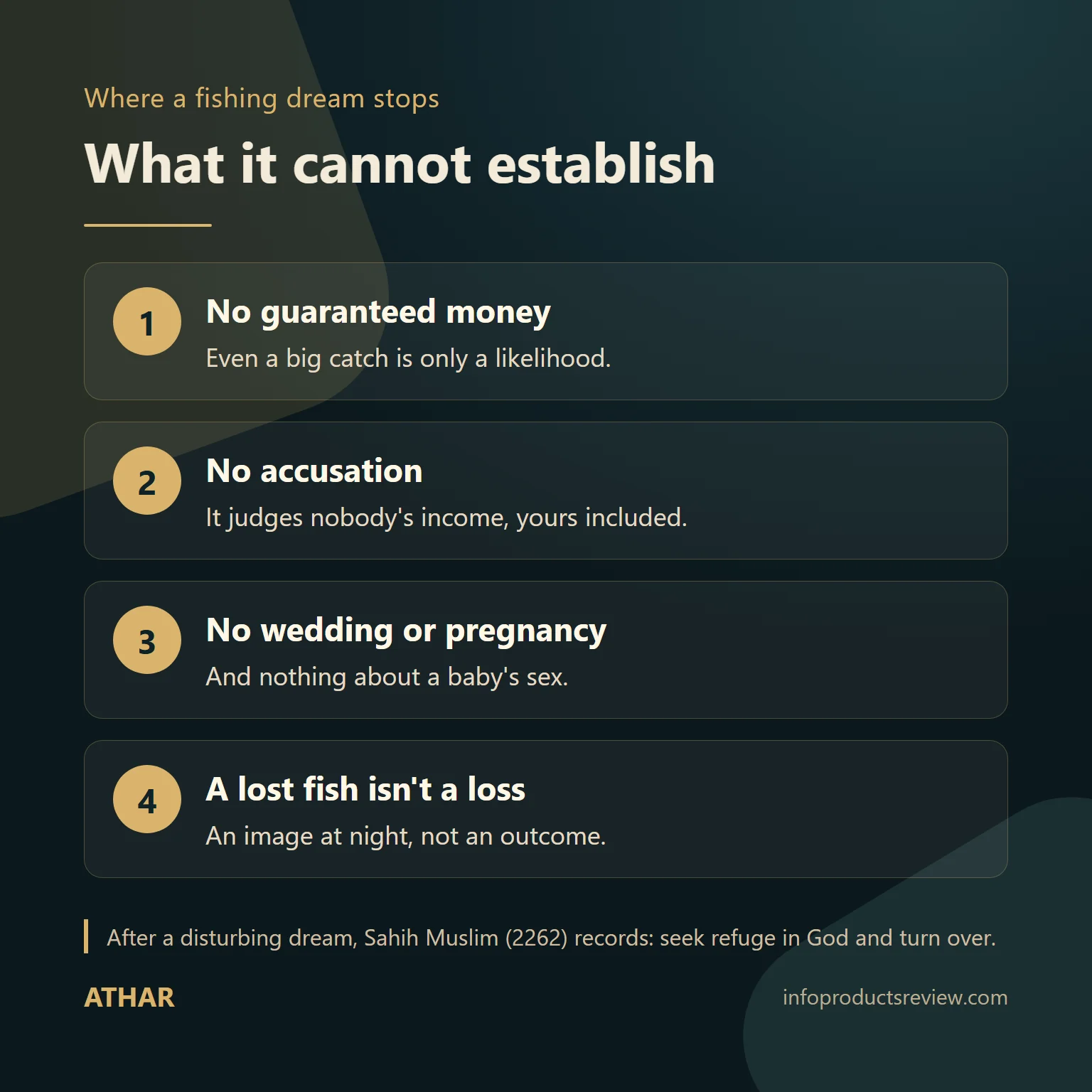
Whatever the details, a fishing dream:
- Doesn’t show that money is coming. Even the hopeful reading in the books is informed guesswork, not a fact.
- Doesn’t show that your income is dishonest, or anyone else’s. The cautious reading answered one man about his dream. It judges nobody’s earnings.
- Doesn’t announce a marriage or an engagement. The reading of fresh fish as a woman answered a particular man, and it is not a promise to anyone who dreams of a fish.
- Doesn’t reveal a pregnancy or a baby’s sex. The books draw no connection between fishing dreams and any of that.
- Doesn’t make a lost catch a real loss. A fish slipping away at night is an image, not an outcome.
- Isn’t a basis for a financial decision. Don’t start a business, borrow money or quit a job because of a fishing dream.
- Isn’t a sign of magic or the evil eye. Nothing the interpreters say about fishing links it to either.
If someone gives you a confident interpretation of your fishing dream, remember what the earliest authors on the subject wrote themselves: an interpreter is never certain about a dream.
Remember, too, that a dream doesn’t change the status of what you actually earn. If your income is lawful, no dream makes it otherwise.
And if you have real doubts about some of it, that’s a question to put to people of knowledge while you’re awake, with the details of the actual transaction, not to a dream interpretation.
If the dream left you uneasy
Not every fishing dream is peaceful. Some involve drowning, a capsizing boat, a huge fish dragging you under, or guilt about fishing where you shouldn’t.
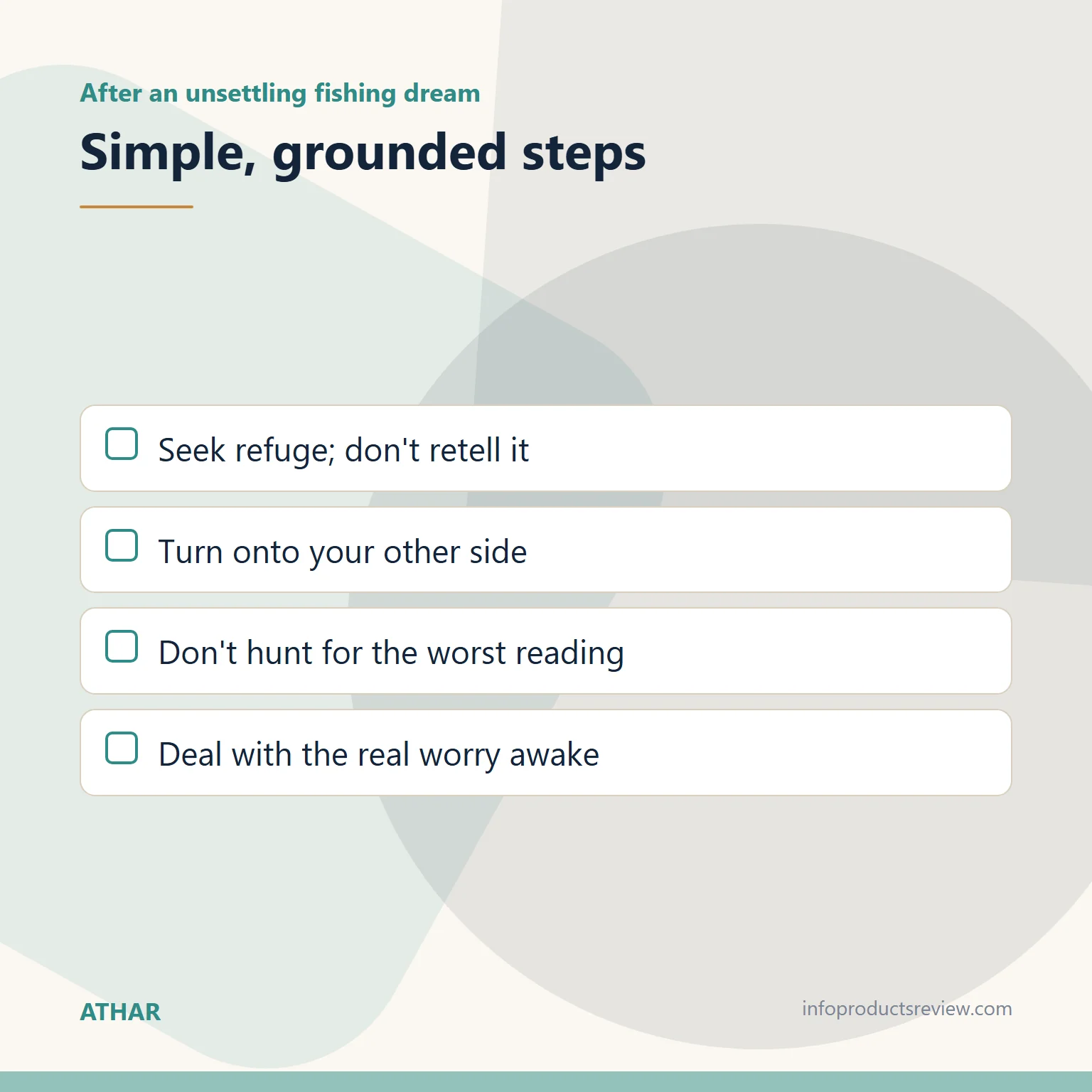
If you wake up shaken, here are a few simple, well-grounded steps. They are enough on their own, and nothing more is needed after them.
Follow what the Prophet ﷺ taught about a dream you dislike. In Sahih al-Bukhari (hadith 7044), from Abu Qatada:
A good dream is from God. If one of you sees something he likes, let him tell it only to someone he loves. And if he sees something he dislikes, let him seek refuge in God from its harm and from the harm of Satan, spit lightly three times, and not tell anyone about it, for it will not harm him
So someone who sees a dream they dislike seeks refuge in God from its harm and from Satan, spits lightly three times, and doesn’t tell anyone about it. The end of the hadith is plainly reassuring: “it will not harm him.”
And in Sahih Muslim (hadith 2262), from Jabir:
If one of you sees a dream he dislikes, let him spit to his left three times, seek refuge in God from Satan three times, and turn over from the side he was lying on
The narration in Muslim adds that the spitting is to the left, and that the sleeper turns over from the side he was lying on. These are simple acts, and they’re enough. After them you don’t need to go looking for a meaning.
Don’t go hunting for the worst interpretation. Scrolling page after page for the meaning of a disturbing dream usually feeds the anxiety, and rarely turns up an answer you can rely on.
Separate the dream from what’s actually worrying you. If it brought a real worry to the surface, whether money, work or a long wait, deal with that worry in waking life: make a plan, get advice, or talk to someone you trust.
If the dream came with guilt, say you were catching fish that weren’t yours, don’t let it put you on trial. But there’s no harm in honestly looking at something only you know about. That’s worth doing whether the dream meant anything or not.
If unsettling dreams keep coming back and affect your sleep or your days, a doctor or sleep specialist will help you more than any interpretation.
How to describe a fishing dream to someone you ask
The rule about asking the dreamer means, in practice, that describing the dream well matters more than looking up its meaning. If you want to share it with someone whose knowledge you trust, this order helps:
- The scene: where you were, what you fished with, who was there.
- What happened: did you catch anything? What? Did something get away?
- How you felt: glad, bored, afraid, guilty.
- What you were fishing for: food, to sell, for fun?
- Your habits: do you fish? Do you work on the water? Did you see fishing recently?
- What’s on your mind lately: without private details you’d rather keep to yourself.
Points four and five are the two the books name outright. Without them, any answer you get is a general guess that isn’t really about you.
If you can, write the dream down soon after waking, before the details blur.
And don’t fold in what you read about it afterwards. A lot of people end up remembering a dream the way it was interpreted to them, not the way they saw it.
Quick reference: fishing details and what the books say
| Detail | In the books of dream interpretation | How we treat it |
|---|---|---|
| Catching fish from the water, in general | A report carried back to dream interpreters: a cautious answer to one questioner | Not generalised; weighed by intention and habit |
| A large haul of big fish | Wealth and gain “because they come from hunting” | A likelihood, not a promise |
| Catching small fish | Sorrow for whoever gets them | Read in context, with the feeling |
| By hand, with a rod, or the bait you used | No meaning of its own for any of them | Describe the details, no stock meaning |
| Fishing with a net | No meaning of its own; the “net set for him” is a trap, not fishing | The trap reading isn’t transferred |
| A fish escaping, an empty net | No meaning of its own | Possible worry, not certain loss |
| Where you fished, how clear the water was | No meaning of its own | Worth including in your description |
| Seeing a fisherman | A reading of the hunter as a figure, in the section on trades | Not applied to your own fishing |
| Fishing is your job or hobby | The habit rule: personal pattern outweighs the general meaning | Usually the day’s leftovers |
Some typical fishing dreams

These are composite examples for illustration. They aren’t real people’s stories or verdicts on anyone’s dream.
A long job search. A young man who has been looking for work for months dreams he’s sitting on a harbour wall with a rod and catches nothing before he wakes. The books give that scene no meaning.
The most likely thing is that it pictures how long the wait feels. What will help him isn’t an interpretation. It’s taking a fresh look at how he’s job-hunting, and finding ways to cope with the pressure of waiting.
A working fisherman. A man who fishes for a living on the coast dreams he hauls in a net full of big fish. By the rule about habit, that’s close to his ordinary day. He can take heart from it, but it’s no reason to change how he runs his work.
The fish that got away. A mother dreams she’s holding a fish that slips out of her hands, and wakes anxious. She then reads online that it means her daughter’s engagement will fall through. That link has no basis in any known book of dream interpretation.
It’s better to treat it like any disturbing dream: seek refuge in God, turn over, and build nothing on it.
Fishing where you shouldn’t. A student dreams he’s fishing in a pond that belongs to someone else, and feels guilty in the dream. The dream doesn’t say he’s taking what isn’t his.
But the question of intention might prompt him to reconsider something only he knows about, like a way of studying he isn’t comfortable with. Taking an honest look at that does him good either way.
Two fresh fish. A single young man dreams he catches two fresh fish, then reads the report and decides a wedding must be on the way. The report answered one questioner, and an interpreter is never certain about a dream. He’s free to feel hopeful, but he shouldn’t make decisions on the strength of it, or start waiting for a date.
Frequently asked questions
Is dreaming about fishing a good sign?
Not always, and not always bad either. The books hold a cautious reading in a report about one questioner, and a hopeful reading of a big catch “because it comes from hunting.” Which applies depends on the dreamer’s intention and situation.
Did Ibn Sirin really say fishing in a dream means unlawful money?
There is an old report to that effect back to dream interpreters, but it concerns one man’s question about his own dream. Whether the chain is reliable isn’t established, and it says nothing about everyone who dreams of fishing.
What does catching a fish with your hands mean in a dream?
The books give it no separate meaning. The claims circulating online have no source anyone can point to. It’s more useful to describe the details of the scene accurately.
What does fishing with a rod mean in a dream?
Nothing specific is said about a rod. Reading it as patience and waiting is a natural description of the scene, not a documented interpretation.
Does a net in a dream mean falling into a trap?
Only in a different sense. The books list a person in power falling into a net set for him among signs of worry and dismissal. That net is a snare aimed at the dreamer, so it tells you nothing about casting a net for fish.
What does it mean if the fish slipped out of my hands?
The books give it no meaning. The scene may reflect worry about losing an opportunity, and it is no news that you will lose it.
Does an empty net in a dream mean loss?
Nothing establishes that. It’s a picture of effort not paying off inside the dream. It may echo how you feel, but it doesn’t forecast a loss.
Does catching a big fish in a dream mean a lot of money?
The old reading is that plentiful large fish are wealth and gain for whoever gets them. It’s still informed guesswork, and it isn’t a promise of money or a reason for a financial decision.
Is a fishing dream different if fishing is my job?
Yes, by the rule on habit and temperament. A fisherman’s dream about his work is closer to the day’s leftovers, unless something in it is unusual for him.
Does a fishing dream mean marriage?
A dream doesn’t announce a marriage. In the report carried back to dream interpreters, someone who caught one or two fresh fish was told he would gain a woman, or two women. But that answered one questioner, and it isn’t a promise.
What should I do after an unsettling fishing dream?
Seek refuge in God from its harm, spit lightly three times and don’t tell anyone about it, as in Sahih al-Bukhari (hadith 7044). Spit to your left and turn onto your other side, as in Sahih Muslim (hadith 2262).
Is anything on this page a definitive interpretation?
No. It sets out possible readings from the books listed in the references, and the limits of what a dream can establish. Nothing here predicts the future.
In summary
- The old books hold both a caution, given to one man, and a hopeful reading of a large haul.
- You choose between them by asking what the dreamer was after, and by weighing their habits and temperament.
- Hands, rods, nets, bait, a failed catch and the setting have no meanings of their own there.
- The “net set for him” in those books is a trap, not fishing gear.
- No fishing dream can promise a windfall, expose anyone’s earnings, or tell you about a wedding or a baby.
- If the dream unsettled you, seek refuge in God, turn over, don’t tell anyone about it, and set it aside.
- ATHAR’s guide to dream interpretation
If you take one question away from this page, make it this one: what were you fishing for? An honest answer will get you closer to understanding your dream than any list of meanings.
Written and reviewed by: the ATHAR editorial team. Quoted texts come from the editions listed in the references; translations from Arabic are our own.
Please note: this page sets out possible meanings, not certainties, and they change with the details of a dream and the dreamer’s circumstances. Nothing here predicts the future, guarantees money, judges anyone’s income, or gives a religious ruling.