

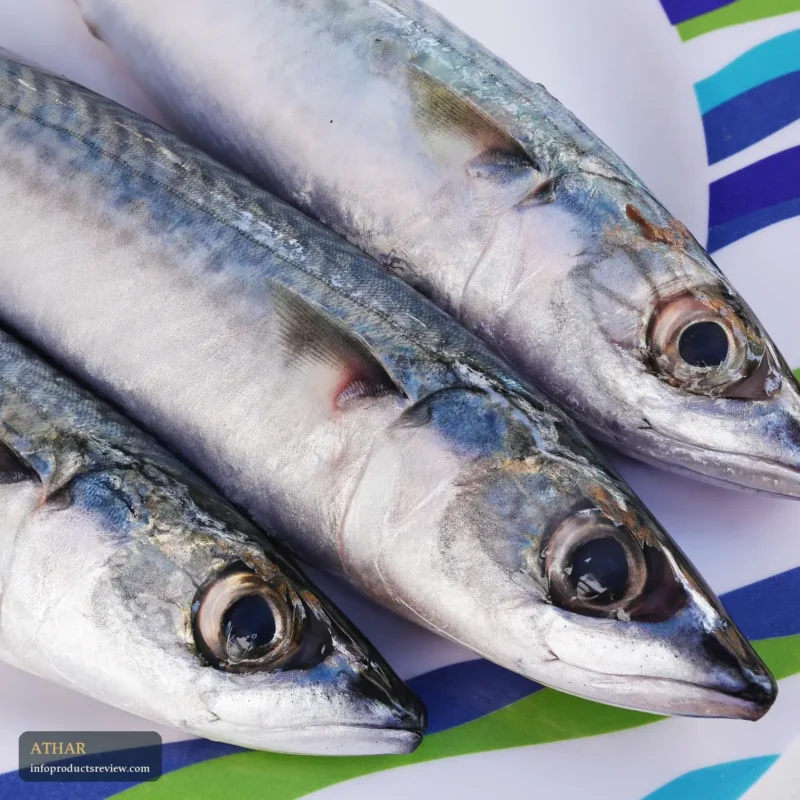
You dreamed about fish, and you woke up wanting to know whether it means money is coming. The short answer is that in the books of dream interpretation, fish stand for provision, earning, and whatever you are working to obtain. The details decide the rest: the state of the fish, its size, how many there were, what you did with them, and how you felt.
In every case this is a possible meaning and not a promise. A fish dream does not guarantee money, announce a pregnancy or set a wedding date. This page is the general starting point for fish dreams, and it links to the separate guides on fishing and on eating fish if that is what you came for.
The bottom line
- The closest meaning: large, fresh fish in quantity that you actually get hold of are read as wealth and gain, meaning something earned through effort. The reason the old books give is simple: fish are hunted, not handed over.
- The detail that changes it: size and state. Small fish are read as scattered small sorrows, and salted fish carry two faces: worry from the saltiness, or money and good for someone who likes it and is used to it.
- Two common cases: grilled fish already on the table is read as provision that comes without toil. Salted fish is also read as travel in search of knowledge to a coastal land. Fishing itself pictures effort, and how the catch goes decides the reading.
- A possibility, not a promise: these are interpreters’ judgements, not rulings. A fish dream cannot confirm a pregnancy, set a wedding date, guarantee money, or justify a financial or family decision.
- Where the books say nothing: there is no fixed meaning for dead fish, for the colour of fish, for sharks and whales, or for raw fish. In those cases read your own feeling in the dream and your situation awake, and don’t believe anyone who tells you a dead fish means someone will die.
What this page covers
- The bottom line
- Why do fish turn up in dreams so often?
- Which details change what a fish dream may mean?
- Large fish, and plenty of them
- Small fish
- Catching fish
- Eating grilled or fried fish
- Salted or dried fish
- Dead or rotting fish
- Buying, giving or selling fish
- A pearl or something valuable inside the fish
- Fish swimming in the sea or in a tank
- Does it mean something different for single women, married women, pregnancy or men?
- What do the books of dream interpretation actually say about fish?
- What is actually established about dreams?
- What does sleep research say about food in dreams?
- When is a fish dream more likely your mind processing the day?
- Common claims that need correcting
- What a fish dream cannot establish
- What to do after dreaming of fish
- How to describe your dream so it can actually be read
- What have interpreters said in recorded interviews?
- A few typical scenes
- Quick reference: detail and nearest reading
- Fish dream guide
- Related guides
- Frequently asked questions
- Is dreaming of fish a good sign?
- What does a big fish mean in a dream?
- Does a fish dream mean pregnancy for a married woman?
- What does catching fish in a dream mean?
- What does eating grilled fish in a dream mean?
- Does a dead fish in a dream mean someone will die?
- What do small fish mean in a dream?
- Does the type of fish reveal a baby’s sex?
- What does salted fish mean in a dream?
- What should I do after a disturbing dream about dead fish?
- Does dreaming of fish mean a single woman will marry soon?
- Is any of this certain?
- In summary
Why do fish turn up in dreams so often?

Before any interpretation, think about where fish sit in your everyday life. For many households they are ordinary food. For families on coasts and rivers they are a livelihood. They belong to holidays, fishing trips and meals that bring people together.
So it is hardly surprising to dream of fish after eating some, watching something about the sea, or walking past a fish counter. Often the explanation really is that ordinary.
The US National Institute of Neurological Disorders and Stroke says in its guide to sleep that events from the day often find their way into our thoughts while we sleep. That is about sleep in general rather than about fish, but it explains why what you saw by day can turn up at night.
At the same time, fish have qualities that led early interpreters to connect them with provision. They are caught by effort. They live in water. They come in plenty or in scarcity, large or small, fresh or salted.
Those very qualities are what a reading is built on. Which is why “what does a fish mean?” isn’t enough of a question: asked that way, it strips out everything that creates the meaning.
In a published interview, one interpreter says many callers ask what a fish or the sea means on its own, as if he were a dictionary, when what he needs is the whole dream in context. You will find that clip in the interviews section further down.
If you’d like the general approach first, our guide to dream interpretation explains how every symbol on this site is read: the meaning first, then its limits.
Which details change what a fish dream may mean?
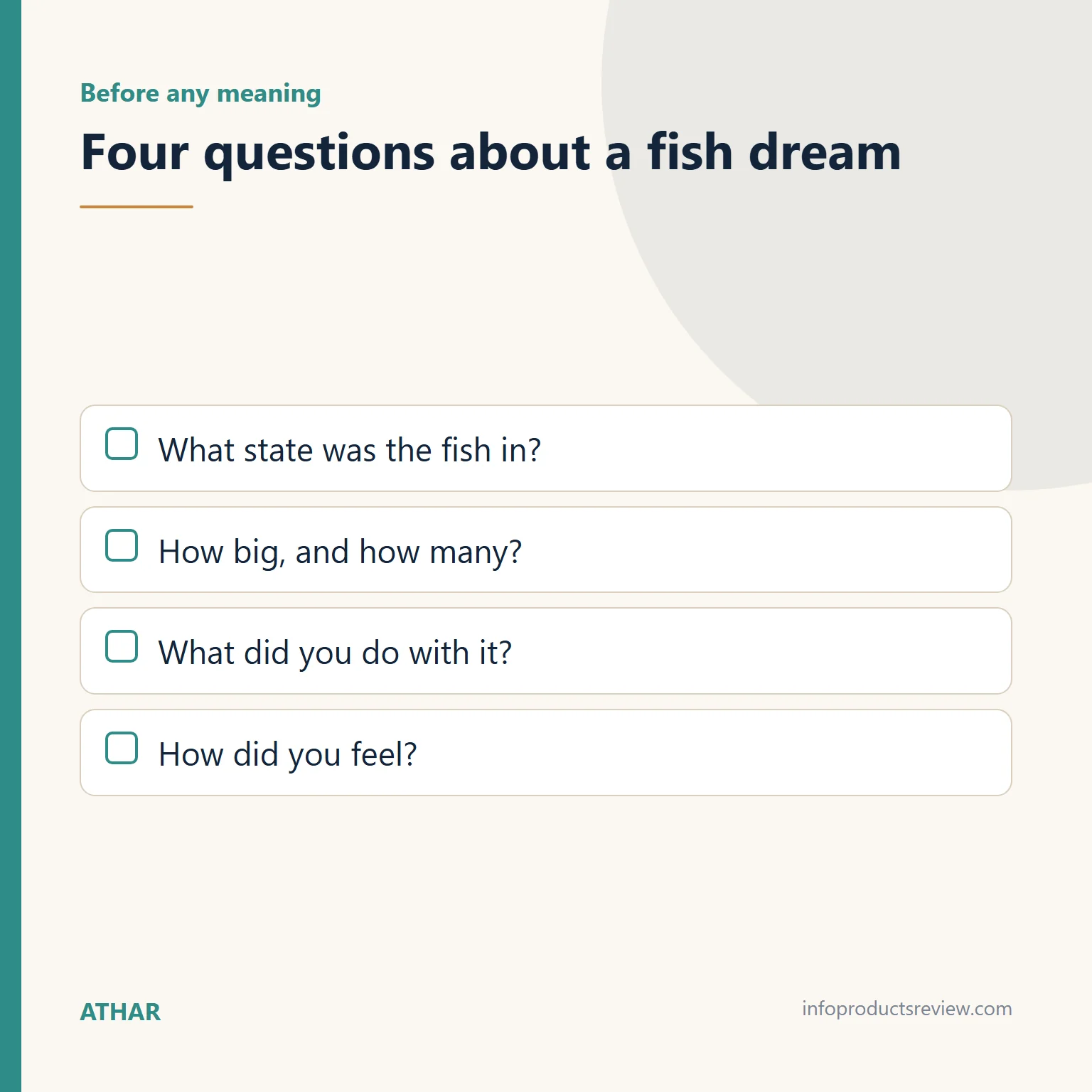
Five details create the meaning. Here they are, from the ones that matter most to the ones that matter least:
First: the state of the fish. Fresh and alive, salted, cooked, or dead and spoiling? In the books of dream interpretation this detail shifts a reading more than any other, and it is the first thing worth pinning down.
Second: size and number. Big and plentiful, or small and few? The old books draw that line explicitly and build two different meanings on either side of it.
Third: what you did. Did you catch them, buy them, eat them, give them away, or just watch them in the water? The gap between seeing and getting is a large one in any reading.
Fourth: how you felt, and your situation. Delight at a catch, or fear of the water? And what is actually on your mind: work, study, marriage, travel?
Last: colour, species and setting. These adjust the degree of a reading rather than creating a new one, which is why they come at the end of the list.
Try answering those five questions before you read any interpretation at all. Half the confusion usually goes. Someone who happily landed a big, fresh fish is not in the same place as someone who watched a small dead fish in murky water and felt afraid.

Large fish, and plenty of them
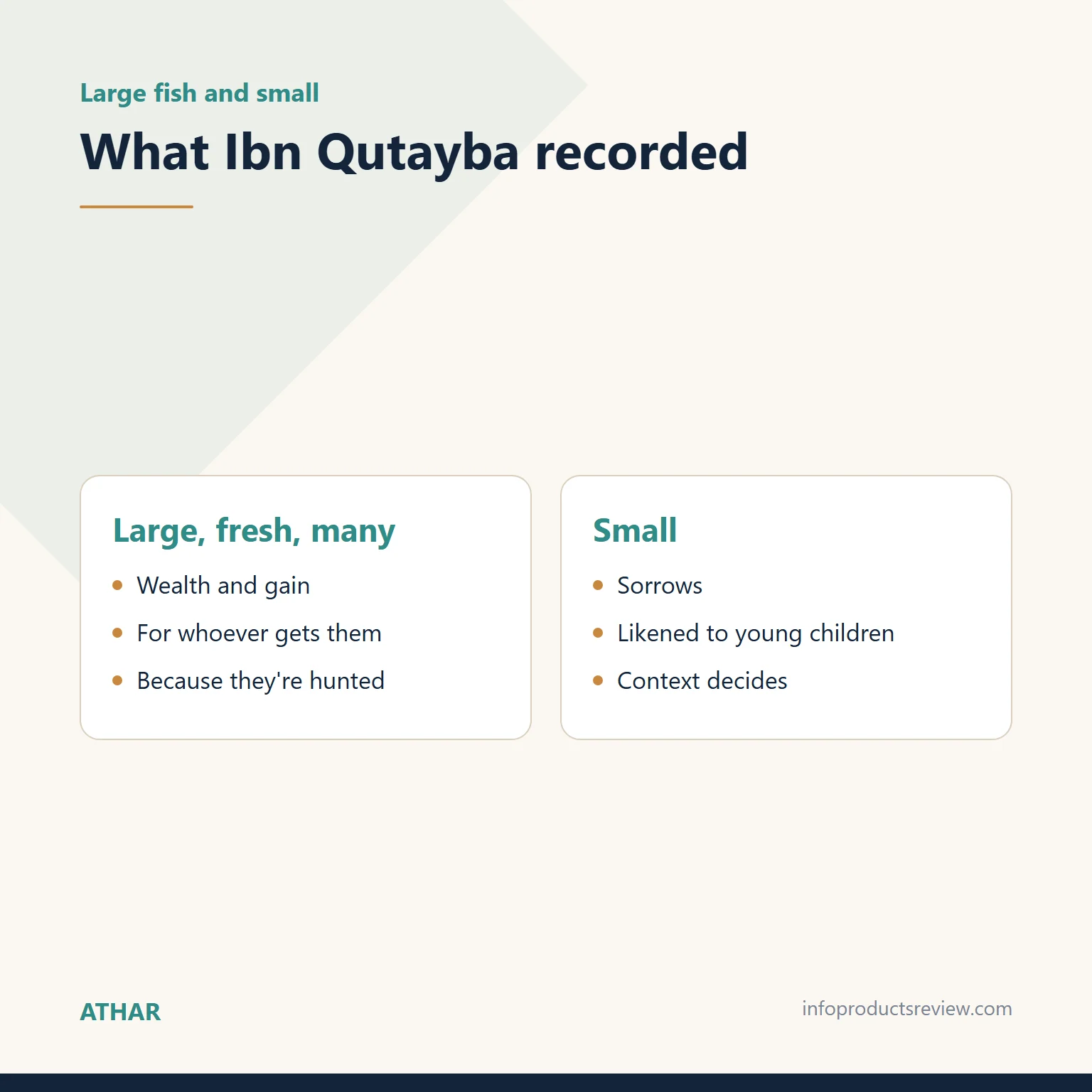
Big fish filling a net, glinting in the water in numbers, carried off in baskets: this is one of the images people are happiest to wake from. The closest reading the dream books give it is wealth and gain for whoever gets hold of them.
But notice this, because it is where most pages go wrong. The reading carries four conditions: the fish must be fresh, large, many, and the dreamer must have got them — actually had them in hand.
So it isn’t about glimpsing a fish swim past. It is about a plentiful catch that ends up with the dreamer, and that distinction disappears from nearly every version of the meaning you’ll read online.
The old books also spell out their logic: large fish, when they are many, are gain “because they are hunted.” In other words, they stand for something you go out and earn, not something placed in your hands.
That is an interpreter’s judgement, not a promise. Its value is in showing the method: take a quality something has in waking life, then look for what shares that quality in the dreamer’s life.
Someone working hard at a job, a business or their studies may find in the dream a picture of what they are reaching for. The dream reflects the effort; it doesn’t announce the result.
The practical response is simple: be grateful, take heart, and keep working through the usual means. Don’t let the dream push you into a hasty financial decision, like starting a venture or taking out a loan while you wait for “money on its way.”
A question to ask yourself: did you actually get the fish in the dream, or only see them? The old reading is for the one who gets them. If plenty of fish swam past and you never touched them, the dream sits closer to hope than to having.
Small fish
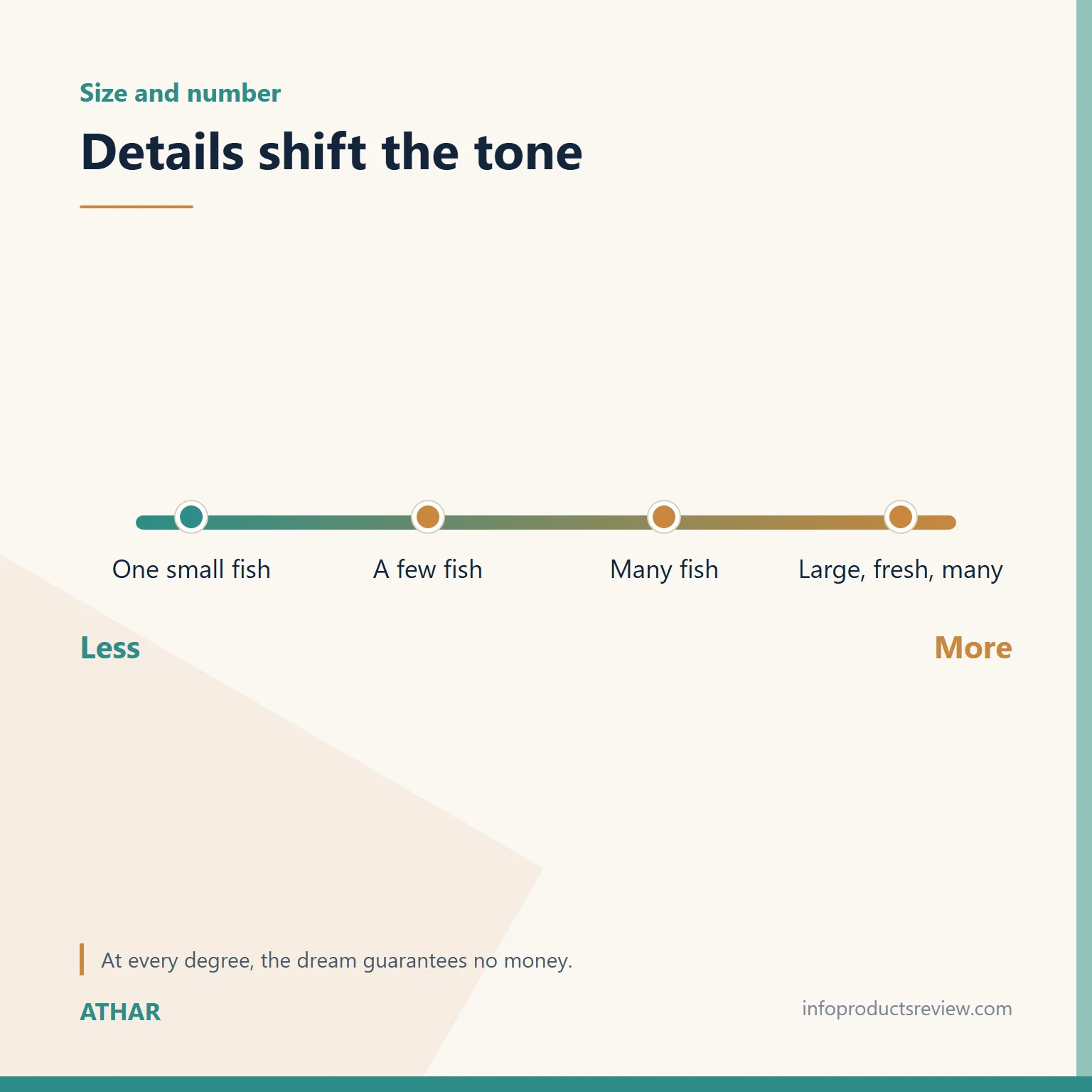
Tiny fish in a bowl, a single small one in your hand, shoals darting in shallow water: the classical reading of that picture is sorrows for the one who gets them, likened in the books to young children.
The comparison is the key to it. Small fish come in numbers, are of little use as a meal, and need handling. So they were read as small, repeated worries rather than one large disaster.
The same passage adds that small salted fish carry no good either. That is all it says; there is no further detail behind it.
We put it in its place. It is the judgement of a ninth-century interpreter, built on an analogy, not a verdict on everyone who dreams of a small fish.
Interpreters themselves hold that context is what counts. So if you saw small fish and felt calm, or the scene was lovely, there is no reason to carry worry because of a general reading.
If they came with heaviness and unease, the dream more likely reflects scattered small worries, and the place to deal with those is waking life, not fear of the dream.
An example of the difference: one mother dreams of small, brightly coloured fish swimming around her children in a pool, and she is happy in the dream. Another dreams of small fish multiplying in her kitchen, and she is irritated.
The first sits closer to comfort and company; the second, to small burdens piling up. Neither is news of a disaster.
Catching fish

In the dream books, fishing sits closest to effort and seeking. Catching fish in a dream leans towards someone pursuing something: income, work, an opportunity, a solution.
And the result matters: an easy, plentiful catch, a long wait with nothing, or a fish slipping out of your hands. A rod, a net, catching by hand, a boat on the water — all of these scenes share one core idea, that you were after something.
He was asked about a man who dreamed he was catching fish from the water, and said the man would come by unlawful money. Then he was asked about someone who got a fresh fish or two, and said he would take a wife, or two.
That answer belongs to a particular questioner in a particular situation, and it isn’t generalised to everyone who dreams of fishing. The same books read a large, plentiful catch as gain “because it is hunted.”
Classical readings aren’t fixed templates. They change with the person asking and the details they describe. And no one’s income should be judged unlawful because of something they saw in their sleep.
If the catch was easy and plentiful, and you were glad: it most naturally pictures effort that looks set to pay off.
If you waited and waited and caught nothing: the dream may reflect a sense that your efforts aren’t bearing fruit right now, a familiar feeling while job-hunting or waiting for a result.
If a fish slipped out of your hands: it most likely reflects worry about losing an opportunity, not a prediction that you will.
Going deeper: fishing has its own guide, covering the two old reports, the rule of asking the dreamer what they were after, and the fact that the books give no special meaning for fishing by hand, with a rod or with a net: dreaming about fishing, and what actually changes the reading.
Eating grilled or fried fish

Eating fish in a dream, especially grilled or cooked, is an image many people find comforting. The closest reading it is given is provision that comes without toil: food already prepared and set in front of you, which cost you no effort to get.
Contemporary books on interpretation tie that reading to “the Table” — the table of food sent down in the well-known Qur’anic story that gives Surat al-Ma’ida its name. Ready food pictures provision that arrives without labour behind it.
It is a modern author’s reading, resting on a clear association between a prepared meal and easy provision. It is not a religious text fixing one meaning for everyone who dreams of grilled fish.
For frying and other ways of cooking, the dream books give no separate meaning. The nearest reading treats it like any cooked fish ready to eat: something that has come to fruition after work, or a full table where family gather.
If you ate fish with family or guests in the dream, the scene may reflect the warmth of being together, or missing it. If you ate it alone, hungrily, the explanation may be simpler still: you went to bed hungry, and the dream showed it.
Going deeper: our guide to eating fish in a dream goes through what the sources say about grilled and salted fish, why a classical passage on grilling meat shouldn’t be applied to fish, and which details the books give no meaning for, such as fried fish, taste or bones.
Salted or dried fish
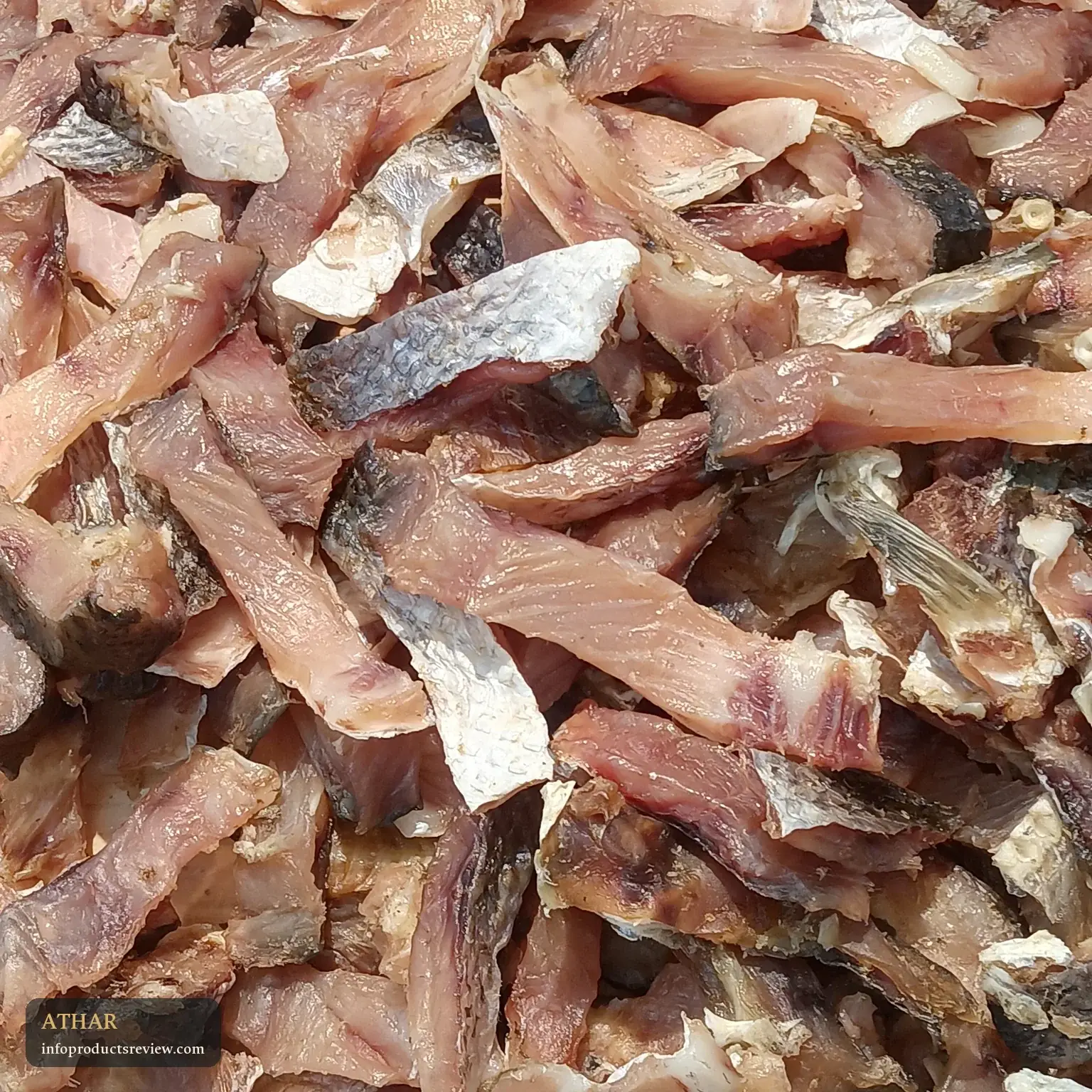
Salted fish is a good example of how a single classical reading can carry more than one face. Whoever gets salted fish in a dream was read as meeting with worry “from its saltiness” — the saltiness itself is where the meaning comes from.
Then the old books immediately qualify it: it may be in a person’s nature that seeing salted fish in a dream means gaining money and good. In other words, the meaning shifts with the person and what they are used to.
Contemporary books add a third face: salted fish as travel in search of knowledge to a coastal land, recalling the story of Moses and al-Khidr, in which a fish plays a part.
So someone who eats and loves salted fish isn’t read the same way as someone who can’t stand it. Someone preparing for a trip or a course of study may find their preoccupation pictured in the scene.
That is exactly what “context decides” means: a symbol isn’t read apart from the person who dreamed it. The same thing can sit heavily on one person and be a pleasure to another.
A question to ask yourself: do you like salted fish in real life, or does it put you off? Your answer is part of the reading, as the dream books themselves insist.
For salted, canned or smoked fish as something you ate, see the guide to eating fish in a dream.
Dead or rotting fish
Dead fish on a beach, spoiling in a bowl, or floating on the surface unsettle a lot of people, and circulating pages give them frightening meanings: loss, failure, even death.
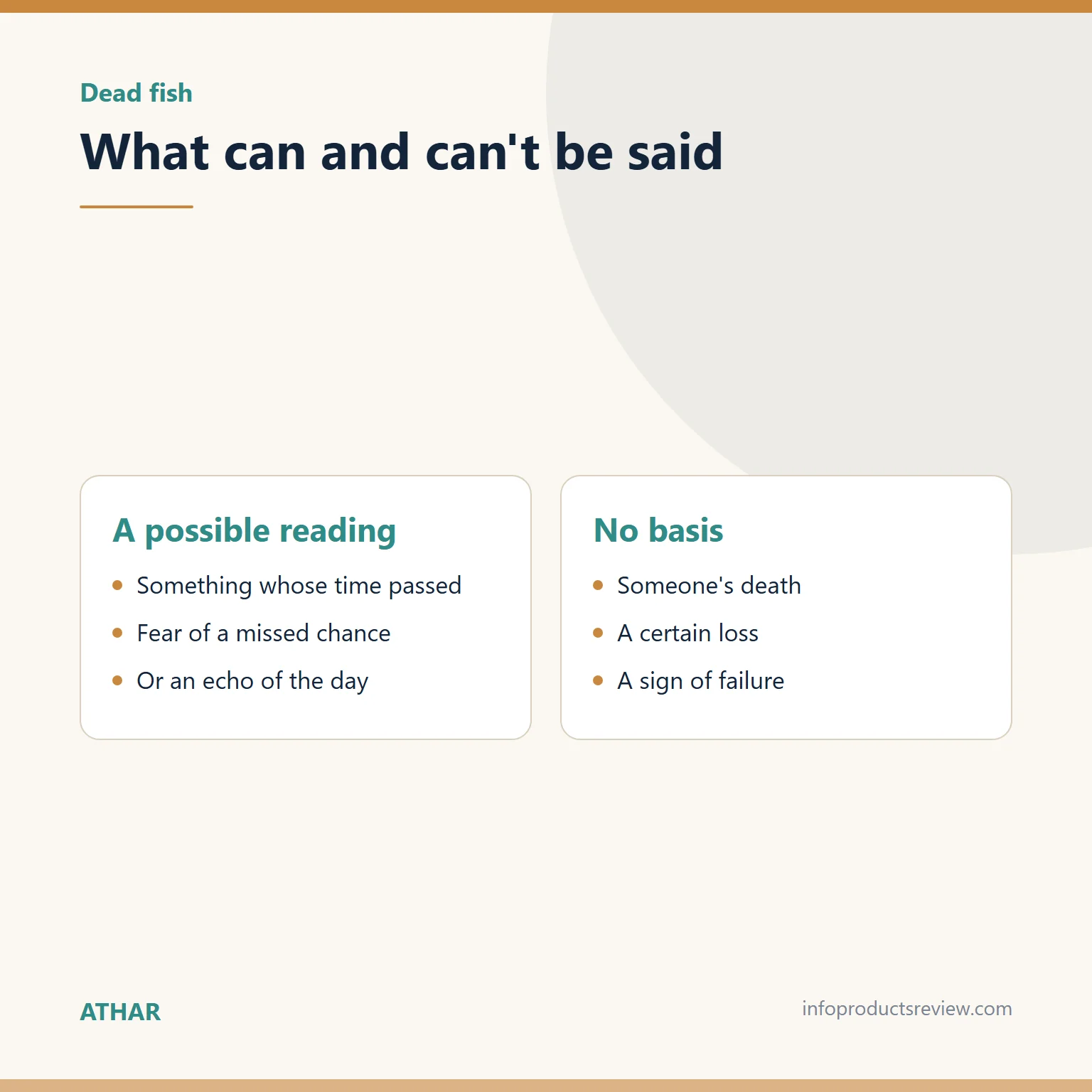
In truth the dream books give no specific meaning for dead fish, so we don’t attach a fixed one and we don’t add anything they never said.
What we can do is follow the same logic they use: if fresh, living fish picture provision you are seeking, a dead, spoiled fish sits closer to something whose moment passed, or that went bad before it could be used.
In waking terms, the image may reflect worry about a missed opportunity, a stalled project, or effort that feels wasted. Or it may be simpler: a smell or sight from the day before.
The claim that a dead fish means someone will die, or that a loss is certain, has no basis in the dream books. No one should be frightened by it, and no suspicion of anyone should be built on it.
If the dream upset you, the section on what is established about dreams, further down, sets out what to do after a disturbing dream. That will serve you better than reading page after page in search of a frightening interpretation.
Buying, giving or selling fish
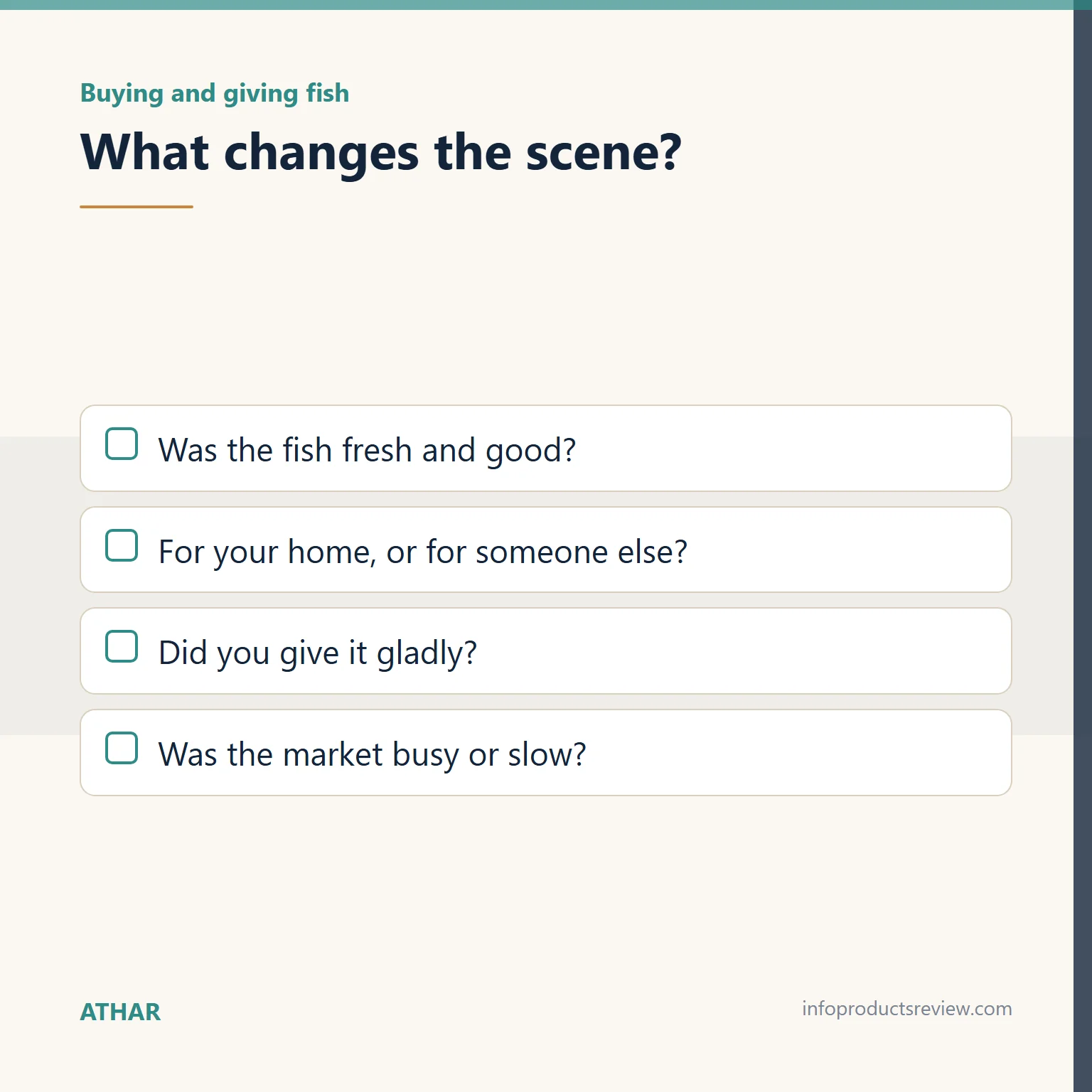
Buying fish sits close to the idea of spending effort on something useful: getting what your household needs, or investing time in something you hope will pay off. Buying good, fresh fish is a calmer scene than buying fish that is off or not what it seemed.
Giving fish to someone pictures generosity and sharing. It may reflect a wish to help someone, or a sense that what you have deserves to be shared with the people around you.
If someone gave you fish, the scene may reflect support or kindness coming your way. That is good to take heart from, and not something to sit waiting on.
Selling fish pictures trade and exchange, and its tone depends on the market in the dream: busy and cheerful, or slow and anxious.
The dream books give no specific reading for any of these scenes, so we present them as readings of the scene by the same logic, not as quotations from an interpreter.
Buying as a step before the meal, and what to notice about choosing, price and who it was for, is covered in the guide to eating fish in a dream.
A pearl or something valuable inside the fish
An old image in dream books is finding something inside a fish. Whoever finds a pearl in a fish’s belly was read as gaining a son through it, and whoever finds fat inside as gaining money and good through it.
That reading comes straight after the report in which a fresh fish is read as a woman, which is why what comes out of the fish is read as a child or a benefit. It belongs to its context rather than standing alone.
We pass it on because it is in a known book, but we are clear about the limit: a dream does not announce a pregnancy or a baby’s sex, and no expectation about that part of your life should be built on it.
The more useful way to read the picture is as it stands: something precious came out of a place you weren’t expecting. If you saw a scene like that, take it as something to be glad about, then turn the question back to waking life — what are you hoping will turn out well right now?
Fish swimming in the sea or in a tank

Fish swimming in clear water are one of the most restful images there is, awake or asleep. They often follow a trip to the coast, a visit to an aquarium, or simply looking at pictures of the sea.
Clear water and colourful fish: most naturally a picture of calm and beauty, perhaps of wanting rest and distance from pressure.
Murky or rough water: changes the picture a lot, and may reflect anxiety or turbulence in waking life more than anything about the fish.
Fish in a small tank at home: may reflect care for something you tend and look after, whether a family, a small project or a hobby.
A whale or a shark: the dream books give no specific reading for either. The most sensible approach is to read their size and power through your feeling: awe at something big, or a challenge that seems larger than you.
A shark shouldn’t be read as a specific enemy or as a betrayal by anyone. A dream names no names, and it is no reason to start doubting a spouse or a relative.
Fish leaping out of the water: a fish that leaps and falls back may reflect chances that appear and vanish, or ideas that flash past. Your feeling colours it: delight at the sight, or regret that you caught nothing.
A fish that drops into your hand: one that arrives without any fishing sits close to the reading of grilled fish, provision without toil, because it cost nothing. It stays a picture to take heart from rather than a promise.
A fish gasping on dry land: an unsettling image of a creature out of its element. It may reflect a feeling that you, or someone you love, are in the wrong place — a job, a setting, a relationship. That is an invitation to look at your life, not a warning about it.
Raw fish: the books give it no meaning of its own. Read it through the gap between raw and cooked: cooked food pictures something finished, while raw food pictures something not yet ready, or a benefit you are rushing before its time.
If you ate it with distaste, the scene leans towards accepting something you don’t want. If you ate it happily, as some kitchens serve it, it may be no more than a habit or a picture from your day.
It is certainly not a sign of illness or loss. And food safety, if that is the real worry, is a question for health professionals rather than a dream page.
Cleaning or cutting fish: scaling, gutting and cutting picture the work that comes before any benefit, and anyone who cooks for a family knows that part is heavier than the meal.
The nearest reading is effort you put in before you see the result: preparing a project, caring for a household, work that needs patience. Easy cleaning of good fish is a calmer scene.
A tiring, off-putting job may instead reflect burdens that feel larger than you can carry. The books give this scene no specific meaning, so it is read by the same logic rather than quoted.
Feeding fish, or putting one back: feeding fish in a lake or a tank pictures giving and caring with nothing expected in return, and fish gathering around you leans towards company and peace of mind. Returning a fish you caught to the water pictures letting go: a decision to give up something you don’t need, or mercy towards something weaker. It shouldn’t be read as losing provision, because here the act is your own choice rather than something taken from you.
Ornamental fish: pet fish in a glass tank are not caught or eaten, so they sit closer to beauty, care and calm than to earning. A clean tank with lively fish leans towards peace of mind; cloudy water and tired fish may reflect worry about something in your care, whether children, parents or a small project. If a pet fish dies in the dream, it may reflect fear of neglecting something, not news that anything bad will happen.
The colour of the fish: plenty of pages assign each colour a meaning — white good, black sorrow, red temptation, gold money — and present the list as though it came from a known book.
The classical books have no such table. They build on freshness, size, number and saltiness instead, which is why colour comes last on our own list.
What can honestly be said is that colour changes how the scene feels more than what it means. Bright fish in clean water leave an impression of clarity; dull or dark fish in murky water leave an impression of heaviness.
That impression is part of your feeling in the dream, and it is worth noticing. But reading black fish as a warning of disaster, or gold fish as a promise of wealth, is an addition with no source behind it.
Does it mean something different for single women, married women, pregnancy or men?
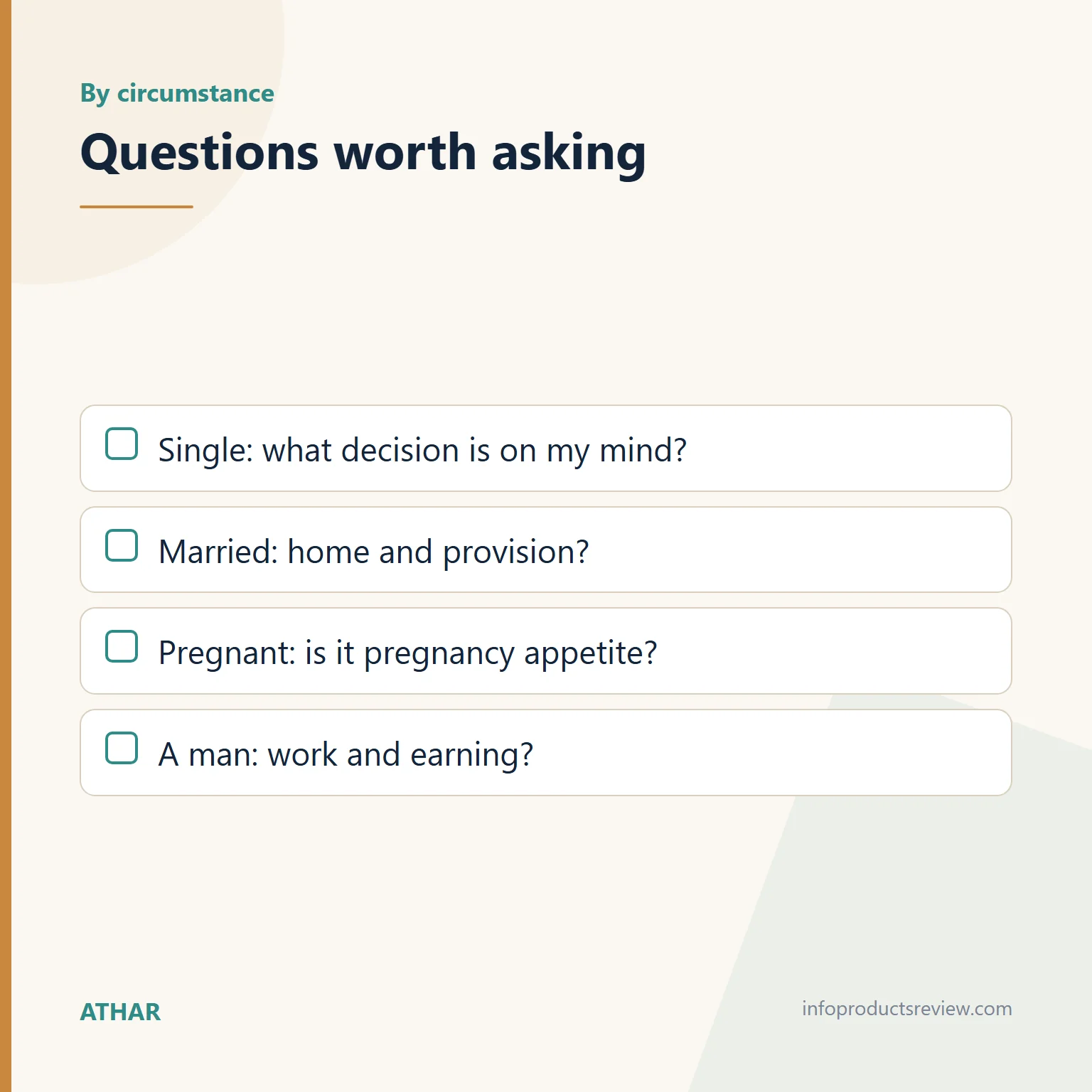
People often ask what fish dreams mean depending on who is dreaming. The core reading is the same, but your circumstances change which questions are worth asking.
If you’re single: common accounts tie fish to an imminent marriage. The books do read a fresh fish as a woman, and getting a fresh fish is read as getting a wife.
But both of those readings concern a man who had the dream, in his own context. They don’t turn into a promise of marriage by a particular date for a single woman. The dream is better read through what’s really on your mind: study, work, or a decision.
If you’re married: the most common question is whether fish mean pregnancy. Nothing in the dream books makes a fish dream evidence of pregnancy. It is more naturally read through home, provision and family, and through how you felt.
If you’re pregnant: common accounts claim the type or size of fish reveals the baby’s sex. There is no basis for that. The dream most likely reflects changing appetite in pregnancy, or preoccupation with the birth and the baby.
For how pregnancy dreams can be read without tying them to the baby, our guide to dreaming about lice during pregnancy is a good example.
If you’re a man: fish and fishing dreams often connect with work, earning and responsibility. Someone job-hunting who dreams of a big catch may find his hopes pictured there. The dream isn’t permission for a major financial decision.
If you’re divorced or widowed: the books give no reading specific to that situation. The same questions still work: what state were the fish in, how did you feel, and what is on your mind these days? The dream is neither a promise of a new marriage nor a judgement on the past.
What do the books of dream interpretation actually say about fish?
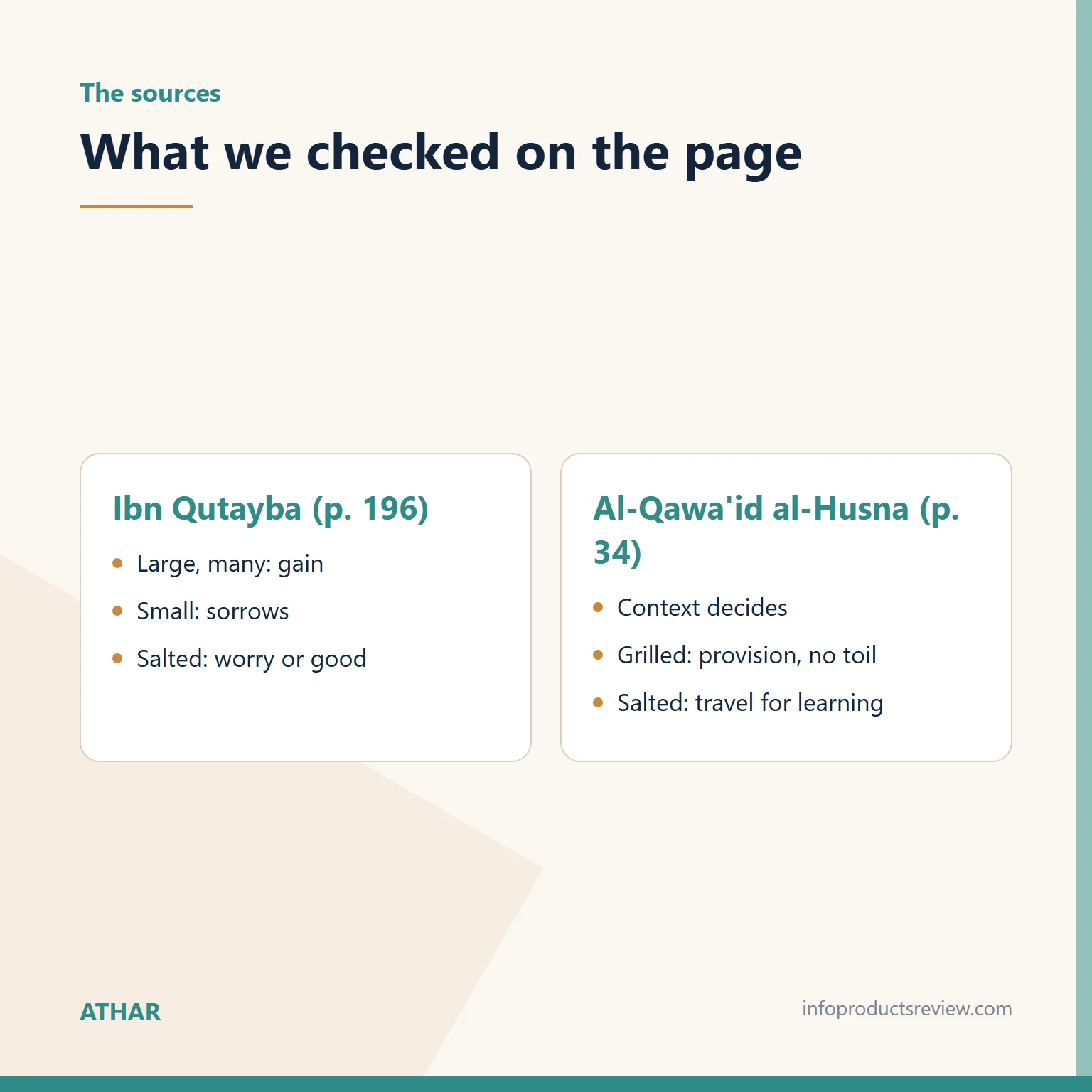
The books of dream interpretation was written in the ninth century, and it has a chapter devoted to fish and other creatures that live in water. These are the four readings that stand out in it:
- Large, fresh fish in quantity are wealth and gain for the one who gets them.
- Small fish are sorrows, likened to young children.
- Salted fish bring worry “from its saltiness,” though for some people they mean money and good.
- A pearl or fat found inside a fish is read as a child, or as money and good.
What stands out is that the book gives reasons alongside the meanings: large fish in number are gain “because they are hunted,” salted fish bring worry “from its saltiness.”
In other words the readings rest on a quality in the thing itself, not on a memorised list. That method is the most useful thing anyone can take from these books.
A contemporary book on the rules of interpretation uses fish to illustrate the principle that context governs a reading: a fresh fish a woman, grilled fish provision without toil, salted fish travel for learning. These are a modern author’s examples, useful for their method rather than as rulings.
What you won’t find in these books matters just as much: no link between fish and a certain pregnancy, none between the type of fish and a baby’s sex, and none between a dead fish and anyone’s death. Anyone offering those is adding, not transmitting.
What is actually established about dreams?
Two things get blurred together. One is interpreting a fish symbol, which is human judgement and can be right or wrong. The other is the Prophet’s guidance on dreams, which is recorded in the two most authoritative hadith collections.
If you dreamed something that pleased you, such as a big catch or a full table, the guidance is to thank God and share it only with people you love. If you dreamed something that disturbed you, such as rotting fish or drowning, Sahih al-Bukhari records, in the Book of Dream Interpretation (hadith 7044, narrated by Abu Qatada), that the Prophet said:
A good dream is from God. If one of you sees something he likes, let him tell it only to someone he loves. And if he sees something he dislikes, let him seek refuge in God from its harm and from the harm of Satan, spit lightly three times, and not tell anyone about it, for it will not harm him
The hadith separates what you like from what you dislike. A dream you like, you can share with someone you love. A dream you dislike, you seek refuge in God from, spit lightly three times — a light puff of breath rather than saliva — and keep to yourself.
Then it reassures you directly: it will not harm you. For anyone shaken by a dream, that one line does most of the work.
Sahih Muslim, in the Book of Dreams (hadith 2262, narrated by Jabir), adds detail: spit to the left three times, seek refuge in God from Satan three times, and turn over from the side you were lying on.
If one of you sees a dream he dislikes, let him spit to his left three times, seek refuge in God from Satan three times, and turn over from the side he was lying on
So if you wake up distressed by a fish dream, do what the two hadiths describe: seek refuge in God, spit lightly to your left three times, turn over, and don’t retell the dream to everyone. You don’t need to go looking for an interpretation of it.
No religious text gives fish a fixed meaning, and nothing makes a fish dream proof of guaranteed income, a pregnancy or a marriage.
No financial or family decision should rest on a dream. Every meaning mentioned on this page is interpretation, and that is what we have said from the first line.
What does sleep research say about food in dreams?
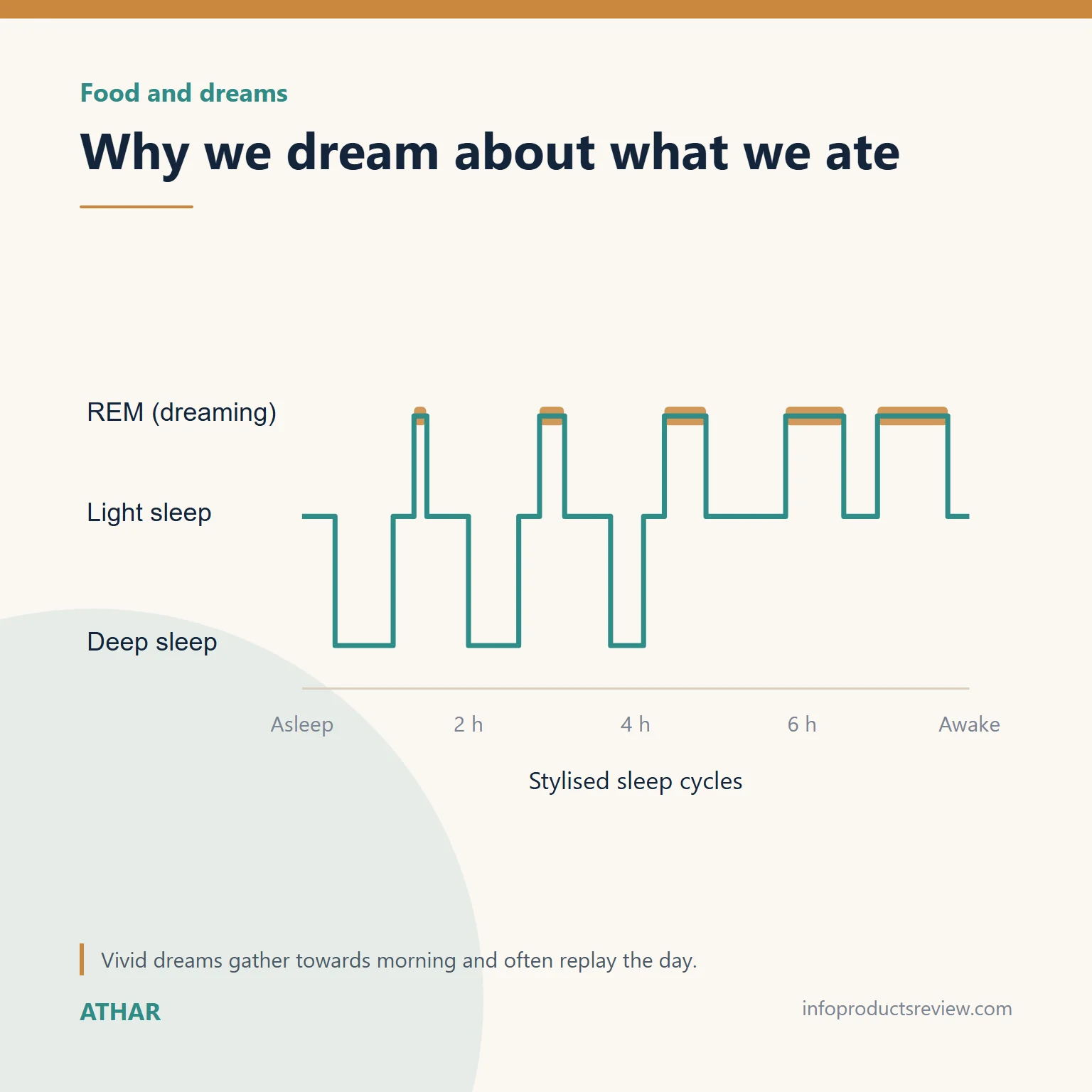
We keep this apart from the interpreters’ material on purpose, because the two answer different questions.
General references on sleep say that elements of waking life are often incorporated into dreams, and that dreaming periods grow longer towards the end of the night. So it’s no surprise if what we ate, saw or thought about shows up.
It’s possible that hunger or a heavy meal before bed colours dreams too; someone who goes to bed hungry or fasting might dream of food and tables.
That doesn’t rule out a dream carrying meaning. It is a reminder not to look for a message in every plate of food that passes through your sleep.
This overlap between daily life and dreams is an observation about human experience. It doesn’t prove that every fish dream is just the day replaying, and it doesn’t prove that it’s a message.
When is a fish dream more likely your mind processing the day?
A dream that comes from your own thoughts is the third of three kinds named in a hadith in Sahih Muslim, in the Book of Dreams (hadith 2263, narrated by Abu Hurayra), which divides dreams like this:
Dreams are of three kinds: a good dream, which is glad tidings from God; a distressing dream, from Satan; and a dream from what a person tells himself
That third kind is whatever occupies you while awake and returns while you sleep. The edition’s footnote records a variant wording of the number, with the same meaning.
The hadith gives no test for telling the kinds apart, but it does teach that not everything you see in sleep is a message. The same hadith in Muslim (2263) goes on to say that whoever sees something he dislikes should get up and pray, and not tell people about it.
These signs can help you recognise a dream that is most likely your own thoughts replaying. No single sign settles it, but several together say a lot:
- You ate or bought fish that day.
- You’d been fishing or at the beach.
- You watched something about the sea or marine life.
- You went to bed hungry, or while fasting.
- Money or work was on your mind as you fell asleep.
If several apply, the dream is most likely an echo of your day, not a message about your future. That doesn’t make what’s worrying you less real; it points you to dealing with it while you’re awake.
Common claims that need correcting
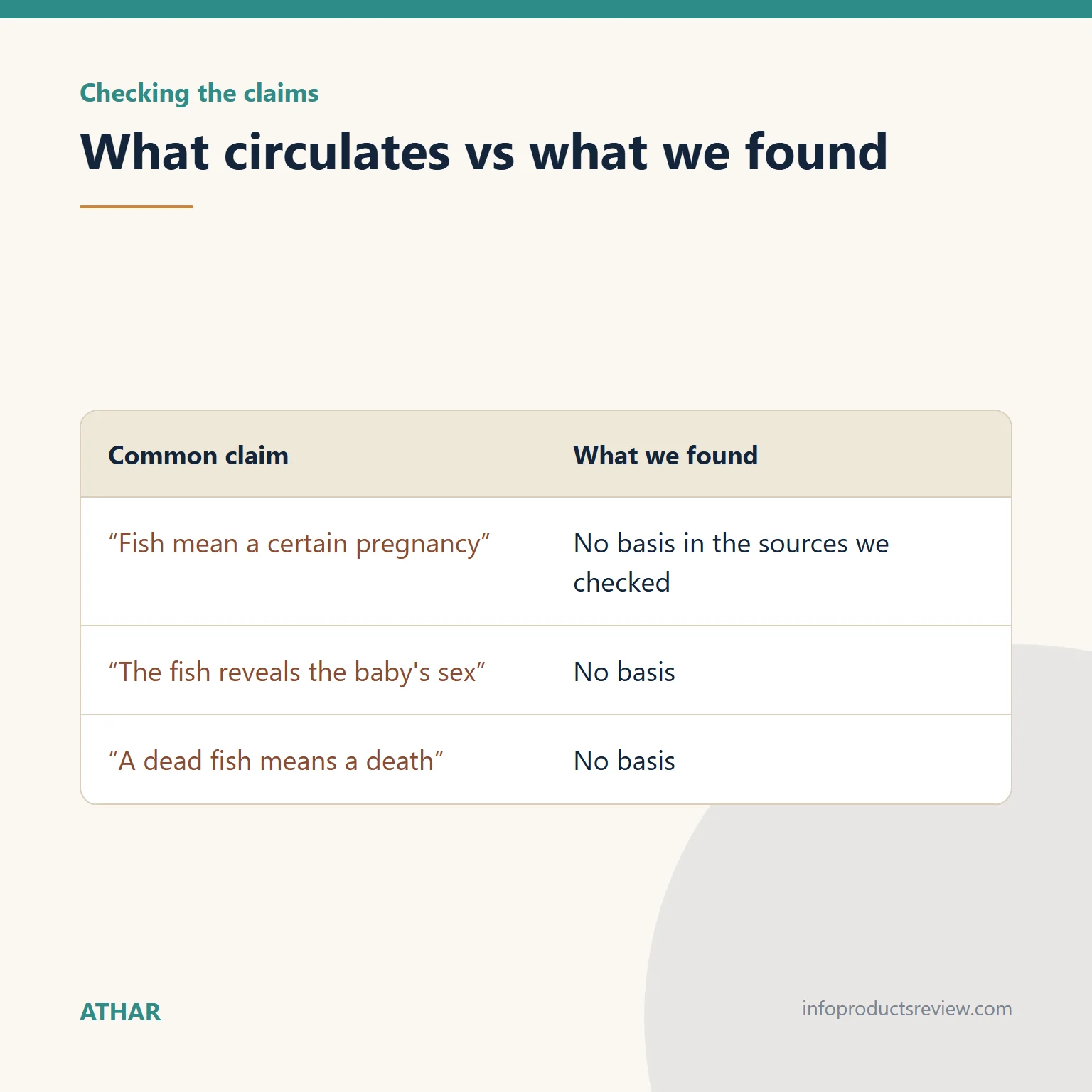
- “Fish in a married woman’s dream mean a certain pregnancy.” The dream books give no basis for this, and dreams don’t announce pregnancies.
- “The type of fish reveals the baby’s sex.” No source supports this, though it’s one of the most widely repeated claims.
- “A big fish means guaranteed money.” The classical reading is that large, fresh, plentiful fish are gain for whoever gets them. That’s an interpreter’s reading, not a guarantee, and no financial decision should rest on it.
- “A dead fish means someone will die.” There’s no basis for this in the dream books, and no one should be frightened with it.
- “For a single woman, fish mean marriage within days.” Dreams don’t set dates.
- Attributing fixed fish meanings to Ibn Sirin as settled fact. The popular book is only attributed to him and that attribution isn’t established; the documented report about him answers specific questioners.
What a fish dream cannot establish
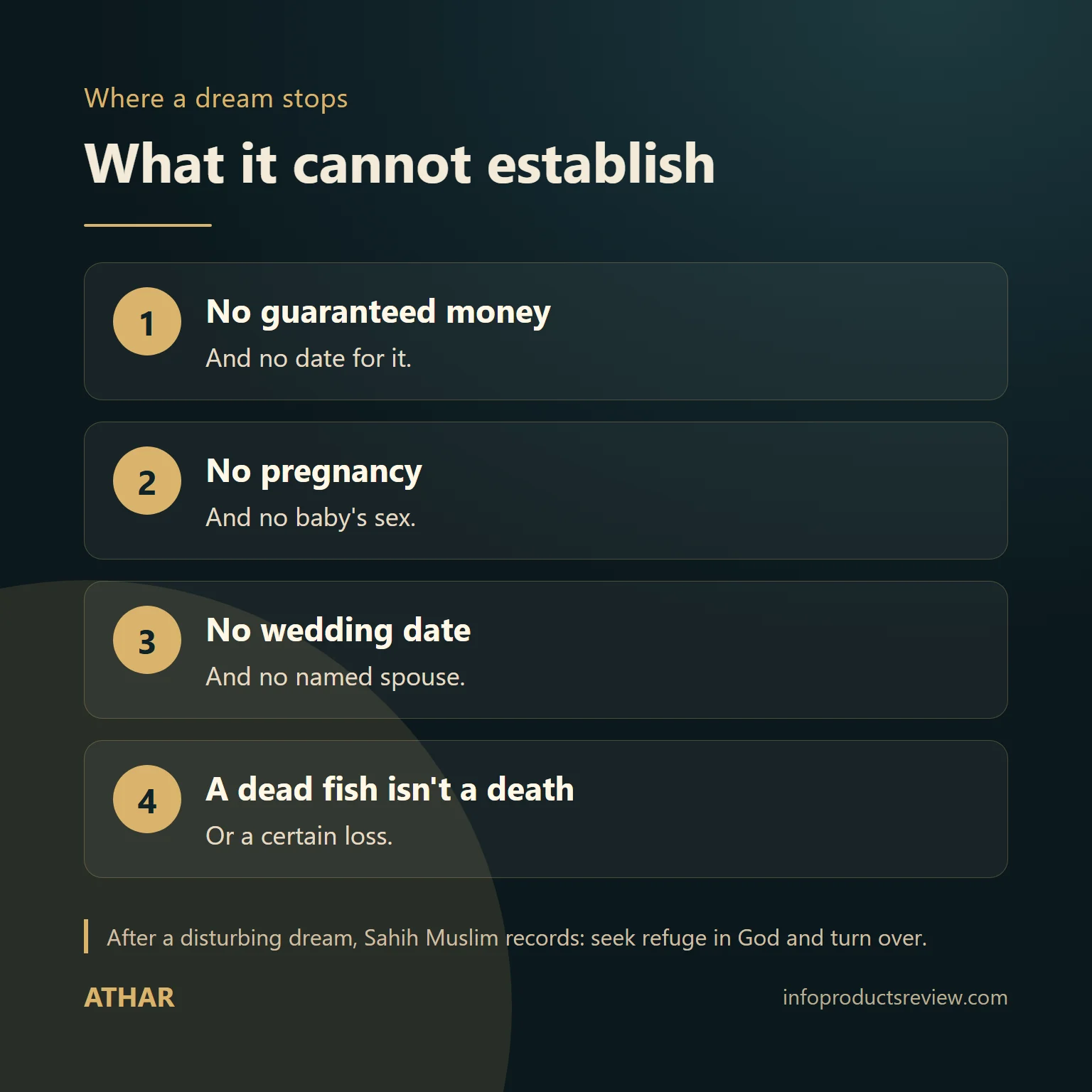
- It can’t guarantee money or set a date for it.
- It can’t confirm a pregnancy or reveal a baby’s sex.
- It can’t set a wedding date or name a spouse.
- A dead fish doesn’t mean a death or a certain loss.
- It isn’t a basis for a financial decision such as starting a business or borrowing.
- It accuses no one of hostility or betrayal, even if a shark or whale appears.
- It doesn’t make anyone’s income unlawful, even though an old report about fishing is sometimes quoted that way.
What to do after dreaming of fish
- If the dream pleased you, be grateful, take heart, and share it only with people you love.
- If it disturbed you, seek refuge in God, spit lightly to your left three times, turn over, and don’t retell it to everyone.
- Look back at your day: a meal, a trip, a conversation about money.
- Work for your livelihood through ordinary means, rather than waiting on a dream.
- Don’t base a major financial or family decision on the dream.
If you are facing a real decision and can’t settle it, the prayer for guidance (istikhara) is a separate practice from dream interpretation, and it is the right place to take that question.
How to describe your dream so it can actually be read
Whether you plan to ask an interpreter or simply want to understand the dream yourself, jot down these five points as soon as you wake, before the details fade:
- The state of the fish: fresh, salted, cooked, or dead?
- Size and number: big and many, or small and few?
- What you did: caught, bought, ate, gave, or just watched?
- The setting: clear sea, murky water, a market, a table?
- Your feeling and situation: during the dream, and what’s on your mind in real life.
Written down like that, the dream stops being a single frightening or exciting image and becomes a scene with a context, which is the only way anyone can read it sensibly.
What have interpreters said in recorded interviews?
Two short clips from published interviews, because hearing how someone reasons can be clearer than reading about it. Take them for what they are: personal views, not religious rulings and not a reading of your dream.
In the first, the interpreter Musa al-Nashmi talks about how to recount a dream. Many people call, he says, asking what a fish or the sea means on its own, as if he were a dictionary, when he needs the whole dream with its details and context before he can take the symbols apart and put them back together.
The speaker says that asking what a fish means on its own isn't enough; an interpreter needs the whole dream with its details and context. Summarised from the Arabic interview; an opinion, not a religious ruling.
In the second, a different interpreter, Khalid Alaabid, reminds viewers that a dream can gladden you but cannot harm you.
The speaker's own view, briefly paraphrased: dreams can gladden but cannot harm. An opinion from an interview, not a religious ruling or a definitive interpretation.
That fits the hadith in Sahih al-Bukhari (7044), which reassures someone who saw a dream he disliked that it will not harm him, and the rule interpreters keep repeating: context comes before the symbol.
A few typical scenes
A young man looking for work dreams of catching large fish in quantity. Most likely a picture of his hopes and effort. He can take heart and keep looking, without turning down a real opportunity while he waits for “bigger provision.”
A married woman dreams of fish in her home and wonders if it means pregnancy. The dream can’t establish that. It’s more naturally read through home and provision, and if a pregnancy is something she longs for, the dream may reflect that longing.
A man dreams of dead fish floating after a setback at work. Most likely an echo of what he’s been through, not a warning of another loss.
A student dreams of eating salted fish before leaving to study abroad. The reading of salted fish as travel for learning is a pleasant echo, though the dream most likely reflects her preoccupation with the trip.
Someone dreams of the whole family gathered around grilled fish. One of the calmer images: provision without toil in the classical reading, the warmth of being together in waking terms.
A trader dreams of a huge catch, then reads online that catching fish means unlawful money. That line comes from an old report answering one particular questioner, and it can’t be used to judge his income. If something about his business genuinely troubles him, the question belongs with people of knowledge about the transaction itself, not with the dream.
Quick reference: detail and nearest reading
| Detail in the dream | Nearest possible reading |
|---|---|
| Large, fresh fish in quantity | In the classical reading, wealth and gain for whoever gets them |
| Small fish | In the classical reading, sorrows; context decides |
| An easy, plentiful catch | Effort that looks set to pay off |
| Grilled fish on a table | Provision without toil |
| Salted fish | Worry or good depending on the person, or travel for learning |
| Dead or rotting fish | Something whose moment passed; not a death or certain loss |
| Fish in clear water | Calm, and a wish for rest |
| A whale or shark | Awe at something big; not a specific enemy |
| After eating fish that day | A natural echo of the day |
Fish dream guide
This page is the general starting point for fish dreams. Specialised guides are added here as they are published, so you can go straight to the detail you are asking about without the same material being repeated across pages.
- Dreaming about fishing — catching fish by hand, with a rod or a net, a catch that gets away, and the rule of asking what the dreamer was after.
- Eating fish in a dream — grilled, fried, raw or salted fish, and buying, cleaning, cutting, taste and bones.
The size and number of fish, whether they are alive or dead, where they are swimming and their colours are covered on this page itself.
Related guides
- All English dream guides by topic — every guide reads a symbol by its details first, then its limits.
- Dreaming of someone who has died — another dream where circulating pages promise far more than any source supports.
- Sleep Foundation — Dreams and how they form
- National Institute of Neurological Disorders and Stroke — Understanding Sleep
Frequently asked questions
Is dreaming of fish a good sign?
It depends on the details. Large, fresh fish in quantity are among the images read as gain; small or dead fish read differently, and context decides.
What does a big fish mean in a dream?
The classical reading is that large, fresh fish in quantity are wealth and gain for the one who gets them — the one who actually has them in hand. That’s an interpreter’s reading, not a guarantee of money.
Does a fish dream mean pregnancy for a married woman?
No. The dream books don’t make fish evidence of pregnancy, and dreams don’t announce pregnancies.
What does catching fish in a dream mean?
Fishing pictures effort and seeking, and the result shapes the reading: an easy, plentiful catch, a long wait with nothing, or a fish that slips away.
What does eating grilled fish in a dream mean?
Grilled fish is read as provision that comes without toil, because it is food already prepared for you. That is a contemporary reading built on the association.
Does a dead fish in a dream mean someone will die?
No. There’s no basis for that in the dream books. It’s more likely a picture of something whose moment passed, or an echo of worry.
What do small fish mean in a dream?
The old books read them as sorrows, likening them to young children. That reading needs context and doesn’t mean everyone who dreams of small fish will grieve.
Does the type of fish reveal a baby’s sex?
No. There’s no source for that, and the dream says nothing about the baby.
What does salted fish mean in a dream?
The old books give two readings: worry “from its saltiness,” or money and good for someone for whom that’s natural. A contemporary book reads it as travel for learning.
What should I do after a disturbing dream about dead fish?
You don’t need to interpret it. The established guidance is to seek refuge in God from its harm, spit lightly three times and not retell it, as recorded in Sahih al-Bukhari (7044); Sahih Muslim (2262) specifies the left side and turning over.
Does dreaming of fish mean a single woman will marry soon?
No dream sets a wedding date. The readings that link fish with a woman concern a male dreamer in context, and they don’t become a promise.
Is any of this certain?
No, and that’s deliberate. What we offer are possible meanings that shift with the details, and none of it predicts the future.
In summary
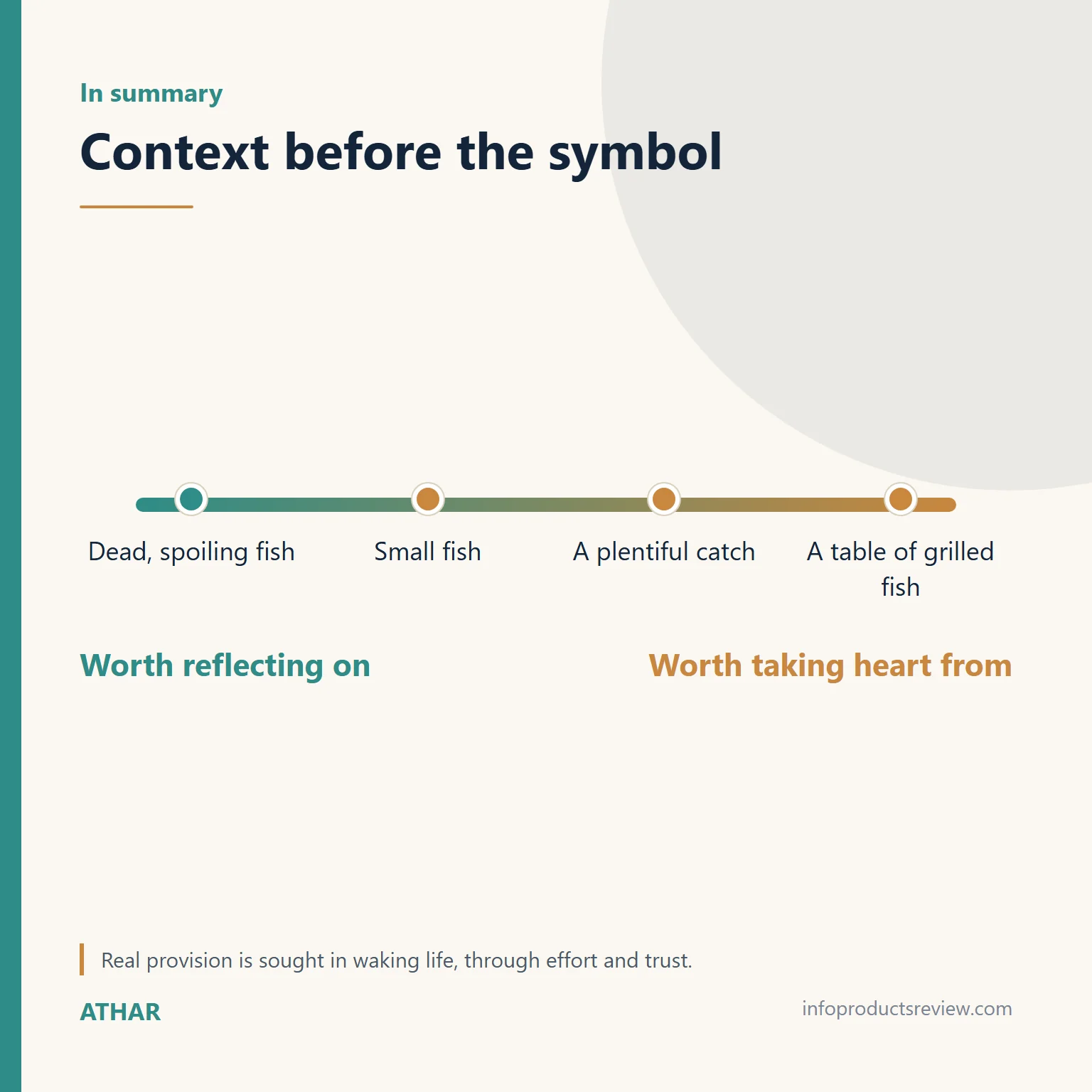
- Dreaming of fish sits closest to provision and effort, and the details change everything.
- Large, fresh fish in quantity were read as gain and small fish as sorrows; context decides.
- Grilled fish is read as provision without toil; salted fish can go either way depending on the person.
- The dream can’t confirm a pregnancy, set a wedding date, guarantee money, or turn a dead fish into a death.
- Context and your real situation come before the symbol.
- After a disturbing dream: seek refuge in God, spit lightly to your left, turn over, and let it go.
If you take one thing from this page, let it be this: fish in a dream can encourage and reassure you, but real provision is found in waking life, through effort and trust in God, not by waiting on something you saw in your sleep.
Written and reviewed by: the ATHAR editorial team. Quoted texts come from the editions listed in the references; English renderings of Arabic texts are our own translation.
Last reviewed: 15 September 2026.
Note: what appears here is a possible meaning, not a confirmed fact, and it changes with the details of the dream and the dreamer’s circumstances. Nothing here predicts the future, promises money, announces a pregnancy or marriage, or offers a religious ruling.