

You saw a spider in a dream — maybe a web too — and went looking for what it means. Almost everything you’ll find starts in the same place: marriage. A suitor on the way, a man who’ll deceive you, a delay in your “turn.”
This guide doesn’t start there, because the classical material on this symbol says none of it. It starts with the single line that was actually written about spiders, then covers what genuinely helps you read your own scene, then says plainly what a dream can’t tell you.
The short answer
- One line is all there is. Ibn Qutayba wrote that the spider is a weak, devout man. That’s the whole of the transmitted material, and it describes a person — nothing more.
- What that line doesn’t contain: no marriage, no engagement, no delay, no deceitful man, no sorcery or envy. Anything you read along those lines was added by whoever wrote it.
- What actually helps you read it: what the spider did, whether there was a web, where the scene was set, and how you woke up. Those are questions about your own situation — not fixed meanings from the dream books.
- What to do: settle yourself first, don’t retell the dream in a group chat, then read the scene against your own life — as a possibility, never as news about your future.
What this page covers
- The short answer
- The single transmitted line
- Why the spider isn’t read as marriage
- The web, which is what most people ask about
- The scenes readers actually describe
- A spider in your room
- On the ceiling or high in a corner
- One coming toward you
- Several spiders
- Killing it or clearing it out
- Being bitten
- If you’re afraid of spiders when you’re awake
- Fear and disgust aren’t the same reaction
- Sleep and anxiety: a separate section on purpose
- The list of things it settles nothing about
- If you woke up unsettled
- Questions to answer before you ask anyone
- Telling a useful page from a frightening one
- Three widespread claims with nothing behind them
- Why nothing here rests on a book attributed to Ibn Sirin
- Your dream isn’t only about your “turn”
- When the dream follows a conversation about marriage
- If you’re under pressure right now
- A large spider, or an odd color
- At your family’s home, or somewhere unfamiliar
- If you saw yourself clearing the web away
- If your mother or sister had the dream about you
- If you’re someone who thinks things over at length
- When the dream is calmer than you think
- What about the reassuring scenes?
- Why so much gets written for single women
- What you actually have after this dream
- One small note on when you search
- Common questions
- Does a spider dream mean marriage is near for a single woman?
- Does it mean a deceitful man is weaving a web around me?
- I saw only a web, with no spider. What does that mean?
- I killed the spider. Does that mean a problem is ending?
- A spider bit me. Is that a warning?
- There were many spiders. Does that mean many problems coming?
- Is a spider dream a sign of sorcery or envy?
- I’m afraid of spiders in real life. Does that affect it?
- It was in my room. Does that mean something is wrong at home?
- Should I tell my family or my friends?
- It keeps coming back. What does that mean?
- Does it indicate illness?
- Should I give charity or recite something because of it?
- Does the size of the spider change anything?
- I woke up fine, then got anxious after reading about it. What now?
- What should I do right now?
- The bottom line
The single transmitted line
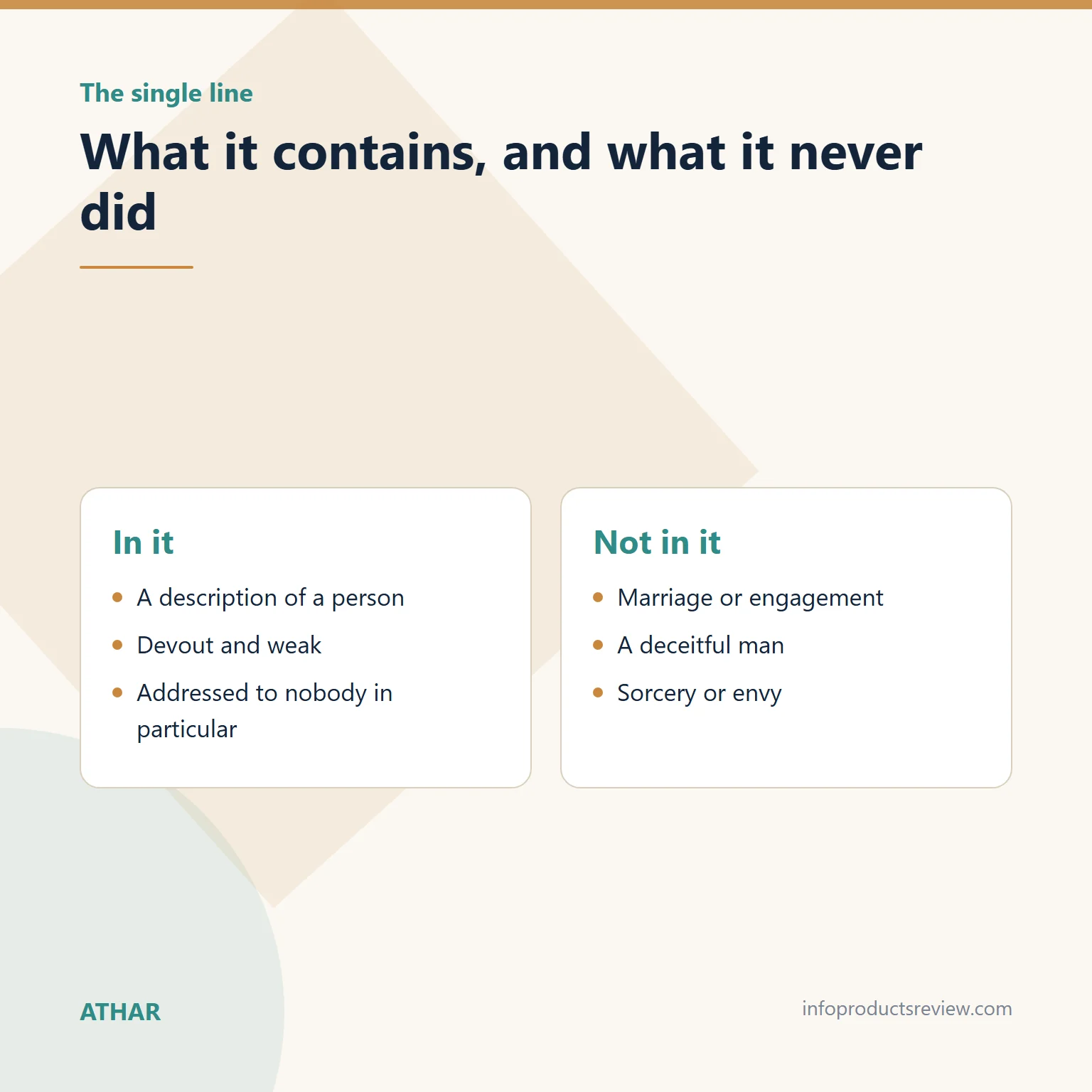
In the classical dream books this site works from, there is exactly one short line about spiders: Ibn Qutayba wrote that the spider is a weak, devout man.
The brevity isn’t something this page is hiding from you — it’s the fact the whole guide rests on. Anyone who found one line and then wrote you twenty meanings is writing from their own head.
It’s fair to note that other interpretation books discuss spiders at greater length. But their attribution isn’t established, or the circulating editions don’t let anyone verify where the wording actually sits. So nothing here is built on them; only what has both a secure attribution and a findable place.
We took the same approach in our scorpion guide for married women. Three observations on that one line are worth having:
- It describes a person, not an event and not an outcome. There’s nothing in it about something happening or being delayed.
- It combines devotion and weakness, which doesn’t read as a warning or as good news. It’s closer to a description of someone’s condition.
- It isn’t addressed to one kind of woman. There’s nothing in it about single women or married ones. Anyone making it specifically about you because you’re unmarried has added what isn’t there.
Why the spider isn’t read as marriage
This is the most common thing written on “spider dreams for single women,” and it’s the furthest from the source.
Here’s the mechanism. The writer sees the reader as “single,” and reads every symbol that reaches her as a message about marriage: a calm scene becomes a suitor approaching, a frightening one becomes a man who’ll deceive her, and a web becomes a delay or being trapped.
None of that is in the line. And nothing in the dream books makes a spider a sign about marriage — arriving or delayed.
There’s another side to this worth saying out loud: you are not a marital status. You’re a person with studies, work, friendships, worries and ambitions. When every dream you have gets read through a single door, it flattens your whole life — and it trains you to wait for news from your sleep instead of living your day.
So the rule here is simple: if a page tells you a spider in your dream means a suitor or a delay, it’s writing about you what it can’t know, from a source that doesn’t exist.
The web, which is what most people ask about
The web is the detail that shows up in most questions: in a corner of the room, across a window, or one you got tangled in.

The dream books give the web no fixed meaning — it isn’t in the transmitted line at all. So instead of handing you a meaning, here are questions:
- Did you see only the web, or the spider with it?
- Was it somewhere familiar to you, or somewhere you didn’t recognize?
- Did you move closer, move away, or clear it?
- Did you feel stuck, or were you just looking at it?
These won’t hand you a verdict, but they return you to the one thing you genuinely have: your own experience inside the dream. Plenty of readers find the last question explains their unease better than any interpretation did.
And you might reasonably ask: what good are questions with no ready answer? Their use is that they move you from waiting for news to understanding your own state. A woman who realizes she woke frightened because she’s afraid of spiders anyway, or because she went to bed anxious about an exam, has saved herself the entire search — and that’s more honest than a page that states a meaning nobody ever wrote.
To be clear once more: those are questions to help you read yourself. They aren’t meanings transmitted from Ibn Qutayba or anyone else.
The scenes readers actually describe
A spider in your room
No fixed meaning. A bedroom is your private space, so anything unsettling appearing there raises the unease on waking. That describes the effect of the scene, not its significance.
On the ceiling or high in a corner
Common, and without a fixed meaning. Many readers describe seeing it at a distance and barely reacting — which is itself a difference worth noticing.
One coming toward you
Approach raises the sense of threat. The question: what did you feel as it moved? And did you wake quickly, or did the scene keep going?
Several spiders
More of them raises the feeling of being crowded, and the number carries no fixed meaning. It shouldn’t be read as a pile of problems on the way.
Killing it or clearing it out
Heavily asked, and there’s no separate fixed meaning for it in the dream books.
What can be observed is that women who kill or clear it usually wake calmer than those who flee. That’s a feeling worth noting — not a promise that a problem will resolve or a worry will lift.
Being bitten
It arrives often in questions, has no fixed meaning, and belongs here inside the guide because it’s part of the scene rather than a topic of its own.
The most that can be said is that the pain in these dreams tends to register emotionally rather than physically. If unease lingers after waking, that’s the aftertaste of a frightening scene, not an extra layer of meaning.
If you’re afraid of spiders when you’re awake
A lot of readers say it: I’m scared of spiders anyway — does that matter?

It explains how hard the dream hit you, and it changes nothing about what was transmitted. Something you fear while awake lands harder at night and stays with you longer.
It also explains why some readers wake up genuinely shaken by a small scene — a little spider in a corner. The scene was small; the fear it woke was old.
Knowing that difference — between the effect of an image and the significance of a symbol — is one of the most settling things after this dream.
Fear and disgust aren’t the same reaction
Two feelings get mixed together in this symbol, and separating them helps.

Some readers aren’t frightened of spiders at all but find them repellent. Others are genuinely afraid — the kind of fear that makes you leave the room.
The dream books assign no different meaning to either. But knowing which one you had tells you how much you’re actually carrying: disgust tends to pass quickly, while fear leaves a racing heart and a weight that lingers.
Sleep and anxiety: a separate section on purpose
This part isn’t interpretation and has nothing to do with spiders. It comes from general health references about sleep, and it’s kept apart so it never blurs into what the interpreters wrote.
What those references describe is that whatever a person moves through during the day tends to seep into their thinking once they are asleep, and that frightening dreams turn up more often among people living with stress or anxiety than among others.
They also note that sad, traumatic or worrying situations may provoke nightmares, and that after a period of insufficient sleep a person often experiences a REM rebound that can bring vivid dreams and nightmares.
Our dream interpretation guides all work this way. All of that describes how sleep behaves generally. It passes no judgment on your dream and doesn’t rule out its having meaning. And if these dreams keep returning and they’re eating into your days or your studies, that belongs with a doctor or a specialist rather than with another page about symbols.
Sources cited on this page
- Primary religious source Muslim ibn al-Hajjaj, Sahih Muslim, p. 1003
- Primary religious source Muhammad ibn Isma'il al-Bukhari, Sahih al-Bukhari, vol. 9, p. 43
- Classical interpretive opinion Ibn Qutayba al-Dinawari, Ta'bir al-Ru'ya, ed. Ibrahim Salih, p. 186
- General health reference — does not interpret the dream symbol National Institute of Neurological Disorders and Stroke (NINDS), Brain Basics: Understanding Sleep
- General health reference — does not interpret the dream symbol Sleep Foundation — Eric Suni; medically reviewed by Abhinav Singh, MD, Why We Have Nightmares (And How to Prevent Them)
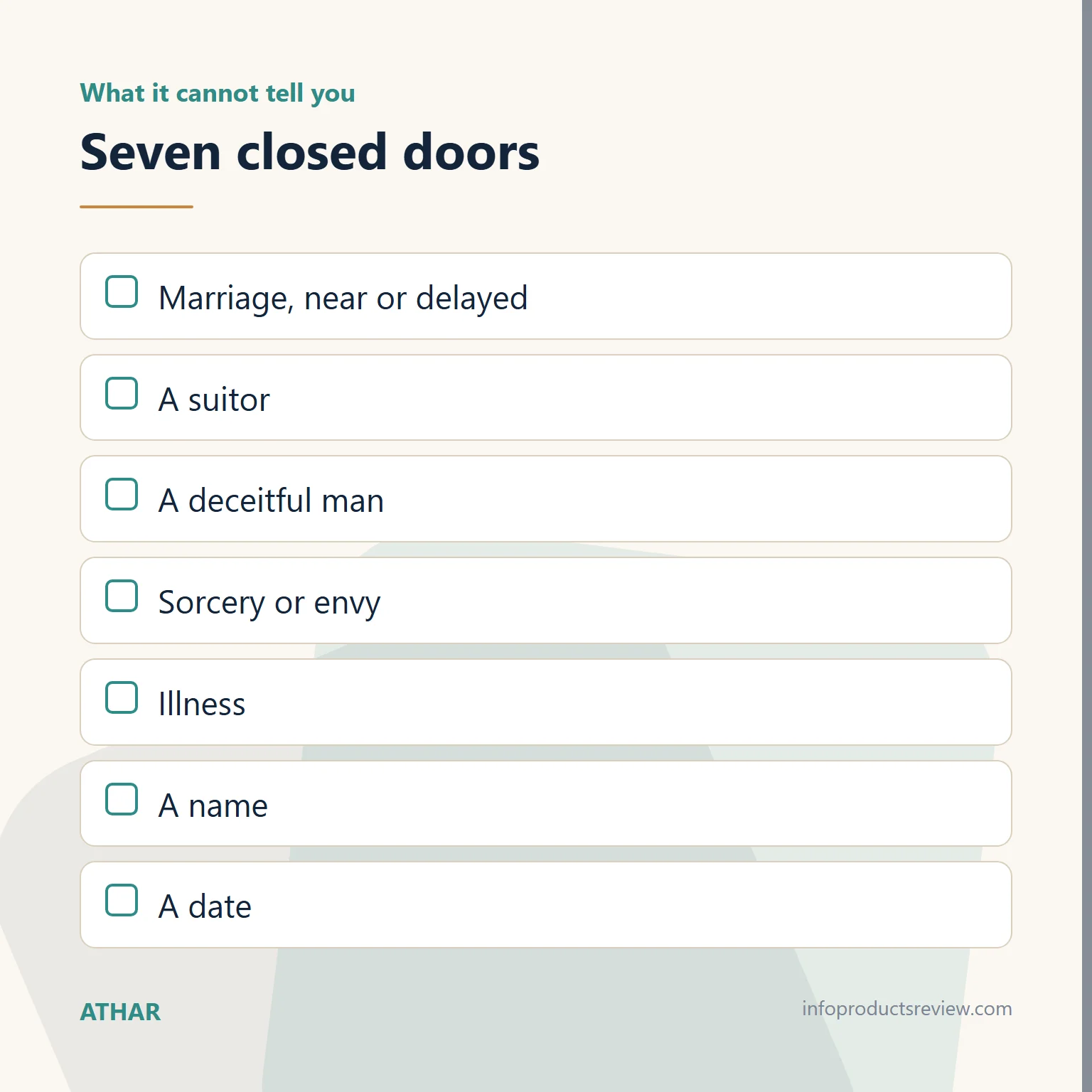
The list of things it settles nothing about
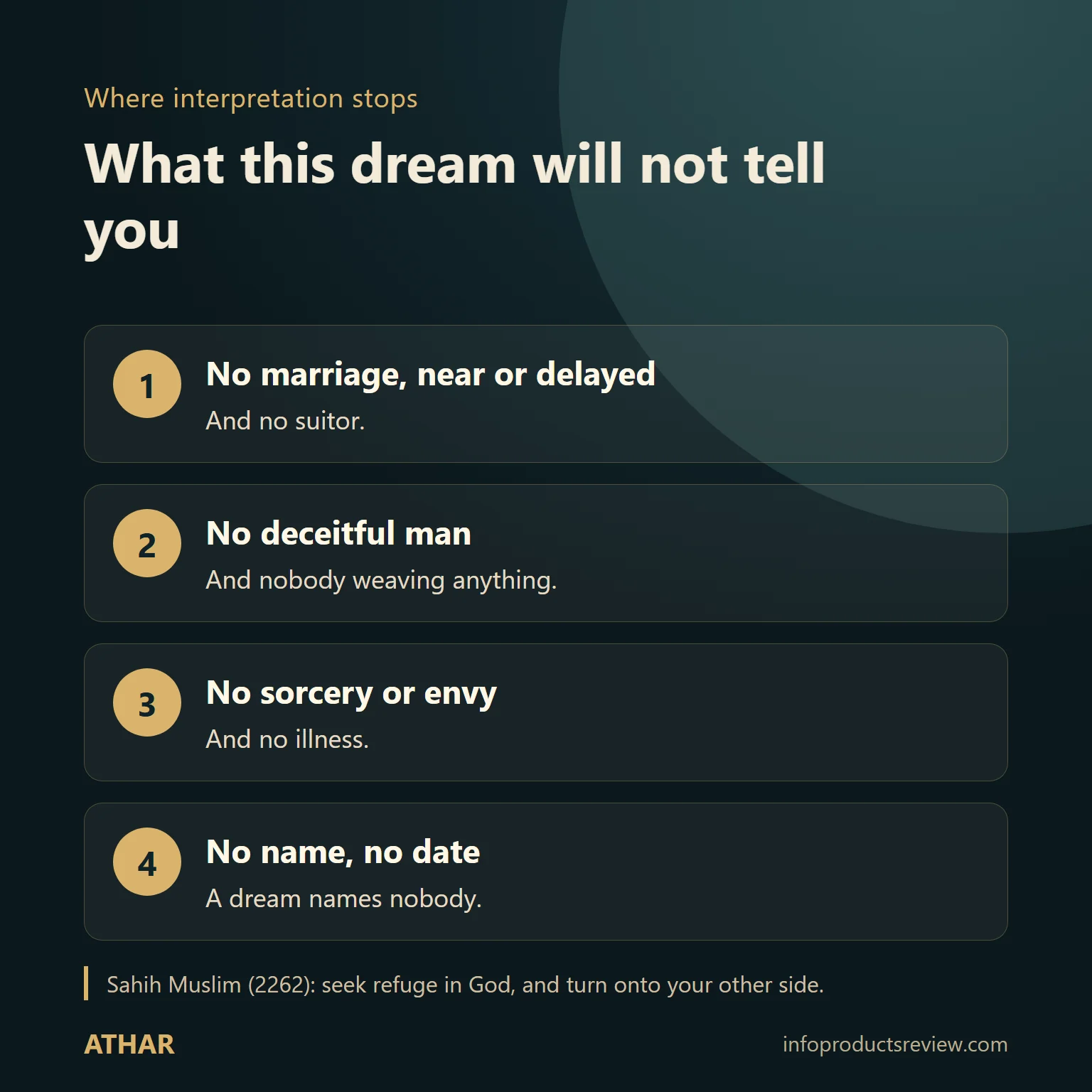
- Not that marriage is coming, near or delayed.
- Not a suitor, and not someone about to enter your life.
- Not a deceitful man “spinning a web around you” — that’s a figure of speech, not a transmitted meaning.
- Not sorcery or envy, and no grounds for a paid ruqya.
- Not a diagnosis, and nothing about anyone’s lifespan.
- It names nobody, even if you recognized a face.
- It sets no date for anything.
If you woke up unsettled
Before any interpretation, there’s short practical guidance for someone who saw a dream they disliked: seek refuge in God from Satan, spit lightly to your left three times, turn onto your other side, tell no one about it — and it will not harm you.

It’s brief, and it addresses the effect on your heart directly, which is why it comes before the search for a meaning.
إذا رأى أحدكم الرؤيا يكرهها، فليبصق على يساره ثلاثًا، وليستعذ بالله من الشيطان ثلاثًا، وليتحوّل عن جنبه الذي كان عليه
Not retelling it helps you for an extra reason here: telling a dream like this in a group of friends opens the door to guesswork, and it often ends with you carrying talk about your “turn” that wasn’t on your mind at all.
Questions to answer before you ask anyone
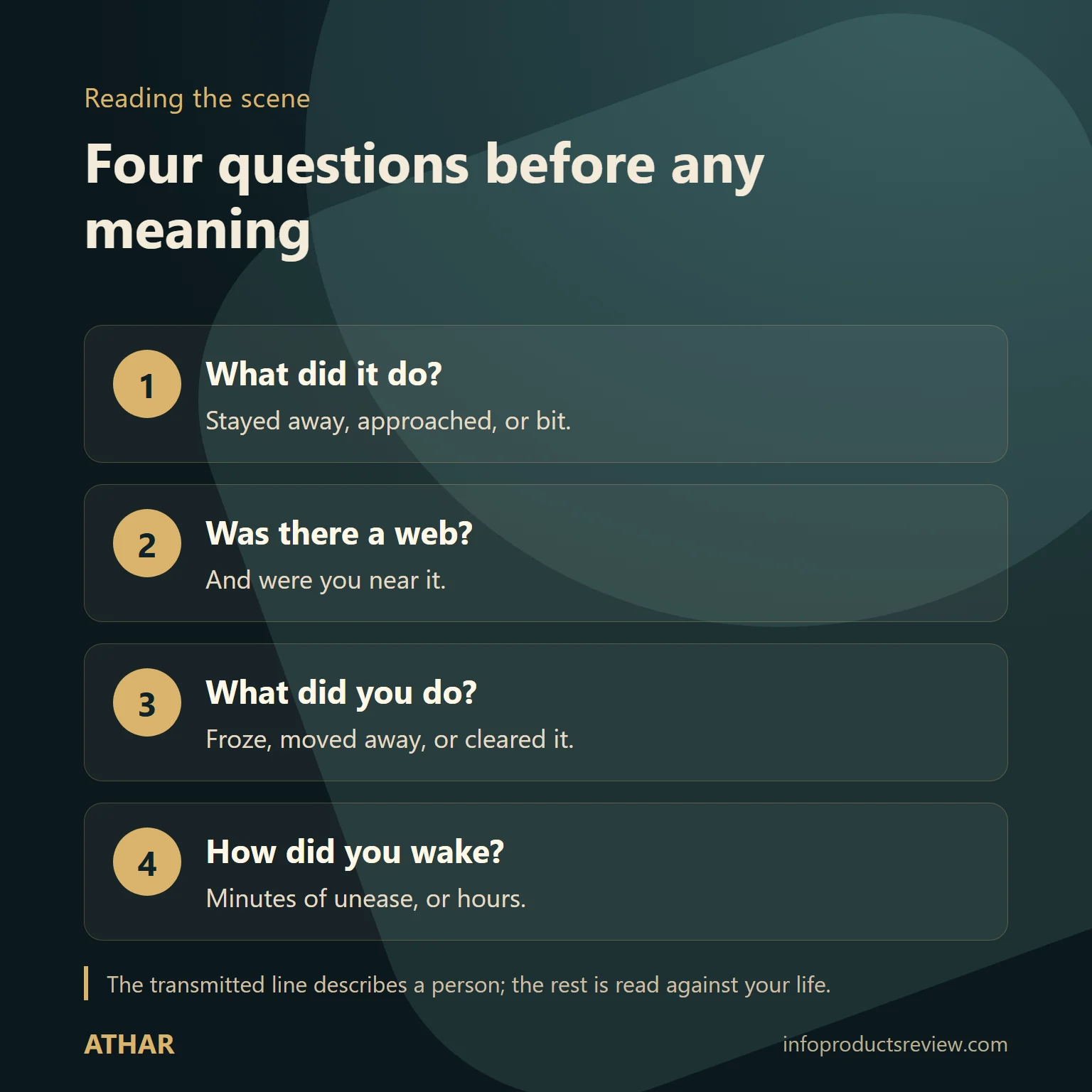
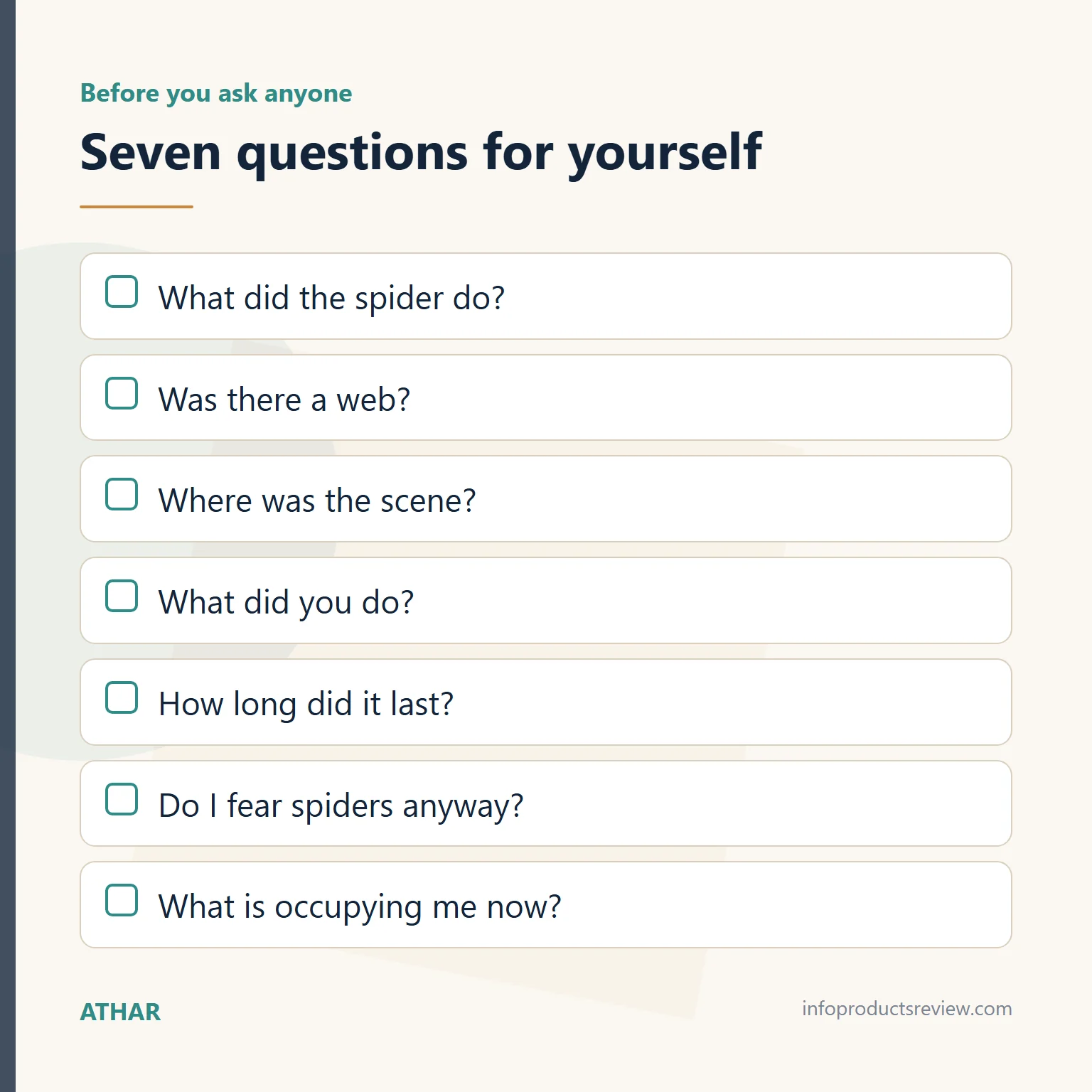
- What did the spider do: stay away, approach, or bite?
- Was there a web, and were you near it?
- Where was the scene — somewhere you know, or not?
- What did you do: freeze, move away, or clear it?
- How long did the feeling last after you woke?
- Am I afraid of spiders in waking life anyway?
- What’s genuinely occupying me right now — study, work, a disagreement, a decision I’ve been putting off?
Notice that the last question has nothing to do with marriage. That’s deliberate: plenty of other things occupy women at this stage of life, and a dream is read against what’s actually on your mind rather than what someone assumes is on it.
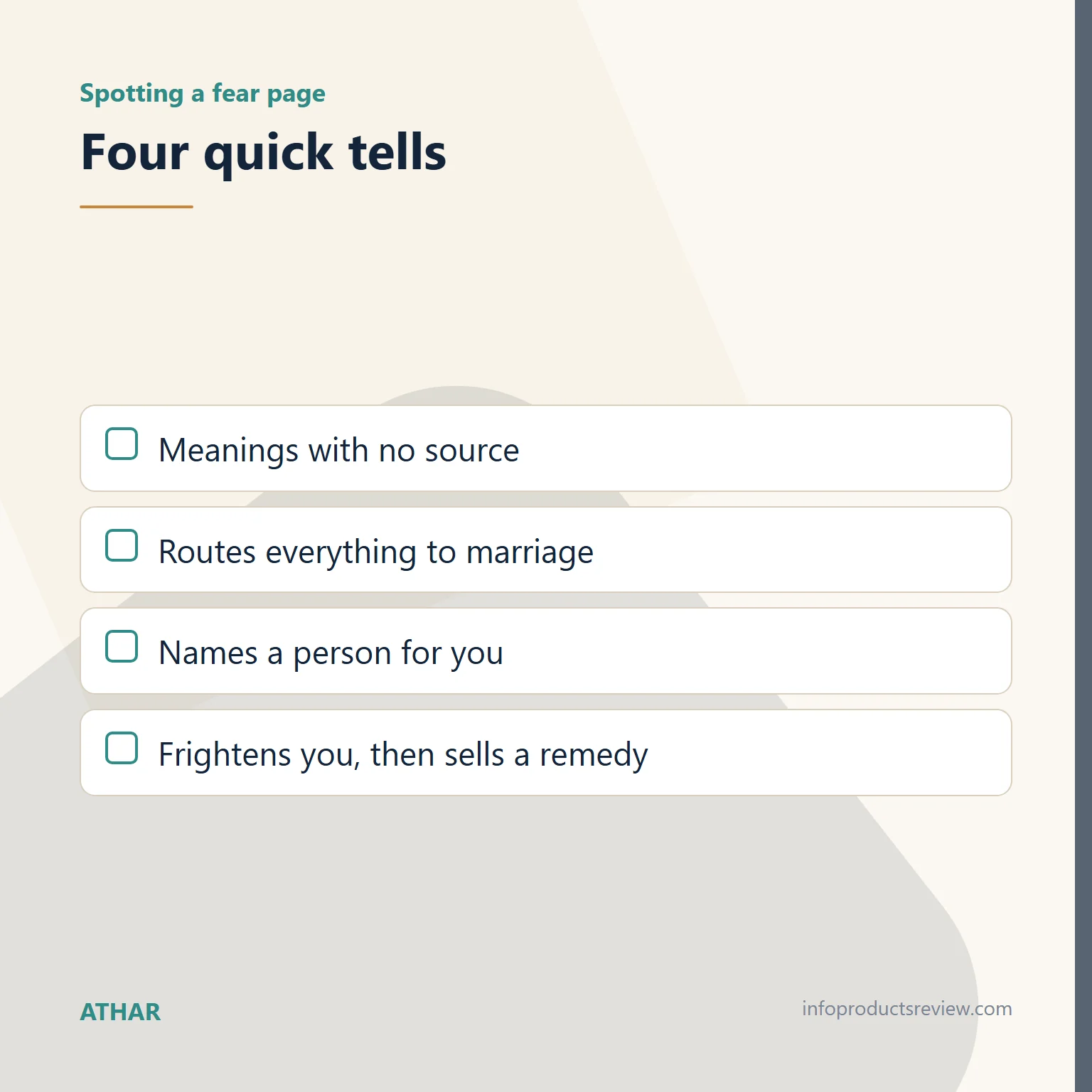
Telling a useful page from a frightening one
- Does it say where its material came from? A page listing ten meanings with no source is writing them.
- Does it route everything to marriage? A sign it’s writing to a marital status rather than to a person.
- Does it predict? “You’ll receive,” “beware of,” “soon” — all invention.
- Does it name people for you? “A man close to you,” “a friend who envies you” — nobody has that.
- Does it frighten you and then offer a remedy? A paid ruqya or a service for sale.
- Does it admit a limit? An honest page sometimes says there’s no fixed meaning for this.
Three widespread claims with nothing behind them
“A web means you’re trapped in a relationship.” A writer’s metaphor, not transmitted material. The web has no fixed meaning at all, let alone one narrowed to a relationship.
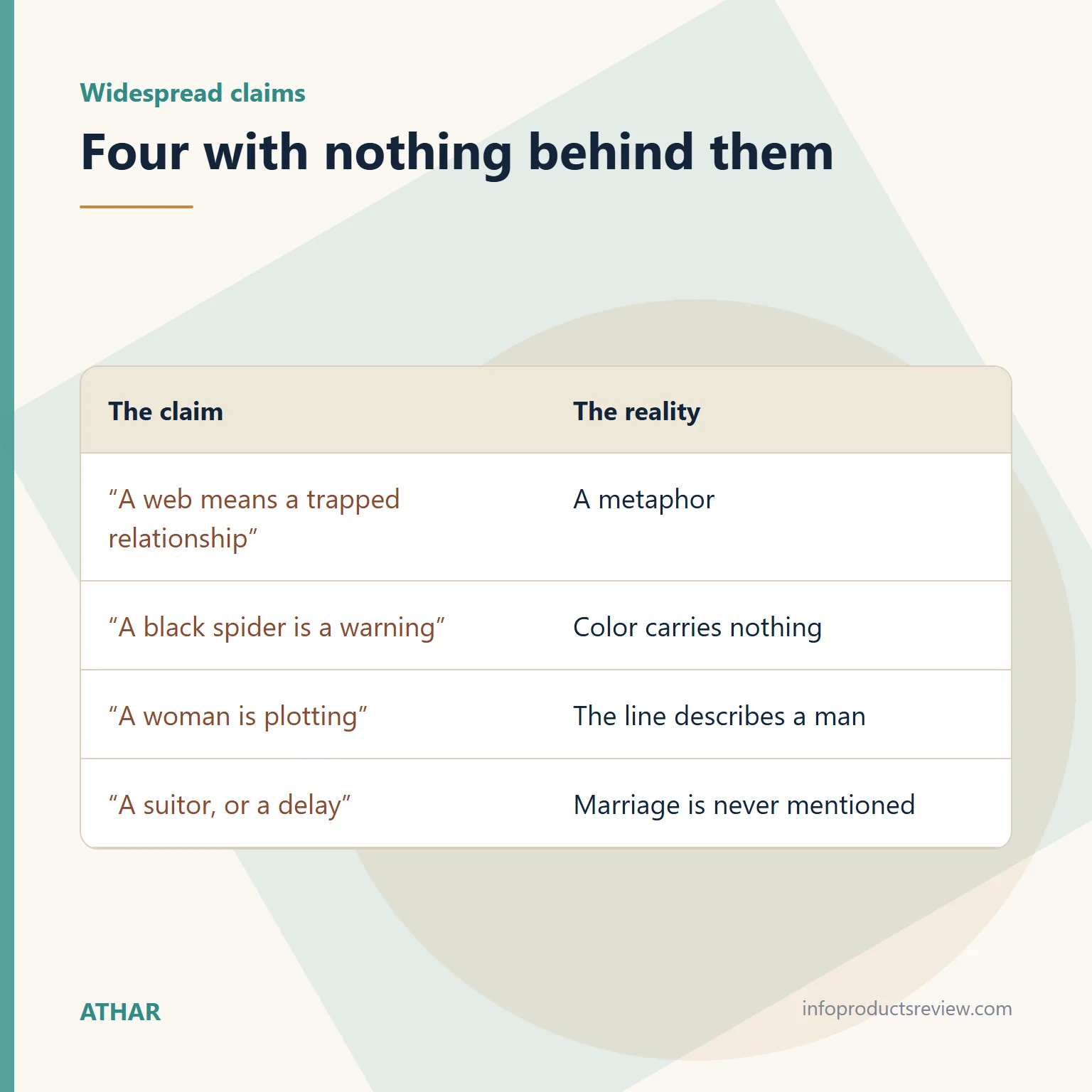
“A black spider is a warning for a single woman.” The dream books tie no meaning to a spider’s color, and nothing makes this symbol a warning in the first place.
“It means a woman is plotting against you.” The transmitted line describes a devout, weak man. There’s no woman in it and no plotting — this claim inverts the source and then adds an accusation against someone unnamed.
A quick test catches all three: any sentence that names a person for you or warns you against someone has gone past what this field can do, however confident it sounds.
Why nothing here rests on a book attributed to Ibn Sirin
You’ll find plenty of titles hanging this symbol on Ibn Sirin’s name, with detailed meanings aimed specifically at single women.
Statements aren’t attributed to Ibn Sirin without an established source. Most of what circulates comes from a book that became known under his name, whose attribution specialists have not established — so nothing on this page is built on it.
There is more on that in what is actually established from Ibn Sirin. Ibn Sirin was a well-known early scholar, but what reached us about his readings comes as scattered reports narrated by others in later books. There’s a real difference between words narrated about a man and a whole book assigned to him — the same difference as between “it was recorded that” and “he said.”
Your dream isn’t only about your “turn”
A woman at this stage is living several things at once: study or a new job, friendships shifting, family pressure sometimes, and questions about the future far bigger than marriage.
So when an unsettling scene shows up at night, it’s natural for it to connect to any of that rather than to one door. Someone in exam week, or starting a job she’s afraid of failing at, or in a rift with an old friend, brings all of it to her sleep.
Which is why the useful question after the dream isn’t “when?” or “who?” but: what’s actually occupying me right now? You’re the only person who holds that answer, and it needs no interpreter.
Plenty of readers find, after that question, that the dream added nothing to what they already knew — and that the unease came from something in waking life, not from the dream at all.
When the dream follows a conversation about marriage
This one repeats a lot: there’s talk at home about an engagement, or a relative asks the same question again, or you attend a wedding — and that night an unsettling scene arrives.
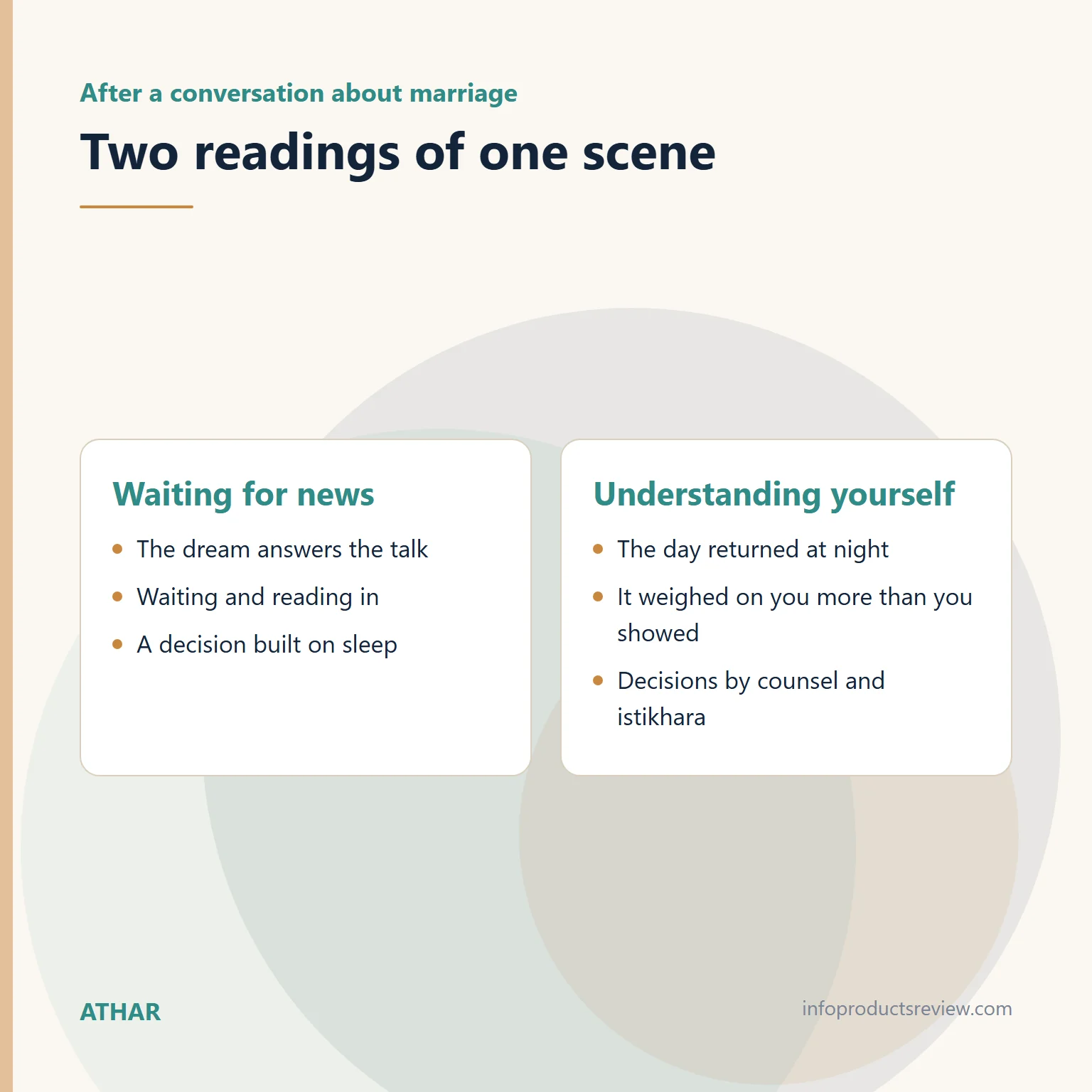
It’s easy then to read the dream as an answer to that conversation. The simpler and likelier reading is that what occupied your mind during the day came back to you at night, as the sleep references describe.
The difference between those two readings is large: the first leaves you waiting for news, the second tells you that conversation weighed on you more than you let on.
And no position toward a person mentioned in that gathering should be built on the scene — nor any decision to accept or refuse. Decisions like that rest on asking, on counsel, and on istikhara, not on an image in a dream.
If you’re under pressure right now
Some readers come to this page genuinely under strain: family insistence, comparison with friends, a sense that time is moving.
It is the same pressure we account for in snake dreams for single women. That pressure makes every symbol look like it’s talking about the same subject, because an occupied mind reads everything through what occupies it.
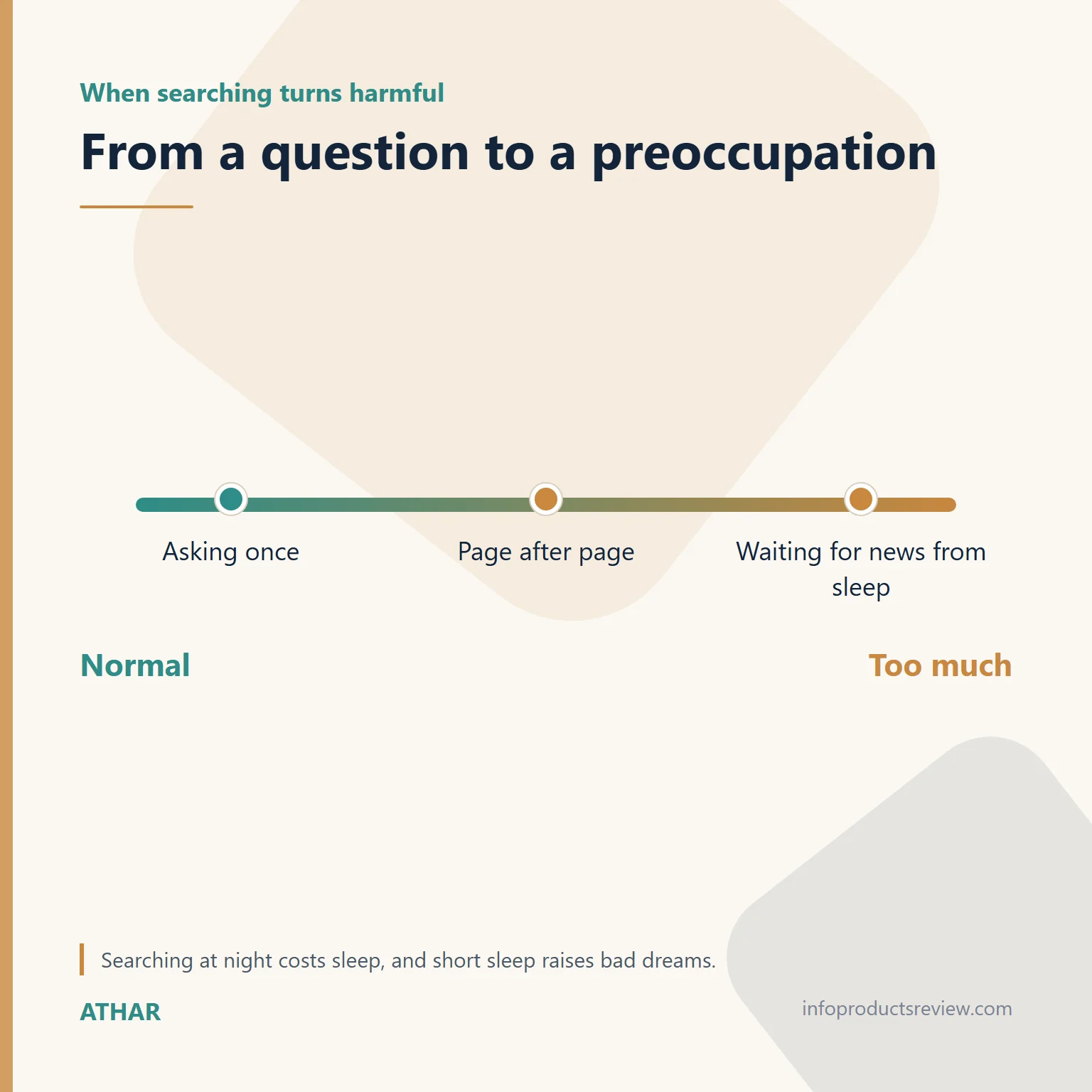
So a caution: if you find yourself reading page after page on the same symbol, each time looking for a line to reassure or alarm you, the issue is no longer the dream.
What helps then is treating the pressure itself — talking to someone you trust, cutting back on whatever feeds the comparison, and putting your attention into what actually benefits you. That lightens the load more than any interpretation will.
And if the distress is heavy, persistent, and affecting your sleep and your days, a specialist is more use than more searching. That’s a wellbeing question, not a symbol question.
A large spider, or an odd color
Questions arrive constantly about size and color: an unusually big spider, a black one, a color that doesn’t exist in life.
The dream books give neither size nor color a fixed meaning in this symbol — the transmitted line mentions neither.
What can be observed is that a larger one leaves a stronger impression on waking, and that unreal colors push the scene toward strangeness rather than fear. That describes the effect on you, not a significance.
Any page handing you a table that pairs each color with a meaning is filling space. In a symbol with this little transmitted material, an honest page is short on meanings and long on limits.
At your family’s home, or somewhere unfamiliar
Place is among the most-asked details, and it carries no fixed meaning in the dream books.
It helps in a different way: the setting that shows up at night is usually the one your thinking has been circling. We make the same observation in lice dreams for single women. Someone preparing to move into student housing sees scenes there; someone whose days are spent at an office sees them there.
If the scene was at your family’s home, the question is what’s occupying you in that circle. It doesn’t mean anyone there is the subject — a dream names nobody.
And if it was somewhere you don’t recognize, don’t strain to identify it. Unfamiliar places are common in dreams and nothing is built on them.
One common mistake is gathering every detail — place, color, size, time, who was present — and demanding one meaning that ties them together. That loads a passing scene with more than it can hold. Take the two clearest details, the ones that actually affected you, and leave the rest alone.
If you saw yourself clearing the web away
A recurring scene: cleaning a corner, brushing away threads by hand or with a broom.

There’s no separate fixed meaning for it. What can be observed is that readers tend to wake calmer from it, because it involves doing something rather than waiting.
Nobody should tell you it means you’ll be rid of a person, or that something pending will end soon. That’s a claim about the future, and a dream doesn’t make claims.
If you want something useful from the scene, take the question: is there something postponed in my waking life I could finish this week? That’s a question you can answer and act on.
If your mother or sister had the dream about you
Questions often start with “my mother saw a spider in my room” or “my sister saw one coming toward me.”
A dream is read against the circumstances of the person who had it. A mother or sister dreaming something frightening about you is most plausibly showing her own concern — an understandable thing between family.
What shouldn’t happen is a family member’s dream turning into a warning delivered to you, or into talk about someone you know. That puts you under pressure for no reason.
If something like that was said to you, the graceful response is to thank whoever worries about you — while knowing privately that what was said is their guess, not certain knowledge.
If you’re someone who thinks things over at length
Some people replay the day before sleeping: a conversation that happened, or a scenario for tomorrow.
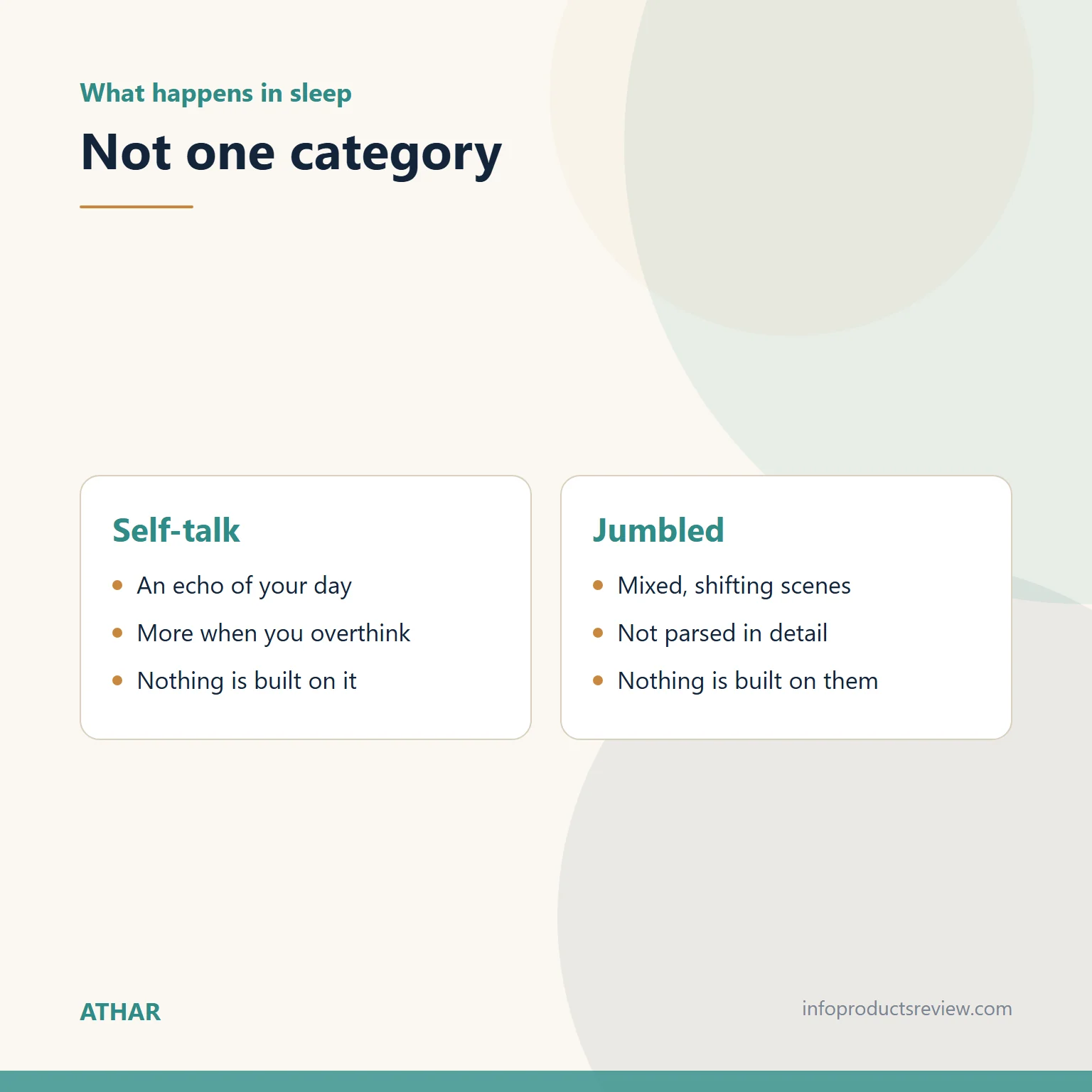
If that’s you, scenes connected to what you were turning over are natural. That’s what the people who knew this field called self-talk — a picture of what occupied you, returning at night.
We set out that split in dreams versus visions. What happens in sleep isn’t one category: some is self-talk, some is a jumble nothing should be built on, and some is the good dream. Nobody holds a reliable instrument for sorting a specific dream into one of those, which is why circumstances were always asked about before an answer was given.
Practically: if your week was crowded, or you lay awake thinking the night of the dream, an echo is the likelier explanation. Saying so doesn’t diminish dreams.
It also helps to put the phone down a while before sleeping, and to make sure interpretation pages aren’t the last thing you read. What enters the mind late tends to show up at night.
When the dream is calmer than you think
Not every scene with a spider is frightening. Many questions describe something quite ordinary: it walked past and disappeared, or there was an old web in a disused corner.
In scenes like that the important question becomes: were you actually unsettled — or did the unease arrive after you read about the symbol?
That happens often. A woman wakes up fine, searches, reads about deception and plotting, and starts carrying a weight she didn’t have.
If that’s your situation, the remedy is simple: close the tabs and trust your first reaction. What you felt on waking is more reliable than what a stranger who doesn’t know you wrote.
What about the reassuring scenes?
Fair is fair in both directions: a frightening scene establishes nothing bad, and a calm one guarantees nothing good. Both are possibilities read against your circumstances rather than news.
Their effect differs, though, and there’s no harm in letting a peaceful dream lift your day — as long as it doesn’t turn into something you start waiting on.
The hadith collections record that someone who sees a dream they like should praise God and may tell it to someone they love. The etiquette distinguishes clearly: what you dislike you leave alone, and what you like you give thanks for.
Why so much gets written for single women
Search any symbol together with “for single women” and you’ll find more pages than for the symbol on its own. That isn’t an accident.
Writing in this space follows what people search for, and that phrasing is searched constantly. Then the pages compete: each tries to be more detailed and more certain than the last, until they’ve left the source entirely behind.
The result is that a woman looking for one line meets twenty meanings, each contradicting the others, none with a source. And she usually picks the one that matches her fear rather than her situation.
Knowing that protects you: when you meet heavy detail in a symbol with little transmitted material, the surplus came from the writer — and a confident tone is not evidence.
What you actually have after this dream
It’s fair to end by saying plainly what you’re leaving with.
You have one transmitted line from Ibn Qutayba, and you know it describes a person rather than forecasting anything. You have a list of what the dream can’t tell you — longer, in this symbol, than the list of meanings, which is to your benefit.
You have questions to read your scenes with: what happened, where, what you did, how you woke. And you have short practical guidance for a dream you disliked.
What you don’t have — and nobody else does either — is a way to learn from a dream when something will happen, who is meant, or what tomorrow holds. Anyone offering you that is offering what they don’t possess.
One small note on when you search
Most people read a page like this right after waking, late at night, still rattled.
That’s the worst moment to look. You’ll accept the first interpretation you find, and it’s usually the most frightening one, because alarming pages are written to catch attention.
Better to follow the short guidance, then go back to sleep. If the question is still there in the morning, read about it calmly — and much of what felt heavy at night will look lighter.
Note too that a long search at 3 a.m. costs you sleep, and short sleep itself raises distressing dreams, as the section above describes. The searching becomes a cause of the thing you were trying to resolve.
Common questions
Does a spider dream mean marriage is near for a single woman?
No. Nothing in the dream books links this symbol to marriage, near or delayed. The transmitted line describes a person and never mentions marriage.
Does it mean a deceitful man is weaving a web around me?
No. That’s a familiar metaphor in writing, not a transmitted meaning. The one line in this symbol describes a devout, weak man, with no deception in it.
I saw only a web, with no spider. What does that mean?
The web has no fixed meaning in the dream books. What helps is looking at where it was and what you felt: were you near it, and did you feel stuck or were you just looking?
I killed the spider. Does that mean a problem is ending?
There’s no separate fixed meaning for killing it. Readers tend to wake calmer from that scene, which is part of your state — not a promise that anything is lifting.
A spider bit me. Is that a warning?
There’s no fixed meaning for a bite, and it shouldn’t be read as a warning about anyone. The most that can be said is that the unease may linger after waking.
There were many spiders. Does that mean many problems coming?
The number carries no fixed meaning and shouldn’t be read as trouble on the way.
Is a spider dream a sign of sorcery or envy?
No. That connection rests on nothing, and it’s among the most exhausting things to carry for no benefit.
I’m afraid of spiders in real life. Does that affect it?
It affects how hard it hit you, not what the symbol means. Something you fear while awake lands harder at night and lingers longer.
It was in my room. Does that mean something is wrong at home?
No. There’s no fixed meaning for where it appears. A bedroom is private space, so anything unsettling there simply raises the unease.
Should I tell my family or my friends?
For a dream you disliked, the guidance is not to retell it — and retelling usually opens the door to guesswork about things that weren’t on your mind.
It keeps coming back. What does that mean?
Nothing makes repetition a confirmation of something coming. Ask what in your days keeps returning the image; health references also note that stress and short sleep raise distressing dreams.
Does it indicate illness?
No. A dream doesn’t diagnose anyone. Health worries belong with a doctor.
Should I give charity or recite something because of it?
Charity and remembrance are good in any case and need no dream to prompt them. No dream obligates a specific act, and nobody should be asking you for money because of one.
Does the size of the spider change anything?
Size has no fixed meaning here. It affects the impression you’re left with on waking, nothing more.
I woke up fine, then got anxious after reading about it. What now?
Trust your first reaction. A lot of the worry in this topic comes from the pages rather than the dream — what didn’t unsettle you on waking doesn’t need carrying afterward.
What should I do right now?
Settle yourself, don’t retell the dream in a group, and write the scene in three lines. Then ask what’s occupying you in waking life, and stop at the limit — no names, no dates.
The bottom line
The transmitted material in this symbol is one line: Ibn Qutayba wrote that the spider is a weak, devout man. There is no marriage in it, no engagement, no deceitful man, and no sorcery.
Everything else is read from what happened in the dream and how you felt when you woke. And you aren’t a marital status whose dreams all get read through one door — you’re a person with a whole life, which is what a dream is measured against. It stays a possibility, never news about tomorrow.