


You’re pregnant, you dreamt about lice, and you woke up uneasy. The short answer is calmer than you might expect: in the books of dream interpretation, lice stand for dependants — the people someone provides for and looks after. They are not an enemy, an illness or a sign of envy.
For a pregnant woman today the nearest reading is usually everyday life with a great many small parts: appointments, preparations, thoughts that keep circling. Where the lice were, what happened to them and how you felt shift that reading.
The bottom line
- The closest meaning: lice stand for dependants — people who rely on you and whom you look after. It’s an ordinary, quiet image, with no danger and no prediction in it.
- The detail that changes it: what happened in the scene and how you felt. Clearing the lice away is the calmest image; fear, bites and spreading make the reading heavier, but never turn it into a warning.
- Common cases: lice on your pillow, which most likely reflects broken sleep and missing rest; lice in a room you’ve been getting ready for the baby, which most likely reflects the sheer weight of preparation.
- A possibility, not a promise: these are possible meanings and they predict nothing. The dream says nothing about the baby, its sex or the birth, diagnoses nothing, establishes no witchcraft or envy, and points at no one.
- Where the books give no specific meaning: there is no special meaning for lice in a pregnant woman’s dream as such, and none for their colour, their number, their bites or nits. The popular idea that lice are a small, recurring worry is widespread but not confirmed, so these details are best read through how you felt and what is going on in your life.
What this dream can’t tell you is worth repeating, because that’s where the fear usually sits: nothing about your baby’s health, nothing about its sex, nothing about when or how you will give birth, nothing about illness, and nothing about witchcraft or envy. Any real medical question goes to your maternity team.
What this page covers
- The bottom line
- What do lice stand for in a dream?
- Why do dreams become so vivid during pregnancy?
- Does the stage of pregnancy change how the dream feels?
- Where did you see the lice?
- A few lice, or a great many?
- Does the colour or size matter?
- Were they moving, or did they bite?
- What if you removed them or combed them out?
- Lice on bedding, cushions and baby things
- How did you feel inside the dream?
- What do the classical dream-interpretation books actually say?
- Lice or nits: does the difference matter?
- What is actually established about disturbing dreams?
- What does sleep research say about unsettling dreams in pregnancy?
- When is a dream just your mind processing the day?
- A clear line: this is not a medical page
- When the dream follows an appointment or a scan
- Common claims that need correcting
- What this dream cannot establish
- What to do after an unsettling dream
- How to describe your dream so it can actually be read
- What might the dream be pointing to in everyday life?
- Should you tell your partner or family about the dream?
- What have interpreters said in recorded interviews?
- A few typical scenes
- Quick reference: detail and nearest reading
- Frequently asked questions
- What does dreaming about lice most often mean during pregnancy?
- Is it a sign that something is wrong with my baby?
- Does it mean I’m having a girl or a boy?
- Why do I keep having strange dreams while pregnant?
- I removed the lice in my dream. Is that a good sign?
- What if the lice bit me?
- Does it mean someone envies my pregnancy?
- What does Islamic guidance say to do after a bad dream?
- I dreamt of nits, not lice. Is that different?
- The dream keeps coming back. Should I worry?
- Where can I read about other pregnancy dreams?
- Is any of this certain?
- Related dreams
- In summary
- Sources and references
What do lice stand for in a dream?

Before getting to pregnancy, it helps to see the whole symbol, because many pages hand you just one end of it and leave you there.
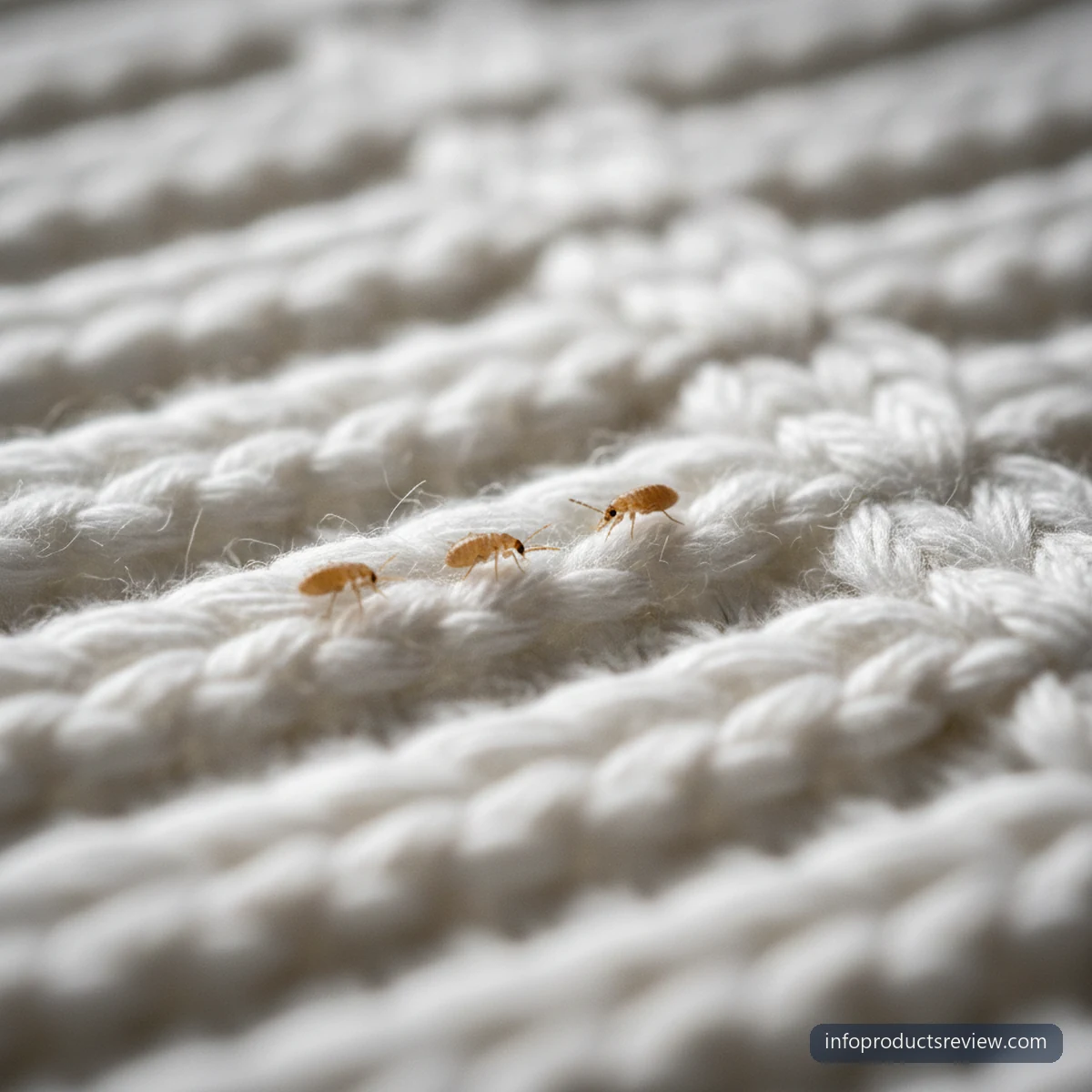
The oldest reading of this symbol is short and single: lice are dependants. Dependants are the people who live under someone’s care and rely on them for their keep. It is an image about responsibility, not about danger.
Modern pages carry a second, very widespread reading: lice as a small worry that keeps coming back, or scattered burdens that pile up until they wear you down. That one isn’t confirmed anywhere in the classical material, and it belongs to no named interpreter.
It’s mentioned here because it’s everywhere, and because it fits what lice are actually like: small, numerous, clinging and irritating. But it remains a rough reading rather than a settled one.
Notice what neither reading contains: no disaster, no illness, no enemy, nothing about a baby. Linking this symbol with pregnancy and birth has no source behind it. It spreads because it finds an anxious reader ready to believe it.
So most of what this page says about individual details is a practical reading. It starts from what lice are like in waking life and then from your own situation. That was the method of the early interpreters themselves, but it isn’t a quotation from any book. The page will tell you plainly when something is handed down and when it’s a rough reading.
If you’d like to see the same method applied to a different symbol, our guide to snake dreams during pregnancy works through the details in the same order: the scene first, then the meaning, then a clear line where medical questions begin.
Why do dreams become so vivid during pregnancy?
This section may help you more than any reading of the symbol, which is why it comes early.
Many women notice their dreams change when they’re pregnant. They seem more frequent, more detailed and much easier to remember. There are ordinary reasons for this, and knowing them takes a lot of the fear out of a strange dream.
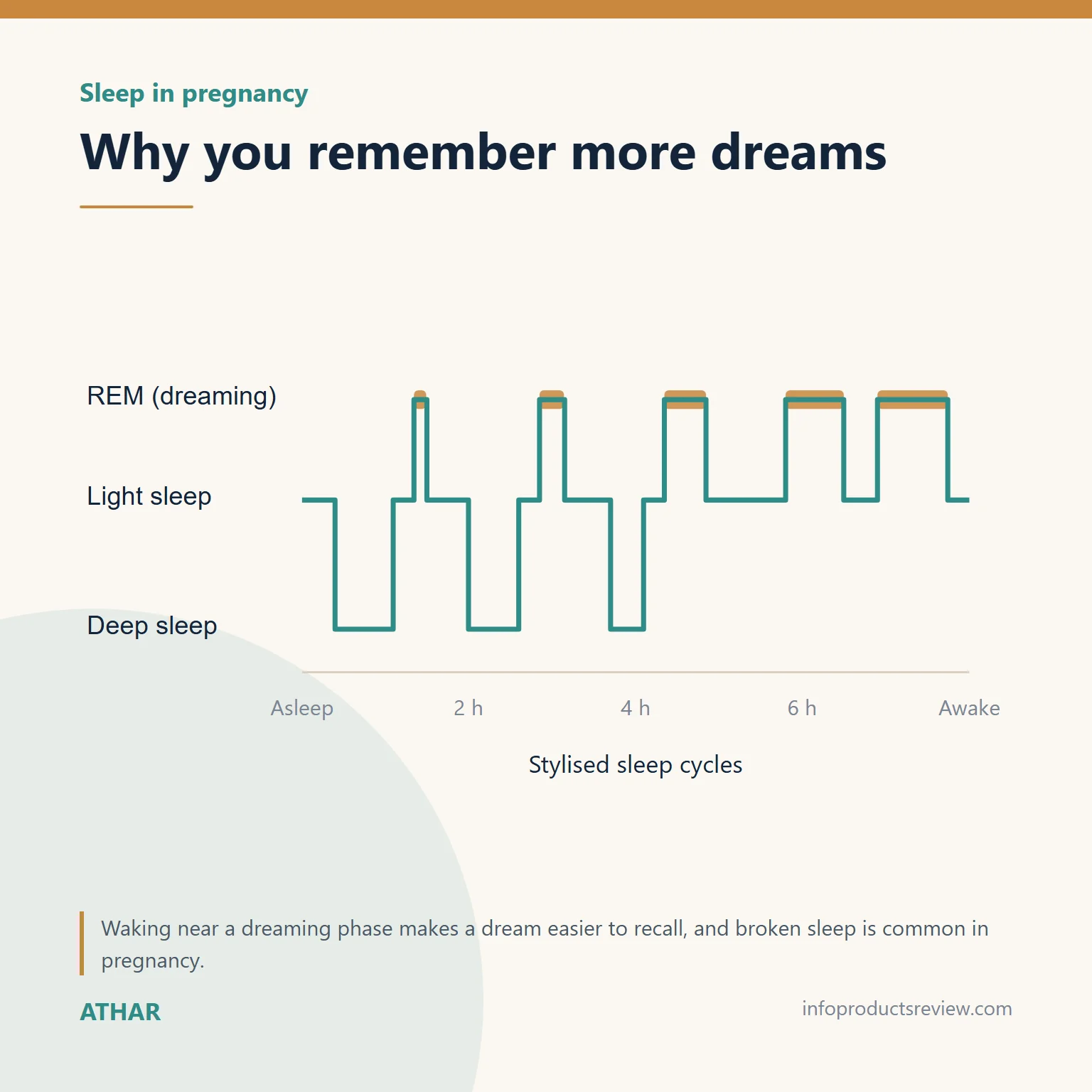
Sleep itself changes. Discomfort, heartburn, a baby moving, and needing the bathroom at night all break sleep into shorter pieces. Each time you wake, especially during or just after a dream, you’re more likely to carry the dream into waking memory.
A night with five interruptions can leave you remembering dreams you would normally have forgotten. So a pregnant woman doesn’t necessarily dream more than anyone else, but she may remember far more. The difference matters: remembering more dreams is not the same as receiving more messages.
Your mind is also busier. Pregnancy brings appointments, preparations, changes at work, changes in relationships, and a steady background of questions about what’s coming.
The sleeping mind tends to replay what the waking mind is carrying, often in symbolic, exaggerated form. And an image of “small things that won’t stop” sits very close to a mind crowded with details.
Waking suddenly also leaves emotion close to the surface. The dream itself may have been quite ordinary, but the moment of waking out of it makes it feel heavier than it was.
None of this makes the dream meaningless. It does mean a vivid dream is not, by itself, a sign that something unusual is happening. Vivid is normal right now. So the first useful question after an unsettling dream in pregnancy is often not “what does it mean?” but “how have I been sleeping this week, and what was on my mind before bed?”
Does the stage of pregnancy change how the dream feels?
The symbol doesn’t change from one trimester to the next, but the life around it does, and that can colour how a dream feels. These are general observations about sleep and mood, not rules of interpretation.
In the early weeks, when tiredness and nausea are often at their strongest and the news may still be private, daytime naps are common. More naps mean more chances to wake straight out of a dream, so more dreams are remembered. A lice dream at this stage sits comfortably alongside that feeling of being worn down by details.
In the middle months, when energy often returns and plans start to take shape, sleep settles for many women. The same dream is then more likely to reflect a crowded to-do list: things to buy, forms to fill, people to tell.
In the final weeks, when sleep is often at its most broken and the birth is close, dreams of any kind tend to become more intense. Finding a comfortable position is harder, waking is more frequent, and the mind is busy with preparations. A lice dream then is more likely to reflect accumulated tiredness and anticipation than anything new.
So a lice dream in the last trimester is not a sign. It turns up at the time when the least unbroken sleep meets the most thinking about details, which are exactly the conditions in which images like this multiply.
Treat this as context rather than a rule. A dream in a particular month doesn’t carry a different meaning, and it says nothing about the pregnancy itself. The detail inside your dream still matters more than the week you’re in.
Where did you see the lice?
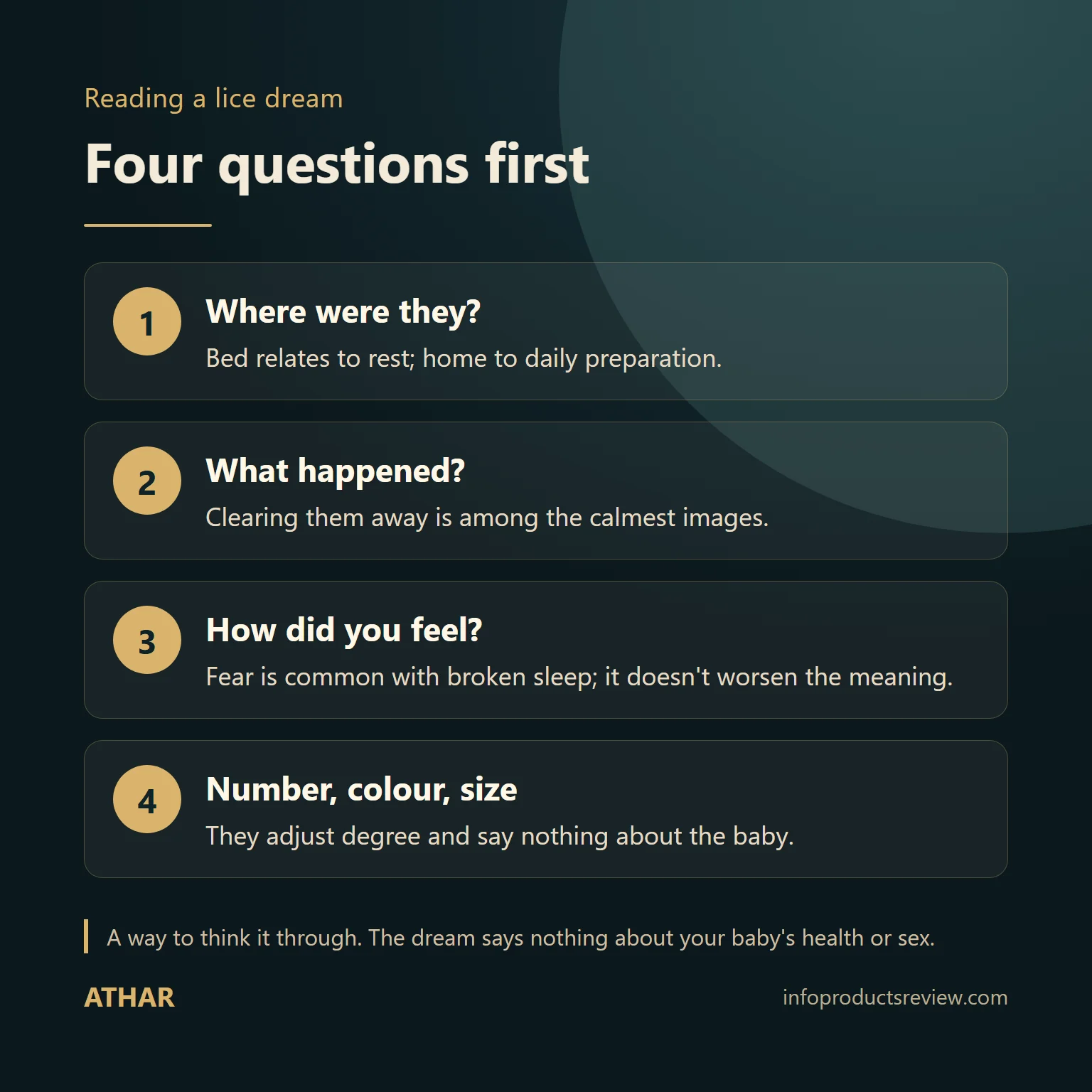
Place is one of the strongest details you have, and it’s the one most often forgotten when the dream is retold. What follows is a rough reading, not a quotation from any book.
On your pillow or bed. The bed is where rest is supposed to happen, and during pregnancy rest is often exactly what is missing. Lice on the bed lean toward something interrupting your rest, whether physical discomfort, worry, or simply too much to think about at night.
In your hair. Hair is close to you and personal. Lice there tend to point toward thoughts that stay with you: preoccupations you carry around all day. It says nothing about your body or your health.
In your bedroom. Your privacy and personal space, which often shrink at this time between appointments, visitors and arrangements.
On clothes or things you use every day. This leans toward the practical demands of daily life, the ordinary tasks that pile up faster than they can be finished.
In a room you’re preparing for the baby. Some women describe exactly this. It usually reflects the weight of preparation itself: the sense that there’s always one more thing to arrange. It is not news about the baby.
At a clinic or during an appointment. The scene most likely reflects your focus on the appointments themselves and on waiting. It is not a hint about any result.
Somewhere outside the home. A workplace, the street, a relative’s house. The dream is then more likely to be about that wider circle and the demands it places on you.
The general rule: the closer the place is to you, the closer the circle it describes. Closeness is not danger. It simply means the dream is about something near to your daily life.
A few lice, or a great many?

This is the question pregnant women ask most, and the one most often misunderstood. Number has no meaning of its own in the classical books.
The nearest reading is that number describes quantity, not severity. A few lice point to a passing concern, something small that you’ll get past. A great many point to a lot of small things at once: many thoughts, a long list of preparations, a head that won’t quiet down before sleep.
That can feel overwhelming in the dream, but it’s still a picture of many minor demands, not of one large danger. And the difference between “a lot to think about” and “a lot of danger” is huge. The first is a state you know and can deal with. The second is a claim the dream offers no evidence for.
If the lice multiplied while you watched, the dream is often reflecting a familiar feeling: things accumulating faster than you can deal with them. That feeling is very common in the later months of pregnancy, when thinking about details goes up and unbroken sleep goes down. It says nothing about what will happen next.
Does the colour or size matter?

Much less than many pages suggest. The classical books say nothing about the colour or size of lice. The detailed colour charts you find online are later additions, and some pregnancy pages even tie colours to the baby’s sex. That has no basis in any source.
Size can be read as a simple scale. If the lice were unusually large, the dream may be magnifying a concern until it seems bigger than it is, which is exactly what anxious minds do at night. If they were barely visible, the concern is likely to be minor or still at an early stage. Either way it’s a change of degree, not of kind.
Dark or light colouring may adjust the tone a little, but a dark louse is not a different symbol from a pale one. And to be completely clear: no source links the colour of anything seen in a dream with the sex of a baby. A dream cannot tell you the baby’s sex at all.
Were they moving, or did they bite?

These are close images, but the difference between them is real. Again, this is a rough reading based on the scene.
Still lice that simply sat there lean toward something present but not active: a worry you’re aware of, but one that isn’t pressing hard right now.
Lice crawling or spreading reflect something that feels like it’s continuing or getting harder to contain: a matter not yet settled, or preparations that keep growing. Continuation, not danger.
Being bitten is the detail that frightens people most. In this kind of reading it points to something you can actually feel, such as tiredness or a lack of time, draining your energy or patience. How hard the bite was in the dream measures how strong the reading is; it never becomes harm. The books give bites no meaning of their own, and none for where on the body they happened.
A word specific to pregnancy: many women read a bite in a dream as a hint of pain or a health problem. There’s no basis for that. It is not a reference to anything happening to your body, and it is not a warning about the pregnancy. If you have real pain or a health worry, take it straight to your midwife or doctor.
What if you removed them or combed them out?

This is one of the most reassuring images in the whole range of lice dreams.
Removing lice, combing them out, washing them away or seeing them gone suggests a burden being dealt with. It can reflect a problem you’re already solving, a worry that’s easing, or simply the mind’s way of tidying up after a demanding day. The more complete the clearing, the clearer the picture.
If you got rid of some and some remained, the nearest reading is that part of something is finished and part isn’t. That’s a realistic picture, not a warning.
If you tried and didn’t manage, the nearest reading is an effort still in progress, not failure. Nothing in the sources makes this image an omen, and nothing links it with the birth or with a difficult labour.
If someone helped you remove them, the dream may reflect the support around you: a partner, a mother, a friend who is lightening the load. That’s worth noticing, because during pregnancy the people who help matter a great deal. But it stays a possibility, never a verdict on anyone.
Lice on bedding, cushions and baby things

Soft furnishings are where the dream becomes most closely tied to rest and comfort. Lice on blankets or cushions tend to reflect the things that keep you from settling: an uncomfortable night, a racing mind, or a list that restarts the moment you lie down.
This reading has the advantage of being testable. Ask yourself how many times you woke last night. If the answer is “a lot”, you’ve found a large part of the explanation.
What helps here is practical rather than symbolic: an extra pillow for support, drinking a little less just before bed, and a quieter, slightly cooler room. These are general tips. If poor sleep continues, mention it at your next appointment.
Lice on baby clothes or a cot can be deeply upsetting to see. It helps to read them for what they are in dream terms: a picture of preparation weighing on you. Nothing in the classical material treats them as a sign about the baby.
How did you feel inside the dream?
Ask anyone about a dream and they’ll describe the scene. Ask how they felt and you’ll get the most honest part of it, because feeling is the part you don’t rebuild after waking.
If you felt disgusted or frightened, the reading leans toward strain and tiredness. If you felt calm, or simply got on with removing them, it softens considerably, toward ordinary demands that you’re handling. Two women can see the same scene and read it differently for that reason alone.
If you felt embarrassed, the dream may be reflecting a worry about how others see you coping. Many women also say they felt protective in the dream, trying to keep the lice away from something or someone. That says more about your care and attention than about any threat.
In pregnancy, feeling deserves extra attention. Frequent waking leaves emotion stronger and closer to the surface, so a dream can seem harsher than it was, not because its content was harsh but because you woke straight out of it.
What do the classical dream-interpretation books actually say?
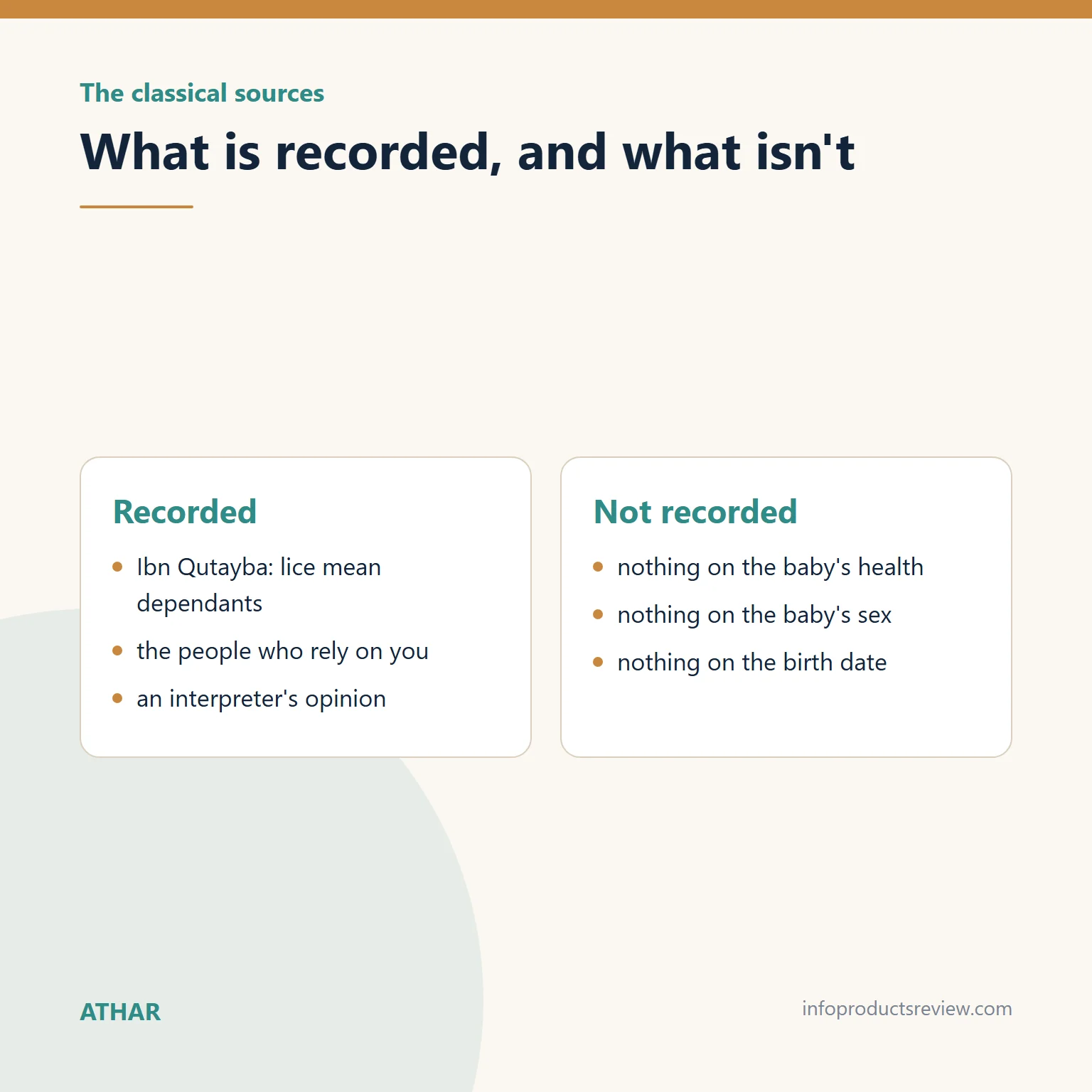
They say one short thing: lice are dependants. The clearest line on this symbol sits in a ninth-century work, one of the earliest surviving books on dream interpretation, and it adds nothing to that meaning.
“Dependants” means the people someone provides for and looks after. So lice here are not an enemy and not envy. They stand for people who live under your care and rely on you. The point is supported with a line of poetry describing a people who grew in number as their sons grew up — in other words, whose dependants multiplied.
This is an interpreter’s judgement, not a religious text, and it doesn’t turn the dream into a prediction. What it shows is the method. Early interpreters began with what a thing is like in waking life and asked what in the dreamer’s life shared those qualities.
Lice are small, numerous, and live on the person who carries them. So do dependants, in a sense: they live under the care of the one who supports them. The meaning rests on a plain resemblance, not on anything mysterious.
Read “dependants” while you’re pregnant and the image may feel close to your situation: thinking about responsibility, and about the people who rely on you, at home or beyond it. But it stays a reading that describes a preoccupation. It is not news about the baby or the birth.
Some pages credit a popular book attributed to Ibn Sirin with other meanings for lice, such as small recurring worries. That book’s attribution to him is not established and those meanings are not confirmed, so they aren’t offered here as a settled interpretation and nothing is built on them alone.
What the old books leave out is just as important, because that’s where the fear sits. They give no special meaning for a pregnant dreamer, say nothing about a baby or its sex, nothing about a birth or its timing, and never link lice with illness, miscarriage, envy or the evil eye.
Lice or nits: does the difference matter?
Some women dream of nits, the tiny eggs, rather than lice. Nits have no meaning of their own in the classical books, so what follows is a rough reading. In dream terms the difference is about stage rather than meaning.
Lice are active and present, so they lean toward something already happening. Nits are still and unhatched, so they lean toward something that hasn’t started yet: a concern at an early stage, a plan put off, or something you know is coming.
In pregnancy the picture is familiar: a written list of preparations with nothing ticked off yet, or a stage you know is ahead and are already thinking about.
It’s also easy to read “eggs” as a reference to the baby. There’s no basis for that in any source. A nit in a dream is a picture of something not yet begun, nothing more specific than that, and it is not a health rule of any kind.
What is actually established about disturbing dreams?
It helps to separate two things. Interpreting a symbol like lice is human judgement. The guidance on what to do after a dream you dislike is recorded in Sahih al-Bukhari and Sahih Muslim, the two most authoritative hadith collections, and it is refreshingly simple.
It doesn’t ask you to find an interpretation. It asks you to seek refuge in God and leave the dream alone. In Sahih al-Bukhari, hadith 7044:
A good dream is from God. If one of you sees something he likes, let him tell it only to someone he loves. And if he sees something he dislikes, let him seek refuge in God from its harm and from the harm of Satan, spit lightly three times, and not tell anyone about it, for it will not harm him
The meaning is plain. A good dream may be shared with someone you love. With a dream you dislike, you seek refuge in God from its harm and from the harm of Satan, spit lightly three times, and tell no one. Then the hadith reassures you directly: it will not harm you.
Sahih Muslim, hadith 2262, records similar guidance with one practical addition: spitting to your left three times, seeking refuge three times, and turning over from the side you were lying on:
If one of you sees a dream he dislikes, let him spit to his left three times, seek refuge in God from Satan three times, and turn over from the side he was lying on
For an expectant mother woken by an unsettling dream, the practical steps are these: seek refuge in God from its harm and the harm of Satan, spit lightly to your left three times, change the side you’re lying on, and don’t feel obliged to retell the dream, as in al-Bukhari (7044) and Muslim (2262). You don’t need to go looking for an interpretation.
What is not established is just as clear. No text makes a particular dream a sign about a pregnancy, a birth or a baby’s health. No text treats a dream as grounds for a medical decision. No religious text gives lice a fixed meaning. The meanings in the interpretation books are all human judgements that may be right or wrong.
What does sleep research say about unsettling dreams in pregnancy?
This is kept separate from the classical material deliberately. The two answer different questions, and blending them misrepresents both.
The Sleep Foundation’s guide to nightmares explains that disturbing dreams become more common with stress, anxiety and poor sleep.
The US National Institute of Neurological Disorders and Stroke explains that most dreaming happens in REM sleep, and that REM periods get longer toward morning. That’s why dreams near dawn tend to be the most vivid and the easiest to remember.
Pregnancy often brings these factors together: broken sleep, physical tiredness and a crowded mind. So a rise in unsettling dreams at this time is expected, and it doesn’t mean something is being kept from you.
The image of lice happens to match a familiar sensation: something small that won’t leave you alone. That overlap is interesting, but it’s an observation about a feeling, not proof that psychology confirms an old interpretation.
None of this suggests a dream diagnoses anxiety or anything else. It’s a general description, not an assessment of you. Anxiety in pregnancy is common, and if worry is affecting your sleep or your days, it’s worth mentioning to your midwife or doctor — not because the dream proves anything, but because your wellbeing deserves the attention.
When is a dream just your mind processing the day?
This question comes before any interpretation, and it’s rarely asked. Sahih Muslim, Book of Dreams, hadith 2263, narrated by Abu Hurayra, records that dreams are of three kinds: a good dream that is glad tidings from God, a distressing dream from Satan, and a dream from what a person tells himself.
Dreams are of three kinds: a good dream, which is glad tidings from God; a distressing dream, from Satan; and a dream from what a person tells himself
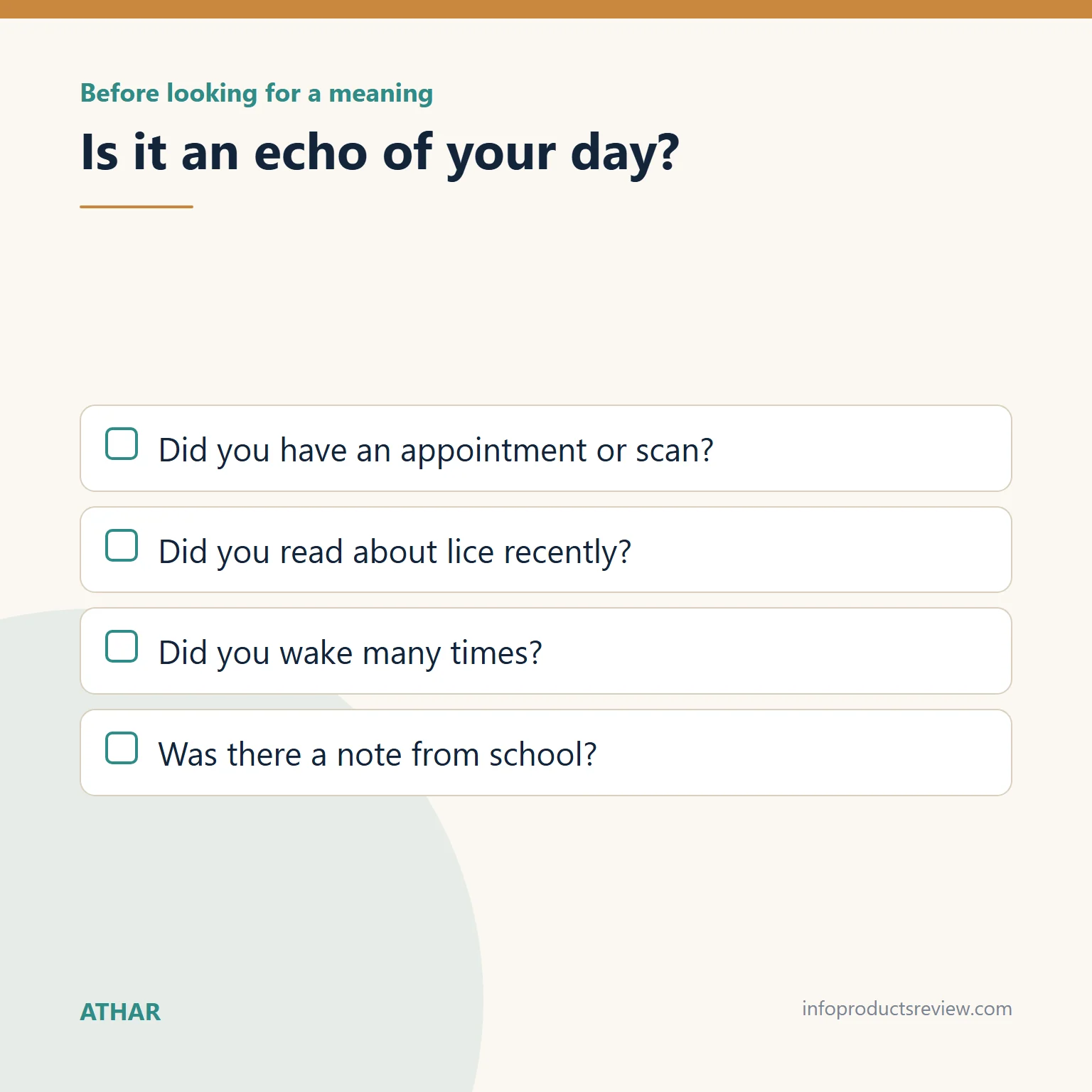
So some dreams are simply the mind talking to itself: an echo of what occupied you while awake. The hadith names the three kinds; it doesn’t hand you a test for telling one from another. No single sign settles it, but several together say a lot:
- The dream echoes something that occupied you that day.
- You read, watched or talked about something related before sleeping.
- Your sleep was short, broken or uncomfortable.
- The scene kept shifting rather than following a clear sequence.
- You had been searching for information about lice, perhaps after a school letter about a nursery outbreak.
That last one happens more than people think. Searching for the meaning of a lice dream just before bed is a good way to dream about lice. If the dream followed a real-life reminder of lice, it’s most likely your mind replaying the day, not sending a message about the future.
There’s also a loop worth naming: an unsettling dream, then a search, then frightening results, then more searching, then worse sleep, then another dream. At that point the dream is no longer the problem. If you recognise yourself in that loop, the helpful step isn’t one more page. It’s stopping.
A clear line: this is not a medical page
Because the fear is so understandable, it’s worth saying plainly.
A dream about lice tells you nothing about your pregnancy, your baby’s development, the baby’s sex, the likely date of delivery, or the risk of any complication. It is not a symptom and it is not a warning. It’s no reason to start a treatment or change a medicine, and this page can’t offer you a diagnosis or medical reassurance.
If you have a real concern, such as pain, bleeding, reduced movements, persistent itching, severe sleeplessness, or anything that feels wrong, contact your midwife or maternity team straight away. That’s always the right step, whatever you did or didn’t dream.
And if you’re dealing with real head lice in your home, which is common when there are older children at school, the NHS page on head lice and nits has general information. Ask your pharmacist or doctor before using any treatment while pregnant. That’s a practical matter, entirely separate from dream interpretation.
Keeping the two apart isn’t evasion. Mixing symbol and medicine makes both less useful, and it can delay a question that should have gone to a professional.
When the dream follows an appointment or a scan
Many women notice that unsettling dreams cluster around antenatal appointments, scans and test results. That isn’t a coincidence, and it isn’t a sign.
Waiting for information is one of the most stressful parts of pregnancy. So is a remark overheard in a clinic, or a quick read about a rare complication. All of it stays in the mind, and the sleeping mind processes that tension in its own language.
It doesn’t replay the scene as it was; it picks an image close to the feeling: something small, numerous and irritating that won’t stop. That is a very close match for the feeling of waiting.
A dream of lice in the nights before or after an appointment is most naturally read as the mind working through anticipation. Before looking for a meaning, ask what your day or week held in the way of appointments and waiting. If you find the answer, you’ve found the nearest explanation, and it’s a comforting one, because it doesn’t add any new piece of news to your life.
If you notice this pattern, it can help to write down your questions for the next appointment before bed. Giving the worry somewhere to go often quiets the dreams that carry it. And if the waiting itself is wearing you down, which is entirely understandable, talking about that with your midwife or someone you trust will help more than talking about the dream.
Common claims that need correcting
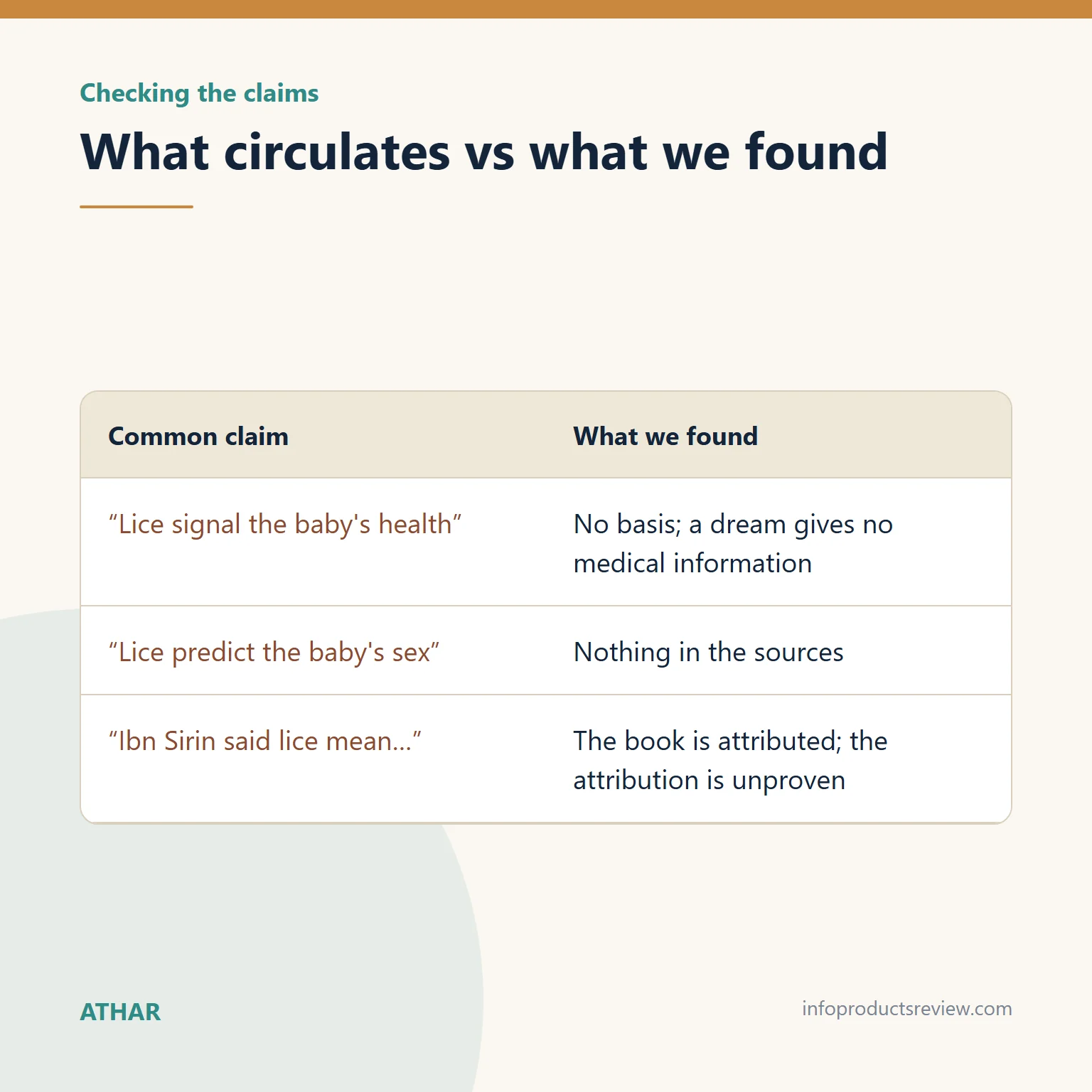
- “Lice in a pregnancy dream are a sign about the baby’s health.” Nothing in the sources supports this, and a dream cannot tell you anything medical.
- “Lice mean the baby will be a girl, or a boy.” No such link exists in the classical material. It circulates without any source at all.
- “Lice mean envy or the evil eye.” The classical books make no such connection, and no religious text establishes it.
- “A lot of lice means something bad is coming.” Number is closer to how many small demands the dream reflects, not how serious anything is.
- Quoting a fixed meaning for lice as Ibn Sirin’s own words. The popular book is only attributed to him, and that attribution is not established. Anyone quoting him with certainty is claiming more than is known.
- “If you dream it repeatedly, it’s a confirmed message.” Repetition has no meaning of its own in the books, and in pregnancy recurring dreams track broken sleep far more closely than any hidden meaning.
A quick way to test any page about dreams: does it name a specific book and author, or only “the old books”? Does it speak with total certainty about what will happen? Does it give dates or news about the baby? Does it bring in magic, envy or illness?
If the answers are no name, yes, yes and yes, you’re reading something added rather than something handed down. Apply the same test to this page. If you ever find it failing, the mistake is ours.
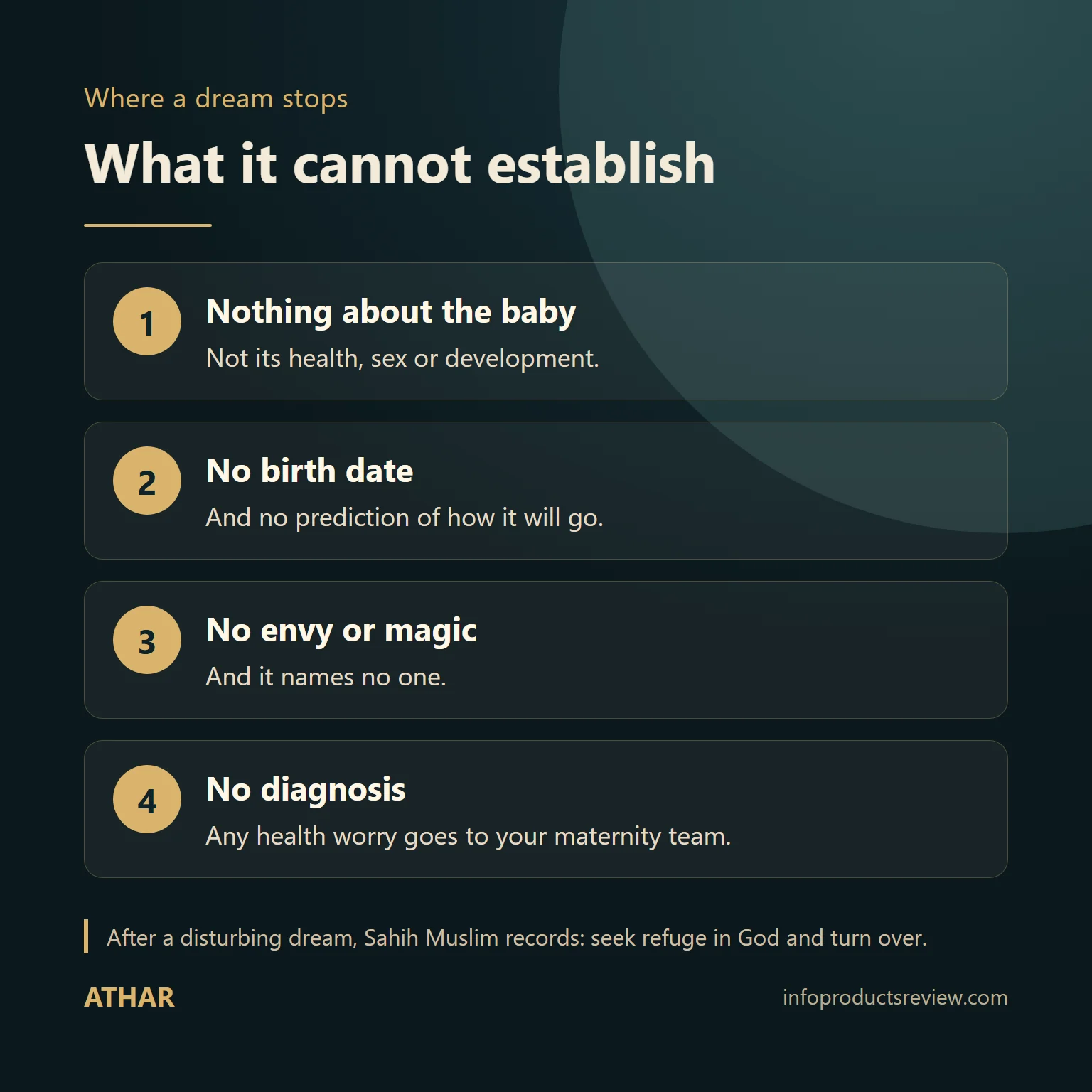
What this dream cannot establish
This is where real harm can happen, so it’s stated plainly:
- It cannot tell you about your baby’s health, development or sex.
- It cannot predict when you will give birth or how the birth will go.
- It cannot diagnose any condition, physical or emotional, in you or anyone else.
- It cannot identify anyone as envious, hostile or responsible for anything, whether a partner, a relative or a neighbour.
- It cannot establish witchcraft, the evil eye or any hidden cause.
- It is not grounds for a decision about your care, your relationships or your plans.
What to do after an unsettling dream
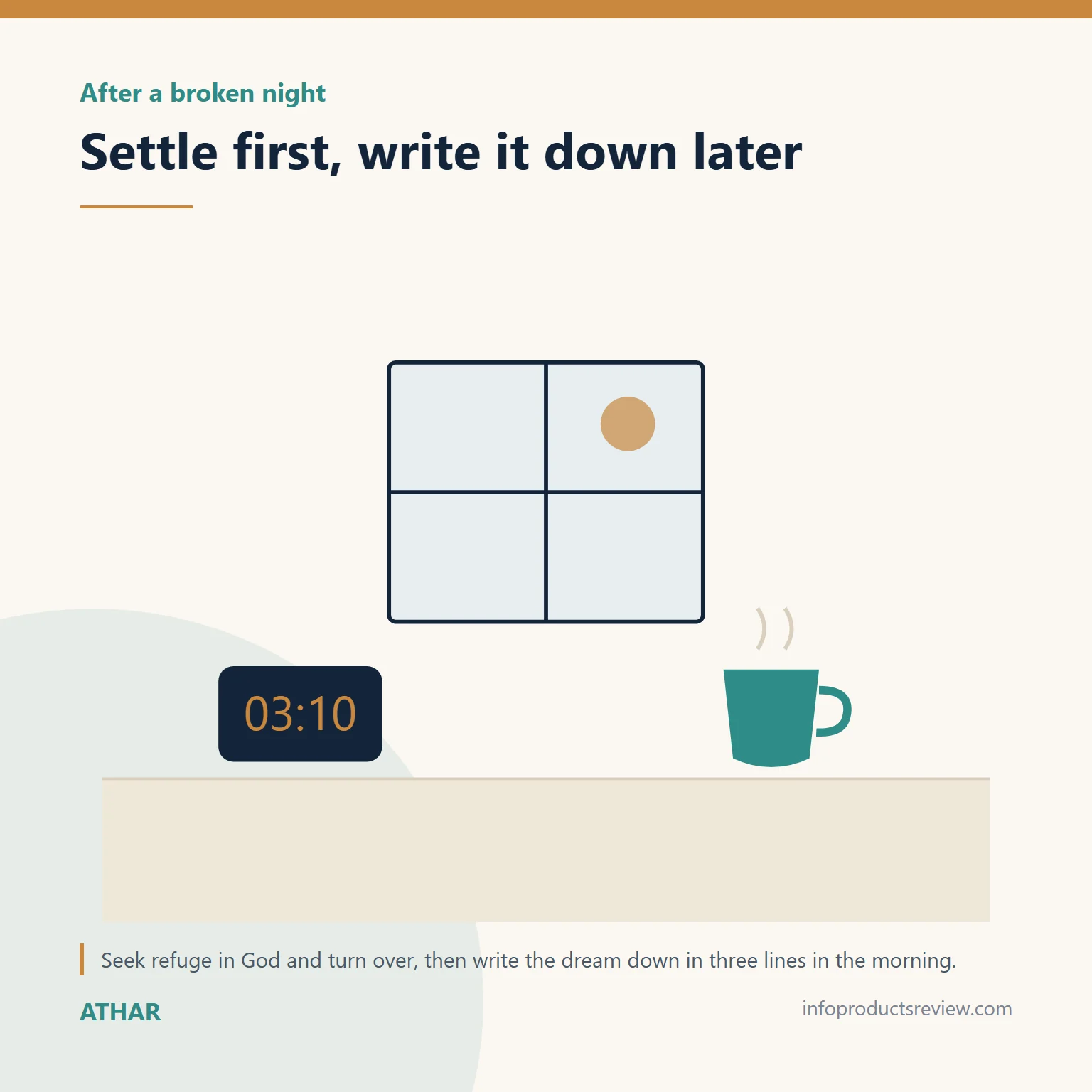
Some steps that help, instead of simply being told not to worry:
- Settle yourself first. Seek refuge in God, turn onto your other side, and take a few slow breaths. There’s no need to analyse anything in the middle of the night.
- Write it down once in the morning: where it happened, what happened, how you felt. Three lines are enough.
- Reread it in the evening. A few hours’ distance usually makes a dream look smaller than it felt on waking.
- Look at the day before. An appointment, a worrying conversation, a news story, a letter from school. That may be the whole explanation.
- Protect your sleep where you can. A consistent bedtime, a cooler room, and a pillow for support can reduce night waking and, with it, how many dreams you remember.
- Don’t build a health worry on it. If you have a real concern, or if distressing dreams keep affecting your days, mention it to your midwife or doctor.
How to describe your dream so it can actually be read
If you want to think a dream through, or talk it over with someone, the order you describe it in matters. Try this:
- The setting. Where were you? In bed, in your room, elsewhere at home, somewhere outside?
- What happened. Did the lice just appear, spread, bite, or get removed?
- Who was there. Were you alone, or did someone help you?
- How you felt during the dream and when you woke: afraid, uneasy, calm, indifferent?
- How you slept that night, and how many times you woke.
The last question is specific to pregnancy, and it’s often the most useful of the five. A description like that turns a frightening image into something you can think about calmly.
And if you only remember one blurred image, that’s normal. Memory keeps the strongest picture and loses what surrounds it within minutes. A general memory gets a general reading, which is more honest than anyone filling in details you never saw. Try recalling the feeling instead of the scene; it gives you much of the reading on its own.
What might the dream be pointing to in everyday life?
If you want to use the dream at all, the most useful question is not “what will happen?” but “what in my life right now feels like this?” A lice dream is a picture of small things that keep returning. Pregnancy is full of them.
The practical load. Appointments, forms, shopping lists, preparing a room, arranging leave from work. None of these is a crisis, but together they can feel endless. If the dream left you feeling there was simply too much to deal with, this is often where it points.
The people who depend on you. This is where the old reading becomes quietly relevant. You may already be caring for older children, a parent or a partner, while also thinking about new responsibilities ahead. A dream about dependants at a time like this isn’t strange. But it describes what’s on your mind, not what will happen.
The thoughts that come back at night. Many women describe a particular kind of worry in pregnancy: not one large fear, but a series of small “what ifs” that return every time they wake. Lice in the hair, close and persistent, are a natural picture of that.
Your own rest. Sometimes the dream is simply about sleep. Broken nights make everything feel heavier, and a mind that can’t settle will often produce images of things that can’t be shaken off.
Recognising which of these fits isn’t interpretation in the classical sense. It’s a way of turning a disturbing image into something you can actually act on: asking for help, splitting up a task, writing a list, or protecting an hour of rest.
Should you tell your partner or family about the dream?
Sahih al-Bukhari (hadith 7044) records that someone who sees a dream they dislike should not tell anyone about it, while a good dream may be told to someone they love. There’s real wisdom in that for pregnancy in particular.
A frightening dream grows with each retelling: every time you tell it you rebuild it, add details that weren’t there, and fix it more firmly in your mind. Retelling also invites other people’s anxious interpretations, which can stay with you far longer than the dream itself.
That doesn’t mean you must carry everything alone. There’s a difference between retelling the dream as a sign and talking about how you’re feeling. Saying “I’ve been sleeping badly and waking up anxious” to your partner, mother or midwife is healthy and practical. It opens the door to support without turning the dream into a prediction.
If a relative offers an alarming interpretation, you can let it pass. No one can read your future from a dream, and a well-meaning comment doesn’t become true because it was said with confidence.
What have interpreters said in recorded interviews?
Two short pointers to published interviews, because hearing how someone reasons can be clearer than reading about it. Take them for what they are: personal views and experiences, not religious rulings and not a reading of your dream.
In the first, an interpreter describes a man who dreamt of three lice in his head; he told him he was in a dispute with three people who wanted some money from him. The interesting part is the method: a real quality of lice, that they take without giving, became the key to the reading.
It was one man’s dream and one man’s circumstances. It doesn’t transfer to your dream, and it points to no one around you.
An example of reading a dream from a real quality of lice. Summarised from the Arabic interview; a personal experience, not a rule.
In the second, a different interpreter makes a point that matters especially during pregnancy: dreams may cheer you, but they will not harm you, and they shouldn’t steer your decisions. That sits well with the hadith in Sahih al-Bukhari (7044) that a disliked dream “will not harm him”.
A practising interpreter's own limit on what dreams are for. From the English subtitles published with the interview.
Look, dreams can gladden you, but will not harm you.
A few typical scenes
These are common versions of the dream. Their readings are rough ones based on the scene and the dreamer’s situation, not quotations from a book.
Lice on the pillow in the third trimester, with broken sleep. This is the most common version. It sits closest to exhaustion and interrupted rest, a picture of small disturbances that keep you from settling.
A lot of lice that you never touched. A crowd of small thoughts and arrangements rather than danger. If there was no fear in the dream, lighter still.
Combing lice out of your hair and feeling relieved. This is among the calmest scenes, leaning toward a concern easing or a burden being managed. A hopeful possibility, not a promise.
Being bitten and waking up. Something irritating you can feel, not harm. It has nothing to do with pain in your body; if you do have pain, see your doctor.
Lice on baby clothes you’d just folded. Upsetting to see, but most naturally read as preparation weighing on you. It is not a sign about the baby.
Lice on a child you know. The dream gives no information about that child or their health. It’s more likely your own concern for the people around you. If the child really has lice, that’s a practical matter, not an interpretive one.
Your partner helping to remove them. This leans toward shared responsibility and support around you.
Waking up itchy. Common, and unrelated to interpretation: attention to the body rises after insect dreams. If itching continues while you’re awake, which can happen in pregnancy for various reasons, mention it to your midwife or doctor.
Lice appearing after a letter about an outbreak at an older child’s school. Almost certainly the day being replayed.
Dreaming of lice after a good night’s sleep. It happens, and it doesn’t undo anything above. Poor sleep makes unsettling dreams more likely; it doesn’t produce them on its own.
Quick reference: detail and nearest reading
A rough summary that doesn’t replace the sections above. Each row assumes the rest of the scene is neutral.
| Detail in the dream | Nearest possible reading |
|---|---|
| Lice in general | Dependants: people who rely on you |
| Lice on the bed or pillow | Something interrupting rest |
| Lice in your hair | Preoccupations that stay with you |
| A few lice | A passing, minor concern |
| Many lice, multiplying | Many small demands at once |
| Being bitten | Something draining energy or patience |
| Removing or combing them out | A burden being dealt with |
| Someone helping you | Support around you |
| Nits rather than lice | Something not yet begun |
| Feeling calm throughout | A much softer reading overall |
Frequently asked questions
What does dreaming about lice most often mean during pregnancy?
In the books of dream interpretation lice are dependants, the people who rely on you. For a pregnant woman the nearest reading is usually everyday life with many small demands: tasks, worries and broken rest. Where the lice were, what happened and how you felt decide the rest. It’s a possibility, not a prediction.
Is it a sign that something is wrong with my baby?
No. Nothing in the classical sources links this dream with a baby’s health, and a dream cannot give medical information. If you have any concern, speak to your maternity team.
Does it mean I’m having a girl or a boy?
No. There’s no basis for that in any source, and the colour of the lice doesn’t change that. A dream cannot tell you the baby’s sex.
Why do I keep having strange dreams while pregnant?
Broken sleep, physical discomfort and a busy mind all make dreams easier to remember. Waking straight out of a dream is what keeps it in memory. Vivid dreams are a normal part of many pregnancies.
I removed the lice in my dream. Is that a good sign?
It’s one of the calmest images, leaning toward a concern easing or a burden being dealt with. It’s a possible meaning, not a promise.
What if the lice bit me?
In this kind of reading it points to something draining your energy or patience. It is not a reference to anything happening to your body. If you have real pain, see your doctor.
Does it mean someone envies my pregnancy?
No. The classical books make no connection between lice and envy, no religious text establishes one, and a dream cannot reveal anyone’s intentions.
What does Islamic guidance say to do after a bad dream?
Seek refuge in God from its harm and the harm of Satan, spit lightly three times and don’t retell it, as recorded in Sahih al-Bukhari (7044). Sahih Muslim (2262) has spitting to your left three times and turning over from the side you were lying on. The hadith states that it will not harm you.
I dreamt of nits, not lice. Is that different?
Nits lean toward something not yet started, while lice lean toward something already happening. Nits have no meaning of their own in the books, and there’s no basis for reading them as a reference to the baby.
The dream keeps coming back. Should I worry?
Repetition has no meaning of its own in the books. Recurring dreams usually follow stress and broken sleep. If they’re affecting your days or your rest, it’s worth mentioning to your midwife or doctor.
Where can I read about other pregnancy dreams?
Our English dream guides are organised by topic, and each reads a symbol the same careful way.
Is any of this certain?
No, and that’s deliberate. These are possible meanings from the classical books, together with the places where those books say nothing, and they shift with the details of the dream. None of it predicts the future.
Related dreams
If a lice dream came to you during pregnancy, these guides read nearby symbols in the same way:
- Dreaming about lice as a single woman — the same symbol in a different season of life, and a useful comparison.
- Snake dream meaning: what the details change — another frightening image that pregnant readers often ask about.
- Dreaming about lice as a married woman — the household reading, useful once children and home are part of the picture.
- Lice in your hair as a married woman — if the dream was in your own hair.
- All English dream guides by topic — every guide reads a symbol by its details first.
In summary
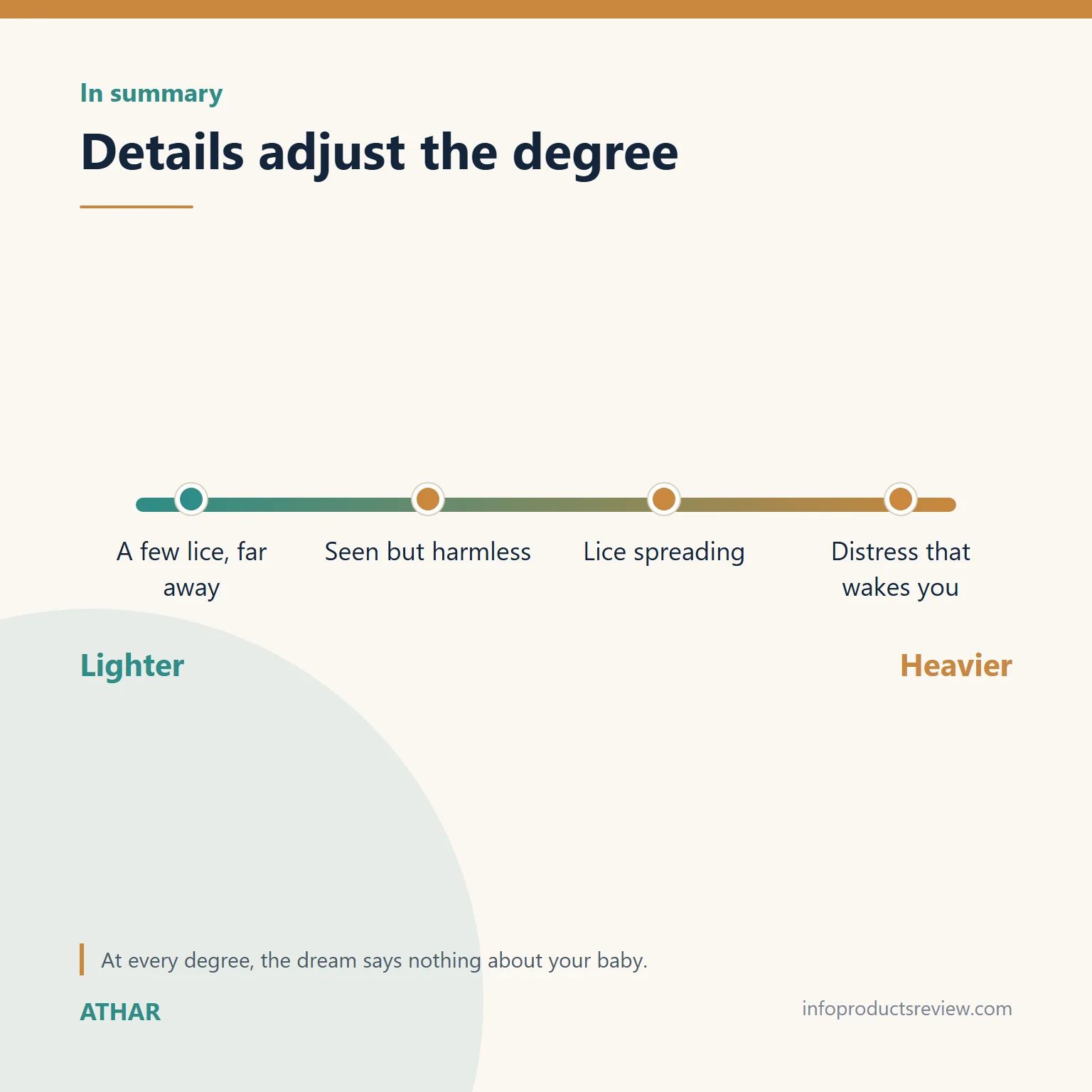
- Lice read as dependants, the people who rely on you. That is the closest meaning in the books.
- Start with place, then what happened, then how you felt, and before all of it, your sleep. Number and colour come last.
- Clearing lice away is one of the most reassuring images; lice that stay mean continuation, not danger.
- The dream says nothing about your baby’s health, sex or birth, and diagnoses nothing.
- After a bad dream: seek refuge in God, turn over, and let it rest.
- Real health concerns always go to your midwife or maternity team.
If you take one thing from this page, let it be this: a possible meaning stays possible, however confidently it’s stated. A vivid dream during pregnancy is common, this one carries no warning about your child, and the nearest explanation is usually the one closest to you: your sleep, your tiredness, and what’s on your mind when you close your eyes.
Written and reviewed by: the ATHAR editorial team. Quoted passages are taken from the editions listed in the sources. English renderings of Arabic texts are our own translation.
Last reviewed: 14 September 2026.
Note: what appears here is a possible meaning, not a confirmed fact. Nothing on this page predicts the future, gives medical advice about pregnancy, or establishes witchcraft, envy or hostility from any person. For any health concern, contact your midwife or doctor.