

You dreamed about gold: a bangle on your wrist, a necklace your husband handed you, your jewellery box lying open, or a piece that went missing while you searched the whole house for it. The short answer is that in the books of dream interpretation, gold jewellery in a woman’s dream is a good image to begin with, not a warning.
What tips the reading is your own detail: the kind of piece, what happened to it, who was there, and how you felt. This page doesn’t assume your question is really about your husband or about pregnancy, and it is clear about what a dream simply cannot tell you.
The bottom line
- The closest reading: gold jewellery in a woman’s dream is a good image in the books of interpretation. Gold on your wrist or round your neck reads as adornment and a sound state of things, not as a caution.
- Married women have no separate entry: the books talk about the piece itself, not about marital status. Your situation tips the reading towards you; it doesn’t create a new meaning.
- Bracelets and anklets: the books allow that these “may” be interpreted as the husband. The word “may” is the most important thing in that sentence: a stated possibility, not a description of your husband and not news about your marriage.
- A necklace: read as an office and a trust, meaning a responsibility you take charge of and something placed in your hands: a home you run, children you raise, money you keep safe.
- Raw gold and small bars: gold that has not been worked reads as a loss or a debt, while a crafted piece is lighter in that sense and closer to adornment.
- Coins: if your dream had more cash than jewellery in it, the readings turn on speech, documents and trust, not on money on its way.
- These are possible meanings, not promises: the dream does not point to infidelity, divorce, pregnancy or a baby’s sex, and it does not reveal magic or the evil eye.
- And for the cases the books leave open — losing gold, selling it, buying it, breaking it, a gift from your husband — read them through how you felt in the dream and what is on your mind by day, not through a stock meaning. If the dream was your own wedding night or your bridal set, that belongs in Dreaming of Your Own Wedding.
What this page covers
- The bottom line
- Why gold keeps turning up in married women’s dreams
- Does being married change what gold means?
- You dreamed of a bangle: does it point to your husband?
- This page’s rule: a dream is not evidence against anyone
- Which piece did you see? The meaning shifts with it
- A necklace
- Bracelets and anklets
- Earrings
- Your wedding ring
- The household’s gold: worked, raw and saved
- Coins: when the dream is about money, not jewellery
- What does it mean if your husband gives you gold?
- Buying gold, or saving with it
- Gold you keep but never wear
- Is silver better than gold in a dream?
- Gold lost or stolen from the house
- Gold for your children, or gold you inherited
- Wearing gold in front of your in-laws
- Gold among the women of the family
- Does gold mean pregnancy, or the baby’s sex?
- Fake gold, or gold that changed colour
- Selling gold, or borrowing against it
- Gold in a new house, or while moving
- Seeing yourself with no gold among women who have it
- Jewellery too heavy to carry
- When the dream keeps coming back
- When someone gives you a frightening interpretation
- Should you tell your husband?
- How the dream felt
- What this dream can’t tell you
- What to do after the dream
- When it’s just the mind talking to itself
- What if you don’t remember the details?
- How to describe your dream so it can be read
- Examples
- Her husband gives her a bangle after a tense week
- She sells her gold in the dream to settle a debt
- She finds her jewellery box empty
- An anklet she can’t get off her foot
- She gives her jewellery to her daughter
- Good coins being counted at home
- A relative wearing a great deal of gold
- A gold dream after a long conversation about prices
- Her mother-in-law places a bangle on her wrist
- Her gold has gone black in the box
- She wears all her jewellery at home, alone
- She sees her husband taking her gold to sell
- Quick table: the detail and the closest reading
- Related dreams
- Frequently asked questions
- What does gold mean in a married woman’s dream?
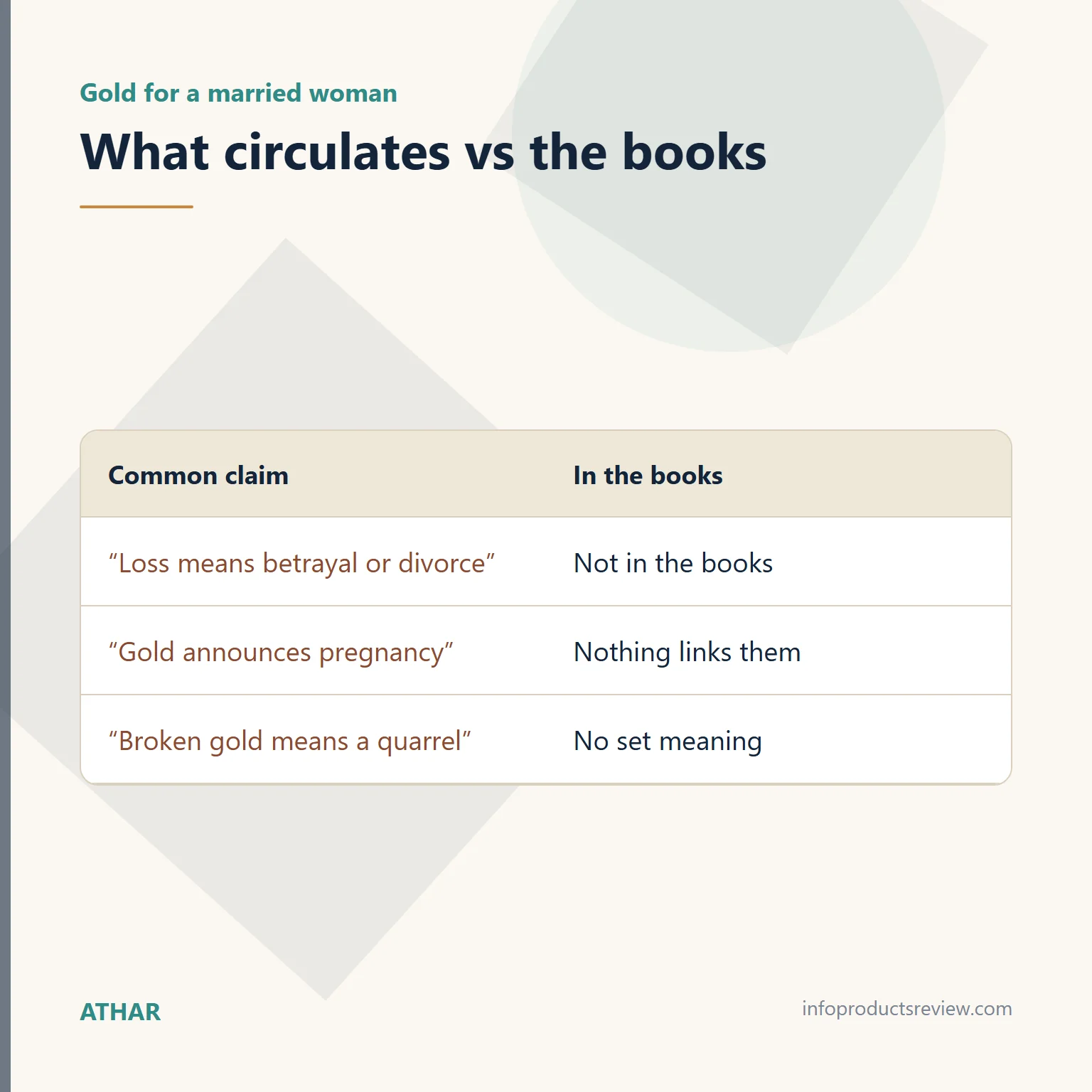
- Does losing gold in a dream mean betrayal or divorce?
- Is gold in a dream a sign of pregnancy?
- What does it mean if my husband gives me gold in a dream?
- What does selling gold in a dream mean for a married woman?
- I dreamed of a bangle on my wrist. Does it point to my husband?
- Does broken gold in a dream mean a quarrel is coming?
- What do coins mean in a dream?
- Does the dream indicate magic or the evil eye in my home?
- I saw my late mother’s jewellery. Is it a message from her?
- Is gold read differently for a married woman than for a single one?
- Is this interpretation definitive?
- In summary
Why gold keeps turning up in married women’s dreams
In many households gold isn’t only decoration. It’s part of the family’s arithmetic: a piece bought for an occasion, another sold when things get tight, a third put aside for a daughter who’s growing up.
You may be the one who keeps the family’s gold, the one people ask about its price, or the one who has spent two months hesitating over an old bangle. All of that keeps gold closer to your mind than you might think.
The US National Institute of Neurological Disorders and Stroke says in its guide to sleep that events from the day often find their way into our thoughts while we sleep.
That’s about sleep in general rather than about gold, but it explains something useful: whatever occupies you by day tends to come back at night in some shape.
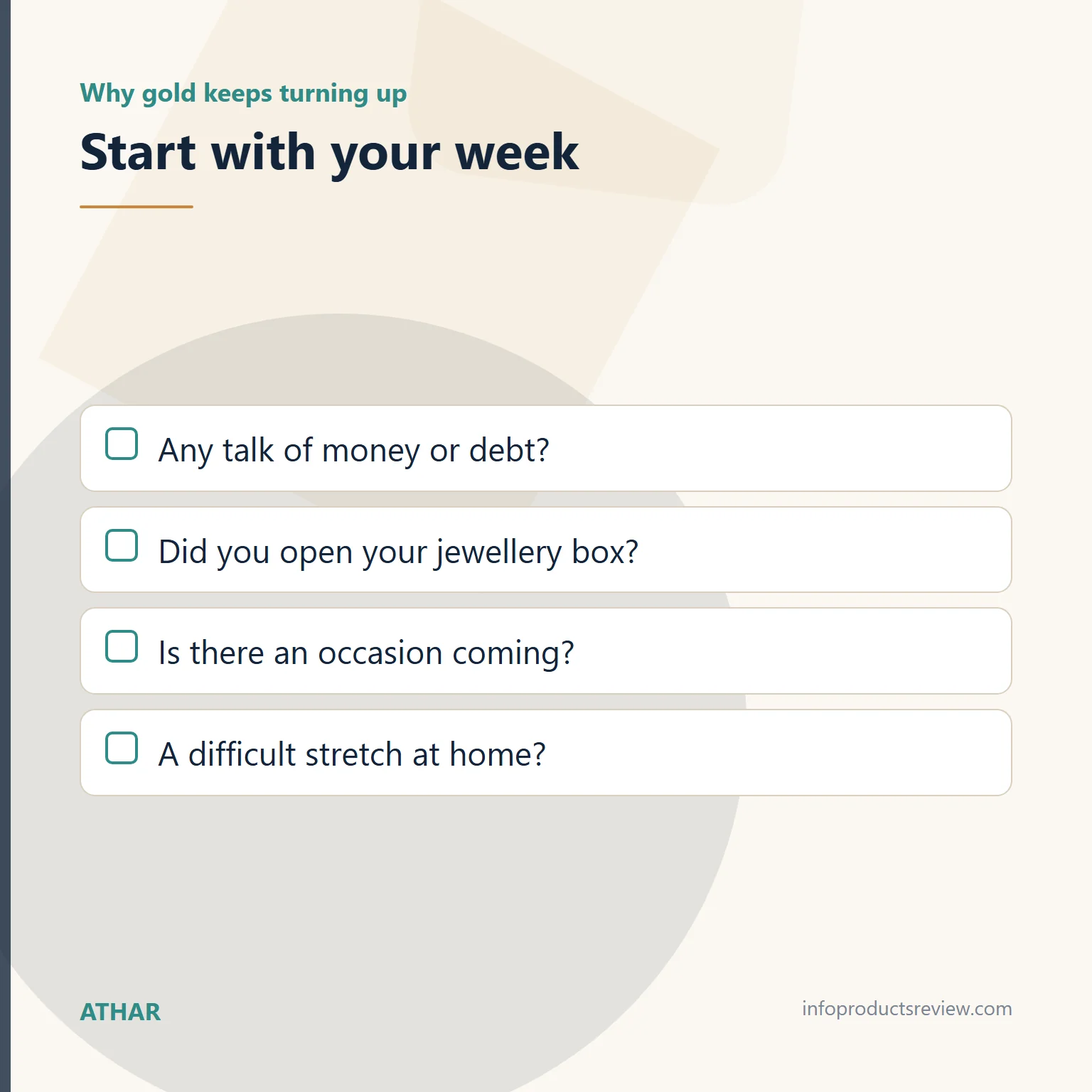
So start with your week:
- Has there been talk at home about money, a debt, or an unexpected expense?
- Have you opened your jewellery box recently, or thought about selling something?
- Is there a wedding or an occasion coming where jewellery gets worn?
- Have you had a row or a difficult stretch with your husband or his family?
If any of that rings true, the dream is most likely an echo of it rather than a message waiting to be decoded. If gold played no part in your days and the dream was vivid and detailed, the rest of this page will help you make sense of it.
Does being married change what gold means?
The direct answer: there is no separate chapter for married women in the books of dream interpretation. What they discuss is the piece itself — a bangle, a necklace, an earring, an anklet, gold worked and gold raw.
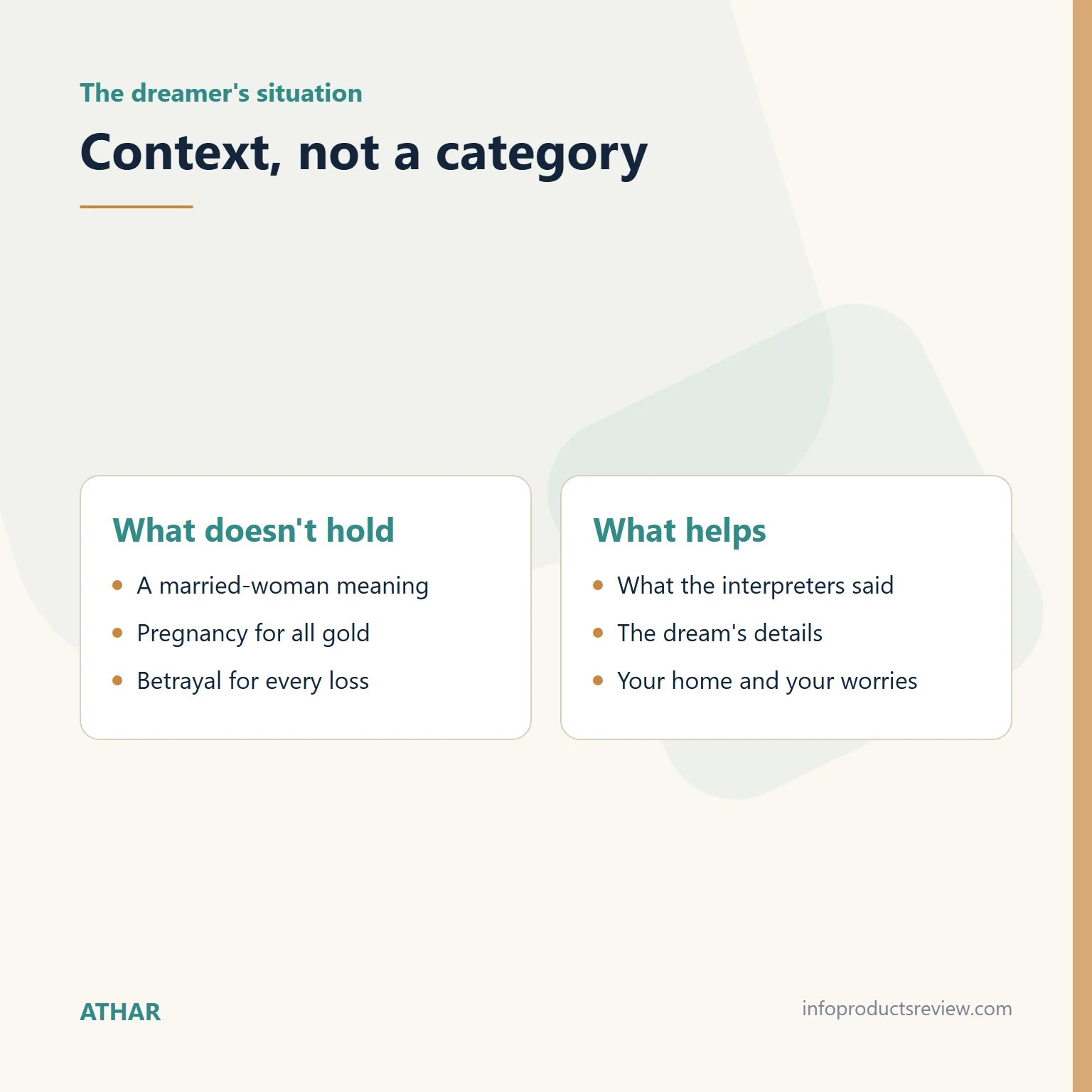
The popular pages, meanwhile, hand married women ready-made meanings: gold means pregnancy, or infidelity, or money coming from your husband. Those are additions you will not find in the old books.
There is one line that comes close to your question, the one that mentions a husband, and the next section takes it apart slowly. Everything else is general to women rather than specific to married ones.
That doesn’t make your situation irrelevant. One of the well-known principles of interpretation is that meaning shifts with people’s circumstances and standing, and that the dreamer’s own state is looked at before any general reading.
“Your state” means your real circumstances: your home, what you’re carrying, what occupies you now. That differs from one woman to the next, however many of you are married.
A woman running a house with small children isn’t in the same place as one whose children have grown up and left. A woman in a tight financial stretch isn’t in the same place as one preparing for her daughter’s wedding. Same piece of jewellery, different life, different closest meaning.
So this page works in three steps:
- What the books say about gold and jewellery, we set out as they say it, with nothing added.
- What they say about husbands and women, we keep within its limits.
- What they don’t cover, like selling, losing or a gift, we don’t invent a meaning for. Instead we help you read it through the dream and your feelings.
You dreamed of a bangle: does it point to your husband?
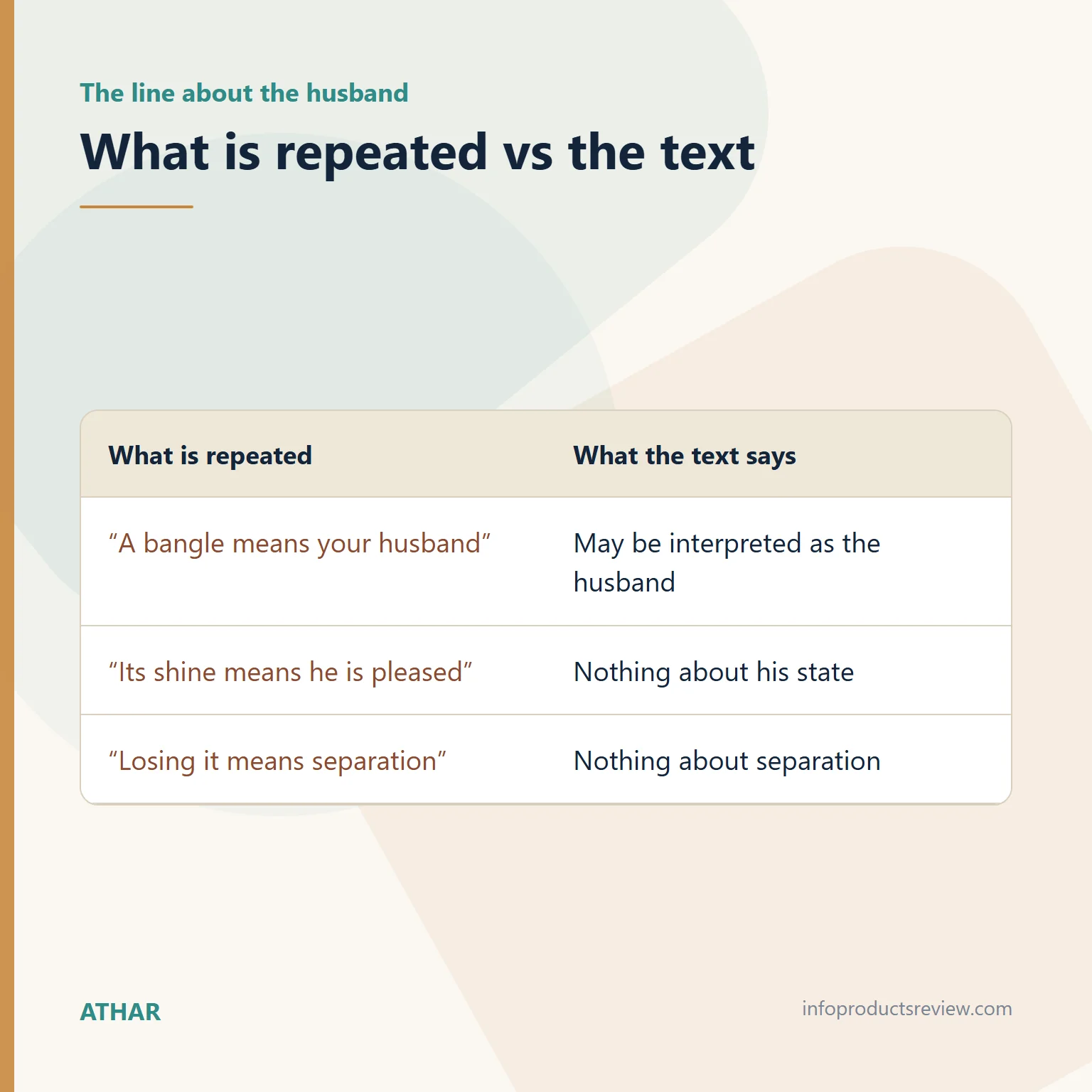
This is the line in the books that comes nearest your question, which is why it deserves to be read slowly. What it says is that an anklet or a bracelet “may” be interpreted as the husband specifically.
It sits in the middle of a passage about bracelets and anklets, just before the lines on worked and unworked gold. In other words it is a line describing a piece of jewellery, not a chapter describing a marriage.
Read it as it stands, because it carries four limits that go missing in most retellings.
First, “may”. The word marks a possibility, not a verdict. Not every anklet is a husband, and not every bracelet.
Second, it says nothing about how the husband is. The sentence says the piece may stand for him. It doesn’t say that a bright bangle means he’s pleased with you, that a broken one means a quarrel, or that losing it means separation. Those are additions with no source behind them.
Third, it sits inside a general passage about jewellery, after readings addressed to a man seeing these pieces on himself. It is not a passage about married life.
Fourth, interpretation as a whole is conjecture. It works by likeness and analogy. You can take comfort from it, but you can’t treat it as settled, and nobody can swear that your dream will turn out the way someone read it.
So if you dreamed of a beautiful bangle on your wrist and felt at ease, you can take it as a good image of your home, without building a judgement on it. If it was tight and hurt, the more useful question is what’s pressing on you at the moment, not what your husband might be hiding.
This page’s rule: a dream is not evidence against anyone
The most damaging thing built on married women’s gold dreams is suspicion, of a husband or of his family. A woman reads that losing gold means betrayal, or that broken gold means divorce, and then starts reading every ordinary thing he does as confirmation.
So let’s be plain: the dream books don’t make a gold dream evidence of betrayal, divorce or bad intent. A dream can’t serve as testimony about a person, and no accusation should ever be built on one.
If something in your home genuinely worries you, the way through it is a direct conversation, or advice from someone you trust — not a dream interpretation.
One question can help before you judge anyone: if I hadn’t had this dream, would I suspect this person? If the answer is no, the dream hasn’t added any evidence. It has only added fear.
Which piece did you see? The meaning shifts with it
The books go piece by piece and give each one its own reading, and those readings are general to women rather than specific to married ones.
We set them out at length in Dreaming of Gold as a Single Woman. Here they are in brief, with what touches your household.
A necklace
A necklace in the books of interpretation is an office and a trust: a responsibility you take charge of, and something placed in your hands. It is one of the clearest jewellery readings, and one of the most useful for a woman running a home.
In that life, a trust is a familiar picture: children, money, a confidence kept, a household managed. It may also be work outside the home, or the care of an elderly parent.
A light, beautiful necklace sits close to a responsibility you’re carrying well. One that chokes you invites a different question: what’s being loaded onto you beyond what you can carry?
A necklace doesn’t mean a position is coming your way, and a necklace falling off doesn’t mean you’ll lose something. Interpretation gives a direction, not news about tomorrow.
Bracelets and anklets
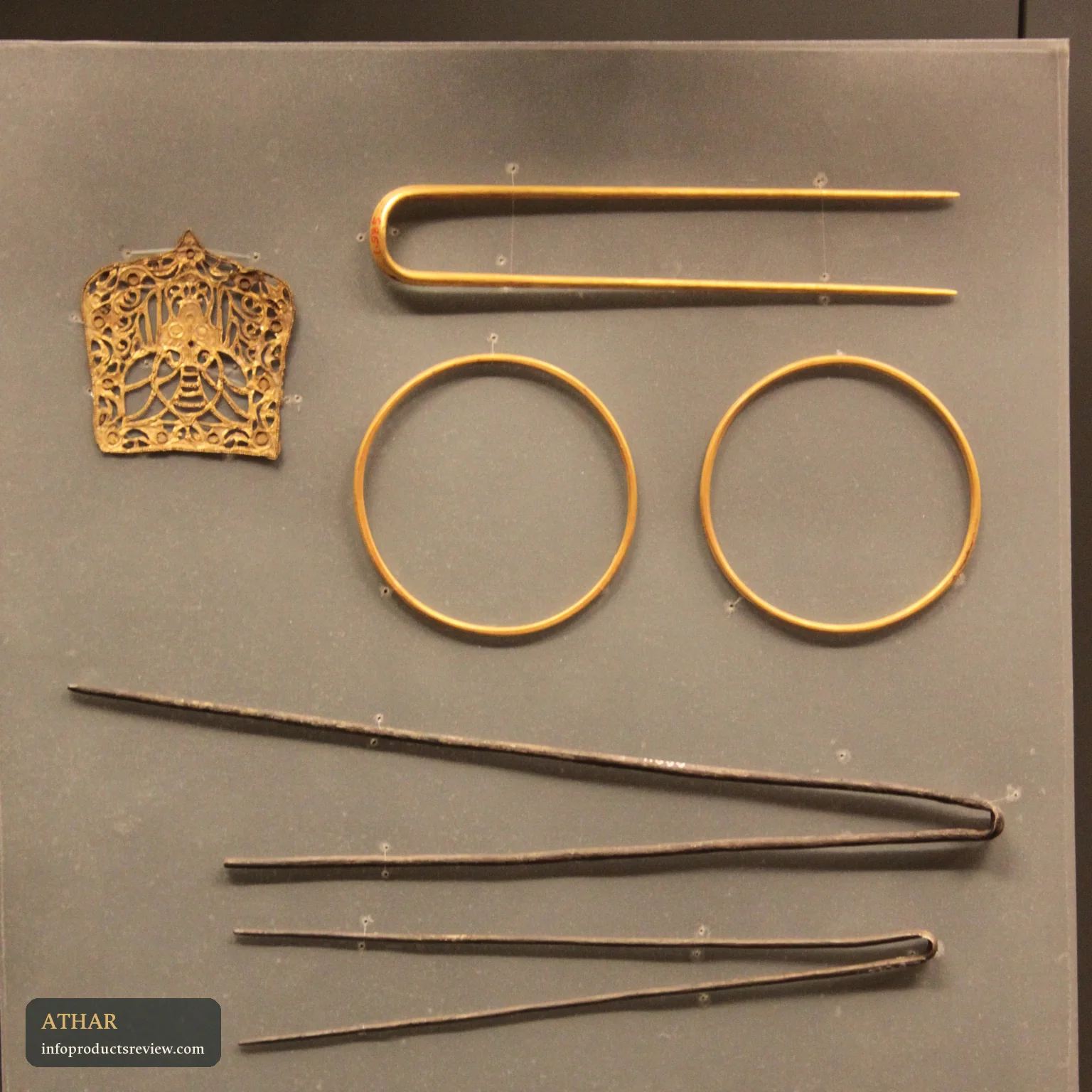
This is where the husband line belongs, and you’ve already met it. But there’s one point here that worries a great many women for no reason at all.
The books do carry harsh readings for bracelets and anklets: that the wearer meets with something unpleasant in what his hands own, or with fear, imprisonment or restraint. Those readings were written about a man seeing them on himself, not about a woman.
The passage then closes with a reassuring line: all jewellery is good for women. So the general picture of a piece of jewellery in a woman’s dream is a good one, not a frightening one.
Don’t take on a reading that was written about someone else. What remains for you is three things: the image, the feeling and the context.
The calmer way to see it: a beautiful bangle on your wrist is a pleasant image of adornment. If it was tight and painful, or you couldn’t get it off, the dream may be about something that constrains you by day — a heavy commitment, time that isn’t yours, a decision you can’t change.
Earrings
Earrings,in an old report, are adornment and beauty among people. Earrings sit close to the face, which is why they were read as how you come across to others.
That suits a woman whose mind is on how she’s seen: in the family, at work, at a coming occasion. The reading here is about your image in the eyes of those around you, not about your money.
If you wore lovely earrings at a family gathering and felt at ease, the nearer reading is good standing among people. If an earring fell off in front of them, the books give that no specific meaning, and the embarrassment you felt is the part worth noticing.
Your wedding ring
If the dream was about your wedding band, worn, lost or broken, that scene has its own page: Dreaming of Your Own Wedding, which covers what the dream books say about rings. We won’t repeat it here.
The household’s gold: worked, raw and saved
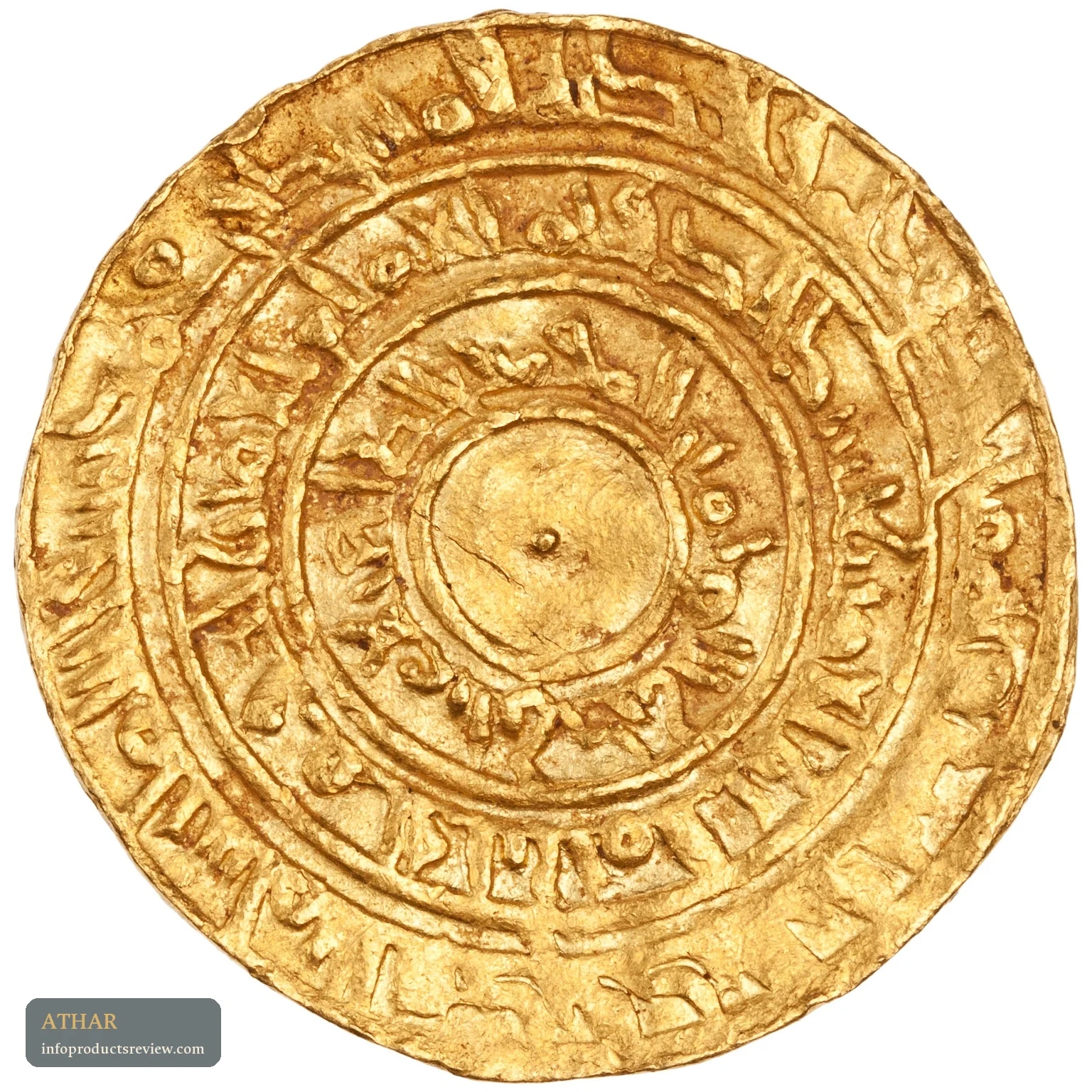
Many married women’s dreams aren’t about a piece being worn but about gold being kept: a small bar for savings, coins in a box, jewellery bought in a better year.
Here an important distinction in the books becomes useful: worked gold against unworked gold. Gold that hasn’t been crafted into a piece is read as a loss, something that ends up owed, while a crafted piece is lighter in that sense.
The reasoning is linguistic. In Arabic, the word for gold, dhahab, sounds like the word for going away, dhahab. Once gold is crafted into a piece, it takes on another name — necklace, bangle, earring — and the sense of loss weakens.
An old report carried in the books says that one of the early interpreters disliked gold unless it was crafted, and disliked raw white silver unless it was worked into something. The principle is the same either way: raw metal reads more heavily than a finished piece.
That link between gold and going away is old and well known. Ibn Hajar records it in Fath al-Bari from the scholar al-Muhallab, who explains a dream the Prophet ﷺ had: that this dream isn’t to be taken literally, that it is a kind of parable, and that because the word for gold comes from the word for going away, the Prophet ﷺ understood it as something that would leave him.
Here is the story in brief, as Sahih al-Bukhari records it (hadith 7034). The Prophet ﷺ saw in his sleep two gold bracelets placed on his hands. He disliked them, was permitted to blow on them, and they flew away. He understood them as two liars who would appear.
The bracelets were a symbol in a dream particular to the Prophet ﷺ, with its own setting and its own explanation. They can’t be turned into a rule for everyone who dreams of gold.
The practical upshot for you: if what you saw was a bar or unworked metal, the books read it more cautiously than jewellery. That reading rests on a word and its sound, and it isn’t news of a loss that has happened.
Even so, a dream is no financial adviser. A bar of gold in your sleep doesn’t set the price of gold in the morning, and buying and selling decisions belong to your own arithmetic.
Coins: when the dream is about money, not jewellery
If your dream had more cash in it than jewellery, the books give coins separate readings, carried with chains of narrators from the earliest interpreters.
In short: sound coins are good speech, and poor ones are bad speech. Dinars are documents that arrive, or deeds a person takes into his hands — papers and undertakings. And coins handed over in a purse mean a secret entrusted to you.
Notice that these are about speech, disputes and trust far more than about wealth. They are about as far as you can get from the promises of riches that fill the popular pages.
Reading a single coin as a child also comes with “may”. It’s a stated possibility, not news of a pregnancy or a sign of one. We’ll come back to that below.
Why include coin readings on a page about gold? Because so many married women’s dreams mix jewellery and money: a box holding both, selling a piece and taking the price, the end of the month showing up at night as a handful of coins.
Once you know that the books read coins as speech and dinars as documents, you have a measure for spotting the exaggeration in any page you read.
The same caution applies: these are interpreters’ judgements, not reports of the unseen. Poor coins in a dream don’t mean a quarrel is on its way, and sound ones aren’t a basis for a decision.
If your dream was mainly about money, Money in a Dream goes into more detail.
What does it mean if your husband gives you gold?
One of the commonest scenes is your husband holding out a piece of gold. The books give a husband’s gift no specific meaning, so don’t expect a ready-made answer from them.
The scene itself raises real questions, though, and they’re more use to you than any symbol:
- Did it come after a quarrel? Reconciliation scenes turn up often after tense days, and usually reflect what you’re hoping for or expecting.
- Did the piece resemble something real? If you’ve talked about buying something, the dream is an echo of that conversation.
- How did it feel to take it? Joy, awkwardness, or the sense that it was compensation for something? The feeling is more truthful here than the symbol.
- What if you refused it? The books give that no meaning, and it isn’t read as rejecting him. Ask instead what you don’t want to accept at the moment.
A gift in a dream isn’t news about his intentions or the state of your marriage. A dream can’t see into anyone’s heart.
It’s worth separating two scenes that get confused: him giving you gold, and him taking gold from you. The first is a picture of giving, the second of loss.
The second often appears when something feels as though it’s being drawn out of your hands: your time, your rest, your say over your own money. That describes your feeling; it isn’t a report of anyone’s behaviour.
Even then, the way through is to read the feeling, not to accuse the person. A woman who dreams her husband took her bangle and then picks a fight about it in daylight has wronged herself and him over a dream.
If the gift in the dream was a bridal set or wedding-night gold, that’s a scene about the wedding itself, which has its own page, so we won’t go over it again here.
Buying gold, or saving with it
In many homes gold is bought as savings rather than adornment: something kept for a hard time, a coin added each year, a bangle bought after a good month. So the buying scene shows up often.
The books give buying gold no specific meaning, so read the scene by what’s in it:
- You bought it with your own money. If you work or manage the household budget, the image sits close to your sense of being able to provide.
- You bought it together. A picture of a shared decision, common when there’s real talk at home about buying or saving.
- You hesitated. Often an echo of a genuine choice between many needs and limited money.
- The price was shocking. An ordinary dream at a time when prices are all anyone talks about.
Keep the distinction you met earlier in mind: a crafted piece reads more lightly than a bar or raw metal. But that doesn’t make a dream your financial adviser. Whether to buy or sell rests on your numbers, not your sleep.
Gold you keep but never wear
Some women dream of pieces that have sat in a box for years: a wedding gift never worn, something too heavy for daily life, inherited jewellery never used. It’s a common dream, and the books give it no specific meaning.
The more useful question: what in your life is stored away and unused? A skill you learned and set aside, a friendship never picked back up, a plan on hold since last year.
Or it may not be symbolic at all: you opened that box a few days ago. More often than not, the whole thing is simpler than it looks.
Is silver better than gold in a dream?
This question comes up a lot, and the answer needs care. The comparison between the two metals does exist in the books, but it wasn’t made in the lines about women.
In the passage on bracelets there’s a sentence saying that if the bangle is silver “it’s better than gold”, and that sits inside the section addressed to a man, as you saw above. A little later comes the line that dirhams are better than dinars — and dirhams are silver while dinars are gold.
So does that mean silver is better for women too? We won’t say so, because the books don’t. There are only two things worth taking from it.
The first is that the comparison exists where it stands. The second is that it wasn’t made in the lines about women, where all jewellery is said to suit them.
So if there was silver in your dream, read it as the image it was, and don’t turn it into a verdict on your gold. Carrying a meaning from one place to another is the single quickest way to ruin a dream reading.
Gold lost or stolen from the house
Few dreams unsettle a married woman more than seeing her gold gone or taken from her home. The books give losing gold, or having it stolen, no specific meaning, so read the scene by what it contains:
- What went missing? Something of yours, the household’s gold, or something belonging to your children?
- Where did it happen? In your own home or somewhere unfamiliar? Scenes set at home often carry your sense of safety there.
- Who was in the scene? If you saw someone you know taking it, the rule above applies: no one is accused over a dream. Familiar people appear in these dreams because they’re in your mind, not because they did anything.
- Did you find it by the end? A dream that ends with finding what was lost feels very different from one that ends mid-search. The ending is part of the dream.
- Are you actually afraid of losing something? It may be a real piece, or something bigger than gold: stability, health, a relationship.
And if the gold that vanished was a gift you treasure, don’t turn it into news about your bond with whoever gave it. Fear of losing something precious shows up in sleep as the loss itself, and that doesn’t mean it will be lost.
Gold for your children, or gold you inherited
Some mothers dream of gold being set aside for a growing daughter, or of jewellery inherited from a mother or grandmother. The books give neither scene a specific meaning.
Both are usually pictures of care and memory: the first about thinking ahead for your children, the second about longing and the bond with someone who has died.
If you saw your mother’s jewellery on your own wrist, the likeliest reading is that she’s on your mind, not that she’s sending you a message. Dreams of the dead are their own subject, quite separate from jewellery.
These scenes often arrive at particular moments: before a wedding in the family, around an anniversary of a death, or after you’ve opened an old box and found a piece you hadn’t seen in years.
There’s nothing in them to worry about, and nothing to build an expectation of an inheritance on. If there’s a real dispute in the family over an estate, it’s settled by rights and accounts, and no one should cite a dream in a money matter between people.
Wearing gold in front of your in-laws
Seeing yourself wearing gold among your husband’s family, or at a family gathering, is a social scene at heart. The truer question is how you felt while you were there.
Proud, self-conscious, or waiting to be judged on how you looked? Your answer to that brings you closer to the dream than any symbol will.
The reading of earrings as adornment and beauty among people fits this scene exactly, because it is a scene of being seen. It doesn’t mean anyone envies you, or that there’s something hidden in anyone’s heart. A dream doesn’t report on that.
Gold among the women of the family
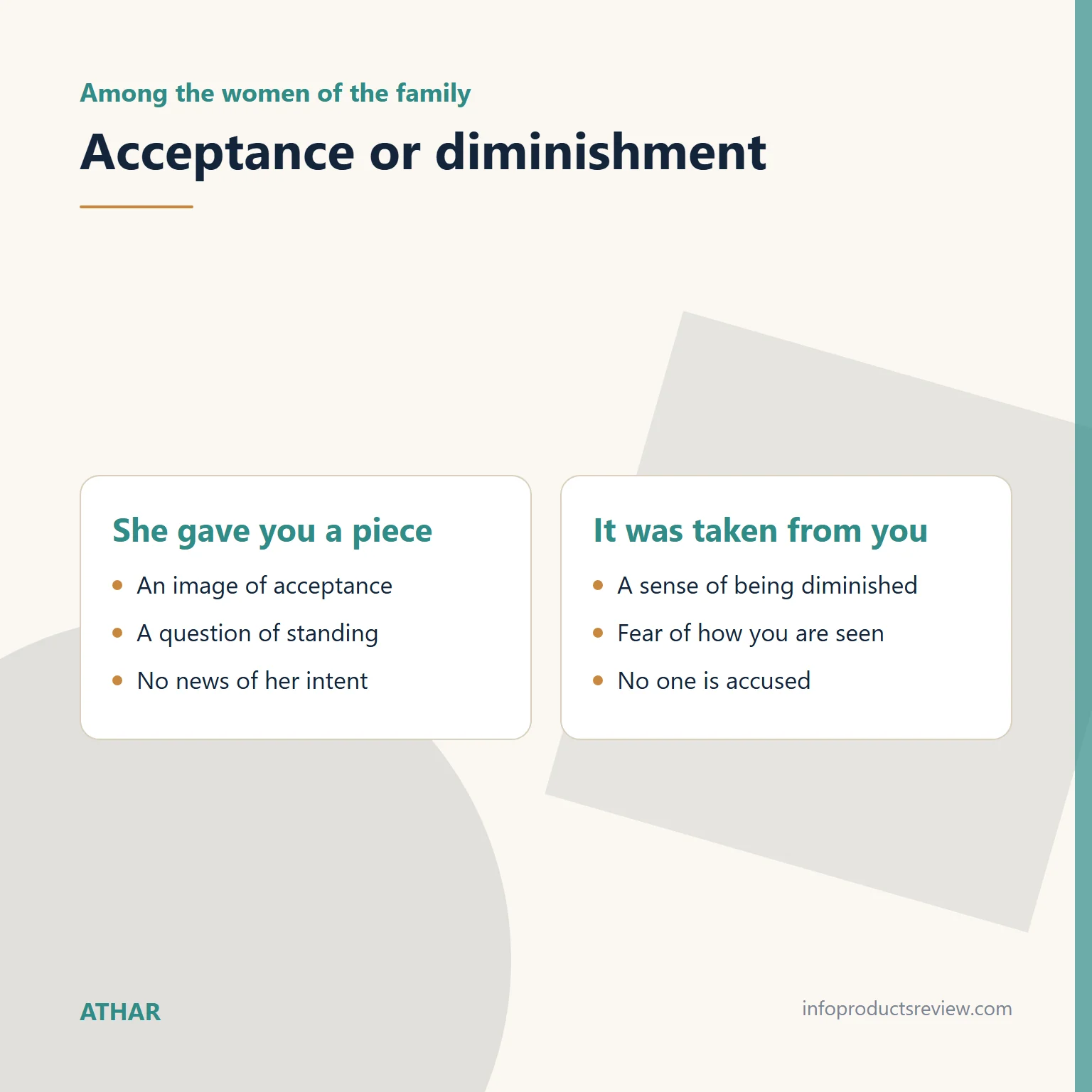
Many of these dreams take place among women: your mother opening her box, your mother-in-law giving you a piece, your sister-in-law wearing what you’d wanted.
The books give these particular scenes no specific meaning, but they usually carry a question about where you stand in those relationships.
If one of them gave you jewellery and you felt accepted, the image sits close to an approval you hope for or already have. If a piece was taken from you in front of them, the nearer reading is a feeling of being diminished, or a fear of how you’re seen.
In neither case is the dream news about a particular woman’s intentions, or a sign that she envies or loves you. Suspicion built on a dream is a door we don’t open here.
Keep in mind that these women appear in your dreams because they’re present in your days, not because the dream is telling you something about them.
Does gold mean pregnancy, or the baby’s sex?
No. We’ll say it plainly, because it’s among the most asked questions in this whole subject, and among the ones that do women the most harm.
The books don’t link gold to pregnancy. The nearest reading in them is that a single coin “may” be a child, phrased as a possibility.
And there’s a wide gap between “a single coin may be a child”, said while describing a coin, and “this dream announces a pregnancy”. The first reads a symbol; the second claims knowledge of the unseen.
The same books contain a sentence that common accounts treat as revealing the baby’s sex. We leave it out on purpose, because it predicts the unseen, and no woman expecting a child should be handed that as if it were knowledge.
Anything about a pregnancy or a baby’s health belongs with a doctor, not a dream book. If you’re pregnant and dreamed of gold, there’s a page for that: Dreaming of Gold While Pregnant.
Fake gold, or gold that changed colour
Discovering in the dream that your gold is counterfeit, that it’s gone dark, or that a piece is far too light, leaves a clear aftertaste: disappointment and doubt. The books give it no specific meaning.
The closer reading is to ask what recently looked lovely and turned out otherwise: a promise not kept, flattery that meant nothing, an expectation that didn’t hold.
It shouldn’t be read as a verdict on a particular person, or as an accusation that a husband or relative is lying. The dream describes your feeling; it doesn’t expose anyone.
Selling gold, or borrowing against it
Dreams of selling gold are common in tight times, and the books give them no specific meaning. The reading starts inside the dream itself.
Ask yourself: did you sell freely for a clear purpose, or under pressure and in tears? The first is closer to a decision you’re weighing; the second to a fear of hardship.
Many women have this dream in a month heavy with commitments. That doesn’t mean hardship is coming, or that what you sold will be lost. And if you do decide to sell something in real life, let the decision rest on the numbers, not on a dream.
If you dreamed of pawning your gold or borrowing against it, ask yourself: is there a debt at home that’s on my mind? Am I afraid of needing something and not having it? The answer sits closer to your dream than any stock meaning.
Gold in a new house, or while moving
Some women see gold in a house they don’t recognise, or while packing and moving. The books give this scene no specific meaning.
But a house in a dream often carries your sense of stability, so a tidy, comfortable one feels quite different from a chaotic place whose doors you don’t know.
Three questions help here. Are you actually facing a move or a change? Do you feel unsettled where you are? Have you been sorting through things and come across old pieces?
Those answers sit closer to your dream than any ready-made meaning from a page that knows nothing about you.
Seeing yourself with no gold among women who have it
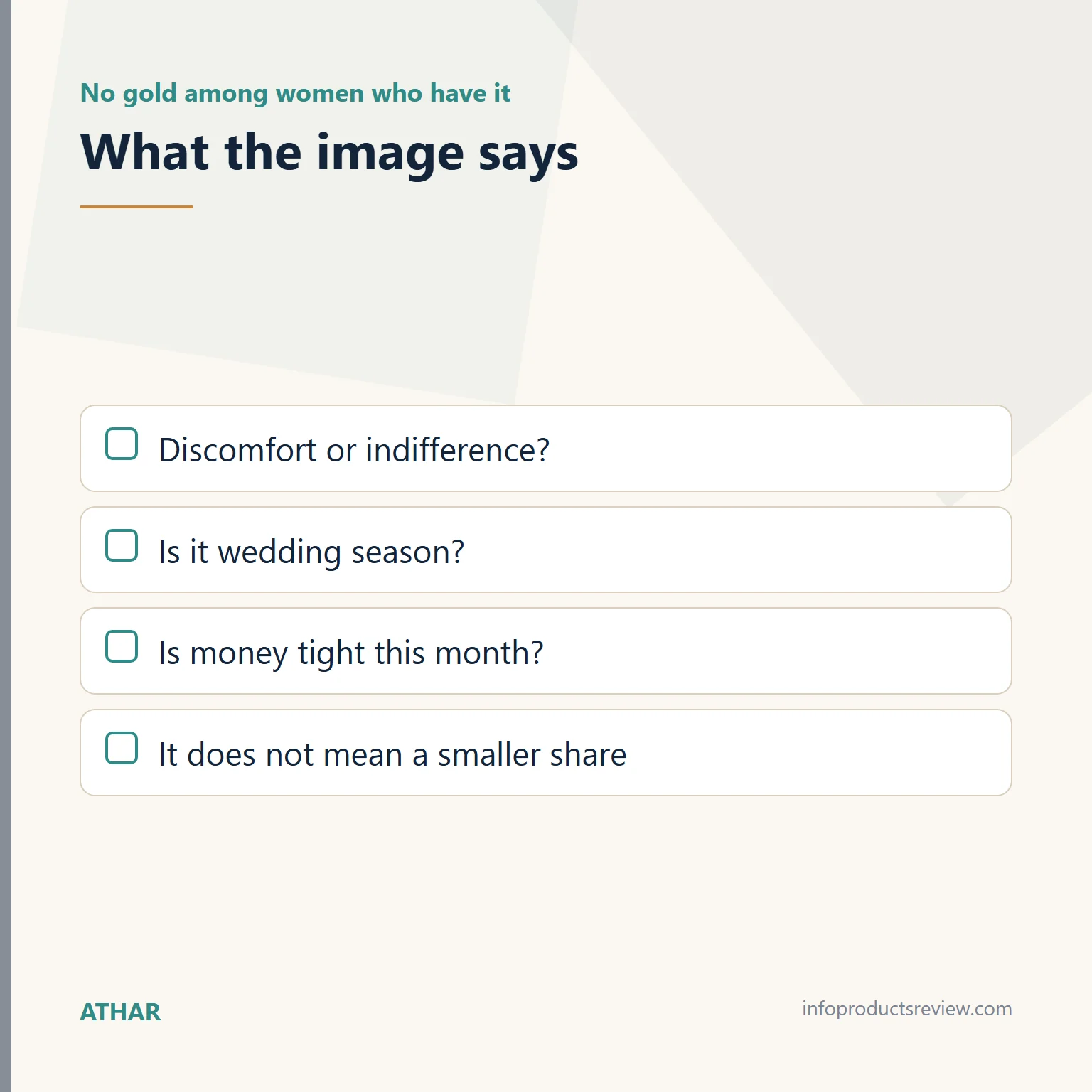
This one recurs in wedding season: women all around in gleaming jewellery, and you with nothing. The feeling is the message. Was it discomfort, indifference, or relief?
It may echo a real social comparison, a financial squeeze, or simple fatigue with what occasions demand.
It doesn’t mean your share is smaller, or that anyone has taken what was yours. Interpretation is conjecture, and what fills your heart is usually what shows up in your sleep.
Jewellery too heavy to carry
Another recurring image is weight: a necklace dragging at your neck, bangles filling your arm so you can’t move it, a heavy crown. The books give the weight of jewellery no specific meaning.
The image speaks for itself, though, and it usually accompanies a familiar waking state: too much asked of you, tiredness you won’t admit to, a role you play because it’s expected rather than chosen.
The reading of a necklace as something entrusted fits well here: what’s hung round the neck is carried, and what’s carried can weigh.
The distinction matters. Saying “this dream describes your sense of burden” is one thing; saying “this dream warns of disaster” is another, and nothing supports it. We stop at the first.
When the dream keeps coming back
Women often ask about repetition: the box opening every time, the bangle lost night after night. Repetition by itself isn’t proof that a dream is true or that something is near.
It’s more useful to look at what repeats alongside it while you’re awake. A dream that recurs in a month of money pressure, an ongoing argument, or a wait for results looks very much like an echo of that pressure.
If the repetition is disturbing your sleep, the way to handle it starts with what’s disturbing your rest and your mind, not with collecting more interpretations.
The Sleep Foundation notes in its guide to nightmares that sad, traumatic or worrying situations can bring on distressing dreams.
That’s about sleep in general, not a reading of gold as a symbol. But it’s a reminder that a dream repeating through heavy days is usually an echo of the weight of those days rather than something chasing you.
When someone gives you a frightening interpretation
You tell a relative or a group chat about the dream, and back comes a verdict: that’s betrayal, that’s magic, that’s a separation coming. And it can sit in your chest for weeks.
What protects you is a principle from the dream books themselves: interpretation is analogy and conjecture, never certainty. Anyone who states the unseen with confidence has gone past what the people of this field allow.
That’s why this page says “may”, “the closest reading”, and “the books give it no specific meaning”. Not because there’s no answer, but because that is the honest answer.
If an interpretation you heard upset you, follow the etiquette for an unwelcome dream, set out at the end of this page: seek refuge, stop talking about it, and turn to something else. Then look at your day rather than your night.
Should you tell your husband?
Sahih al-Bukhari (hadith 7044) teaches that a good dream is shared only with people you love, and that an unpleasant one isn’t told to anyone. The full wording is in “What to do after the dream” below.
At home there’s an extra reason for this: a frightening dream passed to your partner becomes two people’s worry, and can grow into suspicion or a quarrel with nothing behind it.
If the dream touches something real between you, talk about the real thing: the money, the exhaustion, whatever is bothering you, without mentioning the dream. A conversation about the problem is worth more than one about its symbol.
How the dream felt
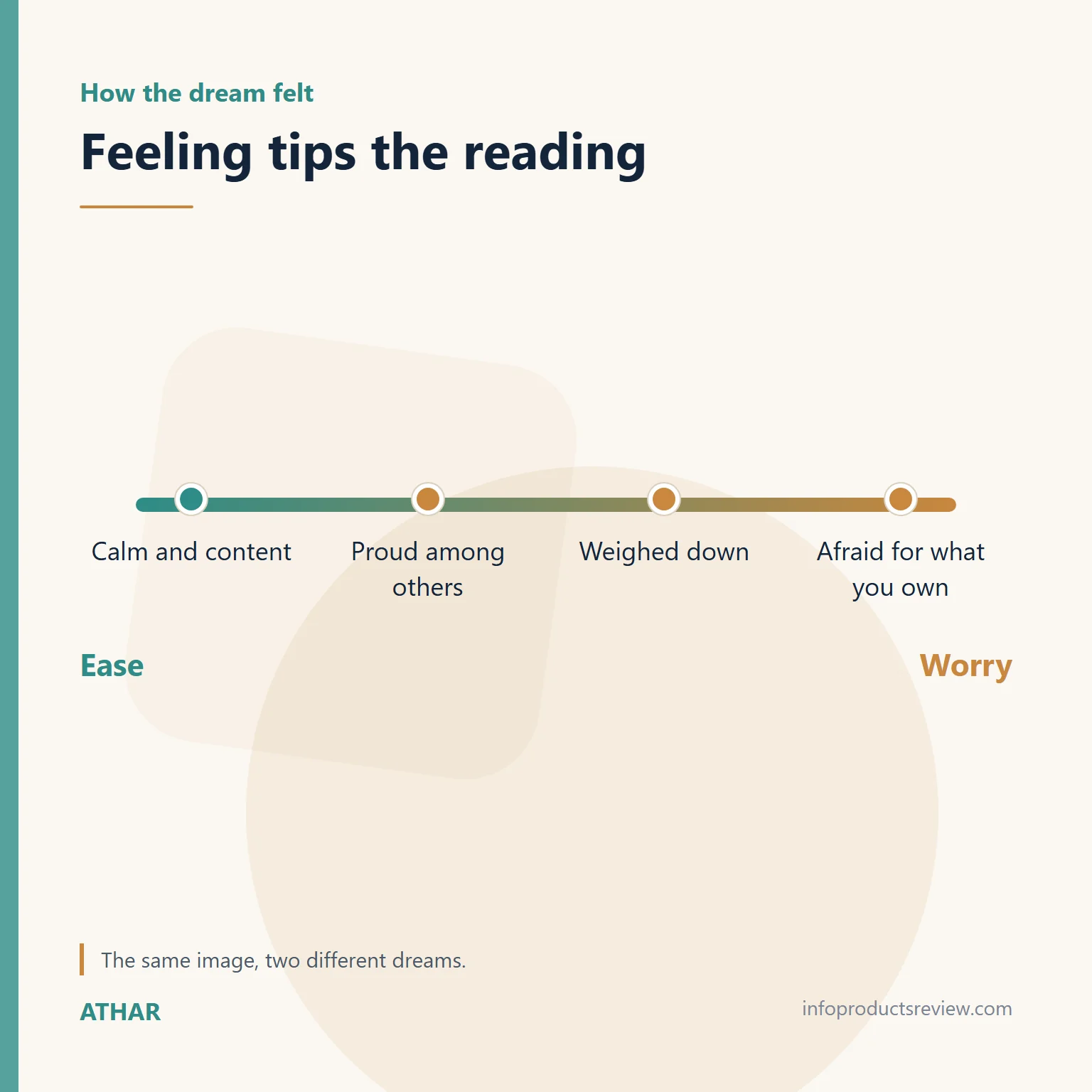
If you take one tool from this page, make it the question of feeling. The same image can carry two entirely different dreams:
- Calm and content: closest to the general picture of jewellery in a woman’s dream, which is a good one.
- Proud among others: close to the reading of earrings as adornment and beauty among people.
- Weighed down: possibly about responsibility, or about what’s expected of you.
- Afraid for what you own: possibly financial worry, or fear for the stability of your home.
- Indifferent: the gold may have been a passing detail in a dream about something else entirely.
This isn’t a replacement for the dream books. It’s what they say themselves when they hold that meaning shifts with the circumstances and with the state of the dreamer.
What this dream can’t tell you
It’s only honest to gather in one place what a dream can’t tell you, so you don’t ask more of it than it can give:
- It can’t indicate betrayal, divorce or separation.
- It can’t announce a pregnancy, a baby’s sex, or a baby’s health.
- It can’t guarantee money or warn of poverty.
- It can’t detect magic, envy or anyone’s intentions.
- It isn’t evidence in a family dispute, or a basis for buying or selling.
Everything beyond that is a possible meaning, read calmly and understood alongside your own life. A dream opens a door for thinking, not a file of verdicts.
What to do after the dream
If it was a lovely dream, thank God, share it with someone you love if you like, and don’t turn it into a waiting game. If it was upsetting, the Sunnah gives clear steps. In Sahih al-Bukhari (hadith 7044), from Abu Qatada:
A good dream is from God. If one of you sees something he likes, let him tell it only to someone he loves. And if he sees something he dislikes, let him seek refuge in God from its harm and from the harm of Satan, spit lightly three times, and not tell anyone about it, for it will not harm him
And in Sahih Muslim (hadith 2262), from Jabir, with a little more detail:
If one of you sees a dream he dislikes, let him spit to his left three times, seek refuge in God from Satan three times, and turn over from the side he was lying on
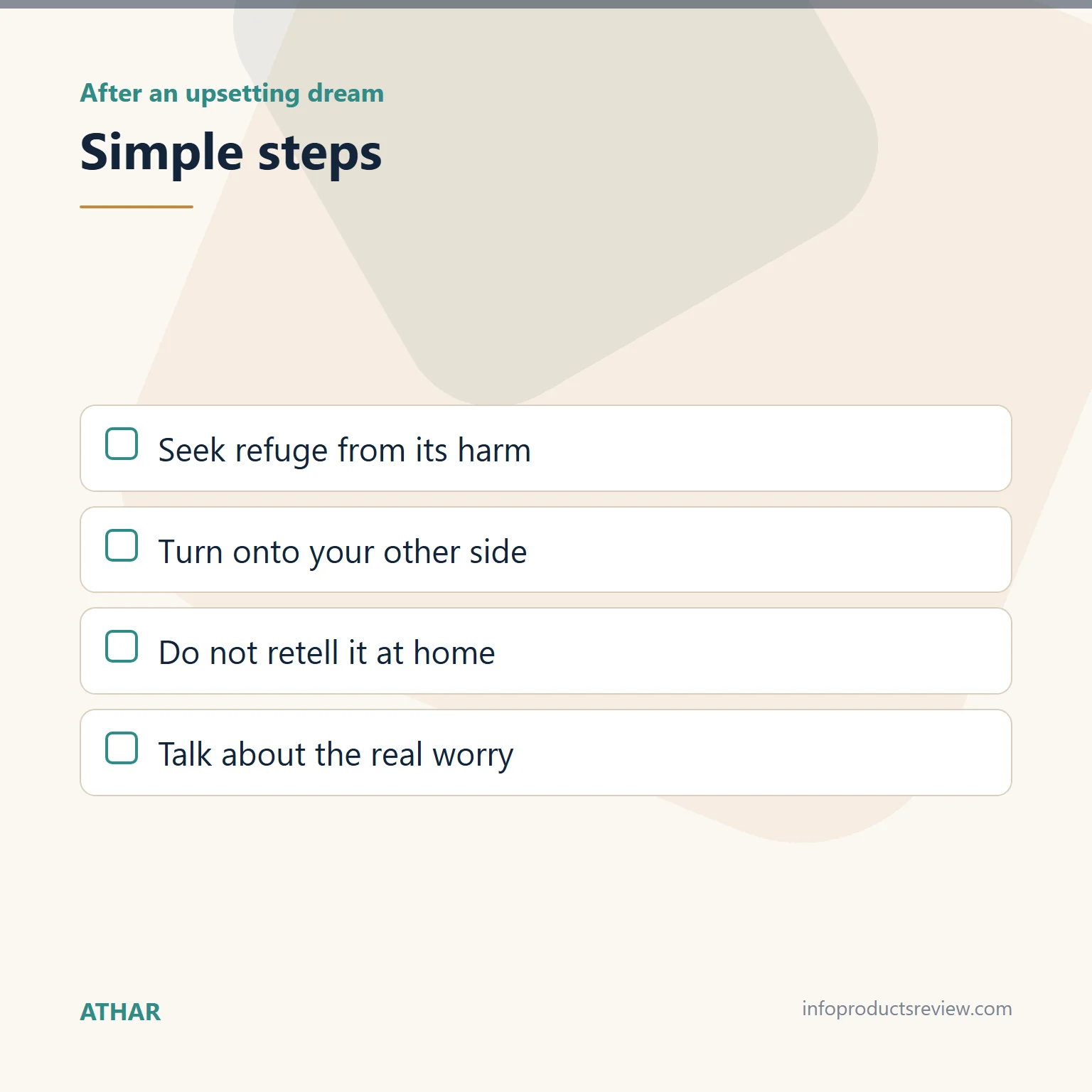
In practice: a good dream is something you can share with people you love. With an unsettling one, you seek refuge in God from its harm, spit lightly to your left three times, turn over from the side you were lying on, and don’t tell anyone about it.
Bukhari’s wording ends with plain reassurance: “it will not harm him.” So there’s no need to chase an upsetting dream with online searches. The steps, gathered:
- Seek refuge in God from the harm of what you saw.
- Spit lightly to your left three times, and turn onto your other side.
- Don’t retell an upsetting dream, especially at home, so it doesn’t become a shared anxiety.
- Don’t go hunting for the worst reading online.
- If the worry lingers, talk about what’s actually worrying you with someone you trust.
When it’s just the mind talking to itself
Interpreters distinguish between a dream that calls for interpretation and what they call hadith al-nafs, the self talking to itself: the desires and feelings a person holds back, which wake up in sleep and carry no interpretation at all.
Dreams about the household’s gold sit very close to this, because for many families gold is tied up with money, saving and occasions.
If your day’s conversation was about a price, a debt or a wedding coming up, the dream is most likely its echo. There’s nothing wrong with that, and it needs no far-fetched meaning.
What if you don’t remember the details?
Often all that’s left is a general impression: gold, a feeling, nothing more. That’s enough to work with.
If the impression was pleasant, be grateful and get on with your day. If it was heavy, seek refuge and don’t prolong the search.
Don’t fill the gaps with details you didn’t see. Nothing spoils the reading of a dream faster than adding to it: a colour that wasn’t there, a person who didn’t appear, a sentence nobody said.
How to describe your dream so it can be read
If you want to understand your dream, or ask someone whose knowledge you trust, a good description gets you halfway. When you wake, write down:
- What you saw: a bangle, a necklace, earrings, an anklet, a bar, coins?
- Was it crafted or raw?
- Whose it was: yours, your children’s, the household’s, inherited?
- What happened to it: worn, sold, lost, stolen, given to you?
- Who else was in the scene?
- How you felt.
- What’s occupying you at the moment.
With those details, the dream becomes something you can understand, and you’re less likely to accept a stock interpretation that knows nothing about you.
Examples
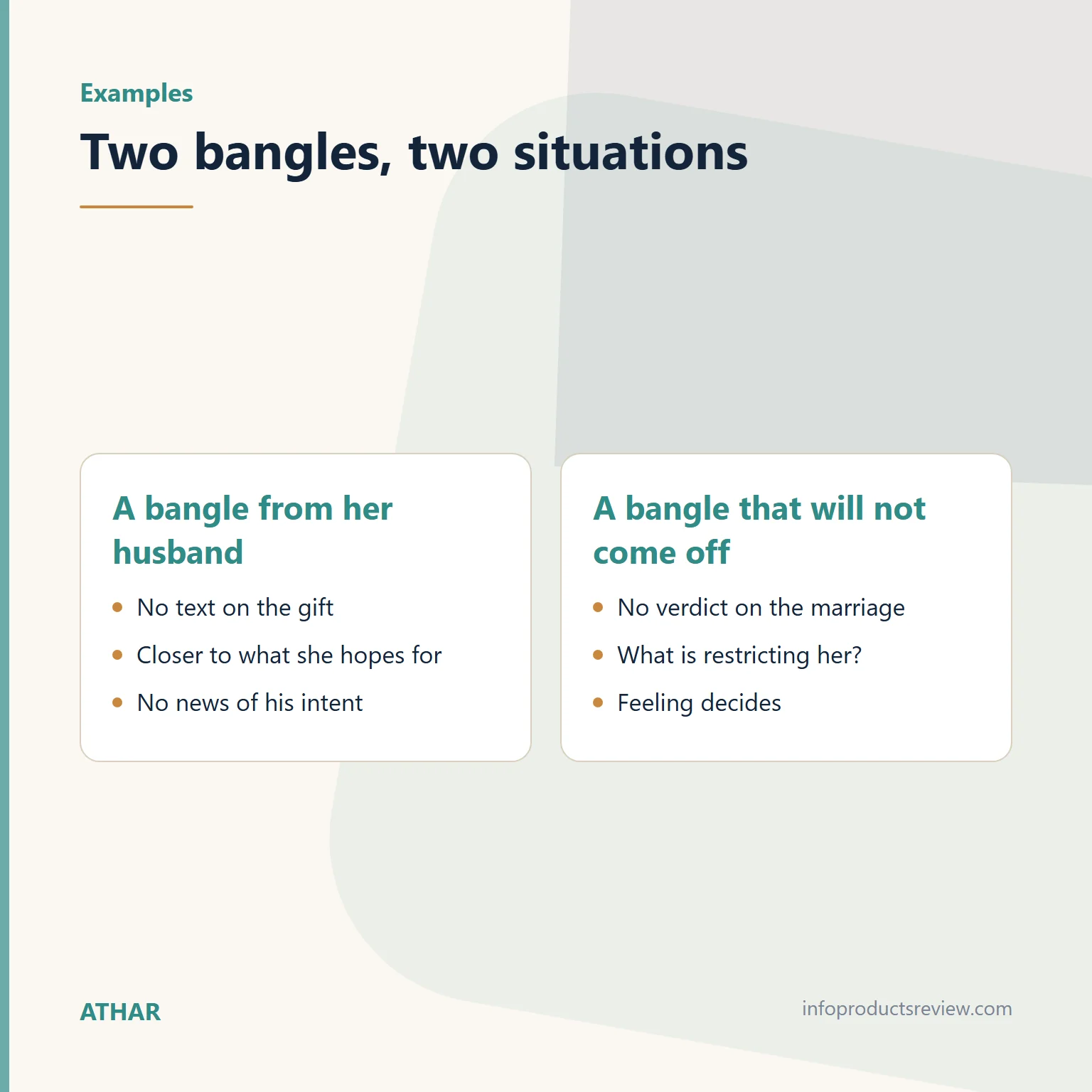
These are composite examples built from common scenarios, not readings of anyone’s actual dream. They show how the understanding shifts with the details and the dreamer’s situation.
Her husband gives her a bangle after a tense week
The books give a husband’s gift no specific meaning. The scene sits closest to what she’s hoping for after the tension. It isn’t news about his regret or his intentions.
She sells her gold in the dream to settle a debt
Selling has no specific meaning in the books. Most likely it’s an echo of a financial commitment on her mind. It doesn’t mean the debt will grow or the gold will be lost.
She finds her jewellery box empty
Loss has no specific meaning in the books. An empty box usually comes with fear about safety at home. She seeks refuge, accuses no one, and asks what she’s afraid of losing.
An anklet she can’t get off her foot
The books allow that an anklet may stand for the husband, but the harsh anklet reading was written about a man. The nearer question is what’s restricting her at the moment, not a verdict on her marriage.
She gives her jewellery to her daughter
Giving has no specific meaning in the books. It’s a picture of care and of things passing on, and it often appears as a daughter grows up or something concerning her draws near.
Good coins being counted at home
Sound coins, in the books, are good speech. Something to take comfort from around a conversation or an agreement at home, rather than a promise of money.
A relative wearing a great deal of gold
The books give this no specific meaning. The question is how she felt. Gladness is one thing, comparison another, and both are ordinary human feelings that say nothing about envy or about that relative’s life.
A gold dream after a long conversation about prices
Most likely the mind replaying the day, needing no symbolic reading.
Her mother-in-law places a bangle on her wrist
The books give this no specific meaning. The scene is closer to her question about acceptance and standing in her husband’s family. It isn’t news about her mother-in-law’s intentions or the future of their relationship.
Her gold has gone black in the box
A change of colour has no specific meaning in the books. The dominant feeling is disappointment or doubt. She can ask what looked lovely and let her down, without turning the dream into an accusation.
She wears all her jewellery at home, alone
The books give this no specific meaning. It may be about wanting to be seen and valued, or about a day when the work she does at home went unnoticed.
She sees her husband taking her gold to sell
The books give this no specific meaning, and no one is accused over a dream. This scene often turns up in months of heavy commitments, or when selling something has been discussed at home. A frank conversation about money is worth more than an interpretation.
Quick table: the detail and the closest reading
| Detail | What the books say | How to read it |
|---|---|---|
| Gold jewellery in general | All jewellery is good for women | A good image; feeling decides |
| Bracelet or anklet | “May” be interpreted as the husband | A stated possibility, not a verdict on the marriage |
| Necklace | Office and trust | Responsibility at home, by your situation |
| Earrings | Adornment and beauty among people | How you are seen |
| Unworked gold | Loss, taken from its name | With caution, not as news of loss |
| Coins | Speech, disputes and trust | About words, not wealth |
| Selling, losing or theft | No specific meaning | Through your household and feelings |
| Pregnancy or a baby’s sex | Nothing | Not to be inferred from a dream |
Related dreams
- Money in a Dream: Speech, Documents and Trust
- Dreaming of Gold as a Man: The Ruling, the Dream and the Difference
- Dreaming of Gold While Pregnant: What a Dream Can’t Tell You
- Dreaming of Gold as a Single Woman: Jewellery, Gifts and Loss
- Dreaming of Your Own Wedding: The Ceremony, the Contract and the Details
- Marriage Dream Meaning: A Complete Guide by Situation, Partner and Feeling
- ATHAR’s guide to dream interpretation
Frequently asked questions
What does gold mean in a married woman’s dream?
Gold jewellery in a woman’s dream is a good image in the books of interpretation, and married women have no separate entry there. The nearest line about husbands says a bracelet or anklet “may” be interpreted as the husband, which is a possibility rather than a ruling. The details and your feelings carry the weight.
Does losing gold in a dream mean betrayal or divorce?
No. The books give losing gold no specific meaning, and a dream can’t serve as evidence about anyone.
Is gold in a dream a sign of pregnancy?
The dream books don’t link gold to pregnancy. The line about a single coin possibly being a child is phrased as a possibility and says nothing about pregnancy or a baby’s sex.
What does it mean if my husband gives me gold in a dream?
The books give a husband’s gift no specific meaning. Look at the kind of piece and how it felt, and don’t ask the dream for news about his intentions or your marriage.
What does selling gold in a dream mean for a married woman?
Selling has no specific meaning in the books. Read it through the motive inside the dream and the commitments on your mind. It doesn’t mean poverty is coming.
I dreamed of a bangle on my wrist. Does it point to my husband?
The books allow that a bracelet or anklet “may” be interpreted as the husband. That’s a possibility; it describes neither his state nor your relationship.
Does broken gold in a dream mean a quarrel is coming?
Breakage has no specific meaning in the books. The feeling that came with it tells you more about what’s on your mind.
What do coins mean in a dream?
In the old reports the books carry, sound coins are good speech, poor ones bad speech, and dinars are documents or deeds. It’s about words and trust more than money.
Does the dream indicate magic or the evil eye in my home?
No. The dream books don’t make a gold dream a sign of either.
I saw my late mother’s jewellery. Is it a message from her?
The likelier reading is that she’s on your mind and you miss her. Dreams of the dead are a separate subject from jewellery.
Is gold read differently for a married woman than for a single one?
The books make no distinction between them. The difference lies in the questions and the context: a home, children and family money here; other questions elsewhere.
Is this interpretation definitive?
No. These are possible meanings that interpreters have given, along with what they don’t cover. Interpretation is conjecture you can take comfort from, not certainty.
In summary
- The books give gold no meaning specific to married women, and hold that all jewellery is good for women.
- The closest line to your question says an anklet or bracelet “may” stand for the husband: a possibility, not a ruling.
- The harsh readings of bracelets and anklets were written about a man seeing them on himself.
- A necklace is an office and a trust; earrings are adornment and beauty among people.
- Raw gold reads more heavily than a crafted piece, and coins are read as speech and trust rather than wealth.
- Selling, losing, theft, breakage and gifts have no specific meaning, and are read through your household and your feelings.
- No betrayal, no divorce, no pregnancy, no baby’s sex, no envy.
- ATHAR’s guide to dream interpretation
If you take one thing from this page: a gold dream is never grounds for putting anyone in your home on trial. It’s read through what you saw, how you felt, and what’s occupying you.
Written and reviewed by: the ATHAR editorial team. Quoted passages are taken from the editions listed in the sources. Translations from Arabic are our own.
Please note: this page sets out possible meanings, not certainties, and they change with the details of a dream and the dreamer’s circumstances. Nothing here predicts the future, guarantees money, judges a relationship, or gives a religious ruling.