

You dreamed about gold: a necklace catching the light, a pair of earrings your mother pressed into your hand, or a piece that went missing and had you searching the whole dream. The short answer is that in the books of dream interpretation, gold jewellery is a good image in a woman’s dream, and being single gives it no separate meaning of its own.
What decides the rest is the detail: what kind of piece it was, whether it was finished jewellery or raw gold, who gave it to you, what you did with it, and how it felt.
The bottom line
- The closest reading: gold jewellery — a necklace, earrings, a bangle — is read as a good image for a woman. The frightening readings of bracelets and anklets that get passed around are written about a man wearing them, not about a woman.
- What changes it: a finished piece is gentler than raw gold. Unworked gold is read as a loss or a debt that might fall on its owner, while worked gold is weaker in harm.
- Two common cases: a necklace stands for an office and a trust — a responsibility placed in your hands. Earrings stand for adornment and grace among people, meaning how well you come across to others.
- Losing gold, buying it or finding it: the books give these no set meaning. Read them through how the dream felt and what is on your mind.
- And is it a sign of an engagement? Nothing in the books says so. There is one recorded opinion about a crown for a woman and one stated possibility about bracelets, and neither works as a promise of marriage.
- What it cannot do: these are possible meanings, not a promise of engagement or money, and not proof of envy or loss.
What this page covers
- The bottom line
- Why gold turns up in your dreams
- Does being single change what gold means?
- Is seeing gold and jewellery a good sign for a woman?
- Finished jewellery versus raw gold: does it matter?
- What kind of jewellery was it?
- What does wearing a gold necklace mean?
- Earrings: grace in other people’s eyes
- Pearls strung on gold
- Bracelets and anklets: worry and restriction?
- What does a gold crown mean for a woman?
- What about a gold ring?
- Gold as a gift: who gave it to you?
- Buying gold or trying it on in a jeweller’s
- Wearing gold to a graduation or a relative’s wedding
- Your gold was lost or stolen: what does that mean?
- Finding gold
- Fake, tarnished or broken gold
- Giving your gold away or selling it
- Seeing gold on another woman
- When the gold dream keeps coming back
- How the dream felt changes the reading
- Does gold in a dream mean a single woman will get engaged?
- What’s actually established in Islam about dreams
- When a dream is just the mind talking to itself
- Common claims that need correcting
- What a gold dream can’t tell you
- What to do after the dream
- How to describe your dream so it can be read
- Examples
- A student dreams of a gold necklace the night before her results
- A young woman buys a bracelet with her first salary
- An earring falls out in front of everyone
- Her mother gives her an old necklace from the family box
- She finds a gold bar lying in the street
- She wears a gold crown at her sister’s wedding
- Her gold is stolen while she watches, unable to move
- The gold turns dull and cheap in her hand
- She happily gives her earrings to a friend
- She wears pearls set in gold while reciting Qur’an
- Quick table: the detail and the closest reading
- Related dreams
- Frequently asked questions
- What does gold mean in a single woman’s dream?
- Does dreaming of gold mean I’ll get engaged soon?
- What does wearing a gold necklace in a dream mean?
- Is a gold bracelet a bad sign for a woman?
- What does losing gold in a dream mean?
- A stranger gave me gold in a dream. Is he a future husband?
- What’s the difference between worked and raw gold in a dream?
- What does a gold crown mean for a single woman?
- Does buying gold in a dream mean money is coming?
- Did Ibn Sirin interpret gold differently for single and married women?
- I dreamed of gold after seeing it in a shop. Does it mean anything?
- Is this interpretation definitive?
- In summary
Why gold turns up in your dreams
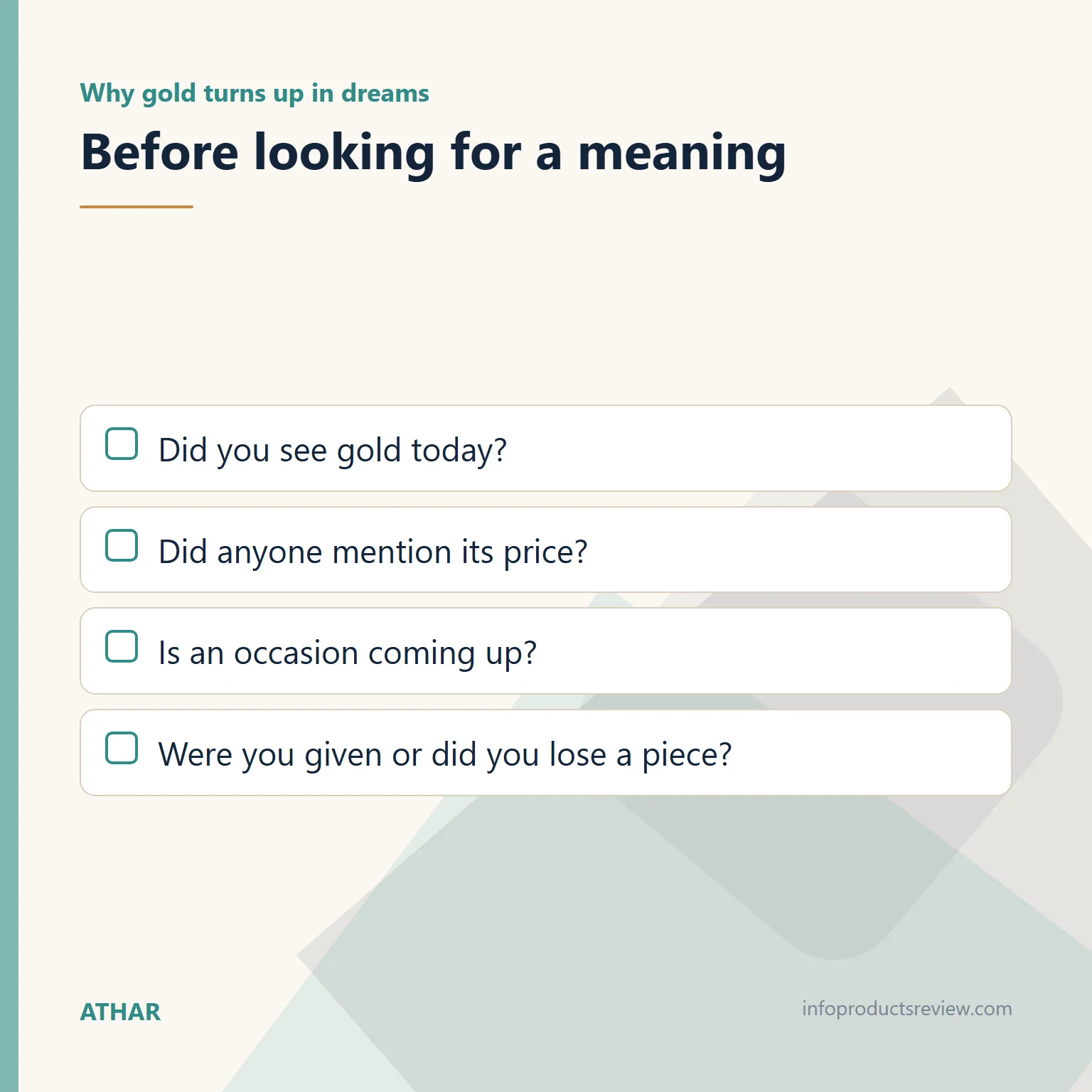
Before looking for a meaning, look at your week. Gold isn’t an exotic symbol for most women. You walk past it in shop windows, it’s in the photos a cousin sends while planning her wedding, and it’s in your mother’s jewellery box.
It only takes a conversation at home about how expensive it has become, or about putting part of a salary aside, for gold to sit in your mind all day. In a busy wedding season you might see a dozen women wearing it and quietly plan what you’ll wear yourself.
The US National Institute of Neurological Disorders and Stroke says in its guide to sleep that events from the day often find their way into our thoughts while we sleep.
That is a general point about sleep rather than about gold, but it explains something useful: what occupies you by day tends to come back at night in some shape.
Notice, too, that a question about gold isn’t only a question about marriage. Being single covers a lot of lives: a student waiting for results, someone saving from her first salary, the friend who goes to every wedding that season. Each of them dreams something that looks like her own life.
So start with a few simple questions about your week:
- Did you see gold today, in a shop, a photo or at an event?
- Did anyone talk about buying a piece, the price of gold, or saving?
- Is there an occasion coming up that you’re planning an outfit for?
- Were you recently given a real piece of jewellery, or did you lose one?
If the answer to any of those is yes, the likeliest explanation is that your mind was replaying the day, and the dream needs no symbolic reading at all. If gold had no place in your waking life and the dream was vivid and specific, the rest of this page will help.
Does being single change what gold means?
A lot of dream sites split every symbol into “for a single woman”, “for a married woman” and “for a pregnant woman”, then hand each one a different meaning: engagement for the first, pregnancy for the second, the baby’s sex for the third.
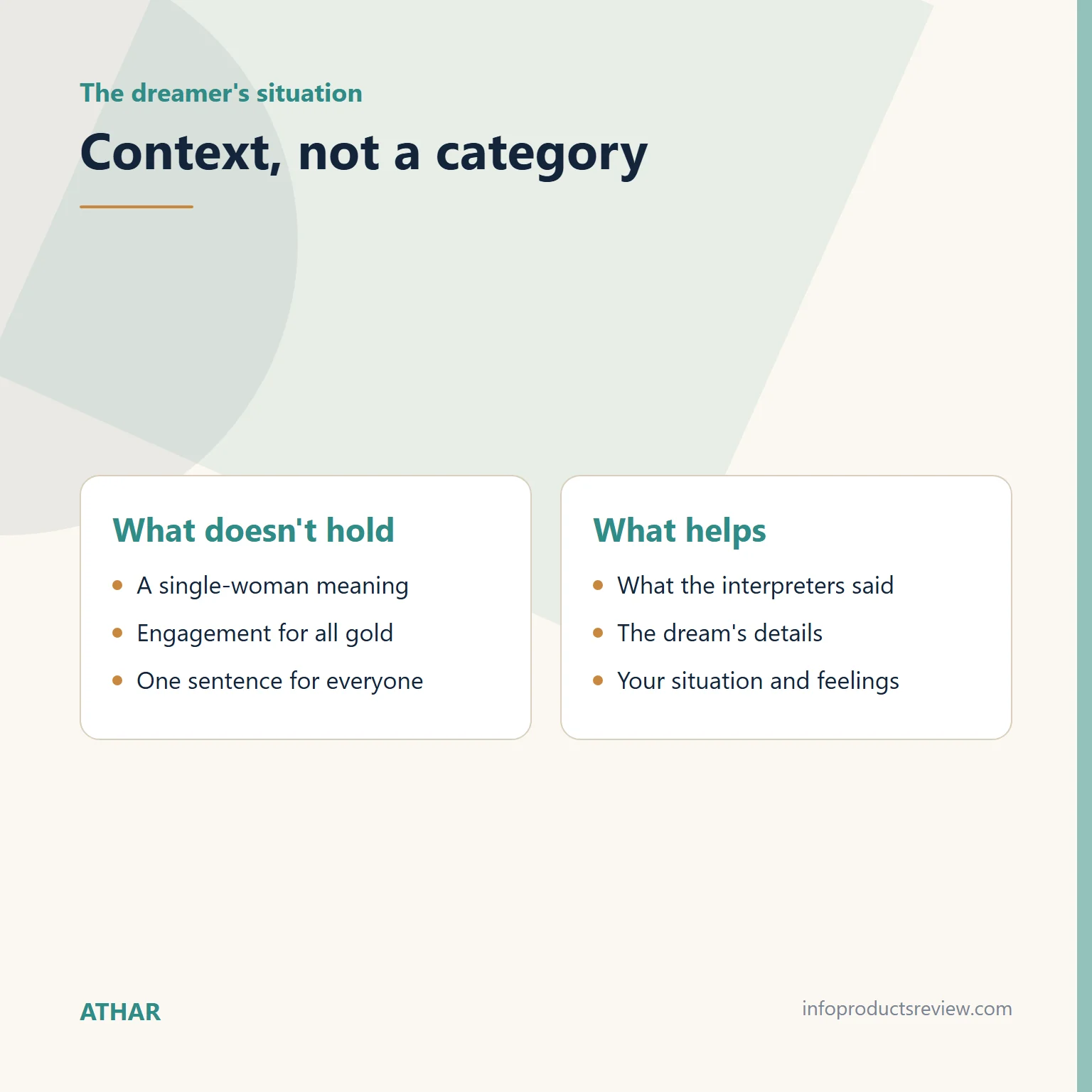
The old books of dream interpretation don’t divide gold and jewellery that way. They write about the piece itself, with one line that concerns women in general.
That doesn’t mean your circumstances are irrelevant. There is a clear principle in the books of interpretation: a reading shifts with people’s conditions and standing, so the dreamer’s own state and situation come first, and the fitting meaning is built on that.
The difference is subtle but important. The dreamer’s state means your actual situation, what you’re carrying and what’s on your mind. It doesn’t mean a category label with a stock meaning attached.
A student who dreams of a necklace the night before her exam results, a young professional who dreams of gold while hoping for a promotion, and a woman who dreams of it after a row with her family shouldn’t all be given the same sentence because they happen to be single.
So this page works in three steps:
- What the books say about gold and jewellery, we give as they say it.
- What they say about women specifically, we report exactly, and no more.
- What they don’t cover, like losing gold or finding it, we don’t invent a meaning for. We help you read that detail through the rest of the dream and how you felt.
Is seeing gold and jewellery a good sign for a woman?
Yes — and this is the most important line on the page. The books of dream interpretation say that jewellery of every kind is a good sign for women in a dream. So gold around your neck or on your wrist is, at root, a good image.
The line comes at the end of a passage on jewellery, gems, gold and silver that includes some harsh readings of bracelets and anklets. Those readings are given for a man, and then the line separates men from women and says jewellery suits women.
That sentence matters more to you than anything else here, for three reasons.
First, the harsh readings are written about men. When you read that gold bracelets mean “something unpleasant in what his hands own” — something heavy falling on what a man holds — or that an anklet means fear, imprisonment or restraint, the text is describing a man who sees these on himself.
The line about women comes immediately afterwards. So applying those warnings to a woman who dreams of a bracelet on her wrist moves them somewhere they were never meant to go.
Second, jewellery on a woman is an ordinary, fitting image. For most women, jewellery is a normal part of dressing up, so seeing it in a dream sits closer to something good than to a warning.
Third, “good” isn’t the same as “guaranteed”. The line says jewellery is a good sign for women. It doesn’t say every necklace means money or every pair of earrings means a proposal. It takes the fear out of the reading; it doesn’t open the door to promises.
Notice, too, that this is said about women in general, not single women in particular. It isn’t your special meaning; it’s the starting point for reading your dream.
Finished jewellery versus raw gold: does it matter?

It does, and this is one of the most useful distinctions the books offer. They separate gold that has been worked into something — a ring, a chain, a bangle — from gold that hasn’t been worked at all.
Gold that has not been crafted is read as a loss, a debt that falls on its owner. Gold that has been crafted is weaker in harm, which makes it the gentler and calmer of the two images.
The logic comes from the language. In Arabic, the word for gold, dhahab, shares its root with dhahab meaning “going away”. Raw gold is read through that link; and when gold is crafted into jewellery it takes a new name — a necklace, a bangle, an earring — so the sense of loss weakens.
Reading a symbol through its name is a familiar method in the books of dream interpretation. The interpreter listens to what a thing is called as much as he looks at what it is.
The same books carry a report, that dream interpreters disliked unworked white silver, and disliked gold unless it was crafted. The report points the same way: a finished piece is calmer than a raw lump.
That wordplay on gold and going away turns up elsewhere too. Ibn Hajar, in Fath al-Bari, quotes the scholar al-Muhallab explaining a dream the Prophet ﷺ saw: the dream is not to be taken literally, it is a kind of parable, and since the word for gold comes from “going away”, it was understood as something that would leave him.
Here is the story in brief, as Sahih al-Bukhari records it (hadith 7034). The Prophet ﷺ saw in his sleep two gold bracelets placed on his hands. He disliked them, was permitted to blow on them, and they flew away. He understood them as two liars who would appear.
So the bracelets were a symbol in a dream particular to the Prophet ﷺ, with its own setting. They can’t be turned into a rule for everyone who dreams of gold.
Two things keep these passages in proportion:
- Al-Muhallab is explaining that one dream, not setting a rule that gold in every dream means something slipping away.
- Reading raw gold as loss is interpretive reasoning built on the name. It carries weight in this tradition, but it isn’t news that you’re about to lose money.
If you dreamed of a necklace, earrings or a bangle, you saw worked gold, the gentler of the two images. If you dreamed of a bar, nuggets or a lump of unworked gold, the reading is more cautious. Either way, your feelings and what happened in the dream still carry the most weight.
What kind of jewellery was it?
The books don’t treat gold as one lump. They go piece by piece, and that detail is one of the most useful things they offer, because it spares you a vague sentence that doesn’t fit your dream.
What does wearing a gold necklace mean?
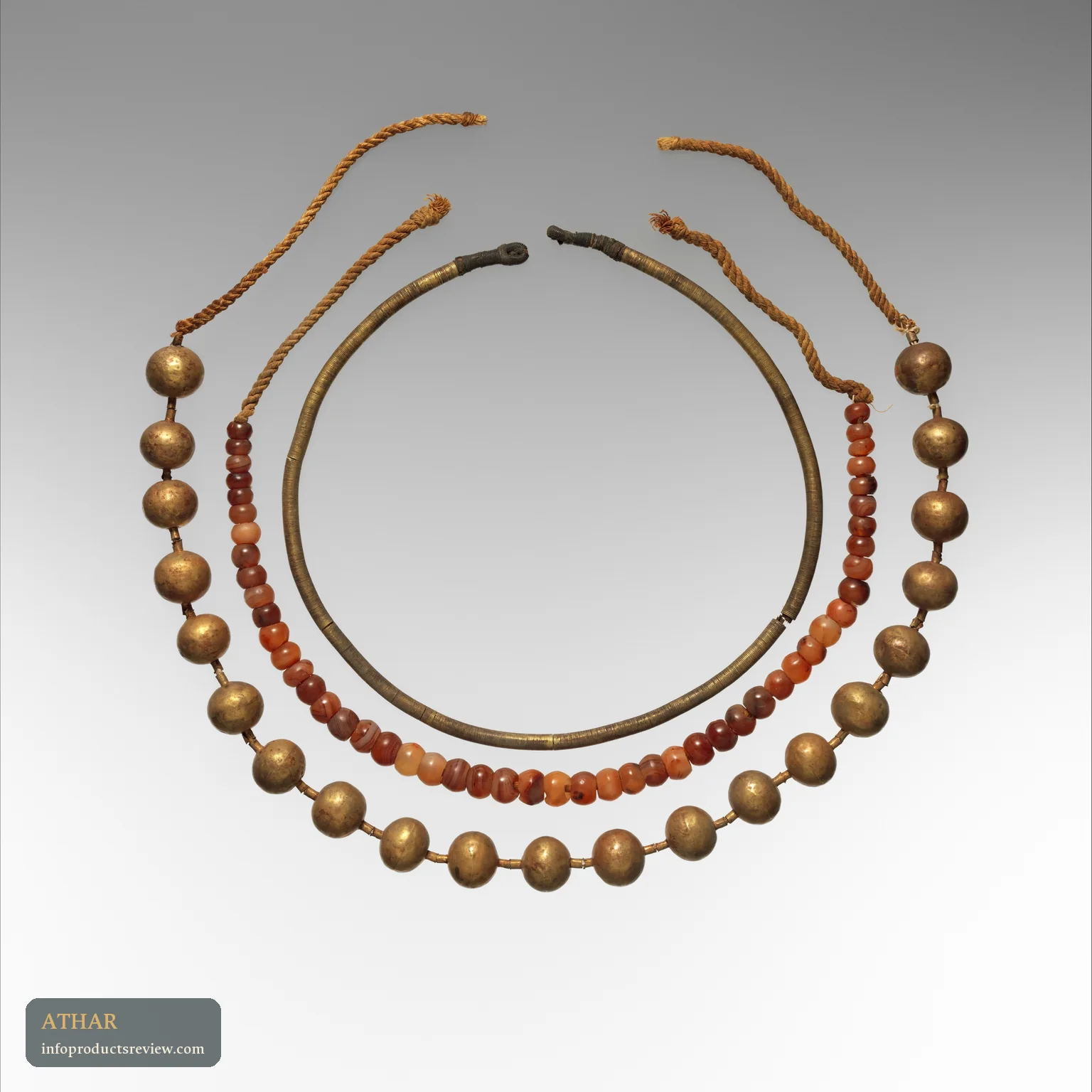
A woman who sees a necklace on herself — of gold, silver, gems or beads — is read as having taken charge of an office and been invested with a trust.
An office here means taking responsibility for something, and a trust is something handed to you to look after. So the necklace isn’t a picture of wealth. It’s a picture of something placed on you that you then carry.
Bring it into today’s terms. A necklace sits around your neck the way a task sits with the person answerable for it: once it’s yours, everyone can see whose it is. That is where the link to responsibility comes from, rather than to money.
That reading fits single women’s lives as they actually are. You might be a student who’s just been asked to lead a project, someone waiting to hear about a new role, or the one in the family everybody leans on.
If you dreamed you were wearing a gold necklace and felt at ease, the closest reading is a responsibility you’re carrying well. If it felt heavy or tight around your throat, the dream may be echoing a weight you’re feeling at the moment.
The necklace doesn’t mean you’ll get the job, and it snapping doesn’t mean you’ll lose one. The reading points in a direction; it doesn’t report on tomorrow.
Earrings: grace in other people’s eyes
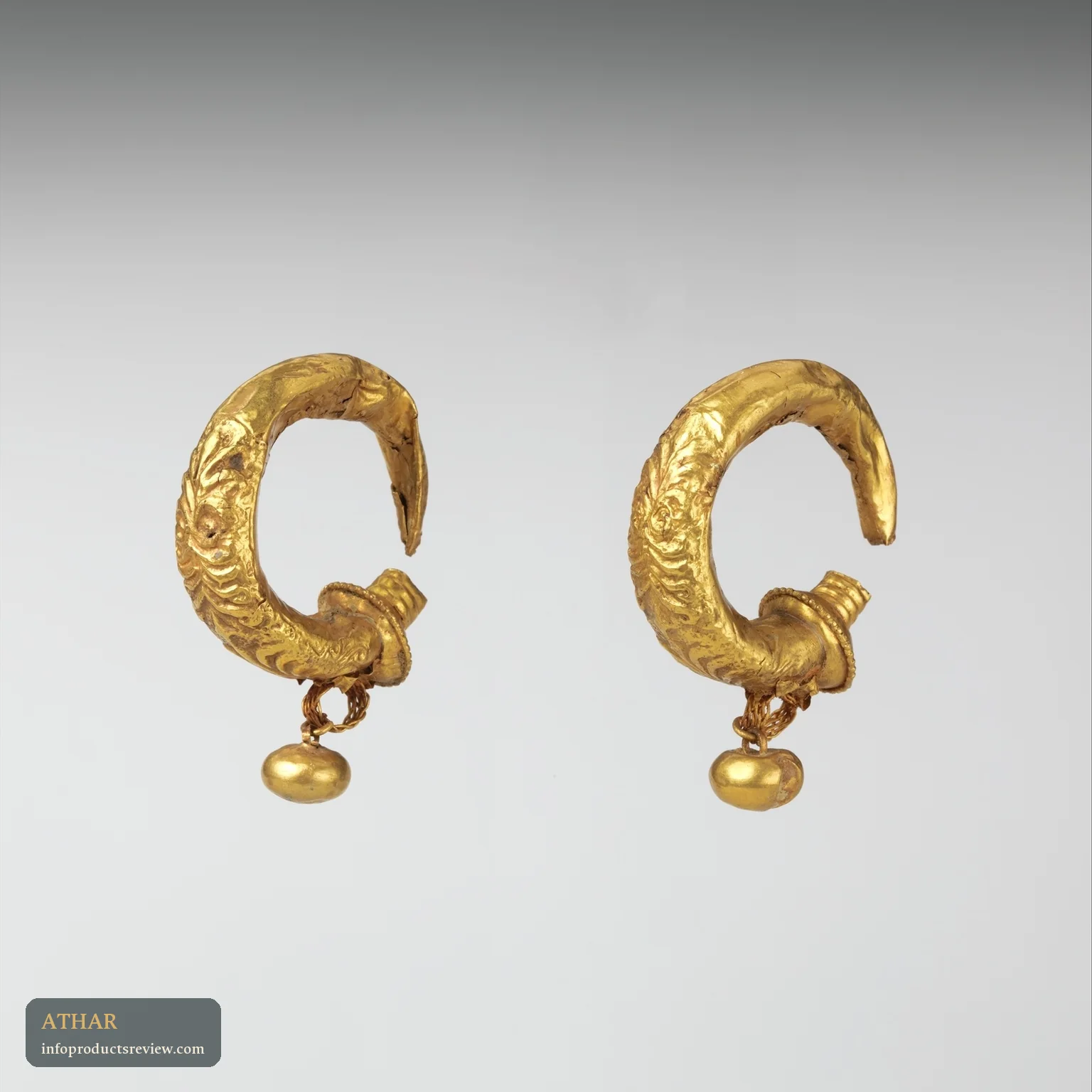
A short saying about jewellery back to dream interpreters, reads a pair of earrings as adornment and beauty among people.
Earrings sit closest to the face, so it makes sense that they’re read as adornment and grace “among people”: the good impression you make on others.
If you dreamed you wore a lovely pair to an event, or someone gave you earrings, the nearest reading is being well regarded or well received. It’s an image that fits a young woman who is conscious of how she’s seen at a new stage of her life.
Losing a single earring is one of the dreams women ask about most. The books give it no meaning of its own; we come to it in the section on losing gold below.
Pearls strung on gold
The same report reads pearls as the Qur’an and a necklace as wisdom or judgement, and just before it comes the line that strung pearls are the word of God or righteous speech.
So if your dream had a string of pearls set in gold, the image leans towards good words and useful knowledge. It might resonate if you’re studying, memorising the Qur’an, or simply someone who cares about saying the right thing.
We don’t go into loose, scattered pearls here, because they’re read in ways that have nothing to do with your question. If your dream was about the pearls themselves, there’s a page for them linked at the end.
Bracelets and anklets: worry and restriction?
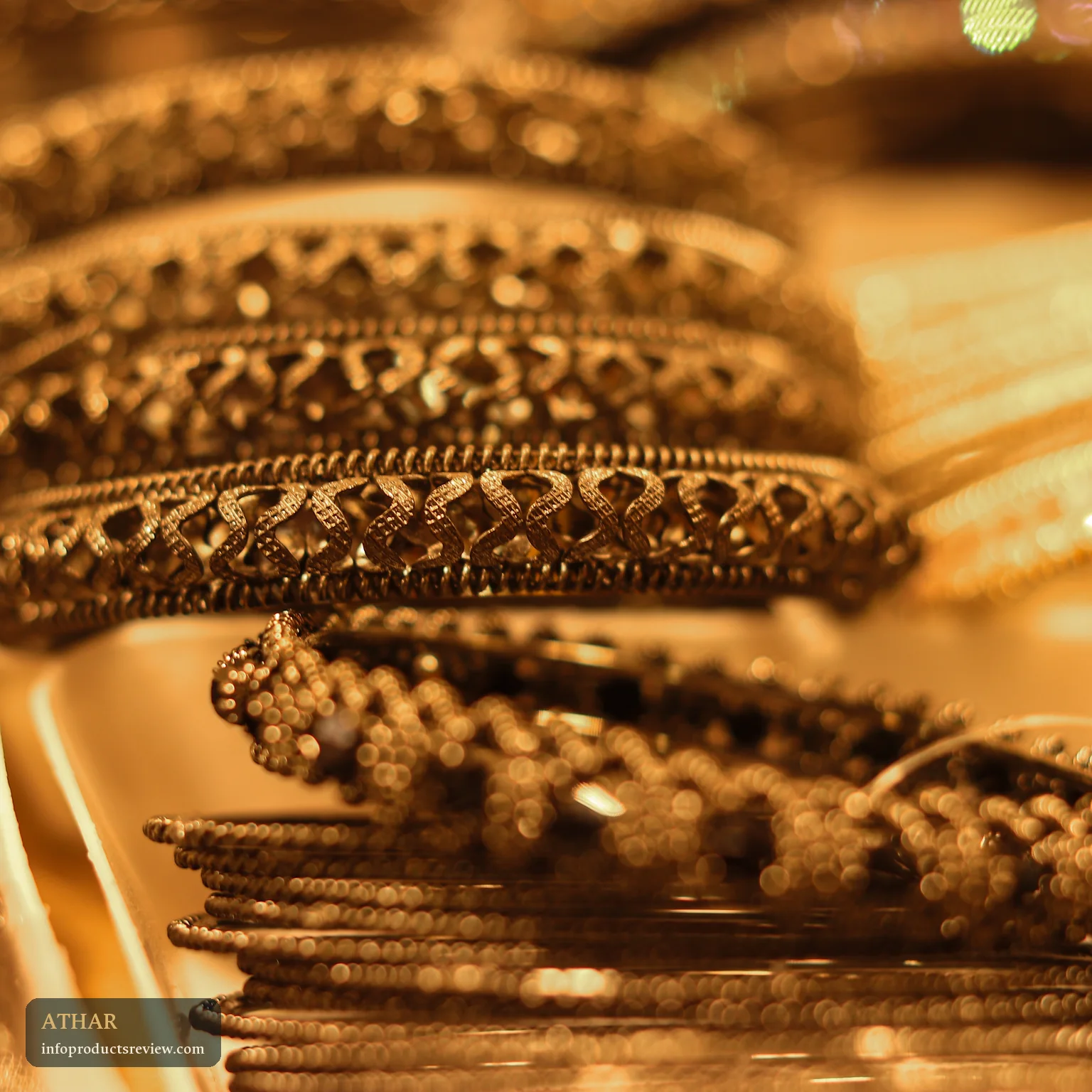
This is where most of the confusion lives. You’ll often read that a gold bracelet in a dream means worry or a restriction. Those readings really are in the books of dream interpretation, but, as we’ve seen, they’re about a man wearing them — and the line that follows says jewellery of every kind is good for women.
The books also say that an anklet or a bracelet may sometimes stand for the husband specifically. Read the word “may” carefully: it marks a possibility, and the sentence mentions neither single women nor timing.
Turning a bracelet on an unmarried woman’s wrist into news of a husband on his way turns a general possibility into a promise nobody made.
The calmer reading: a beautiful bracelet on your wrist is an image of fitting adornment, and how it felt is what tips the balance. If it was tight, painful, or wouldn’t come off, the dream may be about something that’s hemming you in during the day, not about gold at all.
What does a gold crown mean for a woman?
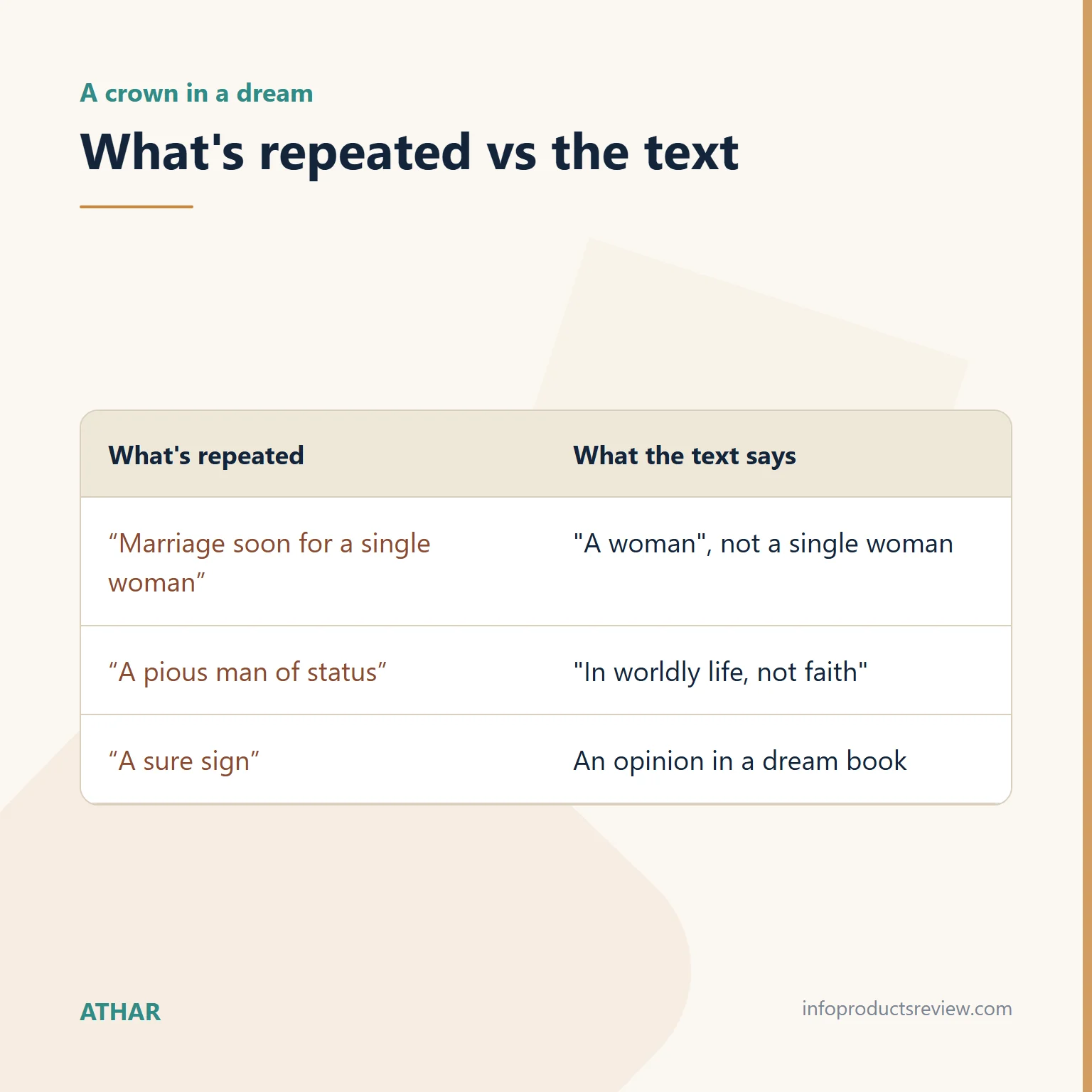
Few claims are repeated more often than “a gold crown in a single woman’s dream means marrying a man of status”. The sentence does have a source: whoever sees a crown of gold or gems attains great and remarkable authority — some large matter they take charge of. And if a woman sees that, she marries a handsome man who is prominent in worldly life rather than in faith.
Read the whole line, though, because it contains three things the popular versions leave out:
- It’s an opinion recorded in a dream-interpretation book, not a religious text and not a guarantee.
- It describes the man as prominent “in worldly life rather than in faith”, so it isn’t the unqualified compliment it’s usually made out to be.
- It says “a woman”, not a single woman or a married one.
So a crown doesn’t mean marriage. A crown is at root an image of standing, and your dream may be about recognition you’re hoping for, a position you’re working towards, or simply a beautiful moment from a cousin’s wedding.
What about a gold ring?
The classical books treat rings in detail, covering their parts and their engraving, which is too much to squeeze in here. If the ring in your dream was a wedding band or an engagement ring, those scenes are covered in Dreaming of Your Own Wedding.
Gold as a gift: who gave it to you?
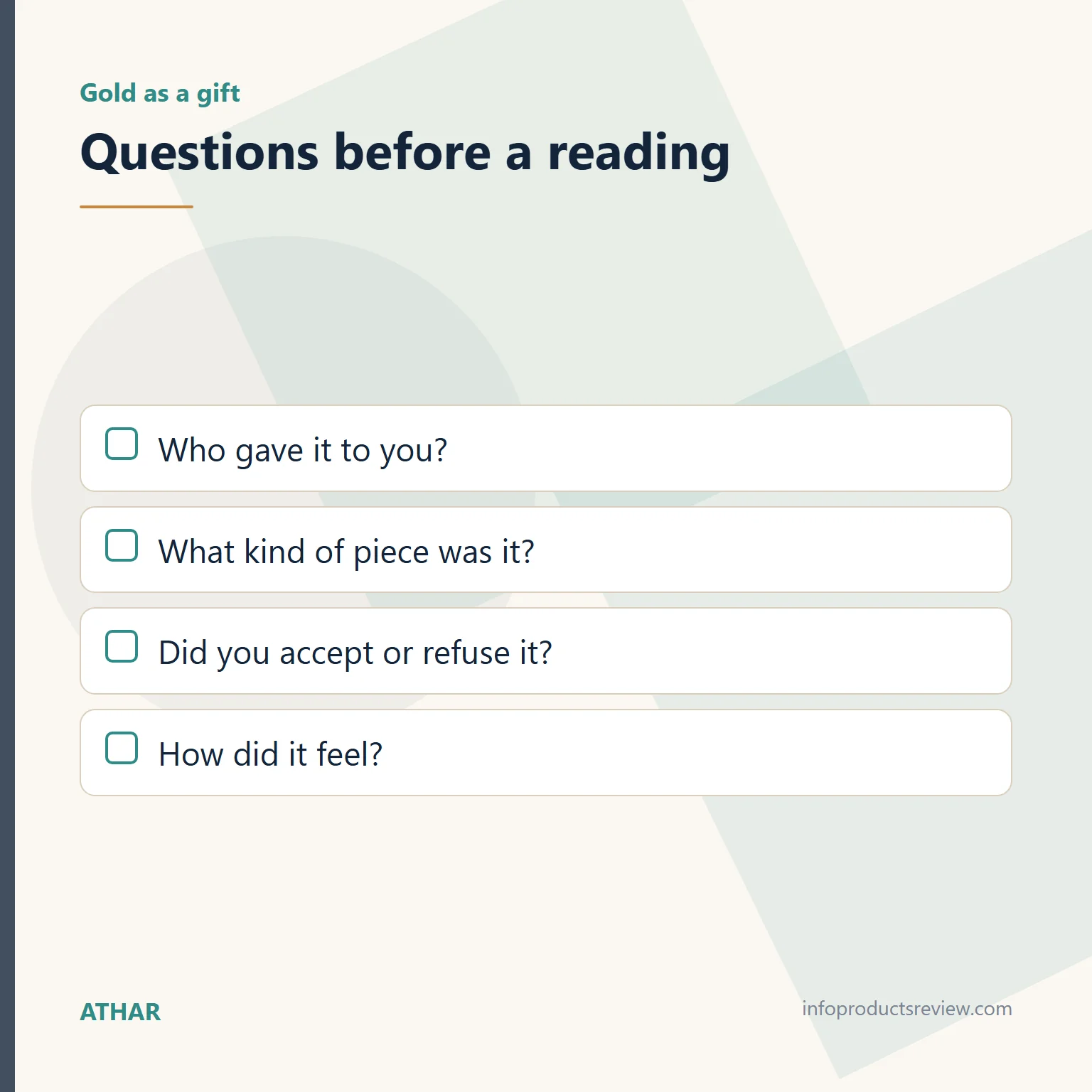
A lot of women’s gold dreams start with someone holding something out. The books don’t change the meaning according to the giver. Who it was does change the context, though, so here’s the real question behind each version.
Your mother, father or a relative. These dreams are often about the relationship itself: closeness, wanting their approval, or a memory of an actual piece at home. If your mother really is keeping some gold for you, or you’ve talked about “the family jewellery”, the dream is most likely an echo of that.
A friend. It may be a picture of mutual appreciation, or of something happening between you, like a graduation. It doesn’t mean jealousy or envy, whatever some sites say.
A stranger. This is where some sites go hunting for a “mystery suitor”. The honest position is that an unfamiliar person in a dream can’t be identified, and what you’re left with is the piece itself and how you felt about it. Pay attention to the jewellery, not the face.
A man you know. A dream can’t tell you what someone else intends. If he’s been on your mind, the likeliest explanation is that the dream reflects that preoccupation, not that it’s a message from him or about him. Don’t base a decision about a relationship on it.
You refused it or gave it back. The books give this no meaning of its own. The useful question is why: because you didn’t like it, or because accepting felt like it would commit you to something? The answer says more about your feelings than about your future.
Buying gold or trying it on in a jeweller’s
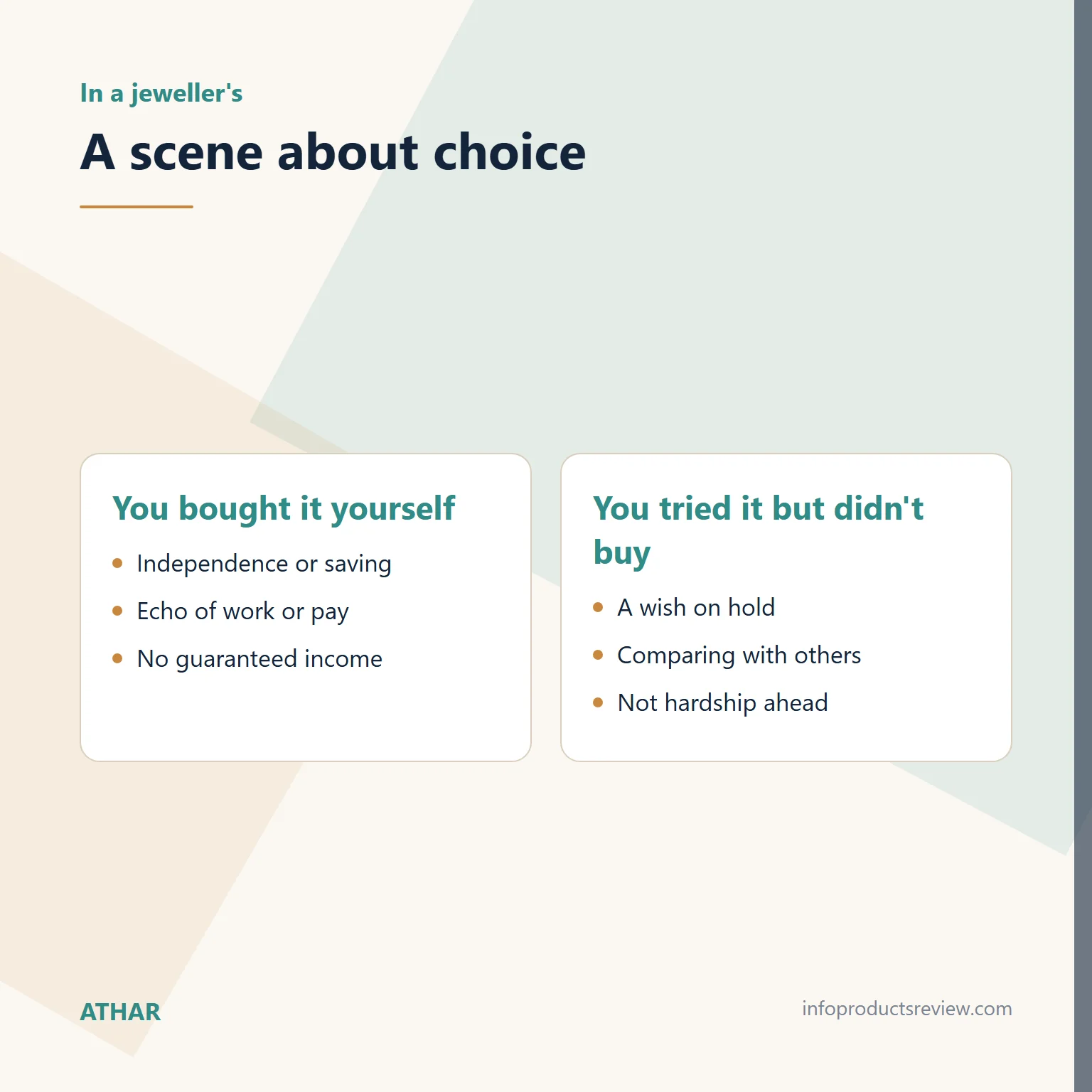
A jewellery shop is its own kind of scene, because it involves choice, price and a decision. Buying gold has no meaning of its own in the books, so we read it by what’s in it:
- You bought a piece with your own money. This sits close to independence or a savings plan, especially if you’ve recently started earning.
- You tried something on but couldn’t afford it. The dream may be about a wish on hold, or about comparing yourself with others. It doesn’t mean hardship is coming.
- You couldn’t choose between lots of pieces. This often shows up during real periods of choice: a course, a job, a family decision.
- The price was shocking. A very ordinary dream at a time when everyone’s talking about the price of gold, and usually just an echo of that.
If you bought raw gold, a small bar as savings for instance, remember the distinction between worked and unworked gold. But don’t let a dream change a real savings decision. Dreams know nothing about the gold market.
Wearing gold to a graduation or a relative’s wedding
Single women often dream of wearing gold at an occasion: a graduation, a sister’s or friend’s wedding, a big family gathering. Those dreams raise two separate questions.
How did you feel in front of everyone? If you felt confident and happy, the image sits close to the reading of earrings as grace in other people’s eyes. If you felt self-conscious, or that the gold was too much for you, or you worried about being stared at, the dream may be more about how you feel in company than about the gold.
Is the occasion real and close? If your cousin’s wedding is a few weeks away and you’ve been thinking about what to wear, the dream is a direct echo of that.
If you dreamed you were the bride and the gold was part of your wedding outfit, that’s a full wedding dream, and it has its own page: Dreaming of Your Own Wedding: The Ceremony, the Contract and the Details.
Your gold was lost or stolen: what does that mean?
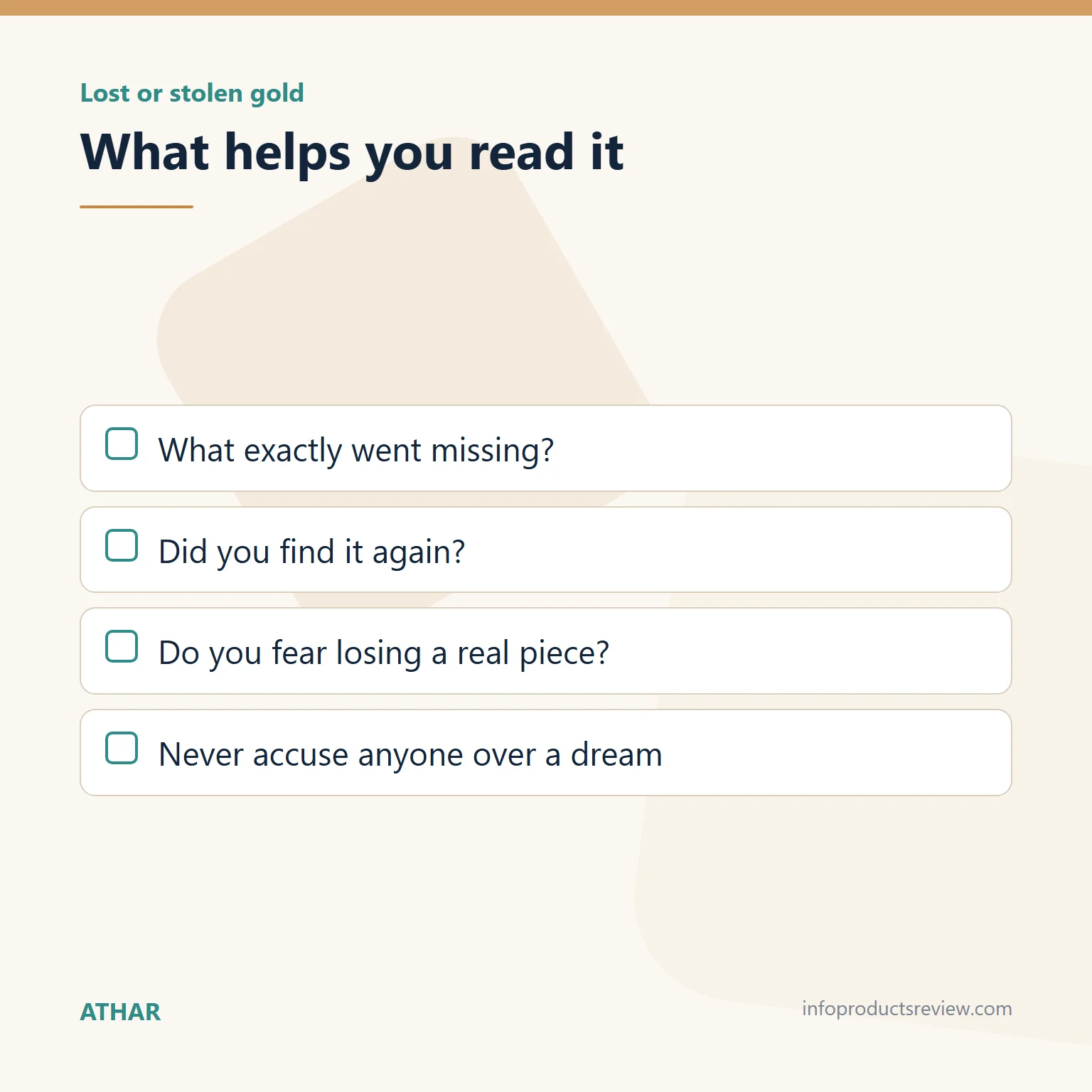
This is one of the most unsettling versions, and one that attracts frightening interpretations: a broken engagement, envy, financial loss.
The reassuring answer is that the books give losing gold, or having it stolen, no meaning of its own. So we read the scene through the dream itself rather than as a fixed sign with no basis.
Some questions that help:
- What went missing? One earring, a necklace, the whole box? A necklace can stand for responsibility and earrings for how others see you. Losing an image may reflect worry about what it stands for, not an actual loss.
- Did you find it again? A dream that ends with finding what was lost feels very different from one that ends mid-search, and the ending is part of the dream.
- Are you actually worried about a real piece? If you wear something valuable and are afraid of losing it, the dream probably reflects that fear.
- Was it a gift? If the piece you lost was one your mother or a friend gave you, the worry may be about the relationship rather than the jewellery: a disagreement that hasn’t been settled, or a distance you feel. It helps more to look at the relationship than to go searching for the piece.
- Who took it? If you saw someone you know stealing your gold, please don’t hold it against them. A dream is not evidence about anyone, and one of the real harms of popular interpretation is how easily it breeds suspicion of people who’ve done nothing.
Finding gold
Some women dream of finding gold on the street, in an old box, or buried in the ground. Finding gold has no meaning of its own in the books.
What helps is the kind of thing you found: finished jewellery is the lighter image, while raw gold is read more cautiously, as you’ve seen.
Finding gold doesn’t mean a windfall, and buried gold doesn’t mean treasure. Those are promises with no basis in the books, and nobody should spend months waiting on them.
The difference between finding and being given matters, too. A gift comes with a person and a relationship; finding comes with nobody. So ask yourself whether you kept what you found or looked for its owner. That says something about how you meet things that arrive without your asking.
Fake, tarnished or broken gold
Sometimes in the dream the gold turns out to be fake, changes colour, or the chain snaps. The books give these details no meaning of their own.
They usually carry a clear feeling, though: disappointment, doubt, a sense that something wasn’t what it seemed. Here the feeling is a better guide than the symbol.
The useful question is whether you’ve recently had that feeling in waking life. A promise that fell through, a friendship that let you down, an opportunity that turned out smaller than it looked?
If so, the dream is probably working through it. Fake gold doesn’t point to a deceitful person in your life. A dream doesn’t name anyone.
Giving your gold away or selling it
You might dream of handing a piece to a sister or friend, or selling your jewellery because you need the money. The books give this no meaning of its own.
Start with the motive inside the dream: were you giving freely, forced by circumstance, or afraid? Giving that leaves you content is different from selling that leaves you feeling you’ve lost something.
Dreams of selling gold often appear when money has been a topic at home, and that is usually a better explanation than any distant symbol.
Seeing gold on another woman
Not every gold dream is about your gold. You might see your sister, a friend or a colleague covered in it, or a woman you don’t know dressed up in gold. The books give this scene no meaning of its own, but it raises clear questions:
- Were you happy for her, or did it sting? Being glad is different from comparing, and comparing is an ordinary human feeling. It doesn’t mean envy or the evil eye.
- Is she going through a real milestone? A sister’s engagement or a friend’s graduation is enough to explain why she appeared wearing gold.
- Were you the one without any? If you felt you were missing something next to her, the dream may be about how you see yourself right now, not about her.
The gold on her tells you nothing about her life, and it isn’t a sign that she envies you or you envy her. A dream isn’t a window into anyone’s heart.
When the gold dream keeps coming back
Some women see gold in their dreams several times in a short period and feel sure the repetition is a “message” that has to be decoded. It’s more useful to ask first: is it the same scene each time, or gold turning up in different scenes?
If the scene repeats — a necklace going missing every time, for example — it often points to an ongoing worry that hasn’t been settled while you’re awake.
If gold appears in different dreams, it may simply be more present in your days than you’ve noticed: wedding season, constant talk about prices, a piece you’re thinking of buying.
And a dream can repeat simply because you’ve been thinking about it every night. A long search for an interpretation keeps the image alive in your mind, so it comes back. Relief comes from dealing with what’s on your mind, not from collecting readings.
How the dream felt changes the reading
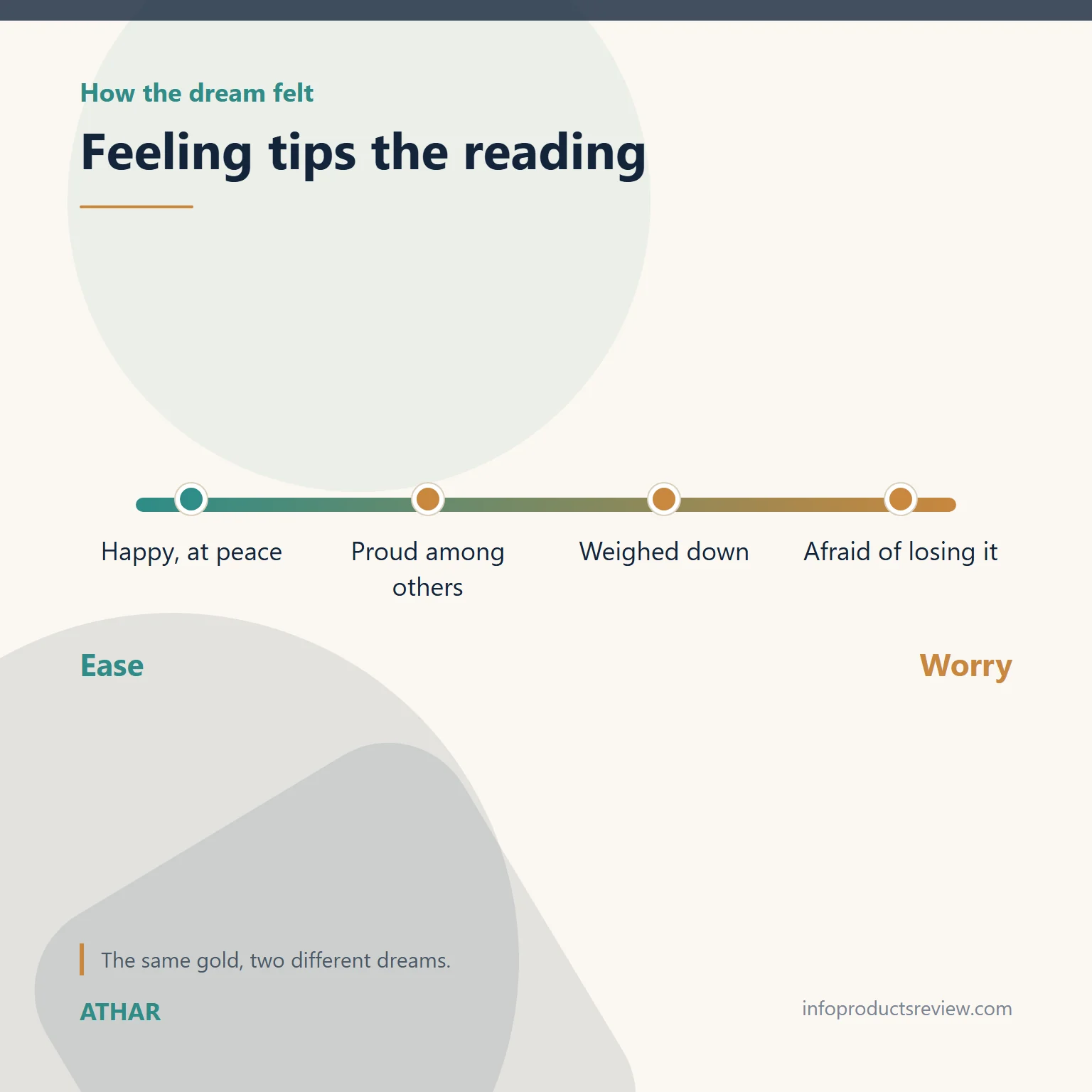
If you take one tool away from this page, make it the question of feeling. Two dreams can both feature gold and still be completely different because of how they felt:
- Happy and at peace: closest to the picture of jewellery as a good sign for women.
- Proud in front of others: close to the reading of adornment and grace among people.
- Weighed down or choked: possibly about a burden, a responsibility, or other people’s expectations.
- Afraid of losing it or having it taken: possibly a real worry about something you care about.
- Nothing much: maybe the gold was a passing detail in a dream that was really about something else.
This isn’t a replacement for the interpreters. It’s what they say themselves when they insist that interpretation is conjecture that shifts with context and circumstance.
Does gold in a dream mean a single woman will get engaged?
This is the question most pages open with and close on, so here’s a straight answer: nothing in the interpretation books relied on here says that gold in an unmarried woman’s dream means engagement or an upcoming marriage.
Only two sentences could be read in that direction, and neither works as a promise:
- A crown, for a woman: she marries a good-looking man who is prominent in worldly life rather than in faith. It’s an opinion in a dream book, it isn’t about single women specifically, and it isn’t wholly flattering.
- Bracelets and anklets: these may sometimes stand for the husband. “May” is a possibility, and the sentence says nothing about a marriage to come or when.
Why dwell on this? Because turning a dream into a promise of marriage can hurt you while seeming to comfort you. It can mean months of waiting, disappointment, or sizing up every man who shows interest as “the one from the dream”.
It’s kinder to yourself to enjoy the dream as a lovely image and leave marriage to its real-world causes. If your question is about marriage dreams themselves, see our Marriage Dream Meaning guide.
What’s actually established in Islam about dreams
What’s firmly established in the two most authoritative hadith collections is short and clear, and it’s enough to handle any dream calmly. In Sahih al-Bukhari, from Abu Qatada:
A good dream is from God. If one of you sees something he likes, let him tell it only to someone he loves. And if he sees something he dislikes, let him seek refuge in God from its harm and from the harm of Satan, spit lightly three times, and not tell anyone about it, for it will not harm him
And in Sahih Muslim, from Jabir:
If one of you sees a dream he dislikes, let him spit to his left three times, seek refuge in God from Satan three times, and turn over from the side he was lying on
In practice: a good dream is something you can share with people you love. With an unsettling one, you seek refuge in God from its harm, spit lightly to your left three times, turn over from the side you were lying on, and don’t tell anyone about it.
The first hadith ends with plain reassurance: “it will not harm him.” So there’s no need to chase an upsetting dream with hours of searching.
As for interpretation itself, the books of this craft describe it as analogy, comparison and conjecture. There is no certainty in it, no swearing to what it hides, and no knowing whether it was right until something shows up in waking life.
So everything on this page, and everything in the dream books, is a possible meaning you can take some comfort from. None of it is a firm basis for expectations about marriage, money or the future.
When a dream is just the mind talking to itself
Interpreters distinguish between a dream that calls for interpretation and what they call hadith al-nafs, “the self talking to itself”, which doesn’t.
That kind belongs to the body: the wishes and feelings you keep pressed down, which wake up in sleep and carry no symbolic meaning. What you long for or fear during the day simply returns to you as an image at night.
Gold dreams are some of the likeliest to fall into this category, because gold is tied to very understandable wishes: looking nice, saving, special occasions.
If you’ve been longing for a particular piece, thinking about an event, or talking about gold a lot, your dream is most likely this kind. There’s nothing wrong with that, and it doesn’t need a far-fetched meaning.
Common claims that need correcting
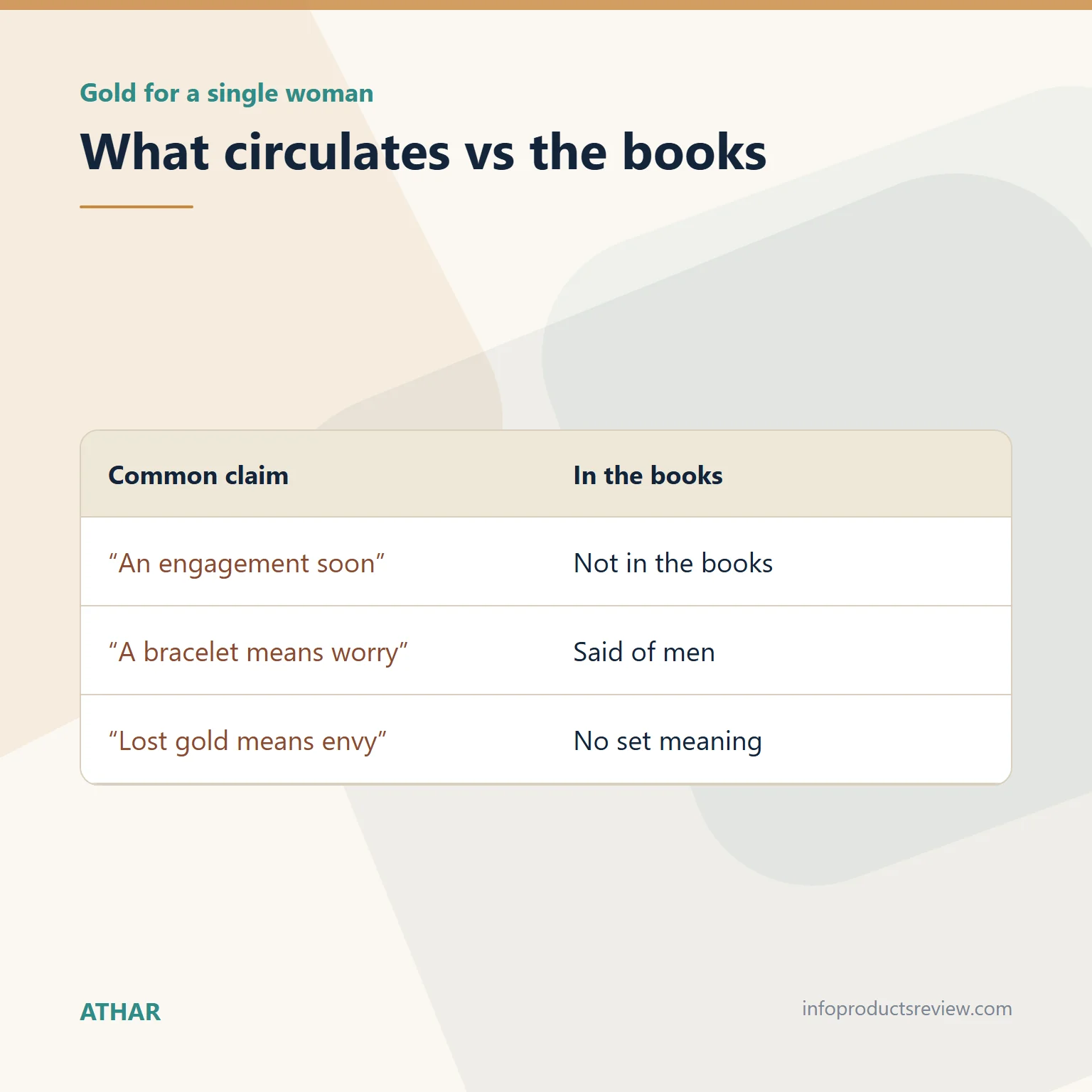
| What you’ll often read | What the interpretation books say |
|---|---|
| Gold means a single woman will soon get engaged | They don’t say so. There’s an opinion about a crown for a woman, which isn’t a promise |
| A gold bracelet means worry and restriction for anyone | That reading is given for men; jewellery of every kind is good for women |
| Losing gold means a broken engagement or envy | Losing gold has no set meaning; it’s read through the dream and your feelings |
| Gold in a dream means money is coming | Nothing guarantees that; raw gold is read with caution, not as a windfall |
| Ibn Sirin read gold differently for single and married women | No such split appears in the two reports carried from him |
| Gold from someone you know reveals their intentions | A dream can’t reveal what anyone intends or serve as evidence about them |
What a gold dream can’t tell you
Being honest means gathering in one place what a dream can’t tell you, so you don’t ask more of it than it can give:
- It can’t give you a date for an engagement or wedding, or tell you who.
- It can’t guarantee money or a job, and it doesn’t mean a real financial loss.
- It can’t detect envy, magic or the evil eye, or show that someone is plotting against you.
- It can’t reveal other people’s intentions, whether they gave you gold or took it.
- It isn’t a sound basis for a decision about a relationship, a job, or buying and selling.
Everything else on this page is a possible meaning, to be read calmly and against your own situation. This one section spares you a warning in every paragraph.
What to do after the dream
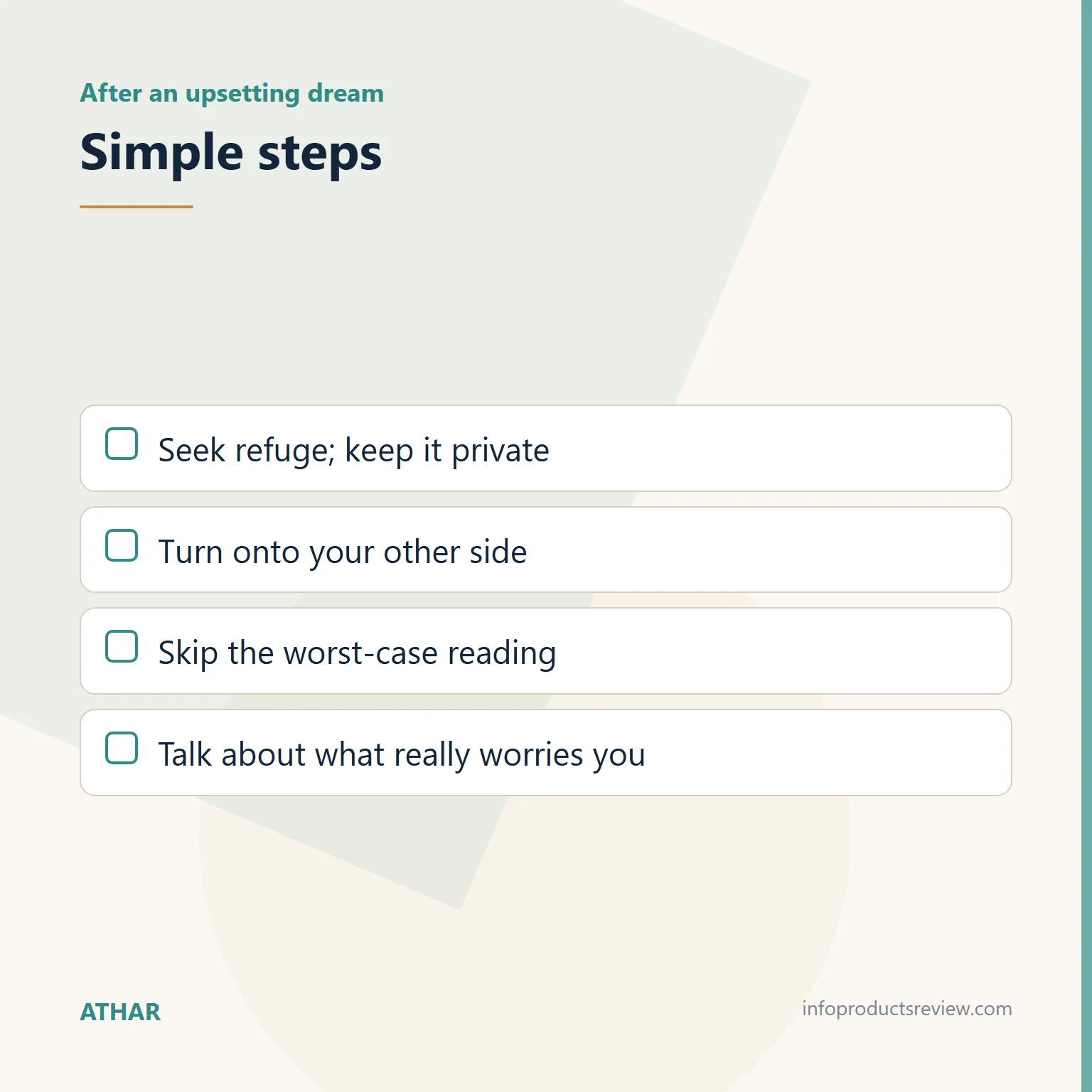
If it was a lovely dream, thank God, share it with people you love if you like, and don’t turn it into a waiting game. If it was upsetting — gold going missing, a theft, a necklace that felt like it was choking you — here are a few simple, well-grounded steps:
- Seek refuge in God from the harm of what you saw.
- Spit lightly to your left three times, and turn over onto your other side.
- Don’t tell people about an upsetting dream, and don’t go looking for the worst possible reading.
- Ask yourself about your day: is there something in it that explains the dream?
- If the dream keeps returning and worrying you, talk to someone you trust about what’s actually worrying you, not about the gold.
Those steps will do more for you than an hour of searching. The worry that lingers after a dream is usually heavier than the dream itself.
How to describe your dream so it can be read
Whether you want to understand the dream yourself or ask someone knowledgeable you trust, a good description gets you halfway there. When you wake up, jot down:
- Exactly what you saw: a necklace, earrings, a bracelet, an anklet, a crown, a bar, a coin?
- Whether it was finished jewellery or raw gold.
- Where it came from: a gift, a purchase, something you found, something inherited, or already yours?
- What you did with it: wore it, gave it away, sold it, lost it?
- How you felt: happy, proud, afraid, weighed down, unsure?
- What’s on your mind these days: studies, work, an occasion, a decision?
With those details the dream becomes something you can actually think about, and you’re far less likely to swallow a ready-made reading written by someone who knows nothing about you.
Examples
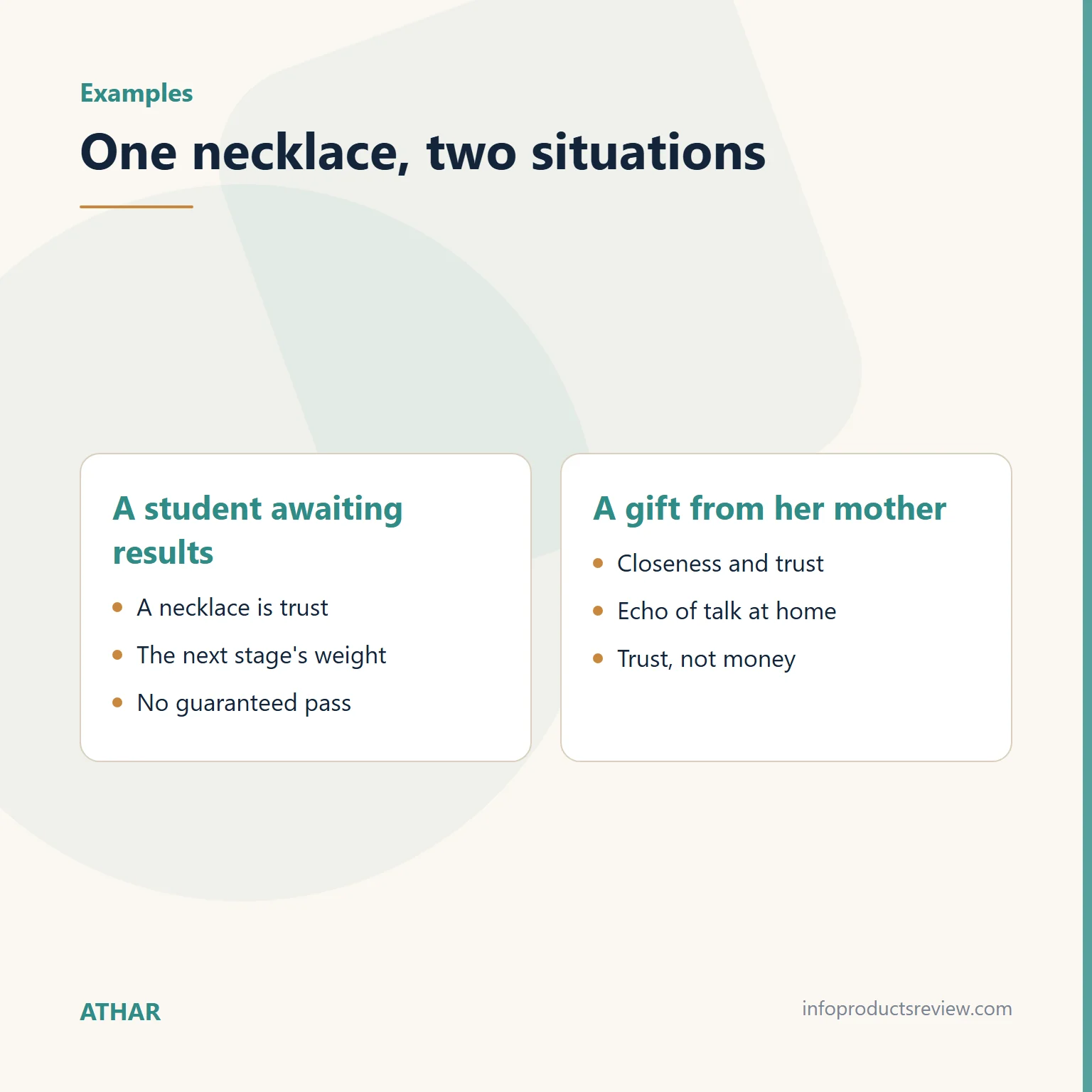
These are composite examples built from common scenarios, not readings of any real person’s dream. They show how the reading shifts with detail and circumstance.
A student dreams of a gold necklace the night before her results
A necklace is read as an office and a trust — a responsibility placed in her hands. For a student waiting on results, the closest reading is a sense of what the next stage will ask of her. The necklace doesn’t guarantee a pass, and a tight clasp doesn’t mean failure.
A young woman buys a bracelet with her first salary
Buying has no set meaning in the books. The context says it all: a first pay cheque, the pleasure of independence, maybe a real plan to buy one. This is close to the mind talking to itself, and a happy version of it.
An earring falls out in front of everyone
Earrings stand for grace among people. Losing one publicly, with a rush of embarrassment, may reflect worry about how others see her or a social situation coming up. It doesn’t mean disgrace or a damaged reputation.
Her mother gives her an old necklace from the family box
The picture sits close to the relationship itself: closeness, trust, perhaps a real conversation about a piece at home. The necklace reads here as something entrusted by her mother, in the sense of trust rather than money.
She finds a gold bar lying in the street
Finding gold has no set meaning in the books, and raw gold is read cautiously. So no windfall and no loss. The useful question: was money or saving on her mind that day?
She wears a gold crown at her sister’s wedding
A sister’s wedding is a real, close event, and crowns and tiaras are part of wedding finery in many families. The dream most likely echoes the occasion. The recorded line about a crown and a woman isn’t a promise about her own marriage.
Her gold is stolen while she watches, unable to move
Being frozen is common in distressing dreams, and theft has no set meaning in the books. She seeks refuge, turns over, accuses no one, and asks herself whether she’s afraid of something being taken from her in waking life.
The gold turns dull and cheap in her hand
The books don’t cover this, and the main feeling is disappointment. She might ask whether something that looked lovely recently let her down, without treating the dream as a verdict on anyone.
She happily gives her earrings to a friend
Giving has no set meaning in the books. The picture is one of affection and generosity, perhaps echoing a time she’s been standing by that friend. It doesn’t mean the friend will take something from her.
She wears pearls set in gold while reciting Qur’an
In the report carried from dream interpreters, pearls are the Qur’an and a necklace is wisdom. The setting is recitation. It’s a fitting, lovely image she can take heart from, without treating it as a certificate about her spiritual state.
Quick table: the detail and the closest reading
| Detail | What the books say | How to read it |
|---|---|---|
| Gold jewellery in general | All jewellery is good for women | A good image; feeling decides |
| Worked gold | Weaker in harm | The gentler image |
| Raw gold or a bar | Loss, taken from its name | With caution, not as news of loss |
| Necklace | Office and trust | Responsibility, by your situation |
| Earrings | Adornment and grace among people | Being well regarded |
| Strung pearls | The Qur’an or righteous speech | Good words and knowledge |
| Crown | For a woman: marriage to a man prominent in worldly life rather than faith | A recorded opinion, not a promise |
| Bracelet or anklet | Harsh readings are for men; may stand for the husband | Fitting adornment; feeling decides |
| Losing it or theft | No set meaning | Through the dream and your feelings |
| Finding, buying or selling | No set meaning | Through your day and circumstances |
Related dreams
- Pearls and Gems in a Dream: Strung, Scattered, Rubies and Emeralds
- Dreaming of Gold as a Man: The Ruling, the Dream and the Difference
- Dreaming of Gold While Pregnant: What a Dream Can’t Tell You
- Dreaming of Gold as a Married Woman: Jewellery, Household Gold and What It Can’t Tell You
- Marriage Dream Meaning: A Complete Guide by Situation, Partner and Feeling
- Dreaming of Your Own Wedding: The Ceremony, the Contract and the Details
- ATHAR’s guide to dream interpretation
Frequently asked questions
What does gold mean in a single woman’s dream?
In the books of dream interpretation, all jewellery is a good sign for women in a dream. They distinguish worked from raw gold and read each piece differently, and they give single women no meaning of their own. So the details and how you felt carry the most weight.
Does dreaming of gold mean I’ll get engaged soon?
The interpretation books relied on here don’t say so. There’s an opinion about a woman seeing a crown, and a possibility that bracelets and anklets stand for a husband. Neither is a promise of engagement or a date.
What does wearing a gold necklace in a dream mean?
A necklace is read as an office and a trust — a responsibility placed in your hands. The closest reading is a responsibility you carry, in your studies, work or family, depending on your situation and how it felt.
Is a gold bracelet a bad sign for a woman?
The harsh bracelet readings are given for a man, and the line that follows says all jewellery is good for women. A bracelet on your wrist is a picture of adornment, unless it came with tightness or pain in the dream.
What does losing gold in a dream mean?
The books give it no meaning of its own. Read it through what was lost, how you felt and what’s worrying you. It doesn’t mean a broken engagement, envy or real financial loss.
A stranger gave me gold in a dream. Is he a future husband?
A dream can’t identify a person or announce a marriage. Focus on the kind of jewellery and how it felt, not on a face you can’t know.
What’s the difference between worked and raw gold in a dream?
Raw gold reads as a loss, a meaning taken from its name, while finished jewellery is weaker in harm because crafting gives it a new name. It’s interpretive reasoning, not a forecast of loss.
What does a gold crown mean for a single woman?
It is recorded that a woman who sees a crown marries a good-looking man prominent in worldly life rather than in faith. It’s a recorded opinion, not specific to single women, and not a promise. A crown is at root an image of standing.
Does buying gold in a dream mean money is coming?
Buying gold has no set meaning in the books, and a dream can’t guarantee income. It’s usually tied to saving, a wish or an occasion in your life.
Did Ibn Sirin interpret gold differently for single and married women?
The two reports carried from dream interpreters on this subject make no such distinction. Most of what headlines attribute to him comes fromsome later compilations and that attribution isn’t established.
I dreamed of gold after seeing it in a shop. Does it mean anything?
Most likely it’s your mind replaying the day, and it doesn’t need a symbolic interpretation.
Is this interpretation definitive?
No. These are possible meanings given by interpreters, along with what they didn’t say. Interpretation is conjecture you can take comfort from, not certainty.
In summary
- The books of dream interpretation give gold no meaning specific to single women.
- All jewellery is a good sign for women in a dream; the harsh readings of bracelets and anklets are given for men.
- Worked gold is gentler than raw gold, and the piece matters: a necklace is trust, earrings are grace among people, strung pearls are good speech.
- Gifts, buying, losing and finding have no set meaning in the books and are read through context and feeling.
- Gold doesn’t mean an engagement is coming, money is guaranteed, or someone envies you.
- ATHAR’s guide to dream interpretation
If you take one thing from this page, let it be this: the gold in your dream is read through what you saw, how you felt and what’s on your mind, not through the fact that you’re single.
Written and reviewed by: the ATHAR editorial team. Quoted texts come from the editions listed in the references; translations from Arabic are our own.
Please note: this page sets out possible meanings, not certainties. Nothing here predicts the future, guarantees money or marriage, or gives a religious ruling.