


You wake up with the wedding still in front of you: a white dress, a room full of family, someone you know, or someone you don’t, standing beside you. Or the strange sense that you got married even though you’re married already.
The short answer: a marriage dream is usually a picture of commitment, new responsibility or a move from one stage of life to another, not news of a real wedding. It doesn’t set a date, it doesn’t name a spouse, and it tells you nothing about what any particular person intends.
This page walks through the symbol case by case. The wedding scene itself, the celebration and the marriage contract, has its own guide: dreaming of your own wedding.
The bottom line
- The answer in one line: marriage in a dream usually pictures a commitment, a responsibility or a move into a new stage of life, not a wedding on its way. It can point to something good the dreamer gains, or to standing they reach at work or among people.
- The detail that changes it: your own situation. A married woman who dreams she married someone else is read, in the books of dream interpretation, as gaining favour and good, not divorce and not betrayal. The same goes for a man.
- The common cases, fast: single people dream of marriage often while it’s on their mind, and the dream simply echoes that. A wife who fears her husband taking another wife may see exactly that, as a fear rather than news. Marrying someone who has died is read as gaining something that seemed over, not as death.
- A possibility, not a promise: everything on this page is a possible meaning. None of it promises a marriage, sets a date, names a spouse or proves a divorce.
- Where there’s no set meaning: refusing a marriage in a dream, running from one, an engagement on its own, a pregnant woman’s marriage dream, and reading a dream by the letters of a name. The books of dream interpretation give these no specific meaning, so they’re best understood through how you felt and what’s on your mind.
A marriage dream isn’t enough to settle any of life’s big questions: it’s no basis for accepting or refusing a proposal, accusing a spouse, or ending a relationship.
What this page covers
- The bottom line
- Why are marriage dreams so common?
- Which details change what a marriage dream may mean?
- What does marriage mean as a symbol in the dream books?
- “I dreamed I got married and I’m single”: what does it mean?
- “I dreamed I married someone else and I’m married”: is it divorce?
- “I dreamed my husband married another woman”: does it mean he will?
- What does a marriage dream mean for a man?
- Marriage dreams during pregnancy, after divorce, or for a widow
- Does it change if you married someone you know, or a stranger?
- What does marrying someone who has died mean?
- What does refusing a marriage, or running from it, mean?
- And what if you dreamed of the engagement alone?
- What does marrying a celebrity or someone of high standing mean?
- When a woman is considering becoming a second wife
- Does a marriage dream have anything to do with divorce?
- What does dreaming of a son’s, daughter’s or relative’s wedding mean?
- Why do marriage dreams increase while studying or starting a job?
- How did you feel in the dream?
- I keep dreaming of marriage: what does the repetition mean?
- What do the older dream books actually say about marriage?
- What is actually established about dreams?
- What do dreams have to do with what occupies us while awake?
- When is a marriage dream more likely your mind processing?
- Common claims about marriage dreams that need correcting
- What a marriage dream cannot establish
- What to do after a marriage dream
- How to describe your dream so it can actually be read
- What have interpreters said in recorded interviews?
- A few typical scenes
- Quick reference: detail and nearest reading
- Related guides
- Frequently asked questions
- What does dreaming of marriage mean in general?
- Does a marriage dream mean a single woman will marry soon?
- I dreamed I married someone other than my husband. Does it mean divorce?
- I dreamed my husband married another woman. Will he?
- What does marrying someone who has died mean in a dream?
- What does a marriage dream mean for a married man?
- What does marrying someone I know mean?
- Does dreaming of marrying a relative mean a forbidden desire?
- What should I do after a marriage dream that upset me?
- I keep dreaming about marriage. Is it a message?
- Are marriage dreams read by the letters of a name?
- Is any of this certain?
- In summary
Why are marriage dreams so common?
Marriage is one of the biggest decisions in a life, and one of the most present in our thoughts. It fills the minds of people waiting for it, people afraid of it, and people living it day to day. It isn’t surprising that it shows up in dreams in so many forms.
Dream interpreters who give interviews say much the same thing. Marriage dreams are among the most common dreams brought to them, and unmarried people ask about them most of all. Some add that anyone about to marry can be so preoccupied that marriage starts filling their nights.
The US National Institute of Neurological Disorders and Stroke notes in its guide to sleep that events from the day often find their way into our thoughts while we sleep. That’s about sleep in general, not about marriage, but it explains why whatever fills your days tends to come back at night.
So start with a few plain questions about your recent days:
- Has marriage, or a particular suitor, been talked about at home?
- Did you go to a wedding, or look at wedding photos before bed?
- Is there a decision about commitment or separation you keep putting off?
- Have you had a disagreement at home, or a fear of losing someone close?
If the answer is yes, the dream is most likely an echo of what you’re living through, and it needs no symbolic reading at all. If marriage played no part in your days and the dream came through vividly, the rest of this page will help you read it.
None of that rules out the marriage symbol carrying wider meanings in the older dream books. There, marriage isn’t always marriage. It can be read as a commitment to work, taking on a responsibility, or moving from one stage of life to the next.
For the general approach first, our guide to dream interpretation explains how every symbol on this site is read: the meaning first, then its limits.
Which details change what a marriage dream may mean?
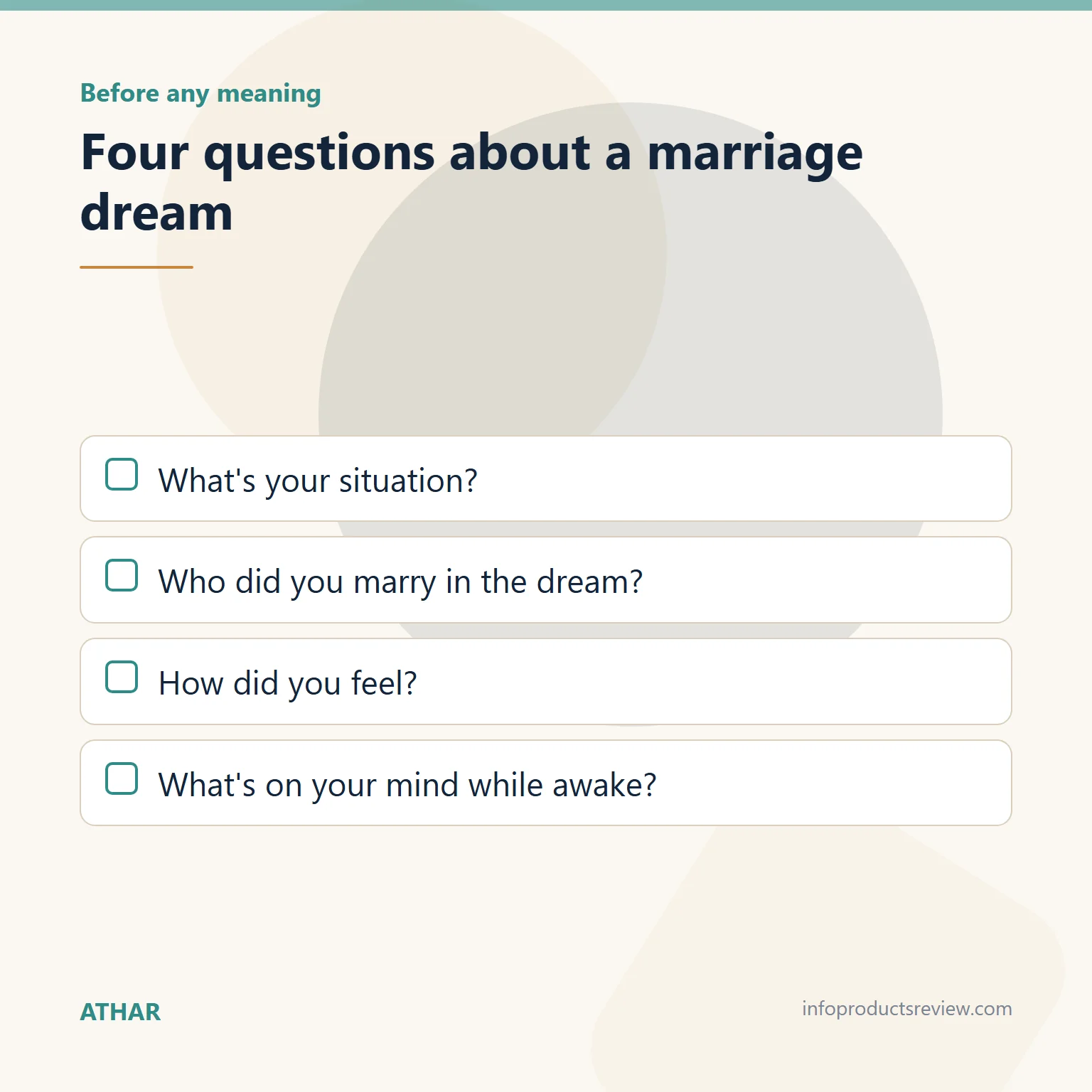
Not every detail carries the same weight. Here they are, from the most important to the least:
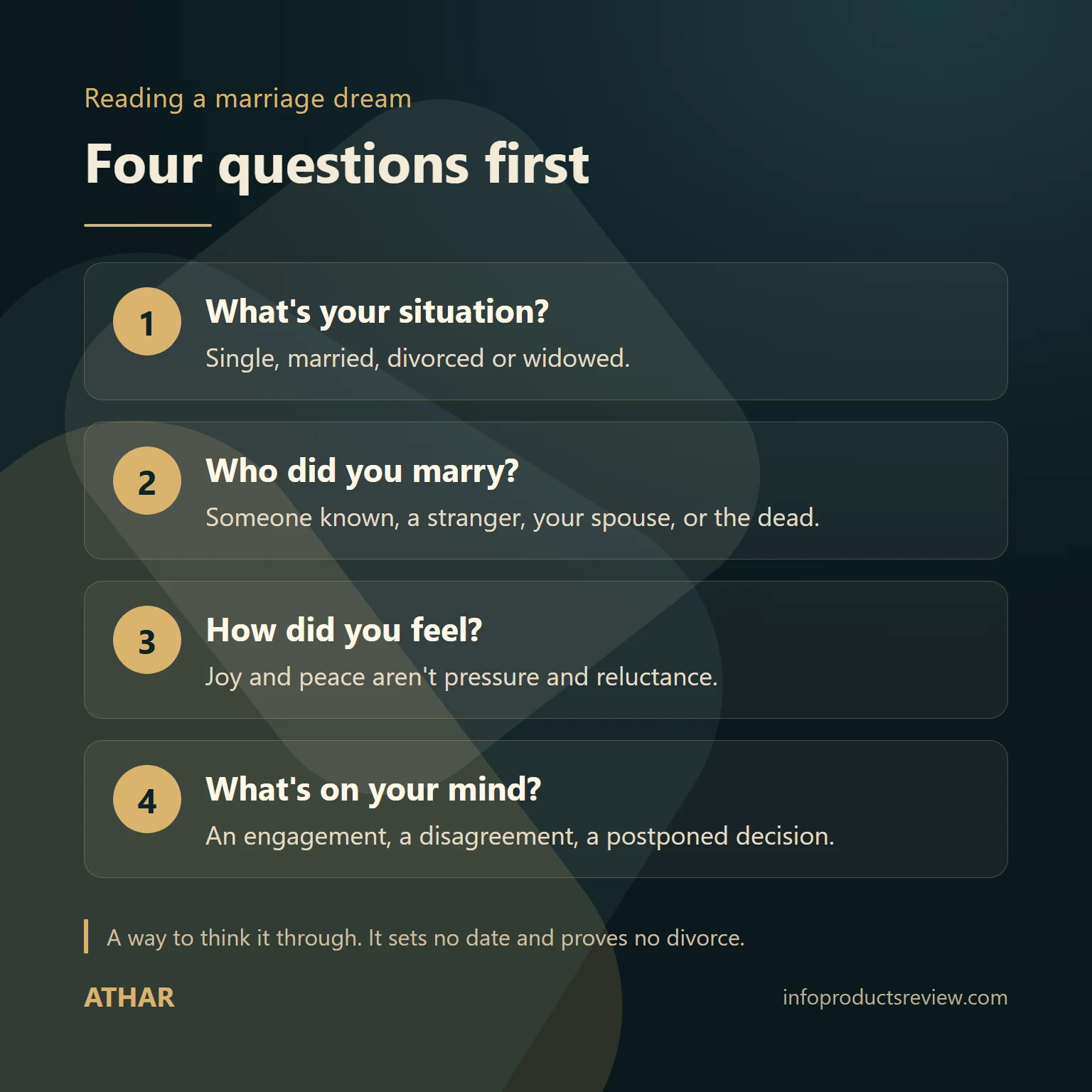
First: your situation. Single, married, divorced or widowed? A man or a woman? This changes the question from the start. A marriage dream during an engagement is a different thing from the same dream in a wife who’s worried about her home.
Second: who you married in the dream. Someone you know, a stranger, your own spouse, or someone who has died? Each of these has its own section below.
Third: how you felt. Joy and peace, pressure and reluctance, or worry about family and what people would say? Feeling often tips the balance between two possible readings.
Fourth: what’s on your mind while awake. A proposal, a work decision, a marital disagreement, a fear of loss. If marriage is already part of your days, the dream most likely echoes it.
Last: details of the celebration, clothing and place. They adjust the degree of a reading; they don’t create a new one.
What does marriage mean as a symbol in the dream books?
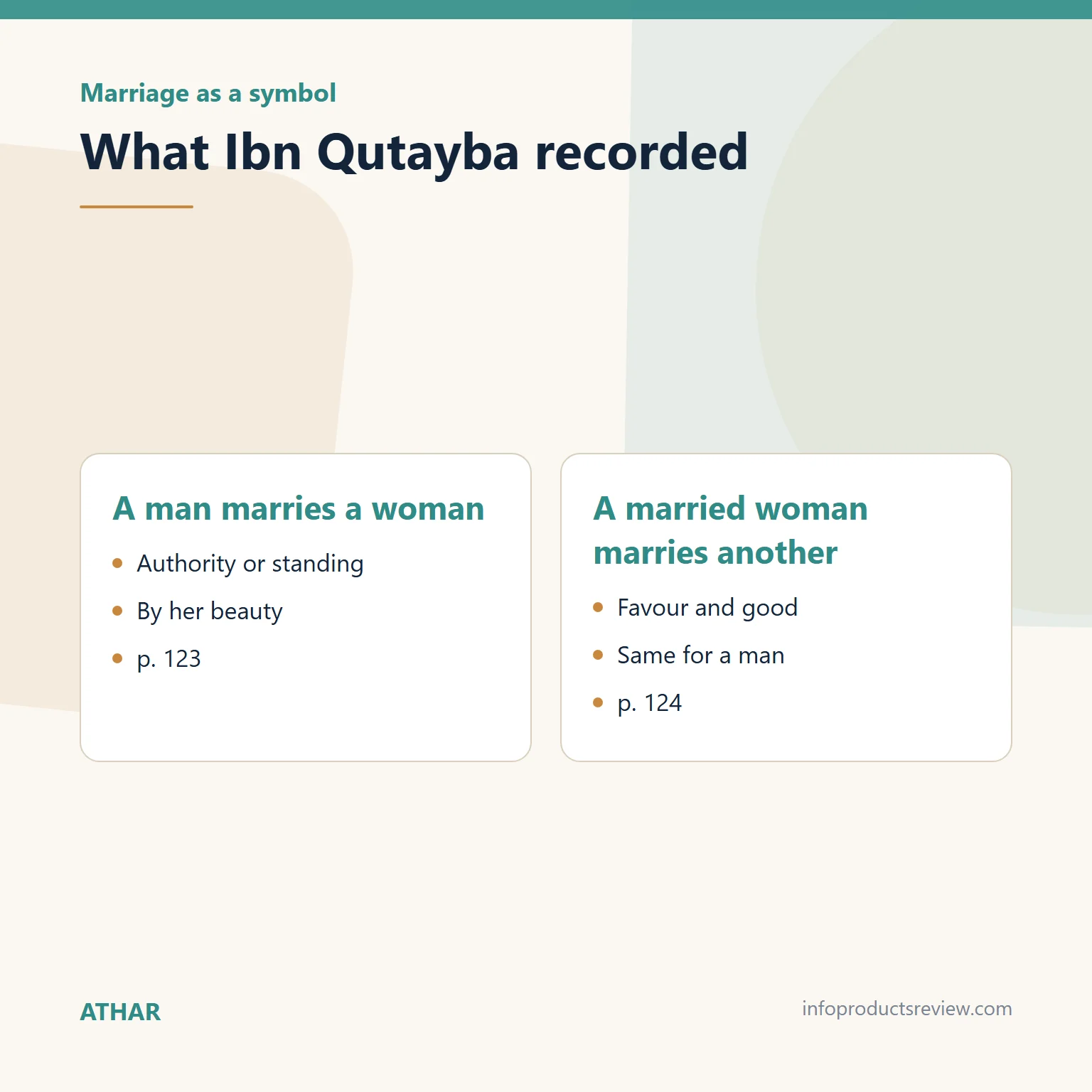
The oldest thing the dream books say about this symbol is a single clear sentence. A man who dreams he married a woman gains standing or authority, meaning a position and influence among people, in proportion to her beauty in the dream. The same reading applies to a man who sees a woman he recognises, or a woman linked to him.
Notice what that reading does. Marriage in a dream isn’t only marriage. It’s something you become bound to and gain from: a job, a standing, a responsibility. Beauty in the dream pictures how much is gained; it isn’t a description of a wife on the way.
It’s simpler than it sounds. Picture the dream saying: “there’s something new you’re about to be tied to.” It doesn’t say what that something is, when it arrives, or who any person in it might be.
This is an interpreter writing in the ninth century, at a time when dream books were mostly addressed to men. Its value is in showing how interpreters think: marriage stands for commitment and gain. It shouldn’t be read as a promise of a position, or as a hint about any particular marriage.
So an honest reading asks about the dreamer’s situation before saying “you’ll get married.” Someone looking for work may find that goal pictured in the symbol. Someone about to marry may simply be dreaming about what fills their days. And someone with neither on their mind can simply be glad of a good dream.
“I dreamed I got married and I’m single”: what does it mean?

This is one of the most common searches there is. The scenes vary: marrying someone you know, a stranger whose face you never saw, a wedding without joy, or one you felt pushed into. Each is read through the dreamer’s situation and her feelings.
If you’re thinking about marriage or there’s a proposal: the dream most likely echoes that preoccupation. That’s very common, and it says nothing about when or whom.
If you married happily and calmly in the dream: it’s an image to take heart from. It may reflect a wish for stability, or a move into a new stage of study or work.
If you married under pressure or unhappily: the dream may reflect pressure over some decision, from family or from circumstances. What helps is a calm conversation while awake, not a hunt for warnings in a dream.
If you married a stranger whose face you didn’t see: plenty of pages attach frightening meanings to this, and no fear should be built on a dream. It’s more naturally read through how you felt. A stranger in a dream often stands for something new whose shape isn’t clear yet, not for a specific person.
After a dream like this, ask yourself one simple question: what has been on my mind this week? Talk at home about a suitor? A friend’s wedding? A decision about study or work? The answer is often clearer than any interpretation.
The dream doesn’t set a wedding date or oblige you to accept or refuse anyone. If a real decision is in front of you, consultation and the prayer for guidance matter far more than the dream.
“I dreamed I married someone else and I’m married”: is it divorce?
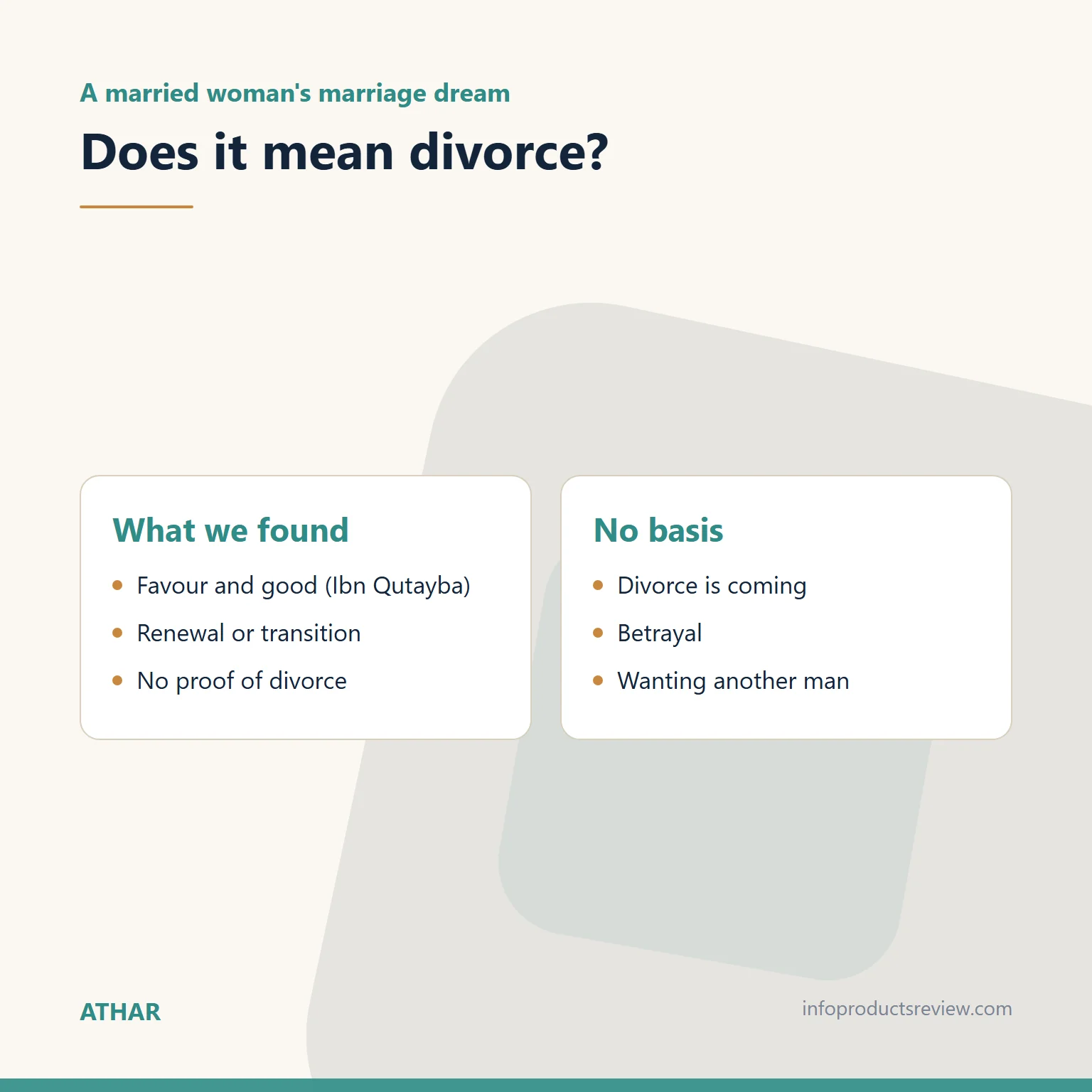
No. That’s the answer worth having in the first line, because many married women are alarmed to dream they got married again, especially to a man who isn’t their husband. The questions come immediately: is it divorce? A sin? Betrayal?
The books of dream interpretation read this exact scene reassuringly. A woman who has a husband and dreams she married another man gains favour and good, and the same applies to a man. That matters, because so many circulating pages tie this dream to divorce or suspicion.
Nor is the dream a sin. Nobody is held to account for what they see in their sleep, and a dream doesn’t reveal what’s in someone’s heart.
If she dreams she marries her own husband again: close to renewal in the relationship, or getting through a hard patch. One of the gentler images, and nothing to worry about.
If she dreams she marries a stranger: favour and good, on that reading. In waking terms it may reflect a wish for change or renewal, or a shift in work or responsibility, not a desire for another man.
If she dreams she marries someone she knows: the dream may relate to a working relationship, a family tie or a shared interest with that person, or simply to their presence in her day. It reveals nobody’s feelings and nobody’s intentions.
For how a married woman’s dreams can be read without fear, our guide to lice dreams for a married woman is a good example.
“I dreamed my husband married another woman”: does it mean he will?
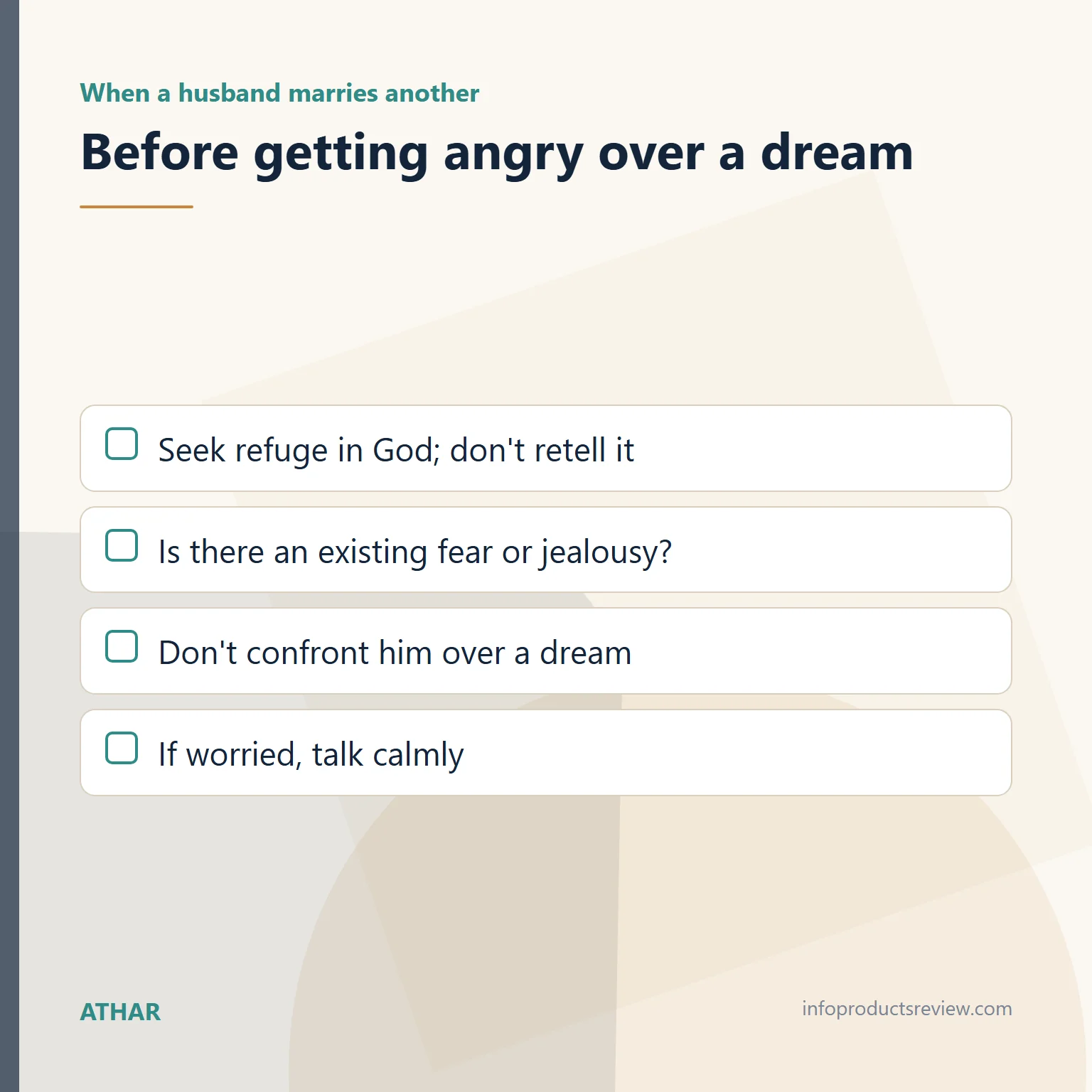
The dream can’t establish that. Still, it’s one of the most painful dreams for wives. Some wake up genuinely angry, and some even confront their husband over something he never did.
Interpreters speaking in published interviews say that a woman who deeply fears this may see the scene itself in her sleep and wake up terrified, and that it is a scare rather than news. You’ll find that clip in the interviews section below.
This dream most likely reflects a fear that’s already there, jealousy, or worry about a change in the relationship. It doesn’t show that he intends anything, or that he has done anything. It’s no basis for an accusation, a fight, or going through his phone.
The Prophet’s guidance for a dream you dislike is to seek refuge in God from its harm and not mention it to anyone, and he said it will not harm you (Sahih al-Bukhari, hadith 7045). If something in the relationship genuinely worries you, the place for it is a calm conversation while awake, not a confrontation built on a dream.
Another dream that often brings married women needless fear is covered in our guide to snake dreams for a married woman.
What does a marriage dream mean for a man?
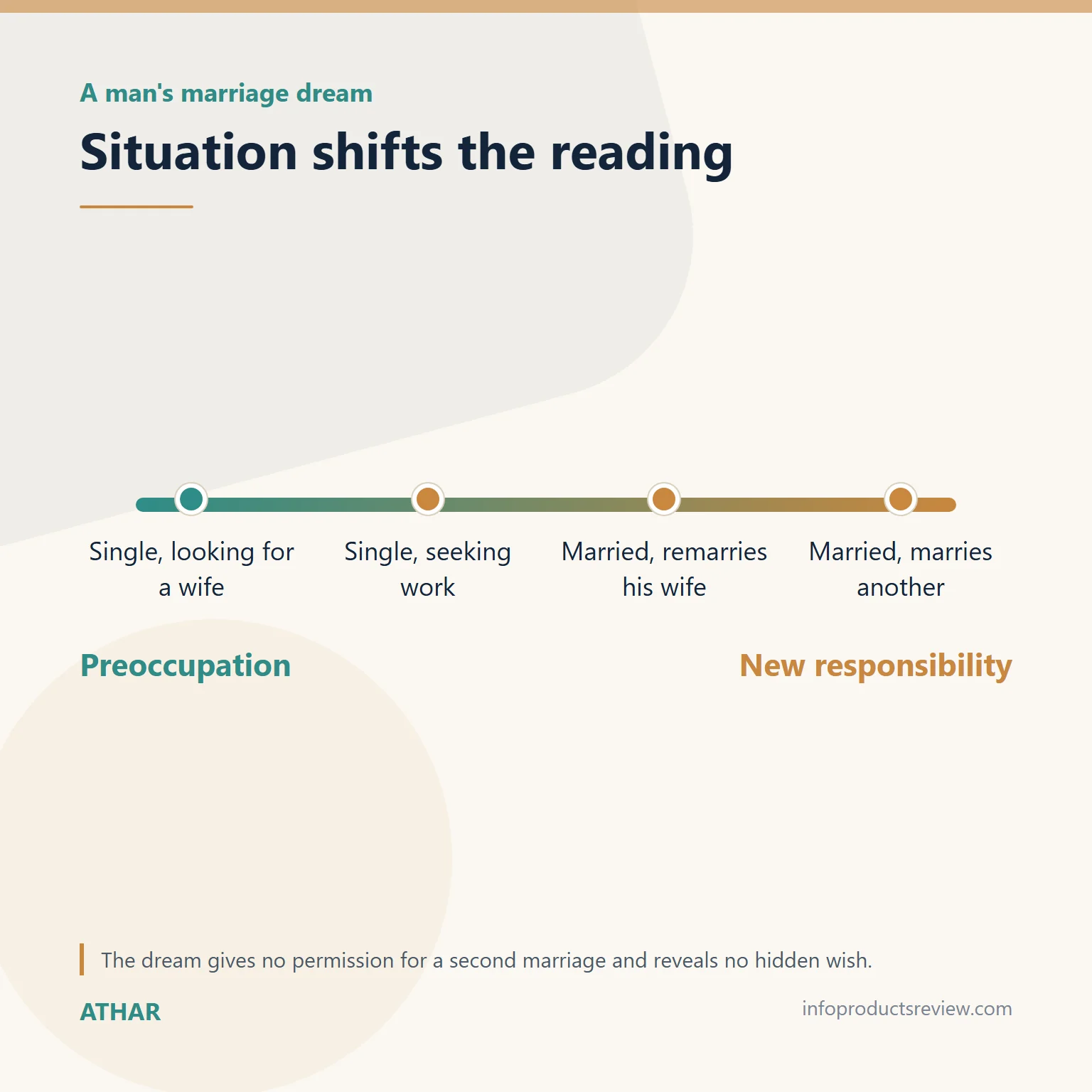
For a man, the symbol reaches past marriage itself towards standing, responsibility or partnership. Here’s the nearest reading for each situation:
If you’re single: marriage dreams often come while you’re looking for a wife or thinking about settling down. Someone seeking work or a promotion may find that goal pictured in the symbol, rather than news of a wife on the way.
If you’re married and dream you married another woman: circulating pages say this means conflict or divorce. The dream books say otherwise. A woman with a husband who dreams she married another gains favour and good, and the same goes for a man. The symbol reads as good, not trouble. In waking terms it may reflect a new responsibility, a partnership or a project.
Contemporary books on reading dreams give “seeing a marriage is trade” as one of their examples. That brings the symbol closer to partnership and work than to a woman as such.
If you’re married and dream you married your wife again: an image of renewal and affection, perhaps a wish to mend things or move past a disagreement.
The dream isn’t permission for a second marriage, evidence of a hidden desire, or a reason for a major decision. For how pressure at work and home can show up in dreams, see our guide to lice dreams for men.
Marriage dreams during pregnancy, after divorce, or for a widow
If you’re pregnant: common accounts claim a marriage dream reveals the baby’s sex or the due date. That claim has no basis in the dream books, and nothing should rest on it. The dream more likely reflects preoccupation with the new stage ahead, or a need for support and closeness.
If you’re divorced: a marriage dream may reflect a wish for a fresh start, fear of repeating a painful experience, or preoccupation with what family and others say. If you dream of returning to your former husband, it may reflect something still unsettled in you, not news of a reunion.
If you’re widowed: a marriage dream may carry longing for the husband you lost, worry about the future, or thoughts of stability. All of that is natural, and none of it is a sin or a warning.
In every case, the dream is no basis for agreeing to or refusing a marriage, and it can’t be used to judge anyone’s intentions. A more useful question is: what do I need right now? Support, time, or an honest conversation with someone I trust?
Does it change if you married someone you know, or a stranger?

Yes, a little. Here’s the nearest reading for each scene:
Someone you know and love: most naturally an echo of feelings and thoughts. It’s one of the most common dreams for anyone attached to someone, and on its own it doesn’t mean the marriage will happen.
Someone you know but don’t love: the dream may reflect a working relationship, a family tie or daily contact with that person, or discomfort about something connected to them. It doesn’t mean you’ll be forced into anything.
A stranger whose face you didn’t see: best read through how you felt. A stranger often stands for something new and unknown, not a specific person.
A relative you couldn’t lawfully marry: this image frightens some people, who worry it says something about them. In the books of dream interpretation, the scene is read as kindness and keeping family ties. So the dream more likely stands for a bond, a duty or a responsibility towards that relative, or simply their presence in your day.
There’s a wider principle here that should put you at ease: a dream that comes in a frightening or embarrassing form isn’t read at face value, and the default reading is the gentler, more hopeful one. There’s no need to carry guilt for a dream you didn’t choose.
What does marrying someone who has died mean?
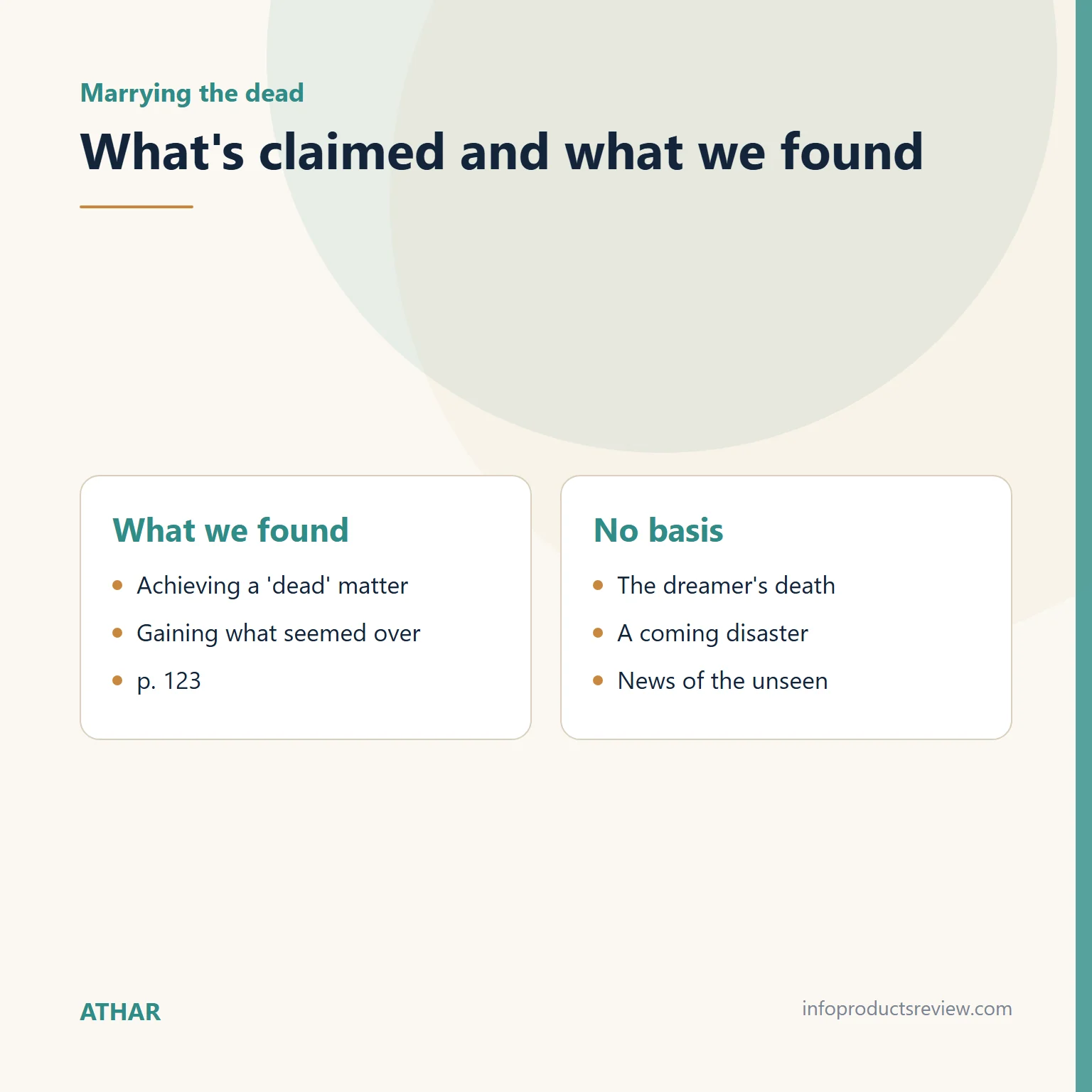
This scene worries many people, and plenty of pages tie it to death. The reading in the dream books is a completely different thing.
Whoever marries a dead woman in a dream “achieves something dead”: they gain something they thought was over or had given up on, such as an old right, a stalled project or a broken tie. It’s a possible reading rather than news, but it’s enough to show that tying this dream to death has no foundation.
If the person who died was a spouse, the dream may be a picture of longing and memory, and what helps afterwards is praying for them. We’ve written more about dreaming of someone who has died.
What does refusing a marriage, or running from it, mean?
Not every marriage dream is about saying yes. Some people dream they refuse a proposal, run away before the ceremony, or say no at the last moment. Others wake up relieved that the marriage didn’t go ahead.
Refusing a suitor in a dream: may reflect genuine hesitation about an option on the table, a sense that the timing is wrong, or fear of a commitment you’re not ready for. The dream doesn’t say the suitor is unsuitable, or that refusing is the right decision.
Running away from a wedding: sits close to a wish to escape pressure or responsibility, whether it’s tied to marriage itself or to work or study. It may come up more for someone who feels a decision is being imposed on them.
Relief that the wedding didn’t happen: worth thinking about calmly. It may echo a hidden worry, or it may just be tiredness. The most useful step is to ask yourself, while awake, what’s really bothering you, and to talk it over with someone you trust.
The dream books give no specific meaning for refusing marriage in a dream. So what’s above is a reading of the scene by the same logic, not a quotation from an interpreter. And the dream is no basis for turning down a proposal or ending an engagement.
And what if you dreamed of the engagement alone?
Some people dream of the engagement with no wedding at all: a suitor coming forward, a family visit, the reading of the Fatiha, or a ring being put on. The image is close to a marriage dream, but it sits nearer to beginnings and intentions than to a full commitment.
If a single woman dreams she’s happily being proposed to, the dream most likely reflects hope or waiting, or echoes talk at home about marriage. If the engagement felt heavy, it may reflect hesitation or pressure from family.
If a man dreams he’s proposing, the dream may reflect an intention or a first step towards something new: a job, a project, a decision. It doesn’t say the engagement will happen, or that the woman in the dream is the wife written for him.
The dream books give the engagement on its own no specific meaning, so this is a reading by the same logic, not a quotation. The wedding scene itself is covered in our guide to dreaming of your own wedding.
What does marrying a celebrity or someone of high standing mean?
Some marriage dreams are more curious than worrying: marrying a famous singer, a footballer, a well-known businessman or someone in high office.
If marriage in a dream is read as standing in proportion to the woman’s beauty, then by the same logic, marrying someone of standing could picture ambition, a wish to be recognised, or a push towards a position of your own. That’s a reading by analogy, not a quotation from any interpreter.
In waking terms, the dream often echoes following that person or admiring them, or a wish for attention and visibility. It doesn’t say a real relationship is coming, or that the dreamer will become famous.
When a woman is considering becoming a second wife
Some women face a delicate situation in real life: a proposal from a married man, or the question of whether to accept being a second wife. That uncertainty can surface in dreams in different ways: a wedding shadowed by worry, a meeting with the first wife, or fear of what people will say.
These dreams most likely reflect the uncertainty itself, not an answer to it. The dream doesn’t say “accept” or “refuse,” and it doesn’t reveal the man’s intentions or his first wife’s position.
A decision like this needs a hard look at real circumstances, advice from people you trust who know the matter, and the prayer for guidance. It shouldn’t rest on a dream, and the dream doesn’t show whether the marriage would be good or bad.
Does a marriage dream have anything to do with divorce?
In many people’s minds, marriage dreams and divorce dreams go together, and someone who dreams of one often asks about the other. Two points should be reassuring.
First: a marriage dream for a married woman doesn’t mean divorce. As we saw, the dream books read a married woman marrying another as favour and good.
Second: dreaming of divorce itself doesn’t establish a divorce in real life. It may reflect a passing disagreement, a fear of loss, or a wish to be rid of some burden that has nothing to do with marriage. We don’t offer an older, fixed meaning for the divorce scene here, because none is confirmed.
The rule is the same either way: no decision in a marriage should rest on a dream, and no one should be accused because of one. If there’s a real disagreement, it belongs in conversation, reconciliation and good advice.
What does dreaming of a son’s, daughter’s or relative’s wedding mean?
People don’t only dream of their own marriage. A parent may dream of a child’s wedding, a brother of his sister’s, a grandmother of her grandson’s. The feeling in these dreams ranges from joy to worry.
A child’s wedding, seen with joy: most likely an echo of a parent’s wish to see their children settled, or real concern for their future. These dreams often come around graduations, or when marriage starts being discussed at home.
A child’s wedding, seen with worry or fear: may reflect fear of separation, unease about a choice that doesn’t sit well, or a sense that the relationship with that child is about to change. Many parents feel this, and it’s natural.
The wedding of a young child: doesn’t point to an early marriage. It’s more likely a picture of care for the child’s future, or a distant hope.
A sibling’s or relative’s wedding: may reflect an expected family event, your relationship with that person, or simply something you heard.
None of these dreams is grounds for arranging a marriage for someone, turning down a suitor on their behalf, or judging a son’s or daughter’s choice. Marriage decisions belong to real life, good advice, and the consent of the people concerned.
Why do marriage dreams increase while studying or starting a job?
Many young people notice that marriage dreams come more often at turning points: the end of a degree, waiting for results, a new job, or moving to another city.
That fits the reading of marriage as standing, or a bond with something new, rather than only a wedding. It also fits the example that seeing a marriage is trade. Someone about to start a job or postgraduate study may dream of getting married, and the symbol may sit closer to the new commitment waiting for them.
If the wedding in the dream was joyful: an image to take heart from as the new stage begins.
If it came with worry or hesitation: it may reflect the natural fear of a new commitment, or of leaving a familiar stage behind.
The dream doesn’t decide success or failure in study or work, and it’s no substitute for effort and good advice.
At a time like this, it helps to write down what’s really on your mind. Is it marriage itself, fear of responsibility, family pressure, or the move to a new life? Often, once it’s on paper, it becomes clear the dream wasn’t about a particular marriage at all, but about a whole stage of life you’re preparing for.
If the dream turns out to reflect worry about a real decision, give that decision its due while awake. Ask about the details, talk to someone who knows the matter, and pray for guidance. Don’t wait for another dream to settle something that needs thought.
How did you feel in the dream?
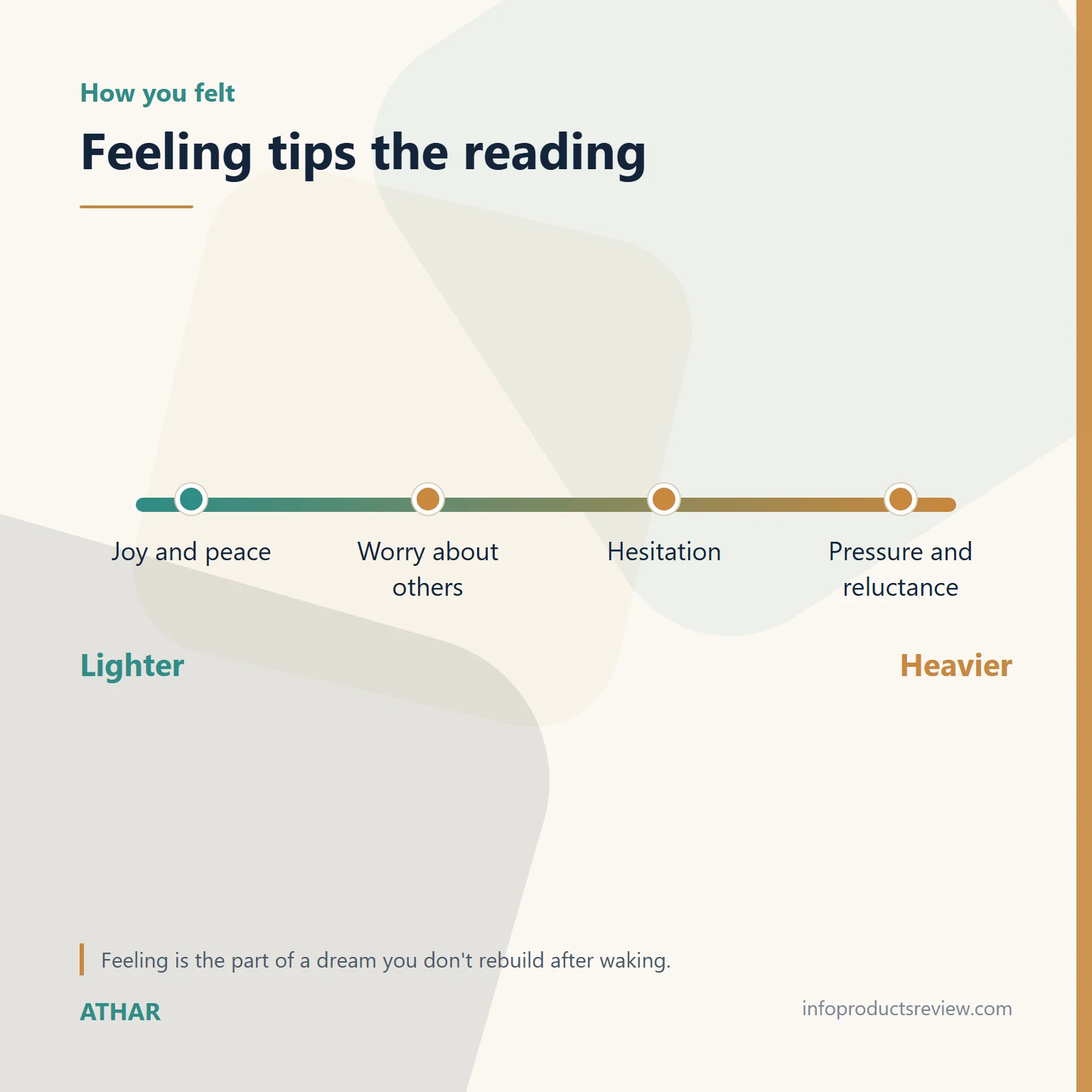
Of all the details, feeling is the most honest, because it’s the part you don’t reconstruct after waking.
Joy and peace: bring the reading closer to good, and a calm move into a new stage.
Reluctance and pressure: bring it closer to pressure over a decision, fear of commitment, or something being imposed on you.
Crying in the dream: can be tears of joy or of sadness, and each is read differently. We cover this in our guide to crying in a dream.
Worry about family or what people think: may reflect concern for the approval of those around you, or fear of family conflict.
If two feelings were mixed, say joy followed by fear, go with the one that stayed with you after waking. It’s usually closer to what’s on your mind.
I keep dreaming of marriage: what does the repetition mean?
Repetition on its own doesn’t turn a dream into confirmed news. Plenty of people dream of marriage again and again, and ask whether that makes it a sure sign.
Recurrence is most likely tied to what’s on your mind: an upcoming proposal, a long wait, a disagreement, a postponed decision. Interpreters say in their interviews that someone about to marry may be so preoccupied that marriage fills their dreams.
Recurrence sets no date and names no person. If the repeated dream is distressing, the Prophet’s guidance for a dream you dislike is enough: seek refuge in God from its harm and don’t mention it to anyone (Sahih al-Bukhari, hadith 7045). There’s no need to look for an interpretation every time.
What do the older dream books actually say about marriage?
The oldest book this page draws on comes from the ninth century, its authorship well documented,. What it says about marriage comes down to three sentences:
- A man who dreams he married a woman gains standing in proportion to her beauty.
- Whoever marries a dead woman gains something that seemed over.
- A married woman who dreams she married another man gains favour and good, and the same goes for a man.
The same book contains harsher readings of some scenes. They’re the judgements of an interpreter from a distant age, not news about anyone. So we only present what helps a reader without frightening them, and we never pronounce on anyone’s future from a dream.
Among contemporary books, one on the principles of reading dreams sets out that symbolic dreams turn on the kind, type and nature of the symbol. In other words, an interpreter looks at what sort of thing you saw and what it is like, not only at how it appeared.
It illustrates that with an old report. A man came to a scholar of the early generations saying he had dreamed of a beautiful white dove on the mosque’s parapet, which a falcon came and carried off. The scholar read the dream as a marriage between a well-known man and a well-known woman of that time, and the report says it happened shortly afterwards.
That doesn’t mean every dove is a marriage. The example shows that marriage can be read from symbols that look nothing like it, and that an interpreter weighs the symbol’s nature, the dreamer’s situation and the people around them. It was one man’s dream in one time and place, not a rule for anyone who dreams of a bird.
What you won’t find in these books matters just as much: no link between a marriage dream and certain divorce, none between a husband remarrying in a dream and betrayal, and no wedding dates or names of spouses. Anyone offering those is adding, not transmitting.
What is actually established about dreams?
Two things get blurred together. One is interpreting marriage as a symbol, which is human judgement and can be right or wrong. The other is the Prophet’s guidance on dreams, which is recorded in the two most authoritative collections, Sahih al-Bukhari and Sahih Muslim.
In Sahih al-Bukhari (hadith 7045), the Prophet said:
If one of you sees a dream he likes, it is from God, so let him praise God for it and speak of it; if he sees otherwise, something he dislikes, it is from Satan, so let him seek refuge from its harm and mention it to no one, for it will not harm him.
The meaning is plain. A dream you like, you thank God for, and you may speak of it. A dream you dislike, you seek refuge in God from its harm and mention it to no one, and it will not harm you. This is general guidance for every dream, not a specific meaning for marriage dreams.
Sahih Muslim (hadith 2262) adds to the same guidance: whoever sees a dream he dislikes should spit to his left three times, seek refuge in God from Satan three times, and turn over from the side he was lying on.
If one of you sees a dream he dislikes, let him spit to his left three times, seek refuge in God from Satan three times, and turn over from the side he was lying on
So if a marriage dream made you happy, thank God. If it upset you, like a husband marrying another woman or a forced marriage, do what those two hadiths (Bukhari 7045 and Muslim 2262) describe: seek refuge in God, and don’t retell the dream to everyone. The hadith in al-Bukhari reassures you it will not harm you.
Reading symbols, though, is analogy, comparison and estimate rather than certainty. An interpreter may be right and may be wrong, and no one should swear to something unseen until waking life bears it out. That caution is written into the books of principles themselves.
Nothing makes a marriage dream news of a wedding or a divorce. No proposal should be accepted or refused on the strength of a dream. And no religious text gives marriage in a dream a fixed meaning; every meaning here is interpretation.
What do dreams have to do with what occupies us while awake?
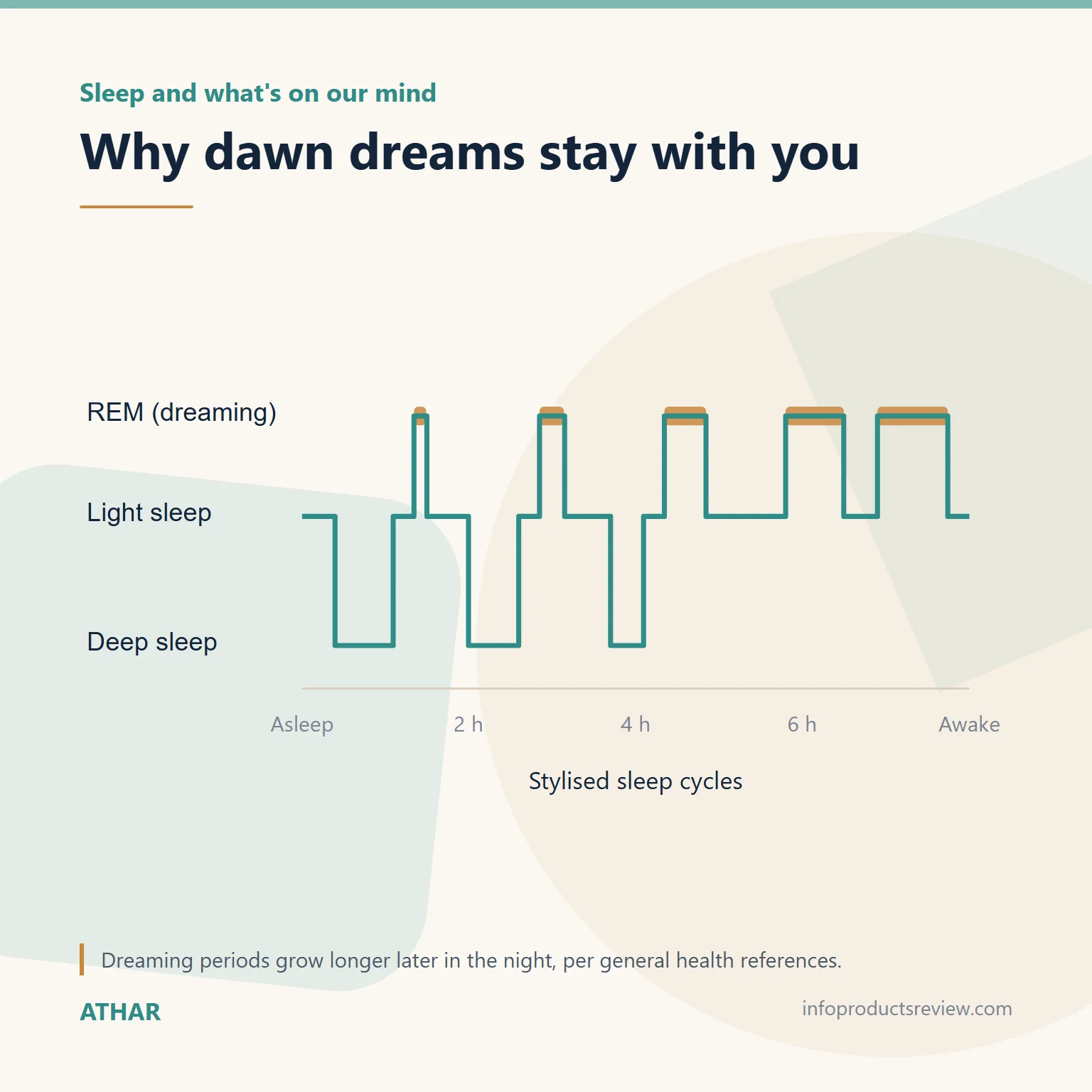
We keep this apart from the older material on purpose. This part is about sleep and the mind; the other is about what interpreters said of symbols.
General health references note that events from the day often find their way into our thoughts during sleep. The Sleep Foundation lists stress, anxiety and too little sleep among the causes of distressing dreams.
So it’s no surprise that marriage dreams cluster around engagements, long waits and marital disagreements, or that they can be upsetting for someone carrying fear of loss or jealousy.
That doesn’t mean every marriage dream is just the mind processing, or that it’s a message. And a dream doesn’t diagnose anxiety or any disorder; that’s work for a professional. If distressing dreams keep coming and spoil your sleep, talking to a doctor or specialist is a practical step.
When is a marriage dream more likely your mind processing?
No single sign settles it, but several together say a lot:
- You’re engaged, or marriage is being discussed with your family.
- You went to a wedding or looked at wedding photos before bed.
- You’re carrying fear or jealousy in your marriage.
- You’ve had a disagreement, or have a postponed decision about commitment.
- You went to bed exhausted, or woke many times in the night.
If several apply, the dream is most likely an echo of what you’re living through, not a message about your future. That’s a comforting measure in itself: take what helps you while awake, and leave whatever claims to know the future.
Common claims about marriage dreams that need correcting
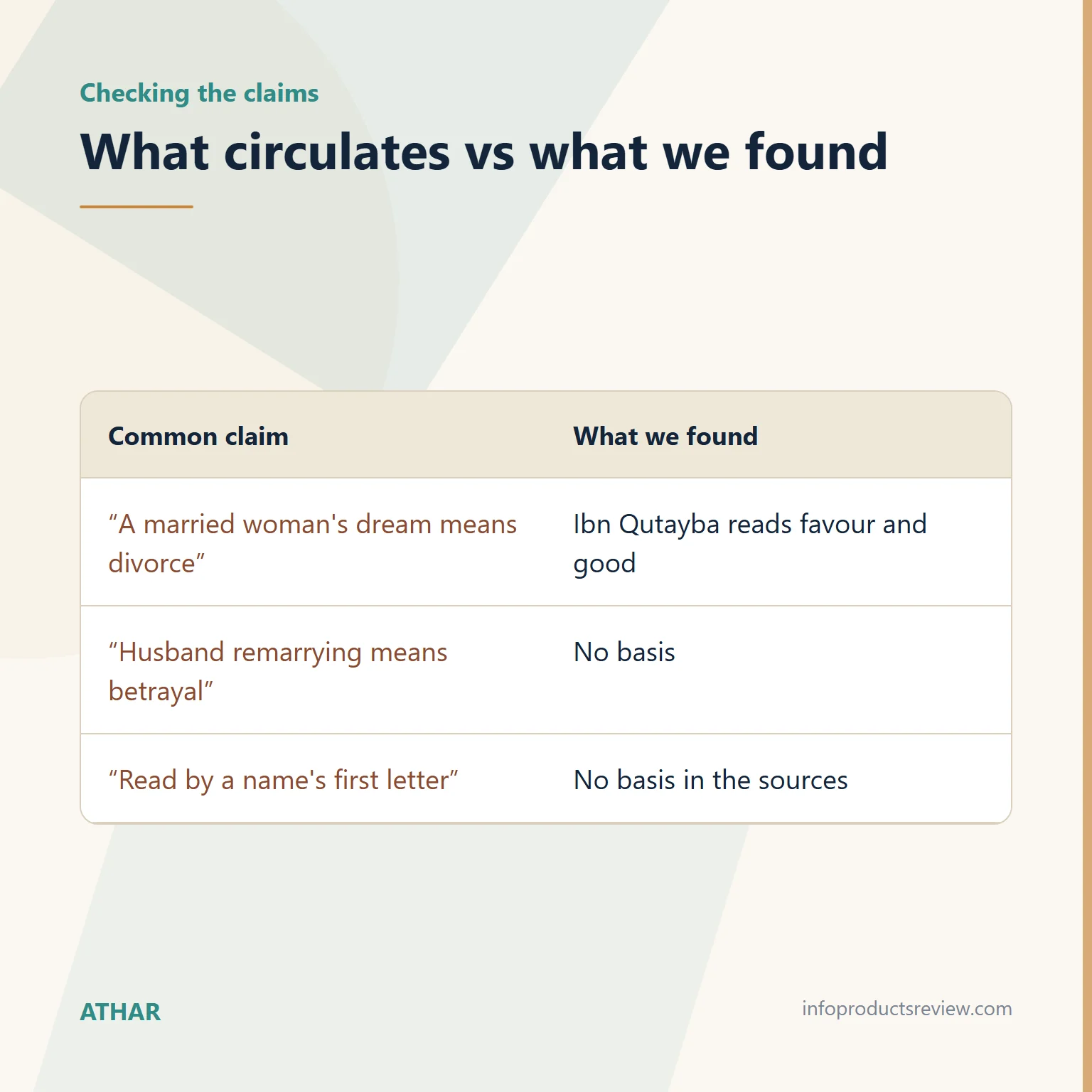
- “A marriage dream for a married woman means divorce.” The dream books read a married woman marrying another as favour and good.
- “Seeing your husband marry another woman is evidence of betrayal.” No known source supports that, and the dream may be a scare rooted in an existing fear.
- “For a single woman, a marriage dream means a wedding within days.” Dreams don’t set dates.
- “Marrying the dead means death.” It’s read instead as gaining something that seemed over.
- “A marriage dream in pregnancy reveals the baby’s sex.” No basis.
- “Marriage dreams are read by the first letter of a name.” The recognised dream books contain nothing of the kind.
- Attributing fixed marriage meanings to Ibn Sirin as settled fact. The popular book is only attributed to him, and that attribution isn’t established.
What a marriage dream cannot establish
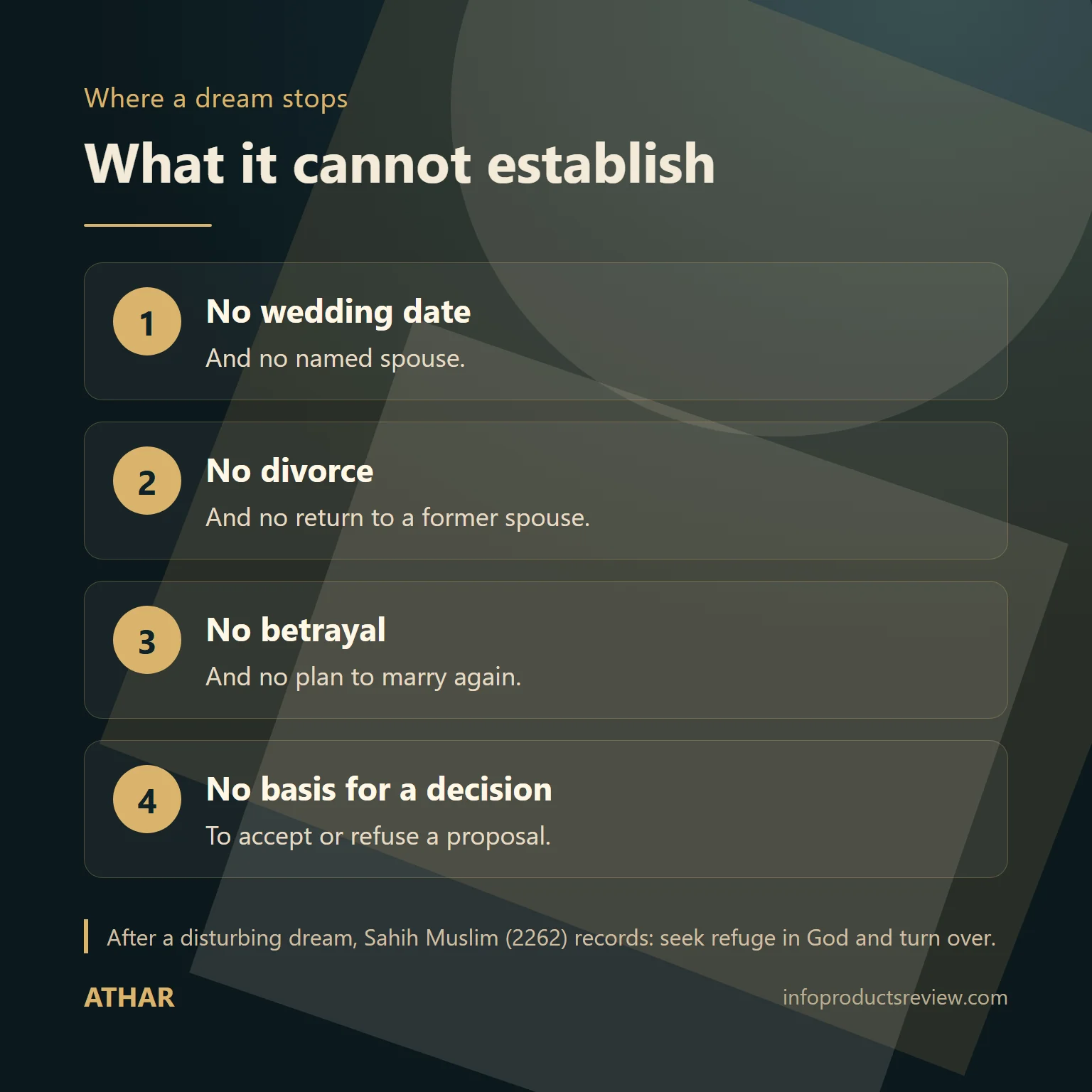
This is where we gather every caution once, so the warnings don’t have to be repeated line by line:
- It can’t set a wedding date or name a spouse.
- It can’t establish a divorce or a return to a former spouse.
- It can’t establish betrayal or an intention to marry again.
- It reveals no forbidden desire, even if the dream involved a relative.
- It can’t announce a pregnancy or a baby’s sex.
- It can’t announce anyone’s death, even if the person you married in the dream had died.
- It isn’t a basis for a decision to accept or refuse a proposal or end a relationship.
- It can’t judge anyone’s intentions, and it never justifies a wounding question to a spouse or a relative.
What to do after a marriage dream

- If the dream pleased you, thank God, take heart, and share it with people you love if you want to (Sahih al-Bukhari 7045).
- If it disturbed you, seek refuge in God, spit lightly to your left three times, turn over, and don’t retell it (Sahih Muslim 2262; Sahih al-Bukhari 7045).
- Look at what’s on your mind: a proposal, a disagreement, a fear, a postponed decision.
- Don’t confront anyone over a dream, or accuse a spouse, fiancé or relative because of it.
- If a real marriage decision is in front of you, consult people you trust and pray for guidance.
How to describe your dream so it can actually be read
- Your situation: single, married, divorced or widowed?
- Who you married: someone you know, a stranger, your spouse, or someone who has died?
- How you felt: joy, reluctance or worry?
- What’s on your mind: an engagement, a disagreement, work?
- Details of the celebration, if there were any.
What have interpreters said in recorded interviews?
Here we summarise what interpreters have said in published interviews, because hearing how someone reasons can be clearer than reading about it. But note this: these are personal views, not religious rulings, and not a reading of your dream.
In the first clip, an interpreter talks about frightening dreams. He says a woman who fears her husband marrying another may see it in a dream and wake terrified, and that it’s a scare rather than news.
The speaker holds that a wife who fears her husband taking another wife may see exactly that in a dream, as a fear rather than news. Paraphrased; an opinion from an interview, not a religious ruling or a definitive interpretation.
In the second, a different interpreter says marriage dreams are among the dreams unmarried people most often bring to him, and that someone about to marry can be so preoccupied that they dream about it. Both views explain why these dreams are so common, not what any one of them means.
The speaker says marriage dreams are among the most common dreams unmarried people bring to him. Paraphrased; an opinion from an interview, not a religious ruling or a definitive interpretation.
That fits what Sahih al-Bukhari records (hadith 7045): a disliked dream is met by seeking refuge in God and cannot harm you. And life’s big decisions aren’t built on dreams.
A few typical scenes
A young woman in the middle of an engagement dreams she’s getting married, and she’s happy. Most likely an echo of her preoccupation, and an image to take heart from, without setting any date. What she needs after the dream is what she needed before it: getting to know him properly, asking questions, and praying for guidance.
A married woman dreams she marries a stranger and fears it means divorce. The dream books read this as favour and good; the dream establishes neither divorce nor sin. There’s no need to tell her husband if it would only worry him.
A wife dreams her husband married another woman and wakes up angry. Most likely a scare rooted in an existing fear. She can seek refuge in God and not confront her husband over a dream. If something at home genuinely troubles her, she can raise it calmly, apart from the dream.
A man looking for work dreams he marries a beautiful woman. The symbol reaches beyond marriage to standing he may gain. He can take heart and keep going, without expecting the dream to bring him the job.
A widow dreams she marries her late husband. Most likely a picture of longing and memory; what helps afterwards is praying for him and giving charity on his behalf.
A young man dreams he marries a close relative he could never marry, and wakes up shaken. The dream books read such a scene as kindness and keeping family ties. It most likely concerns his bond with that relative, and reveals nothing about him.
Quick reference: detail and nearest reading
| Detail in the dream | Nearest possible reading |
|---|---|
| A man marries a woman | Standing in proportion to her beauty |
| A married woman marries someone else | Favour and good, not divorce |
| Your husband marries another woman | Fear or jealousy, not betrayal |
| A single woman marries happily | An echo and good news, not a date |
| A forced or unhappy marriage | Pressure over a decision or fear of commitment |
| Marrying someone who has died | Gaining something that seemed over |
| Marrying a relative | Kindness and family ties, not a forbidden desire |
| The dream keeps recurring | A waking preoccupation, not confirmed news |
Related guides
- All English dream guides by topic — every guide reads a symbol by its details first, then its limits.
- Dreaming about lice as a single woman — another dream that reflects the worries of a waiting season and is read through feeling.
- Crying in a dream — tears often appear in wedding dreams, and their kind changes the reading.
- Athar in English
- National Institute of Neurological Disorders and Stroke — Understanding Sleep
- Sleep Foundation — Nightmares, stress and too little sleep
Frequently asked questions
What does dreaming of marriage mean in general?
Most naturally a symbol of commitment, transition or new responsibility. In the dream books, a man who dreams he married a woman gains standing in proportion to her beauty. The meaning shifts with the dreamer’s situation and feelings.
Does a marriage dream mean a single woman will marry soon?
No dream sets a wedding date. It often echoes preoccupation with marriage, and it can be taken as encouragement without building a decision on it.
I dreamed I married someone other than my husband. Does it mean divorce?
No. The dream books read a married woman marrying another as gaining favour and good. The dream isn’t read as divorce or betrayal.
I dreamed my husband married another woman. Will he?
The dream can’t establish that. It’s most likely a scare rooted in an existing fear. Seek refuge in God, and don’t build an accusation on it.
What does marrying someone who has died mean in a dream?
The dream books read it as gaining something you thought was over. The dream doesn’t point to anyone’s death.
What does a marriage dream mean for a married man?
It may be read as taking on a new responsibility or partnership. A married woman who dreams of marrying another gains favour and good, and the same goes for a man. It reveals no intention to marry again.
What does marrying someone I know mean?
Most likely an echo of that person’s presence in your life or thoughts; on its own it doesn’t mean the marriage will happen.
Does dreaming of marrying a relative mean a forbidden desire?
No. Such a scene is read as kindness and keeping family ties, so it more likely stands for a bond, closeness or responsibility towards that relative.
What should I do after a marriage dream that upset me?
Seek refuge in God from its harm and don’t mention it to anyone, as in Sahih al-Bukhari (7045); Sahih Muslim (2262) adds spitting to the left three times and turning over.
I keep dreaming about marriage. Is it a message?
Recurrence is usually tied to what’s on your mind while awake, and it doesn’t make the dream confirmed news.
Are marriage dreams read by the letters of a name?
The recognised dream books contain nothing of the kind, and nothing should be built on it.
Is any of this certain?
No, and that’s deliberate. What we offer are possible meanings that shift with the details, and none of it predicts the future.
In summary
- Marriage in a dream is a symbol of commitment, transition or responsibility, not news of a wedding.
- A man who marries a woman in a dream gains standing in proportion to her beauty, and a married woman who marries another gains favour and good.
- Dreaming your husband married another woman may be a scare, not news.
- Marrying the dead is gaining something that seemed over, not death.
- The dream can’t set a date, establish divorce or betrayal, or carry a decision.
- After a disturbing dream: seek refuge in God, turn over, and don’t retell it (Sahih al-Bukhari 7045; Sahih Muslim 2262).
If you take one thing from this page, let it be this: the decision to marry is too big to rest on a dream. A dream can reassure you or show you what’s on your mind, but it can’t choose for you.
Written and reviewed by: the ATHAR editorial team. Classical and hadith quotations are taken from the editions named in the sources; English renderings of Arabic texts are our own translation.
Last reviewed: 15 September 2026.
Note: what appears here is a possible meaning, not a confirmed fact, and it changes with the details of the dream and the dreamer’s circumstances. Nothing here predicts the future, sets a wedding date, proves divorce or betrayal, or offers a religious ruling.