

Pregnancy changes how you sleep, and it changes how you dream — or at least how much of it you remember. You wake more often, the scenes stay sharper, and when one of them has a scorpion in it, you end up with two questions instead of one: what does this mean, and does it have anything to do with my baby?
This guide answers the first from what the classical dream books actually say, and answers the second plainly: a dream tells you nothing about your pregnancy or your baby.
The short answer
- The closest meaning. Ibn Qutayba described the scorpion as a weak enemy whose harm goes no further than his tongue, and who treats friend and enemy exactly alike. The symbol is about someone who does damage by talking — not about danger closing in on you.
- What changes the reading. What happened in the scene, what you did, and how you woke. Color, size and where you were stung carry no fixed meaning in the dream books.
- What nobody can tell you from it. Not your baby’s sex, not whether your pregnancy is healthy, not your due date or how the birth will go, and not that anything will go wrong. No dream supports a diagnosis or a medical decision.
- What to do with that. Settle yourself first: seek refuge in God, spit lightly to your left three times, turn onto your other side, and don’t retell the dream. Then look at your night rather than the symbol — broken sleep and a busy mind explain a great deal of what happens in pregnancy dreams.
What this page covers
- The short answer
- What the old dream books actually say
- Does being pregnant change the meaning?
- Why unsettling dreams get more common in pregnancy
- Three questions that tell scenes apart
- What happened in the scene?
- Where were you?
- How did you wake up?
- The scenes expectant mothers actually ask about
- A scorpion near the bed
- A scorpion moving toward your belly
- Being stung
- Killing the scorpion
- More than one scorpion
- One that runs off or disappears
- What this dream cannot tell you
- If you woke up frightened: what comes first
- When the question belongs to your doctor, not a dream page
- Why the same scene hits harder now
- Should you change anything because of it?
- When relatives interpret it for you
- What about the reassuring dreams?
- Where your dream sits among the kinds
- If this pregnancy follows a loss
- If your older child or your home appears
- When someone else has the dream about you
- Why this gets searched at 3 a.m.
- If you want to ask an interpreter, what should you write?
- What if you don’t remember the details?
- Does the time of night matter?
- And after the birth?
- Two worked examples
- Mistakes that keep showing up on these pages
- Common questions
- Does a scorpion dream mean danger to my baby?
- Does it indicate my baby’s sex?
- I was stung on the belly. Is that a warning?
- I killed the scorpion. Does that mean an easy birth?
- Does the meaning change by trimester?
- I’ve had these almost nightly since getting pregnant. Is that normal?
- Is a scorpion dream a sign of envy or sorcery?
- There were many scorpions. Is it more serious?
- Should I tell my husband or my mother?
- Should I give charity or recite something because of this dream?
- I woke up crying from fear. Is that a bad sign?
- Could it just be anxiety?
- I saw it at my parents’ house. Is it about one of them?
- What should I do right now?
- The bottom line
What the old dream books actually say
There’s very little classical material on this symbol, and that works in your favor: a short line can’t support the dozens of confident meanings pinned to it online.

Ibn Qutayba wrote that the scorpion is a weak enemy, that his scheming goes no further than his tongue, and that friend and enemy are the same to him. The harm described is verbal — gossip, talk that travels — not harm to a body or a household. And the word “weak” matters, because the fear this dream leaves behind is much larger than what the symbol was ever said to carry.
He also recorded one image where the direction reverses: a person who sees a scorpion in his own hand stinging people is someone who backbites people. There the harm travels outward from the dreamer.
That is the whole of it. Everything after this is either a question to help you read your own situation, a limit on what interpretation can do, or general health information about sleep in pregnancy — which gets its own clearly marked section so it never blurs into the interpretation.
Does being pregnant change the meaning?
This is almost certainly why you’re here, so here it is straight:
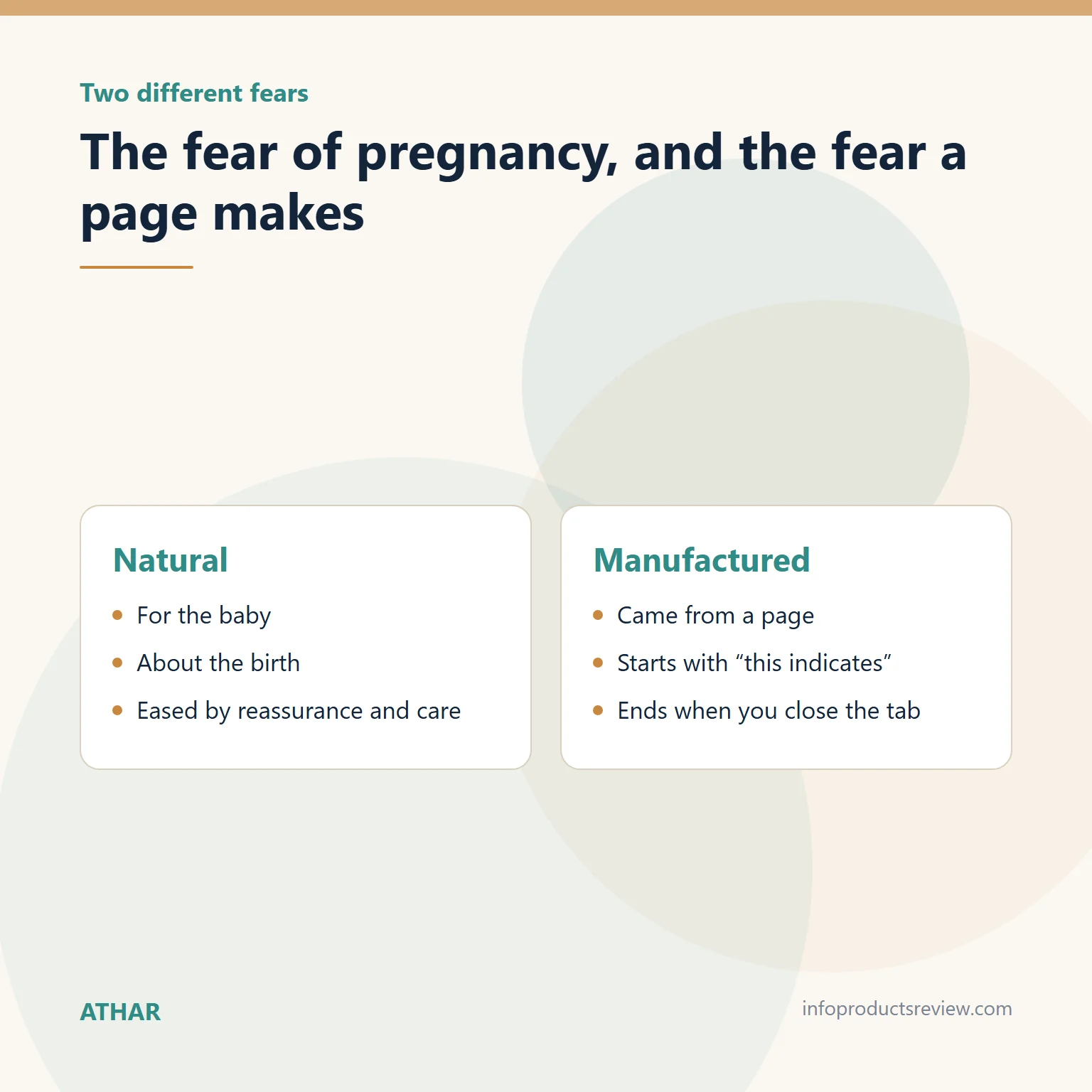
Nothing in the verified sources gives this symbol a fixed meaning that changes simply because you are pregnant. What differs is the context of the dream and the questions on the dreamer’s mind.
In practice: the description of the symbol is the same for you as for anyone else — it is the same description set out in our guide for married women. What’s different is you — your body is tired, your sleep is broken, and your heart is occupied by something enormous. The same scene lands on a more alert nervous system, so it hits harder.
So when a page tells you that a scorpion in a pregnant woman’s dream specifically indicates this or that, what you’re reading is the writer’s addition, not anything transmitted. A great deal of what gets published in this corner of the internet runs on the fear of expectant mothers, because it’s the easiest fear to trade on.
Why unsettling dreams get more common in pregnancy
This section is not interpretation and has nothing to do with scorpions. It comes from general health references about sleep, kept separate on purpose.
Those references note that sleep starts changing in the first trimester: fluctuating hormone levels cause generalized discomfort and other problems that make it harder to fall asleep and stay asleep.
They also note that in the third trimester many pregnant women experience vivid, disturbing dreams that further impair sleep quality.
And they note that anxiety about the upcoming labor, about becoming a mother, about juggling work and home, or other worries, may keep your mind racing at night.
Alongside that, sleep references observe that events from the day often work their way into your thoughts during sleep, and that people dealing with stress or anxiety are more likely to have frightening dreams.
Our dream interpretation guides all take that approach. All of that describes sleep in general. It is not a verdict on your dream, it doesn’t rule out the dream having meaning, and it is not a diagnosis. If your sleep is bad enough to be affecting your days, that’s a conversation for your doctor or midwife rather than a search for a symbol.
Sources cited on this page
- Primary religious source Muslim ibn al-Hajjaj, Sahih Muslim, p. 1003
- Primary religious source Muhammad ibn Isma'il al-Bukhari, Sahih al-Bukhari, vol. 9, p. 43
- Classical interpretive opinion Ibn Qutayba al-Dinawari, Ta'bir al-Ru'ya, ed. Ibrahim Salih, p. 198
- General health reference — does not interpret the dream symbol Sleep Foundation, Pregnancy & Sleep: Common Issues & Tips for Sleeping
- General health reference — does not interpret the dream symbol National Institute of Neurological Disorders and Stroke (NINDS), Brain Basics: Understanding Sleep
Three questions that tell scenes apart
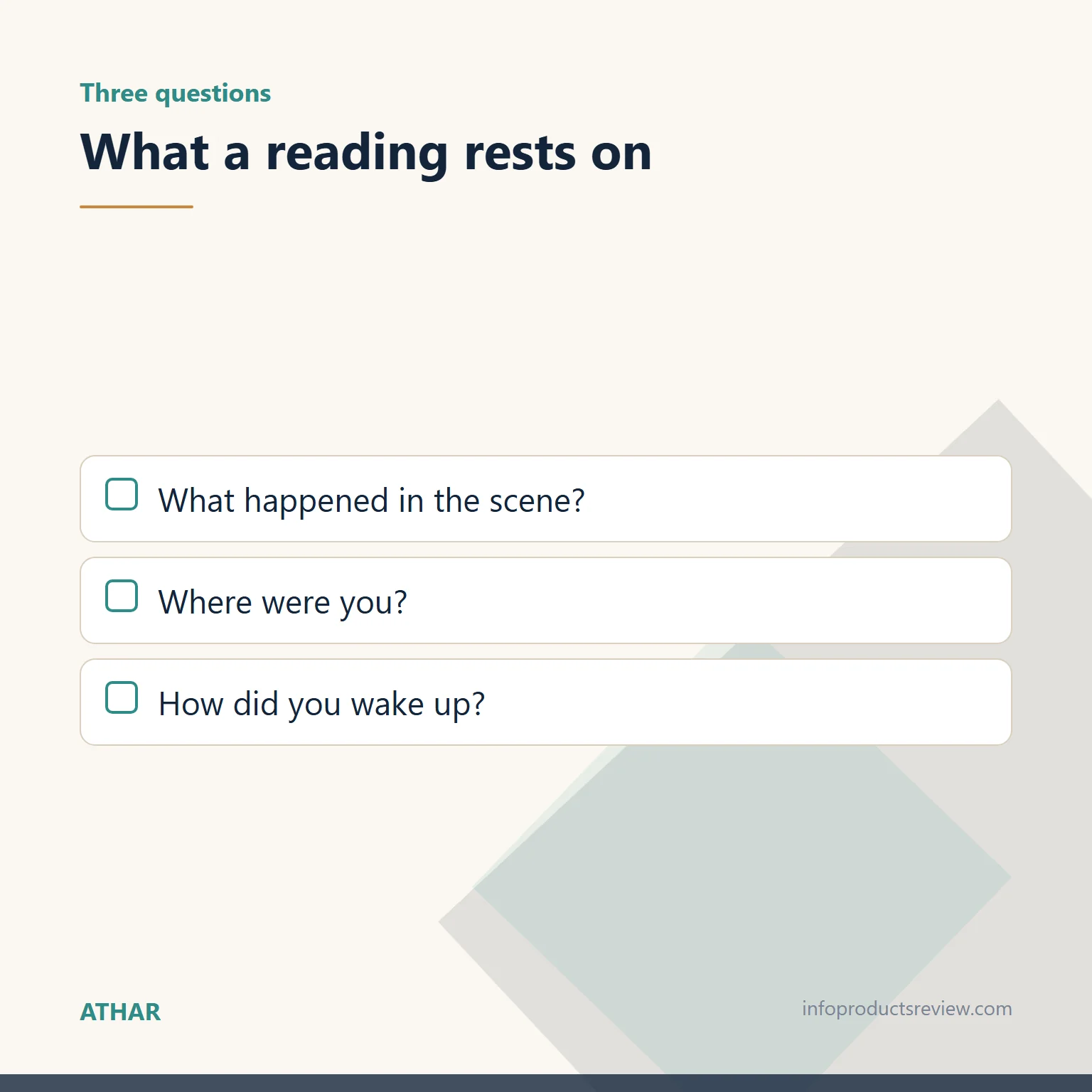
Rather than hunting for a sentence that matches your night, answer three questions — the same ones the people who knew this field asked a dreamer before saying anything.
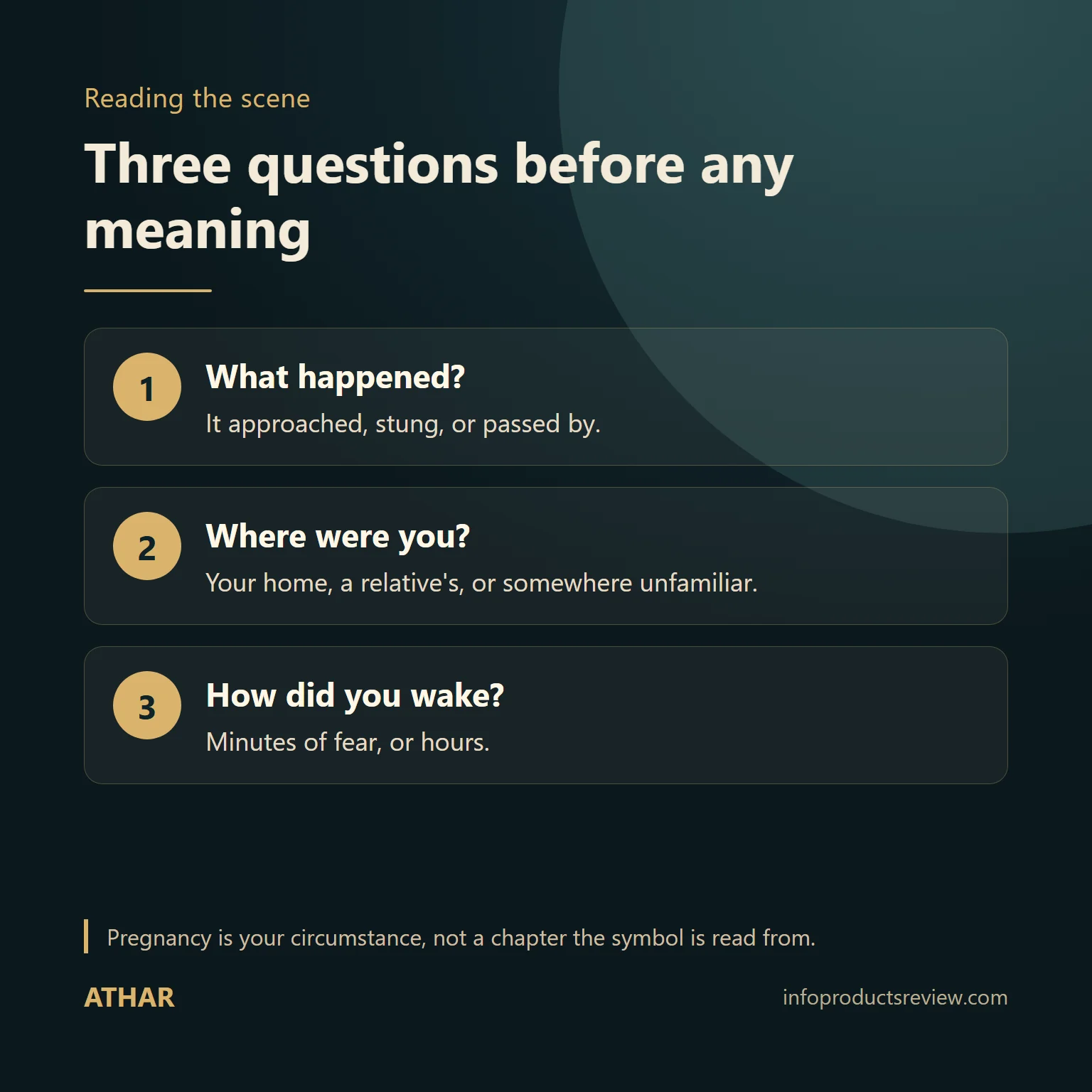
What happened in the scene?
Did the scorpion stay at a distance? Come closer? Sting? Was it in your hand?
The only image with something specific attached to it is a scorpion in your own hand stinging people, which was tied to backbiting. Everything else has no fixed meaning and is read in context.
Where were you?
Your home, a relative’s house, somewhere unfamiliar. No location carries a fixed meaning, but the setting tells you which part of your life your mind has been circling lately — and that’s genuinely useful information about yourself.
How did you wake up?
Startled, with the feeling hanging around for hours? Or awake briefly and then back to sleep? How you woke is the most reliable thing you have, because it’s the only part that doesn’t shift each time you retell the dream.
Those three are enough. Anyone offering you a chart of colors, body parts and hours of the night is filling space.
The scenes expectant mothers actually ask about
These are the versions that arrive most often. For each one: what can honestly be said, and what shouldn’t be said at all.

A scorpion near the bed
It frightens because the bed is where you rest, and rest is in short supply right now. There’s no fixed meaning for it in the dream books.
The more useful question: had you gone to bed tense that night? Many women notice these scenes cluster after tiring or worrying days.
A scorpion moving toward your belly
This is the version that scares women most, and the one fear pages exploit hardest.
Plainly: nothing makes this scene evidence of harm to your baby, of a problem with the pregnancy, or of anything about the birth. A mother’s fear for the baby she’s carrying is the single most constant thing in her waking mind, so its showing up at night in the shape of the thing she fears is entirely understandable.
If you woke from this one frightened, the first move is to settle yourself — not to go looking for a page that claims to know what will happen to your baby.
Being stung
The sting frightens most, and it belongs here inside the guide because it’s part of the same symbol, not a separate subject.
The transmitted description sits entirely in the territory of speech: a weak enemy whose harm doesn’t go past his tongue. There’s no bodily harm in the description at all.
As for where you were stung — hand, foot, belly — there’s no fixed meaning for it in the dream books, and it’s read in context. The detailed charts assigning a meaning to each spot have nothing behind them.
If you woke still feeling it physically, that’s something people report after distressing dreams generally. It isn’t specific to pregnancy or to this symbol. Real recurring pain or insomnia is a question for your doctor.
Killing the scorpion
Heavily asked, and heavily loaded online with talk of victory, escape and danger passing.
Accurately: the dream books give killing a scorpion no separate fixed meaning. What’s observable is that women who kill it usually wake calmer than those who run, and that feeling is worth noting — it isn’t a promise.
Nobody should tell you it means your birth will go smoothly. That’s a claim about the future that no one owns.
More than one scorpion
A higher count raises the sense of being surrounded, and carries no fixed meaning. The transmitted description is about weakness, so numbers don’t make the symbol more dangerous.
One that runs off or disappears
A quieter version, also without a fixed meaning. Many women wake from it barely troubled, and it passes without leaving much behind.
What this dream cannot tell you
This list is deliberate, because the real damage in this topic happens when a pregnant woman’s dream is asked to carry what it can’t.
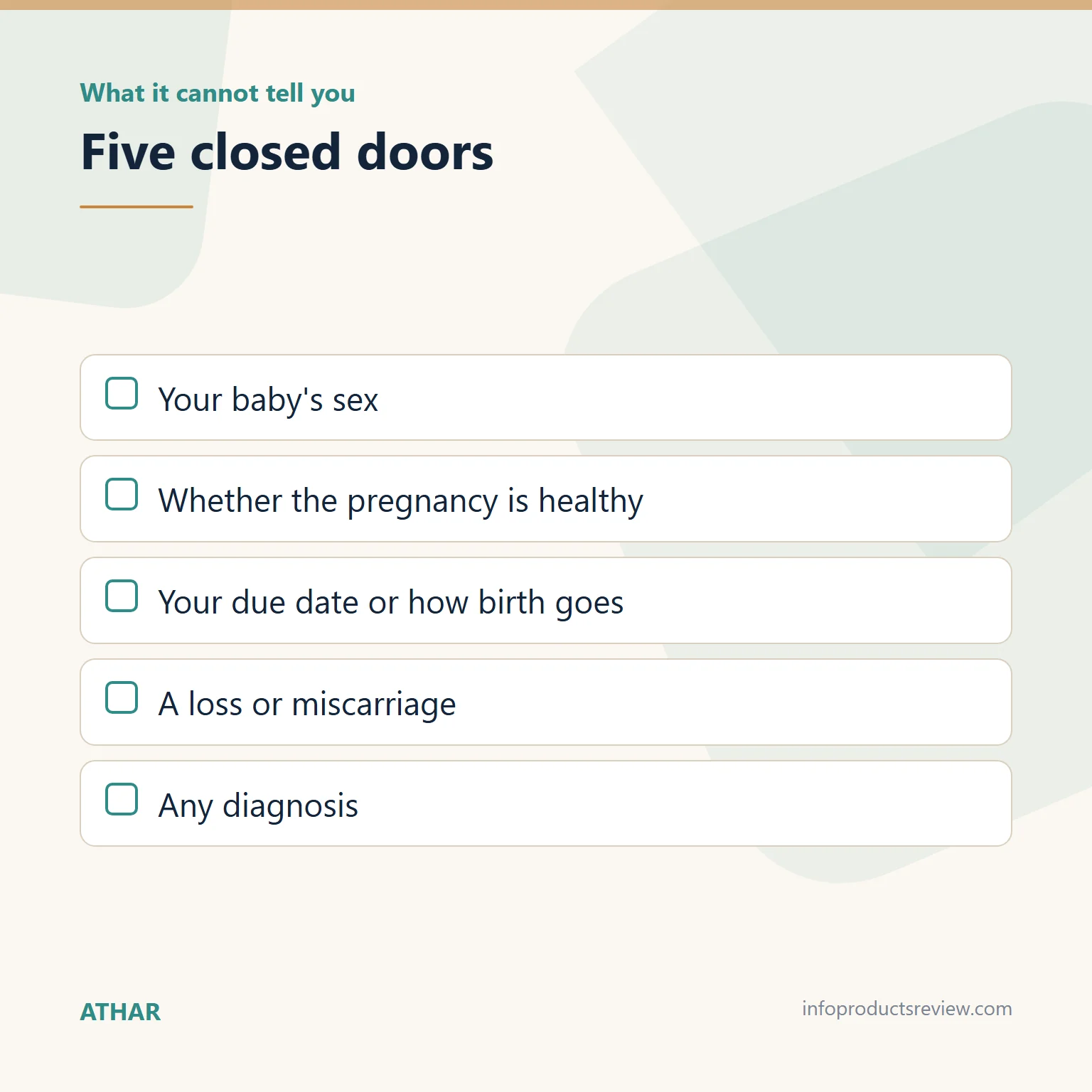
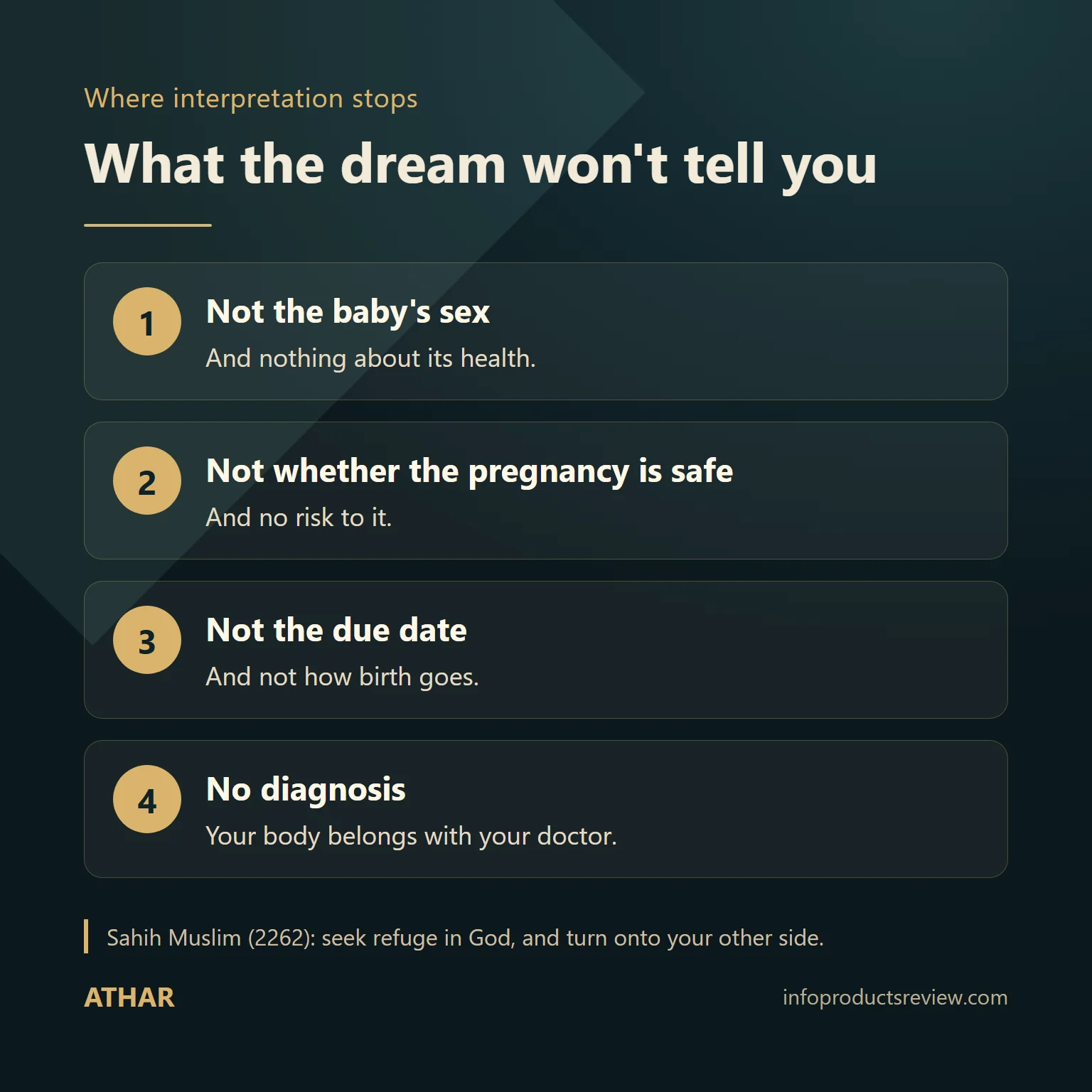
- Not your baby’s sex. Nothing in the dream books identifies it, and any page claiming otherwise is guessing.
- Not whether your pregnancy is healthy or at risk. Anyone telling you that has issued a medical opinion from a dream page.
- Not your due date, and not how the birth will go.
- Not a miscarriage or a loss. Nobody should ever frighten a pregnant woman with that.
- Not a diagnosis for you or your baby, and no substitute for your prenatal care.
- Nothing about your husband, and no evidence of betrayal or divorce.
- Not sorcery or envy — a route straight into anxiety you can least afford right now.
- It names nobody, even if you saw a face you recognized.
- It sets no timeline for anything.
If you woke up frightened: what comes first
Fear after a bad dream in pregnancy shows up in the body too — a racing heart, shallow breath, and real trouble getting back to sleep. So the first move treats you, not the symbol.
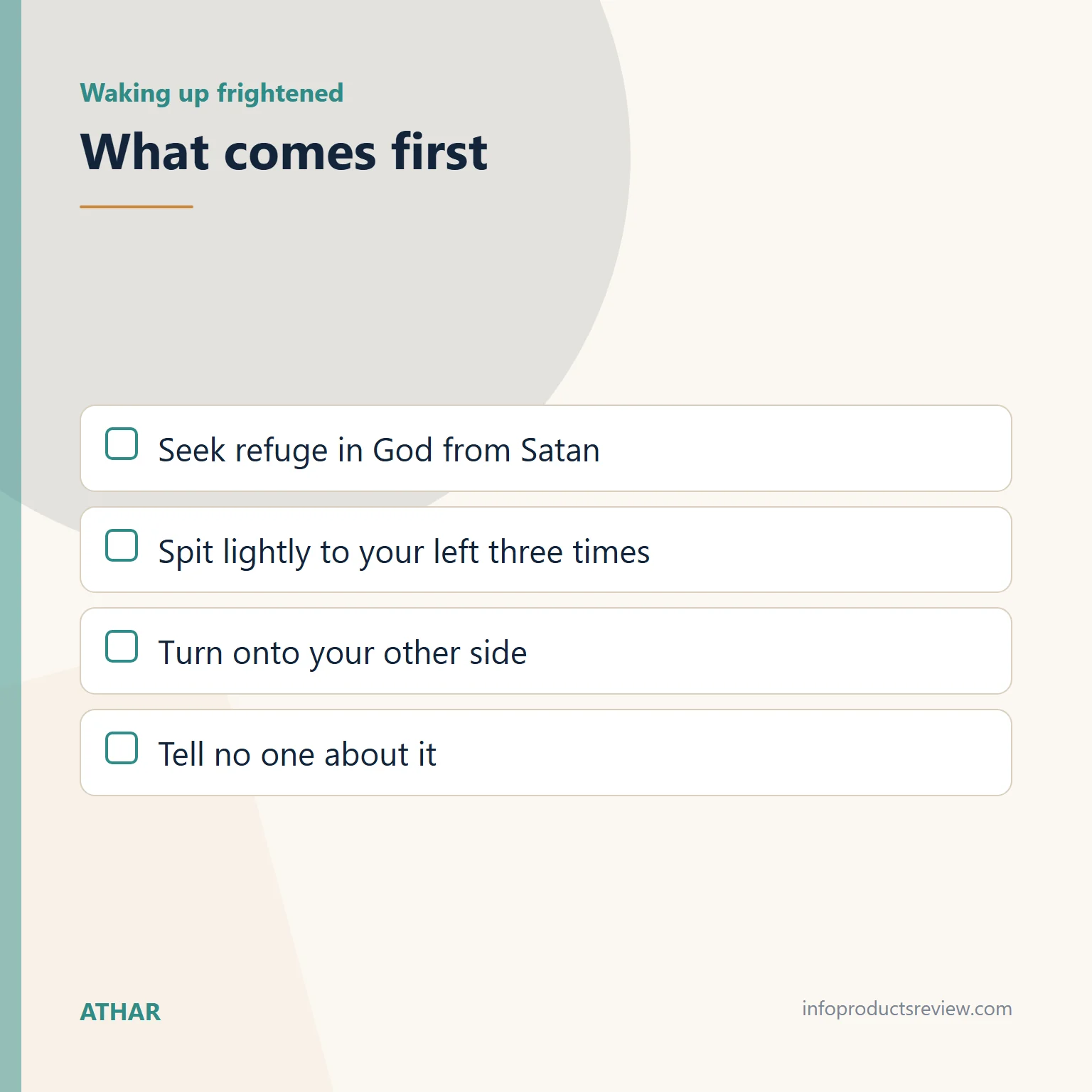
The prophetic guidance for someone who sees a dream they dislike is short: seek refuge in God from Satan, spit lightly to your left three times, turn onto your other side, tell no one about it — and it will not harm you.
It’s brief, it’s practical, and it addresses the effect on your heart directly, which is exactly why it comes before any interpretation.
إذا رأى أحدكم الرؤيا يكرهها، فليبصق على يساره ثلاثًا، وليستعذ بالله من الشيطان ثلاثًا، وليتحوّل عن جنبه الذي كان عليه
And then: don’t open your phone to read about the symbol in that moment. Searching while frightened means accepting the first frightening answer you find — and then carrying it for weeks.
When the question belongs to your doctor, not a dream page
This is the most important section here, because mixing the two is what actually causes harm.
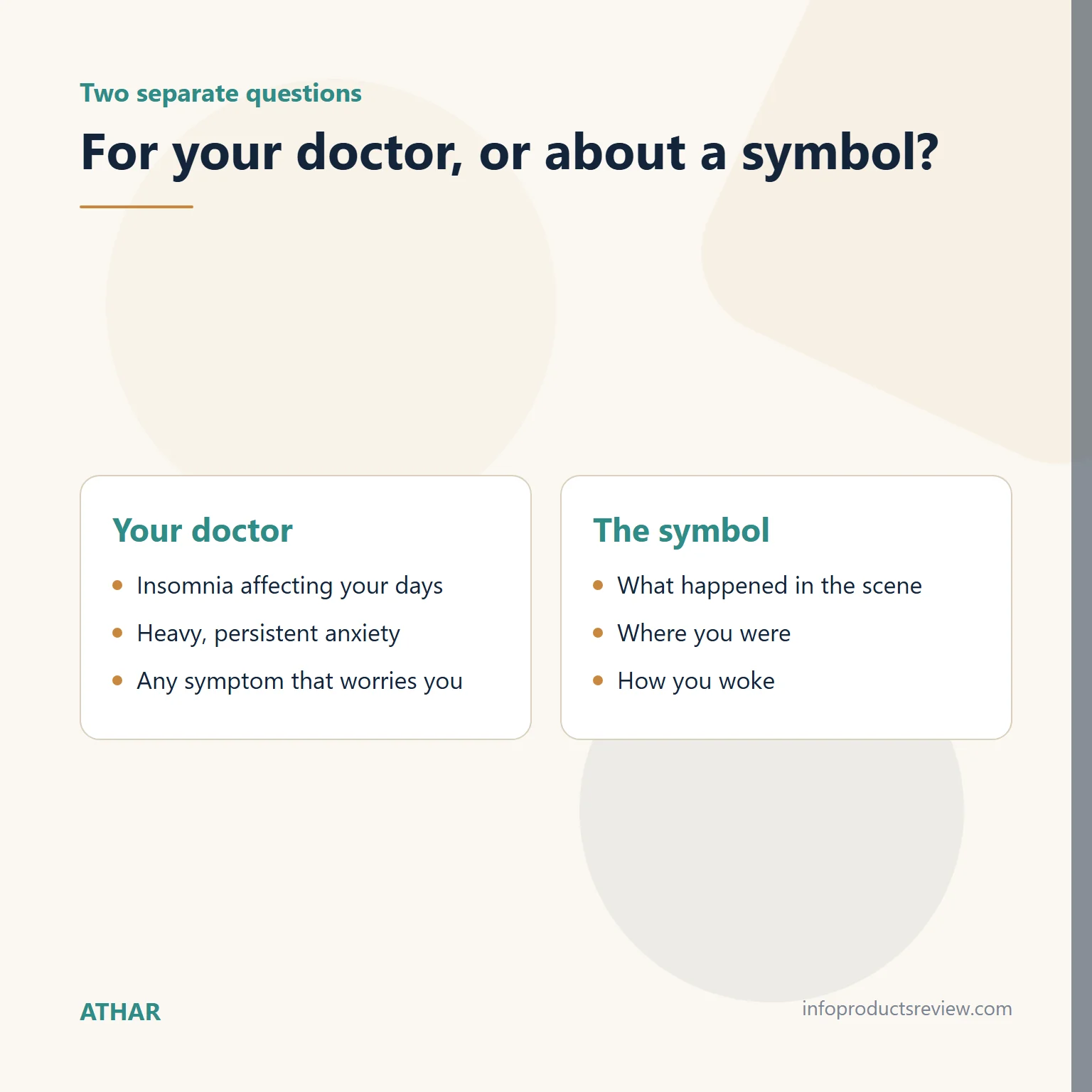
Go to your doctor or midwife, not to an interpretation page, if you have:
- Heavy, persistent anxiety that follows you through most days.
- Insomnia that’s affecting your ability to get through the day.
- Nightmares most nights that are keeping you from sleeping.
- Any physical symptom in your pregnancy that worries you.
No symbol and no interpreter answers those, and no amount of searching for a meaning will resolve them.
If the dream came once or twice and your day carried on normally afterward, it needs nothing more than the settling above.
Why the same scene hits harder now
A woman might see this exact dream before pregnancy and forget it within the hour, then see it while pregnant and carry it for two days. The difference isn’t in the symbol. It’s three things stacking up — the same stack that makes snake dreams in pregnancy land harder too.

Your body is tired, and a tired body makes for a more easily shaken mind. Your sleep is broken, so you wake close to the dream while it’s still vivid. And your heart is already occupied by one enormous thing, so a frightening image finds a place waiting for it.
Knowing that helps on its own: it explains the weight of the aftermath without making the dream carry something it can’t. The feeling is real. It just isn’t evidence that anything matching its size exists in your life.
And that gap is precisely what fear pages trade on — building a meaning sized to your panic rather than to anything in the sources.
Should you change anything because of it?
A practical question that comes up constantly: should I cancel a trip? Postpone a visit? Avoid someone? Switch doctors?
Decisions don’t get built on dreams. A dream may point you at something already on your mind, but it isn’t a basis for a waking decision — least of all in pregnancy, where the decisions touch your health and your baby’s.
If you feel hesitant about something, that hesitation existed before the dream, and the dream added no evidence to it. Settle it the way waking questions get settled: advice from someone you trust, and a look at the actual reasons.
And if the decision is medical — an appointment, a medication, a monitoring plan — a dream has no place in it at all.
When relatives interpret it for you
You’re surrounded by people who love you, and nearly all of them mean well. But telling a dream in a family gathering opens a door that doesn’t close easily: an interpretation from one person, an old story from another, a warning from a third.
Most of what gets said in those conversations isn’t knowledge. It’s personal experience, memory and genuine fear — and you leave carrying everyone’s worry at once.
Which is why the guidance not to retell a dream you disliked is practical before it is etiquette. Silence here protects you.
If you already told it and heard something that frightened you, remember that what you heard was one person’s guess, usually offered with good intentions and no knowledge. You are not obliged to carry anyone else’s fear.
What about the reassuring dreams?
Not every pregnancy dream is frightening. Plenty of women have calm, comforting scenes and then ask whether it’s good news.
Fair is fair in both directions: just as a frightening scene establishes nothing bad, a comforting one guarantees nothing good. Both are read against your circumstances, and both are possibilities rather than news.
That said, their effect differs, and there’s no harm in letting a peaceful dream lift your day. Calm is worth something in these months — as long as it doesn’t turn into a promise you start waiting on.
The hadith collections record that someone who sees a dream they like should praise God and may tell it to someone they love. The etiquette itself distinguishes clearly between what you dislike, which you leave alone, and what you like, for which you give thanks.
Where your dream sits among the kinds
What happens in sleep isn’t one category. Some of it is your own mind replaying what occupied you — we cover that split in dreams versus visions. Some is a jumble nothing should be built on. And some is the good dream.
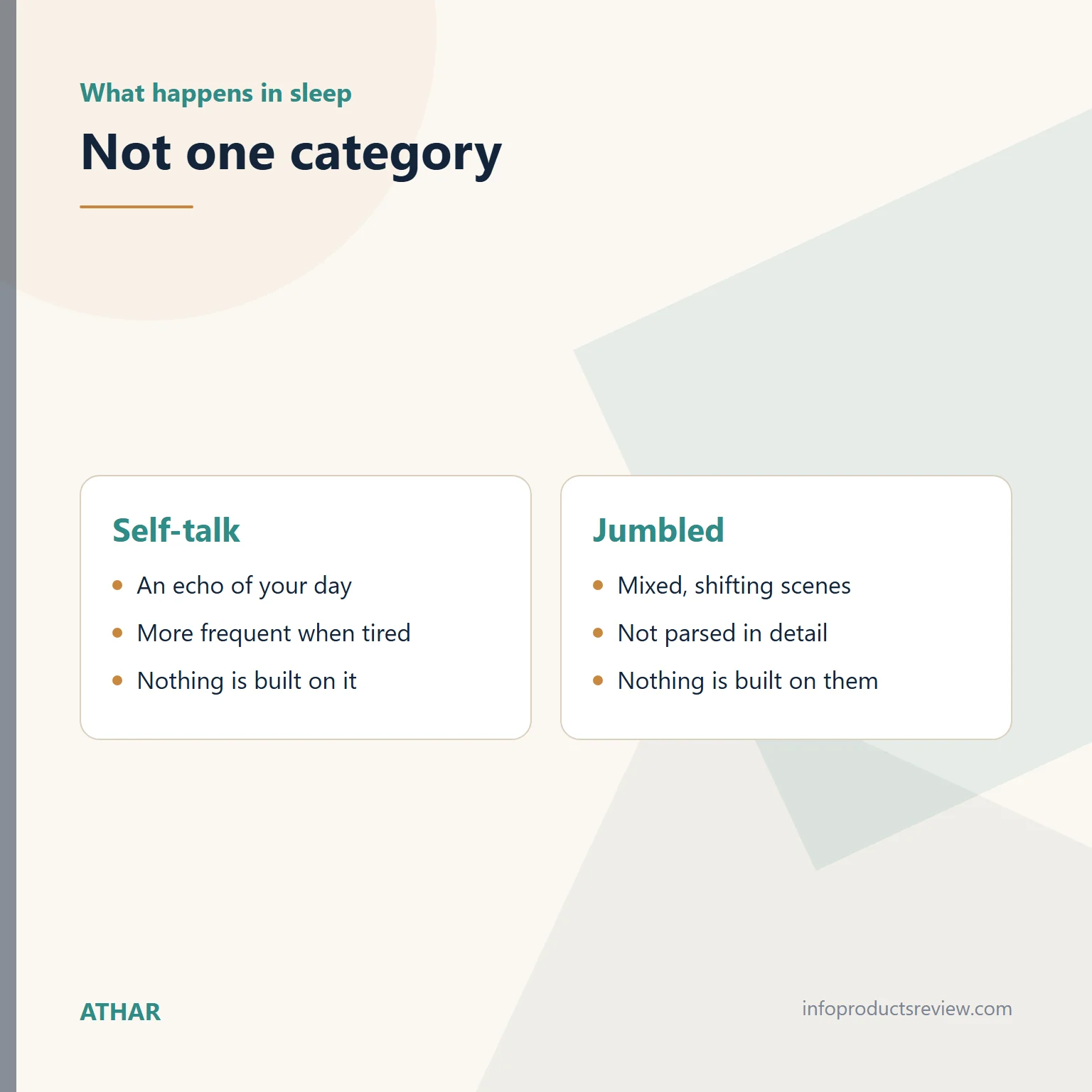
Nobody holds a reliable instrument for sorting a specific dream into one of those, which is why circumstances were always asked about first.
And a pregnant woman’s circumstances are about as legible as they get: a tired body, broken sleep, and one large thing occupying the mind. When a frightening scene lands on top of that, the possibility that it’s an echo of your days is a strong and reasonable one.
Saying so doesn’t diminish dreams. It just keeps everything in its place.
If this pregnancy follows a loss
Some readers arrive here with a hard history: an earlier loss, a difficult pregnancy, a long wait. For them a frightening dream doesn’t land on empty ground — it lands on a heart that already knows the pain.
So, more plainly for them: a dream does not tell you what is coming. No one should read a scorpion scene as a sign that what happened before will happen again. Nobody owns that claim, and the damage of making it to someone who has been through it is doubled.
What can honestly be said is that anxiety living in you after a previous experience shows up at night, because what occupies us awake returns to us asleep. A frightening image in that situation is closer to a reflection of your fear than to a warning.
And if that anxiety is heavy and persistent, it deserves care — from your doctor or a specialist. It’s a question about your wellbeing, not about a symbol.
If your older child or your home appears
A pregnant woman with children dreams about them, because her days are full of them. So the scorpion may turn up near your child, in their room, or while you’re holding them.
Nothing makes that scene evidence of your child becoming ill, of harm reaching them, or of envy directed at them — the same point we make about lice dreams in pregnancy. A mother’s fear for her children is near-constant, and in pregnancy everything is felt faster and harder.
And if the home itself features, remember what your home is in your waking life right now: the place of tiredness, sorting and getting ready for someone new. Its appearance isn’t a sign of something wrong with it — it’s a picture of what’s occupying you.
When someone else has the dream about you
A steady stream of questions starts with “my husband saw a scorpion sting me while I was pregnant” or “my mother saw scorpions in our house.”
A dream is read against the circumstances of the person who had it. Someone who dreams something frightening about a pregnant woman he loves is most plausibly showing his own worry about her — which is a reasonable thing to feel at this stage.
What shouldn’t happen is one family member’s dream turning into news delivered to the pregnant woman: “we saw this about you, so be careful.” That loads her heart for nothing, at the moment she most needs calm.
The etiquette here is for the dreamer to hold back what they disliked, especially from someone it would affect.
Why this gets searched at 3 a.m.
Most people reading a page like this are reading it late, right after waking. Pregnant women most of all, since waking at night is already part of the routine.
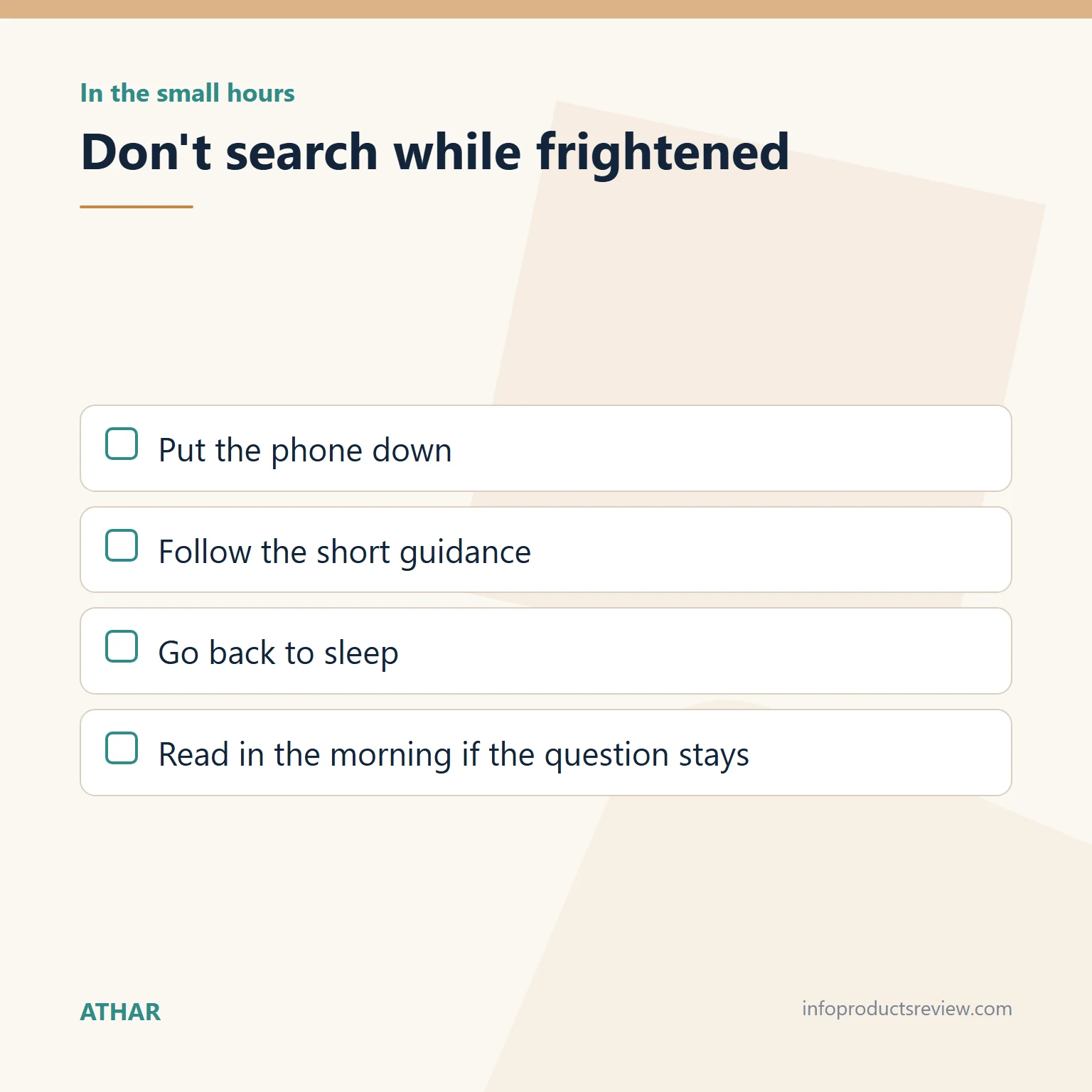
That hour is the worst possible time to go looking for a meaning. Your body is tired, you’re rattled, and a bright phone screen makes getting back to sleep harder. Then you meet pages competing for attention, each writing what grabs rather than what holds up.
The better move is the short guidance above, then putting the phone down. If the question is still there in the morning, read about it calmly — and you’ll find that a lot of what terrified you at night looks much smaller in daylight.
This isn’t a throwaway tip. Sleep is a need in pregnancy, and every minute spent hunting a frightening meaning comes out of your own rest.
If you want to ask an interpreter, what should you write?
Asking is fine when it’s done properly: privately, and with someone whose knowledge and character you trust.
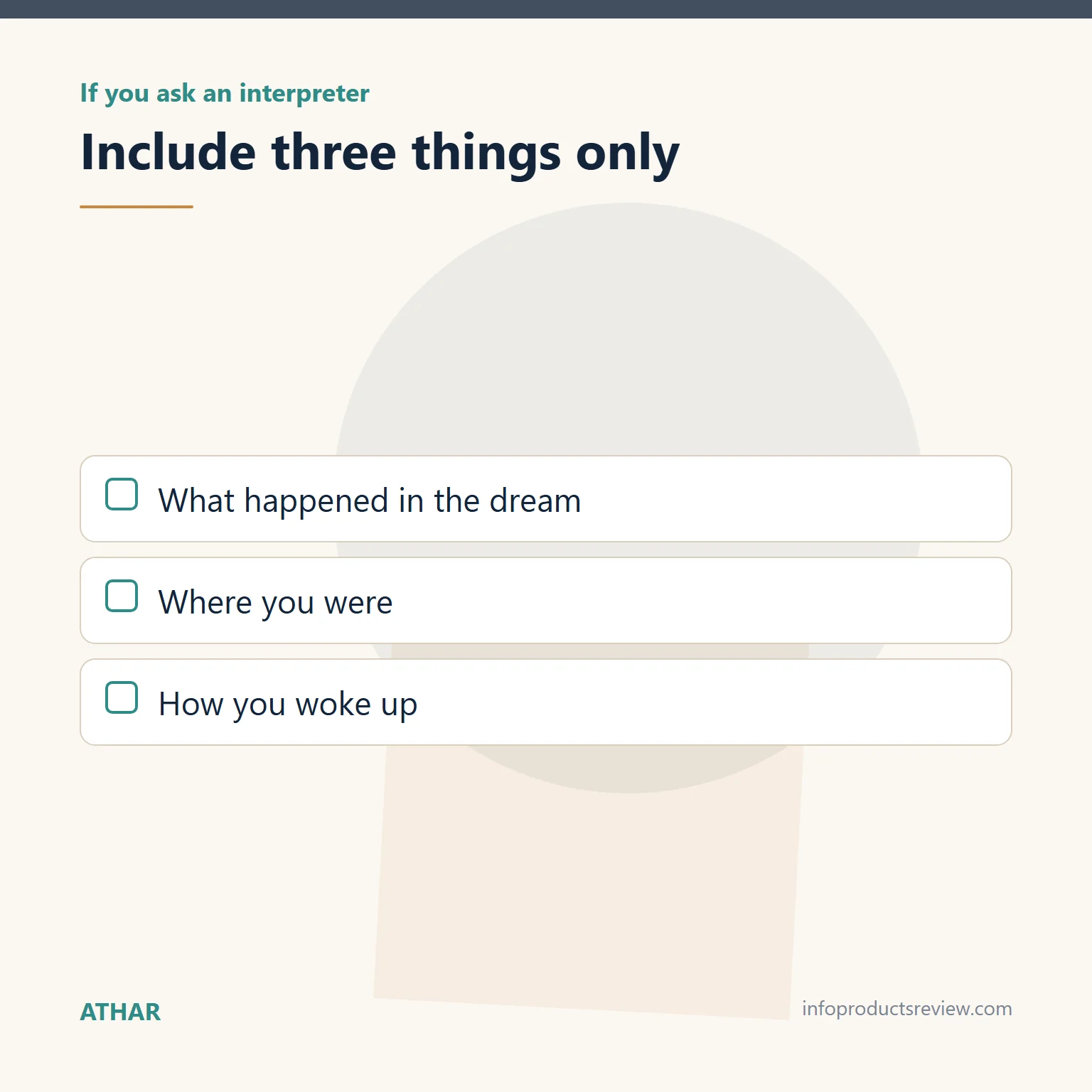
Include three things only: what happened in the dream, where you were, and how you woke. Mentioning that you’re pregnant and how far along is enough — that describes your circumstances, it doesn’t change the symbol.
Leave out your suspicions about people, what your friend told you, and whatever you read before asking. All of it steers the answer toward what you fear instead of letting the scene be read as it is.
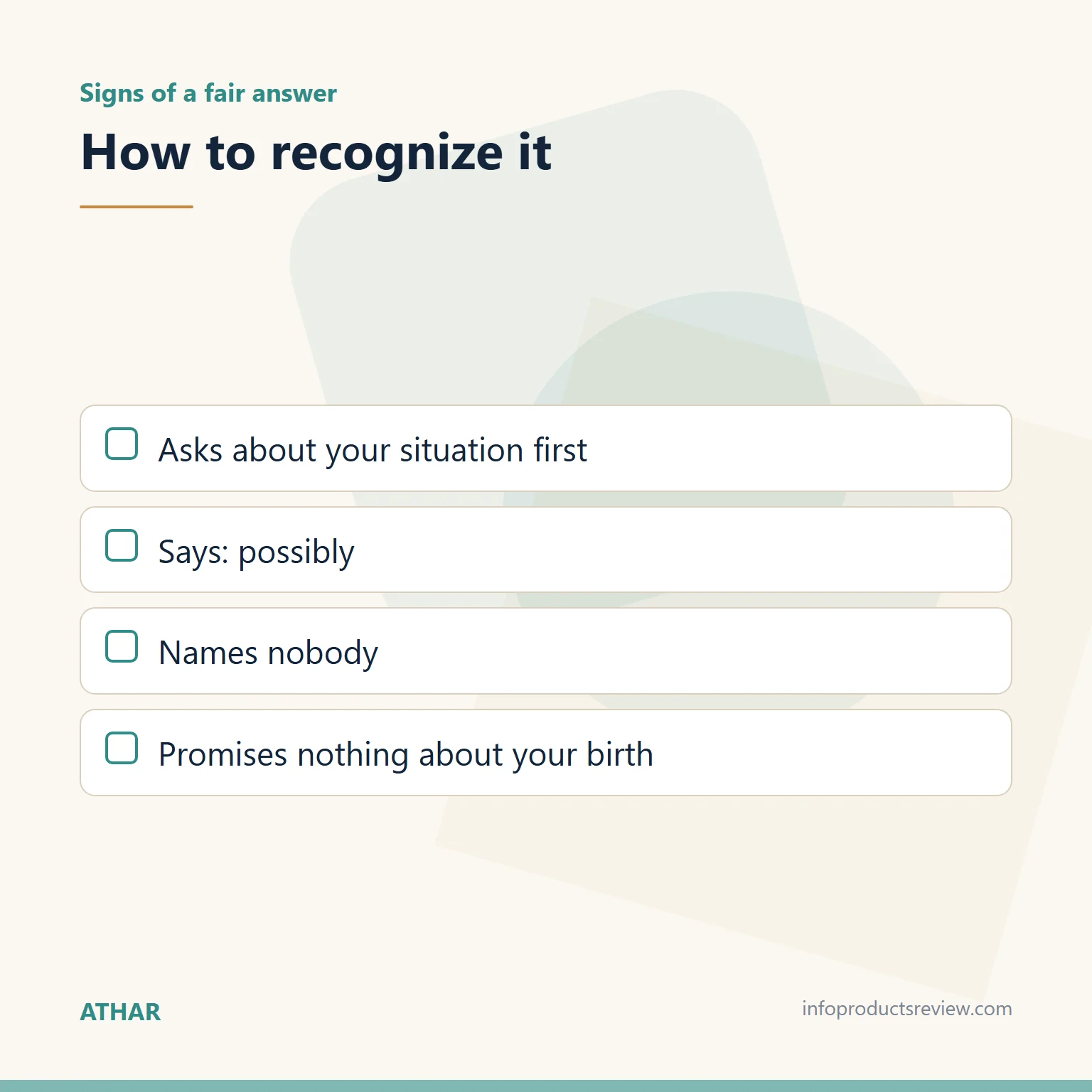
A fair answer asks about your circumstances first, says “possibly” and “God knows best,” names nobody, fixes no date, and promises nothing about your birth.
If what comes back is categorical and frightens you about your baby, the problem is the answer, not your dream — and you’re not required to believe it.
What if you don’t remember the details?
Plenty of questions start with “I’m not sure, but I think it was a scorpion.” That’s common, especially with a night broken into pieces.
Forgetting isn’t a problem to fix and isn’t a sign of anything. But it does limit what can be said, because the whole reading rests on what happened, what you did, and how you woke.
If all that’s left is the fear, then fear is what you have — and it describes your night, not your future. Anyone handing you a detailed interpretation of a dream you can’t recall is interpreting your fear, not your dream.
You don’t need to strain to recall it, and you don’t need to keep a dream journal — that tends to occupy the mind more than it helps. Writing a scene down is worth it only when it stayed with you and unsettled you.
Does the time of night matter?
People ask about dreams near dawn, about naps, and whether some are truer than others.
There’s no fixed rule in the dream books making the hour a measure of a dream’s truth. Most of what circulates on that is inherited without a source, much like the claims we examine in what is actually established from Ibn Sirin.
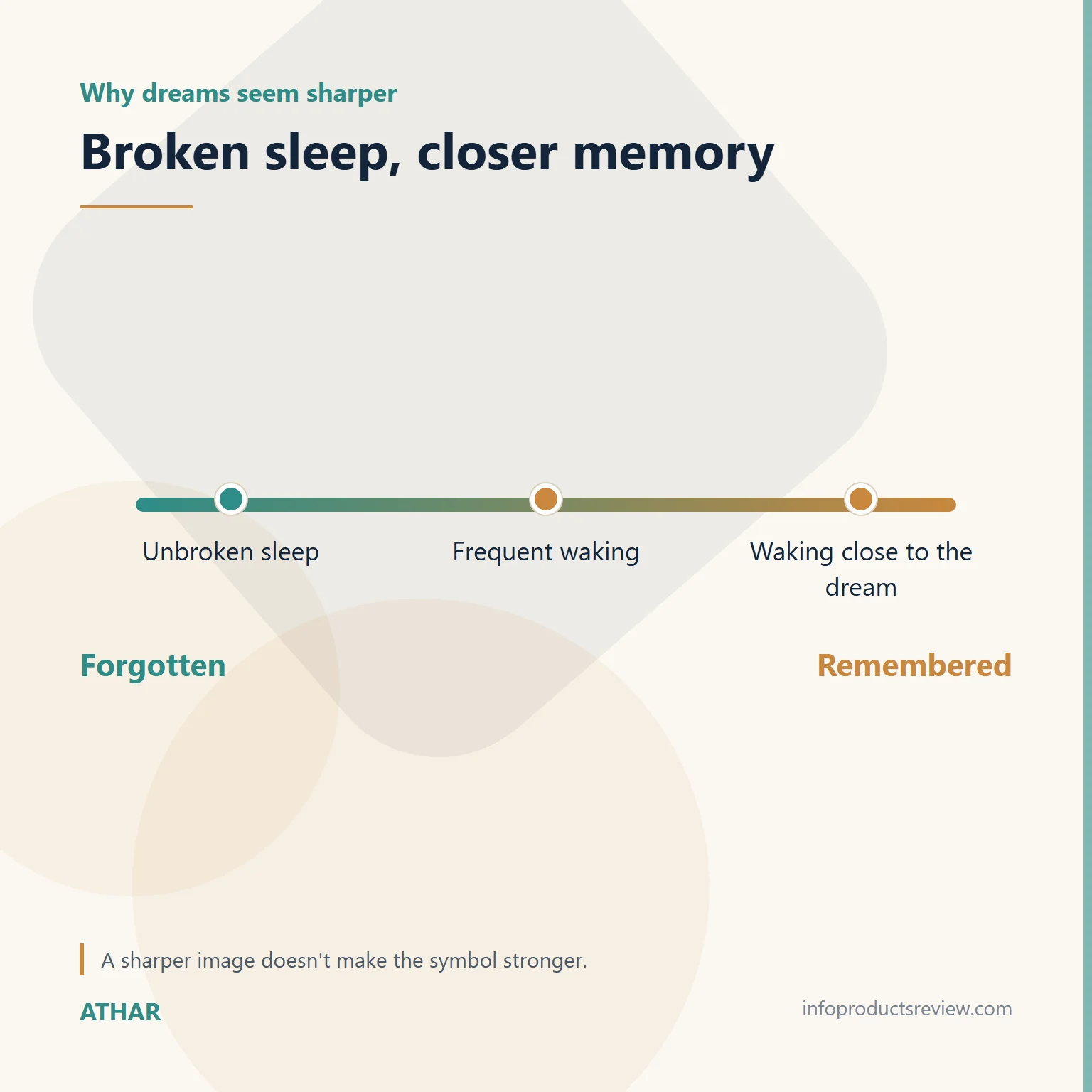
What can honestly be said concerns sleep rather than symbols: your sleep in pregnancy is broken, and waking close to a dream leaves it sharper in memory. So if dawn dreams feel more powerful, the likeliest explanation is that you remember them better — not that they’re truer.
And after the birth?
Many women notice the unsettling dreams ease after birth, and that sleep settles again gradually as the nights steady.
That’s expected: the biggest driver of vivid, well-remembered dreams is broken sleep itself, and when sleep changes, so does what you retain from it.
It doesn’t mean everything you saw while pregnant was meaningless. It means much of it was tied to your circumstances in those months — which is reason enough not to carry into motherhood a fear planted by a page you read on a rough night.
Two worked examples
These are illustrations written for this guide. They aren’t dreams reported by anyone, and they aren’t statements from the interpreters.
One. A woman eight months along wakes twice in the night, and the second time she has dreamed of a scorpion crossing the floor near the door. She wakes with her heart pounding. What genuinely helps her: knowing that vivid, disturbing dreams are common at this stage, and starting with the short guidance rather than her phone. What nobody should tell her: that someone in the house envies her, or that this is a warning about her baby.
Two. A woman dreams a scorpion appears and she kills it, and she wakes calm. Later she reads a page telling her this means her labor will be easy. What genuinely helps her: her calm is worth having. What doesn’t: a promise about the birth that the writer has no way of knowing. Expectations about labor don’t get built on a dream in either direction.
Mistakes that keep showing up on these pages
You’ll read a lot on this symbol, and most of it repeats the same failures:
- Inventing a pregnancy-specific meaning. “For a pregnant woman this indicates…” is presented as transmitted when it’s the writer’s own.
- Tying the dream to the baby’s sex. Pure guesswork.
- Frightening readers about miscarriage or a difficult birth. The heaviest thing you can say to a pregnant woman, and the least honest.
- Linking the symbol to sorcery or envy, then offering a remedy for sale.
- A detailed chart of colors and body parts, which suggests a precision that doesn’t exist.
- Mixing sleep science and interpretation in one paragraph, so guesswork borrows the authority of research.
Common questions
Does a scorpion dream mean danger to my baby?
No. Nothing makes this dream evidence of harm to a baby or a problem with a pregnancy. The transmitted description is about harm through speech, not harm to a body.
Does it indicate my baby’s sex?
No. Nothing in the dream books identifies a baby’s sex, and anyone linking the symbol to it is adding their own material.
I was stung on the belly. Is that a warning?
There’s no fixed meaning for where a sting lands; the scene is read in context. Fear for the baby you’re carrying is the most constant thing on your mind, so its appearing at night makes sense. Health worries belong with your doctor.
I killed the scorpion. Does that mean an easy birth?
No. Killing it has no separate fixed meaning, and a dream makes no promises about birth or its timing.
Does the meaning change by trimester?
The dream books tie no meaning to a stage of pregnancy. Your sleep does differ across the months, and health references note that vivid, disturbing dreams are common in the third trimester.
I’ve had these almost nightly since getting pregnant. Is that normal?
Health references describe sleep changing from the first trimester onward, and disturbing dreams being common later on. That’s a general description, not a diagnosis. If nightmares are keeping you from sleeping or affecting your days, raise it with your doctor.
Is a scorpion dream a sign of envy or sorcery?
No. That connection rests on nothing, and it’s among the fastest ways to exhaust a pregnant woman for no benefit.
There were many scorpions. Is it more serious?
Numbers carry no fixed meaning, and the transmitted description speaks of a weak enemy. A higher count doesn’t change that.
Should I tell my husband or my mother?
For a dream you disliked, the guidance is not to retell it. Repeating a frightening scene to someone who loves you tends to hand them the same worry, and they may answer with an interpretation that frightens you further.
Should I give charity or recite something because of this dream?
Charity and remembrance are good in any case and need no dream to prompt them. But no dream obligates a specific act, and nobody should be asking you for money for a remedy because of one.
I woke up crying from fear. Is that a bad sign?
Fear describes your state; it doesn’t rank the dream. Emotions run closer to the surface in pregnancy. The guidance for a dream you dislike is to seek refuge in God, turn onto your other side, and tell no one.
Could it just be anxiety?
It could. Health references note that events from the day enter your thoughts during sleep, that people under stress are more prone to frightening dreams, and that worry about labor and new responsibilities can keep the mind racing at night. None of that rules out the dream having meaning.
I saw it at my parents’ house. Is it about one of them?
No. The setting points to the part of your life your mind is circling, not to a person. Family homes feature often in pregnancy, with visits and preparations — that’s enough to explain the backdrop without suspecting anyone.
What should I do right now?
Settle yourself, don’t retell the dream, and write the scene in three lines: what happened, where, and how you woke. Then look at your sleep and what’s on your mind — and leave every question about your body or your baby to your doctor.
The bottom line
Ibn Qutayba described the scorpion as a weak enemy whose harm doesn’t pass his tongue and who treats friend and enemy alike, and said that a person holding a scorpion that stings others is someone who backbites people. That’s what was transmitted; everything else is read from what happened in the dream and how the dreamer felt.
Nothing in it changes because you’re pregnant. The dream doesn’t speak about your baby, your birth, or the health of your pregnancy. What concerns your body belongs with your doctor — and what concerns your heart starts with settling it, not with searching.