


You dreamed your teeth were falling out, and you woke up with your heart racing and one question in your head: is this bad news about my family, or about my marriage? The short answer is that in the books of dream interpretation of dream interpretation, teeth falling out is read as something to do with your family and the people closest to you, or with a stage of life you’re moving through. It doesn’t announce a delayed marriage, and it doesn’t foretell anyone’s death or illness.
This page is about your situation in particular: study, an engagement, family, friendships, and the versions of the dream that young women describe most often. For the symbol in all its general forms and the different kinds of teeth, see our complete guide to teeth falling out in a dream.
The bottom line
- The closest meaning: in the dream books, teeth stand for the household and relatives. So the dream most likely concerns your family — your father, mother, brothers and sisters — or your friends, or a transition like graduating, travelling, or starting a first job.
- The detail that changes it: which tooth. In this reading, upper teeth are the men in the family and lower teeth the women; front teeth are the closest relatives and molars the most distant.
- Two common cases: teeth falling into your hand with no blood, which is the lightest version — a change in a relationship where the connection survives; and lower teeth falling out, which points toward the women in your family, like your mother or sisters, without naming anyone.
- A possibility, not a promise: the old books do record a heavy reading for a tooth that falls out untreated, as the death of a relative. That is one interpreter’s view. A dream foretells no one’s death and no one’s illness, and a frightening dream is meant to be read toward ease and good news first.
- Where the books give no specific meaning: being single. Nothing in them links teeth falling out to a late marriage or a broken engagement, and none of them gives a set meaning for blood, braces, swallowing a tooth or wisdom teeth.
In short: this dream can’t delay a marriage, set a date for an engagement, show that one will end, point to a particular relative, or diagnose anything. What’s on this page is a set of possible meanings, read through your own details and your own life.
What this page covers
- The bottom line
- Why single women often dream about teeth
- Which details change the reading?
- What teeth mean in the books of dream interpretation
- A reassuring principle: frightening dreams lean toward ease
- Teeth falling into your hand
- Teeth falling out without blood
- Teeth falling out with pain or blood
- Lower teeth falling out
- Upper teeth falling out
- Front teeth falling out
- All your teeth falling out
- Loose teeth that don’t fall out
- Teeth dreams during study and exams
- Teeth dreams, engagement and marriage
- Teeth dreams and friendships
- Having a tooth pulled
- A single tooth falling out
- Braces or dental work in the dream
- Does it mean someone in your family will die?
- When the dream keeps coming back
- What’s actually established in Islam about dreams
- Common claims that need correcting
- What this dream can’t tell you
- What to do after the dream
- How to describe the dream so it can be read
- What contemporary interpreters say about this dream
- Examples
- Quick table: the detail and the closest reading
- Related dreams
- Frequently asked questions
- What does it mean for a single woman to dream of teeth falling out?
- What does it mean if the teeth fall into my hand?
- What does it mean if they fall out without blood?
- What do lower teeth falling out mean for a single woman?
- Does this dream mean I’ll marry late?
- Does it mean my engagement will be broken off?
- An upper tooth fell out. Will something happen to my father?
- Why do I have this dream before exams?
- What does a front tooth falling out in front of people mean?
- What should I do after a disturbing teeth dream?
- Is the dream a sign of envy or the evil eye?
- Is this interpretation definitive?
- In summary
Why single women often dream about teeth

This stage of life packs a lot of change into a short time. A course finishes or starts, exams come round, a first job appears. A proposal arrives, or doesn’t. Relatives ask questions, and friendships shift.
All of it stirs up one thing: a fear of losing people and of things changing. And teeth falling out is one of the strongest pictures of loss there is, so it’s no surprise that it turns up in exactly these weeks.
The US National Institute of Neurological Disorders and Stroke notes in its guide to sleep that events from the day often invade our thoughts while we sleep, and that people under stress or anxiety are more likely to have frightening dreams.
That’s about dreams in general, not teeth in particular. But it explains the timing: why the dream shows up during exam season, through long waits, or when there’s tension at home.
Teeth are also part of your smile, and part of how you appear to other people. So a fear of embarrassment, or of what others think of you, can easily surface at night as a tooth falling out in front of everyone.
And sometimes the dream comes when life feels calm and there’s nothing in your day to explain it. That’s where the dream books’ reading of teeth becomes useful, because it ties them to family and kinship, as you’ll see in a moment.
Before that, our guide to dream interpretation explains how every symbol on this site is read, and where a reading stops. Many teeth dreams come from ordinary daytime worry rather than from the kind of dream worth pausing over.
Which details change the reading?
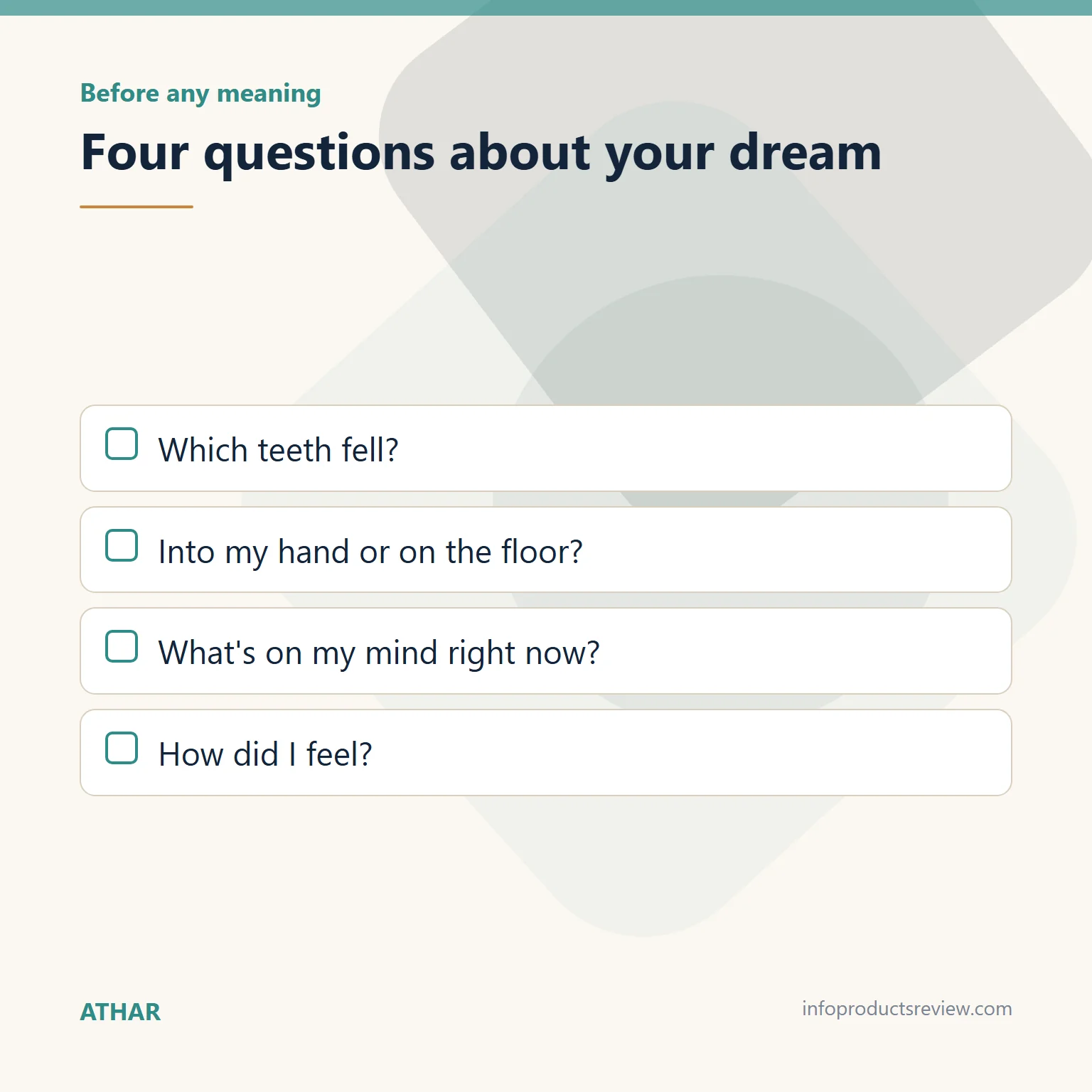
It’s simpler than it looks. Four questions sort out almost any teeth dream, in order of how much they shape the reading:
First: which teeth? Upper or lower? Front teeth or molars? One, or several? This is the one detail the old books spell out, which is why it comes first.
Second: how and where did they come out? Into your hand, onto the floor, or lost altogether? With pain and blood, or with neither?
Third: what’s on your mind in waking life? Exams, an engagement, your relationship with a parent, a strained friendship, or a move for work or study?
Fourth: how did you feel in the dream and after it? Calm, frightened, or embarrassed?
There’s a reason for that order. One of the working principles of dream interpretation is that a reading varies with people’s circumstances and standing, so the dreamer’s own situation is looked at first and everything else is built on that.
It’s a principle of method, not a meaning reserved for unmarried women. But it explains why your situation gets asked about before any interpretation, and why one answer can’t fit everybody.
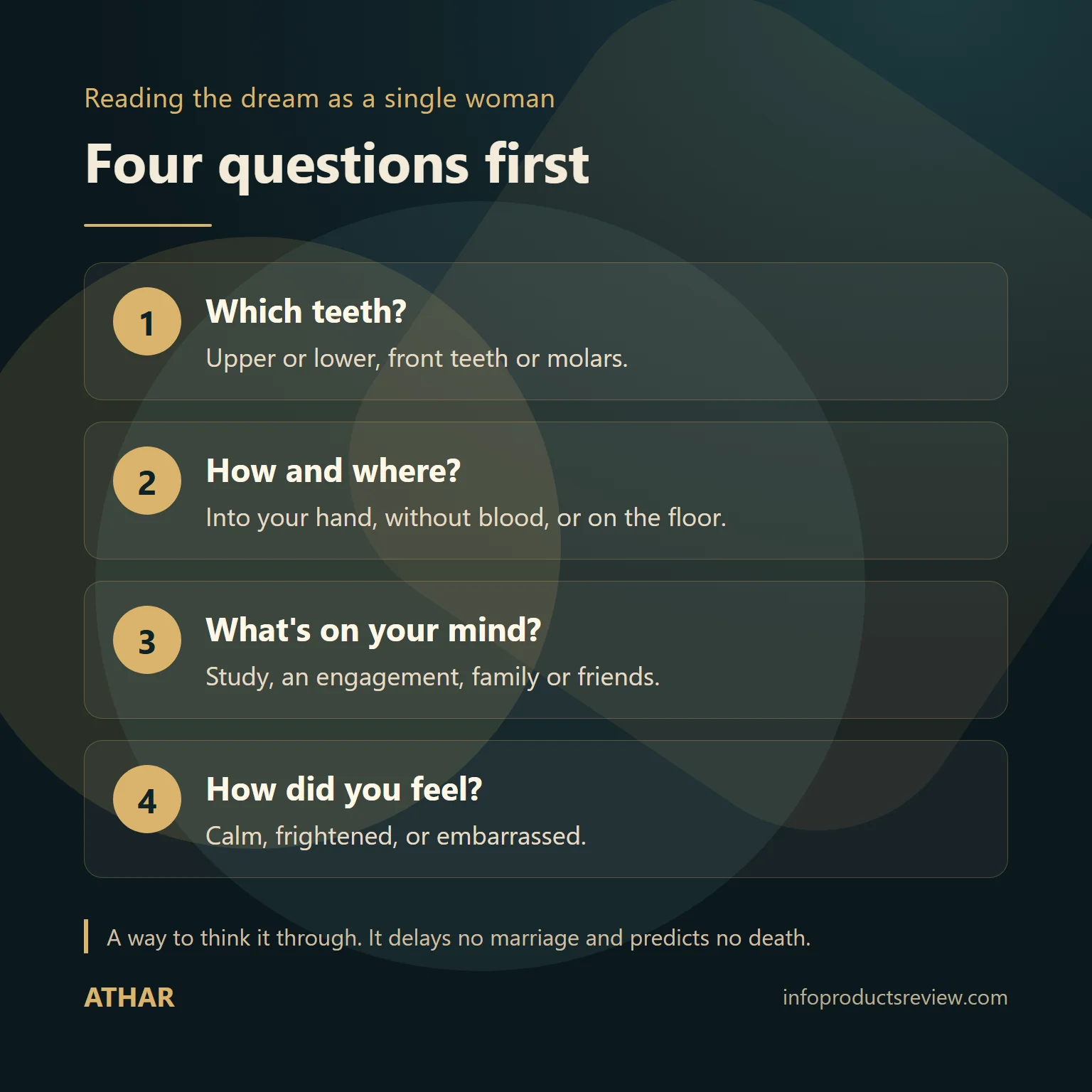
You don’t need to remember everything. The clearest detail is enough. Then ask yourself who, or what, came to mind the moment you woke up.
What teeth mean in the books of dream interpretation
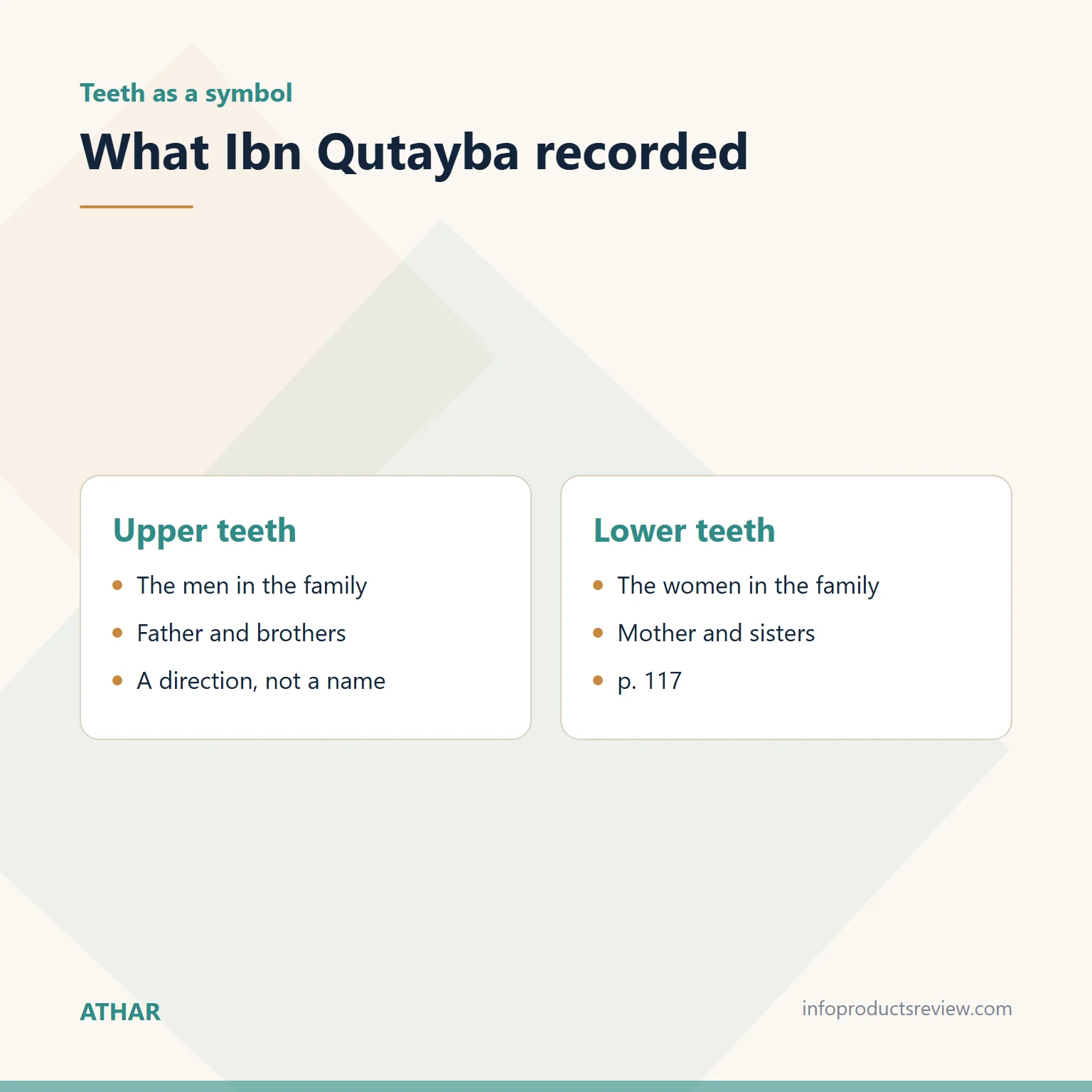
The clearest reading of teeth in the old books of dream interpretation is that they stand for the household and relatives. Front teeth are the closest of them, molars the most distant, upper teeth the men and lower teeth the women.
The comparison behind it is rather neat. Kinship is likened to teeth because they sit close together and hold on to one another, the way people still talk about family ties being interlocked.
So whatever you see in your teeth — soundness, decay, loss, change — is read as something happening among those people. And a new tooth growing in where you had none is read as a benefit coming to a brother or a child.
For a woman who isn’t married, “the household” usually means her father, mother, brothers and sisters, then the wider family. So the first question this dream raises isn’t “is someone going to die?” It’s “how are things between me and my family right now?”
This is an early interpreter’s reading, and its value is that it shows the logic of the symbol instead of leaving you guessing. It shouldn’t be pinned on one person, or treated as settled news. And the old books give no separate meaning for teeth in an unmarried woman’s dream.
A reassuring principle: frightening dreams lean toward ease
Many women wake from this dream full of dread. Then they search, find the heaviest interpretations first, and end up more frightened than when they started.
Here’s a principle that helps, and it comes from within the tradition of interpretation itself: when a dream arrives with fear and dread, the default reading leans toward ease and good news.
In other words, an interpreter shouldn’t follow your fear to the worst possibility. The lighter, more hopeful reading comes first. That doesn’t deny that a dream can be upsetting; it means a dream shouldn’t be given a frightening meaning simply because it frightened you.
Alongside it sits a second principle: interpretation is analogy, comparison and judgement — never certainty. So everything on this page is a possibility that brings you closer to a meaning, not news about what’s coming.
These are principles of the craft, not religious rulings. But they suit a dream like this one, where the heaviest reading shouldn’t be put ahead of the gentlest without a reason drawn from your actual life.
Teeth falling into your hand
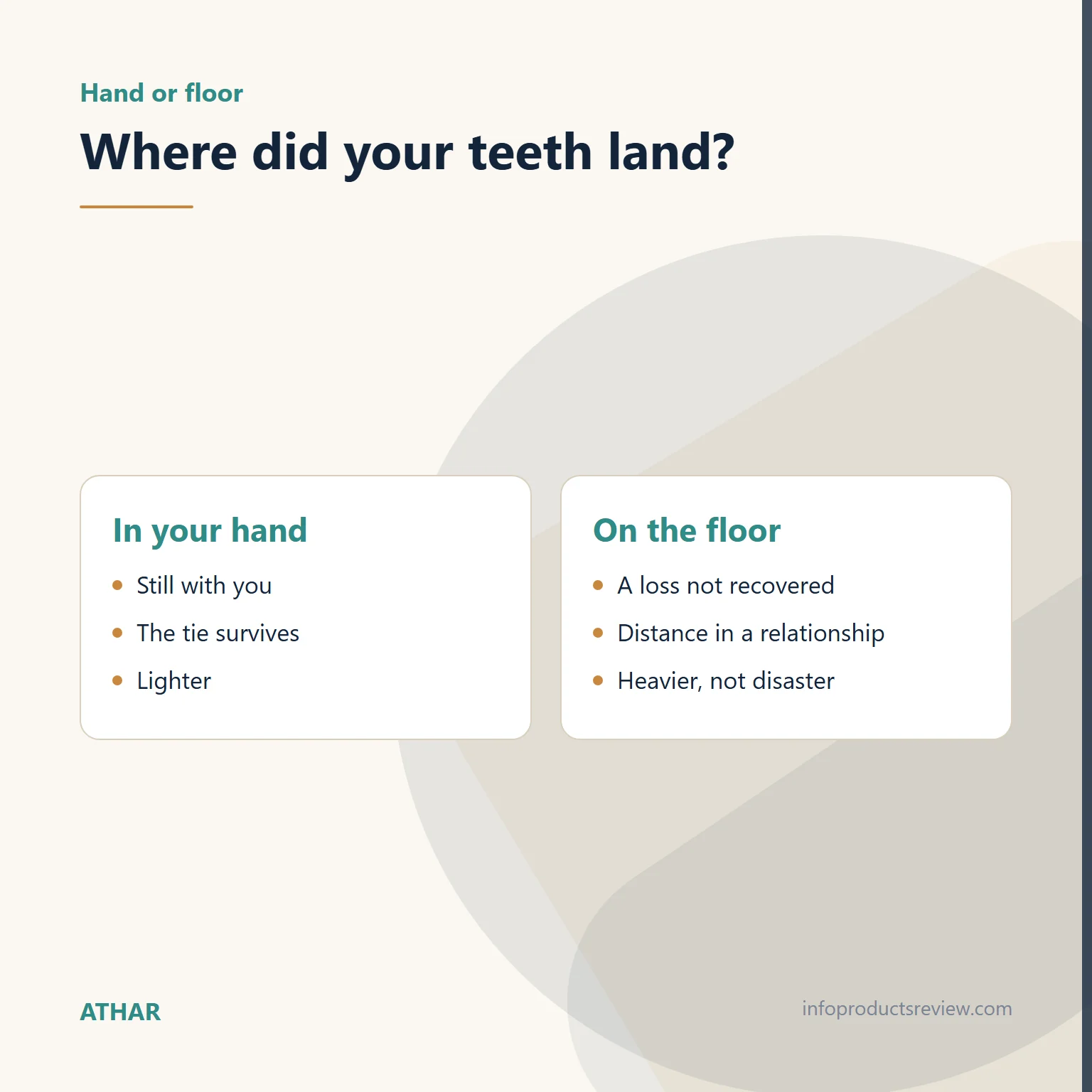
This is one of the versions women ask about most: the teeth come out into your hand, and you’re still holding them.
The nearest reading by the symbol’s logic: what falls into your hand isn’t lost. If teeth stand for family, falling into the hand sits closer to a change in a relationship where the connection survives, or to something that can still be caught before it slips away.
If your brother is getting ready to move, your sister is about to marry and leave home, or a friend is drifting because her life is full, the dream may simply be echoing that. This is a reading by analogy, not something any book states.
As for what circulates: a claim passed around from a book attributed to Abd al-Ghani al-Nabulsi has it that teeth falling into the palm without pain are coins, as many as the teeth. That attribution isn’t established, so it’s talk commonly repeated rather than his settled word, and no meaning is built on it. Don’t wait on money because of it.
For a student: it may picture the end of a stage of study, where what you learned stays with you and the affection between you and your friends lasts, even as everyone goes their own way.
Teeth falling into your hand carries no hint about a marriage being delayed, and no promise of a particular sum arriving at a particular time.
One question is worth more than any ready-made meaning here: who do I feel drifting a little, even though the warmth between us is still there?
Teeth falling out without blood
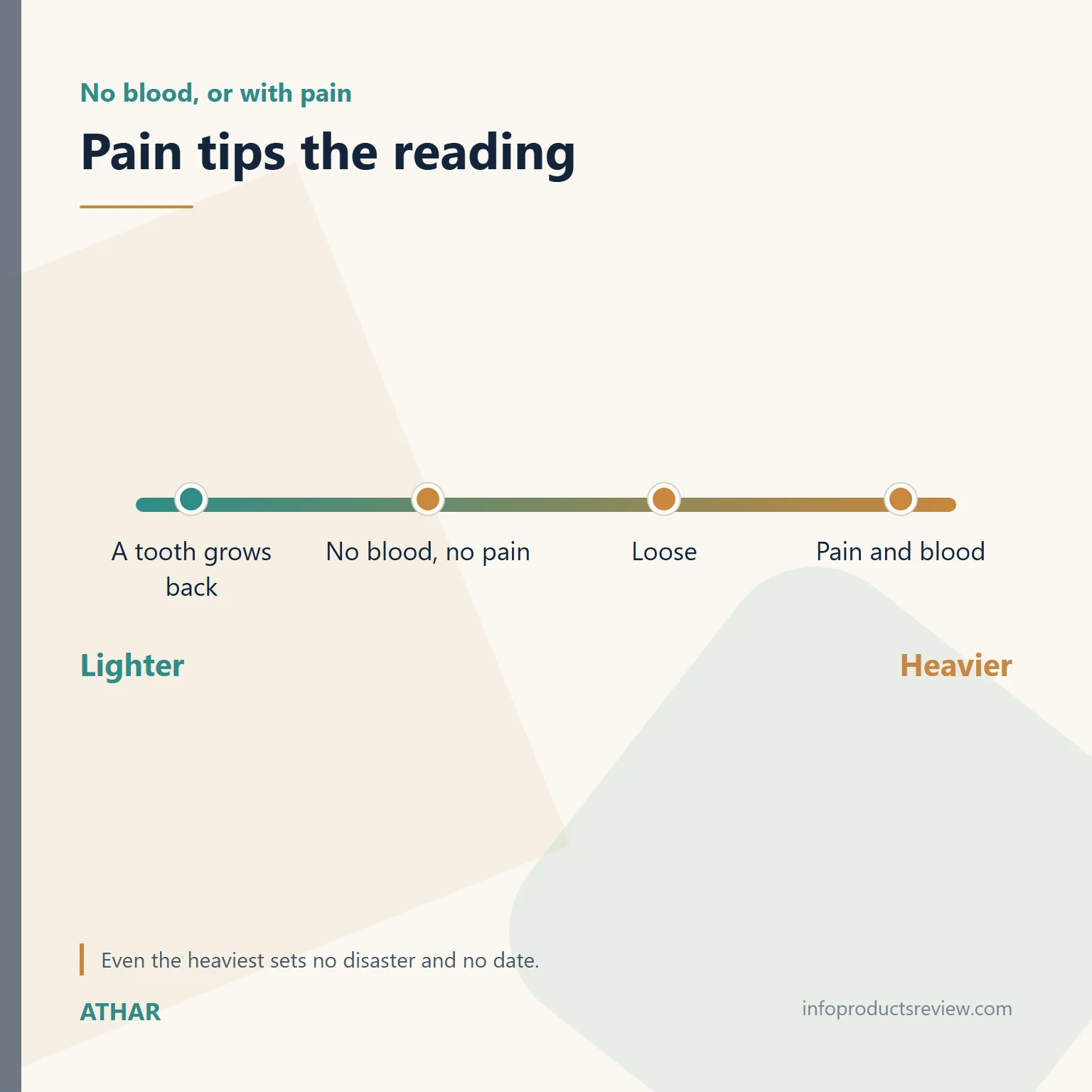
When teeth come out easily, with no bleeding and no pain, the dream weighs less on the dreamer. The reading leans toward a change that passes relatively smoothly rather than toward some silent disaster.
A contemporary interpreter, speaking from experience in a recorded session, reads painless tooth loss according to which teeth were involved. His example is a student close to graduating, whose circle is about to scatter as everyone heads their own way.
That’s a view drawn from his own practice, not something a book states. But it fits a great many women in their final years of study, who are among the most frequent dreamers of this dream.
So the nearest reading of teeth falling out without blood is the end of a stage, a move into new surroundings, or quietly stepping back from a relationship that no longer does you good. The absence of blood and pain lightens the reading; it doesn’t turn it into a certainty.
The old books give no particular meaning to blood or its absence. The difference between the two versions is a difference of feeling and of the symbol’s logic, not something the books set down.
Teeth falling out with pain or blood
When pain or blood comes with the tooth, the dream is heavier. By the logic of the symbol, the reading leans toward something difficult: a painful argument with a family member, a friendship ending badly, or a letdown over something you’d been hoping for.
But heavier isn’t the same as an unavoidable disaster. The more useful question is whether there’s a relationship in your life that’s hurting right now. If there is, the dream is most likely echoing it rather than announcing something new.
And if you actually have pain in your teeth or bleeding gums, your body may be shaping the dream. That’s a question for a dentist, not an interpreter. A dream tells you nothing about the state of your teeth.
Lower teeth falling out
In the dream books, lower teeth stand for women. So for an unmarried woman, a dream about them sits closer to the women in her family: her mother, her sisters, her aunts. By the logic of the symbol it can stretch to her closest friends too.
Falling out painlessly: closer to a gentle change in one of those relationships. If your sister is preparing to marry or move away, or a friend has become wrapped up in her own life, the dream may be echoing that.
Loose: closer to tension or a cooling with one of the women in your family, or to your worry about your mother if she’s been unwell. Here the dream echoes the worry; it carries no news about her health.
Falling out with pain: closer to a hurtful argument, or a moment that stayed with you longer than it should have.
No fear about your mother or a particular sister should be built on a dream. The division points a direction and names nobody, and the whole thing may be about a relationship that simply needs attention.
What helps is checking in on whoever you feel you’ve drifted from: a short call, a visit, a kind word. That’s worth doing for its own sake, whatever the dream meant.
Upper teeth falling out
In the dream books, upper teeth stand for men. So a dream about them sits closer to your father, your brothers, your uncles — not to something happening to you.
Many women worry the dream is about their father specifically. A contemporary interpreter, in a recorded session, holds that the ominous reading of teeth falling out applies only in very rare cases, and that trouble with a tooth is usually read as trouble in a relationship with a relative or friend, one worth mending.
So there may be a misunderstanding between you and your father or a brother, or a decision about your life they haven’t agreed with, and the dream is picturing that. It’s a far likelier reading than the frightening ones that circulate online.
The dream might also be echoing your worry about your father’s health if he’s unwell. In that case it tells you nothing about what lies ahead for him. Prayer, kindness and looking after him are what help.
Front teeth falling out
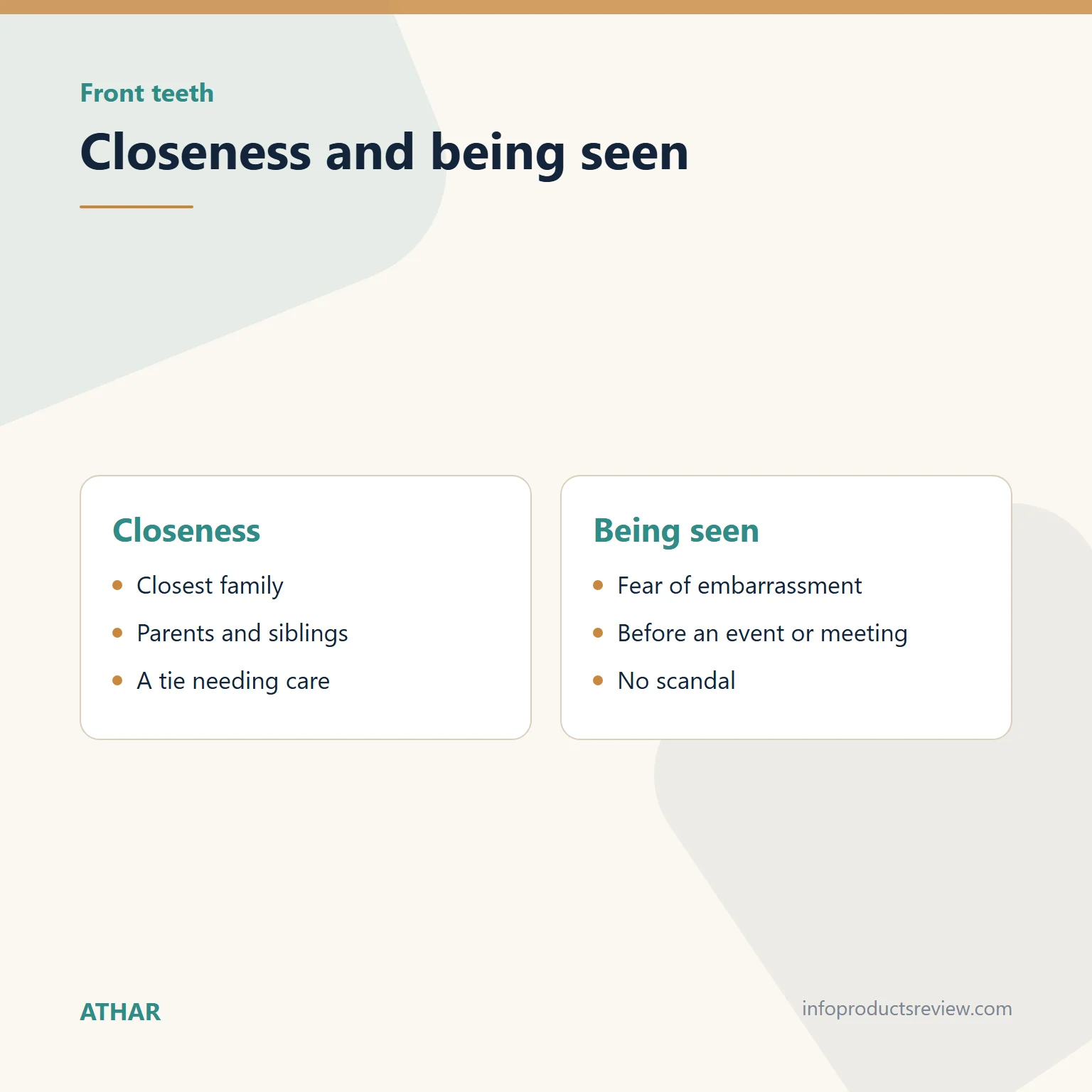
The front teeth, the ones in the middle of your mouth, are read in the old books as your closest relatives. They’re also the most visible part of your smile. So a dream about them carries two meanings at once:
Closeness: something to do with the people at the centre of your life, like your parents or your closest sibling. This part rests on the books’ reading of the front teeth.
Being seen: a fear of embarrassment, of being talked about, or of appearing in a way you wouldn’t want. That’s common before an event, an interview, or meeting a suitor’s family. This part is a reading from feeling and from the symbol’s logic, not from any book.
So if you dreamed a front tooth fell out while you were smiling in front of people, the nearest reading is worry about a social situation, or about how others see you. There’s no hint in it of something happening to you or to your family.
All your teeth falling out
Losing every tooth is a frightening picture, and it attracts the worst scaremongering: “a disaster for the whole family,” “you’ll never marry.” Nothing in the known dream books supports either claim.
A contemporary interpreter mentions, in a recorded session, a man who dreamed all his teeth fell out and then moved on his own to a new department at work. He also notes that a student about to graduate may have this dream, because the group they’ve spent years with is about to scatter.
That’s a view from his own experience, not a book’s. But a woman finishing her studies, moving to another city for work, or getting ready to leave her parents’ home is living through something very close to it.
So the nearest reading of all your teeth falling out is a big change in your surroundings: moving from one environment into another, or a whole chapter of life closing. There’s no news of a death in the family in it, and no verdict that you’ll never marry.
Loose teeth that don’t fall out
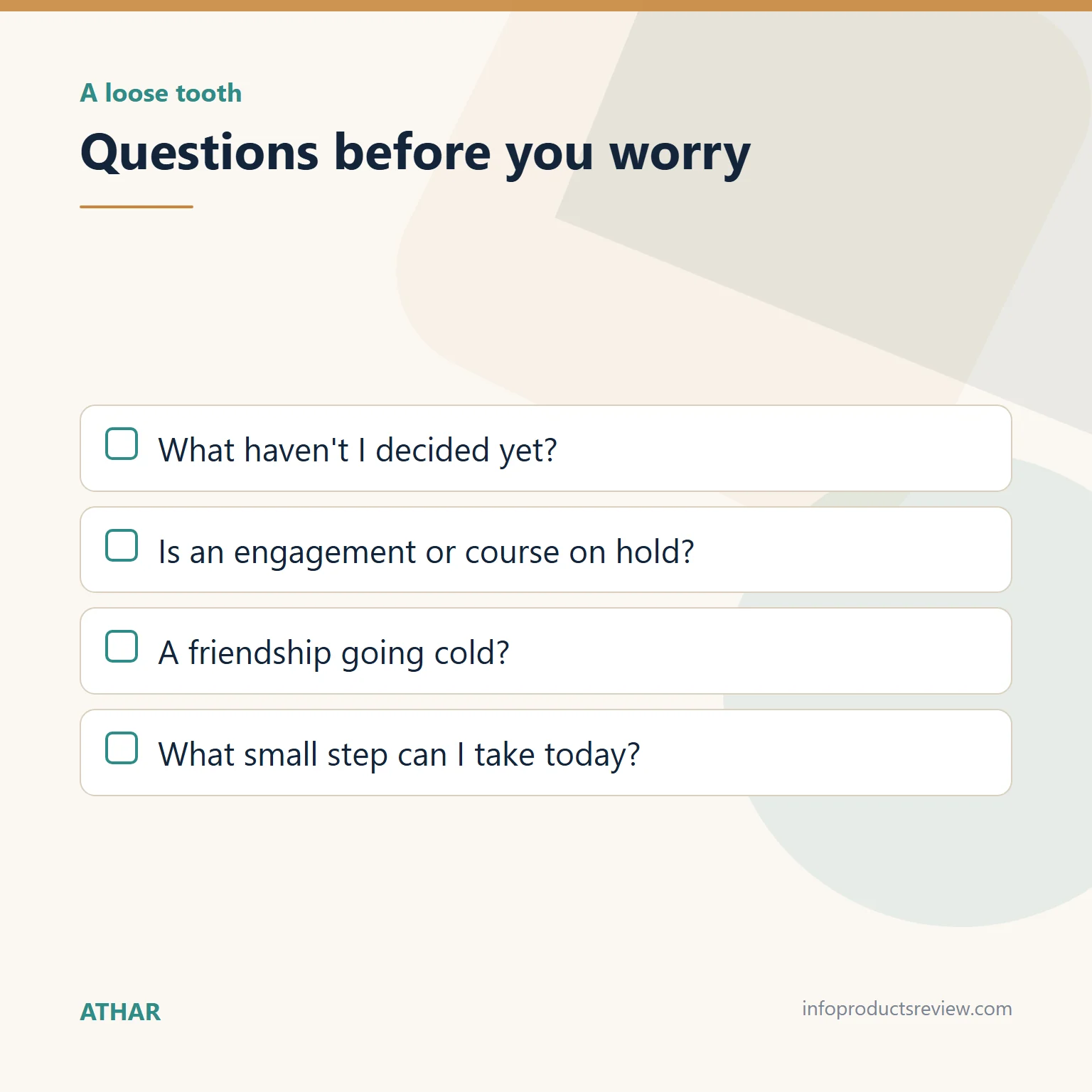
A tooth that wobbles but stays is a picture of something unsettled that hasn’t been decided yet. In a young woman’s life there’s usually plenty of that: a study or work decision left hanging, a friendship in a cool patch, an engagement question that hasn’t come into focus.
It’s a picture of an opportunity rather than a warning. Something unresolved can be settled, and a shaky relationship can be mended before it breaks, the way a tooth gets looked after before it falls.
The known books give no specific meaning for a loose tooth, so this is a reading by the symbol’s logic alone. Even so it’s one of the most useful versions, because it points you at a place where one small step would help.
So ask yourself: what am I still undecided about? Whose relationship with me feels loose at the moment? And what small step would steady it again?
Teeth dreams during study and exams
Plenty of students have this dream the night before an exam or during revision weeks. In that case the nearest reading is an echo of pressure, and of the fear of failing or of disappointing your family. It isn’t a message about your results.
The Sleep Foundation’s page on nightmares notes that worrying situations which bring stress and fear may provoke nightmares, and that after a stretch of insufficient sleep a REM rebound can trigger vivid dreams and nightmares.
Exam periods tend to bring both at once: pressure and short nights. That’s about disturbing dreams in general rather than teeth dreams in particular, but it explains the timing well.
So if the dream keeps returning in those weeks, sorting out your sleep and cutting back on late nights will do more for you than hunting for a new meaning. A short review before bed beats a long night of cramming that leaves your head heavy in the morning.
Women close to graduating may have it too, which connects to what one contemporary interpreter describes about the student whose circle scatters as they move into working life and into surroundings where nobody knows them yet.
Teeth dreams, engagement and marriage

This is what frightens women most: does the dream mean a delayed marriage, or a broken engagement? Let’s answer plainly.
The short answer: the known dream books don’t link teeth falling out to a woman’s marriage being delayed. It’s a widespread claim with nothing behind it, and in those books teeth are read as family and kin, not as marriage.
If you’re engaged: the dream may echo ordinary nerves before marriage, a fear of leaving your parents’ home, or tension between the two families. There’s nothing in it that establishes an engagement will end.
If you’re waiting for a proposal: it may reflect the pressure of relatives’ questions, or worry about the future. It sets no date, decides nothing about what’s written for you, and closes no door.
Relatives’ questions deserve a word of their own. “When are we celebrating you?” “Why aren’t you married yet?” However kindly meant, those questions leave a pressure you don’t notice by day and meet again at night. A teeth dream after a family gathering full of them is far more likely an echo of that pressure than news about your future. It can help to prepare a short, calm answer before the next gathering, and to spend your time with people who steady you rather than add to the worry.
If you’re genuinely unsure about an engagement, the traditional path is to pray the istikhara prayer for guidance and to ask people you trust, not to wait on a dream. Our guides to marriage dream meaning and dreaming of your own wedding may help if this is on your mind.
Teeth dreams and friendships
Trouble with the teeth can be read as trouble in a relationship with a relative or a friend, as one contemporary interpreter puts it in a recorded session. The teeth sit at the front of your face, he says, just as the people close to you sit at the front of your life.
That’s his personal view rather than a book’s reading. But it lands very close to a young woman’s life, where friends make up a large part of every day.
So the dream might be picturing:
- A friendship going through a cool patch or a misunderstanding.
- A friend drifting away because of marriage, a move, or a busy life.
- Fear of losing an important circle during a time of change.
Here the dream is a nudge toward a relationship that needs care. It’s no verdict on your friend or her intentions, and no reason to suspect her, confront her, or end a friendship.
The same goes for decay or a broken tooth, which the same interpreter reads as a strained relationship worth mending. Beyond that, the following are readings by the symbol’s logic only: decay as small frictions building up, a sudden break as a hurtful moment or a quick argument over one word, and a darkened tooth as a worry about someone in the family.
Having a tooth pulled
In the old books, pulling out a tooth, or having someone else pull it, is read as a financial loss in proportion to the compensation owed for a tooth, and sometimes as a family tie being cut.
The same passage carries the heavy reading of a tooth falling out untreated, which is covered with its limits in the section on death below. We record that reading because it’s there in the books, and we keep it in proportion: an interpreter’s view, not news about anyone’s life.
The versions below have no set meaning in the books, so they’re readings by the symbol’s logic:
A dentist pulling the tooth in the dream: closer to a conscious decision to end something harmful, like an exhausting friendship or a habit you know is costing you.
Someone yanking it out by force: closer to pressure you feel over a decision being made for you, or a sense that a matter isn’t in your hands.
And if you’ve been through a broken engagement or a serious falling-out at home, the dream may simply be carrying that pain rather than pointing at new pain ahead.
A single tooth falling out
By the symbol’s logic, one tooth falling out reads lighter than many, because the symbol is narrower. If teeth stand for family, one tooth sits closer to one person, or one relationship, than to your whole family at once.
Where that tooth sits suggests the direction: an upper tooth nearer to one of the men in your family, a lower tooth nearer to one of the women, a front tooth nearer to the people at the centre of your life, a molar nearer to a more distant relative.
On molars, one contemporary interpreter says in a recorded session that back teeth are often read as savings spent on something important. That’s his personal view, not a book’s, though it may fit a woman saving for study or travel.
Wisdom teeth get no meaning of their own in the old books, so they fall under molars in general. Many women in their twenties really are dealing with a wisdom tooth coming through or being taken out, and then the dream is most likely echoing what the body is going through. The pain itself is for a dentist.
The useful question is whether there’s one relationship on your mind right now: a friend who’s pulled away, or tension with a brother or sister. The dream points at a specific place that needs attention, not at some general disaster waiting for your family.
Braces or dental work in the dream
Many young women wear braces or are thinking about them, and dream that the braces come off, that a tooth slips out of them, or that a crown breaks.
The classical dream books give no meaning for any of this, simply because none of it existed when they were written. So there’s no old reading waiting to be applied to it.
The nearer reading is that the dream reflects how much your appearance and your treatment are on your mind, or a worry that something you’ve worked and paid for might go wrong. By analogy it might picture a setback in something you’ve been patiently trying to fix.
There’s nothing in it to suggest the treatment will fail. Questions about the braces themselves — how long, what result — belong with your orthodontist rather than an interpretation page.
A close cousin of this dream is watching your teeth fall out in the mirror, which the books also leave without a set meaning. It tends to carry worry about self-image: how do I look, am I pretty enough, what do people see? It’s common before events, during stretches of comparing yourself with others, or after a hurtful comment about your looks. Be gentle with yourself, and notice whether scrolling through other people’s photos is quietly feeding it.
Does it mean someone in your family will die?
This question deserves a straight answer, so here it is.
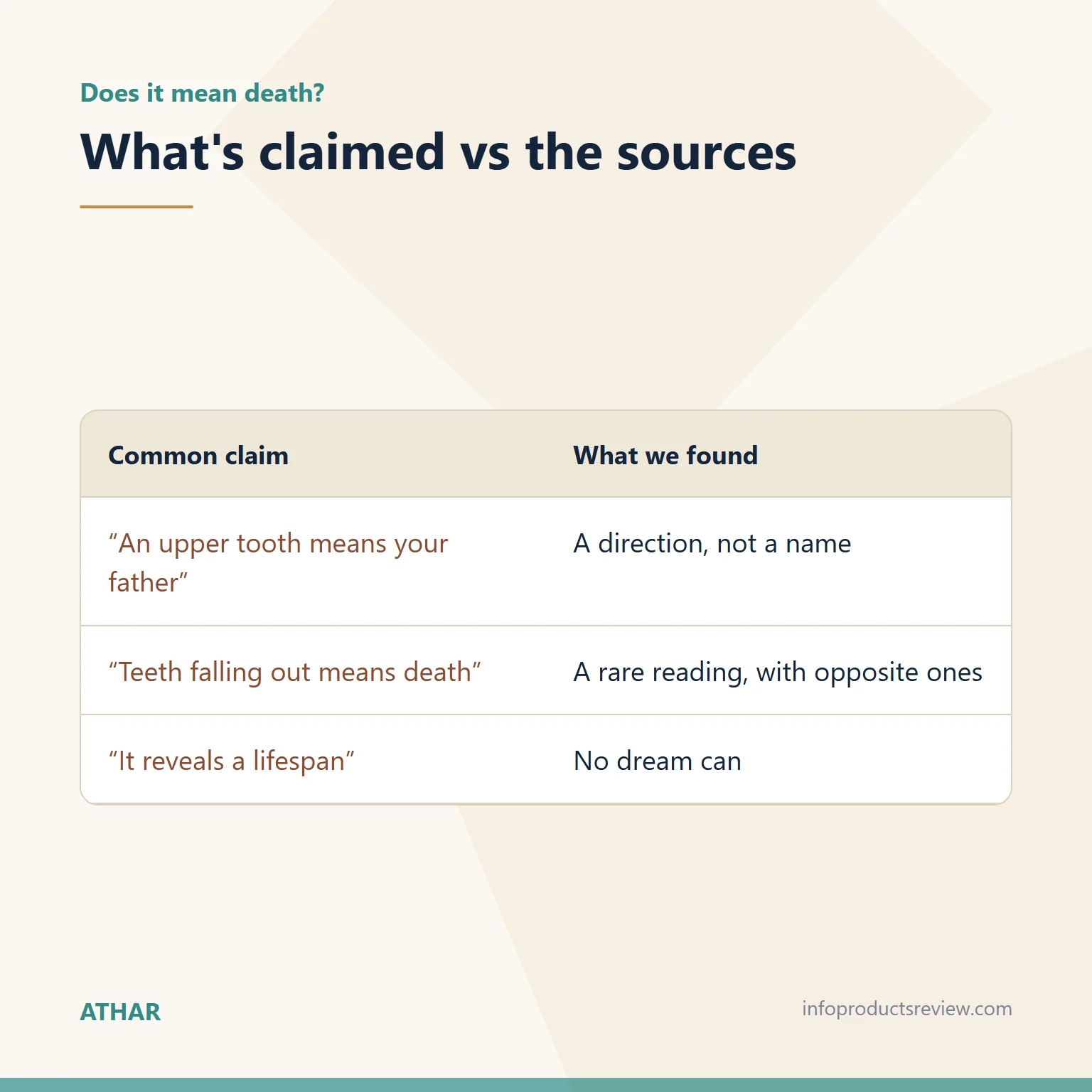
What the books record: in the old books, a tooth falling out untreated is read as the death of a relative. That reading exists, and there’s no point hiding it from you.
But set against it: the same book starts from teeth standing for family and kinship, reads what happens to them through what happens in those relationships, and reads a new tooth as a benefit for a brother or a child. The heavy reading is the exception inside a passage that is otherwise about relationships.
And one contemporary interpreter holds, in a recorded session, that the ominous reading applies only in very rare cases, and that these dreams are normally read in terms of relationships rather than lifespans.
Most importantly: no one knows when anyone will die, and no one’s lifespan can be read from a dream. This dream foretells nobody’s death and nobody’s illness.
So if one of your parents is ill and you had this dream, it’s most likely reflecting your worry for them. We go into the question in full in the complete teeth dream guide, and what’s established about dreams connected to death is gathered in our guide to dreaming of someone who has died.
The same applies if you dreamed of your mother’s or a friend’s teeth falling out rather than your own: the dream most likely echoes your worry for her, or a change you sense between you. Check in on her and be kind to her, but don’t tell her the dream and worry her for nothing — Sahih al-Bukhari (7045) has it that a dream you dislike, meaning one that unsettles or frightens you, isn’t to be told to anyone.
When the dream keeps coming back
Some women have this dream again and again, sometimes for years. Repetition doesn’t make it a certainty, and it doesn’t mean something bad is getting closer.
It may simply track what keeps repeating in your life: ongoing worry, pressure about marriage, a relationship left hanging, a constant fear of embarrassment.
So notice when it comes. Before exams? After arguments at home? After visits from relatives who ask a lot of questions? That observation is worth more than hunting for a new meaning each time.
You could jot down the date of each dream and what happened the day before. After a few weeks a pattern usually shows itself, and the cause with it. And if the repetition is spoiling your sleep, talking to a professional will help more than chasing interpretations.
Be careful, too, about where you read. Pages that pin confident meanings on an interpreter with no book behind them, or tie every detail to a specific disaster, add worry without adding knowledge. One calm answer from someone whose knowledge and faith you trust beats moving from page to page until you find the harshest reading — interpretation is judgement and likelihood, so it shouldn’t become a worry that lasts for weeks.
And if you woke up in tears from this dream, our page on crying in a dream may help.
What’s actually established in Islam about dreams
Two things need to stay apart: reading the symbol of teeth, which is interpretation and can be right or wrong; and the Prophet’s guidance on handling dreams, which is established and doesn’t shift.
What’s established is that a dream you like is from God, so you praise Him for it and may speak of it, and a dream you dislike is something to seek refuge from and not to tell anyone about. In Sahih al-Bukhari (7045), narrated by Abu Sa’id al-Khudri:
If one of you sees a dream he likes, it is from God, so let him praise God for it and speak of it; if he sees otherwise, something he dislikes, it is from Satan, so let him seek refuge from its harm and mention it to no one, for it will not harm him.
The point of the hadith is that a disliked dream is no basis for fear and no basis for a decision. You seek refuge in God from its harm, you don’t retell it, and then you can rest easy that it won’t harm you.
That’s general guidance for any disliked dream, not an interpretation of teeth. It tells you how to handle the fright, not what the symbol means.
Sahih Muslim (2262), from the hadith of Jabir, adds more: spit lightly to your left three times, seek refuge in God from Satan three times, and turn over from the side you were lying on.
If one of you sees a dream he dislikes, let him spit to his left three times, seek refuge in God from Satan three times, and turn over from the side he was lying on
So if you dreamed your teeth fell out and it frightened you, seek refuge in God from its harm, don’t retell it to everyone, and don’t post it in group chats looking for interpretations, as Sahih al-Bukhari (7045) and Sahih Muslim (2262) direct.
A dream establishes no ruling, accuses nobody, and is never a reason to cut off a relative. That alone takes this dream out of the territory of fear.
Common claims that need correcting
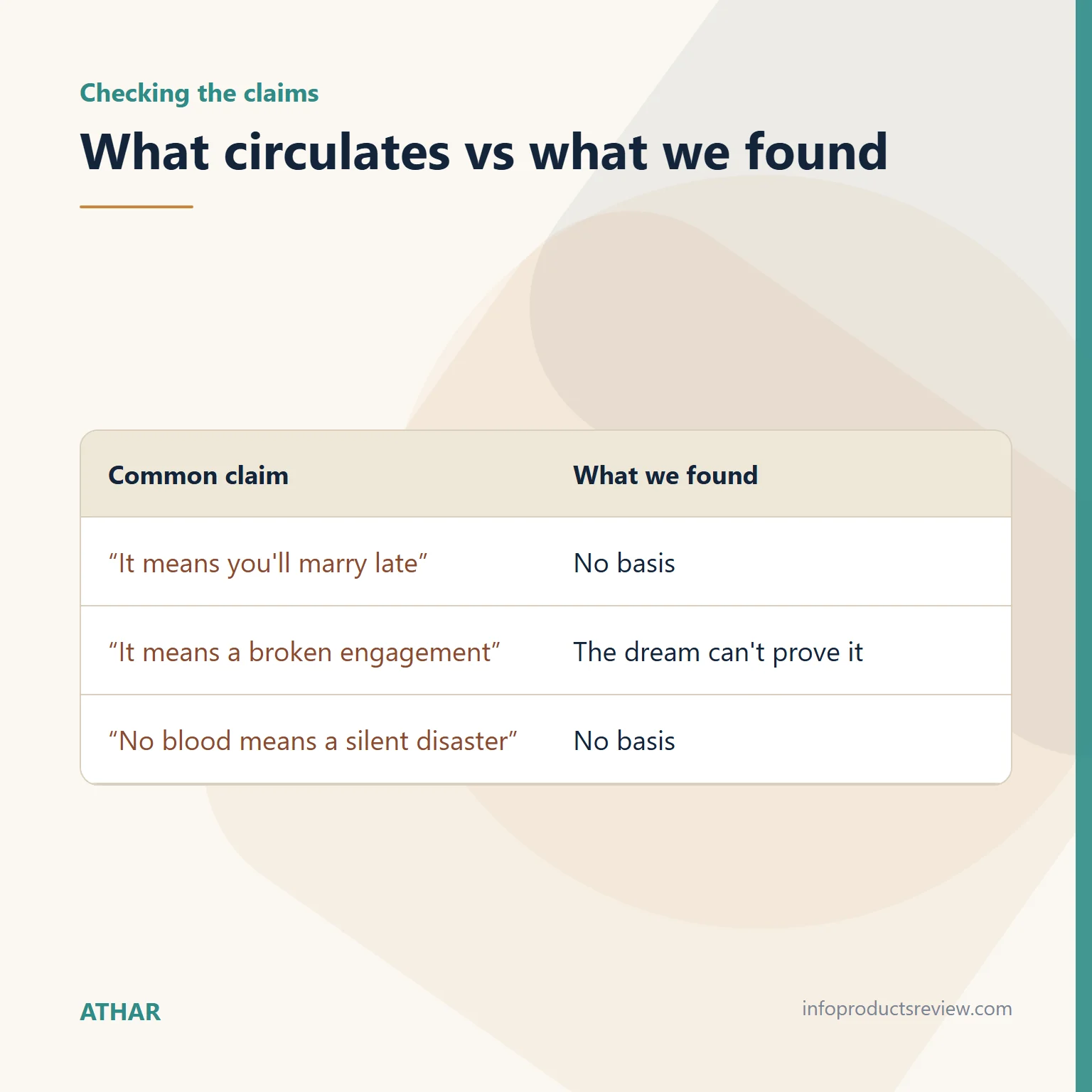
“Teeth falling out means a single woman won’t marry, or will marry late.” The known dream books say nothing of the kind; they read teeth as family and kin.
“It means the engagement will be broken off.” The dream can’t establish that. It’s far more likely an echo of ordinary nerves before a big step.
“An upper tooth falling out means your father will die.” The upper and lower division suggests a direction only. It names nobody and says nothing about death.
“No blood means a silent disaster is coming.” There’s no basis for that. Painless tooth loss is the lighter reading by the symbol’s logic, and contemporary interpreters lean the same way.
“Ibn Sirin’s detailed interpretation for single women.” The popular book under his name is only attributed to him, and its authorship isn’t established, so those details can’t rest on it.
What this dream can’t tell you
And to close the door on scaremongering completely, here’s the edge of what can be drawn from the dream:
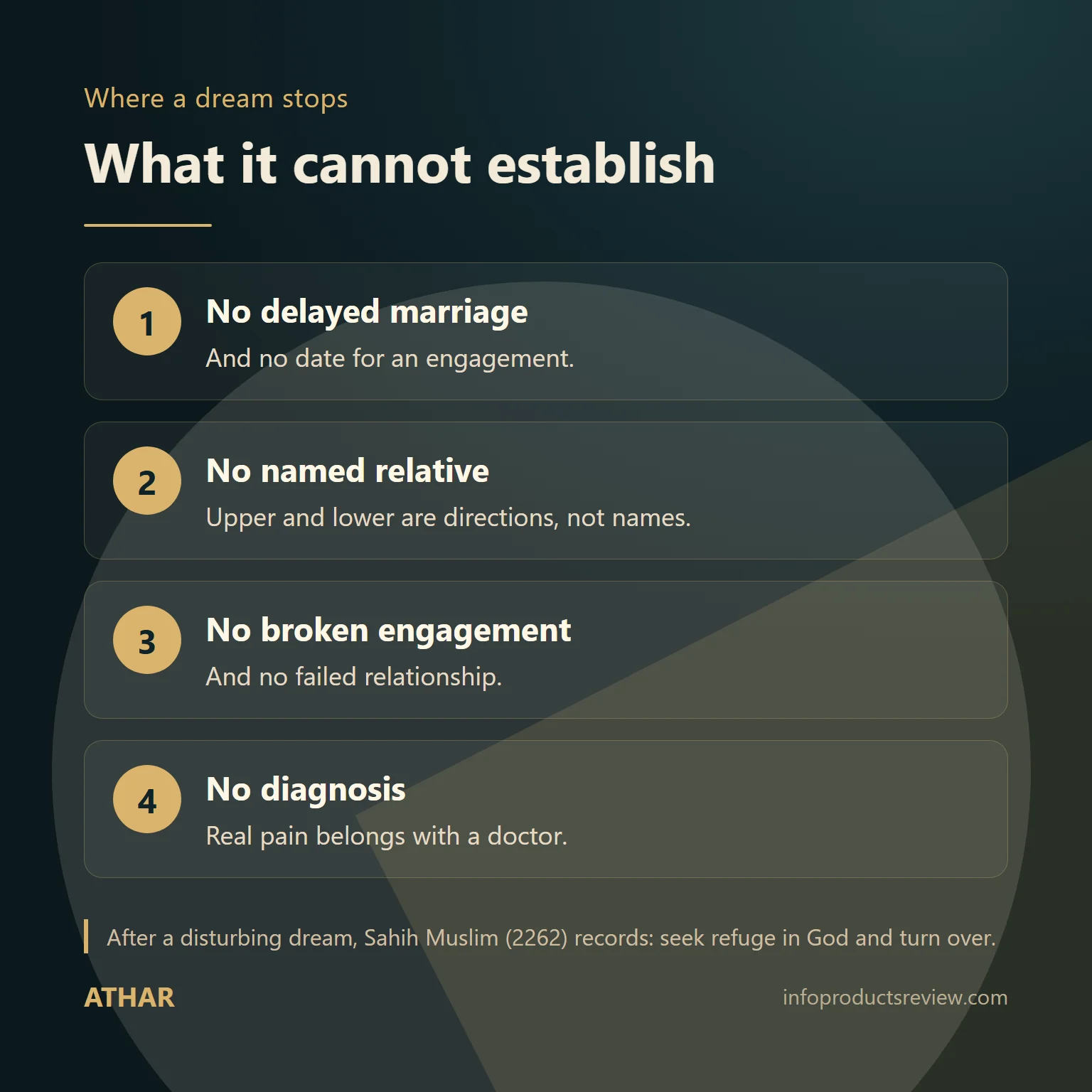
- It can’t delay a marriage or set a date for an engagement.
- It can’t show that an engagement will end or a relationship will fail.
- It can’t tell you anyone in your family will die.
- It can’t point to a particular relative or friend.
- It can’t diagnose a problem with your teeth or your health.
- It isn’t evidence of magic, envy or the evil eye.
What to do after the dream
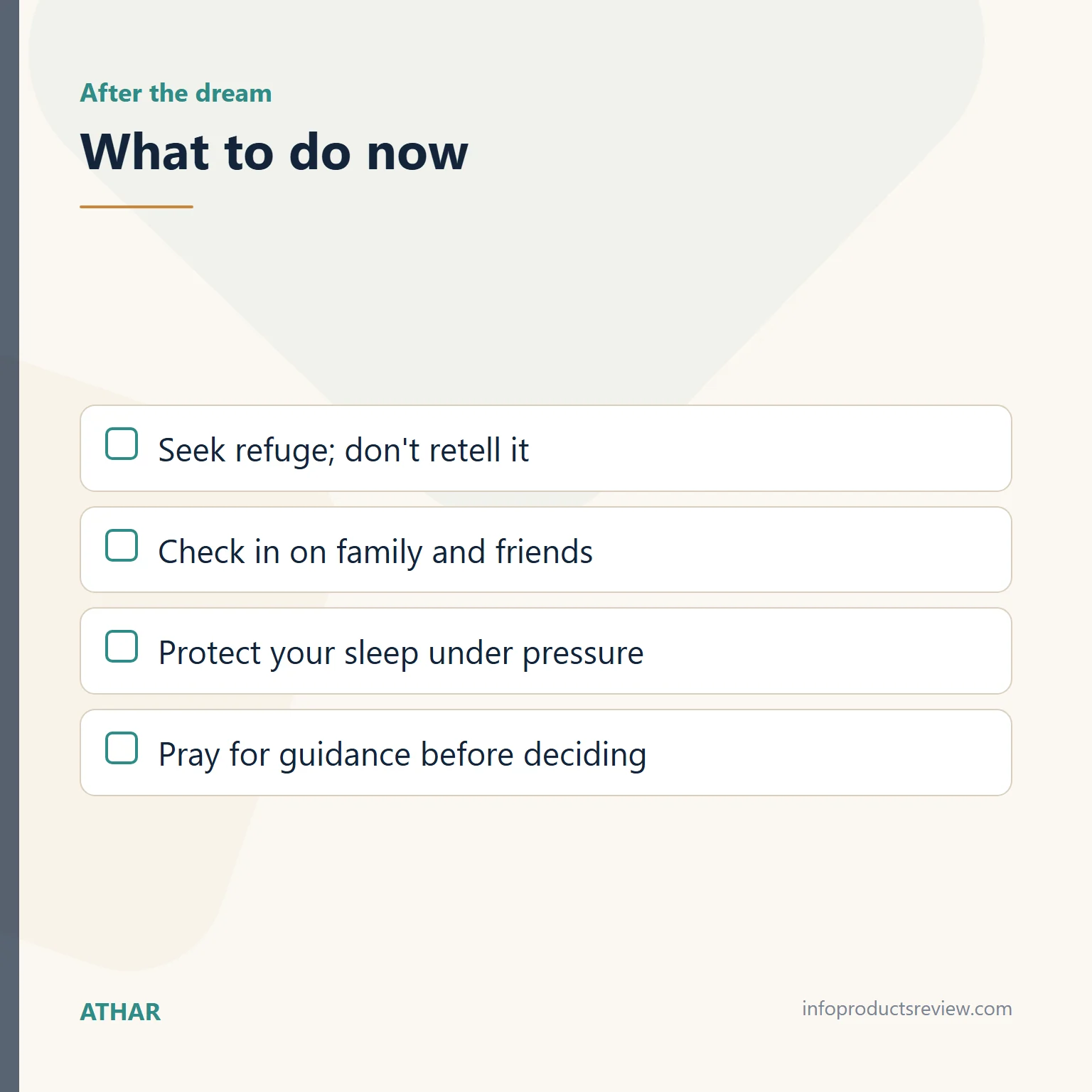
If it was disturbing: seek refuge in God from its harm, spit lightly to your left three times, turn over, and don’t retell it to everyone, as in Sahih al-Bukhari (7045) and Sahih Muslim (2262).
Check in on your relationships: is there someone in your family you need to make peace with? A friend who’s drifted? That’s worth doing for its own sake, whatever the dream meant.
If you’re under pressure: with exams, waiting, or tension at home, cut back on late nights and look after your sleep.
If you’re facing a decision: pray for guidance and ask people you trust, rather than waiting for a dream to settle it.
If you have real pain: see a dentist.
How to describe the dream so it can be read
If you want to make sense of your dream, or take it to someone whose knowledge you trust, set it out like this:
- Which teeth: upper or lower? Front teeth or molars? One or many?
- How and where: into your hand or onto the floor? With pain and blood, or without?
- Where you were: at home, in front of people, at university?
- How you felt: calm, frightened, or embarrassed?
- What’s on your mind: study, an engagement, family or friends?
You’ll often find that an orderly description makes half the meaning clear before you ask anyone. If a tooth fell out while you were eating with family, the real question may be about the atmosphere at home; if it fell out mid-conversation, it may be about something you said, or something you still need to say.
What contemporary interpreters say about this dream
Here are two views from contemporary interpreters in recorded sessions, because they show how an interpreter actually thinks about this dream. One caveat: this is personal opinion, not religious text and not an established rule, and it’s paraphrased rather than quoted.
The first says from experience that painless tooth loss is read according to which teeth were involved, with back teeth often read as savings spent on something important.
His examples are a man who dreamed all his teeth fell out and then moved alone to a new department, and a student whose circle scatters just before graduation as everyone heads their own way.
From his own experience, the speaker says painless tooth loss is read according to which teeth are involved, giving the examples of a student whose circle scatters before graduation and a man who moved alone to a new department. Summarised from the Arabic interview; an opinion, not a religious ruling or a definitive interpretation.
The second argues that the ominous reading of teeth falling out is rare. Teeth sit at the front of your face the way relatives sit at the front of your life, so trouble with them points to a relationship with a relative or friend that’s worth mending.
The speaker holds that the ominous reading of teeth falling out is rare, and that trouble with the teeth is usually read as trouble in a relationship with a relative or friend that's worth mending. Summarised from the Arabic interview; an opinion, not a religious ruling or a definitive interpretation.
Both line up with the rest of this page: details are read in context, the ominous reading isn’t the default, and a disturbing dream is something to seek refuge from rather than something that can harm you. Neither gives a meaning specific to single women.
Examples
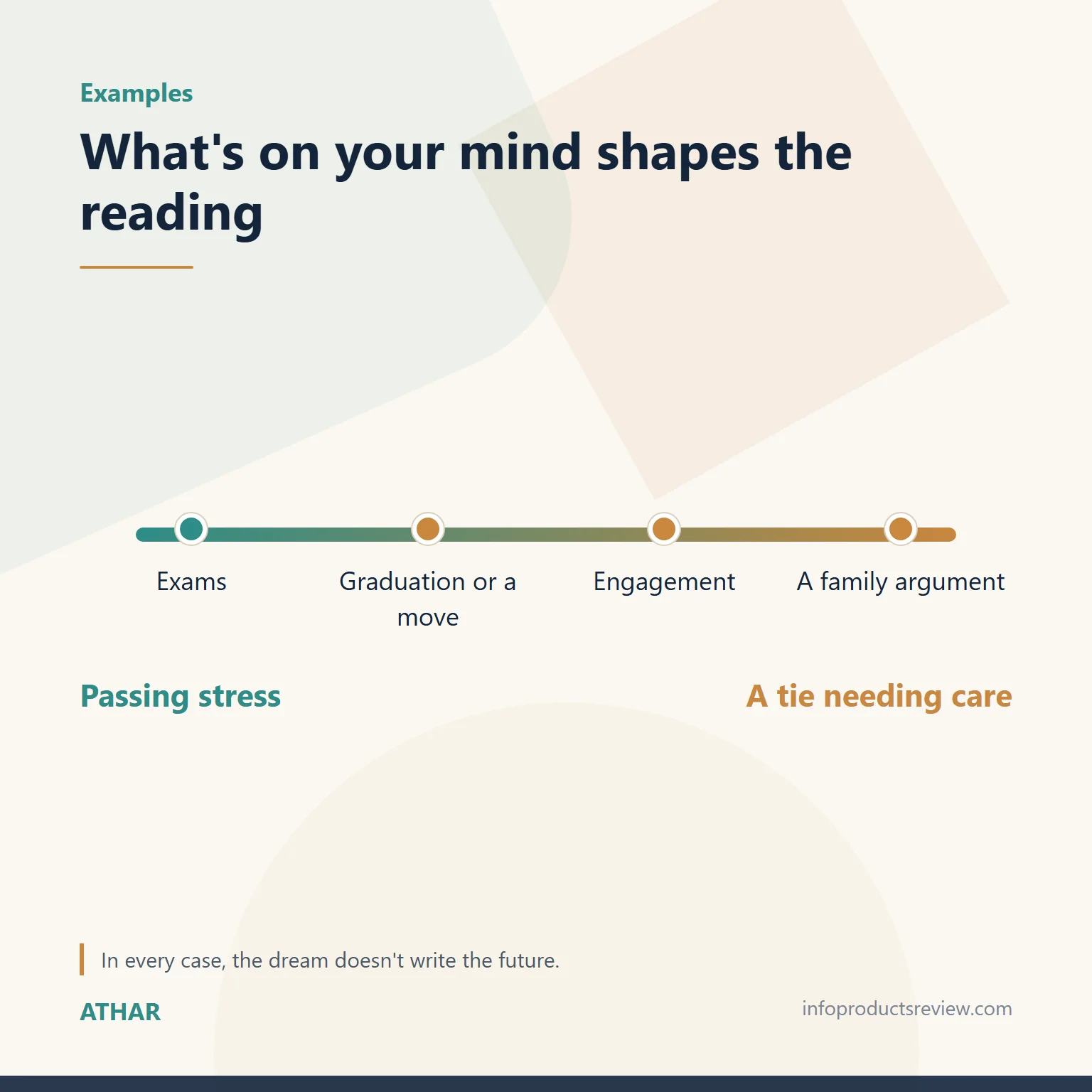
These are illustrations of how the reading works, not verdicts on anyone’s actual dream:
A final-year student dreamed her teeth fell painlessly into her hand. Closest reading: the end of her studies and parting from her friends while the friendship lasts.
A young woman dreamed a lower tooth went loose after an argument with her sister. Closest reading: an echo of the argument, and a nudge to make peace with a kind word.
An engaged woman dreamed a front tooth fell out in front of her fiancé’s family. Closest reading: nerves about embarrassing herself at the meeting, not a broken engagement.
A woman whose father is ill dreamed an upper tooth fell out. Closest reading: her worry for him. It says nothing about what lies ahead for him; prayer and care are what help.
A student whose teeth dreams come back every exam season. Closest reading: stress and too little sleep. The answer is rest, not interpretation.
A young woman dreamed a new tooth grew in. The old books read that as a benefit for a brother or a child: one of the reassuring readings, and no promise of particular news.
A woman about to move to another city for her first job dreamed her teeth fell out one after another, without pain. Closest reading: an echo of the big change ahead and of leaving familiar faces behind. The useful question: how will I keep in touch with them after the move?
A young woman dreamed her mother’s teeth fell out while her mother had been unwell for a while. Closest reading: her fear for her mother. What helps is caring for her and praying for her, without telling her the dream.
Quick table: the detail and the closest reading
| What you saw | Closest reading | What it doesn’t mean |
|---|---|---|
| Into your hand | By the symbol’s logic: change, with the connection kept | A delayed marriage |
| Without blood | By the symbol’s logic: a smooth change or a move | A silent disaster |
| Lower teeth | In the dream books: the women in your family | Your mother’s death |
| Upper teeth | In the dream books: the men in your family | Your father’s death |
| Front teeth | In the dream books: closest family; also fear of embarrassment | A scandal |
| Loose teeth | By the symbol’s logic: something not yet decided | A broken engagement |
| All your teeth | A big change, or a move | That you’ll never marry |
| The night before an exam | Stress and too little sleep | Your results |
Related dreams
- Teeth falling out in a dream: the complete guide to every version of the symbol.
- Lice dreams for a single woman: another symbol read through a young woman’s situation.
- Lice in your hair as a single woman: an example of reading the details for an unmarried woman.
- Athar in English
- National Institute of Neurological Disorders and Stroke: Brain Basics, Understanding Sleep
- Sleep Foundation: Nightmares
Frequently asked questions
What does it mean for a single woman to dream of teeth falling out?
Most naturally, something about her family and closest circle, since the dream books read teeth as the household and relatives. It may also echo a transition like graduating. There’s no hint in it of a delayed marriage.
What does it mean if the teeth fall into my hand?
The known books give it no set meaning. By the symbol’s logic it’s lighter than teeth hitting the floor: a change in a relationship where the connection survives, or something that can still be put right.
What does it mean if they fall out without blood?
Most likely a change that passes fairly smoothly, like a stage ending or a move. No pain and no blood lighten the reading without making it a certainty.
What do lower teeth falling out mean for a single woman?
In the dream books, lower teeth stand for women, so it likely concerns the women in her family or her friends, without naming anyone.
Does this dream mean I’ll marry late?
No. The known dream books don’t link teeth falling out to a late marriage; they read teeth as family, not marriage.
Does it mean my engagement will be broken off?
The dream can’t establish that. It’s more likely ordinary nerves before marriage, or tension between the families.
An upper tooth fell out. Will something happen to my father?
In the dream books, upper teeth are the men in your family, which is a direction, not a name. It most likely concerns the relationship, or your worry for him if he’s unwell. A dream foretells nobody’s death and nobody’s illness.
Why do I have this dream before exams?
Most likely because of stress and too little sleep at that time, not as a message about your results.
What does a front tooth falling out in front of people mean?
Most likely a fear of embarrassment or of how others see you, especially before an event or an important meeting.
What should I do after a disturbing teeth dream?
Seek refuge in God from its harm and tell no one, as in Sahih al-Bukhari (7045); Sahih Muslim (2262) adds spitting lightly to the left three times and turning over.
Is the dream a sign of envy or the evil eye?
A dream isn’t evidence of that, and it’s never a reason to accuse anyone.
Is this interpretation definitive?
No, and deliberately so. These are possible meanings that change with the details, and none of them predicts the future.
In summary
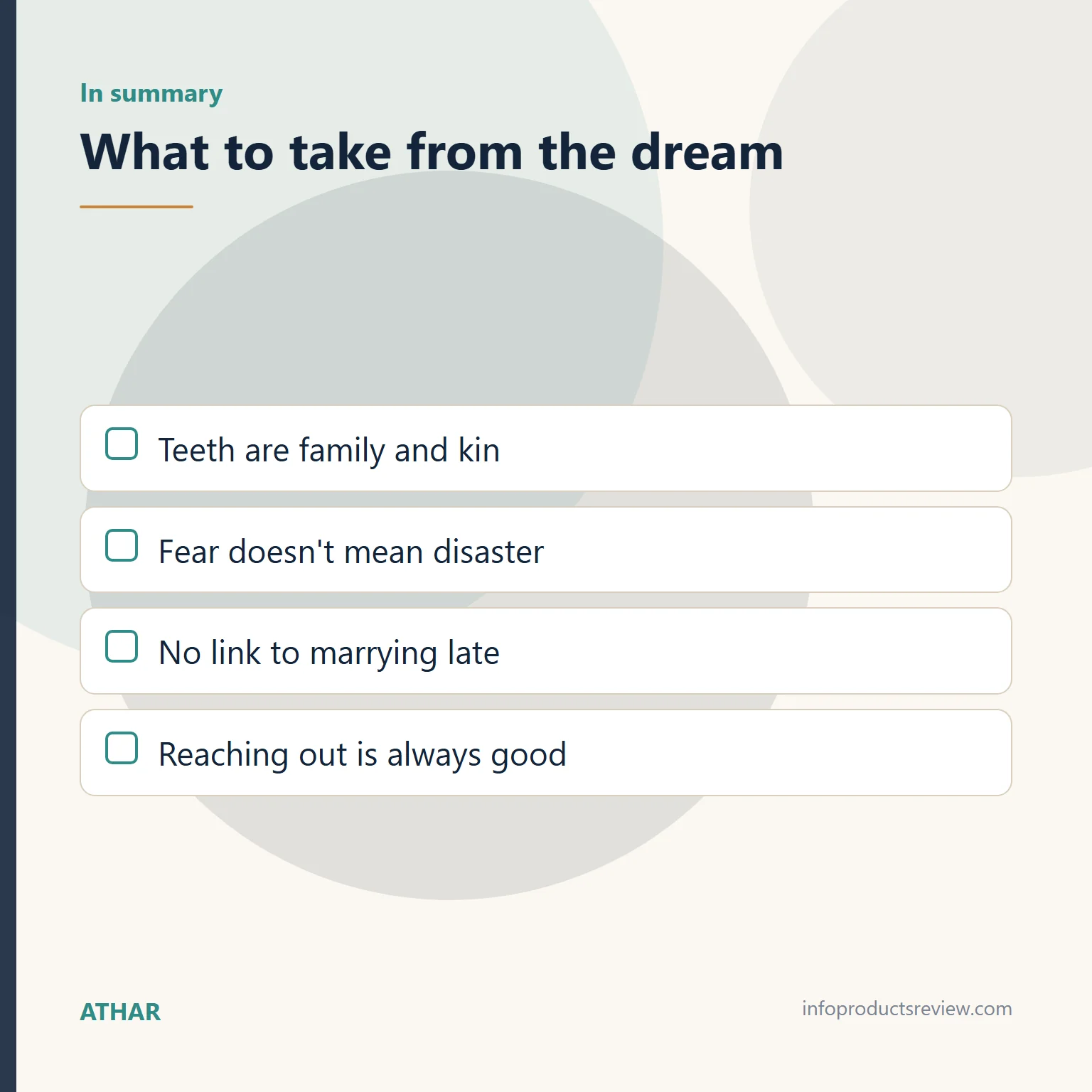
- In the dream books, teeth are the household and relatives: front teeth the closest, molars the most distant, upper teeth men and lower teeth women.
- A frightening dream leans toward ease and good news, and interpretation is judgement rather than certainty.
- Teeth falling into your hand, or falling without blood, read lighter by the symbol’s logic — most likely as change or a move.
- There’s no basis for linking the dream to a late marriage or a broken engagement.
- The dream can’t tell you anyone will die, point to a relative, or diagnose anything.
- After a disturbing dream: seek refuge in God, turn over, and don’t retell it.
If you take one thing from this page, let it be this: a dream doesn’t write your future, but it might remind you of your family, your friends and what’s weighing on you. Reach out to the people who need you, go easy on yourself, and leave what’s written to God.
Written and reviewed by: the ATHAR editorial team. Classical and hadith quotations are our own translations from the editions listed in the sources.
Last comprehensive update: 15 September 2026.
Note: the meanings on this page are possibilities, not established facts, and they change with the details of a dream and the dreamer’s situation. Nothing here predicts the future, sets a date for marriage, tells you anyone will die, diagnoses a health problem, or gives a religious ruling.