


You wake up with a picture you would rather not have: lice. On your head, maybe, or on the jacket you wear to work, or spreading across a place you would never expect to find them. It is unpleasant, and oddly embarrassing, even though nobody else saw the dream.
So you look it up. One page says it means enemies. Another hints at witchcraft. A third warns of money trouble on the way. They all sound certain, and none of them names a source.
This page takes a different route. What dreaming about lice may mean for a man depends on the whole scene: where the lice were, what happened to them, how many there were, and above all how you felt.
It also keeps three things apart that most pages blur together: the one line a well-known classical interpreter actually wrote about lice, the guidance recorded in Sahih al-Bukhari and Sahih Muslim about a dream you dislike, and the mass of claims that simply circulate online with no source at all. And it says plainly what a dream like this cannot tell you, however often the internet repeats it.
The bottom line
Dreaming about lice most often reflects small things that keep coming back: demands that never quite end, scattered responsibilities that eat into your time, and people who rely on you. At its root, the symbol is not about disaster or enemies.
- The nearest meaning: Ibn Qutayba al-Dinawari, writing in the ninth century, recorded that lice mean dependants, the people you provide for and look after. That is the clearest reading transmitted from a well-known classical interpreter, and for a man carrying a household it lands very close to home.
- The detail that changes it: place. Lice at home lean toward the circle of family and those you provide for; lice at work lean toward the pressure of earning a living.
- The two commonest scenes: lice spreading reflect ongoing strain; removing them is one of the most reassuring images in this symbol.
- How you felt tips the balance: strong distress leans toward exhaustion and worry, calm softens the reading a great deal.
- A limit worth keeping: all of this is a possible meaning, not a report about your life. Interpretation is conjecture you may find useful; it is not grounds for a decision about money, work or anyone in your family.
- Where the books say nothing: no classical source gives men a separate chapter on this symbol, none gives lice a meaning by colour or size, and none connects them with witchcraft, envy or a wife’s infidelity. Anyone offering those is adding, not transmitting.
Some things a dream simply cannot establish. It cannot show witchcraft or envy, cannot name anyone working against you, cannot predict a financial loss, and cannot diagnose illness. Those are claims about real life, and they need evidence from real life.
What this page covers
- The bottom line
- What do lice stand for in a dream?
- Which details actually change the meaning?
- Where did you see the lice?
- A few lice, or a great many?
- Do colour and size mean anything?
- What if the lice were moving, or bit you?
- What does removing or killing lice mean?
- Lice on work clothes or where you earn your living
- When lice stand for the responsibility of a family
- Lice on clothes and personal belongings
- What if the lice were on someone else?
- Lice or nits: does the difference matter?
- Does it change when you’re job-hunting or retired?
- How did you feel inside the dream?
- What do the classical dream-interpretation books actually say?
- What is actually established about disturbing dreams?
- What does sleep research say about unsettling dreams?
- When is a dream just your mind processing the day?
- A clear line: dreams are not medicine
- When the dream comes during a season of money pressure
- Common claims that need correcting
- What this dream cannot establish
- What to do after an unsettling dream
- How to describe your dream so it can actually be read
- What have interpreters said in recorded interviews?
- A few typical scenes
- Quick reference: detail and nearest reading
- Related dreams
- Frequently asked questions
- What does dreaming about lice most often mean for a man?
- Does it mean my wife is unfaithful?
- Does it mean my income will shrink?
- I killed the lice in my dream. Is that a good sign?
- I saw lice on my work clothes. What does that mean?
- I saw lice in my son’s hair. Does that mean something about him?
- Is it a sign of envy or witchcraft?
- What should I do after an unsettling lice dream?
- Is the meaning different for men and women?
- The dream keeps coming back. Is it a message?
- Does a lice dream mean something is wrong with my body?
- Is any of this certain?
- In summary
- Sources and references
What do lice stand for in a dream?

Start with the full range of meaning, because most pages give you only one end of it.
Only one explicit meaning for lice comes down to us from a well-known early interpreter, and it is a single line: Ibn Qutayba read lice as dependants. The classical section below looks at that line closely, because it turns the usual angle on this dream upside down.
The wider reading — lice as something minor, recurring and draining: a worry that won’t leave, or scattered burdens that pile up until they tire you — rests on what lice are actually like. They are small, numerous, persistent, attached to their host, and they take without giving anything back. That is how the early interpreters reasoned, but it is not a line quoted word for word from any of them, and we say so rather than dress it up as one.
Later popular compilations add other meanings: small sums of money arriving in dribs and drabs, a large but ineffective crowd of people, a worry that keeps returning. None of these is confirmed. They are not traceable to a critical edition that could be quoted, so we report them as ideas in circulation rather than established readings, and we build nothing on them alone. Notice, though, that even in circulation they are nowhere near the witchcraft and envy that fill so many pages today.
The practical conclusion is simple. A symbol that can mean “a recurring worry” in one scene and “the people who depend on you” in another cannot be read without knowing what actually happened in the dream. Any page that gives you one meaning without asking is guessing.
An interpreter makes the same point in a recorded interview, in more practical words:
A single symbol may have ten possibilities, so the interpreter puts several symbols of the dream together, asks about the dreamer's situation, and then favours one of the meanings.
So being asked about your own circumstances is not a way of dodging the question. It is the answer. That is one speaker’s view in an interview, not a religious ruling.
If you want to see the same method applied to another symbol men often ask about, our guide to snake dreams for a man follows the same order: the scene first, then the meaning.
Which details actually change the meaning?

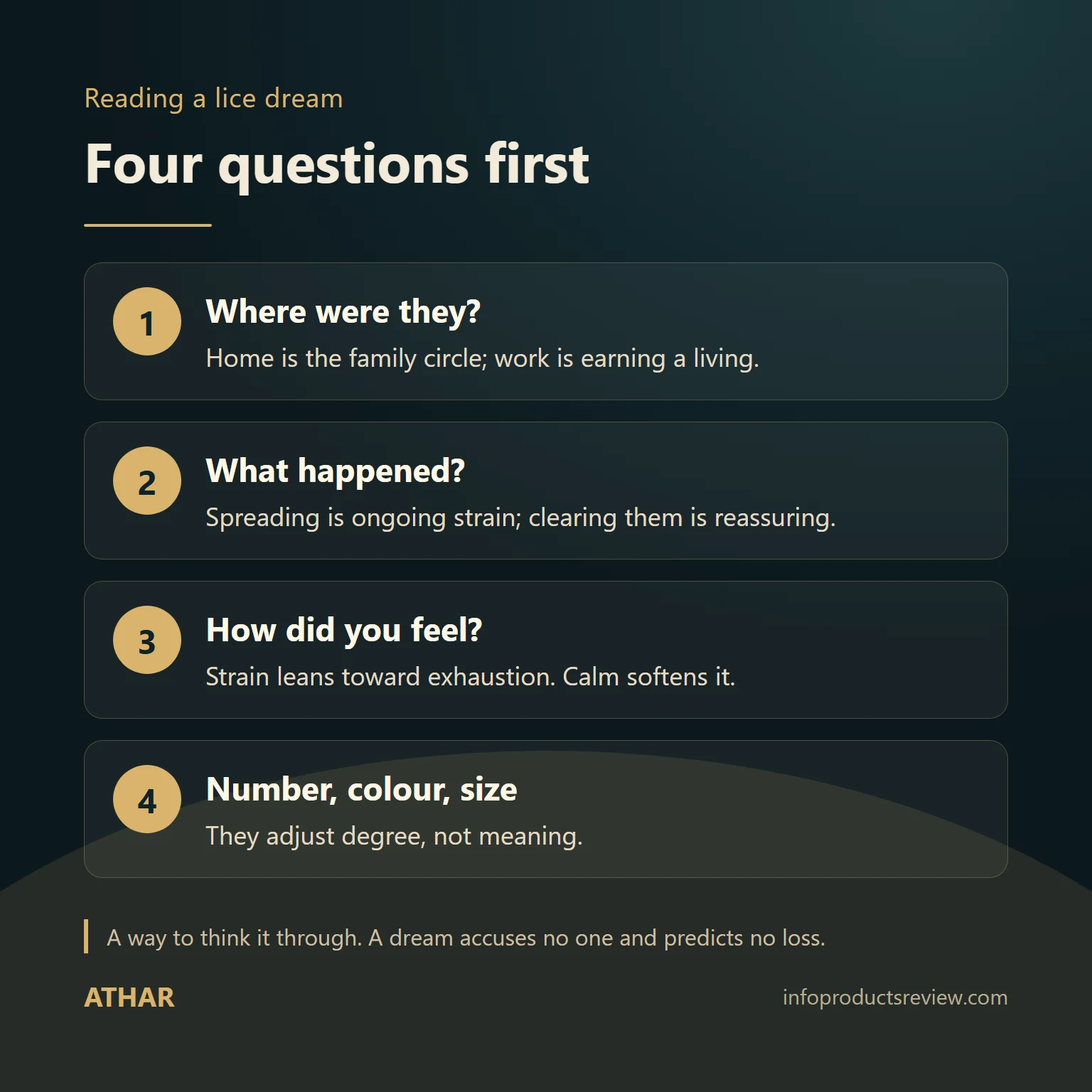
Before going through them, it helps to know their order of importance, because most people start at the wrong end.
First: place. Your home, your workplace, your car, somewhere public? That sets the circle the dream is talking about.
Second: what happened. Did you only see the lice, or did they spread, bite, or get removed? Action shifts the reading more than appearance does.
Third: how you felt. Irritation, embarrassment, disgust, calm, indifference? This is often the most honest part of the dream, because it’s the part you don’t reconstruct after waking.
Last: number, size and colour. These adjust the degree of a meaning. They don’t create a new one.
That order isn’t our invention. Al-Sadhan, in his modern handbook of interpretive principles, holds that the accompanying detail in a scene is what an interpretation actually rests on:
The accompanying detail in a dream is what an interpretation rests on, so look for the meaning according to the detail that is present.
Which means the word “lice” on its own is not a scene. The accompanying detail is the place, the action and the feeling, and that is what tips one meaning over another. It is a contemporary author’s principle, not a religious ruling.
Where did you see the lice?

Place is the strongest detail you have, and the one most often forgotten when the dream is retold.
At home. What appears at home relates to your closest circle: your wife, children, parents, anyone living with you. That is not an accusation against any of them; closeness describes the circle, not the people in it. The most natural reading is that what is weighing on you right now comes from inside the household: expenses, requests, or responsibilities that have landed on you alone.
At work. The reading moves to the pressure of making a living: a stream of small tasks, colleagues with constant demands, or a manager piling on more than you can reasonably carry. The dream describes a feeling you already know. It doesn’t announce that you will lose your job.
In your car or on the road. Roads are about movement and effort. Lice there lean toward burdens that follow you from one obligation to the next, as if there is never a moment to stop.
In a public place. A mosque, a market, a gathering of friends. The circle widens to your community and your standing in it. The dream may reflect concern about how you are seen, or social obligations that have become tiring.
In bed. Bed is where rest should happen. Lice there lean toward whatever is actually keeping you from rest: poor sleep, a mind that won’t switch off, worries that return as soon as you close your eyes.
The simple rule: the closer the place, the closer the circle. Closer does not mean more serious. It only means nearer to you.
A few lice, or a great many?
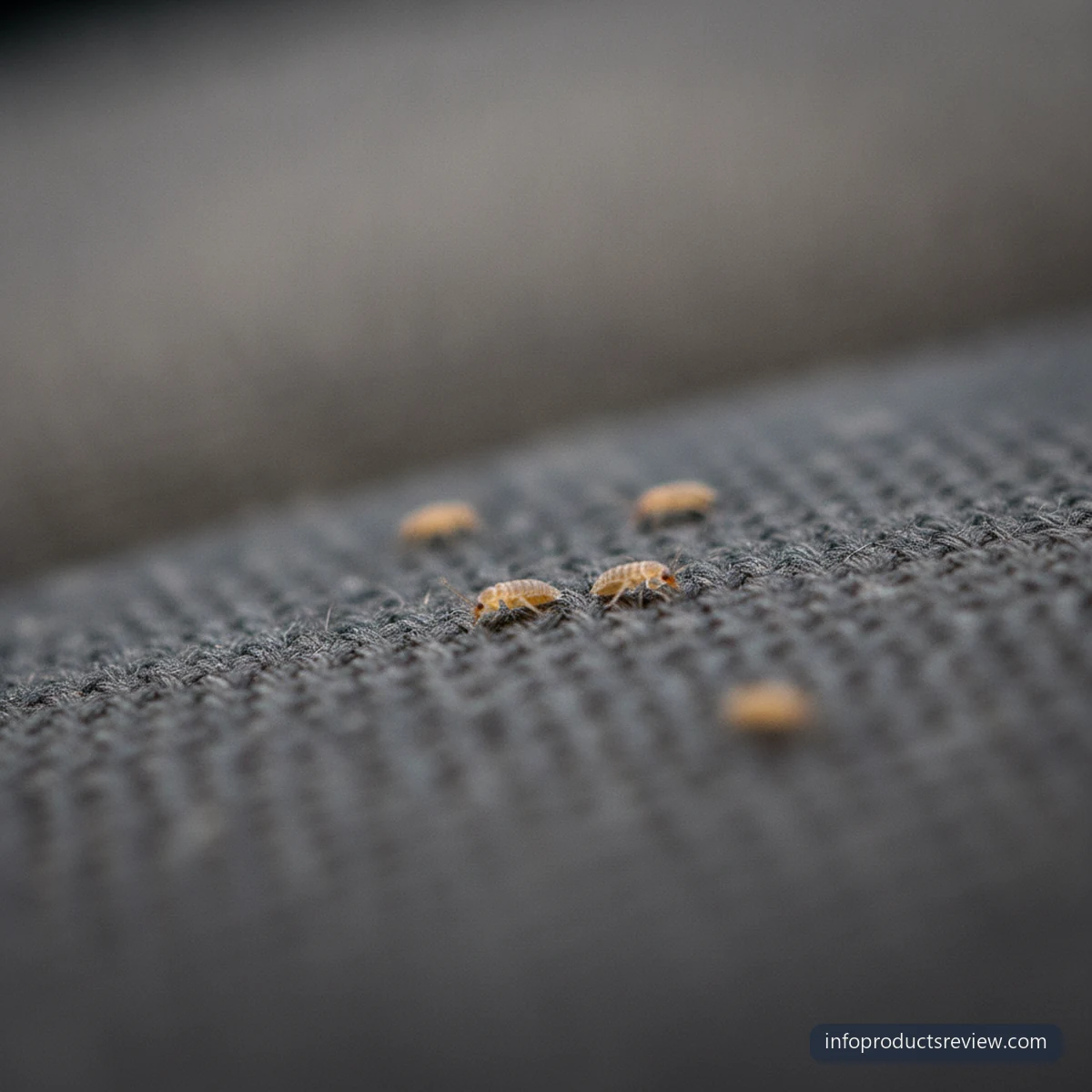
Number measures quantity, not seriousness. That distinction is worth holding on to.
A few lice lean toward a passing concern or a small obligation you will get past. A great many lean toward lots of small things at once. The scene can feel overwhelming, but it still describes many minor demands, not one major crisis.
If the lice multiplied while you tried and failed to get rid of them, the dream is most likely reflecting the sense that obligations are piling up faster than you can clear them. That is a very common feeling in a season of financial or work pressure, and it says nothing about what happens next.
The difference between “many worries” and “many enemies” matters enormously. The first describes a state you can recognise in yourself. The second is a claim about people, and a dream offers no evidence for it.
Do colour and size mean anything?

Far less than the circulating pages suggest. The classical material says very little about the colour of lice, and the detailed colour charts online are later additions with no source.
Unusually large lice may mean the dream is magnifying a small worry until it seems bigger than it is, which is exactly what a tired mind does at night. Barely visible lice suggest a concern that is minor or still at an early stage.
Dark or light colouring shifts the tone slightly, but it doesn’t change the kind of meaning. A black louse isn’t a different symbol from a pale one, and anyone who assigns a separate fate to each shade is inventing rather than reporting.
What if the lice were moving, or bit you?

Still lice that did nothing lean toward something present in your mind but not pressing hard right now.
Moving or spreading lice reflect something you feel is growing or getting harder to contain. Note the word: continuing, not dangerous.
Lice that drop away or leave on their own lean toward relief: pressure that is easing without effort on your part.
Being bitten is the detail that frightens people most. In dream reading it points to something draining your energy or patience: repeated demands, or someone who takes more of your time than they give back. It has nothing to do with your body and is not a sign of illness.
What does removing or killing lice mean?

This is one of the most reassuring scenes in the whole range of lice dreams.
Removing lice, combing them out, washing them away or killing them leans toward getting rid of a burden or bringing something irritating to an end. It can reflect a problem you have already started solving, a small debt you have cleared, or an obligation you finally dealt with after putting it off.
If you removed them one by one until they were gone, the picture leans toward working through things step by step. If someone helped you, the dream may be pointing to support around you: a brother, a friend, a colleague who lightens the load. That is worth noticing and appreciating.
If you cleared some and some remained, the nearest reading is that part of something has finished and part of it hasn’t. That is an honest picture of most problems in life.
If you tried and couldn’t get rid of them, the reading leans toward a sense that something is out of your control for now. That feeling passes and changes; it is not a permanent verdict, and nothing in the classical material turns this scene into a bad omen.
Lice on work clothes or where you earn your living

This scene is especially common for men, because for many of them work is where everyday pressure collects.
If you saw lice on your work clothes, your desk or among your tools, the dream is most likely talking about the wearing details of the job: an inbox that never empties, one small task after another, responsibilities added without anything taken away.
If the lice were specifically on the tools of your trade, the dream may reflect concern about the quality of your work or a fear of falling short. That is really a sign of how much you care, not of failure.
Notice what the dream does not say. It doesn’t say you will be dismissed, that a colleague is plotting against you, or that your income will stop. All of those are fear-based readings with no basis in the symbol.
One practical question is worth more here than any table of symbols: which small task have you put off more than once this week? Often the answer explains the scene better than the symbol does.
When lice stand for the responsibility of a family
This is where Ibn Qutayba’s line comes very close to a man’s life.
If lice mean dependants, the more natural question isn’t “who hates me?” but “who relies on me?” Many men carry more than they say out loud: household costs, children’s schooling, supporting parents, sometimes helping brothers or other relatives.
That meaning isn’t bad in itself. People who rely on you describe a circle of responsibility. It can be tiring, but it is tiredness with a purpose. The dream leans toward this reading when the scene is calm: lice that do no harm, no fear, no strong disgust.
When the scene is tense and upsetting, the reading leans toward that responsibility feeling heavier than your capacity right now. That’s worth paying attention to in waking life. Are you carrying alone something that could be shared? Do you need to ask for help?
Again: this is a possible reading, not a confirmed fact. It promises nothing, it doesn’t make you guilty of anything toward anyone, and it doesn’t mean something is wrong inside your home.
Lice on clothes and personal belongings
Some men don’t see lice on their heads at all, but on things they use every day: a shirt, a jacket, a wallet, a phone, the driver’s seat.
Personal belongings in dream reading sit closer to the details of daily life than to relationships. So lice on them lean toward small practical preoccupations: paperwork waiting to be done, appointments piling up, commitments that slip into your day without you quite noticing.
If the lice were on clothes you wear in front of other people, such as a suit for an occasion or a work uniform, the reading can move toward concern about your public image and what is expected of you. If they were on things nobody else sees, the preoccupation is more likely private, something you haven’t talked about yet.
If they were on clothes you had just washed, the picture has a particular flavour: something you thought was finished has come back, a matter closed on the surface but not in fact.
Washing clothes or cleaning belongings of lice in the dream leans toward putting things in order and regaining control over the details. Overall it is a reassuring picture.
What if the lice were on someone else?
Men often see lice on another person rather than on themselves: a colleague, a friend, one of their children, a stranger in a public place. It is worth resisting a quick reading that turns the dream into a verdict about that person.
On one of your children or someone at home. The dream most likely reflects your care for them and your sense of responsibility, not a flaw in them or something bad about to happen to them.
On a colleague. It may reflect concern about a problem affecting your team, or a feeling that you are carrying part of someone else’s load. It says nothing about that colleague’s intentions or situation.
On a friend. It may echo pressures you know they are facing, or your worry for them. Either way, it isn’t evidence of anything in their life.
On a stranger. Usually the lightest scene of all, closer to a passing image than something worth dwelling on.
The rule is the same in every case: a dream doesn’t reveal another person’s situation or intentions, and it should never be the basis for thinking badly of anyone. Familiar faces turn up in dreams constantly, because a sleeping mind reaches for the faces it knows, not because those people are the subject.
Lice or nits: does the difference matter?
Some men dream of nits, the tiny eggs stuck to hair, rather than lice. The difference lies in the shape of the scene, not in the root of the meaning.
Lice are active and present, so they lean toward something already happening that needs dealing with. Nits are still and unhatched, so they lean toward something that hasn’t started to have an effect yet: a matter at its beginning, an obligation still ahead, a worry put off for later.
Seeing both together suggests one thing under way and another on its way, a fair description of many people’s lives in a busy season, not a warning.
This distinction is drawn from the picture itself; the classical books give nits no separate section. And it describes an image in sleep, not your household: nits in a dream don’t mean there are lice in your home, just as lice in a dream don’t mean a real infestation.
Does it change when you’re job-hunting or retired?
The stage of life a man is in changes how the dream feels, even though it doesn’t change the symbol.
While looking for work, worry and waiting increase, and small details pile up: applications, calls, bills that won’t wait. A lice dream then is closer to a picture of that scattered strain than to a message that income will be delayed.
At the start of a new job, unfamiliar responsibilities multiply and everything seems to need attention. The dream may reflect that temporary pressure, which usually eases as things become familiar.
After retirement, the sense of responsibility itself can shift: less pressure from work, sometimes more concern with the household, children and health. The dream may simply reflect those new preoccupations.
This is not a passing observation of ours. Al-Sadhan holds that the dreamer’s own situation and standing belong inside the interpretation:
Interpretation differs with people's circumstances and standing: one must look at the dreamer's situation and position, and build the fitting interpretation on that.
So the same scene can be read two different ways for two men in different circumstances, without the symbol changing at all. It is a contemporary author’s principle, useful as reassurance and never as certainty.
At every stage, the details inside the dream still matter more than the stage. The stage is context that helps you understand, not a rule that settles the meaning.
How did you feel inside the dream?

Of all the details, this is the most honest, because it’s the part that stays with you unchanged after waking.
If you felt strong irritation or disgust, the reading leans toward exhaustion and pressure. If you felt calm, or simply got on with removing the lice, it softens considerably toward ordinary burdens you are handling.
If you felt embarrassed, as though afraid someone would see the lice on you, the dream may reflect concern about how others see you, or a fear of being thought to fall short. That feeling is common among men under pressure at work and at home.
If you felt very little, and could barely recall the dream, it is most likely passing mental noise rather than something worth dwelling on.
Two men can see an identical scene and end up with different readings, because one woke up alarmed and the other didn’t care. So make the feeling one of the first three things you write down, not the last.
What do the classical dream-interpretation books actually say?

The clearest thing said about this symbol by a well-known early interpreter is a single line, in Ibn Qutayba al-Dinawari’s Ta’bir al-Ru’ya, a ninth-century work that survives in a critical edition. The line is short, and it changes the whole angle:
Worms and lice mean dependants.
“Dependants” means the people a person provides for and is responsible for. So for Ibn Qutayba, lice are not an enemy and not envy. They stand for people who live under your care and rely on you. He supports the reading with a line of old Arabic verse that uses the same root to describe a household grown large.
That is an interpreter’s judgement, not a religious text. What makes it useful is the method it shows. The early interpreters started from what a thing is actually like in waking life. Lice are small, numerous, close and dependent. Then they asked what in the dreamer’s life shares those qualities.
Later popular compilations, including a widely sold book attributed to Ibn Sirin, give lice other meanings, such as small worries that keep coming back. That attribution is itself unproven, and those readings cannot be traced to a critical edition that could be quoted. So we mention them as circulating and unconfirmed, build nothing on them, and never call them Ibn Sirin’s own words.
The same applies to readings of lice passed around in the name of Abd al-Ghani al-Nabulsi: there is no text in hand to quote, so we transmit nothing from him on this symbol and put no meaning in his mouth.
What is missing from these sources matters just as much. There is no chapter singling out men for this symbol, no link between lice and a wife’s infidelity, none with witchcraft or the evil eye, and no mention of a specific financial loss. Anyone offering those is adding, not transmitting.
What is actually established about disturbing dreams?
Two things often get blurred together. One is interpreting the lice symbol, which is human judgement. The other is the guidance of the Prophet ﷺ on what to do after a dream you dislike, recorded in Sahih al-Bukhari (hadith 7044) and Sahih Muslim (hadith 2262).
The guidance doesn’t ask you to hunt for an interpretation. It asks you to seek refuge in God and leave the dream alone. In Sahih al-Bukhari:
A good dream is from God. If one of you sees something he likes, let him tell it only to someone he loves. And if he sees something he dislikes, let him seek refuge in God from its harm and from the harm of Satan, spit lightly three times, and not tell anyone about it, for it will not harm him
Sahih Muslim records the same guidance with one practical addition, turning away from the side you were sleeping on:
If one of you sees a dream he dislikes, let him spit to his left three times, seek refuge in God from Satan three times, and turn over from the side he was lying on
For you, the next step is simple. If the dream left you uneasy, seek refuge in God, spit lightly to your left three times, turn over, and don’t retell it to everyone. The wording in Sahih al-Bukhari 7044 is explicit that it will not harm you.
Much more is not established. No text makes a particular dream evidence of witchcraft or the evil eye. No text makes a dream binding on a decision about money, work, marriage or a relationship. And no religious text gives lice a fixed meaning. Every meaning on this page is an interpreter’s opinion, which can be right or wrong.
Al-Sadhan adds a limit that fits a frightening dream in particular: the default is to read it on its lighter, more reassuring side, and interpretation as a whole stays analogy and conjecture rather than certainty:
When a dream comes with fear and dread, the default in interpreting it is ease and good tidings … Interpretation is analogy, likeness and conjecture, never certainty, though it may be taken as reassurance.
That carries two consequences. A dream that unsettled you is read first on its lighter side, not its heaviest. And what you read here, or anywhere else, stays a conjecture you may find useful, never a ruling to build a decision on.
What does sleep research say about unsettling dreams?
We keep this separate from the classical material on purpose. The two answer different questions, and merging them distorts both.
Sleep research is clear on a few points. Distressing dreams become more frequent with stress, anxiety and short or broken sleep. Vivid dreams concentrate in the later part of the night, when REM sleep runs longest, which is why dreams near dawn are the ones we remember best. The Sleep Foundation’s overview of nightmares sets out that pattern in plain terms.
Many men don’t talk about pressure, so it surfaces in sleep instead of conversation. Long working hours, going to bed late, and thinking about bills right before sleep all make unsettling dreams more likely.
The image of lice happens to match a familiar sensation: something small that won’t let go. A thought that returns, a commitment that never finishes. That overlap is an observation about a feeling, not a reason to say psychology confirms an old interpretation.
And we never suggest a dream diagnoses anxiety or anything else. If stress is affecting your sleep or your days on a regular basis, talking to a doctor or a qualified professional is a practical, sensible step.
When is a dream just your mind processing the day?
This question comes before any interpretation, and it rarely gets asked. It isn’t an evasion either: Sahih Muslim (hadith 2263) records a threefold division of what a sleeper sees.
Dreams are of three kinds: a good dream, which is glad tidings from God; a distressing dream, from Satan; and a dream from what a person tells himself
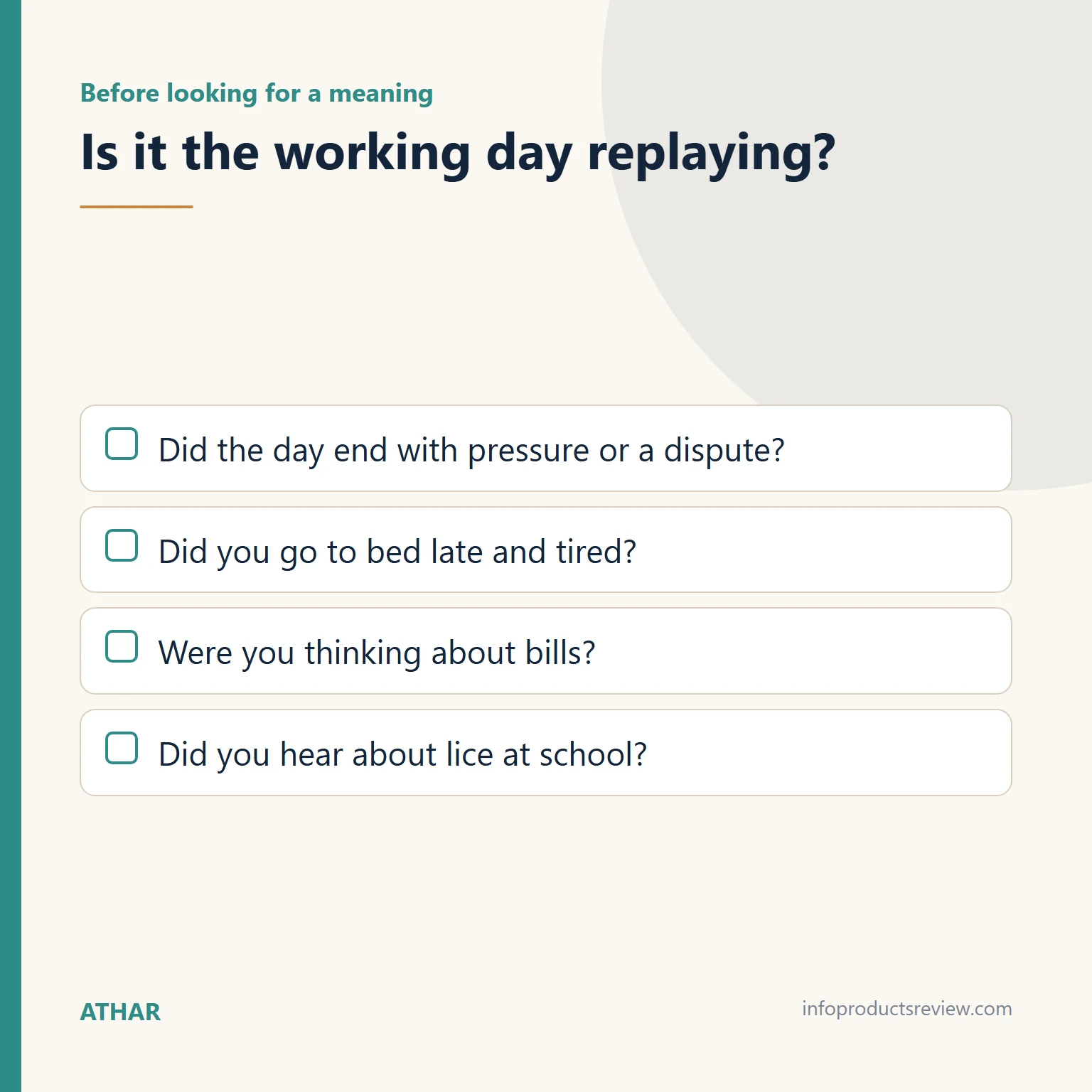
So some of it is good news, some of it is distress, and some of it is the mind talking to itself with no meaning underneath the picture. No single sign settles which you had, but several together say a lot:
- The dream echoes something that occupied you that day.
- You read, watched or heard something related before sleeping.
- You went to bed late, exhausted, or slept badly.
- The scene kept shifting rather than following a clear sequence.
- You have children at school and recently heard about lice going around.
That last one happens more often than people expect. If the dream followed a letter from school or a conversation about lice at home, it is most likely your mind replaying what you heard, not a message about your future.
Interpretive writing treats mind-talk as its own category, one for which no meaning is sought:
Mind-talk belongs to the body: it is the wishes and feelings held back below awareness, which wake up in a dream, and it has no interpretation.
If your dream belongs to that category, looking for its symbol is looking for something that isn’t there. That is reassurance in itself, not a loss.
A clear line: dreams are not medicine
Because the confusion is common, it is worth stating plainly.
A dream about lice tells you nothing about your health. It doesn’t mean something is wrong with your body or your scalp. It is an image in sleep, not a symptom, and nothing here is a diagnosis or a treatment.
Waking up itching is common after a dream about insects, and it has nothing to do with interpretation: attention to the body simply increases. If the itching continues while you are awake, that is a question for a professional.
If you are dealing with real head lice at home, which is common when children are at school, treating them is a practical matter your pharmacist or a public health source such as the NHS page on head lice and nits can guide you through. That has nothing to do with dream interpretation.
When the dream comes during a season of money pressure
Many men have this dream during periods of debt, just before a repayment is due, or when expenses arrive all at once.
It helps to separate two things. The dream may reflect the financial pressure you are living with, because the sleeping mind replays what the waking mind is carrying. But it doesn’t tell you that things will get worse, that you will lose money, or that anyone is taking what is yours.
What actually helps in that situation isn’t an interpretation. It’s putting some order into what can be ordered: a list of expenses, an honest conversation with whoever shares the responsibility, postponing what can be postponed. A dream that reflects pressure usually eases once the pressure has somewhere clear to go in real life.
And it is no basis for a money decision: not for selling, buying, borrowing or delaying a payment. Those follow from your numbers, not from an image you saw in your sleep.
Common claims that need correcting
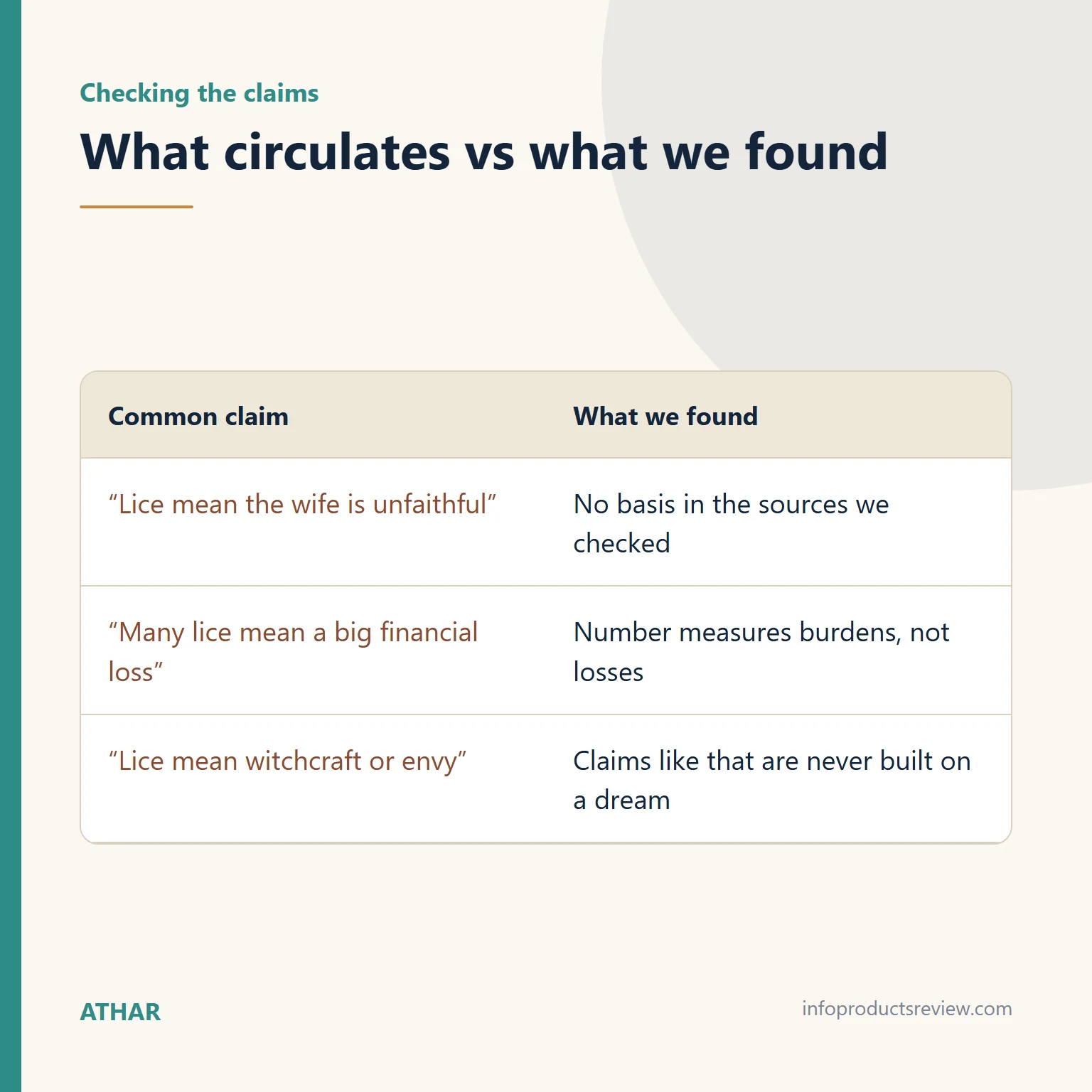
- “Lice in a man’s dream mean his wife is unfaithful.” No classical source says anything of the kind, and it is one of the most harmful additions, because it can damage a marriage without any evidence.
- “Lice mean envy or the evil eye.” Nothing in the classical material connects the symbol to either. The link was added later and repeated until it sounded traditional.
- “Lice mean witchcraft.” The same. And a claim of that weight is never built on a dream.
- “A lot of lice means a big financial loss.” Number measures how many small burdens the dream reflects, not the size of a loss.
- “The colour decides the meaning.” The classical material says very little about colour, and the charts online are a late addition.
- Quoting a fixed meaning for lice as Ibn Sirin’s own words. The popular book is only attributed to him, and that attribution is unproven. Anyone quoting him with certainty is claiming more than is known.
- “A recurring dream is a confirmed message.” Recurrence tracks stress and poor sleep far more closely than it tracks any hidden meaning.
What this dream cannot establish

Stated plainly, because this is where real harm happens:
- It cannot name anyone as working against you.
- It cannot accuse your wife or anyone in your household of anything.
- It cannot establish witchcraft, envy or the evil eye.
- It cannot set a date for a loss, a gain or any event.
- It cannot diagnose a physical or psychological condition.
- It is not grounds for a decision: not for leaving a job, ending a relationship, or buying and selling.
What to do after an unsettling dream
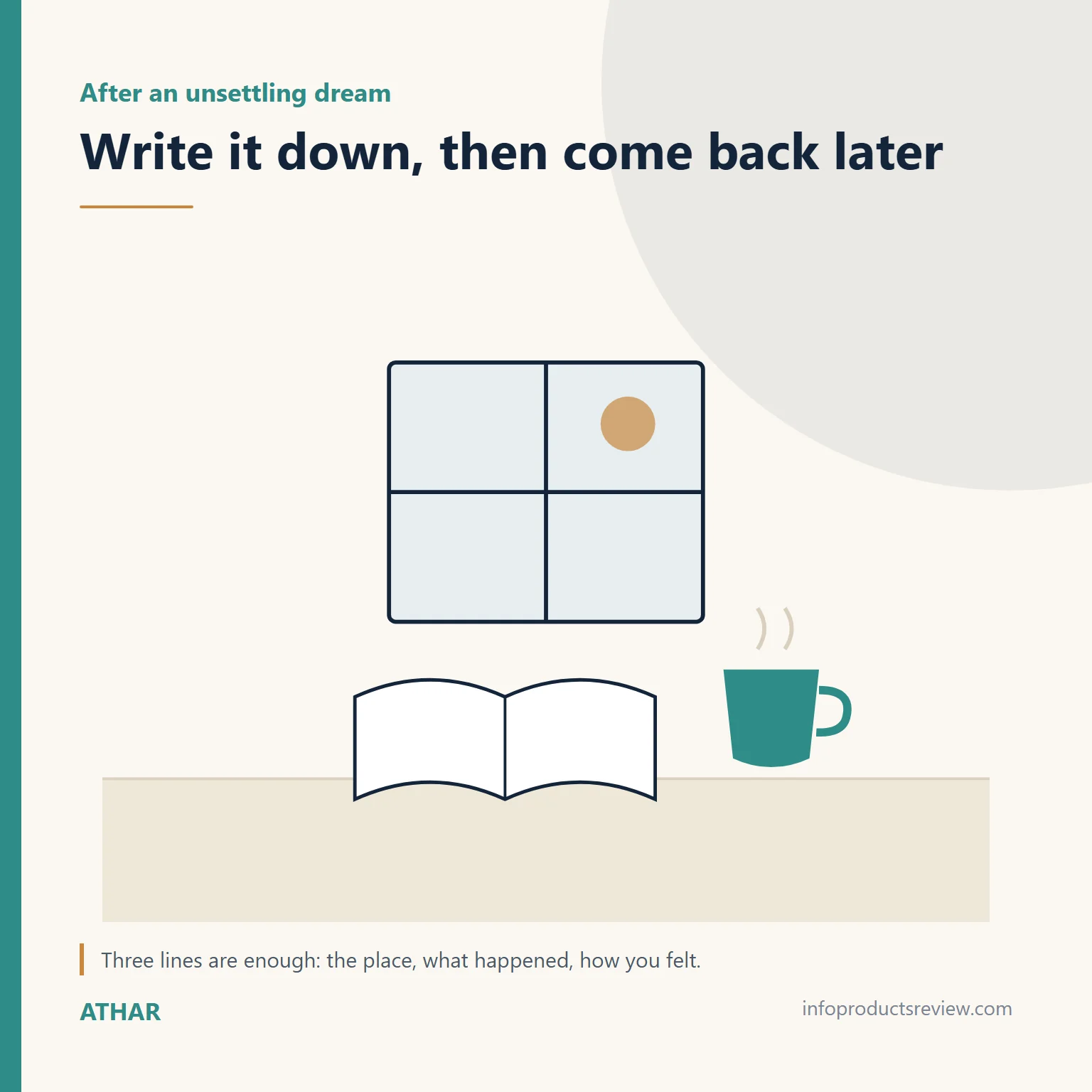
Something workable, rather than being told not to worry:
- Settle first. Seek refuge in God, turn onto your other side, and don’t try to analyse anything in the middle of the night.
- Write it down once in the morning: the place, what happened, how you felt. Three lines are enough.
- Check the day before. A tense meeting, a difficult message, a conversation about money. That may be the whole explanation.
- Don’t build a decision on it, and don’t accuse anyone because of it.
- Look after your sleep. If unsettling dreams keep returning, start with your hours of sleep and your stress before you start with a symbol.
And if you find yourself moving from one interpretation page to the next looking for reassurance, stop. At that point the searching has become the problem, not the dream. Write it down once and leave it for a few days: what had meaning will still be there, and what didn’t will fade on its own.
There is also a middle path between ignoring the dream and obeying it. Ask yourself one question: what small, repeating thing is eating my time and energy this week? If an answer comes, deal with the smallest part of it today, share it with someone who can help, or set a clear limit around it. Many men notice that unsettling dreams ease once the thing weighing on them finally moves, even by one step.
How to describe your dream so it can actually be read
If you want to think a dream through, or talk it over with someone you trust, the order you describe it in makes a real difference. Try this:
- The setting: home, work, somewhere unfamiliar?
- What happened: did the lice appear, spread, bite, or get removed?
- Who was there: were you alone, or with someone?
- How it ended: did the scene resolve, or did you just wake up?
- How you felt, both during the dream and when you woke.
A description like that turns an unpleasant image into something you can think about calmly. Any reading offered without those five is a reading of the word “lice”, not of your dream.
Interpreters themselves complain about being asked for a bare symbol. One says so bluntly in a recorded interview:
The dreamer has to relate the dream with all its details … I am not a dream dictionary to be used that way.
So if you want a reading of your own dream, give the whole scene, however short it is. That is one speaker’s view, not a rule.
What have interpreters said in recorded interviews?
Two short pointers to published interviews, because hearing how someone reasons can be clearer than reading about it. Take them for what they are: personal views and experiences, not religious rulings and not a reading of your dream.
In the first, an interpreter describes a man who dreamt of three lice in his head and how he connected them with three people pressing him for money. The interesting part is the method rather than the result: a real quality of lice, that they take and give nothing back, became the key to the reading. It doesn’t mean every lice dream is about disputes or money.
An example of reading a dream from a real quality of lice. Summarised from the Arabic interview; a personal experience, not a rule.
In the second, a different interpreter draws a line that matters for any man facing a financial or career decision: don’t let dreams run your life or your choices.
A practising interpreter's own limit on what dreams are for. Quoted from the English subtitles published with the interview.
Don't determine your life, or make decisions, or serious matter concerns based on dreams.
That fits the guidance quoted above from Sahih al-Bukhari (7044): a dream may lift your spirits, but it never replaces thinking, asking advice and deciding in the real world.
A few typical scenes
A man sees lice on his work clothes during a week packed with deadlines. Most likely an echo of work pressure and its accumulating details, not a warning about his job.
A man calmly removes lice from his son’s hair. One of the calmest scenes: care for those he provides for, and a responsibility he is handling. It sits very close to the “dependants” reading, and says nothing about the boy himself.
A man watches lice spread through his home, can’t stop them, and wakes up upset. Most likely exhaustion from household responsibilities falling on him alone. The useful response is to look at what could be shared, not to hunt for a hidden cause.
A man dreams of lice after a school letter about an outbreak. Almost certainly the mind replaying the day.
A man sees one large louse bite him just before a debt repayment. Most likely the dream magnifying financial pressure he is already living with, not a prediction of loss.
A man sees a single louse that then disappears. One of the lightest scenes: a passing concern that came and went.
A man sees lice on a colleague after a tense argument with him. Most likely the dream reflecting the effect of the argument on the dreamer, and not evidence of anything about the colleague or his intentions.
Quick reference: detail and nearest reading
| Detail in the dream | Nearest possible reading |
|---|---|
| Lice at home | Responsibilities within the family circle |
| Lice at work or on work clothes | Pressure of earning a living |
| A few lice | A passing concern or small obligation |
| Many lice, multiplying | Many small burdens at once |
| Being bitten | Something draining energy or patience |
| Removing or killing them | Getting rid of a burden |
| Someone helping you | Support around you |
| A calm scene, no fear | A lighter reading, close to “dependants” |
| Strong embarrassment | Concern about how others see you |
Every line assumes the rest of the scene is neutral, and none of them replaces the sections above.
Related dreams
These guides read nearby symbols the same careful way:
- Dreaming about lice as a married woman — the same symbol from the angle of running a household, a useful comparison for the same circle.
- Dreaming about lice as a single woman — the symbol at a different stage of life, where the circle the dream describes changes.
- Lice in your hair as a married woman — if your wife saw lice in your hair, that page reads the scene from her side.
- Dreaming about lice during pregnancy — useful if the dream came while your family was expecting a child.
- All English dream guides by topic — every guide reads a symbol by its details first.
Frequently asked questions
What does dreaming about lice most often mean for a man?
Most often it reflects small, recurring demands on your time and energy: work obligations, expenses and family responsibilities. Ibn Qutayba read lice as dependants, the people who rely on you. The exact reading depends on where the lice were, what happened and how you felt.
Does it mean my wife is unfaithful?
No. No classical source links this symbol with infidelity, and a dream is never evidence against anyone. It is never a reason to think badly of a wife or a relative.
Does it mean my income will shrink?
No. The dream may reflect financial pressure you are already feeling, but it doesn’t tell you what will happen to your income and isn’t a basis for a money decision.
I killed the lice in my dream. Is that a good sign?
It is one of the most reassuring scenes, leaning toward getting rid of a burden or ending something irritating. It remains a possible meaning, not a promise.
I saw lice on my work clothes. What does that mean?
Most likely it reflects the accumulated details and daily pressure of your job. It doesn’t mean you will lose your job or that anyone is plotting against you.
I saw lice in my son’s hair. Does that mean something about him?
No conclusion about your son can be drawn from it. The dream most likely reflects your care for those you provide for and your sense of responsibility toward them.
Is it a sign of envy or witchcraft?
No. Nothing in the classical material connects lice to either, and claims like that are never built on a dream.
What should I do after an unsettling lice dream?
You don’t need to interpret it. The established guidance is to seek refuge in God, spit lightly three times and not retell it, as recorded in Sahih al-Bukhari (7044). Sahih Muslim (2262) has spitting three times to the left and turning away from the side you were lying on.
Is the meaning different for men and women?
The symbol itself doesn’t change, and the sources don’t give men a separate chapter on it. What changes is the circle the dream talks about: work, earning, and family responsibility.
The dream keeps coming back. Is it a message?
Recurring dreams usually follow stress and poor sleep. If they are affecting your rest or your days, start with your stress and your hours of sleep before looking for a symbol.
Does a lice dream mean something is wrong with my body?
No. A dream isn’t a medical symptom. If there are real lice at home, treating them is a practical matter your pharmacist can help with.
Is any of this certain?
No, and that is deliberate. What we offer are possible meanings drawn from named sources, which shift with the details of the dream. None of it predicts the future.
In summary

- Start with place, then what happened, then how you felt. Number and colour come last.
- The most common meaning is small, recurring demands on your time and energy, not disaster or enemies.
- Ibn Qutayba read lice as dependants: the people who rely on you.
- Removing lice is one of the most reassuring images.
- Readings about small sums of money, a crowd of people or a recurring worry circulate without a confirmed source.
- The dream accuses no one, establishes no witchcraft or envy, and predicts no loss.
- After a bad dream: seek refuge in God, turn over, and let it rest.
- Don’t base a decision about money, work or a relationship on it.
If you take one thing from this page, let it be this: a possible meaning stays possible, and the responsibilities you carry in real life deserve more of your attention than an image you saw in sleep.
Written and reviewed by: the ATHAR editorial team. Classical and hadith quotations are taken from the named editions and checked against the page image; English renderings of Arabic texts are our own translation.
Last reviewed: 14 September 2026.
Note: what appears here is a possible meaning, not a confirmed fact, and it changes with the details of the dream and the dreamer’s circumstances. Nothing here predicts the future, diagnoses a medical or psychological condition, or establishes witchcraft, envy, infidelity or hostility from any person.