


You wake up with a picture that won’t quite leave: lice in your hair. Between the strands, maybe, or on the comb you use for your own hair and your children’s, or under your headscarf. Before you’re properly up you touch your head, then remember the day ahead is full and there’s no time to dwell on it.
But the image stays. And when you look it up, the explanations pile in. One page links lice in a married woman’s hair to a husband’s betrayal. Another talks about the evil eye. A third promises a pregnancy. They all sound certain, and none of them names a source.
This page looks at one specific version of the dream: dreaming about lice in your hair as a married woman. That means scenes where hair is the setting: your own hair, combing it, your headscarf, or one of your children’s hair. For lice dreams more broadly, around the house, in bed or on belongings, we have a separate guide and point to it where it helps.
Three things get blurred together in almost everything written about this symbol, and we keep them apart: what one well-known early interpreter actually recorded in his book, what is established in Sahih al-Bukhari and Sahih Muslim about a dream you dislike, and what simply circulates without a traceable origin. And we say plainly what this dream cannot mean, so you don’t carry a worry that was never yours.
The bottom line
Lice in a married woman’s hair most naturally reflect small thoughts and responsibilities that keep returning: the endless list of household and family tasks, a mind that won’t switch off when you try to rest, and care for yourself that keeps getting postponed because someone else always comes first. Hair here stands close to the self and to thinking, not to the body or illness.
- The nearest meaning: Ibn Qutayba al-Dinawari, in his book Ta’bir al-Ru’ya, records that lice mean dependants, the people who rely on you and whose affairs you look after. That is the clearest reading transmitted from a well-known early interpreter, and it sits very close to the life of a mother running a home.
- The detail that changes the reading: what you did with the lice. Combing them out is one of the clearest reassuring images, leaning toward sorting your thoughts and putting down a burden. Being unable to get them out leans toward exhaustion.
- The two most common cases: lice in one of your children’s hair, which is closer to worry for them and care for them than to anything wrong with them; and a head full of lice, which is closer to many small things piling up at once.
- A limit worth keeping: all of this is a possible meaning, not a confirmed fact. Interpretation is conjecture you may take as reassurance, never grounds for a decision or a judgement about anyone.
- Where the books say nothing: the early source records no separate entry for lice in the hair specifically, none for married women in particular, and nothing about the colour or size of lice. Anyone handing you a detailed meaning for this exact case is adding it themselves.
Some things this dream cannot establish. It cannot prove betrayal or another woman, the evil eye, envy or witchcraft. It says nothing about pregnancy or divorce. And it doesn’t mean anything is wrong with your hair. Those are claims about waking life, and they need waking-life evidence, not a dream.
What this page covers
- The bottom line
- Why are lice different in a married woman’s hair?
- Which details change the meaning of lice in the hair?
- Where in your hair were the lice?
- A few lice in your hair, or a great many?
- Does the colour or size of the lice matter?
- Lice moving in your hair, or making you itch
- Combing your hair and getting the lice out
- Lice in one of your children’s hair
- Lice in your husband’s hair, or moving from him to you
- Lice in the hair and the responsibility of a household
- Lice or nits in the hair: does the difference matter?
- How did you feel inside the dream?
- What do the classical dream-interpretation books actually say?
- What is actually established about disturbing dreams?
- What does sleep research say about unsettling dreams?
- When is a dream just your mind processing the day?
- A clear line: dreams are not medicine
- Should you tell your husband or family about the dream?
- Common claims that need correcting
- What this dream cannot establish
- What to do after an unsettling dream
- How to describe your dream so it can actually be read
- What have interpreters said in recorded interviews?
- A few typical scenes
- Quick reference: detail and nearest reading
- Related dreams
- Frequently asked questions
- What does dreaming about lice in your hair most often mean for a married woman?
- Does it mean my husband is unfaithful?
- I saw lice in my daughter’s hair. Is something wrong with her?
- I combed the lice out of my hair. Is that a good sign?
- Do nits in the hair mean a pregnancy is coming?
- Does it mean the evil eye or envy from my in-laws?
- I saw lice moving from my husband’s hair to mine. What does that mean?
- What should I do after an unsettling lice dream?
- Is lice in the hair different from lice around the house?
- The dream keeps coming back at the start of term. Is it a message?
- Does the dream mean I actually have lice?
- Is any of this certain?
- In summary
- Sources and references
Why are lice different in a married woman’s hair?
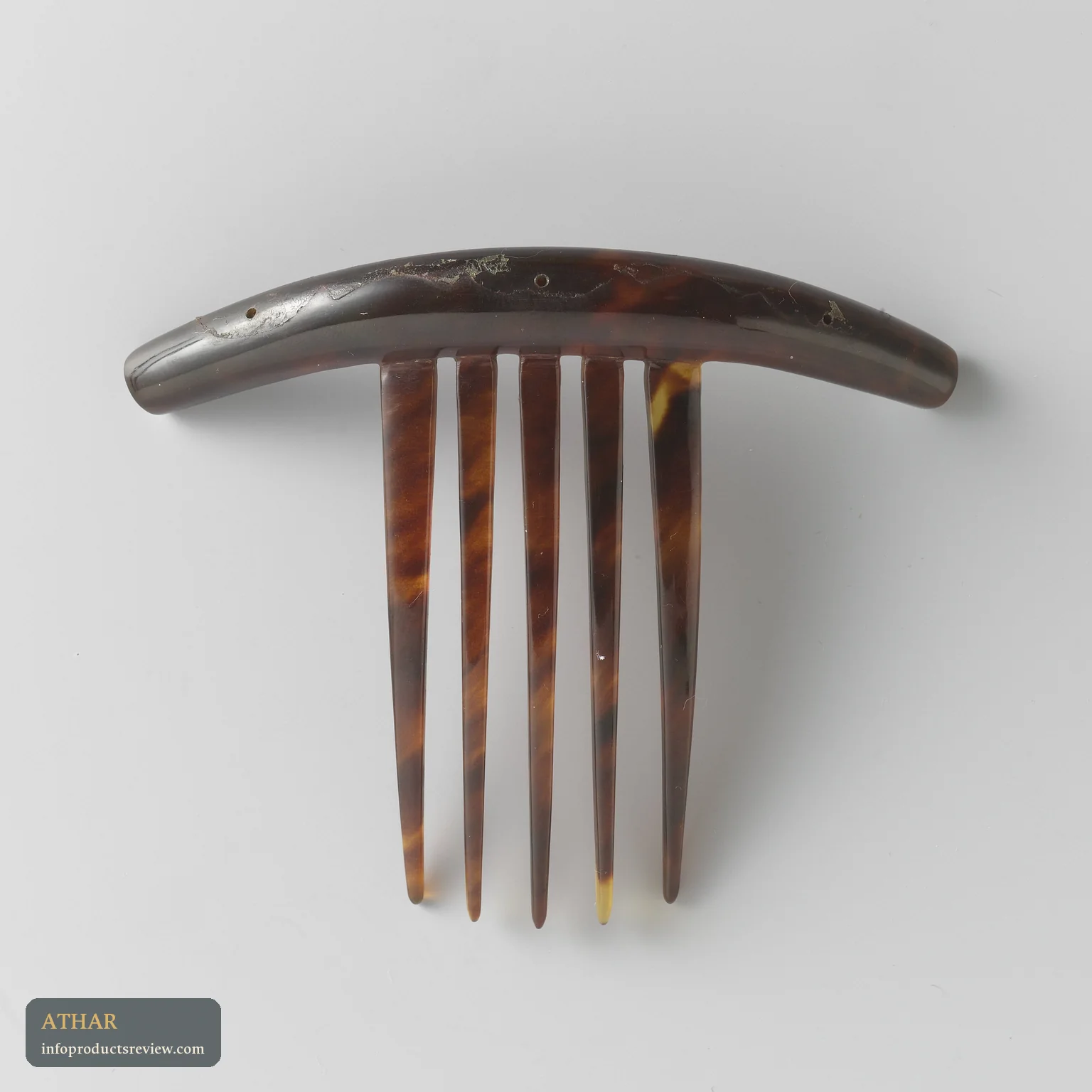
Lice anywhere in a dream lean toward something small, recurring and draining. Hair adds something particular to the picture, and married life adds something more.
Hair sits against the head, and in dream reading the head is close to thinking and inner preoccupation. So when the lice are in your hair, the reading leans toward what is going on in your own mind: tomorrow’s arrangements, the children’s appointments, household costs, small thoughts that don’t stop even as you try to fall asleep.
Many married women notice that caring for their own hair has itself become something postponed: a quick brush, hair tied back in a hurry, very little time for themselves. So the dream can sometimes reflect a sense that you have been so absorbed in others that very little of your own time is left.
That difference is not a passing remark of ours. Al-Sadhan, in al-Qawa’id al-Husna, holds that the dreamer’s circumstances and standing are part of the interpretation itself, so one symbol is read according to who saw it:
Interpretation differs with people's circumstances and standing: one must look at the dreamer's situation and position, and build the fitting interpretation on that.
Which means that lice in the hair of a woman running a home and raising children are not read the way they would be for a student, or for a man working far from his family. The circle the dream is talking about is yours: a household, children, a husband, and the wider family obligations around them.
But notice the limit. These are readings of the feeling a scene carries, not judgements about your home, your husband or your looks. Anyone who tells you lice in your hair mean a cooling marriage or another woman is saying something with no basis.
For the general reading of lice dreams for a married woman, around the house, in bed and on belongings, our guide to dreaming about lice as a married woman covers it all.
Which details change the meaning of lice in the hair?
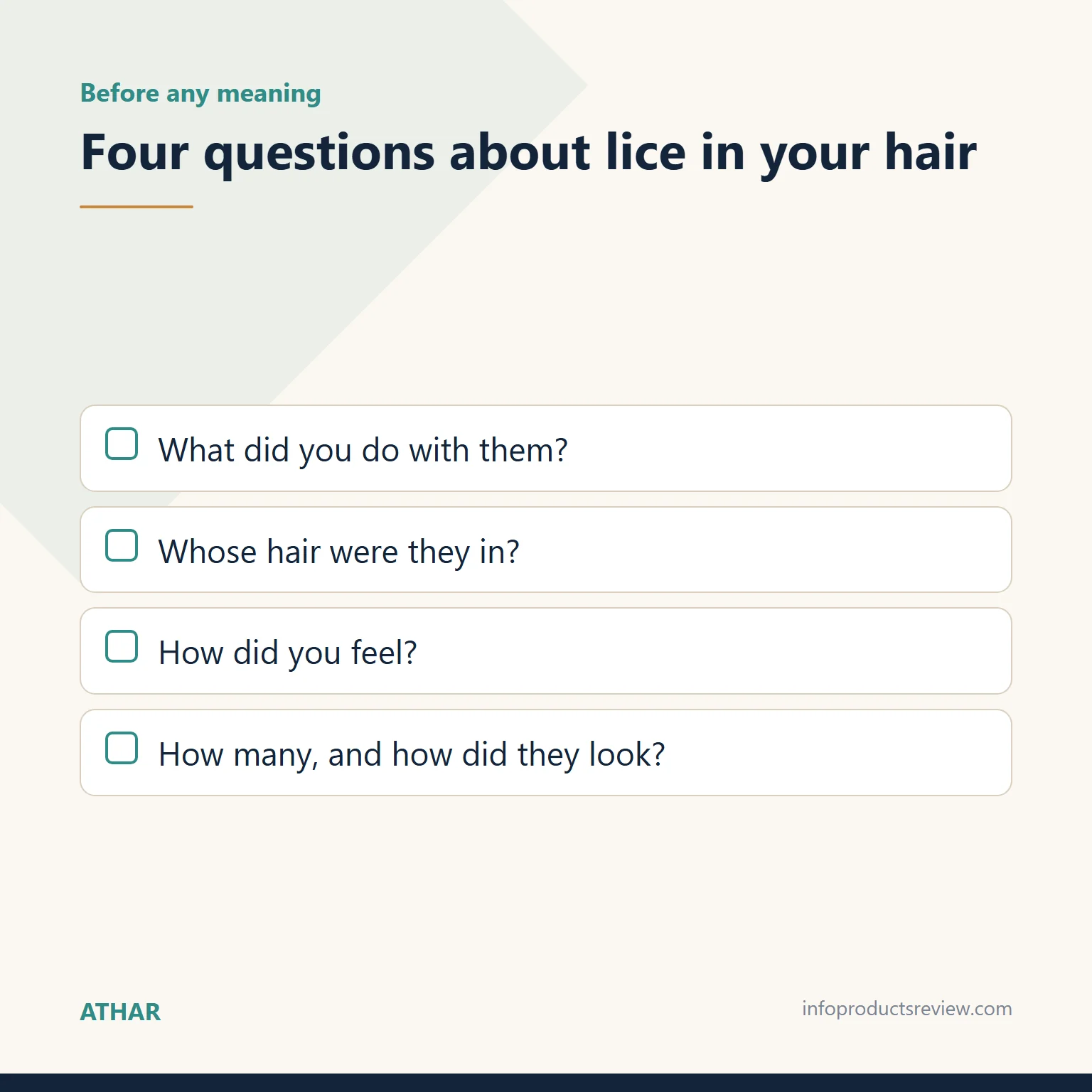
Before going through the scenes, here are the details in order of how much they matter, because many women start from the wrong end:
First: what you did with the lice. Did you comb them out, try and fail, or get pulled away by something else? In a hair dream, the action is the clearest part of the scene.
Second: whose hair they were in. Your own, your daughter’s or son’s, or did they move from someone else to you? This shifts the circle the dream is talking about.
Third: how you felt. Strain, embarrassment, worry for the children, or calm as you dealt with it?
Last: number, colour and size. These adjust the degree of a meaning. They don’t create a new one.
That order isn’t our preference either. Al-Sadhan holds that the accompanying detail in a scene is what an interpretation actually rests on:
The accompanying detail in a dream is what an interpretation rests on, so look for the meaning according to the detail that is present.
The practical consequence is clear. One symbol can be read as thoughts being sorted in one scene and as exhaustion in another. Any page that hands you a single meaning for lice in the hair without asking what you did, whose hair it was and how you felt is guessing.
An interpreter in a recorded interview puts the same point in working terms:
A single symbol may have ten possibilities, so the interpreter puts several symbols of the dream together, asks about the dreamer's situation, and then favours one of the meanings.
And before any symbol, it helps to ask whether the dream is worth dwelling on at all. That question comes before any interpretation, and the section below on a mind processing the day is where we answer it.
Where in your hair were the lice?
On the scalp. The spot closest to thinking itself. It leans toward a deep preoccupation that stays with you: a household worry, concern for one of the children, a family decision on hold, or money on your mind every night.
At the ends of your hair. The ends are further from the head, so the reading leans toward lighter concerns closer to the surface: small daily details, things that could be sorted quickly if you found the time.
On a comb or brush. Here the lice are outside the hair, in the tool you use to care for yourself and your children. The reading leans toward a worry beginning to leave you, or one you are already dealing with.
Under your headscarf. A headscarf is part of how you go out into the world. The dream may reflect concern about how you are seen by your in-laws, neighbours or colleagues, or a sense of appearing composed while feeling worn out inside.
In your hair while looking in a mirror. A mirror adds the idea of seeing yourself. The scene can reflect a rare moment of turning toward yourself in the middle of looking after everyone else, and asking: what is really weighing on me?
On the pillow beside your head. An image close to rest itself. It can simply reflect thoughts following you into bed, which many mothers recognise: the body lies down and the mind starts organising tomorrow.
None of these positions is an entry transmitted from an early interpreter on lice. They are readings of the scene by the same method the interpreters used: look at where a thing sits and what it clings to in waking life, then ask what resembles that in the dreamer’s life. We say so plainly, so none of it is taken for more than it is.
A few lice in your hair, or a great many?
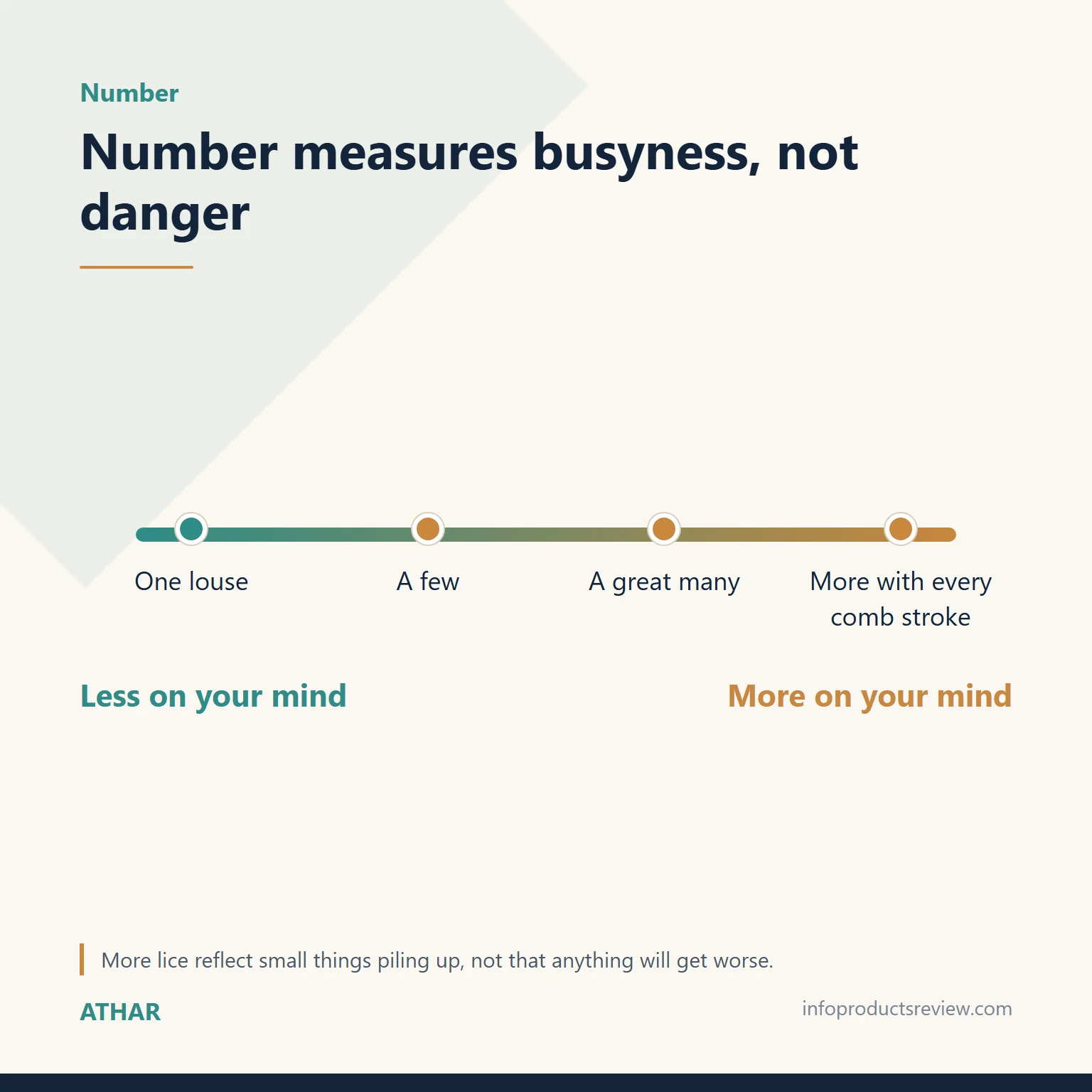
Number measures how much is occupying you, not how dangerous anything is. It’s worth remembering that each time the dream returns.
One louse or a few lean toward a single thought on your mind, or a passing worry you will get past. A head full of lice leans toward lots of small things at once: school runs, children’s requests, household jobs, family visits, and work commitments if you work outside the home.
If the lice seemed to multiply every time you combed, the reading leans toward the feeling that trying to get on top of things only uncovers more of them. Every mother knows that feeling in a busy season, like the start of a school year or a run of family occasions. It doesn’t mean things will get worse.
One question helps here more than any interpretation: did the number you saw resemble the number of unfinished things in your day? Many women find the answer is yes, and that the dream did no more than give that crowding a picture.
Does the colour or size of the lice matter?
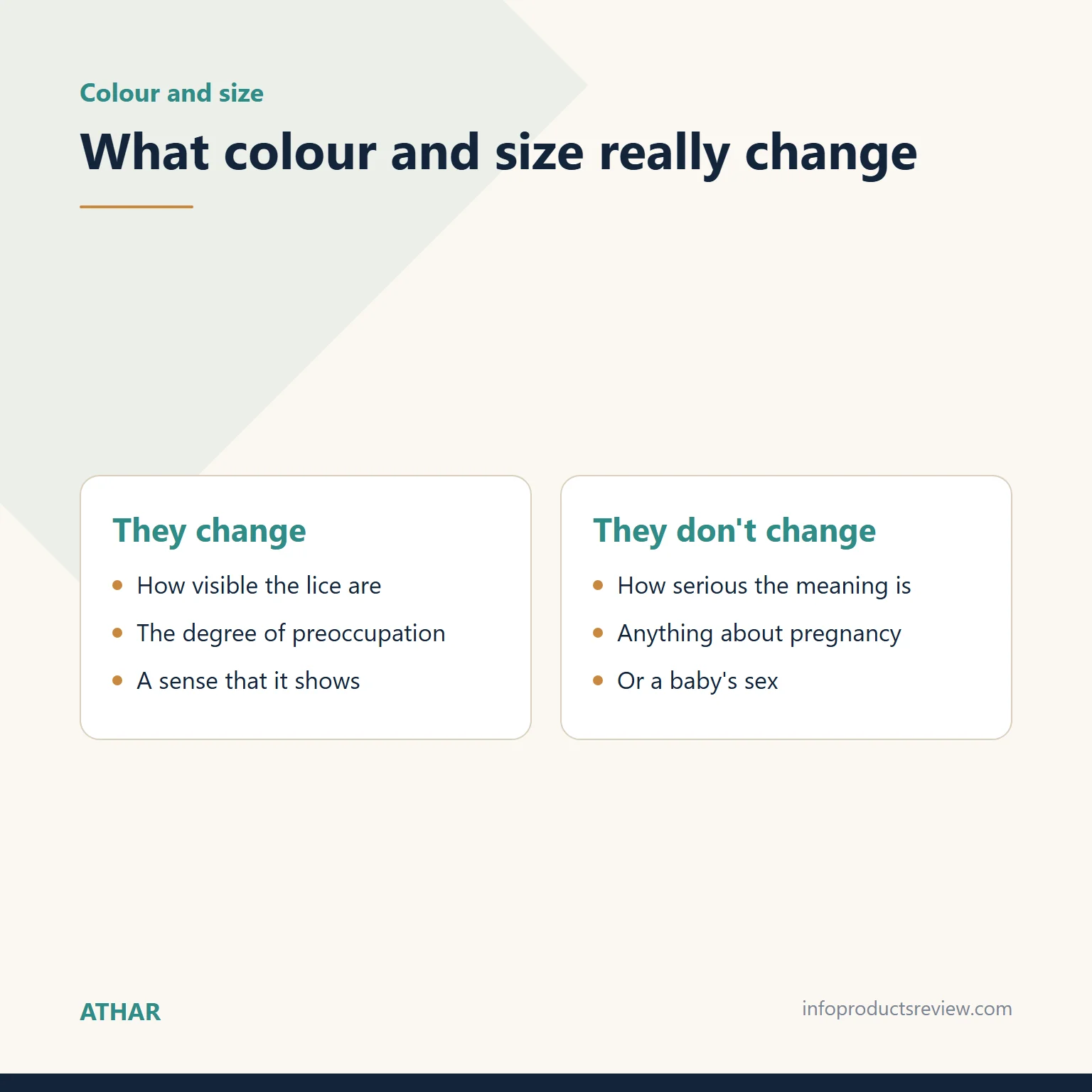
Much less than people claim. The early source gives lice no meaning tied to colour at all, and the charts assigning a meaning to each colour are later additions with no source behind them.
Unusually large lice may reflect a tired mind enlarging a small worry, which is exactly what exhaustion does at night. Barely visible lice lean toward a minor concern or one just beginning.
Dark lice in light hair, or light lice in dark hair, make the lice stand out, reflecting a preoccupation you feel others can see. That doesn’t make the meaning more serious, and it has nothing to do with pregnancy or a baby’s sex, whatever some pages claim.
Lice moving in your hair, or making you itch
Still lice lean toward a thought that is present in your mind but not pressing hard right now.
Lice moving between strands reflect a preoccupation that jumps from one thing to the next without settling: one job finishes and the next begins.
Itching in the dream is one of the most unpleasant details. In dream reading it leans toward an unease you can’t quite place, or something small that nags at you day after day. It has nothing to do with the state of your scalp or your health.
Very often the itch in a dream is purely physical: hair tied too tightly, a rough pillowcase, a warm room. A sleeping mind turns that sensation into an image it already knows, and the image becomes lice.
Combing your hair and getting the lice out
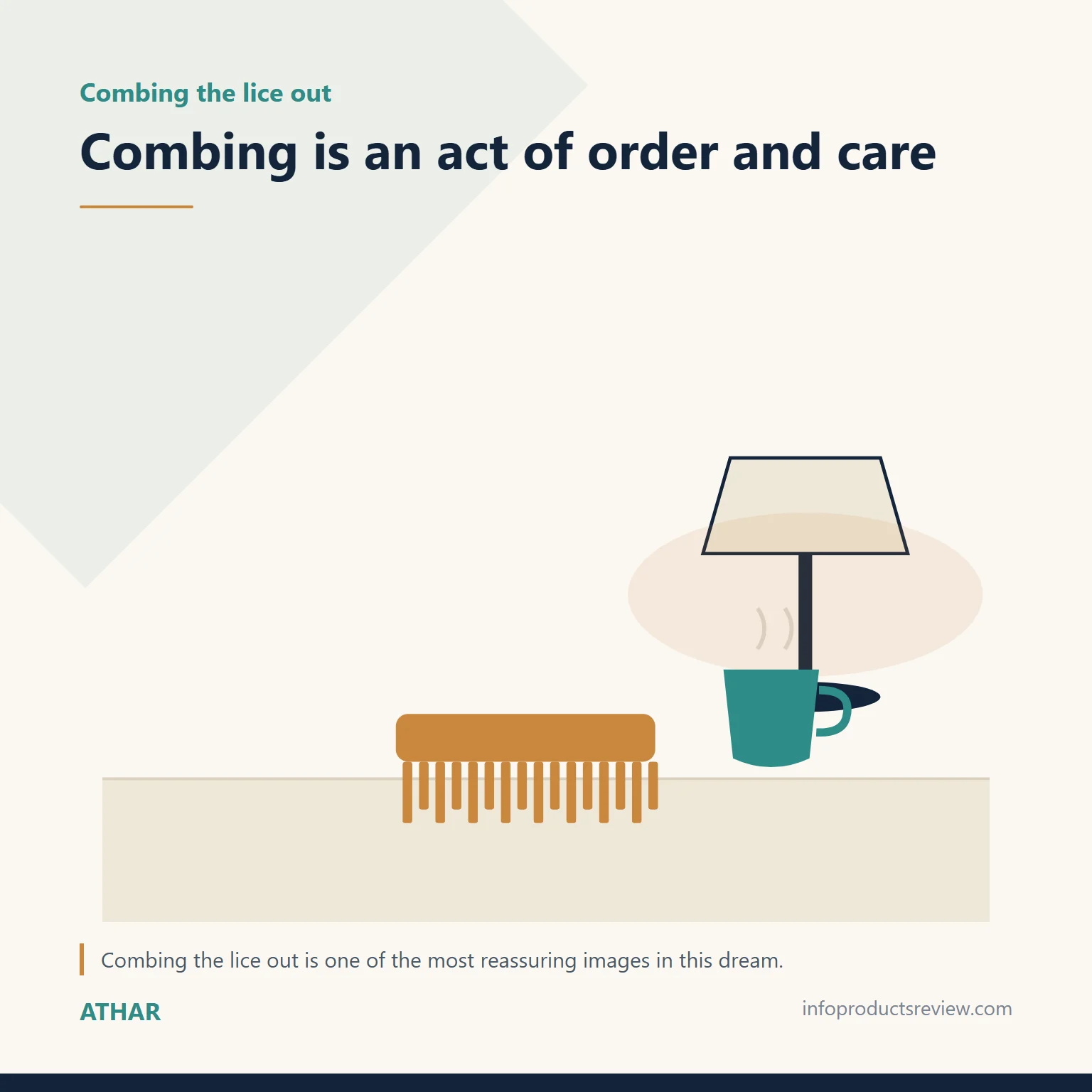
This is the heart of the hair dream, and its most reassuring scene.
Combing in a dream is an act of order and care. Getting the lice out with a comb leans toward letting go of a draining thought, finishing something that was on your mind, or finding a little calm again after a stressful stretch. The more completely the lice come out, leaving the hair clean, the clearer the sense of relief.
If you combed for a long time and not all of them came out, the reading leans toward something that needs time and patience, not something impossible. If your husband, your mother or an older daughter helped you comb, the dream may point to close support easing your load, which is worth appreciating and asking for in real life.
Killing the lice after combing them out leans toward settling a matter and not returning to it. That too is a reassuring image.
If the comb broke in your hand or simply didn’t work, the reading leans toward the method you are using in waking life no longer being enough, not toward the problem having no solution. It can be a practical nudge to rearrange things: hand one task over, or let something wait.
Lice in one of your children’s hair
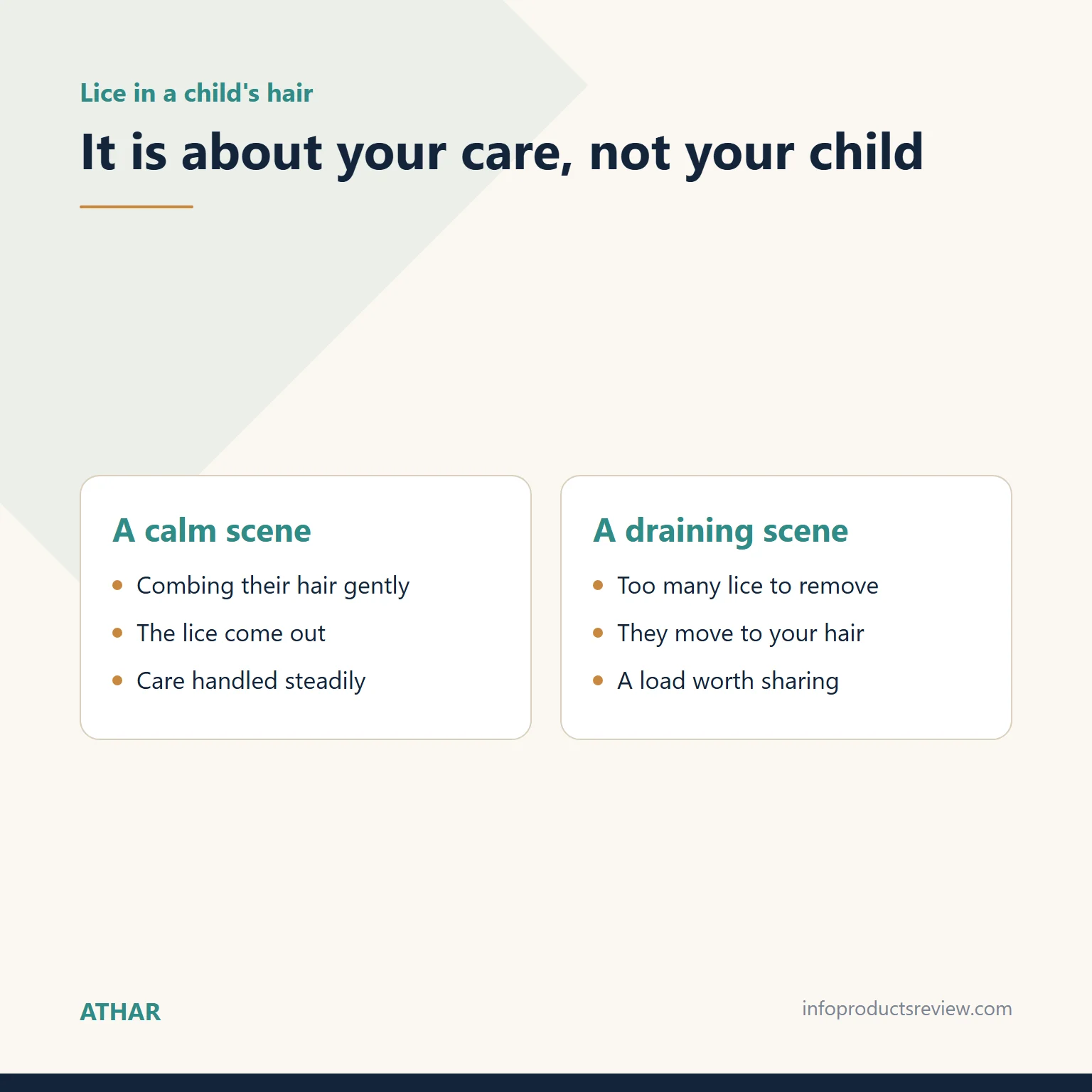
This is one of the most common scenes in mothers’ dreams, and one of the most worrying: lice in your daughter’s or son’s hair, and you trying to get them out.
The dream most likely reflects your care and concern for your children, which every mother carries: their schooling, their health, their friends, the details of their day. Ibn Qutayba’s reading of lice as dependants comes very close here: the ones who rely on you and need your attention.
If you were calmly combing your child’s hair and getting the lice out, this is among the calmest versions of the dream: care, attention and a responsibility you are handling steadily.
If there were too many lice to get out, the reading leans toward exhaustion from the sheer number of responsibilities, or a sense that what the children need is more than you can give right now. That is worth looking at: what could be shared with someone else?
If the lice moved from your child’s hair to yours, it may reflect a sense that their worries have become yours, an honest feeling for many mothers and not a warning of anything.
The dream doesn’t mean your child is ill, affected by the evil eye, or in any kind of harm. And if lice really are going around your children’s school, the dream is most likely a direct echo of what you heard.
Lice in your husband’s hair, or moving from him to you
Some married women see lice in their husband’s hair, or moving from him to them. This is where the circulating pages get most alarming, so it deserves a clear answer.
The dream most likely reflects a shared preoccupation: expenses, a family decision, or work pressure he is under that you feel at home. Lice moving from him to you can reflect the sense that his worry has become yours, which is common in married life and carries nothing bad.
The claim that lice in a husband’s hair mean betrayal, another woman or witchcraft has no basis in the early sources. It is one of the most harmful additions, because it can plant suspicion in a home without any evidence at all.
If something in your relationship genuinely worries you, the place for it is a calm conversation in waking life, not an image you saw in sleep.
If you were combing your husband’s hair and getting the lice out. This scene carries the sense of standing beside him more than anything else. Most likely you are sharing a worry he is going through, or trying to ease a pressure you can see is weighing on him. If the lice came out and the scene settled, the picture is close to getting through a hard stretch together.
If you saw lice in his hair and couldn’t get near him. The dream may reflect a sense that something between you hasn’t been talked about yet, or that he is carrying a worry he isn’t sharing. That doesn’t mean coldness and it doesn’t mean betrayal. It points to a calm conversation being more useful than you might expect.
In all these scenes, the dream stays a mirror of what occupies you about your husband and your home. It is not a window into his heart or into anything he might be keeping from you.
Lice in the hair and the responsibility of a household
This is where the early passage comes very close to a married woman’s life.
If lice mean dependants, the more natural question isn’t “who wishes me harm?” but “who relies on me?” Many mothers carry far more than they say: running the house, the children’s schooling, caring for ageing parents, endless family obligations, and sometimes a job as well.
That reading isn’t bad in itself. People relying on you describe a circle of responsibility. It can be tiring, but it is tiredness with a purpose. The dream leans this way when the scene is calm: lice that do no harm, no fear, no strong disgust.
When the scene is tense and upsetting, it leans toward that responsibility feeling heavier than your capacity right now. That deserves attention in real life: are you carrying alone something that could be shared? Do you need to ask clearly for help?
Try a short exercise. Write down everyone who depends on you in an ordinary week, and what each of them needs from you. Many women are surprised by how long the list runs, and equally surprised that one or two items on it could be carried by somebody else at no real cost to anyone.
Lice or nits in the hair: does the difference matter?
Nits, the eggs stuck to the hair, appear in some dreams instead of lice or alongside them. The difference lies in the shape of the scene, not the root of the meaning.
Lice are active and present, so they lean toward something already happening that needs dealing with. Nits are still and unhatched, so they lean toward something that hasn’t taken effect yet: an obligation ahead, a worry about something that hasn’t happened, a plan on hold.
Some pages link nits in a married woman’s hair to pregnancy, because “eggs” suggest it. There is no basis for that link in the early sources. Nits in a dream are a picture of something at its beginning, not news of a pregnancy.
If the nits were many and stuck fast, refusing to come out with the comb, the reading leans toward something that hasn’t even started occupying more of your mind than it deserves. The most useful thing in waking life is usually to fix a date for it and write it down, so it leaves the open-ended part of your thinking.
How did you feel inside the dream?
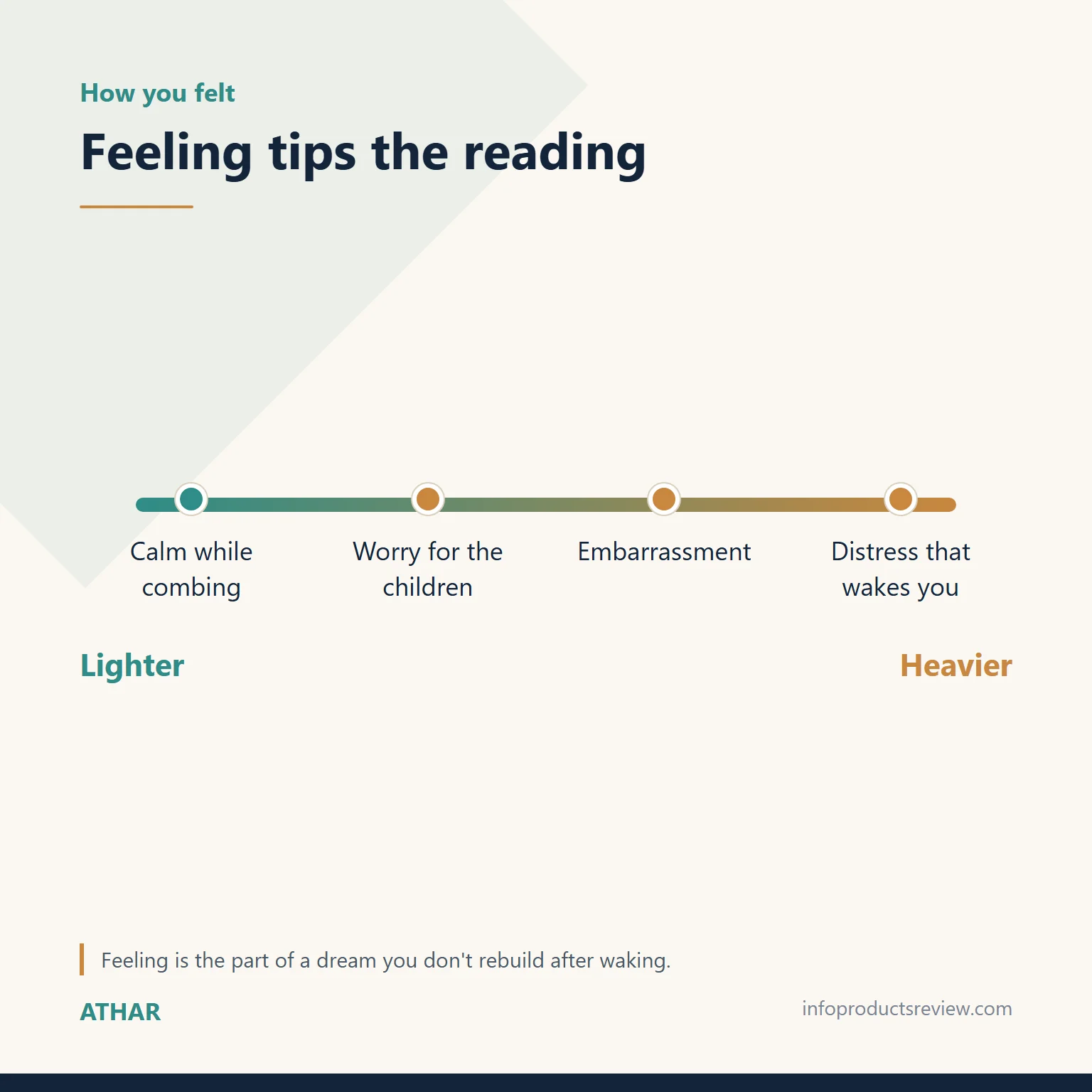
Of all the details, this is the most honest, because it’s the part you don’t rebuild after waking.
If you felt strain or strong disgust, the reading leans toward exhaustion and pressure. If you felt calm, or were simply busy combing without fear, it softens considerably toward ordinary burdens you are handling steadily.
If the strongest feeling was worry for the children, the dream reflects your care for them more than anything about lice. If it was embarrassment at the thought of someone seeing lice in your hair, the reading leans toward concern about how you are seen, especially by in-laws or at family occasions.
If you woke with your hand in your hair, that is simply the effect of a vivid dream on the body. It is common and carries no extra meaning.
What do the classical dream-interpretation books actually say?
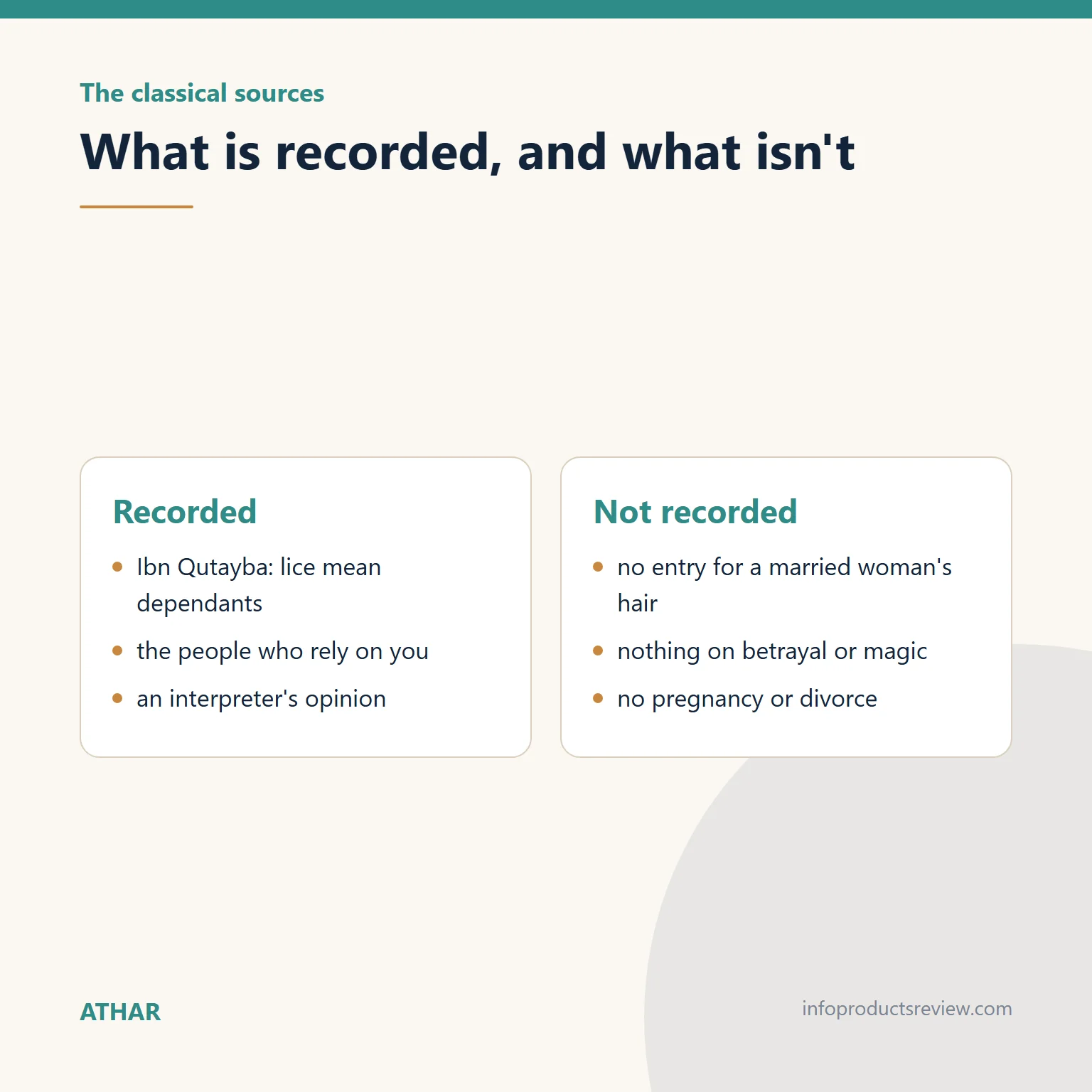
The clearest thing transmitted on this symbol from a well-known early interpreter is a single line, from Ibn Qutayba al-Dinawari’s Ta’bir al-Ru’ya, a ninth-century work that survives in a critical edition. It is one line long, and closer to the life of a woman running a home than you might expect:
Worms and lice mean dependants.
“Dependants” means the people a person provides for and is responsible for. So for Ibn Qutayba, lice are not an enemy and not envy. They stand for people who live under the dreamer’s care and rely on them. He supports the reading with a line of old Arabic verse that uses the same root to describe a household grown large.
That is an interpreter’s judgement, not a religious text. What makes it useful is the method: the early interpreters started from what a thing is actually like in waking life. Lice are small, numerous, close and dependent. Then they asked what in the dreamer’s life shares those qualities.
This source records no separate entry for lice in the hair, and none for married women specifically. The hair-specific detail on this page is a reading of the scene using the same method, not a quotation from an interpreter.
Later popular compilations, including a widely sold book attributed to Ibn Sirin, give lice other meanings: a small recurring worry, small sums of money arriving in instalments, a large crowd of little consequence. Those readings are unconfirmed. The attribution to Ibn Sirin is itself not established, and no critical edition supports them in a form that could be quoted word for word. So we mention them as circulating rather than settled, build nothing on them alone, and never present them as Ibn Sirin’s words.
The same goes for what gets attributed to Abd al-Ghani al-Nabulsi on this symbol. We hold no text of his that could be quoted, so we transmit nothing from him about lice and put no meaning in his mouth that has not been established as his.
What you won’t find in these sources matters just as much. There is no link between lice in a married woman’s hair and betrayal or another woman, none with the evil eye, envy or witchcraft, and no mention of pregnancy or divorce. Anyone offering those is adding, not transmitting.
One last note on names. The popular books are sold under the names of Ibn Sirin and al-Nabulsi, but the name on a cover is not the same as an established text inside it. So when a page puts a confident sentence about a married woman’s hair in either man’s mouth, treat the attribution as the part that needs checking first.
What is actually established about disturbing dreams?
Two things often get blurred together. One is interpreting the lice symbol, which is human judgement. The other is the Prophet’s guidance on what to do after a dream you dislike, which is recorded in Sahih al-Bukhari and Sahih Muslim.
The guidance doesn’t ask you to hunt for an interpretation. It asks you to seek refuge in God and leave the dream alone. In Sahih al-Bukhari:
A good dream is from God. If one of you sees something he likes, let him tell it only to someone he loves. And if he sees something he dislikes, let him seek refuge in God from its harm and from the harm of Satan, spit lightly three times, and not tell anyone about it, for it will not harm him
Sahih Muslim records the same guidance with one practical addition, turning away from the side you were sleeping on:
If one of you sees a dream he dislikes, let him spit to his left three times, seek refuge in God from Satan three times, and turn over from the side he was lying on
For you, the next step is simple. If the dream left you uneasy, seek refuge in God, spit lightly to your left three times, turn over, and don’t retell it to everyone. Sahih al-Bukhari (7044) is explicit that it will not harm you.
Much more is not established. No text makes a particular dream evidence of betrayal, the evil eye or witchcraft. No text makes a dream binding on a decision about a marriage, a divorce, a pregnancy or a dispute. And no religious text gives lice a fixed meaning; every meaning offered is a human judgement that may be right or wrong.
Al-Sadhan adds a limit that applies directly to a dream that frightens the person who saw it: the default is to read it on its lighter, reassuring side, and interpretation as a whole is analogy and conjecture, never certainty:
When a dream comes with fear and dread, the default in interpreting it is ease and good tidings … Interpretation is analogy, likeness and conjecture, never certainty, though it may be taken as reassurance.
That says two things at once. A dream that unsettled you is read on its lighter side first, not its heaviest. And what you read here or anywhere else stays conjecture you may take as reassurance, never a ruling to build a decision on about your home, a relationship or how you raise your children.
What does sleep research say about unsettling dreams?
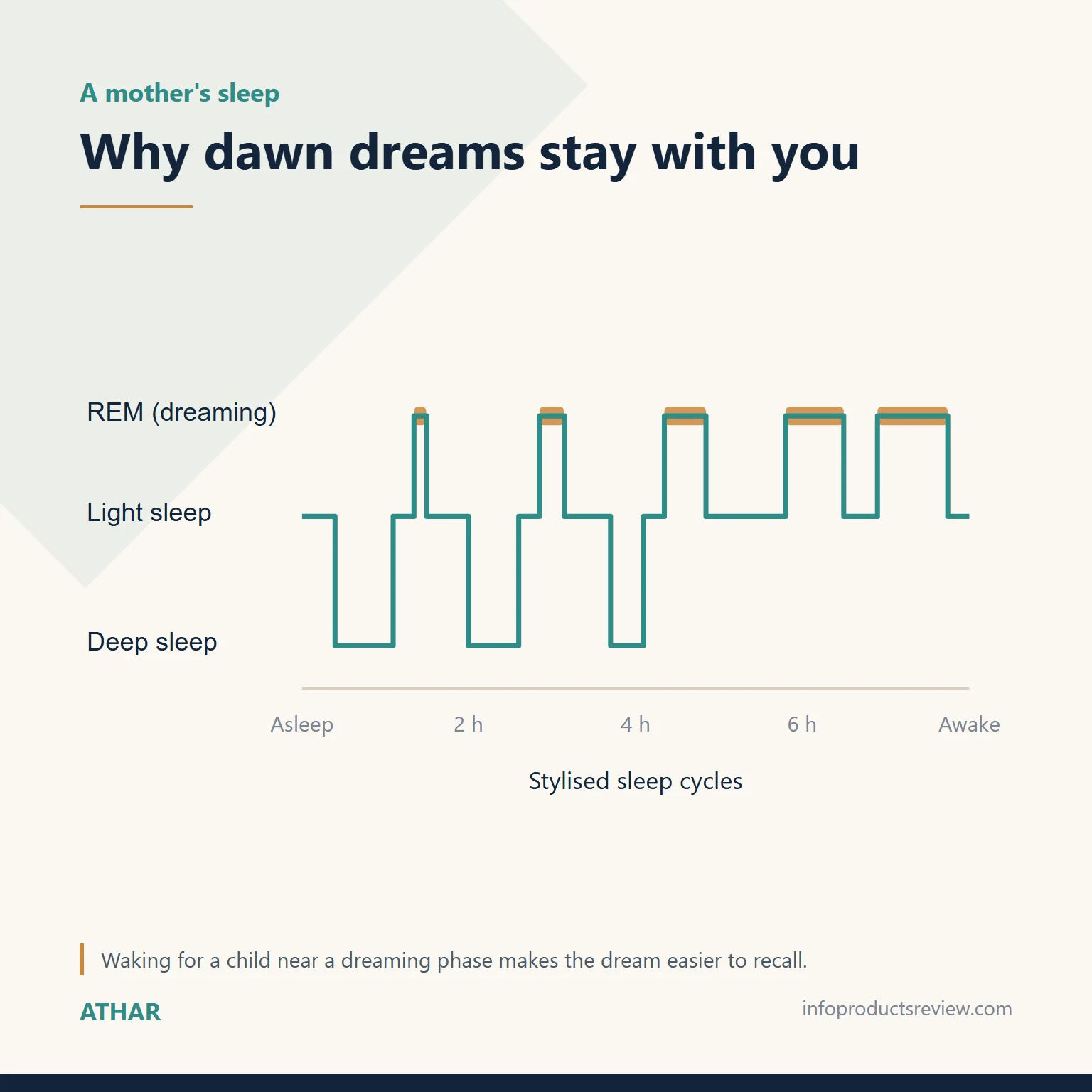
We keep this separate from the classical material on purpose, because the two answer different questions and merging them distorts both.
Sleep research is clear on a few points. Distressing dreams become more frequent with stress, anxiety and short or broken sleep. Vivid dreams concentrate in the later part of the night, when REM sleep runs longest, which is why dreams near dawn are the ones you remember best. That is what general sleep references set out, such as the Sleep Foundation page on nightmares.
Mothers in particular know broken sleep: waking for a child, thinking through the morning, staying up late to finish the day’s jobs. Each waking near a dreaming phase makes a dream easier to recall and more vivid by morning.
The image of lice in the hair matches a familiar sensation: a thought you can’t get out of your head. That overlap is an observation about a feeling, not proof that psychology confirms an old interpretation. And a dream doesn’t diagnose anxiety or anything else; that is a professional’s work, and if pressure is affecting your sleep or your days consistently, speaking to a doctor is a practical step.
When is a dream just your mind processing the day?
This question comes before interpretation, and it is rarely asked. It isn’t an evasion either: the three kinds of what a sleeper sees are set out in Sahih Muslim (2263):
Dreams are of three kinds: a good dream, which is glad tidings from God; a distressing dream, from Satan; and a dream from what a person tells himself
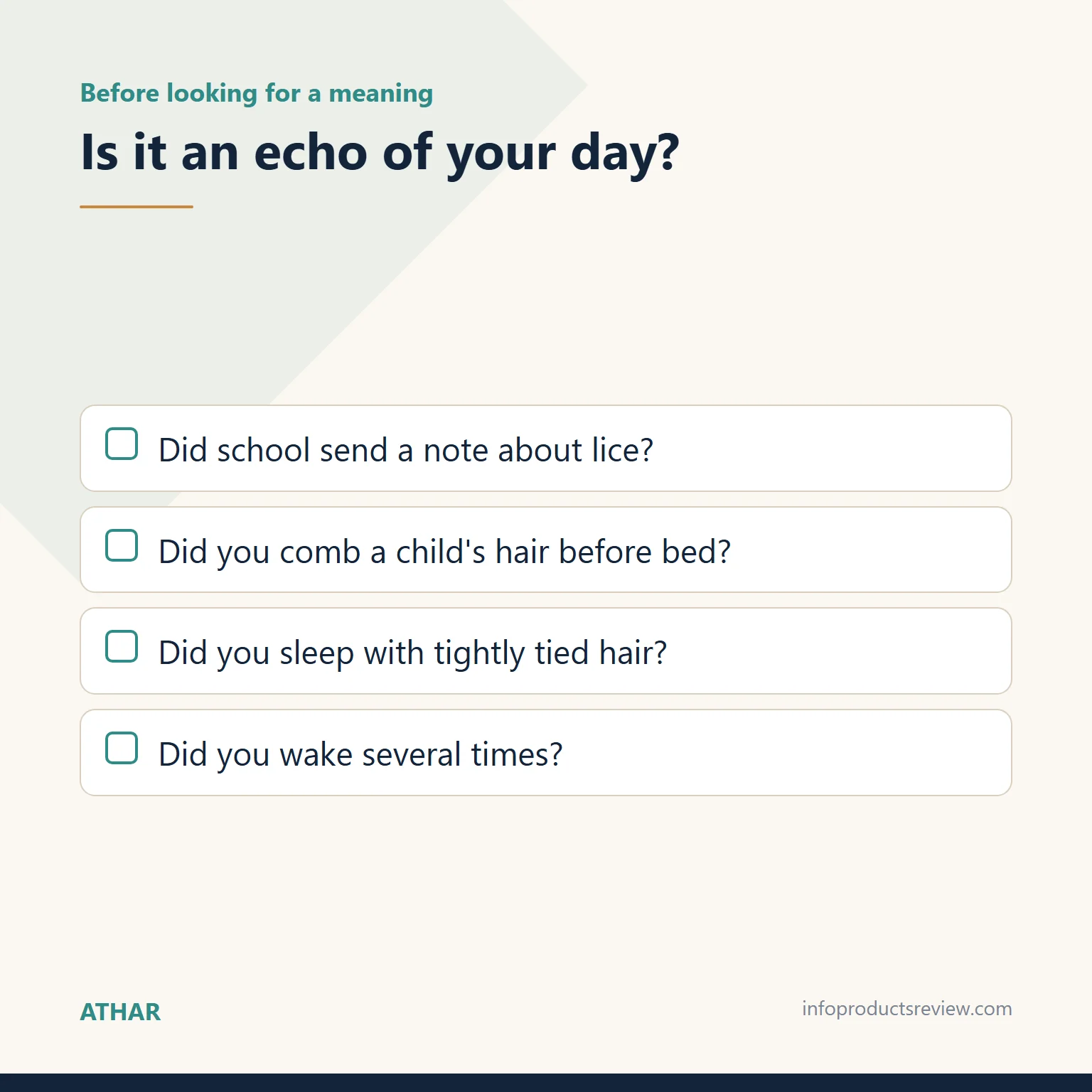
The third kind, what a person tells himself, is what most people see most nights, and no meaning is sought for it. No single sign below settles the matter, but several together say a lot:
- The dream echoes something that occupied you that day.
- A letter came home from school about lice going around.
- You combed one of the children’s hair before bed, or lice came up in conversation.
- You slept with wet or tightly tied hair and felt a pull or an itch.
- You woke several times in the night.
The second and third signs come up again and again for mothers. If the dream followed a day like that, it is most likely a direct echo of what you lived through, not a message about your future or your home.
The interpretation books treat mind-talk as a category of its own, one for which no meaning is looked for:
Mind-talk belongs to the body: it is the wishes and feelings held back below awareness, which wake up in a dream, and it has no interpretation.
There is real relief in that. You are not required to find a meaning for every image that passes through your sleep. Some dreams need nothing more than a longer night and a quieter one.
A clear line: dreams are not medicine
A dream about lice in your hair doesn’t mean you have lice, that anything is wrong with your scalp, or that one of your children is affected.
If there really are lice at home, which is very common when children are at school, dealing with them is a simple practical matter a pharmacist or a public health source can guide you through. And if hair loss or constant itching worries you in waking life, a doctor is the right person to ask.
Nothing on this page is a diagnosis or a treatment. A dream is an image in sleep; the body is a question for the people who treat it.
Should you tell your husband or family about the dream?
The guidance recorded in Sahih al-Bukhari and Sahih Muslim is that a dream you dislike need not be retold. There is real wisdom in that here, because a retold dream often invites a hasty interpretation from a relative or neighbour, about the evil eye, envy or betrayal, and that can stay in a home far longer than the dream itself, and leave a mark on relationships.
That doesn’t mean keeping everything to yourself. There is a difference between retelling a dream as a sign and talking about how you are. Telling your husband, “I’ve been exhausted lately and I need more help with the children,” is healthy and practical. It opens the door to support without turning the dream into a prediction.
If someone offers you a frightening interpretation, you don’t have to accept it. No one can read the future of your home from a dream, and a comment doesn’t become true because it was said with confidence.
Common claims that need correcting
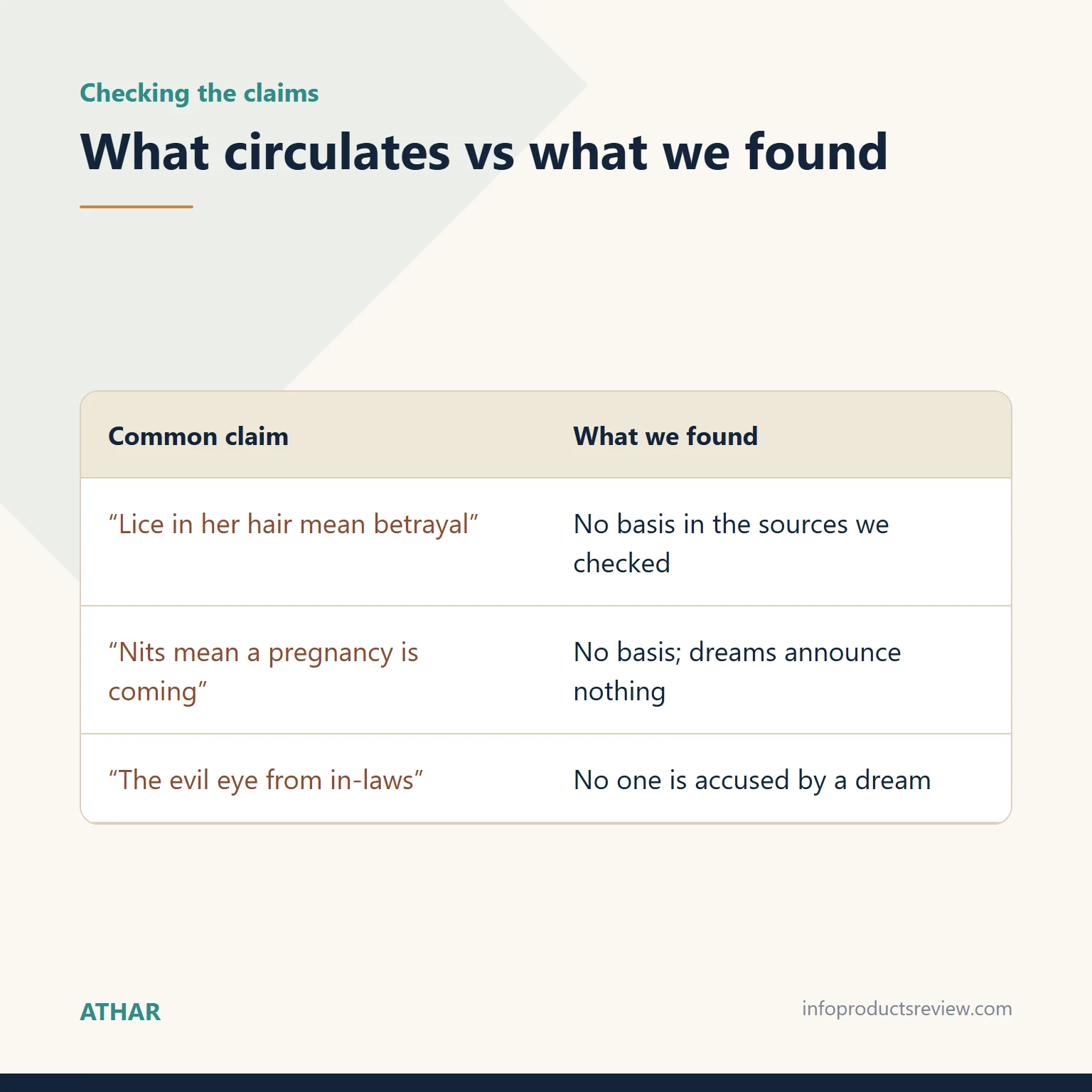
- “Lice in a married woman’s hair mean her husband is unfaithful.” No basis in the early sources, and one of the most harmful additions because it plants suspicion without evidence.
- “Lice in the hair mean the evil eye or envy from your in-laws.” The early source records nothing connecting the symbol to either, and no one should be accused because of a dream.
- “Nits in the hair mean a pregnancy is coming.” There is no source for this, and dreams don’t announce pregnancies.
- “Lice in your children’s hair mean something is wrong with them.” The dream most likely reflects your care for them, not anything in them.
- Pinning a fixed meaning for lice in a married woman’s hair on Ibn Sirin. The popular book is only attributed to him, that attribution is not established, and it holds no verifiable entry specific to hair.
- “A recurring dream is a confirmed message.” Recurrence tracks stress and poor sleep far more than any hidden meaning.
- “The colour of the lice fixes the meaning.” Colour and size adjust the degree only, and the early sources give them no meaning of their own.
What this dream cannot establish
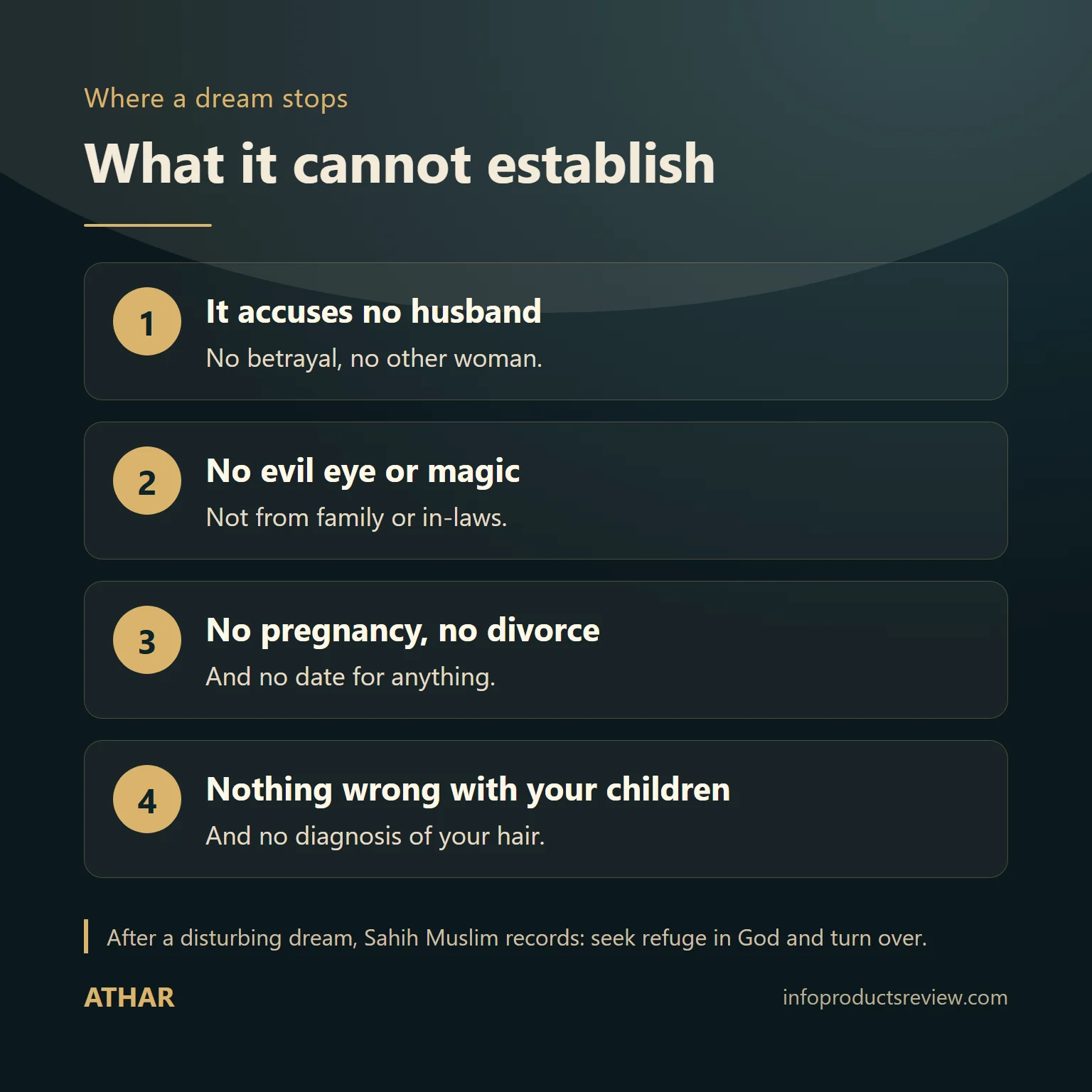
- It cannot accuse your husband of betrayal or prove there is another woman.
- It cannot accuse your family or in-laws of the evil eye, envy or witchcraft.
- It says nothing about pregnancy or divorce, and sets no date for anything.
- It doesn’t mean anything is wrong with your children.
- It diagnoses nothing about your hair or scalp.
- It is not grounds for a decision about your marriage, a relationship or how you raise your children.
What to do after an unsettling dream
- Settle first. Seek refuge in God, turn onto your other side, and don’t try to analyse anything in the middle of the night.
- Write it down once in the morning: whose hair the lice were in, what you did, how you felt.
- Check the day before. A note from school, a worrying conversation, a crowded day with no rest.
- Look after your rest. Take a short moment for yourself, even a few minutes; constant exhaustion makes unsettling dreams more likely.
- Don’t base a decision on it, and don’t accuse anyone inside or outside your home because of it.
How to describe your dream so it can actually be read
- Whose hair: yours, a child’s, or your husband’s?
- Where in the hair: scalp, ends, comb, or under your scarf?
- What you did: combed them out, left them, or tried and couldn’t?
- How it ended: clean hair, or waking suddenly?
- How you felt, during the dream and after waking.
A description like that turns an unsettling image into something you can think about calmly. Any interpretation given without those five is an interpretation of the word “lice”, not of your dream.
Interpreters themselves object to being asked about a bare symbol. One of them puts it this way in a recorded interview:
The dreamer has to relate the dream with all its details … I am not a dream dictionary to be used that way.
What have interpreters said in recorded interviews?
Two short pointers to published interviews, because hearing how someone reasons can be clearer than reading about it. Take them for what they are: personal views and experiences, not religious rulings and not a reading of your dream.
In the first, an interpreter describes a man who dreamt of three lice in his head: the first came out and died easily, the third took real effort. He connected them with disputes involving three people. The interesting part is the method: every detail of getting the lice out of the head carried meaning. It doesn’t mean every dream of lice in the hair is about disputes.
An example of reading each detail of removing lice from the head. Summarised from the Arabic interview; a personal experience, not a rule.
In the second, a different interpreter draws a line that matters in any marriage: don’t let dreams run your decisions, and interpretation stays conjecture even when a dream turns out to be true.
A practising interpreter's own limit on what dreams are for. Quoted from the English subtitles published with the interview.
Don't determine your life, or make decisions, or serious matter concerns based on dreams.
That agrees with the guidance in Sahih al-Bukhari and Sahih Muslim quoted above. A dream may lift your spirits, but it never takes the place of conversation, understanding and deciding things in waking life.
A few typical scenes
A mother sees lice in her daughter’s hair the night before the school year starts. Most likely an echo of getting the children ready and the new routine, not anything about her daughter.
A married woman combs her hair until every louse is out and feels relieved. One of the calmest scenes: sorting her thoughts and setting down a burden.
A married woman sees lice moving from her husband’s hair to hers. Most likely a shared worry, such as money or a family decision. It has nothing to do with betrayal or witchcraft.
A married woman sees lice under her headscarf before visiting her in-laws. Most likely concern about how she will be seen during that visit.
A mother sees lice multiply in her hair, can’t get them out, and wakes exhausted. Most likely strain from responsibilities falling on her alone. The useful response is to look at what could be shared, not to search for a hidden cause.
A woman in the first months after giving birth sees lice in her hair after a broken night. Most likely an echo of exhaustion and a new responsibility. An extra hour of sleep will do more than an interpretation.
Quick reference: detail and nearest reading
| Detail in the dream | Nearest possible reading |
|---|---|
| Lice on the scalp | A deep preoccupation with home and children |
| Lice on a comb | A worry beginning to leave you |
| Combing the lice out | Sorting your thoughts, setting down a burden |
| Lice in a child’s hair | Worry for them and care for them |
| Lice moving from your husband | A shared worry, not betrayal |
| Lice under your headscarf | Concern about how you are seen |
| Nits in the hair | Something at its beginning, not a pregnancy |
| Too many lice to get out | Responsibilities heavier than your capacity right now |
| Calm while combing | A much lighter reading |
Related dreams
- Dreaming about lice in your hair as a single woman — the same scene at a different stage of life.
- Dreaming about lice during pregnancy — because the pregnancy question comes up so often with this dream, and that page answers it directly.
- Snake dreams for a married woman — another symbol read with needless fear for married women, and corrected the same way.
- All English dream guides by topic — every guide reads a symbol by its details first.
- Dreaming about lice as a single woman — the wider lice reading before marriage, at home, at work and on belongings.
- Dreaming about lice as a man — useful if you saw lice in your husband’s hair, since it reads the symbol through a man’s responsibilities.
Frequently asked questions
What does dreaming about lice in your hair most often mean for a married woman?
Small thoughts and responsibilities that keep returning, especially around home and children. The meaning depends on what you did with the lice, whose hair they were in, and how you felt. It stays a possible meaning, not a confirmed one.
Does it mean my husband is unfaithful?
No. Nothing in the early sources links this symbol with betrayal, and a dream is never evidence against anyone.
I saw lice in my daughter’s hair. Is something wrong with her?
No conclusion about her can be drawn from it. The dream most likely reflects your care and natural worry for her.
I combed the lice out of my hair. Is that a good sign?
It is one of the clearest reassuring images, leaning toward sorting your thoughts and setting down a burden. It remains a possible meaning, not a promise.
Do nits in the hair mean a pregnancy is coming?
No. There is no basis for this in the sources, and dreams don’t announce pregnancies. Nits in a dream picture something at its beginning.
Does it mean the evil eye or envy from my in-laws?
No. The early source records nothing connecting the symbol to that, and no one should be accused because of a dream.
I saw lice moving from my husband’s hair to mine. What does that mean?
Most likely a shared worry, such as money or a family decision. It has nothing to do with betrayal or witchcraft.
What should I do after an unsettling lice dream?
You don’t need to interpret it. The established guidance is to seek refuge in God, spit lightly three times and not retell it, as recorded in Sahih al-Bukhari (7044). Sahih Muslim (2262) adds spitting to your left three times and turning away from the side you were lying on.
Is lice in the hair different from lice around the house?
Hair sits closer to thinking and inner preoccupation; the house sits closer to the circle of responsibilities around you. Both are read by place, action and feeling.
The dream keeps coming back at the start of term. Is it a message?
Most likely it echoes the busyness and short sleep of that season, and usually eases once the routine settles.
Does the dream mean I actually have lice?
No. The dream tells you nothing about your hair. If there are real lice at home, a pharmacist can help with the practical side.
Is any of this certain?
No, and that is deliberate. What we offer are possible meanings that shift with the details, and none of it predicts the future.
In summary
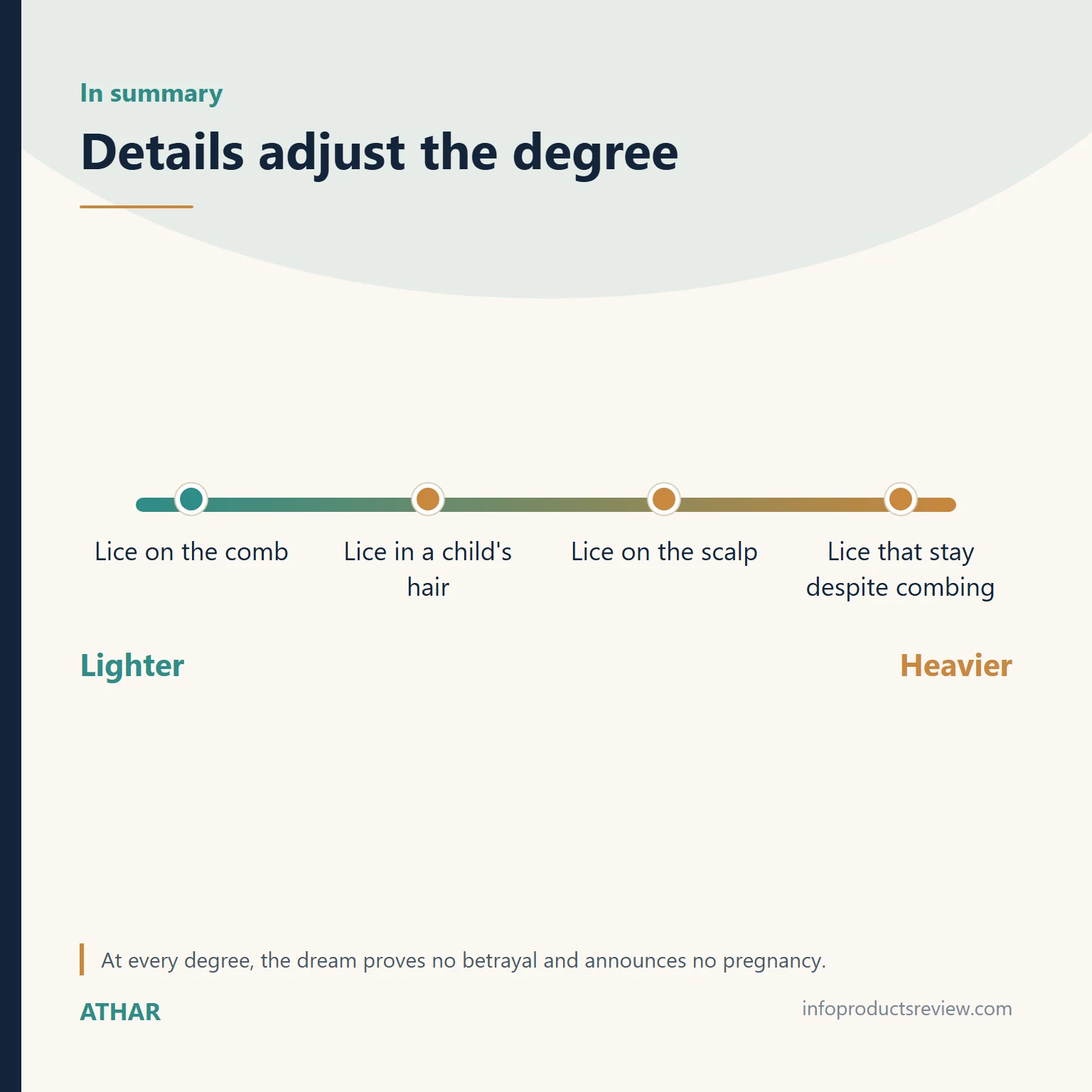
- Lice in a married woman’s hair sit closest to the thoughts and responsibilities that stay with her.
- Start with what you did with the lice, then whose hair they were in, then how you felt. Number and colour come last.
- In Ibn Qutayba’s passage, lice mean dependants: the people who rely on you.
- Combing the lice out is one of the most reassuring images.
- Lice in a child’s hair reflect care for them, not anything wrong with them.
- Readings about small sums of money, a crowd or a recurring worry circulate without a confirmed source.
- The dream proves no betrayal, evil eye or envy, and says nothing about pregnancy or divorce.
- After a bad dream: seek refuge in God, turn over, and let it rest.
If you take one thing from this page, let it be this: the thoughts that follow you into a dream deserve some rest and support in waking life, not fear.
Written and reviewed by: the ATHAR editorial team. Classical and hadith quotations are taken from the named editions and checked against the page image; English renderings of Arabic texts are our own translation.
Last reviewed: 15 September 2026.
Note: what appears here is a possible meaning, not a confirmed fact, and it changes with the details of the dream and the dreamer’s circumstances. Nothing here predicts the future, gives medical advice, or establishes betrayal, the evil eye, envy, witchcraft or hostility from any person.