


You dreamt of lice, you’re married, and you woke up asking whether it was a warning. The short answer: in the classical dream books lice stand for dependants — the people you provide for and look after. So at its most likely, the dream is about the circle of responsibility in your home: children, a husband, perhaps ageing parents, and a household that needs running every day.
There is no enemy in that, no betrayal and no witchcraft. What shifts the reading is the detail: where the lice appeared, what happened, and how you felt.
This page walks through those details in the order that matters, and it says plainly what a dream cannot tell you — so that one night’s images don’t turn into a suspicion nobody has earned.
The Bottom Line
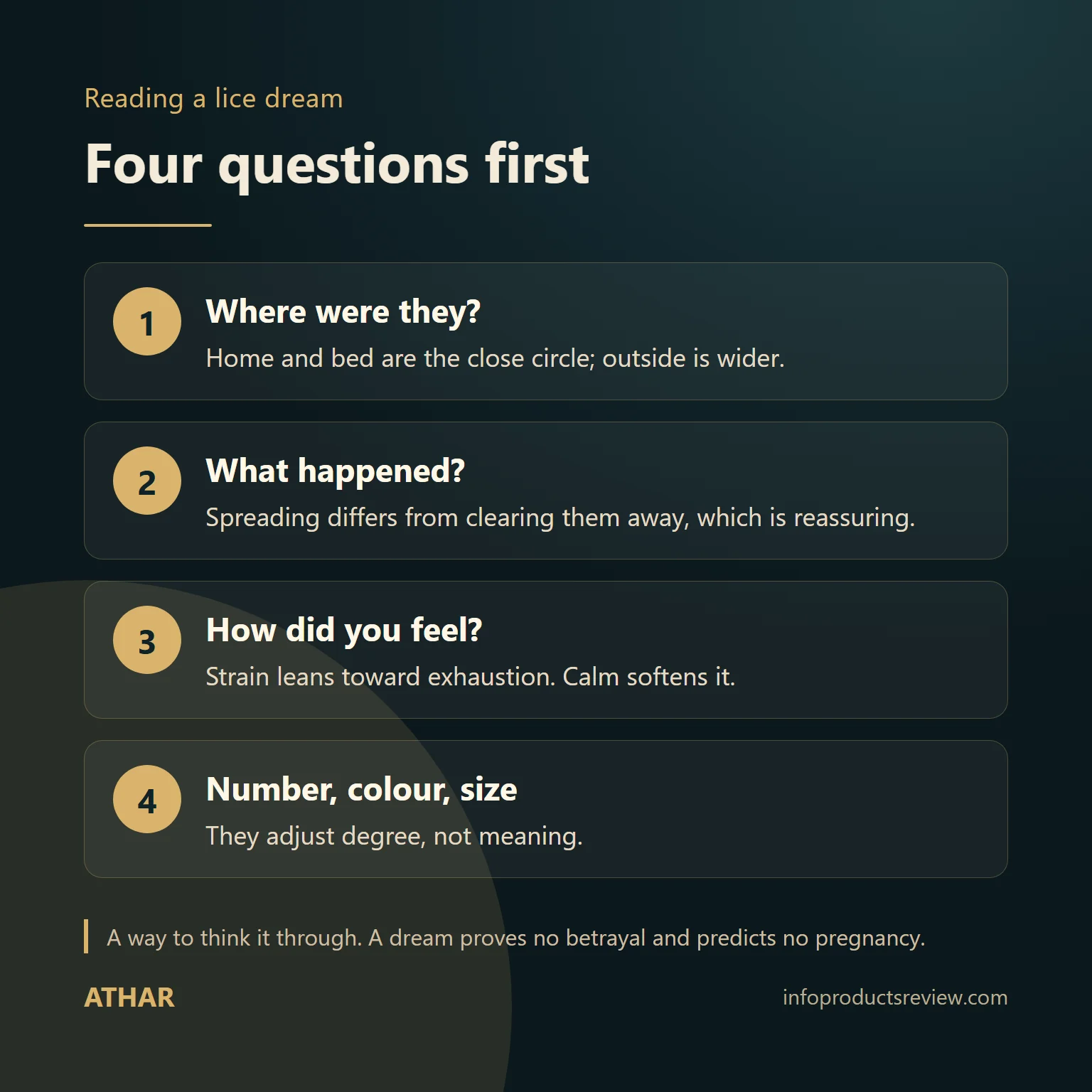
- The closest meaning: the classical dream books read lice as “dependants”, the people a person provides for. For a married woman, the nearest reading is the people who rely on you at home and the responsibility you carry for them. Not an enemy, and not a misfortune.
- The detail that changes it: how you felt in the dream. A calm scene leans toward a responsibility you’re carrying with enough in reserve. An upsetting one leans toward that responsibility weighing more than you have to give right now.
- Common cases: clearing lice away by washing, combing or killing them is usually a reassuring image — a worry eased, or order restored. Lice on your husband or children point to your own concern for them, not to anything about them.
- A possibility, not a promise: these are possible meanings. The dream establishes no betrayal, no witchcraft and no envy, announces no pregnancy and no divorce, and diagnoses no illness in you or anyone else.
- Where the books give no specific meaning: a married woman’s situation, the number of lice, their colour, a bite, the place, or getting rid of them. What this page says about those details is a practical reading of the scene and your circumstances, not a quotation from any book.
What this page covers
- The Bottom Line
- What do lice mean in a dream generally?
- Why does the reading differ when you’re married?
- Does the place in the dream change the meaning?
- What does a large number of lice mean?
- What is the difference between nits and lice in a dream?
- Do the colour and size of lice change the reading?
- Moving, spreading, biting: what is the difference?
- What does clearing the lice away mean?
- On bedding, clothes and household things
- I saw lice on my husband or my child: what does that mean?
- When the responsibility outgrows the capacity
- Household strain and relationship strain are not the same thing
- How much does the feeling inside the dream matter?
- What do the classical dream books actually say about lice?
- Lice as dependants: the side most pages leave out
- What is actually established about disturbing dreams, and what isn’t?
- What do modern sleep references say?
- When is the dream just the mind still working?
- Does the dream mean real lice, or an illness?
- Claims about lice dreams that need correcting
- What this dream cannot establish
- What to do with the dream
- What have interpreters said in recorded interviews?
- Situations and examples of a lice dream
- A lot of lice in the house, and I never touched them
- Lice on my pillow while I slept
- I cleaned the house of them until they were gone
- One bit me and I woke
- I saw lice on my husband
- On clean clothes straight out of the wash
- At my parents’ house rather than mine
- At the front door
- It repeated during a crowded week
- I woke up itching
- I saw them and felt nothing at all
- Someone else cleared them away for me
- Quick reference: detail and nearest reading
- Related dreams
- Frequently asked questions
- What do lice most often mean in a married woman’s dream?
- Does it indicate betrayal or another woman?
- Does it mean witchcraft or envy?
- I cleaned them away in the dream. Is that good?
- One bit me. Does that mean harm?
- I saw lice on my children. Is something wrong with them?
- Does it mean a pregnancy is coming?
- Is the meaning different because I’m married?
- Is the reading for nits different from lice?
- It repeated several nights. What does that mean?
- Should I tell anyone about it?
- Where do I read about my exact situation?
- What you can reasonably take from this
- In summary
- Sources and references
What do lice mean in a dream generally?

Before narrowing things to a married woman’s life, it helps to know what the symbol itself carries.
The clearest early reading of lice is short and blunt: worms and lice are “dependants”. Dependants are the people someone provides for and takes responsibility for — a household that relies on them for its day and its living.
Later popular compilations, including a widely sold book attributed to Ibn Sirin, are often said to read lice as a small worry that keeps coming back. That reading isn’t confirmed in any reliable source, and the book’s attribution to Ibn Sirin is itself not established. So we don’t lean on it.
Notice how far that early meaning sits from the “betrayal” and “witchcraft” that fill the search results. The symbol is about people in your care, not people set against you. That’s a difference of direction, not just of wording.
The practical consequence is clear: one symbol reads according to its scene, so no page can know what you saw without knowing how you saw it. It is the same problem we set out in our guide for a single woman, with a different symbol.
We apply the same principle elsewhere. Our guide to snake dreams for a married woman works the same way: the scene first, then the meaning.
Why does the reading differ when you’re married?

What differs for a married woman isn’t the symbol. It’s the circle the symbol lands on.
The books give no meaning specific to married women for lice, and anyone who presents one as coming from the classical tradition is adding rather than passing something on. But a married woman’s life does have wider and more tangled circles: a household to run, a marriage, perhaps children, an extended family, guests, and arrangements that never quite end.
So when lice stand for dependants, they land on a wide circle of people and tasks. Not because your situation is worse, but because what’s asked of you is more varied.
The useful question here isn’t “what do lice mean?” It’s who is relying on me at the moment, and what small, repeating thing is using me up? Most women know the answer before they reach the end of the page.
A simple example: a woman whose children are starting a new school year, whose mother-in-law is staying for a fortnight, and who works outside the home as well. If she dreams of lice in that stretch, the nearest reading is that the dream is describing the crowding itself, not telling her anything new.
Lice in the hair bring scenes of their own, such as combing them out of a child’s hair or finding them on a brush. The way to read them doesn’t change: place first, then what happened, then how you felt.
Does the place in the dream change the meaning?
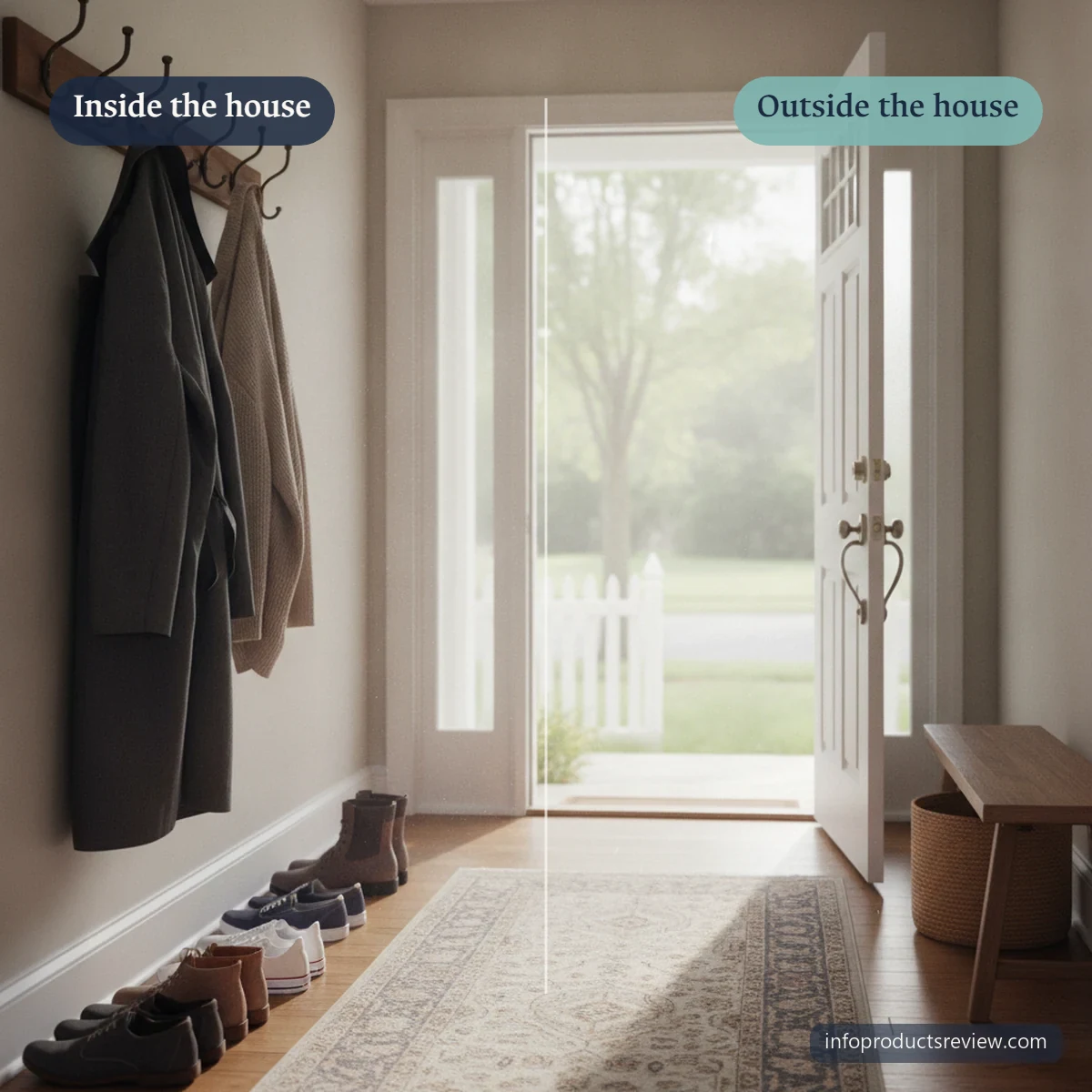
Place is one of the strongest details you have, and the first to go missing when a dream gets retold. The books give the place no meaning of its own for lice, so what follows is a practical reading that connects the scene to your life.
In the bedroom. The narrowest and most personal circle: rest, privacy, the hours that are supposed to be yours. It often turns up for someone who feels her own space shrinking under everyone else’s needs.
In the kitchen or the living room. The rooms of daily management. The nearest reading is the household’s own repeating work — the kind nobody notices until it stops.
At the door or in the entrance. Where inside meets outside. The nearest reading is what’s arriving from beyond the house: guests, news, new obligations.
At your parents’ home. A close circle, but not your daily one. Usually a preoccupation tied to the extended family: a visit, an illness, a piece of news everyone is carrying.
Outside the home. Work, the market, the street. A wider circle: the people you deal with rather than the people you live with.
The simple rule: the nearer the place, the nearer the circle. Nearness isn’t danger; it’s only nearness. The same way of reading a scene runs through our general guide to reading a dream by its details.
What does a large number of lice mean?
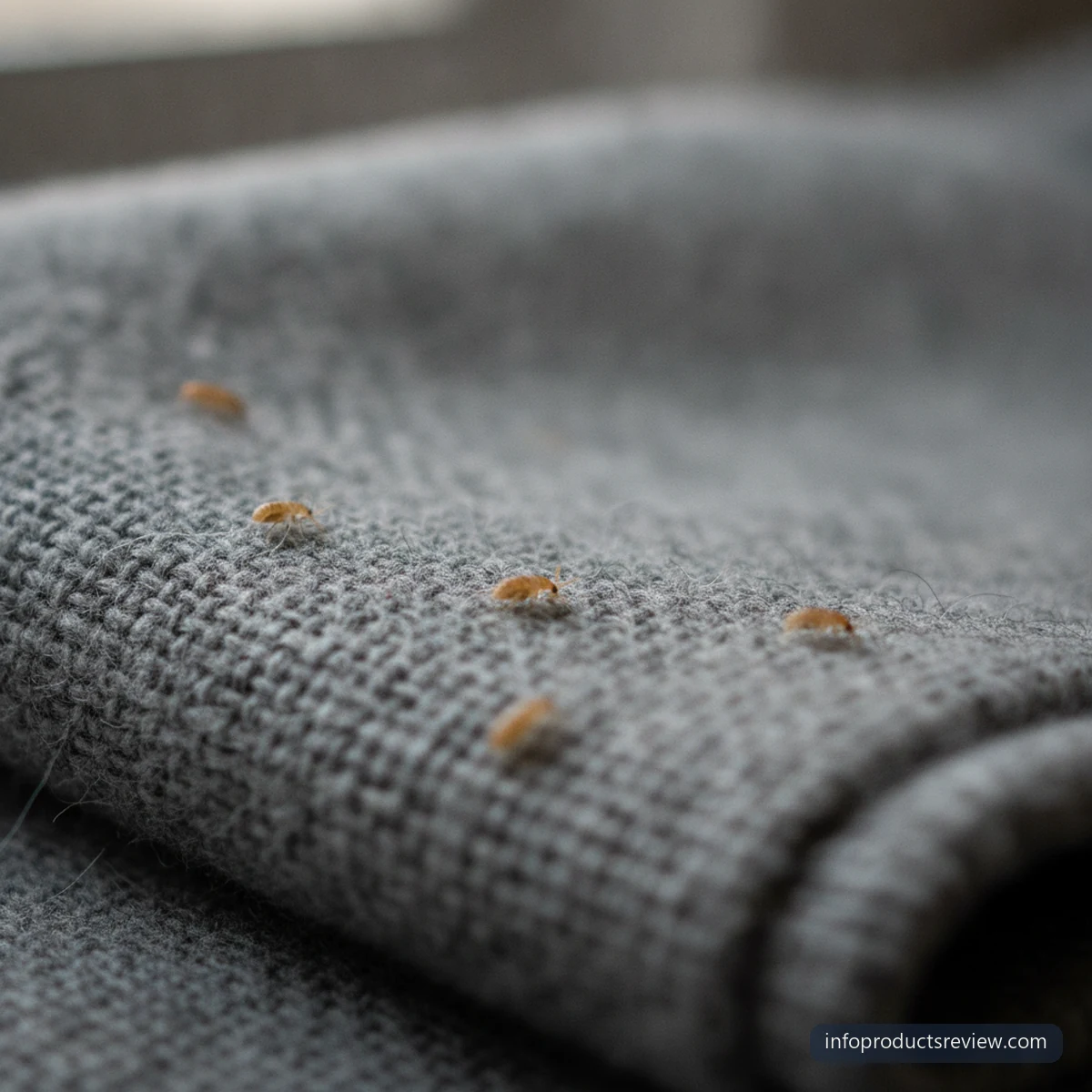
This is one of the most misread parts of a lice dream, so here’s the answer first: a large number points to a load, not to opponents.
The books give number no separate meaning. But if lice are dependants, a great many of them sits closer to how much is being asked of you. Lice spread about usually reads as tasks piling up, demands arriving from several directions at once, or a head full of lists that never empty.
The gap between “many burdens” and “many enemies” isn’t a matter of phrasing. The first is a state you can recognise and act on. The second is a claim about people, and a dream offers no evidence for it.
Many women who dream of large numbers are genuinely in a crowded season: a move, a birth in the family, someone’s illness, a long stretch of hosting. When that’s the case, the dream is describing your present, not reporting on your future.
A few lice, one or two, sit closer to a single, limited preoccupation. Often it’s something you know perfectly well and keep putting off from one week to the next.
What is the difference between nits and lice in a dream?
Readers ask about this constantly, and the distinction turns out to be useful.
Nits are the small eggs fixed to the hair shaft. The books give them no meaning of their own, so the difference from lice lies in the shape of the scene. Lice move, are visible, and are a nuisance now. Nits sit still, fixed, and haven’t hatched. So they lean toward what hasn’t taken effect yet: a commitment at its beginning, an arrangement deferred, something you know is coming.
In a household that’s a familiar picture: a list written and not begun, or a season you can see coming, such as guests, a move or a family occasion, that you’re already planning around.
Seeing both together holds one thing under way and one on its way. Seeing nits alone suggests what’s occupying you is still at the preparation stage. The single woman’s guide draws the same distinction from a different angle.
The caution stands: this describes a dream, not your household, and not a health matter.
Do the colour and size of lice change the reading?
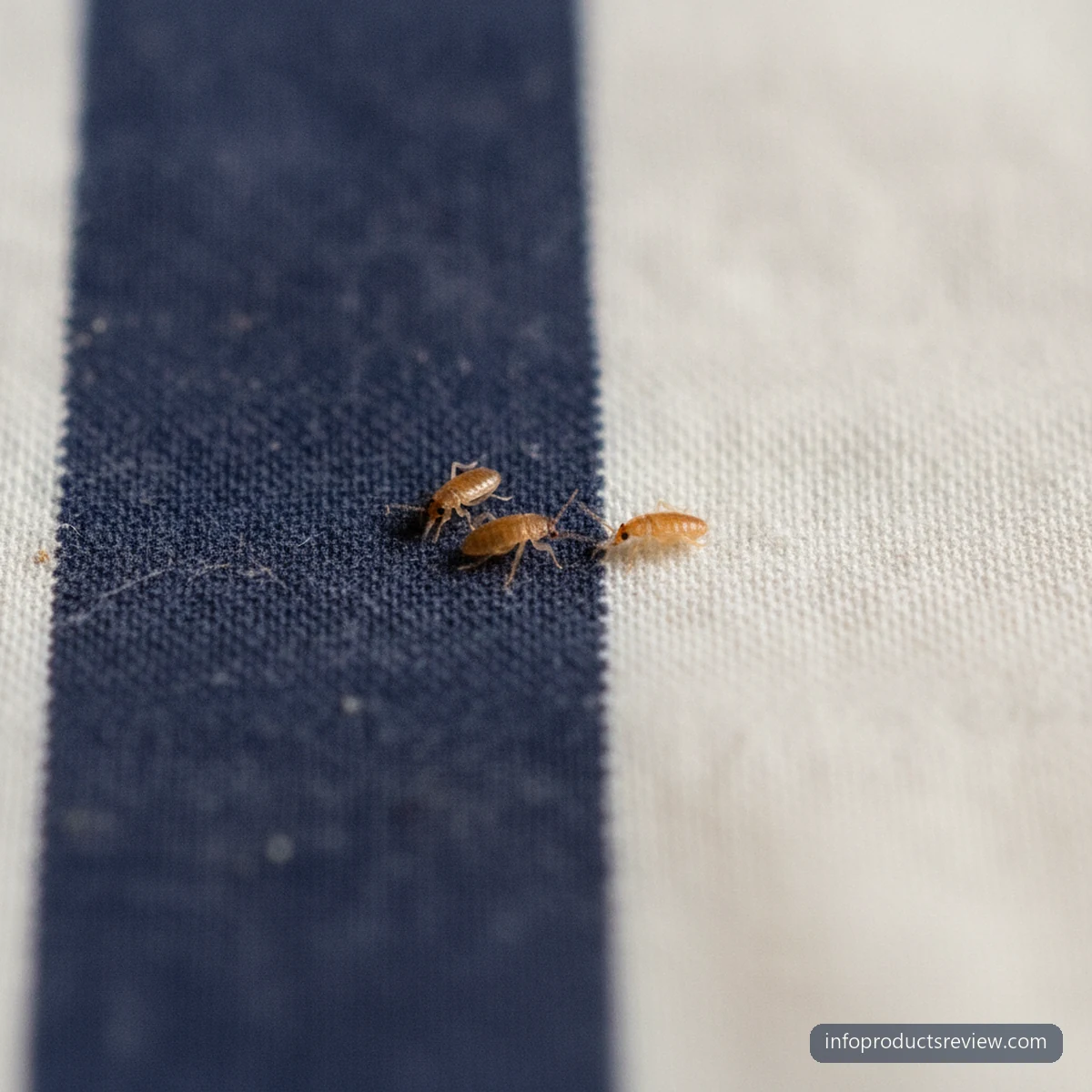
The short answer is no. Nothing in the classical books gives the colour or size of lice a meaning. What circulates online is an elaborate table assigning each shade a separate fate, with no source behind it.
Size reads as scale: larger means a larger matter, smaller a lesser one. It’s a change of degree, not of kind. A large louse that did nothing is still a louse that did nothing.
Colour carries no dependable meaning of its own either. Anyone offering a distinct meaning per shade is adding, not passing anything on. The same problem comes up in our guide to black snake dreams for a married woman.
Moving, spreading, biting: what is the difference?
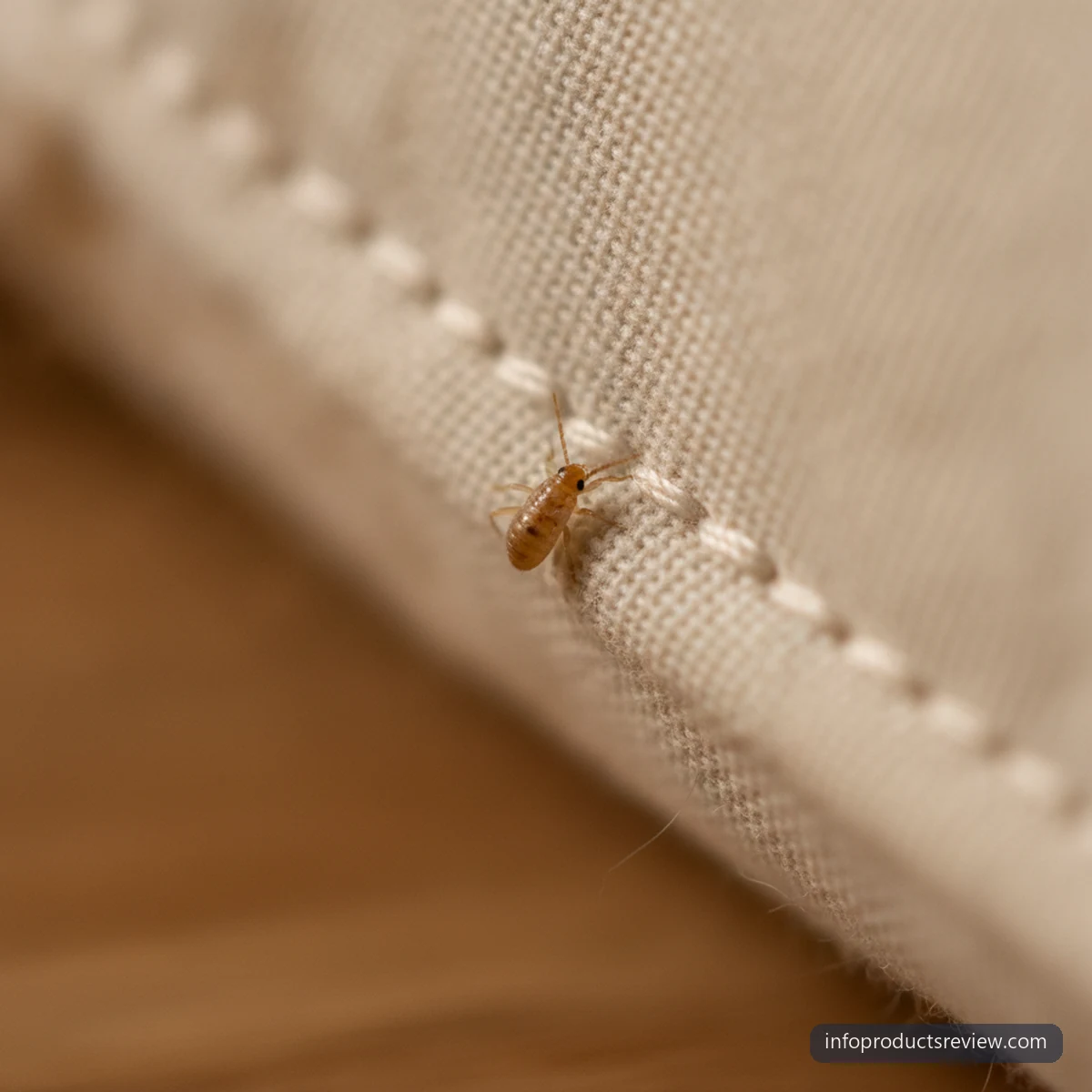
Three neighbouring images, and the differences between them are real. All three are practical readings of the scene, not quotations.
Still lice. Among the lightest images: something present that isn’t developing — like an open file on your desk that neither grows nor shrinks.
Lice moving and spreading. Continuation, not danger: something not yet closed, or a responsibility widening by degrees.
Being bitten. The meaning shifts from “present” to “felt”: an irritation you’re actually living with. How sharp the bite was in the dream measures how sharp the irritation is; it doesn’t turn it into serious harm. There’s no separate meaning for the part of the body bitten, so the tables that offer one are an addition with no basis.
Lice falling away or moving off by themselves. Leans toward relief: a pressure easing without effort from you.
What does clearing the lice away mean?

This is the clearest reassuring image in a lice dream, and it’s worth saying without hedging.
Getting rid of lice, by washing, combing, cleaning or killing them, generally reads as getting past something wearing: a problem ended, disorder brought back into order, a load eased. The more complete it was in the dream, the clearer the reading.
Removing some while some remain reads as part finished and part not, which is an honest picture of most of what happens in a household.
Trying and not managing it reads as an effort still under way, not a final failure. Nothing in the classical books makes that image an ill omen, and the same holds for the equivalent scene in black snake dreams for a single woman.
Remember that this is a possible reading, not a promise. You can clear the lice in a dream and wake to exactly the same workload. The useful step is to ask which task you actually need to finish this week.
On bedding, clothes and household things

Where in the house the lice appeared changes which circle the scene is describing.
On the bed or a pillow. Closest to your rest, your sleep and your privacy. With this image a practical question comes first: how have you been sleeping these last few weeks?
On clothing. Clothes are what other people see of you, so the nearest reading is a preoccupation with what’s noticed or said.
On kitchen or household items. Daily management: repeating work, or the feeling that the same job is being done again every day.
On the children’s things. A clear caution here: this is not a sign of illness, infestation or neglect. The nearest reading is your own concern for them, which is ordinary and says nothing about their state.
I saw lice on my husband or my child: what does that mean?
This scene causes more needless distress than almost any other, so we’ll deal with it head-on.
Someone from your household appearing in a dream tells you nothing about them. Not their intentions, not their honesty, not their health, not their feelings toward you. The mind reaches for the nearest faces because they’re the most present in your day, not because they’re the subject of a message.
The balanced reading is that your own preoccupation is bound up with that circle: worry for them, responsibility toward them, something of theirs sitting in your thoughts. That sits close to the old meaning of “dependants”: the people whose affairs you look after. And the person doing the worrying in that sentence is you.
Because it comes up so often, plainly: this dream establishes no betrayal, no other woman, and no ill intent from anyone. Building a suspicion of a husband on a dream is building on nothing. The harm that follows is real, while the evidence never was.
If something in your marriage was already worrying you before the dream, it deserves a calm conversation with your husband or with someone you trust. The dream adds no evidence to it and takes none away.
When the responsibility outgrows the capacity
You won’t find this in a table of symbols, but it’s closer to many readers’ lives than anything in one.
Running a household rarely means one large task. It means twenty small ones that come back every day. And because each one is small, none of them looks like a reason to be tired. Yet you are.
When lice dreams recur in a stretch like that, the nearest reading is exactly that sensation: being worn down by detail rather than by events. And if lice stand for dependants, the image holds both halves — the people you look after, and the weight of looking after them when it grows.
What helps here isn’t a further interpretation but a practical question: what could be reduced, deferred or shared this week? The dream won’t answer that. It may be a useful prompt to ask it.
Household strain and relationship strain are not the same thing
Many readers arrive here running two quite different things together, and separating them helps.
Household strain is about tasks and management: what has to be done, when, and who will help. It tires you without threatening you.
Relationship strain is about communication, feeling valued, and having room of your own. It’s different in kind, and no list of tasks resolves it.
Read through the classical meaning, lice lean heavily toward the first. They picture the people you provide for and look after, not conflict and not emotional distance.
So reading this dream as a sign of trouble in a marriage is a long way from the source and from the nature of the symbol alike. If something in your relationship is genuinely weighing on you, it deserves a calm and direct conversation, not an inference drawn from a dream.
How much does the feeling inside the dream matter?

More than anything else in it. Ask anyone about a dream and they’ll describe the scene. Ask how they felt and you’ll get the truest part of it.
Unease and disgust lean the reading toward exhaustion and pressure. Calm, or the sense of having it in hand, leans it toward steadiness and capability. Two women can describe the same scene and read it differently, because one woke unsettled and the other simply wasn’t bothered.
Feeling has one more advantage: it’s the part we don’t rebuild after waking. The scene gets quietly rearranged in the retelling. So make it one of the first things you note, not the last. The same point applies to men’s dreams, where feeling is even more often left out of the telling.
One question that helps: if this scene had happened while you were awake, would it have upset you, or would you have dealt with it calmly? Your answer will take you nearer the meaning than any table.
What do the classical dream books actually say about lice?

The oldest surviving reading of this symbol is remarkably short: worms and lice are “dependants”. Two words, and they sit remarkably close to the life of a woman running a home.
“Dependants” here means the people a person provides for and is responsible for. So lice are not an enemy and not envy. They stand for people who live under your care and rely on you.
The reading is supported with a line of early Arabic verse about bellies that “teemed” and sons who grew up — in other words a household that became large and full of people.
That is an interpreter’s judgement, not a religious text. What makes it useful is the method it shows. The early interpreters started from what a thing is like in waking life, then asked what in the dreamer’s life shares those qualities.
Lice are small, numerous, close, and live on the person who carries them. Dependants, likewise, stay close to the one who provides for them and live in their care. The link comes from that resemblance, not from any claim to knowledge of the future.
Later popular compilations, including a widely sold book attributed to Ibn Sirin, give lice other meanings, such as small worries that keep coming back. Those meanings aren’t confirmed in any reliable source, and the attribution to Ibn Sirin isn’t established. So we mention them only as circulating ideas and build nothing on them.
What the classical books don’t say is worth stating just as plainly. There is no meaning specific to married women for this symbol, no link between lice and betrayal or another woman, none with witchcraft or the evil eye, and no mention of divorce or pregnancy. Anyone offering those in the name of the old books is adding, not passing anything on.
Lice as dependants: the side most pages leave out
Most of what is written about this dream takes one side only: lice as an enemy or a misfortune. The classical line points somewhere else entirely.
If lice mean dependants, the more natural question for a married woman isn’t “who wishes me harm?” but “who relies on me?” That is a very real question: children, a husband, perhaps ageing parents, and a household that needs running every single day.
That reading isn’t a bad one. People relying on you describe a circle of responsibility. It can be tiring, but it’s tiredness with a purpose. The dream leans this way when the scene is calm: lice that do no harm, no fear, no disgust strong enough to wake you.
When the scene is tense and upsetting, it leans instead toward that responsibility feeling heavier than your capacity right now. That is worth attending to in waking life, not explaining away with a hidden cause.
“Dependants” here is not news of a growing family, a pregnancy or a baby. The books are describing what lice resemble, not what is going to happen.
Some pages also link lice with small, scattered sums of money. That reading isn’t confirmed in the sources, so we don’t build on it.
What is actually established about disturbing dreams, and what isn’t?
Two things often get blurred together. One is interpreting the lice symbol, which is human judgement. The other is the Prophet’s guidance on what to do after a dream you dislike, which is recorded in the two most authoritative hadith collections, Sahih al-Bukhari (7044) and Sahih Muslim (2262).
That guidance doesn’t ask you to hunt for an interpretation. It asks you to seek refuge in God and leave the dream alone. In Sahih al-Bukhari, Book of Dream Interpretation, hadith 7044:
A good dream is from God. If one of you sees something he likes, let him tell it only to someone he loves. And if he sees something he dislikes, let him seek refuge in God from its harm and from the harm of Satan, spit lightly three times, and not tell anyone about it, for it will not harm him
The hadith opens with the good dream, which comes from God, and then turns to the dream you dislike: seek refuge in God from its harm, spit lightly three times, and tell no one. It closes with “it will not harm him”. That is guidance for anyone who sees something they dislike, not an interpretation of any particular symbol.
Sahih Muslim, Book of Dreams, hadith 2262, records the same guidance with one practical addition — turning away from the side you were sleeping on:
If one of you sees a dream he dislikes, let him spit to his left three times, seek refuge in God from Satan three times, and turn over from the side he was lying on
In Muslim’s wording the spitting is to the left, three times, with refuge sought from Satan three times, and then turning over. For you, the next step is simple. If the dream left you uneasy, seek refuge in God, spit lightly to your left three times, turn onto your other side, and don’t retell it to everyone.
Al-Bukhari’s hadith 7044 is explicit that it will not harm you. That line is worth reading twice, because it settles half the worry that brought you to this page.
Much more is not established. No text makes a particular dream proof of betrayal, witchcraft or the evil eye. No text makes a dream binding on a decision about a marriage, a divorce or a pregnancy. And no religious text gives lice a fixed meaning. Every meaning on this page is an interpreter’s opinion, which can be right or wrong.
What do modern sleep references say?
This section stands apart from the last one deliberately. The two aren’t answering the same question, and merging them misrepresents both.
What sleep references say clearly: distressing dreams cluster with stress, with short and broken sleep, and with anxiety. Frightening dreams concentrate in the later part of the night, when REM sleep runs longest. Recurrence tracks strain far more closely than it tracks any particular symbol.
You can read more in the Sleep Foundation’s guide to nightmares and the National Institute of Neurological Disorders and Stroke’s guide to sleep.
The image of lice sits close to a feeling that anyone running a home will recognise: something small that won’t stop, a job that returns as soon as it’s done. That closeness doesn’t mean psychology “confirms” the classical reading. It’s an observation about a feeling, not proof of a symbol.
And we don’t say this dream diagnoses anything. Diagnosis is a clinician’s work. You can read how we keep the two apart in our English dream interpretation section.
When is the dream just the mind still working?
This question comes before interpretation and is rarely asked. Sahih Muslim, Book of Dreams, hadith 2263, divides dreams into three kinds: a good dream, a distressing dream from Satan, and a dream from what a person tells himself.
Dreams are of three kinds: a good dream, which is glad tidings from God; a distressing dream, from Satan; and a dream from what a person tells himself
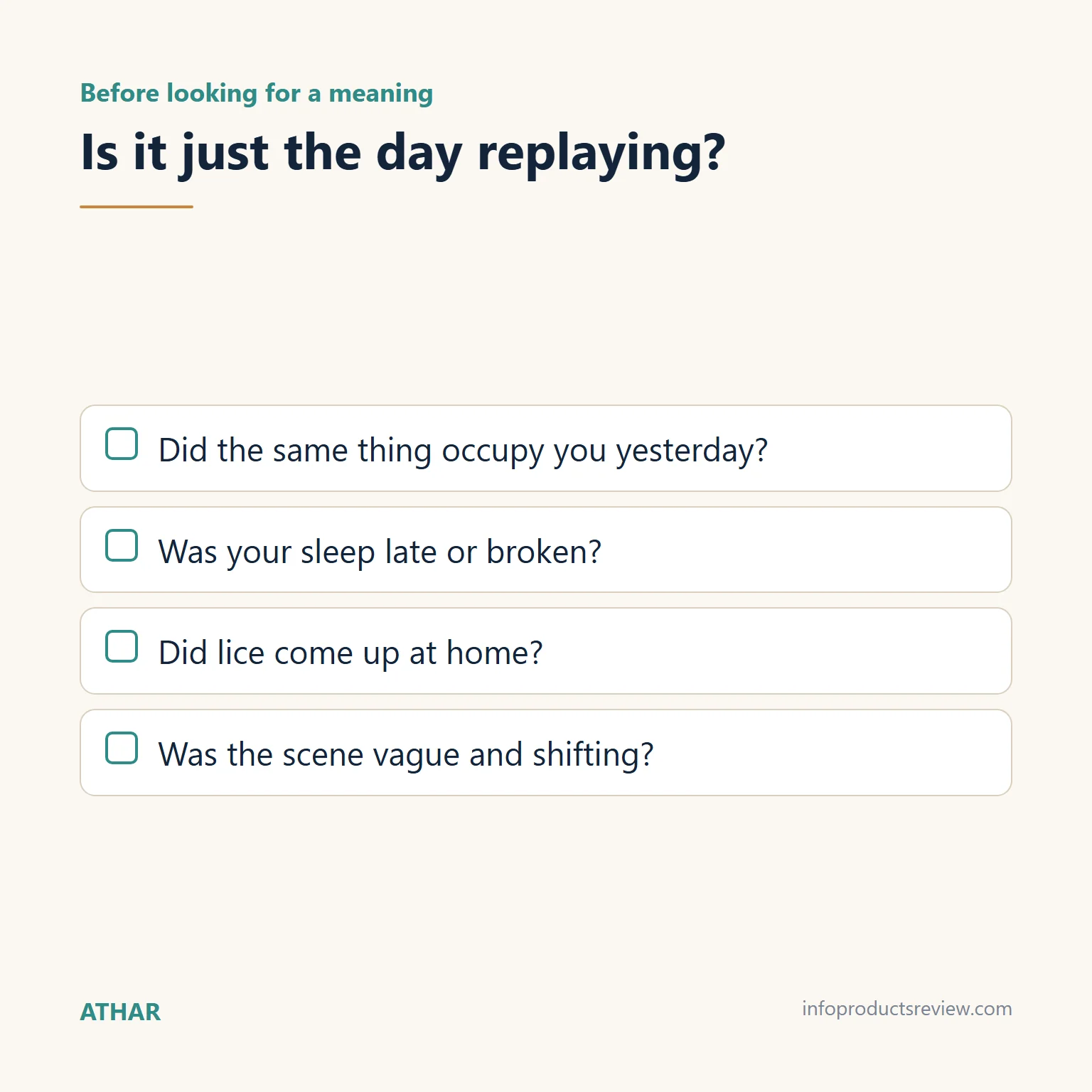
So some dreams are simply the mind talking to itself — an echo of what filled your waking hours and your thoughts before bed. The hadith names the kinds; it doesn’t give a sure test for each. These practical signs may help, though none of them decides it alone:
- The dream repeats the shape of something that filled your day.
- You’d been cleaning, sorting, or dealing with something similar before bed.
- You slept late, badly, or in broken stretches.
- The scene was vague and shifting rather than sequential.
- You’d been searching this very topic before you slept.
That last one earns a pause: reading about lice dreams before bed is an efficient way to dream about lice. If that’s the sequence, the dream is about your evening.
There’s a pattern worth naming, too. A dream unsettles you, so you search; the results alarm you, so you search more; you sleep worse and dream again. At that point the dream has stopped being the problem. The way out isn’t another page. It’s to write the dream down once and leave it alone.
A common version of this: you spent the day tidying up after a long visit, then dreamt of small, scattered mess. Or you’d been following a health matter for one of the children, and a small, nagging worry turned up in the dream. In cases like these the dream needs no symbolic reading. Look at the near explanation first, and only then at the distant one.
Does the dream mean real lice, or an illness?
No, and the confusion is common enough to be worth a firm line.
Seeing lice in a dream is not evidence of real lice in your home, not an indicator of illness, and not a reason to start treating anyone. The reverse holds too: if you’re dealing with real head lice at home and then dream of them, the dream is most likely an echo of your waking life.
If you have an actual health question, it belongs with a clinician or an official health source, such as the NHS page on head lice and nits, not on a dream-interpretation page. We offer no diagnosis and no treatment here. The same separation runs through our guide to snake dreams during pregnancy, where the temptation to medicalise a symbol is strongest.
Claims about lice dreams that need correcting
- “Lice indicate betrayal.” The classical books make no such link, and no suspicion of a person should ever rest on a dream.
- “They indicate witchcraft or envy.” The old books connect this symbol with neither; the link was added later.
- “A lot of them means disaster is coming.” Number sits closer to how much is on your plate than to catastrophe.
- “For a married woman it means pregnancy.” No basis, and dreams don’t announce a pregnancy or its timing.
- “Colour decides the meaning.” The colour of lice carries no meaning in the classical books.
- “Recurrence is a confirmed message.” Recurrence isn’t a meaning of its own; from the sleep side it tracks strain.
What this dream cannot establish
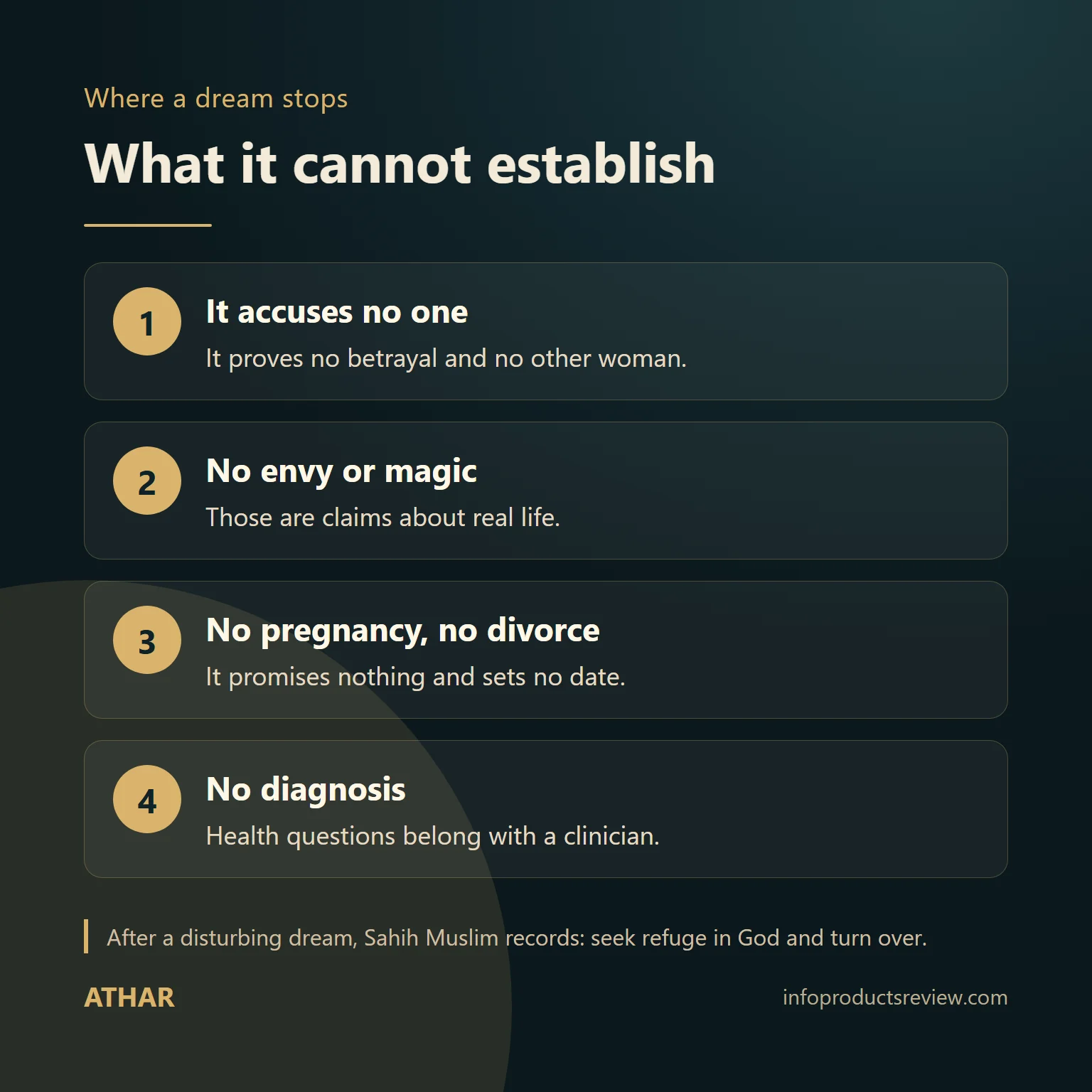
- It cannot establish betrayal or ill intent from anyone.
- It cannot name a person, in any direction.
- It cannot establish witchcraft or the evil eye.
- It cannot set a time for anything.
- It cannot announce a pregnancy or a divorce.
- It cannot diagnose you or anyone in your household.
- It is not grounds for a decision: not a confrontation, not an estrangement.
It helps to test any page on this subject, ours included, with four quick questions. Does it name a specific book and author, or only “the old books”? How certain is it — the early dream books use “perhaps” and “may” constantly, and flat certainty usually signals a modern addition.
Then two more. Does it give a timeframe, such as “within days”? And does it tie lice to witchcraft, envy or betrayal? The classical tradition does none of that, so a page that does is writing on its own account.
What to do with the dream
- Write it down once, within minutes: the place, what happened, how you felt.
- Read it back that evening. Distance changes how a dream looks.
- Look at the day before it, and your sleep, before you reach for a symbol.
- Don’t build a decision on it: no confrontation, no accusation.
- If it recurs and tires you, start by reducing the load rather than by searching for more meaning.
If you can’t remember the details, that’s normal. Memory keeps the strongest image and loses the rest within minutes of waking. A general image gets a general reading, which is more honest than someone supplying details you never saw.
Try recalling the feeling instead of the scene. Many women can’t remember the place or the number but know exactly whether they were frightened or indifferent, and the feeling alone gives you half the reading.
And something concrete, because telling someone not to worry helps nobody. Sit for two minutes and list the small repeating things occupying you this week. Most people find there are between five and ten, that each is small, and that the total is what exhausts.
Then sort them: what can end today, what can wait a week without harm, and what someone else could share. Three questions turn a vague weight into something you can act on. Sleep is the third lever: short sleep makes unsettling dreams more likely, and unsettling dreams spoil sleep, so easing either side eases the other.
What have interpreters said in recorded interviews?
Two short pointers to published interviews, because hearing how someone reasons can be clearer than reading about it. Take them for what they are: personal views and experiences, not religious rulings and not a reading of your dream.
In the first, an interpreter describes a man who dreamt of three lice in his head, and how he read them as a dispute with three people who wanted money from him. The interesting part is the method rather than the result: lice live off someone else and take from them, and the interpreter seems to have built his reading on that quality. It’s one experience, not a rule for everyone who dreams of lice.
An example of reading a dream from a real quality of lice. Summarised from the Arabic interview; a personal experience, not a rule.
In the second, a different interpreter draws a line that matters in any marriage: don’t let dreams run your decisions, because interpretation stays a matter of likelihood.
A practising interpreter's own limit on what dreams are for. From the English subtitles published with the interview.
Don't determine your life, or make decisions, or serious matter concerns based on dreams.
That sits well with the guidance in al-Bukhari’s hadith 7044 above: a good dream may bring comfort, and a disturbing one is met with seeking refuge in God and not spread. But a dream doesn’t replace conversation, understanding, and making decisions in waking life.
Situations and examples of a lice dream
These are possible readings of common scenes, built on the scene itself and on the old meaning of “dependants”. They are not quotations of a set meaning for each case.
A lot of lice in the house, and I never touched them
A large number with no action: many demands gathered together rather than a threat. If there was no fear in it, lighter still.
Lice on my pillow while I slept
The narrowest circle: your rest and your privacy. Start with the sleep question before the symbol.
I cleaned the house of them until they were gone
Among the clearest reassuring images: disorder brought back into order, or a load that ended.
One bit me and I woke
An irritation genuinely felt rather than serious harm. Its sharpness in the dream is the measure, with no timing attached and no meaning to where it bit.
I saw lice on my husband
The scene tells you nothing about him. The nearest reading is your own preoccupation with something in that circle. No confrontation and no suspicion should follow from it.
On clean clothes straight out of the wash
A subtle one: something you thought was finished coming back. The nearest reading is a matter closed in appearance, not in fact.
At my parents’ house rather than mine
The extended family rather than your daily circle. Usually a preoccupation connected to them.
At the front door
Where inside meets outside: what’s arriving from beyond the house, whether obligations, news or visitors.
It repeated during a crowded week
Recurrence isn’t a meaning of its own. Paired with a crowded season, it’s most likely an echo of the crowding.
I woke up itching
Common, and unrelated to interpretation: attention to the body rises after insect dreams. If the itching continues while you’re awake, that’s a question for a clinician.
I saw them and felt nothing at all
The absence of feeling is a useful detail, not a missing one. When a scene stirs nothing in you, the reading leans toward something present that isn’t actually draining you, however many lice the picture showed.
Someone else cleared them away for me
A gentler image, and more common than people expect. The nearest reading is shared load: what tires you isn’t something you’re required to carry alone. It says nothing about any particular person or their intentions.
Quick reference: detail and nearest reading
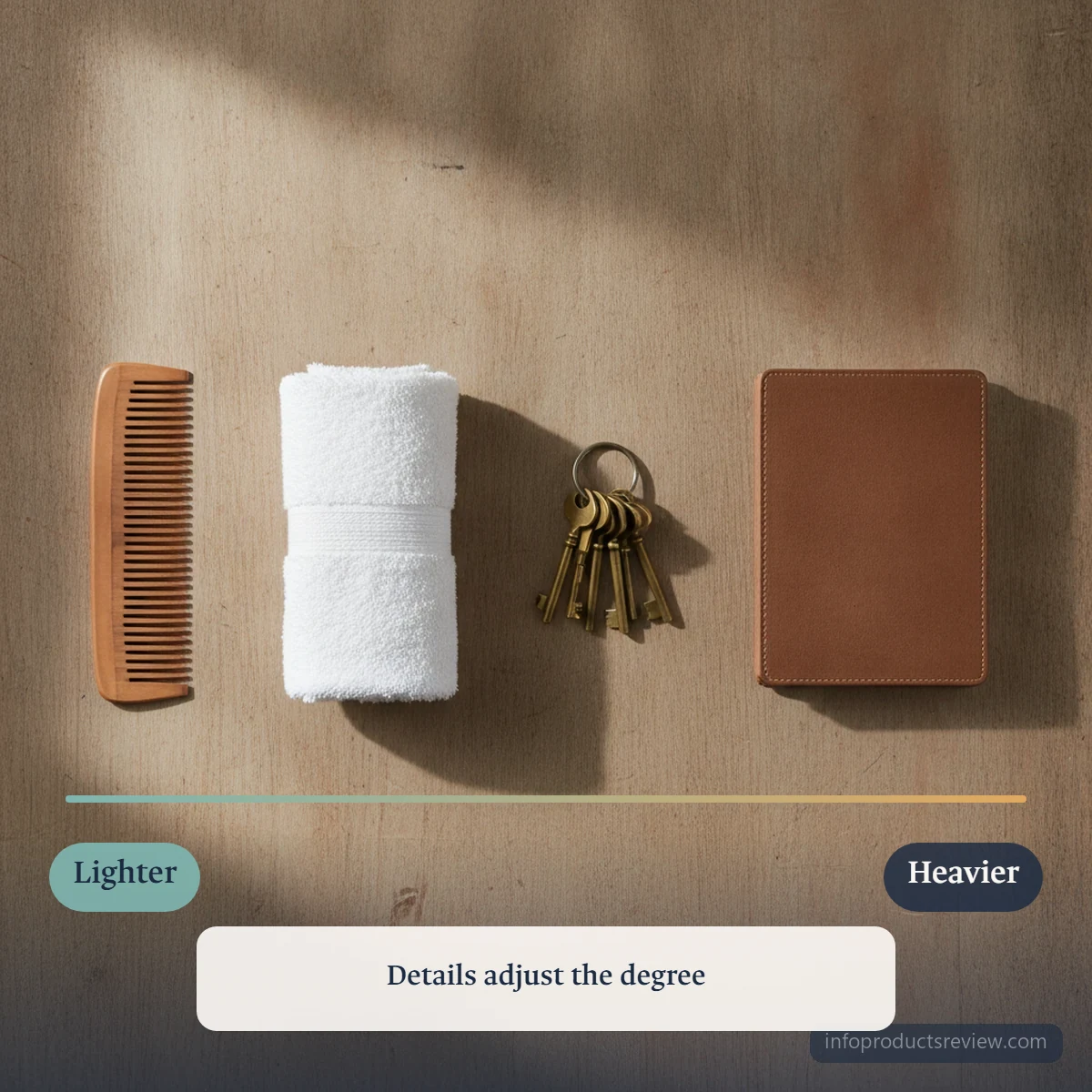
A summary, not a substitute for the sections above. Each line assumes the rest of the scene is neutral. The root meaning is that lice are dependants; the lines below are practical readings of the details.
- Many lice: many demands and tasks, not many opponents.
- Few lice: a limited preoccupation.
- Still: present but not developing.
- Moving and spreading: continuation, not danger.
- A bite: an irritation felt, scaled to its sharpness.
- Cleared completely: getting past something wearing.
- Partly cleared: partial relief.
- The bedroom: rest and privacy.
- Kitchen and living room: the daily running of the home.
- The doorway: what arrives from outside.
- Your parents’ home: the extended family.
- On clothing: what other people see of you.
- You felt calm: leans toward steadiness.
- You felt weighed down: leans toward exhaustion; ask what is draining you while you’re awake.
Related dreams
These guides read nearby symbols the same careful way:
- Dreaming about lice during pregnancy: because “does this mean a pregnancy?” is one of the most common questions about this dream, and that page answers it directly.
- Dreaming about lice as a man: the same household circle seen from a husband’s side.
- Lice in your hair as a married woman: when the dream happens in your hair or your children’s, combing included.
Frequently asked questions
What do lice most often mean in a married woman’s dream?
The classical books read lice as “dependants”, the people a person provides for. For a married woman the nearest reading is the circle of responsibility at home, and an upsetting scene may point to small, repeating demands that have grown heavy. The place, what happened and how you felt decide between the readings.
Does it indicate betrayal or another woman?
No. The old books connect this symbol with nothing of the kind, and a dream establishes no claim about a person. It is not grounds for a confrontation or a suspicion.
Does it mean witchcraft or envy?
No. That association was added later until it began to sound traditional; it has no basis in what the classical books say about lice.
I cleaned them away in the dream. Is that good?
It’s among the clearest reassuring images: something wearing that you got past, or order restored. The more complete it was, the clearer the reading. It remains a possible meaning, not a promise.
One bit me. Does that mean harm?
The nearest reading is an irritation genuinely felt rather than serious harm, measured by how sharp it was in the dream. There’s no separate meaning for where it bit, and no timing for anything.
I saw lice on my children. Is something wrong with them?
A dream gives no information about their health or their circumstances. The nearest reading is your own concern for them, which is ordinary and not news about anyone.
Does it mean a pregnancy is coming?
No. There’s no basis for that in this symbol. “Dependants” describes the people you already provide for, not news of a baby, and dreams don’t announce a pregnancy or its timing.
Is the meaning different because I’m married?
The circle differs, not the symbol. The books give no meaning specific to married women; what’s specific comes from your life: the home, the responsibilities, the relationship, the extended family.
Is the reading for nits different from lice?
Different in the shape of the scene, not the root of the meaning. Nits are still and unhatched, leaning toward what hasn’t taken effect; lice are present and moving, leaning toward what’s already under way.
It repeated several nights. What does that mean?
Recurrence isn’t a meaning of its own. The nearest reading is a preoccupation that keeps returning, and from the sleep side it tracks strain and short sleep more than the content of the dream.
Should I tell anyone about it?
You don’t need to interpret it, and you don’t need to retell it. For a dream you dislike, Sahih al-Bukhari (7044) records seeking refuge in God from its harm, spitting lightly three times and telling no one; Sahih Muslim (2262) has spitting to your left three times, seeking refuge from Satan three times and turning onto your other side. Talking about how you feel with someone you trust is a different matter, and often helpful.
Where do I read about my exact situation?
If the lice were in your hair or your children’s hair, the guide to lice in your hair as a married woman is closer to your dream. For comparison, the single woman’s guide reads the same symbol for a different circle. Either way the method is the same: place first, then what happened, then how you felt.
What you can reasonably take from this
If you arrived worried, here is what the source actually supports.
The only meaning the classical books give lice is “dependants”: people in your care, not an enemy and not a misfortune. The commonest versions of this dream are also among the lightest: lice seen doing nothing, or a few that pass.
The clearest reassuring image, clearing them away, is a common one too. And if there was no fear in it, the reading leans toward steadiness rather than threat.
The readings that would genuinely have alarmed you, such as betrayal, witchcraft, or an event with a date on it, are precisely the ones the old books don’t give. That isn’t reassurance for its own sake. It’s what remains once the additions are removed.
If you tell the dream to anyone at all, al-Bukhari’s hadith 7044 reserves a good dream for someone you love and asks that a disturbing one not be spread. Retelling an unsettling dream tends to enlarge it: each telling rebuilds the scene and adds to it.
Telling it around the house can also pass the worry to others for no reason. Someone who hears that you saw lice on one of your children may act on that, and a suspicion or an upset can grow out of nothing. Writing the dream down once for yourself and then leaving it is usually enough.
In summary
- The classical meaning: lice are dependants, the people you provide for. The dream sits closest to the circle of responsibility in your home.
- Start with the place, then what happened, then how you felt. Number and colour come last.
- Clearing them away is among the clearest reassuring images; their staying means continuation, not danger.
- The dream establishes no betrayal and no witchcraft, names nobody, sets no date, and announces no pregnancy.
- Don’t build a decision or a confrontation on it.
- If it recurs and wears you down, start by reducing the load and improving your sleep.
And if one thing is worth keeping: a possible meaning stays possible, however confidently it is said.
Written and reviewed by: the ATHAR editorial team. Quoted passages from the classical and hadith books are taken from the editions listed in the sources. English renderings of Arabic texts are our own translation.
Note: what appears here is a possible meaning, not a confirmed fact, and it changes with the details of the dream and the dreamer’s circumstances. Nothing here predicts the future, diagnoses a medical or psychological condition, or establishes betrayal, witchcraft, envy or hostility from any person.