

You wake with a jolt and run your tongue along your teeth to check they’re all still there. The dream was vivid: a tooth wobbling and then dropping out, a handful of teeth crumbling into your palm, or a molar breaking with pain and blood. Then the fear sets in. Does it mean someone is going to die? Am I ill? Is something about to happen to my family?
Dreams of teeth falling out are among the most common dreams people report, and among the most surrounded by scaremongering. Plenty of pages call them an omen of death without any detail at all, or attach confident meanings to one interpreter or another with no book and no page behind them.
This is a complete guide to teeth falling out as a dream symbol: which teeth fell, how they fell, where they landed, and who had the dream. The particular case of an unmarried woman, with everything that tends to be on her mind around study, engagement and family, has its own guide: teeth falling out in a dream as a single woman. Here we only touch on it.
Throughout, we keep three things apart: what a classical interpreter actually recorded, checked against the printed page; what the most authoritative hadith collections establish about handling dreams; and what’s simply one person’s view in an interview or a claim that circulates with no source. And we say plainly what this dream can’t tell you.
The bottom line
In the classical dream books, teeth most naturally stand for your household and your relatives, and teeth falling out is usually read as something to do with them: closeness or distance, connection or strain, being together or apart. It is not, in most cases, news of a death.
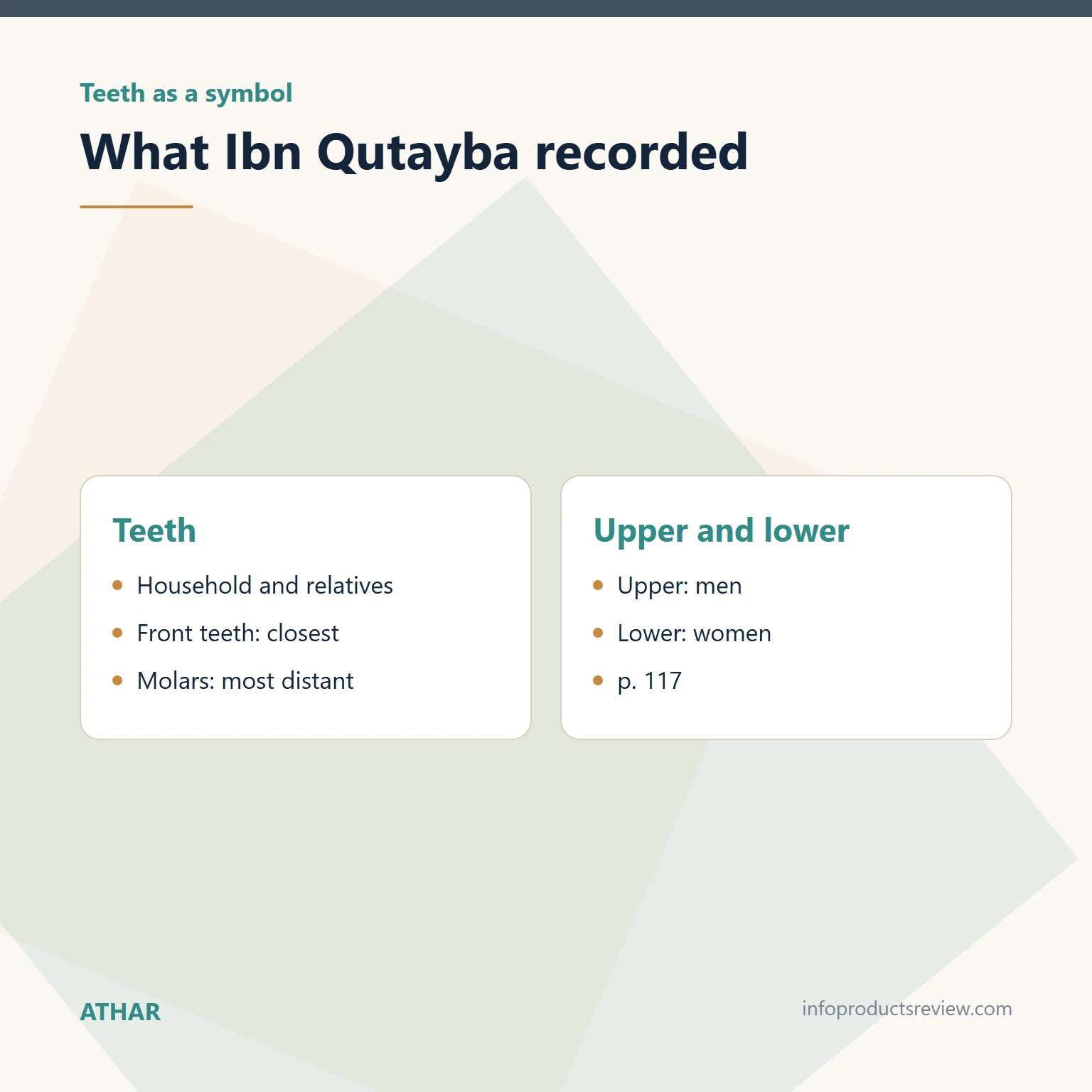
- In Ibn Qutayba’s book: in a passage we checked on the page, teeth are the household and relatives. The front teeth are the closest, the molars the most distant, the upper teeth men and the lower teeth women.
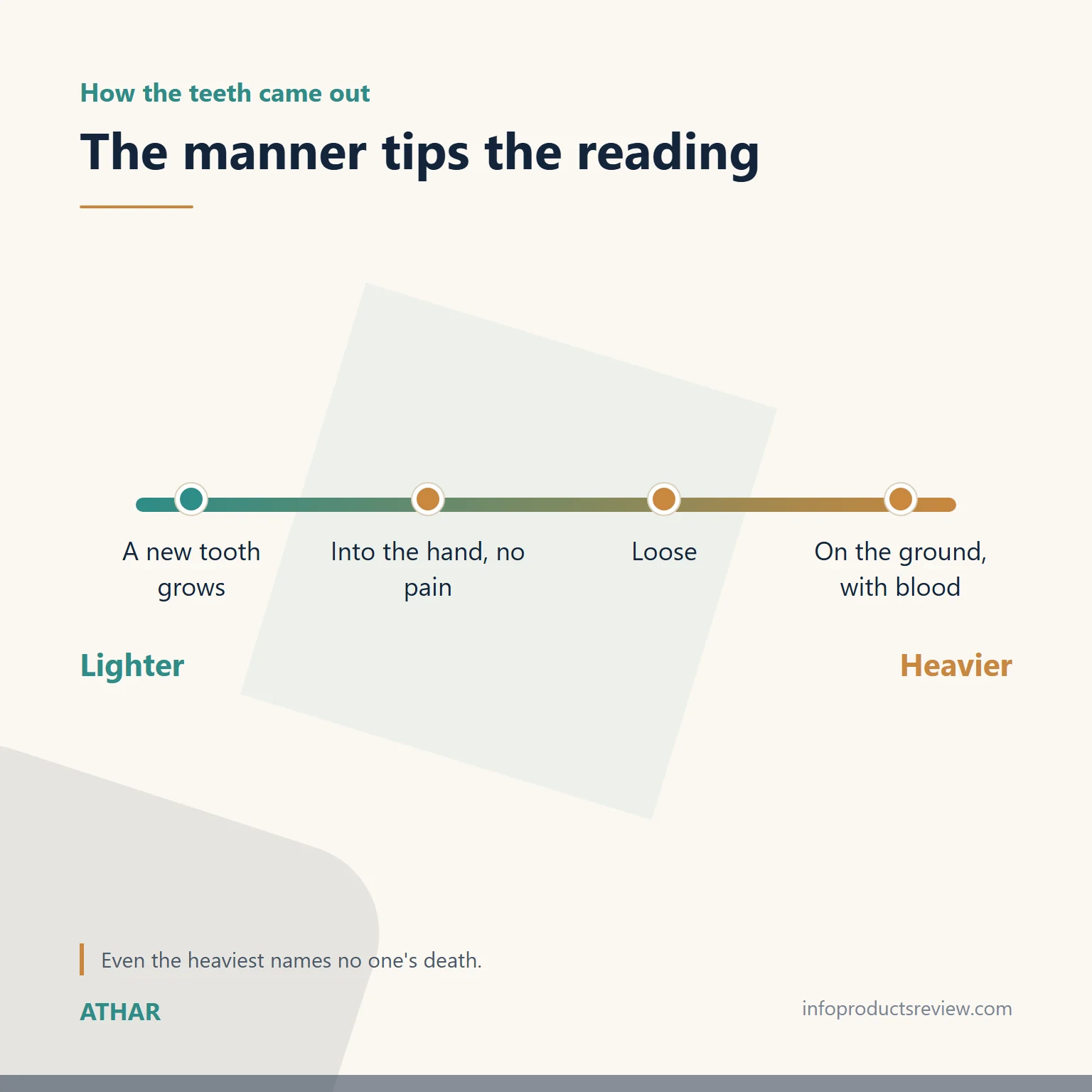
- Where and how they fall matters: into your hand isn’t the same as onto the ground, painlessly isn’t the same as with blood, and one tooth isn’t all of them.
- In published interviews: some interpreters say the ominous reading of this dream is rare, and that it’s usually read in terms of relationships or change.
- Keep it in proportion: interpretation is analogy and conjecture, not certainty, and a bad dream is something to seek refuge from, not something that can harm you.
This dream can’t tell you that anyone will die, diagnose an illness, prove a falling-out, or serve as the basis for a decision.
What this page covers
- The bottom line
- Why are teeth dreams so common?
- Which details change what the dream may mean?
- What teeth mean in the classical dream books
- Upper teeth and lower teeth
- Front teeth and molars
- All your teeth falling out
- Teeth falling into your hand
- Teeth falling on the ground, or lost
- Teeth falling out with no pain or blood
- Teeth falling out with pain or blood
- Loose teeth that don’t fall out
- Decayed, broken or blackened teeth
- Having a tooth pulled in a dream
- A new tooth growing
- A single tooth falling out
- False teeth, crowns or braces coming out
- Someone else’s teeth falling out
- Swallowing a tooth
- When the dream keeps coming back
- How the dreamer’s situation changes the reading
- A child’s teeth falling out
- How to make sense of such different readings
- Does dreaming of teeth falling out mean death?
- Anxiety and disturbing dreams
- When it’s a health question, not a symbol
- What’s attributed to Ibn Sirin about teeth dreams
- What’s actually established in Islam about dreams
- Common claims that need correcting
- What this dream can’t tell you
- What to do after a teeth dream
- How to describe the dream so it can be read
- What interpreters say in recorded interviews
- Examples
- Quick table: the detail and the closest reading
- Related dreams
- Frequently asked questions
- What does dreaming of teeth falling out mean in general?
- Does dreaming of teeth falling out mean death?
- What’s the difference between upper and lower teeth falling out?
- What does it mean when teeth fall into your hand?
- What does it mean if teeth fall out with no pain or blood?
- What if teeth fall out with blood?
- What do molars falling out mean?
- What does it mean if all your teeth fall out?
- What does a new tooth growing mean?
- What should I do after a disturbing teeth dream?
- Does the dream mean something’s wrong with my teeth?
- Is this interpretation definitive?
- In summary
- Sources and references
Why are teeth dreams so common?
Your teeth are one of the most visible parts of your face. People see them when you smile and speak, and you use them every day without thinking. Losing them in a dream is a powerful picture of losing something close, visible and important.
The US National Institute of Neurological Disorders and Stroke notes that events from the day often invade our thoughts during sleep, and that people under stress or anxiety are more likely to have frightening dreams. Someone going through a big change, worrying about a family member or under pressure at work may well have dreams full of loss and upheaval, and teeth falling out is one of the commonest forms that takes.
Sometimes, though, people have this dream at the calmest point in their lives, with nothing in their day to explain it. That’s where the classical reading of the symbol comes in, and it ties teeth to family and kinship.
If you want the broader approach first, our guide to dream interpretation explains how every symbol on this site is read: sources first, then limits.
Which details change what the dream may mean?
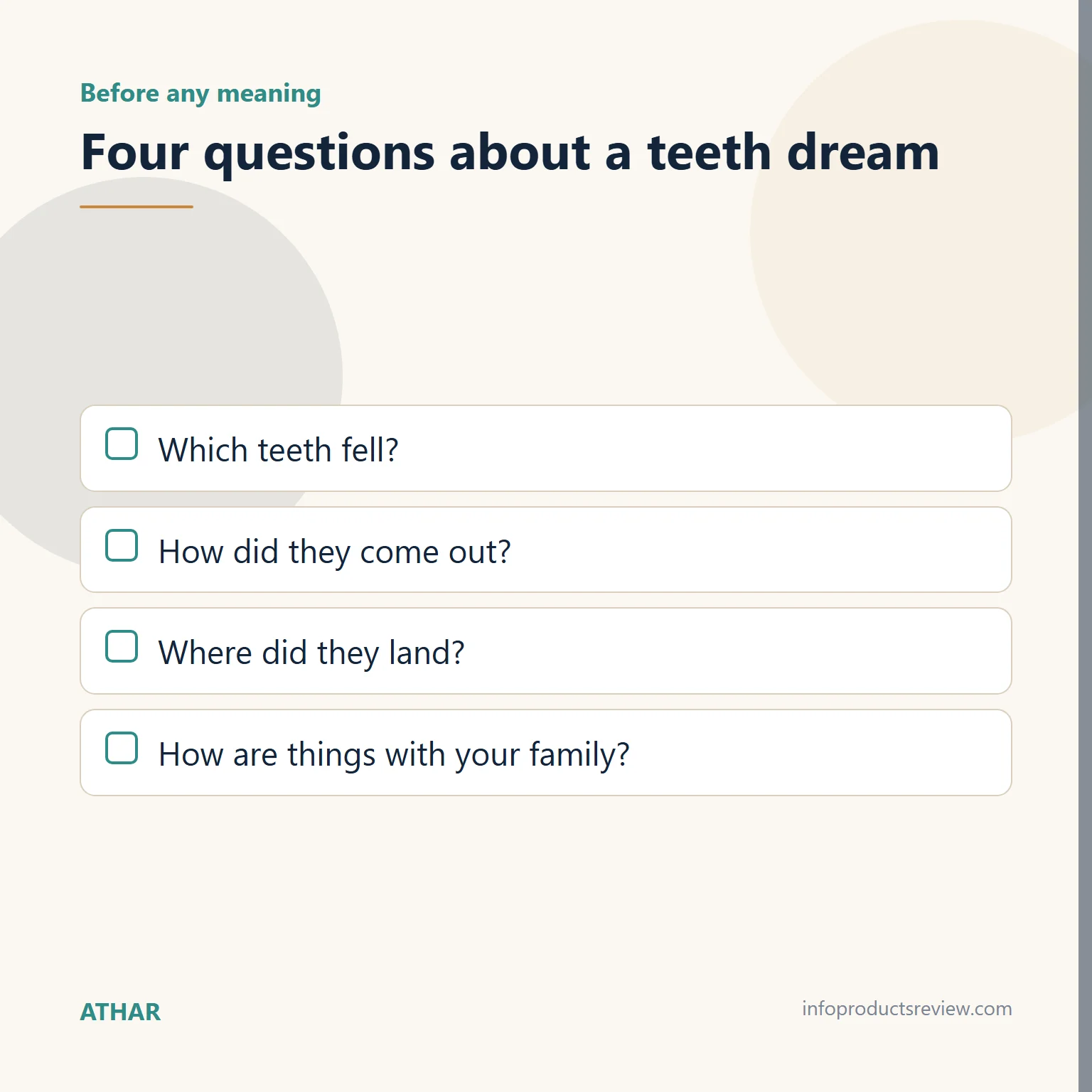
Here they are, from most to least important:
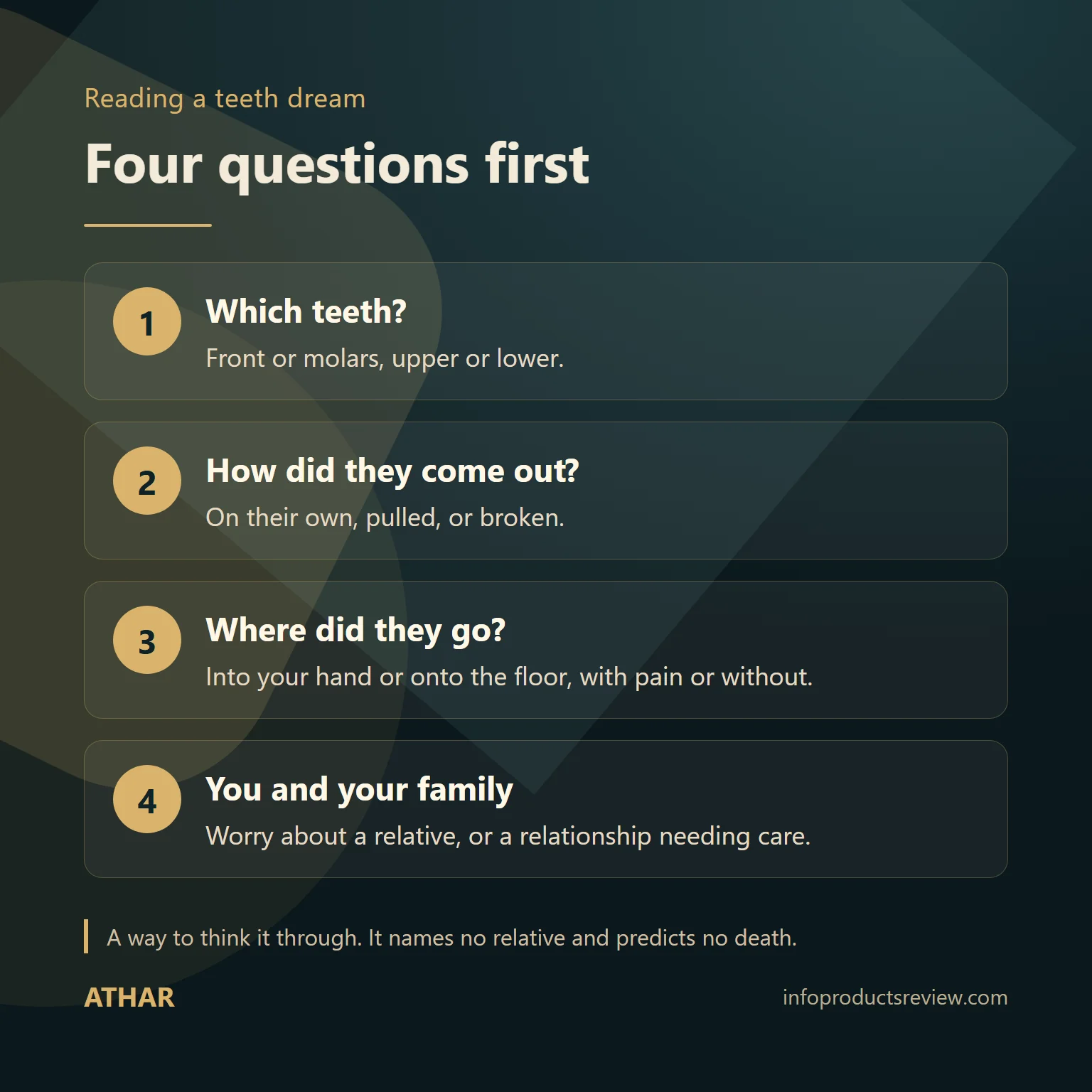
First: which teeth? Front teeth or molars? Upper or lower? One tooth, several, or all of them?
Second: how did they come out? On their own for no reason, after wobbling, pulled by someone, or broken?
Third: where did they go? Into your hand, into your lap, onto the floor, or swallowed and lost?
Fourth: was there pain or blood? And how did you feel: calm, terrified, or embarrassed in front of people?
Fifth: your real life. Are you worried about someone in your family? Is a relationship strained? Are you going through a big transition? And do you actually have a problem with your teeth?
What teeth mean in the classical dream books
In his book on dream interpretation, the ninth-century scholar Ibn Qutayba has a chapter on the parts of the body and what they signify in dreams. On teeth, he’s explicit:
Teeth are the people of one's household and one's relatives; the front teeth are the closest of them, and distance grows with distance from them. The molars are the most distant.
He explains the comparison in the same passage: kinship is likened to teeth because they sit close together and are joined, and people speak of “interlocking ties of kinship.” Just as teeth line up side by side in the mouth, a family gathers around a person, the closest first.
He adds that the upper teeth are men and the lower teeth are women, and that whatever good, decay, loss or change you see in them applies to those people. And if someone sees a new tooth growing that wasn’t there before, it means some benefit for a brother or a child.
That’s the key to the whole dream. The first question isn’t “Is someone going to die?” It’s “Who in my family might this tooth stand for, and what’s happening in my relationship with them?”
This is the reading of a ninth-century interpreter, and its value is in showing the logic of the symbol. It shouldn’t be pinned on a particular person or treated as a confirmed prediction.
Upper teeth and lower teeth
Following Ibn Qutayba’s text, the reading can be laid out like this:
Upper teeth: read as the men in your family, such as your father, brothers or uncles. Losing one, or seeing it change, sits closer to something about one of them, or about your relationship with them.
Lower teeth: read as the women in your family, such as your mother, sisters or aunts. What happens to them sits closer to something about those relationships.
One interpreter says in a published interview that this division has some basis, but he mostly reads a problem with a tooth as a problem in a relationship, not a disaster for the person. There might be tension between you and a parent or a relative, and the dream pictures it.
No one should build a fear about a specific person on this split. It points in a direction; it doesn’t name anyone.
Front teeth and molars
Ibn Qutayba says the front teeth, the incisors in the middle of your mouth, are your closest relatives, and distance grows with distance from them, so the molars are the most distant.
Front teeth falling out: because they’re the closest and the most visible, the dream sits nearer to the people at the centre of your life. It also sits nearer to embarrassment, since front teeth are what others see.
Canine teeth: between the front teeth and the molars, so they’re read as people who are moderately close.
Molars: closer to more distant relatives, or to something less visible. One interpreter says in an interview that back teeth can also be read as savings set aside and then spent on something important.
Wisdom teeth: we found no specific text on them in the sources we checked; they fall under molars in general.
All your teeth falling out
Dreaming that every tooth you have is falling out is one of the most frightening versions of this dream, and one of the most exaggerated online: “a death in the family,” “disaster for everyone.”
For historical context only: the digital copy we have of a later dream book attributed to the Damascene scholar Abd al-Ghani al-Nabulsi links losing all your teeth to a long life. That copy is unannotated and can’t be tied to a verified edition, so we don’t use it as evidence for any meaning.
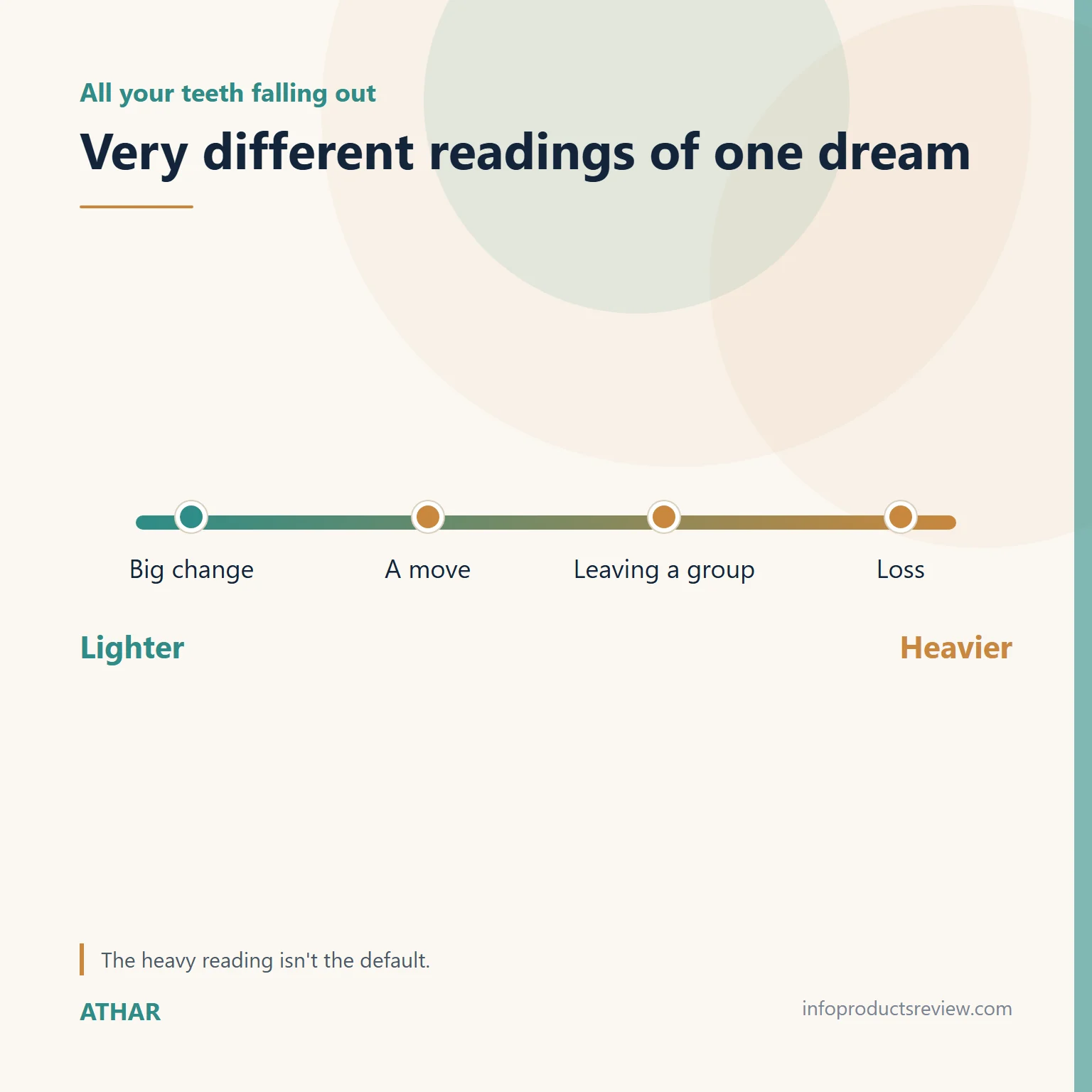
One interpreter describes, in a published interview, a man who dreamed all his teeth fell out. He read it as the man being transferred alone to a new unit where he knew nobody, and says that’s what happened. He adds that students often have this dream just before graduating, when they’re about to part from their classmates as everyone goes their own way.
So the closest reading of all your teeth falling out is a big change in the world around you: a move, leaving a group behind, a new stage of life. On its own, it doesn’t mean anyone will die.
Teeth falling into your hand
Teeth falling into your hand, where you can hold them, is a different picture from teeth hitting the floor or disappearing. They’re still with you, within reach.
The unannotated digital copy of al-Nabulsi’s book also says teeth falling into the palm are coins. We record that as historical context about what circulates in dream books, not as evidence, because the text can’t be tied to a verified edition.
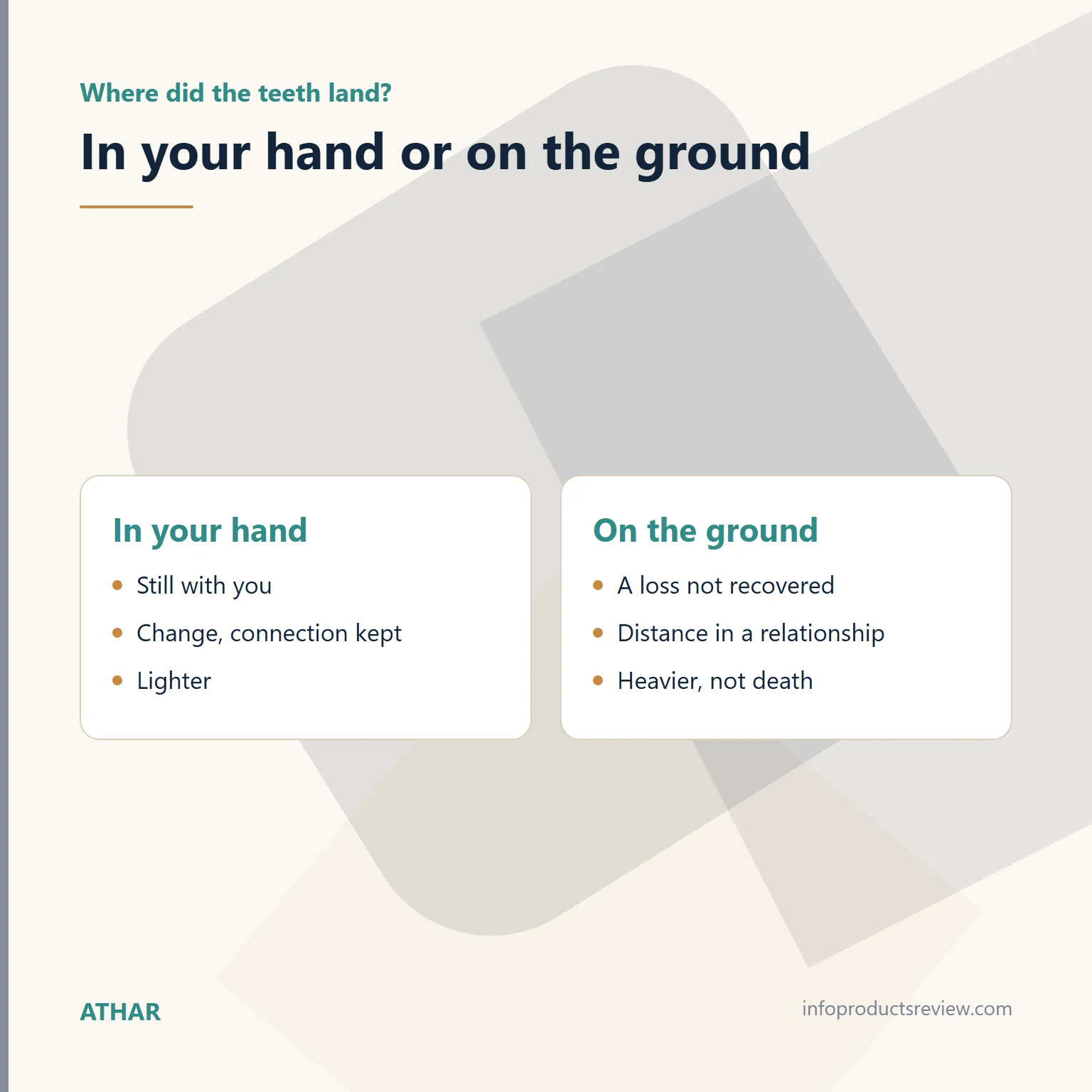
The meaning that fits the logic of the symbol is simple: what falls into your hand isn’t lost. If teeth are family, then falling into the hand sits closer to a change in a relationship where the connection survives, or to something that can still be put right. That’s why interpreters generally treat it as lighter than teeth falling on the ground.
Teeth falling on the ground, or lost
When teeth fall to the ground and you can’t find them, or you swallow them, the picture is of a loss that can’t be recovered. Interpreters read it as heavier than teeth falling into your hand.
But heavier doesn’t mean death. The nearer reading is distance in a relationship, contact breaking off with a relative, or losing something hard to replace. If you’re already worried about someone ill in your family, the dream may simply reflect that worry. It says nothing about what will happen to them.
If this scene unsettled you, follow what the Prophet’s teaching sets out for a disturbing dream. You’ll find it in the section on what’s established in Islam below.
Teeth falling out with no pain or blood

This is one of the most common questions. The tooth simply comes out, with no pain, no bleeding and sometimes no fear.
One interpreter says in a published interview that teeth falling out painlessly is something he reads according to which teeth fell, giving examples like savings spent on something important or a move into a new stage. That’s his experience, not a text.
So the closest reading of painless tooth loss is a change that passes relatively easily: a move, something coming to an end, a shift in a relationship without much hurt. In interpreters’ general usage, the absence of pain lightens the reading.
Teeth falling out with pain or blood
When severe pain or blood comes with the tooth, the dream weighs more heavily, and the reading leans toward something difficult: a painful disagreement, a loss that leaves a mark, or something that has to be wrenched away.
One distinction matters a lot here. If you actually have pain in your teeth or gums, the dream may be picking up on what’s happening in your body. That’s a question for a dentist, not for an interpreter.
Loose teeth that don’t fall out
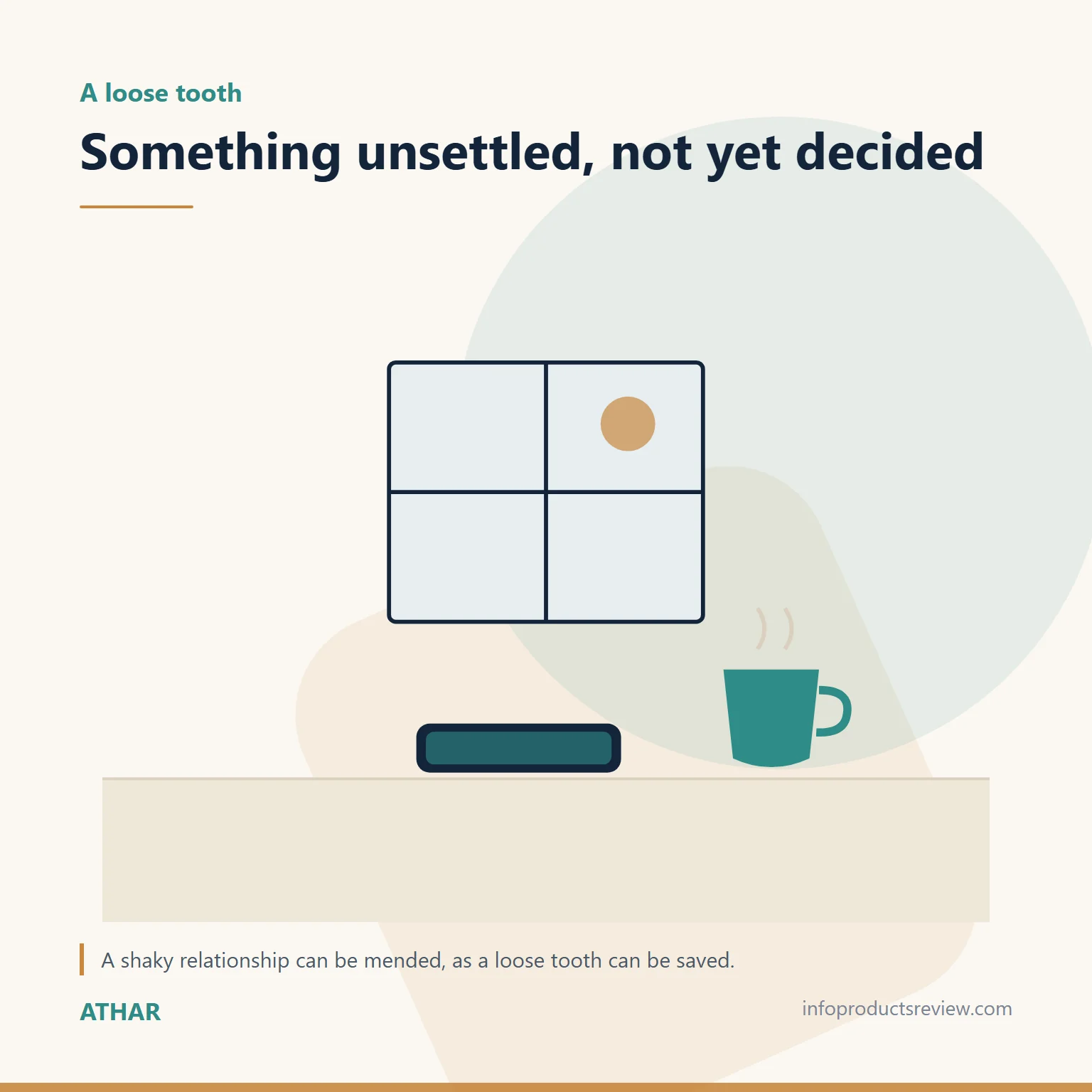
Dreaming that a tooth is loose and wobbling but never comes out is a picture of something unsettled that hasn’t been resolved.
By the logic of the symbol, the nearer reading is a strained relationship that hasn’t broken: coolness, an unresolved disagreement, or worry about a relative. It’s an opportunity rather than a warning. A loose tooth can often be saved, and a shaky relationship can be mended.
Decayed, broken or blackened teeth
One interpreter says in a published interview that decay, looseness or bad breath in a dream can be read as trouble in your relationships with relatives or friends. He points to an Arabic expression, “he’s one of my teeth,” meaning someone of your own generation and circle.
Decay: closer to a small problem building up in a relationship, or words said behind someone’s back.
A broken tooth: closer to a sudden disagreement or a hurtful moment.
Blackened or discoloured teeth: closer to a worry affecting a family member, or something clouding a relationship.
In each case, the same interpreter suggests asking the dreamer about their relationships before offering any reading, and encouraging reconciliation. It’s a useful approach: the dream becomes a nudge toward a connection that needs care.
Having a tooth pulled in a dream
Ibn Qutayba writes that if someone treats one of his teeth and pulls it out, or someone else pulls it, it means a financial loss in proportion to the compensation owed for a tooth, and it may mean a tie with a relative being cut. In the same passage he gives a heavy reading for a tooth falling out untreated.
We record that reading honestly because it’s in the text, and we put it in context: it’s an interpreter’s view, not news about anyone’s fate. You’ve already seen, in the section on losing all your teeth, how far apart interpreters’ readings of the same dream could be, from long life to a move to money.
A dentist pulling the tooth: closer to removing something harmful by choice, or ending something that hurts.
Pulling it out yourself: closer to a decision of your own to cut something off, or a loss you accept.
Someone else yanking it out: closer to pressure or a loss forced on you.
A new tooth growing
Ibn Qutayba’s text says that someone who sees a new tooth growing that wasn’t there before gains some benefit for a brother or a child. It’s one of the reassuring readings in this chapter, and it fits the symbol’s logic: more teeth, more good in the family.
The same goes for dreaming that your teeth are longer, stronger or more beautiful than they are. The closest reading is something good in your family or in your relationships with them.
A single tooth falling out
One tooth falling out is generally a lighter reading than many, because the symbol is narrower. If teeth are family, one tooth sits closer to one person or one relationship, not the whole family.
Where that tooth sits is what points the direction: an upper front tooth nearer to a close male relative, a lower tooth nearer to a close female relative, a molar nearer to someone more distant.
One tooth shouldn’t be translated into news about a particular person. The more useful question is whether there’s one relationship in your life that needs some attention right now.
False teeth, crowns or braces coming out
Many people today have crowns, bridges, braces or dentures, and may dream they fall out or break. We found no text on this in the sources we checked, because none of it existed in the classical interpreters’ time.
By the analogy the principle above describes, a crown or denture is something made to replace what was lost, so its falling out might be read as a setback in something you’d been relying on to make up for a gap, or as worry about being exposed in front of others. If you actually wear one, the dream is most likely just reflecting that, such as a fear of it slipping out in public.
That’s a reading by analogy, not a text. We include it because it’s closer to real life than applying the reading for natural teeth unchanged.
Someone else’s teeth falling out
Dreaming that your father’s, a friend’s or your spouse’s teeth are falling out, rather than your own, shifts the reading. The teeth in the dream are theirs, so the symbol concerns their family and relationships, or your relationship with them.
The closest reading is that the dream reflects worry about that person, or a change you sense in your relationship. If you dream that a parent who is ill is losing their teeth, it’s most likely a picture of your concern for them, not news of what will happen to them.
What helps here is simple: check in on that person, ask how they are, and be kind to them. That’s good in itself.
Swallowing a tooth
A tooth that falls out in your mouth and gets swallowed sits between falling into your hand and being lost on the floor. It hasn’t come out in front of anyone, but you’re not holding it either.
We found no specific text on this in the sources we checked. By the logic of the symbol, it might be read as a family matter that stays within the home and never comes out, or as keeping something painful to yourself. It doesn’t mean harm will come to your body.
When the dream keeps coming back
Some people have this dream again and again, sometimes for years. Repetition alone doesn’t turn a dream into confirmed news or mean that something bad is getting closer.
It may track what keeps repeating in your life: ongoing worry about a family member, constant pressure, a relationship left hanging. The US National Institute of Neurological Disorders and Stroke notes that people under stress or anxiety are more likely to have frightening dreams, though that doesn’t mean every recurring dream comes from stress.
If the dream keeps returning, notice when it comes. Before exams? During arguments? Around travel? That observation is more useful than hunting for a new meaning each time. And if the dreams are wrecking your sleep, talking to a professional will help more than chasing interpretations.
How the dreamer’s situation changes the reading
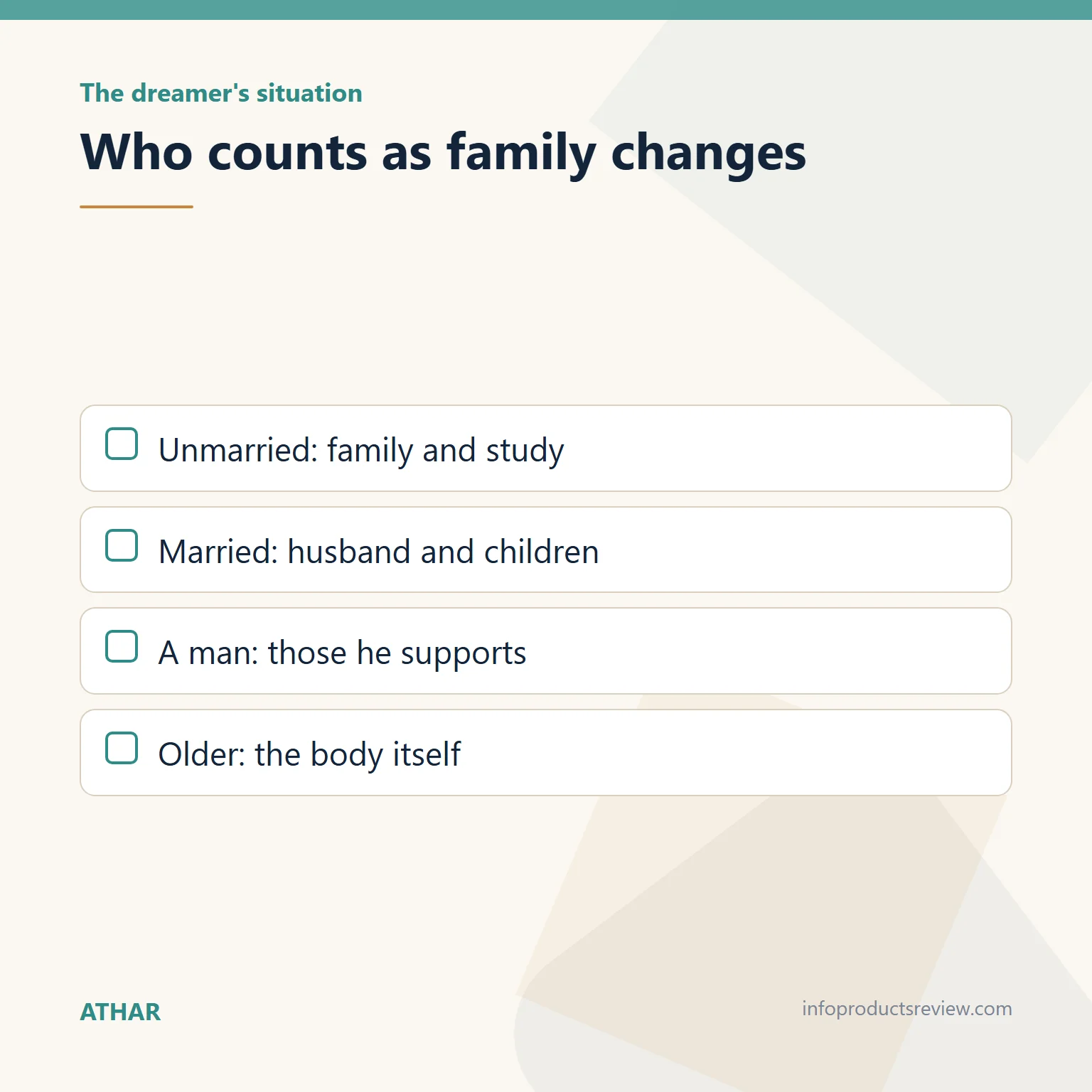
An unmarried woman: the dream often ties to her family or to a transition like study or engagement. That case is covered in detail on its own page in this series, including teeth falling into the hand, without blood, and lower teeth.
A married woman: “family” widens to include her husband, children and in-laws. A problem with a tooth might picture tension at home; healthy teeth might picture stability. Our guide to lice dreams for a married woman uses the same method for another symbol.
A pregnant woman: worry about the baby and about her body is common. The dream says nothing about the health of the pregnancy; anything that worries her medically belongs with her doctor.
A divorced or widowed woman: the dream may echo a loss she’s been through, or a change in her ties with her former in-laws or her own family.
A man: the symbol widens to the people he supports and works with. One interpreter says that for someone in business, the dream may point to financial matters that need sorting out. Reading a symbol through a man’s responsibilities is also covered in our guide to lice dreams for men.
An older person: the dream may be closer to the reality of their own body. One interpreter mentions that a pulled molar can sometimes be read as an elderly person who needs care.
A child’s teeth falling out
Dreaming that your child’s teeth, or a child you know, are falling out is different from dreaming about your own. A child’s baby teeth fall out in real life so that new ones can grow in. That’s normal growth.
So the closest reading is a stage of growth or transition in the child’s life: starting school, getting older, a change in their habits. If you’re the parent, the dream may simply reflect how much their upbringing is on your mind. We found no specific text on children’s teeth in the sources we checked.
How to make sense of such different readings
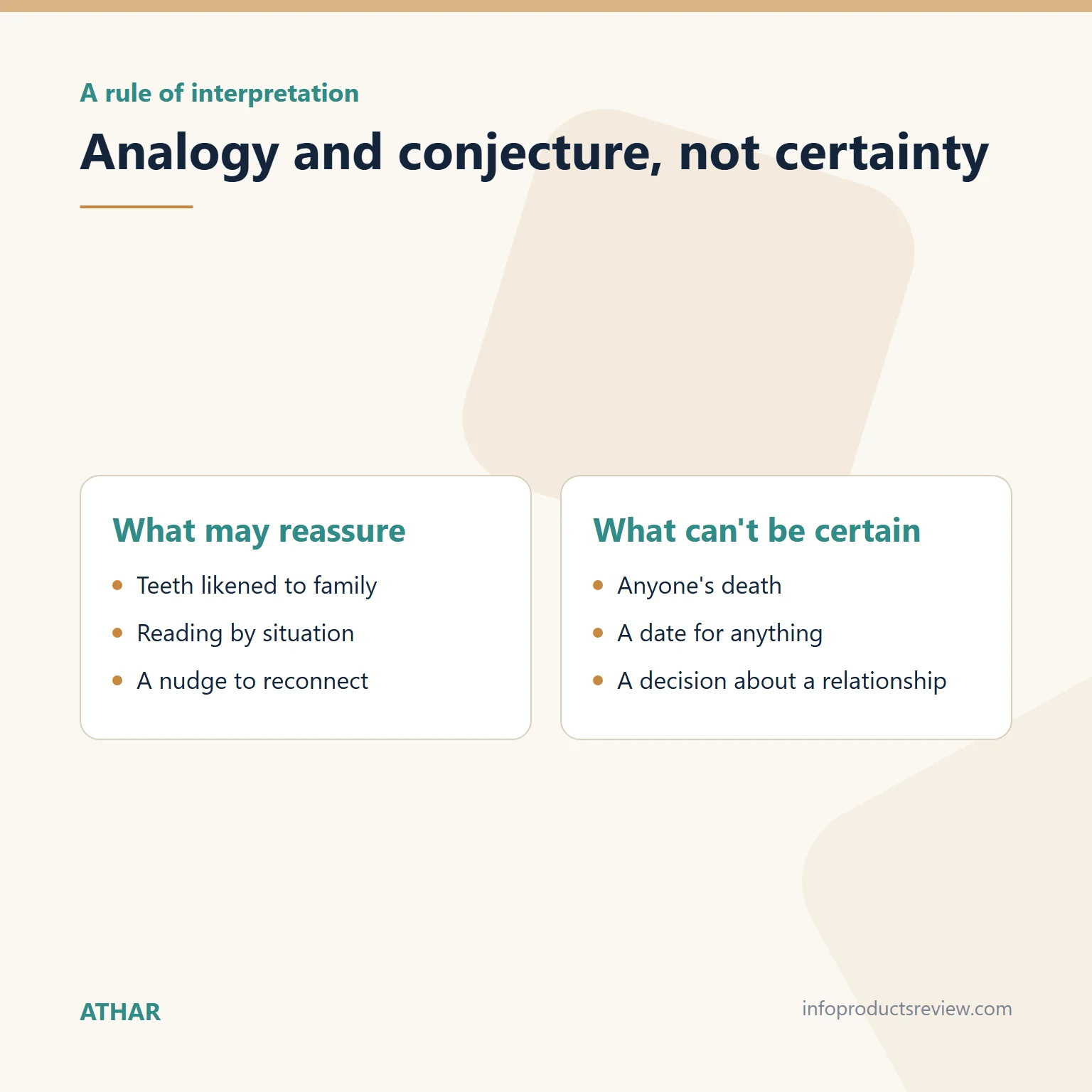
It can be confusing to see the same dream read as a relative’s death by one interpreter, long life by another, and a move or money by a third. A principle set out by a contemporary author in a book on the rules of dream interpretation helps here:
Interpretation is analogy, comparison and conjecture; it is not certain, but it may be taken as a source of reassurance.
In other words, what interpreters say about teeth falling out isn’t certain news. It’s reasoning by comparison: teeth resemble family in how they sit together and close by, so what happens to them is compared to what might happen in a family. Comparison can be right or wrong, and it changes with the dreamer’s situation.
That’s why it makes no sense to take the heaviest reading and ignore the rest, or to treat any single reading as certain. The more useful question is: what fits my situation and my real life?
Does dreaming of teeth falling out mean death?
This is the question people ask most, and it deserves a straight answer.
What the sources say: yes, Ibn Qutayba reads a tooth falling out untreated as a relative’s death. That’s there, and we won’t hide it.
But Ibn Qutayba’s own starting point is that teeth stand for family and kinship, read through what happens in those relationships, and he reads a new tooth growing as a benefit for a brother or a child. One interpreter says in a published interview that the ominous reading applies only in very rare cases, giving the example of a man whose very elderly father was in intensive care, and that it isn’t the default meaning of this dream.
Most importantly, no one knows when anyone will die, and no one’s lifespan can be read from a dream. The authentic hadith reassures anyone who sees a dream they dislike that it won’t harm them if they seek refuge in God from it.
So the bottom line is this: some interpreters read the dream heavily in particular circumstances, but it can’t serve as news of anyone’s death, and in most cases it’s better read in terms of relationships and change. If this is weighing on you, our guide to dreaming of someone who has died covers what’s established and what isn’t about dreams connected to death.
Anxiety and disturbing dreams
We keep interpreting the symbol separate from what general health references say about dreams, because they’re two different subjects.
The US National Institute of Neurological Disorders and Stroke notes that events from the day often invade our thoughts during sleep and that people under stress or anxiety are more likely to have frightening dreams. The Sleep Foundation notes that worrying situations that bring stress and fear may provoke nightmares, and that after a period of insufficient sleep a REM rebound can trigger vivid dreams and nightmares. We haven’t relied on any scientific claim specific to teeth dreams, because we didn’t find a trustworthy source on that we could check.
The practical takeaway: if this dream keeps coming back during a stressful period, easing the stress and sleeping properly may do more good than searching for a meaning. And if you woke up in tears from this dream, our page on crying in a dream may help.
When it’s a health question, not a symbol
If you actually have tooth pain, bleeding gums or a loose tooth, don’t look for the dream’s meaning before seeing a dentist. A dream can’t diagnose anything and isn’t a substitute for a check-up.
Likewise, if disturbing dreams keep coming until they ruin your sleep and affect your day, talking to a professional will help more than chasing interpretations.
What’s attributed to Ibn Sirin about teeth dreams
Many pages carry titles like “Ibn Sirin’s interpretation of teeth falling out” and list confident meanings with no book and no page. The popular dream book that circulates under the name of Muhammad ibn Sirin, the early scholar whose name is attached to so much dream lore, is attributed to him, and scholars who have examined it don’t accept that he wrote it.
So we’re careful: the book attributed to Ibn Sirin does discuss teeth, but we haven’t relied on it here, because we haven’t found a critically edited text we could quote with a page reference. What we quote comes from Ibn Qutayba’s book, which has a documented author and a scholarly edition.
If you want to understand why we handle attributions this way, how ATHAR checks attributions explains the approach behind every page.
What’s actually established in Islam about dreams
Two things need to stay separate: reading the symbol of teeth, which is interpretation and can be right or wrong; and the Prophet’s guidance on how to handle dreams, which is established.
What’s established is that a dream you like is from God, so you praise Him for it and may speak of it, and a dream you dislike is something to seek refuge from and not tell anyone about. In Sahih al-Bukhari:
If one of you sees a dream he likes, it is from God, so let him praise God for it and speak of it; if he sees otherwise, something he dislikes, it is from Satan, so let him seek refuge from its harm and mention it to no one, for it will not harm him.
And in Sahih Muslim (2262), from the hadith of Jabir, the instruction is to spit lightly to the left three times, seek refuge in God from Satan, and turn over from the side you were sleeping on.
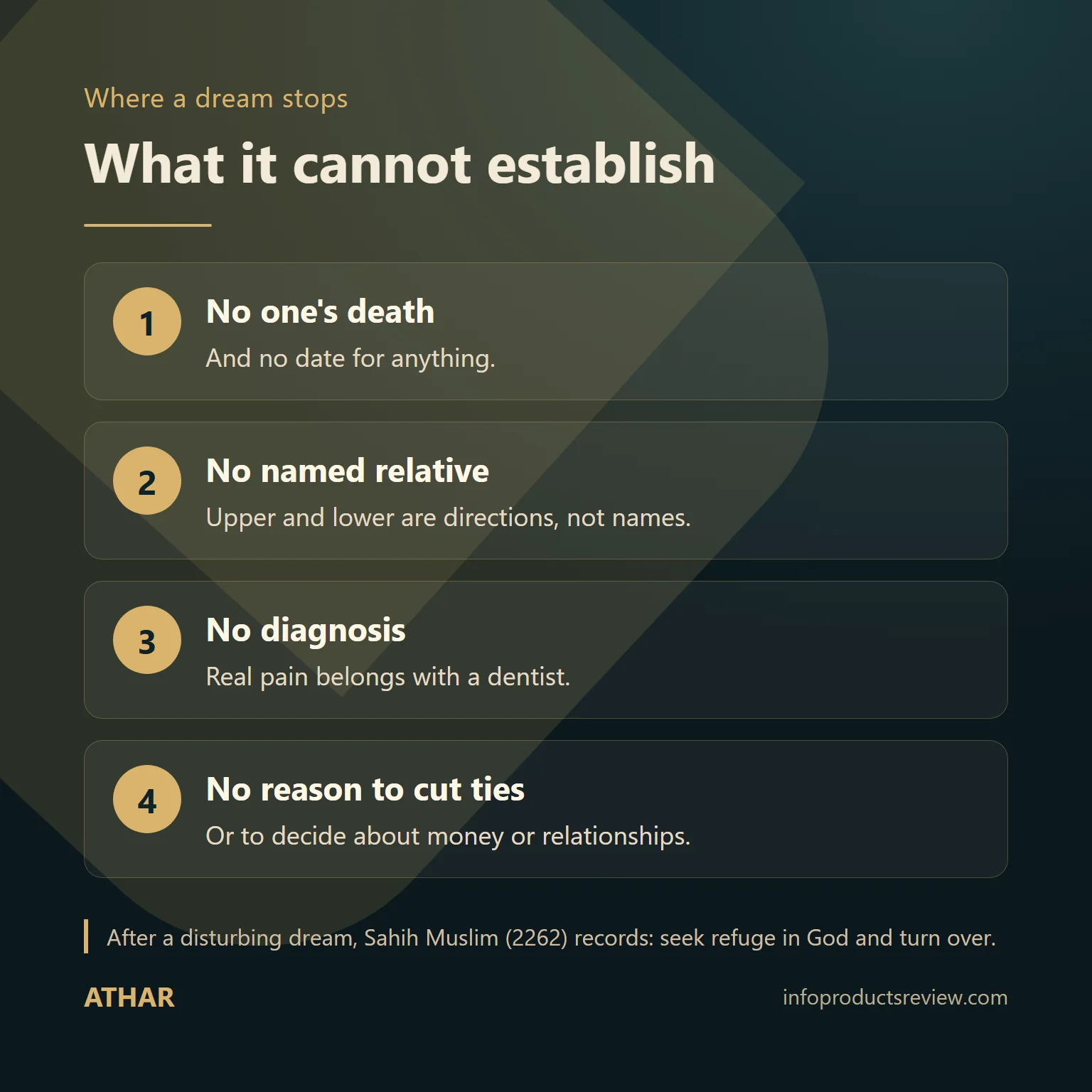
So if you dreamed your teeth fell out and it frightened you, seek refuge in God from its harm and don’t retell it to everyone. The hadith reassures you it won’t harm you. A dream establishes no ruling, accuses no one, and is never a reason to cut off family.
And there’s something good to take from reading teeth as family: if the dream reminds you of a relative you’ve neglected, reach out to them. That’s worthwhile in itself, whether the dream meant anything or not.
Common claims that need correcting
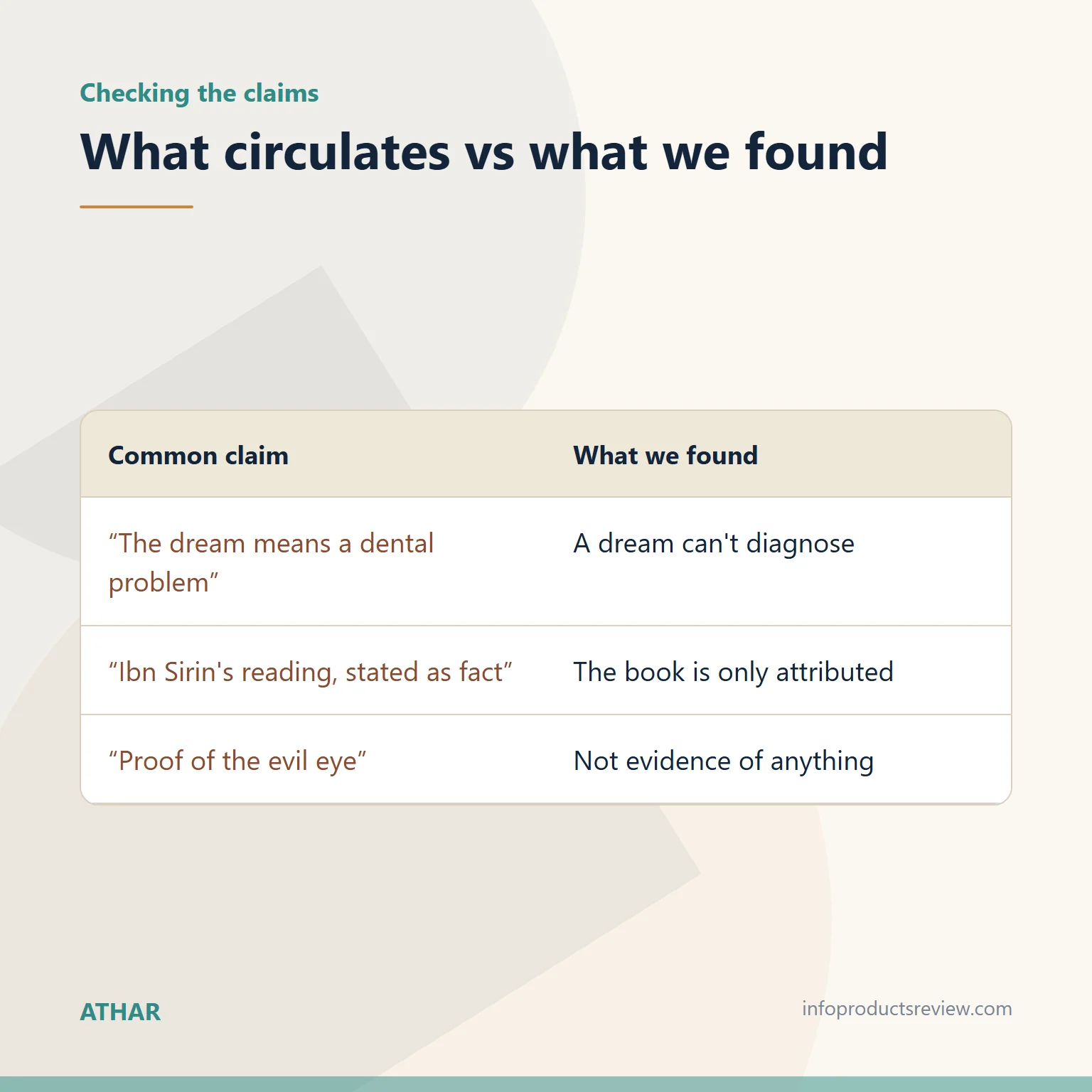
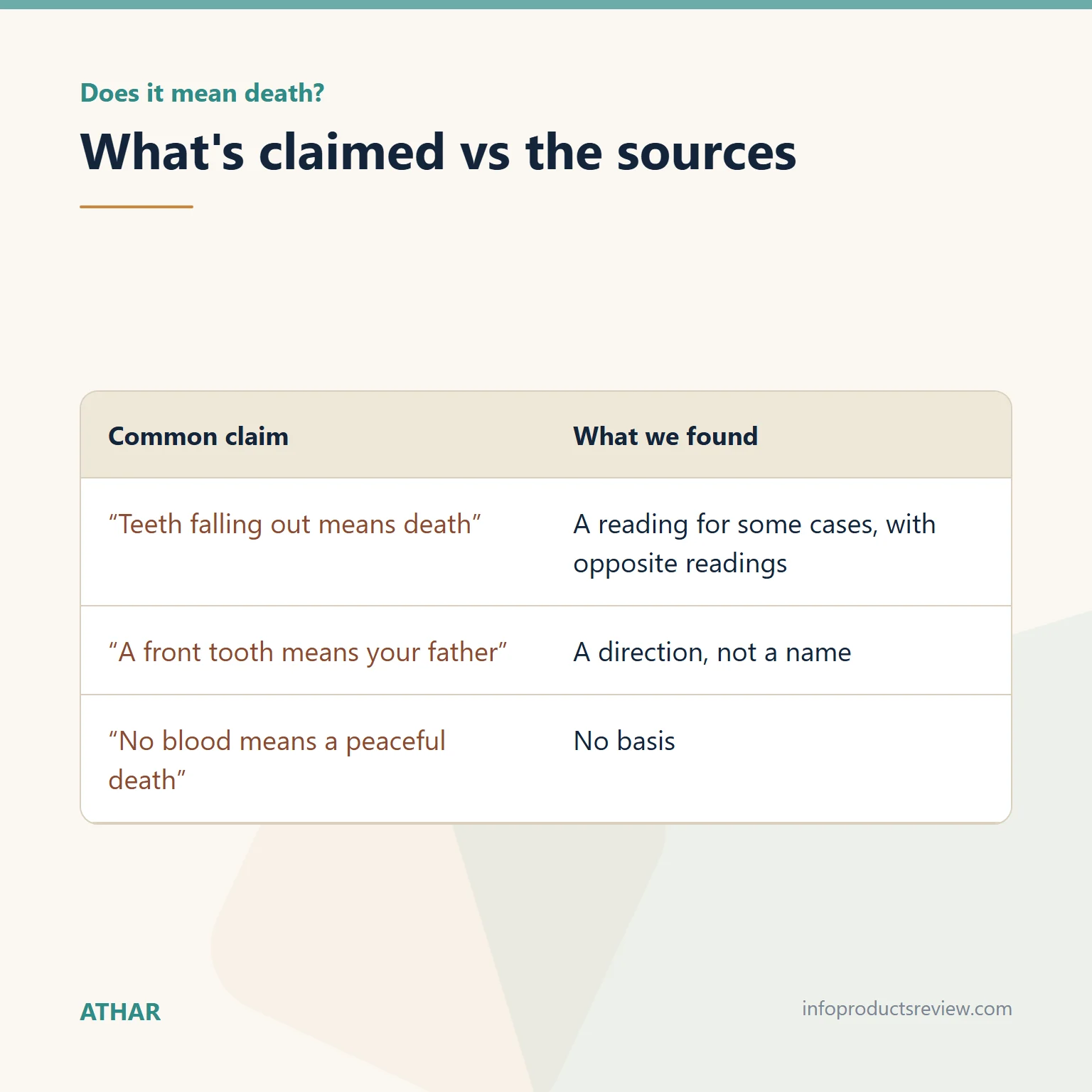
“Teeth falling out means someone in your family will definitely die.” Ibn Qutayba gives that reading for one particular case, but his starting point is teeth as kinship and relationships. It can’t be stated as certain, and it can’t point to a person.
“Losing a front tooth means your father will die.” The division into men and women, close and distant, suggests a direction. It names no one.
“Teeth falling out without blood means the death will be peaceful.” We found no basis for that in the sources we checked.
“The dream means you have a dental problem.” A dream can’t diagnose anything. Real pain belongs with a dentist.
“Ibn Sirin’s interpretation of teeth falling out,” stated as fact. The popular book under his name is only attributed to him, and that attribution isn’t established.
What this dream can’t tell you
To close the door on scaremongering, here’s where the dream stops:
- It can’t tell you that anyone will die, or when anything will happen.
- It can’t point to a particular relative.
- It can’t diagnose a problem with your teeth or your health.
- It can’t prove a falling-out that hasn’t happened.
- It isn’t evidence of magic or the evil eye.
- It isn’t a basis for decisions about money or relationships.
What to do after a teeth dream
If it was disturbing: seek refuge in God from its harm, spit lightly to your left three times, turn over, and don’t retell it to everyone, as the hadith collections record.
Look calmly at your relationships: is there a relative you’ve neglected? A disagreement left hanging? That’s worth attending to for its own sake.
If you’re worried about someone who’s ill: the dream is most likely a reflection of that worry. Pray for them and do what you can to care for them.
If you have real pain: see a dentist.
If the dream keeps coming back: ask what keeps coming back in your days, whether stress or worry, and ease it where you can.
How to describe the dream so it can be read
If you want to make sense of the dream yourself, or talk it through with someone whose knowledge you trust, describe it in this order:
- Which teeth: front teeth, canines or molars? Upper or lower? One or many?
- How they came out: on their own, after wobbling, pulled, or broken?
- Where they went: into your hand, onto the ground, or lost?
- Pain and blood: was there any?
- How you felt: calm, frightened, or embarrassed?
- Your real life: what’s on your mind about your family, your relationships and your health?
You’ll often find that an orderly description makes half the meaning clear before you ask anyone.
What interpreters say in recorded interviews
Here are two excerpts from published interviews, because they show how some interpreters think about this dream in particular. A clear caveat: what speakers say in interviews is personal opinion, not religious text and not an established rule, and we paraphrase rather than quote.
In the first, an interpreter argues that the ominous reading of teeth falling out is rare, and that teeth at the front of your face stand for the relatives at the front of your life, so trouble with them points to a relationship worth mending.
Why it's here: the speaker holds that the ominous reading of teeth falling out is rare, and that teeth are usually read as relatives and friends, so trouble with the teeth points to a relationship worth mending. Paraphrased; an opinion from an interview, not a religious ruling or a definitive interpretation.
In the second, another interpreter describes from experience how teeth falling out painlessly can be read as a move or as savings spent on something important, with real examples.
Why it's here: from his own experience, the speaker says teeth falling out without pain may be read, depending on which teeth, as a move or as savings spent on something important. Paraphrased; an opinion from an interview, not a religious ruling or a definitive interpretation.
Both line up with what this page has said throughout: details are read in context, the ominous reading isn’t the default, and a disturbing dream is something to seek refuge from, not something that can harm you.
Examples
A man dreamed an upper front tooth fell painlessly into his hand. Closest reading: a change in his relationship with a close male relative where the connection survives, or something that can be put right. It doesn’t mean death.
A woman dreamed her lower teeth were loose. Closest reading: strain or worry involving one of the women in her family, or a relationship that needs care.
A student about to graduate dreamed all his teeth fell out. Closest reading: leaving his classmates behind and moving into a new stage of life.
A man worried about his sick father dreamed a molar was pulled. Closest reading: an echo of his worry for his father. It says nothing about his father’s fate; prayer and care are what help.
A woman dreamed a new tooth grew in. In Ibn Qutayba’s text: a benefit for a brother or a child. One of the reassuring readings.
A man with real toothache dreamed his teeth were crumbling. Closest reading: the dream picking up on his pain. The right step is a dentist.
Quick table: the detail and the closest reading
| What you saw | Closest reading | What it doesn’t mean |
|---|---|---|
| Teeth in general | For Ibn Qutayba: household and relatives | A specific person |
| Upper teeth | The men in your family | Your father’s death |
| Lower teeth | The women in your family | Your mother’s death |
| Front teeth | Your closest relatives | A certain disaster |
| Molars | More distant relatives | A falling-out that has happened |
| Falling into your hand | Change, with the connection kept | A loss that can’t be made good |
| Falling painlessly | A change that passes easily | A peaceful death |
| Falling with pain and blood | Something difficult | A medical diagnosis |
| All your teeth | A big change or a move | A death in the family |
| A new tooth growing | Benefit for a brother or child | A particular baby |
Related dreams
- Marriage dream meaning: another symbol read through family and commitment.
- Dreaming of your own wedding: an example of reading the details of a single scene.
- Lice dreams for a single woman: how a single woman’s situation shapes the reading of a symbol.
Frequently asked questions
What does dreaming of teeth falling out mean in general?
Most naturally, something to do with family and relatives, since Ibn Qutayba reads teeth as the household and kin. The meaning shifts with which teeth, how they fell, and the dreamer’s situation.
Does dreaming of teeth falling out mean death?
Ibn Qutayba gives that reading for one particular case, but he reads teeth first as kinship and relationships. The dream can’t serve as news of anyone’s death.
What’s the difference between upper and lower teeth falling out?
For Ibn Qutayba, upper teeth are the men in your family and lower teeth the women. That suggests a direction; it doesn’t name anyone.
What does it mean when teeth fall into your hand?
Interpreters generally treat it as lighter than teeth falling on the ground: a change where the connection survives, or something that can still be put right.
What does it mean if teeth fall out with no pain or blood?
Most likely a change that passes relatively easily, like a move or something ending. The lack of pain lightens the reading.
What if teeth fall out with blood?
The reading leans toward something difficult or a painful disagreement. If your gums are actually bleeding, see a dentist.
What do molars falling out mean?
Ibn Qutayba reads molars as the more distant relatives. Some interpreters also read back teeth as savings.
What does it mean if all your teeth fall out?
Most likely a big change in your surroundings, like a move or leaving a group behind. On its own, it doesn’t signal disaster for your family.
What does a new tooth growing mean?
Ibn Qutayba reads it as a benefit for a brother or a child, one of the reassuring readings.
What should I do after a disturbing teeth dream?
Seek refuge in God from its harm and tell no one, as in Sahih al-Bukhari (7045); Sahih Muslim (2262) adds spitting lightly to the left three times and turning over.
Does the dream mean something’s wrong with my teeth?
A dream can’t diagnose anything. If you have real pain, see a dentist.
Is this interpretation definitive?
No, and deliberately so. These are possible meanings that change with the details, and none of them predicts the future.
In summary
- For Ibn Qutayba, teeth are the household and relatives: front teeth the closest, molars the most distant, upper teeth men and lower teeth women.
- Teeth falling into your hand or without pain read lighter than teeth hitting the ground with pain and blood.
- Ibn Qutayba gives the ominous reading for one particular case, but it isn’t the default way teeth are read.
- Interpretation is analogy and conjecture, not certain news.
- The dream can’t tell you anyone will die, diagnose illness, or point to a particular relative.
- After a disturbing dream: seek refuge in God, turn over, and don’t retell it.
If you take one thing from this page, let it be this: if the dream brings your family to mind, reach out to them and see how they are. That’s good whatever the dream meant, and how long anyone lives is known only to God.
Written and reviewed by: the ATHAR editorial team. Classical and hadith quotations are our own translations from the editions listed, checked against images of the printed pages.
Last comprehensive update: 15 September 2026.
Note: the meanings on this page are possibilities, not established facts, and they change with the details of a dream and the dreamer’s situation. Nothing here predicts the future, tells you anyone will die, diagnoses a health problem, or gives a religious ruling.